Every Tarot Card Yes or No: The Complete Cheat Sheet (All 78 Cards)
Every one of the 78 cards in a standard tarot deck has a yes, no, or maybe answer, upright and reversed, and this page lists all of them in one place. You’ll find five scannable tables (Major Arcana plus the four suits), the reasoning behind each call, and the handful of cards that split experienced readers down the middle. Bookmark it, print it, argue with it.
How this cheat sheet works
The verdicts below follow the imagery and traditional meanings of the Rider-Waite-Smith deck, which is the template most modern decks copy. It was first published by William Rider & Son in 1909, based on the instructions of academic and mystic A. E. Waite and illustrated by Pamela Colman Smith. If your deck renames cards (The Crone instead of The Hermit, for example), match by position and the answer still holds.
Each card gets one of three verdicts:
- Yes: the card favours the outcome or the action you’re asking about.
- No: the card works against it. Where the No is really about timing, the notes say “not yet.”
- Maybe: the card itself refuses to be binary. It’s telling you the answer depends on something you haven’t settled, or on information you don’t have.
Two rules make any yes/no list work. First, you need to decide beforehand whether or not you are going to include reversals. A yes/no system is a convention, and the method works only as a convention you define before seeing the cards. Do not mix systems after the draw. Second, commit to your list before you shuffle. As Brigit Esselmont of Biddy Tarot puts it, it’s important to decide your personal list of Yes and No cards before you do a Tarot card reading, otherwise you might be tempted to change your answer according to what you’d like to see.
The deck leans yes (until you flip it)
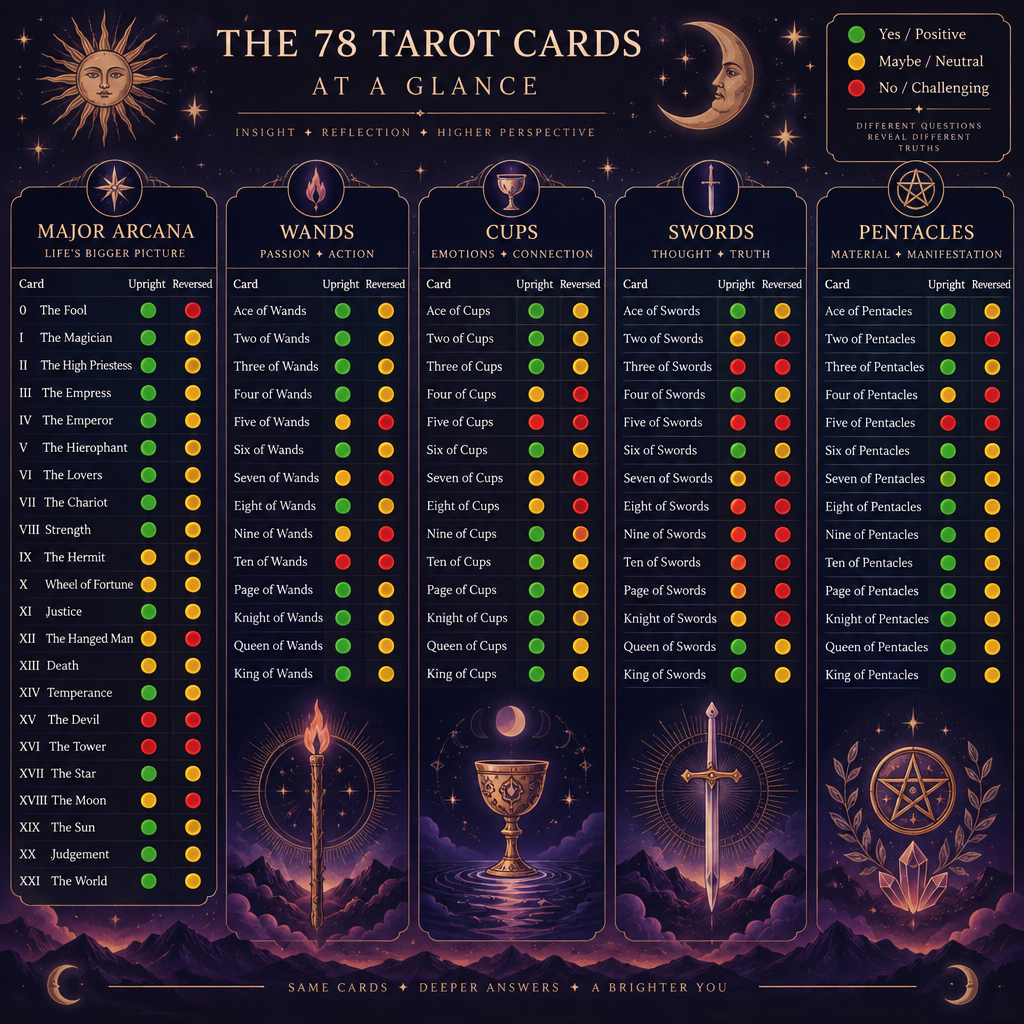
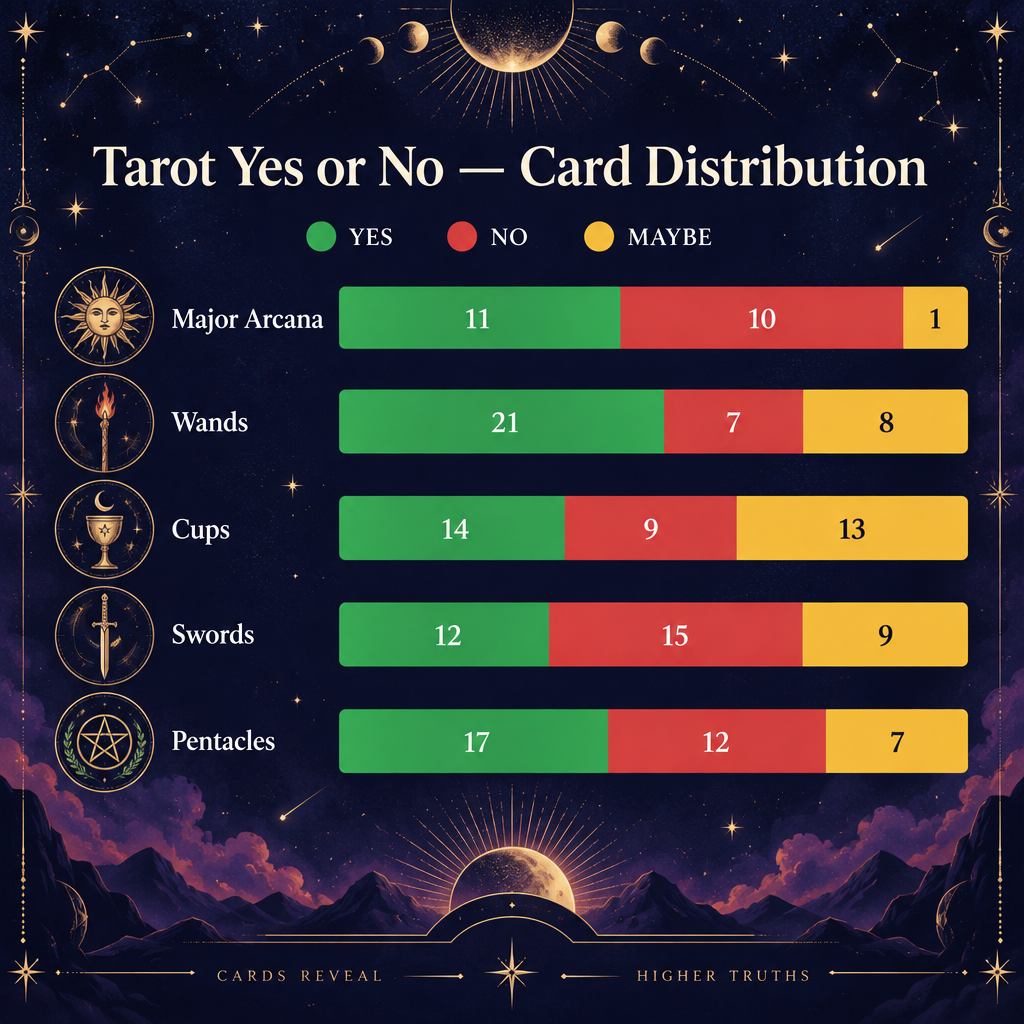
Count the upright verdicts on this sheet and a pattern jumps out: 52 of 78 cards read as Yes, 19 as No, and only 7 as Maybe. Roughly two in three cards will tell you what you want to hear. Other lists land in the same neighbourhood; one large reference notes that the tarot deck naturally leans positive, with nearly 60% of cards indicating “Yes.”
| Group | Upright Yes | Upright No | Upright Maybe |
|---|---|---|---|
| Major Arcana (22) | 14 | 5 | 3 |
| Wands (14) | 12 | 2 | 0 |
| Cups (14) | 10 | 3 | 1 |
| Swords (14) | 6 | 7 | 1 |
| Pentacles (14) | 10 | 2 | 2 |
| All 78 | 52 | 19 | 7 |
Swords is the only suit that leans No, which fits a suit built around conflict, anxiety, and hard truths. Wands doesn’t contain a single Maybe.
Add reversals and the balance tips the other way. Across the 78 reversed positions, 58 read as No, 15 as Maybe, and just 5 as Yes. That is the practical argument for reading reversals in yes/no work: a one-card pull from an all-upright deck is stacked in favour of Yes, and reversals restore some honesty.
Major Arcana yes or no
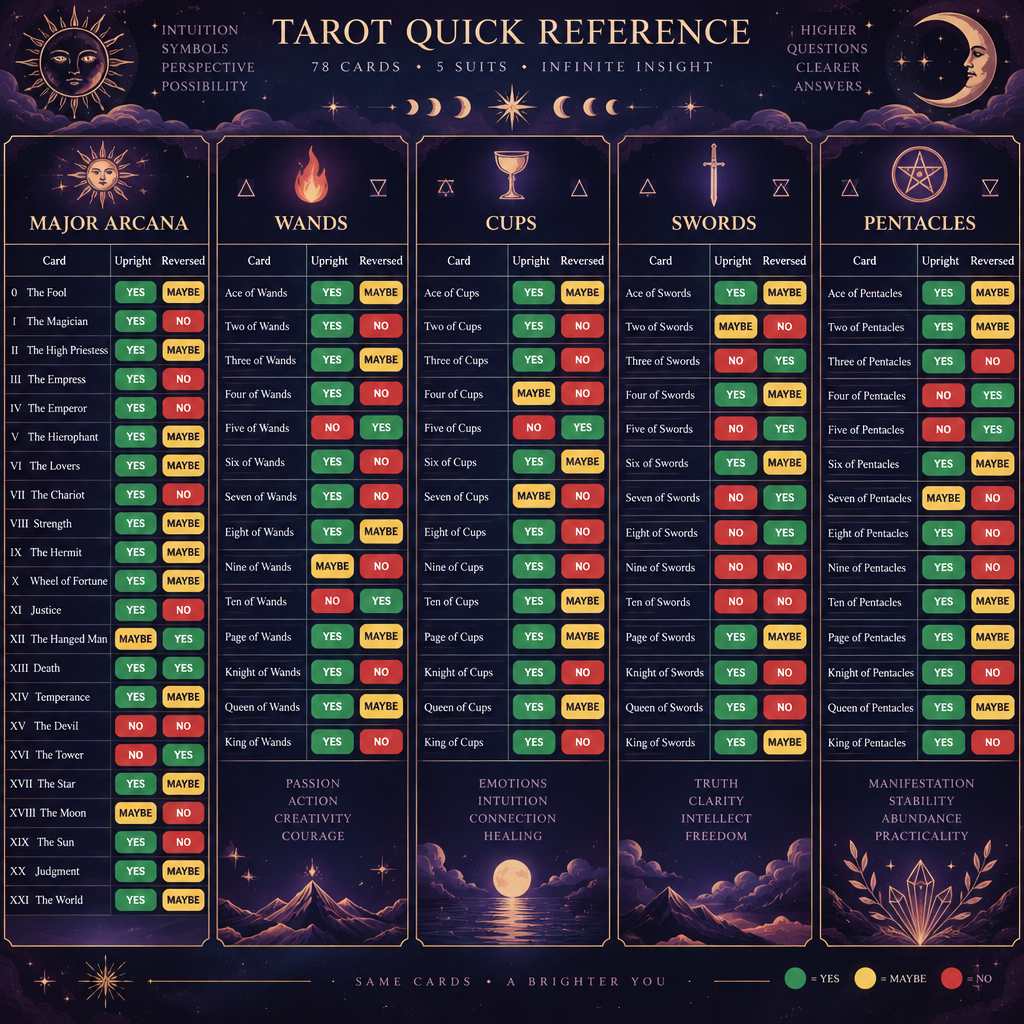
The 22 trumps carry the most weight in any reading. The 22 Major Arcana cards represent life’s karmic and spiritual lessons. When one of these lands in a yes/no pull, treat it as a louder answer than any pip card would give.
| # | Card | Upright | Reversed | The short version |
|---|---|---|---|---|
| 0 | The Fool | Yes | No | A leap worth taking; reversed, you’re leaping blind |
| I | The Magician | Yes | No | You have the tools; reversed, talent wasted or misused |
| II | The High Priestess | Maybe | No | The answer is hidden for now; reversed, you’re ignoring your gut |
| III | The Empress | Yes | No | Growth and abundance; reversed, nothing grows in neglected soil |
| IV | The Emperor | Yes | No | Structure wins; reversed, control slips or turns rigid |
| V | The Hierophant | Yes | No | Yes, by the book; reversed, the conventional route fails |
| VI | The Lovers | Yes | No | Alignment and real choice; reversed, values clash |
| VII | The Chariot | Yes | No | Victory through will; reversed, you’ve lost the reins |
| VIII | Strength | Yes | No | Quiet confidence prevails; reversed, self-doubt undermines you |
| IX | The Hermit | No | No | Not now: go inward first; reversed, isolation without insight |
| X | Wheel of Fortune | Yes | No | Luck turns your way; reversed, the turn goes against you |
| XI | Justice | Maybe | No | You get what you’ve earned; reversed, an unfair outcome |
| XII | The Hanged Man | Maybe | No | Suspended: wait and see differently; reversed, stalling past the point of use |
| XIII | Death | No | No | An ending, not the outcome you asked for; reversed, refusing to let go |
| XIV | Temperance | Yes | No | Steady, balanced yes; reversed, excess tips the scale |
| XV | The Devil | No | Yes | Bound by something unhealthy; reversed, the chains come off |
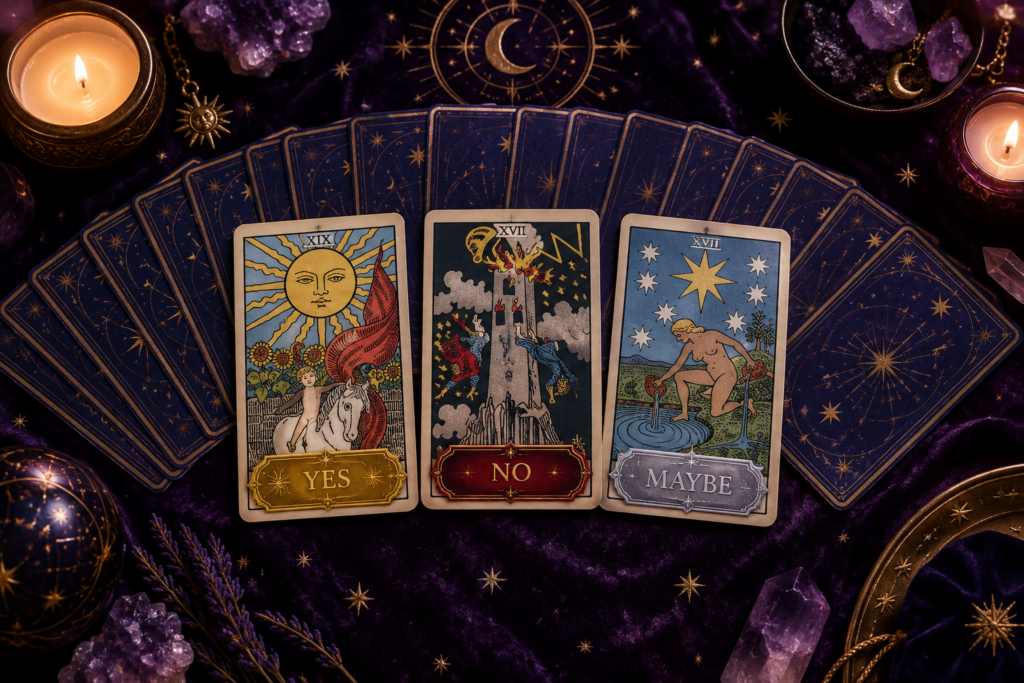
| XVI | The Tower | No | No | Upheaval; reversed, disaster dodged but the ground is still shaky |
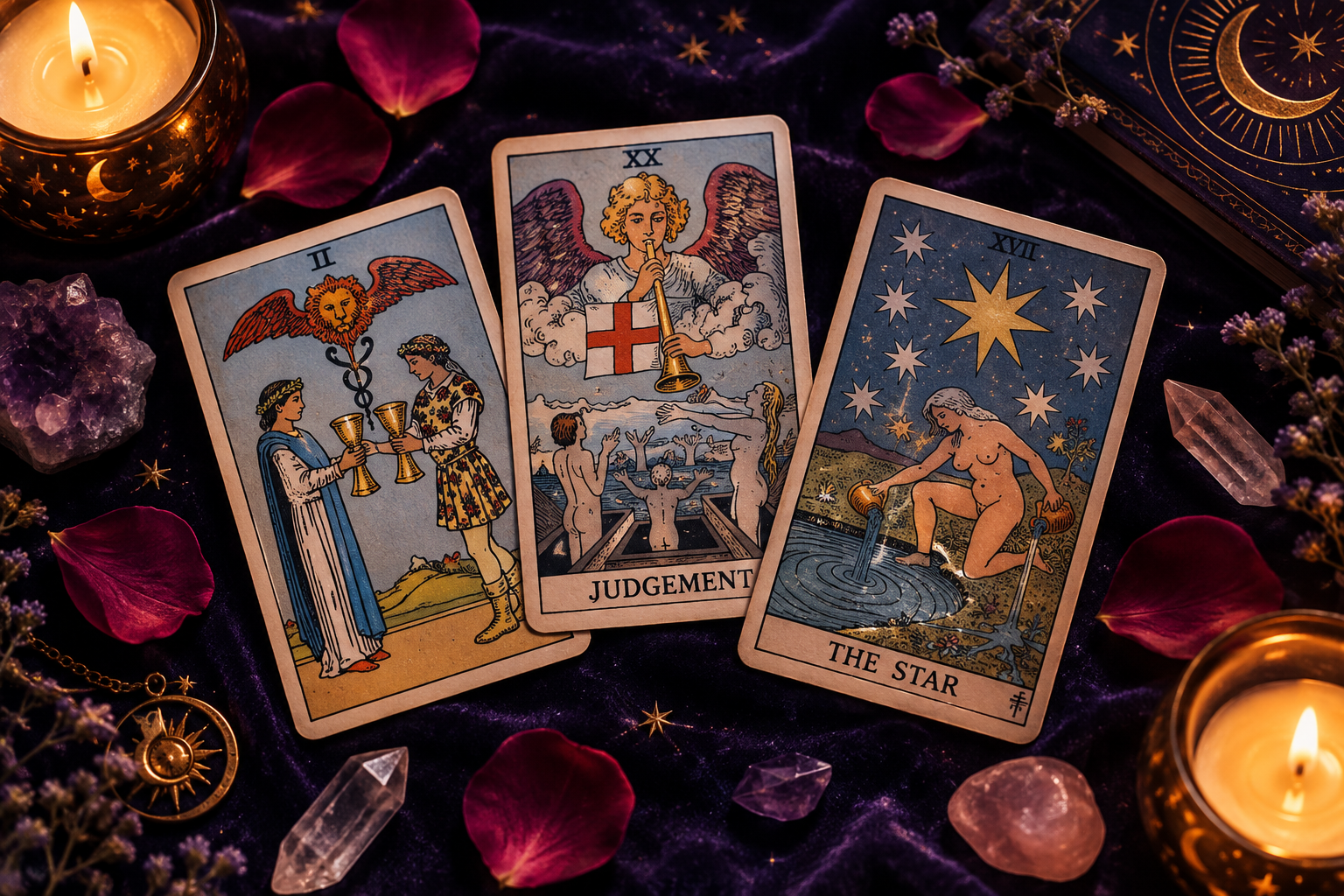
| XVII | The Star | Yes | No | Hope and renewal; reversed, faith needs rebuilding first |
| XVIII | The Moon | No | Maybe | Too much is hidden to proceed; reversed, the fog begins to lift |
| XIX | The Sun | Yes | Yes | The clearest yes in the deck; reversed, still yes, just dimmer or later |
| XX | Judgement | Yes | No | A clear call to act; reversed, self-doubt drowns the call |
| XXI | The World | Yes | No | Completion; reversed, not yet, loose ends remain |
Suit of Wands yes or no
Fire, action, ambition. Wands answer fast and mostly favourably. The two upright No cards (Five and Ten) are the suit’s pictures of squabbling and burnout.
| Card | Upright | Reversed | The short version |
|---|---|---|---|
| Ace of Wands | Yes | No | A spark catches; reversed, a false start |
| Two of Wands | Yes | No | Yes, once you commit to a plan; reversed, fear of the unknown stalls you |
| Three of Wands | Yes | No | Expansion, ships coming in; reversed, the ships are late |
| Four of Wands | Yes | Maybe | Celebration; reversed, postponed rather than cancelled |
| Five of Wands | No | Maybe | Conflict and competition; reversed, tension easing |
| Six of Wands | Yes | No | A public win; reversed, a fall from favour |
| Seven of Wands | Yes | No | Yes, if you hold your ground; reversed, you’re overwhelmed |
| Eight of Wands | Yes | No | A fast yes; reversed, not yet, expect delays |
| Nine of Wands | Yes | No | A hard-won yes; reversed, you’re out of fight |
| Ten of Wands | No | Maybe | Overloaded; reversed, yes once you put something down |
| Page of Wands | Yes | No | Good news and enthusiasm; reversed, hesitation |
| Knight of Wands | Yes | No | Bold and quick; reversed, reckless or stalled |
| Queen of Wands | Yes | No | Confidence draws it in; reversed, insecurity repels it |
| King of Wands | Yes | No | Leadership pays off; reversed, impulsive or domineering |
Suit of Cups yes or no
Water, feeling, relationships. Cups is the go-to suit for love questions, and it’s generous with Yes answers. Its No cards (Four, Five, Eight) are the suit’s images of apathy, grief, and walking away.
| Card | Upright | Reversed | The short version |
|---|---|---|---|
| Ace of Cups | Yes | No | New feeling flows; reversed, emotions blocked |
| Two of Cups | Yes | No | Mutual connection; reversed, imbalance between you |
| Three of Cups | Yes | No | Shared joy; reversed, gossip or a third party |
| Four of Cups | No | Yes | Apathy, the offer ignored; reversed, you re-engage |
| Five of Cups | No | Maybe | Grief; reversed, acceptance opens a door |
| Six of Cups | Yes | No | A gentle, familiar yes; reversed, stuck in the past |
| Seven of Cups | Maybe | Yes | Too many options, some illusory; reversed, clarity arrives |
| Eight of Cups | No | Maybe | Walking away; reversed, one more try |
| Nine of Cups | Yes | Maybe | The wish card; reversed, the wish is delayed or rings hollow |
| Ten of Cups | Yes | No | Lasting harmony; reversed, disconnection at home |
| Page of Cups | Yes | No | A sweet surprise; reversed, emotional immaturity |
| Knight of Cups | Yes | No | A romantic offer; reversed, moody and unrealistic |
| Queen of Cups | Yes | No | Compassion and intuition; reversed, insecurity |
| King of Cups | Yes | No | Emotional maturity; reversed, manipulation |
Suit of Swords yes or no
Air, intellect, conflict. This is the suit that says no. Seven of its fourteen cards read No upright, and its reversals are where most of the deck’s “obstacles clearing” Maybes live.
| Card | Upright | Reversed | The short version |
|---|---|---|---|
| Ace of Swords | Yes | No | A breakthrough; reversed, clouded judgment |
| Two of Swords | Maybe | No | Stalemate, no decision made; reversed, avoidance |
| Three of Swords | No | Maybe | Heartbreak; reversed, healing begins |
| Four of Swords | No | Maybe | Rest first, not now; reversed, a restless return |
| Five of Swords | No | Maybe | A hollow victory; reversed, reconciliation |
| Six of Swords | Yes | No | A slow, quiet yes; reversed, you’re stuck |
| Seven of Swords | No | Maybe | Deception; reversed, coming clean |
| Eight of Swords | No | Yes | Trapped by fear; reversed, you walk free |
| Nine of Swords | No | Maybe | Anxiety; reversed, hope returns |
| Ten of Swords | No | Maybe | Rock bottom; reversed, recovery |
| Page of Swords | Yes | No | Curiosity, but verify what you hear; reversed, careless talk |
| Knight of Swords | Yes | No | Swift and decisive; reversed, reckless |
| Queen of Swords | Yes | No | Yes, if you’re honest with yourself; reversed, bitterness |
| King of Swords | Yes | No | Clear authority; reversed, misuse of power |
Suit of Pentacles yes or no
Earth, money, work, the body. Pentacles say yes slowly and mean it. The two upright Maybes (Two and Seven) are both about timing and juggling rather than doubt.
| Card | Upright | Reversed | The short version |
|---|---|---|---|
| Ace of Pentacles | Yes | No | A solid opportunity; reversed, a missed one |
| Two of Pentacles | Maybe | No | Yes if you can keep juggling; reversed, overcommitted |
| Three of Pentacles | Yes | No | Teamwork and skill; reversed, poor collaboration |
| Four of Pentacles | No | Maybe | Holding on too tight; reversed, letting go |
| Five of Pentacles | No | Maybe | Hardship; reversed, recovery |
| Six of Pentacles | Yes | No | Generosity flows; reversed, strings attached |
| Seven of Pentacles | Maybe | No | Not yet: the harvest needs time; reversed, wasted effort |
| Eight of Pentacles | Yes | No | Yes, through work; reversed, sloppy or unfocused |
| Nine of Pentacles | Yes | No | Independence and reward; reversed, a setback |
| Ten of Pentacles | Yes | No | Lasting security; reversed, disputes and loss |
| Page of Pentacles | Yes | No | A promising start; reversed, procrastination |
| Knight of Pentacles | Yes | No | Slow, sure yes; reversed, stagnation |
| Queen of Pentacles | Yes | No | A nurturing yes; reversed, imbalance |
| King of Pentacles | Yes | No | Abundance; reversed, greed |
The cards readers argue about
No two published lists agree on every card, and the disagreements cluster around the same dozen. Here’s where this sheet takes a side, and why.
The High Priestess, Justice, The Hanged Man, The Hermit. These four show up as the contested cards on nearly every list. One popular reference tags them as Most Context-Dependent: The High Priestess, Justice, The Hanged Man, The Hermit. Another list marks The High Priestess ~ Yes outright, and the same source calls The Wheel of Fortune~ Maybe. It’s up to Fate … The Hanged Man ~ Yes. This sheet treats the High Priestess, Justice, and Hanged Man as Maybe because each card’s core message is literally “the answer isn’t available yet, or it depends on you.” The Hermit gets a flat No because, for almost any question about an outcome in the world, a card about withdrawing from the world is not an endorsement.
The Moon. Lists split between Maybe and No. It’s a No here for one practical reason: the card warns that you’re missing information, and acting on a Maybe feels a lot like acting on a Yes. Reversed, the illusion lifts, so the verdict softens to Maybe.
Death and the Eight of Cups. Both are firm No cards for outcome questions, and both flip depending on what you ask. The Eight of Cups is “No” for “Should I stay in this relationship?” but could be “Yes” for “Should I leave this job?” Death is typically “No” but could be “Yes” for “Should I end this chapter of my life?” The verdicts in the tables assume you’re asking whether something you want will happen or whether a plan will succeed. If your question is about ending something, read these two as Yes.
The Devil reversed and the Eight of Swords reversed. Both get a Yes, which surprises people who assume reversals only make things worse. A reversal modifies the upright theme; it does not automatically make a card negative or turn it into its opposite. When the upright card is bondage or entrapment, the reversal is release, and release is a Yes. The same logic applies to the Four of Cups: the upright Four of Cups often describes withdrawal, dissatisfaction, or failing to engage with what is available. The Four of Cups reversed can suggest re-engagement and emotional movement after a stagnant period. Here a reversal may feel more open than the upright card, which is a useful reminder that reversed does not mean worse.
The Sun and Nine of Cups reversed. These are the deck’s two happiest cards, and their reversals don’t cancel that. Tarot Elements notes that most other tarot readers would agree that the Sun is an undeniable yes card, as is the 9 of Cups. As the traditional wish card, if you are asking for your heart’s desire and you get either of these cards, you can be rest assured that your wish will be granted. Reversed, the same source suggests reading them as it will happen, but not yet – you must wait. That’s why the Sun stays Yes reversed and the Nine of Cups drops only to Maybe.
Court cards. Pages, Knights, Queens, and Kings often describe a person or an approach rather than an outcome, which makes their verdicts the softest on the sheet. Some readers strip them out entirely for binary questions: you may wish to remove the court cards from the minor arcana for a 1-card reading. These are the pages, knights, Queens and Kings. You can leave them in, but they are trickier to read as a yes or no, depending on the question. If you keep them in, read the Yes as “yes, if you act like this figure” and the No as “not while this figure’s worst habits are running the show.”
Running a yes/no reading with this sheet
Ask a question the cards can actually answer. “When” and “how” questions have no yes/no form. One practical guide gives the contrast: Don’t ask: “When will I get promoted?” or “when will I land a new job?” Do ask: “Will I be offered a new job this year?” or “should I go on a date with him / her?” Add a timeframe and an actor and you’ll get cleaner answers.
Pick one card or three, and decide in advance. A single card is the fastest method. Tarot Elements describes the simplest version: ask a yes no question and draw a single tarot card. This can be a jumper from the pack, one drawn randomly from a pack spread out on a table, or just a plain shuffle and cut. The only thing I then do is determine the yes or no answer based on my own positive or negative association with the card. For a three-card pull, tally the verdicts and let the majority rule. If a Major Arcana card lands among Minors, give it the tie-break.
Give a Maybe one clarifier, then stop. Pull a single extra card and let it settle the direction. Pulling a fourth and fifth until you like the answer defeats the point. If you don’t like the answer, asking again won’t change reality. Trust the first card you draw.
Or skip the list entirely and read orientation. Biddy Tarot’s most basic technique ignores card meanings altogether: When in doubt, keep it basic. If the Tarot card is upright, you’ve got a Yes. If it’s reversed, it’s a No. To use this technique, make sure your deck has a balanced mix of upright and reversed cards. It’s crude, but it’s fast and it removes the temptation to reinterpret.
Know when the format is the wrong tool. Plenty of respected readers dislike yes/no readings. Esselmont herself writes, I prefer not to do Yes/No Tarot readings. Her reasoning is that the future is not set in stone, and you are its creator. Whatever you believe about that, a binary answer is a poor fit for medical, legal, or financial decisions, and for any question about what another person secretly feels. Use the sheet for decisions that are yours to make.
FAQ
Which tarot cards mean yes most strongly?
The Sun, The World, The Star, the Ace of Cups, the Nine of Cups, the Ten of Cups, the Six of Wands, and the Ten of Pentacles. The Sun is the only card on this sheet that stays Yes even when reversed.
Which tarot cards mean no most strongly?
The Tower, Death, The Devil, the Ten of Swords, the Three of Swords, the Eight of Swords, the Nine of Swords, and the Five of Pentacles. The Tower, Death, and The Hermit are the three Major Arcana cards that read No in both orientations.
Does a reversed card always mean no?
No. On this sheet, 58 of 78 reversed cards read No, but 15 read Maybe and 5 read Yes. Reversals of harsh cards often signal that obstacles are easing. One guide sums up the shift: a naturally positive card reversed might shift from “yes” to “not yet” or “yes, but with complications.” A challenging card reversed might shift from “no” to “the obstacles are clearing” or “no, but the situation is improving.”
What should I do when I pull a Maybe card?
Read the note first, because most Maybes name the condition (a decision you haven’t made, information you don’t have, or timing). If you still need a direction, draw one clarifier and let it decide. Don’t keep pulling.
Can I do a yes/no reading with only the Major Arcana?
Yes, and it’s a good option for beginners. You could choose to pull one card from only the major arcana for a quick yes / no answer. The 22 trumps give you 14 Yes, 5 No, and 3 Maybe upright, with far less ambiguity than the court cards introduce.
Should I change a card’s verdict if it feels wrong?
Only before you draw, and only permanently. Personal associations are legitimate: while the Death card is traditionally one of the main obvious ‘No’ cards if you work with one of the death deities, like Santa Muerte or Hel, it may feel more like a ‘Yes’ to you. In that case, always go on your gut feeling. Edit your copy of the list, then stick to it. Changing a verdict after you’ve seen the card isn’t intuition, it’s negotiation.