Eight Of Swords: Yes or No Tarot Meaning
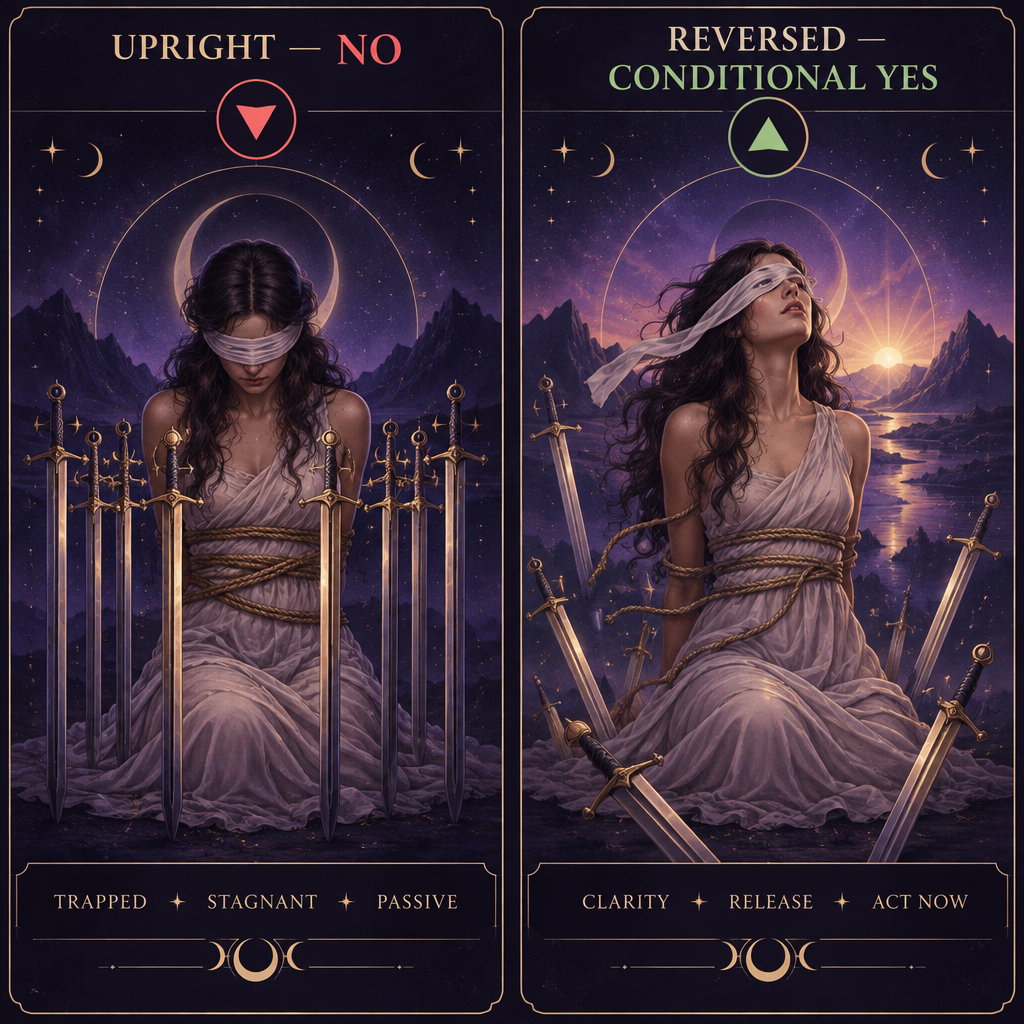
The Eight of Swords is a no when it lands upright and a conditional yes when it appears reversed. Upright, the card describes a mind so hemmed in by fear that the situation cannot move forward; reversed, the blindfold is coming off, but the outcome still depends on you acting on what you can now see. Here is how to read that verdict for love, work, money, health, and any decision that has you stuck.
Quick Answer
| Position | Verdict | Why |
|---|---|---|
| Upright | No | The querent is trapped by their own thinking, not by the situation itself. Nothing moves until the mental knot is untied, so the answer to “will this happen” is no for now. |
| Reversed | Conditional yes | Restriction is lifting and clarity is returning. The yes only holds if you step out of the circle of swords rather than waiting to be rescued. |
If you pulled the card upright and want a one-word reading, take the no. If you pulled it reversed, treat it as a yes with a job attached.
Card Attributes at a Glance
| Attribute | Detail |
|---|---|
| Suit | Swords |
| Element | Air (thought, communication, judgement) |
| Number | 8 (power, structure, cycles, momentum that has stalled) |
| Astrology | Jupiter in Gemini, first decan of Gemini (roughly May 21 to May 31) |
| Yes or no (upright) | No |
| Yes or no (reversed) | Conditional yes |
| Related cards | Nine of Swords, Ten of Swords, The Tower, The Devil, Eight of Wands |
| Deck reference | Rider-Waite-Smith, illustrated by Pamela Colman Smith, 1909 |
The Jupiter in Gemini pairing is worth pausing on. Jupiter expands whatever it touches, and Gemini is the sign of the restless, doubling mind. Put them together and you get thoughts that multiply until they crowd out action. That is the whole card in one sentence.
Keywords
Upright
- Restriction and limitation
- Feeling trapped or cornered
- Fear, anxiety, overthinking
- Victim mentality
- Helplessness and paralysis
- Self-imposed prison
- Waiting to be rescued
Reversed
- Freedom and release
- Empowerment
- Clarity, the blindfold coming off
- Liberation from old beliefs
- Confidence returning
- Taking responsibility for the way out
- New perspective
What the Eight of Swords Actually Shows
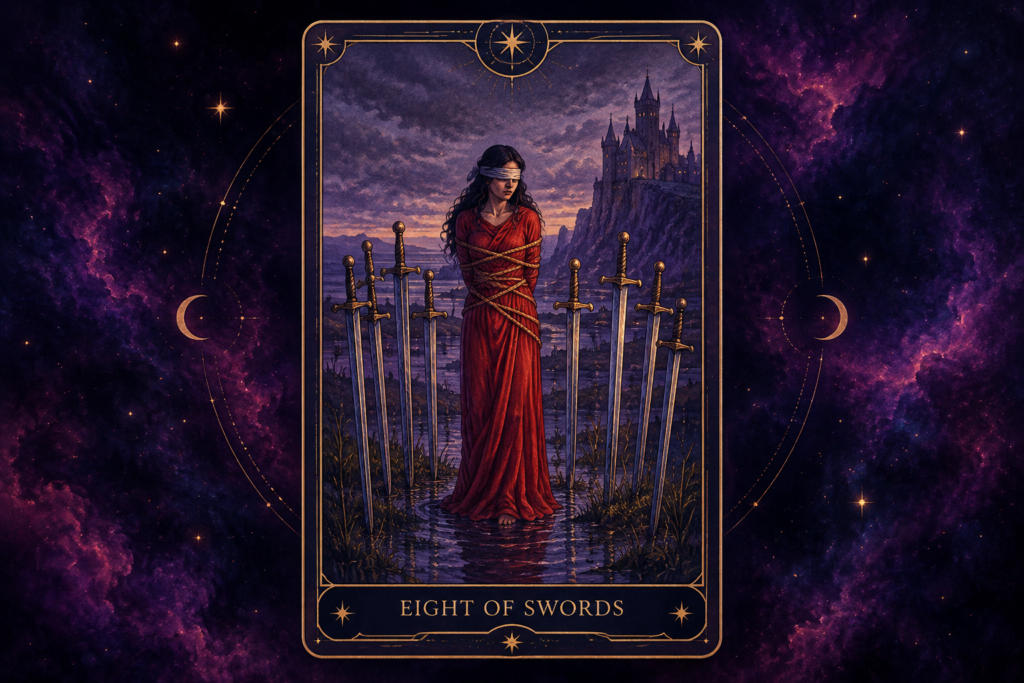
In Pamela Colman Smith’s illustration, a woman stands blindfolded and loosely bound, with eight swords planted upright around her. Every detail on the card argues that her prison is less solid than it feels.
Look at the binding first. Her arms are tied, but her legs are free. She could walk. Now look at the swords. They form a fence on three sides, not a full ring. There is an open gap directly behind her, and not one blade touches her body. The barrier is an incomplete circle, which is the illustrator’s way of saying escape has been possible the whole time.
Her feet rest in marshy ground with water pooling around them. Water on a Swords card is a deliberate mismatch: the suit belongs to the intellect, but the woman is standing in emotion. She is thinking her way in circles about something she actually feels, and the swamp is slowly holding her in place. Behind her, a castle sits on a cliff. Most readers see it two ways at once. It is the authority, family, employer, or partner whose judgement she fears, and it is also the safe structure she has walked away from and could return to.
The sky is grey and low. No sun, no storm. Just a flat, dull light that matches the mood of someone who has stopped expecting anything to change.
Why the Upright Eight of Swords Is a No
The upright card says no because nothing in the picture is moving. The woman is not fighting, not planning, not even testing whether the ropes are tight. She has accepted the story that she is stuck, and as long as that story holds, the outcome you asked about will not arrive.
This is a different kind of no from the Ten of Swords or The Tower. Those cards describe events happening to you. The Eight of Swords describes a lack of events, a situation frozen by fear, indecision, or the belief that someone else has to fix it. When you ask “Will I get the promotion” or “Will they come back” and this card appears upright, the reading is not that the universe has ruled against you. It is that the querent’s own posture is blocking the door.
Practically, that means the upright answer often comes with a diagnosis. The no is caused by:
- Waiting for permission you do not need
- Overanalysing until every option looks dangerous
- Avoiding a conversation that would resolve things
- Believing an old rule (about money, love, worth) that no longer applies
Fix the cause and the card stops saying no. Until then, it does.
Why the Reversed Eight of Swords Is a Conditional Yes
Reversed, the swords fall and the blindfold slips. The querent sees the gap in the circle, notices that their legs were never tied, and realises the castle was not a jail. That shift in perception is real progress, and it is why the card turns toward yes.
The condition is that seeing is not the same as leaving. Plenty of people reach the reversed Eight of Swords moment, understand exactly what has been holding them back, and then stand in the swamp for another year anyway. The card promises that the way out exists and that you are now capable of taking it. It does not promise that the outcome happens on its own.
So read the reversed card as: yes, if you move. Yes to the new job if you actually apply. Yes to the relationship if you have the honest conversation. Yes to recovery if you follow the plan. Remove the action and the yes collapses back into the upright position.
Upright vs Reversed Compared
| Upright | Reversed | |
|---|---|---|
| Core energy | Stagnation, restriction | Release, momentum returning |
| Mindset | Victim, powerless, “there is nothing I can do” | Agent, responsible, “I can see the way out” |
| Action orientation | Passive, waiting to be rescued | Active, choosing to step forward |
| Internal vs external | Internal blocks experienced as external limits | Internal shift that changes external results |
| Emotional tone | Anxiety, shame, dread | Relief, cautious confidence |
| Yes or no | No | Conditional yes |
| Timing | Not right now | Soon, once you act |
Timing: Not Right Now vs Never
The upright Eight of Swords is almost never a permanent no. It is a “not while you are standing here” no. The question is how long you plan to stand there.
Three things typically shift the answer from no to yes:
- New information. The blindfold represents something you refuse to look at or cannot see yet. A frank conversation, a medical result, a look at the actual bank balance, and the swords start to look smaller.
- A single small action. The card responds to movement, not to grand gestures. Sending the email, booking the appointment, saying the sentence out loud. One step out of the circle changes the reading.
- Letting go of a fear about the castle. Much of the paralysis on this card is about disapproval from an authority figure. When that fear is tested against reality, it usually shrinks.
In timing-focused spreads, the upright card points to a delay measured in the querent’s own decision-making rather than in weeks or months. The Swords suit as a whole runs fast once it runs at all, so when the reversed card appears, expect things to change quickly after you commit. Air moves; it just needs somewhere to go.
Eight of Swords Yes or No in Love
Upright: No
For relationship questions, the upright card is a no driven by fear rather than by an absence of feeling. Common scenarios it describes:
- You want to know if someone will commit, and the honest answer is that one of you is too afraid of being hurt to move.
- You are asking whether to stay, and the card shows you feel unable to leave when in fact nothing physical is stopping you.
- You are wondering if an ex will return, and the card says you are trapped in the story of the relationship rather than in the relationship itself.
The water at the woman’s feet is especially telling in love readings. Feelings are real, but they are being processed entirely in the head, turned into worst-case scenarios and unspoken assumptions. The no here is a signal to say the thing you have been rehearsing silently. Until that happens, the situation will not progress.
Reversed: Conditional yes
Reversed, the love answer brightens considerably. You are ready to trust again, or you have finally understood that the barrier between you and the person you want was mostly built from your own doubts. For singles, it points to becoming available in a way you were not before. For couples, it marks the end of a stalemate.
The condition: someone has to break the silence. If the yes you are hoping for depends on the other person making the first move while you stay quiet, you are still upright, just holding the card differently.
Eight of Swords Yes or No in Career and Money
Upright: No
Career questions with this card upright almost always circle back to a feeling of being stuck in a role, a company, or a financial pattern you believe you cannot escape. Will you get the promotion? Not while you are waiting for someone to notice you. Will the business idea work? Not while it stays a thought experiment. Should you accept the offer? The card suggests you are viewing the choice through fear of what you might lose rather than what you might gain, and the answer is no until you can see it clearly.
For money specifically, the upright card describes avoidance. Bills unopened, statements unread, a debt problem you think about constantly but never actually measure. The no is not about your capacity to recover financially. It is about the fact that nothing recovers while you refuse to look at the numbers.
Reversed: Conditional yes
Reversed, the card favours career moves that come from a clearer head. You have realised the job is not the only job, the industry is not the only industry, or the fear of the boss’s reaction was bigger than the boss. Applications, negotiations, and honest conversations about pay all get a yes here, provided you actually initiate them.
In money readings, the reversed card often marks the moment someone finally sits down with the spreadsheet. The situation is manageable, options exist, and the yes applies to plans you execute rather than plans you admire.
Eight of Swords Yes or No in Health
Upright: No, with a warning about anxiety
Health questions are where this card needs the most care. It is not a card of physical catastrophe. It is a card of mental strain: anxiety, insomnia, rumination, stress that shows up as tension, headaches, or a churning stomach. Asked “Will this resolve on its own,” the upright answer is no, because the pattern keeping you unwell is a loop you are stuck inside.
The card also flags avoidance of medical help. The castle in the background can be the clinic you keep not calling. If you have been putting off an appointment out of fear of what you might hear, the card is describing exactly that.
Reversed: Conditional yes
Reversed, recovery becomes likely, especially for stress-related and anxiety-driven conditions. The mind is loosening its grip. The condition is following through: keeping the appointment, taking the medication, sticking with the therapy, changing the schedule that was grinding you down. This is not medical advice, and no card replaces a doctor. The reversed Eight of Swords simply says you are now in a position to take the steps that help.
Eight of Swords as Advice: Should I Take Action?
Upright: Not yet, and here is why
As an advice card, the upright Eight of Swords does not tell you to charge ahead. It tells you that you are not seeing clearly enough to act well. The blindfold is the point. Before making the move, remove it: get the facts, ask the awkward question, look at what you have been avoiding. Acting while blindfolded just relocates the swords.
So the answer to “Should I do this right now” is no. The answer to “Should I do the thing that would let me see clearly” is yes, immediately.
Reversed: Yes, move
Reversed, the advice flips. You can see now. Waiting longer is not caution, it is the old habit reasserting itself. The card says take the step you have been contemplating, and take it before the grey sky settles back in. The gap in the swords does not stay open forever; the mind is quite capable of building a new fence.
Spiritual and Emotional Insight
Upright, the Eight of Swords is one of the most honest cards in the deck about how suffering works. Most of what holds people in place is not a wall but a belief about a wall. The woman is not a victim of the swords; she is a victim of the sentence “I am trapped,” repeated until it became furniture. Emotionally, the card asks you to notice the difference between what is happening and what you are telling yourself about it. That noticing is uncomfortable, because it removes the comfort of blamelessness. It also returns your power.
Reversed, the spiritual message is about responsibility as liberation. The moment you accept that you tied the blindfold, you also accept that you can remove it. There is often grief in this position: grief for the time spent standing in the swamp, and for the version of yourself that needed the prison. Let that grief pass through rather than turning it into a new set of swords. The reversed card marks a genuine turning point, but it is a doorway, not a destination.
Related Cards to Read Alongside It
Nine of Swords. The next step down if nothing changes. Where the Eight is fear in the daytime, the Nine is fear at 3 a.m. Together in a spread, they describe anxiety that has become chronic, and they strengthen a no.
Ten of Swords. The ending the Eight is afraid of. Ironically, the Ten is often a relief because at least something finally happens. If both appear, the message is that the dreaded outcome may be less damaging than the waiting.
The Tower. External upheaval that forcibly removes the swords. When The Tower joins the Eight, the situation will not wait for you to walk out on your own.
The Devil. A close cousin. The Devil’s chains are as loose as the Eight’s ropes, but The Devil’s prison is desire and habit where the Eight’s is fear.
Eight of Wands. The counterweight. Same number, opposite motion. If the Eight of Wands appears with a reversed Eight of Swords, expect events to move very fast once you commit.
FAQ
Is the 8 of Swords a yes or no?
Upright, it is a no. Reversed, it is a conditional yes that depends on you taking action. The upright no comes from paralysis and fear rather than from any external obstacle, which is why it can flip once the querent changes their behaviour.
Can the 8 of Swords be positive?
Yes, in two ways. Reversed, it is straightforwardly positive: freedom, clarity, and a way forward. Upright, it is positive in the sense that it names a problem you can actually solve. Nobody else has to do anything for this situation to change. That is bad news for people waiting to be rescued and good news for everyone else.
What is the warning of the Eight of Swords?
The warning is that you are mistaking a belief for a fact. You feel trapped, so you have stopped looking for the exit, and the longer you stay still the more real the trap feels. The card also warns against acting rashly while still blindfolded. Get clear first, then move.
What does the 8 of Swords mean in a reading?
It means restriction that is largely self-imposed. Expect themes of anxiety, overthinking, victim mentality, and avoidance. Reversed, it means those patterns are breaking down and the person is regaining agency. The surrounding cards tell you whether the shift comes from within (Star, Sun, reversed Devil) or is forced from outside (Tower, Ten of Swords).
Is the Eight of Swords a no in love?
Upright, yes, it is a no, usually because fear is blocking honest communication rather than because feelings are absent. Reversed, it becomes a yes as long as one of you is willing to speak first.
Does the Eight of Swords mean never, or just not now?
Almost always not now. The card describes a stalled situation, not a closed one. New information, a single concrete step, or letting go of a feared authority figure’s opinion are the three things that most reliably turn the reading around.
Is the Eight of Wands yes or no?
The Eight of Wands is a clear yes, and a fast one. It is the card of swift movement, messages arriving, and events accelerating. People often confuse the two eights when they only remember the number, so check the suit: Wands means go, Swords means you are the one holding yourself back.
What does the reversed Eight of Swords mean for a decision?
It means you finally have enough clarity to decide, and the decision to act is favoured. The yes is conditional only because seeing the way out is not the same as taking it. If you have already decided and are asking for permission, the card gives it.