
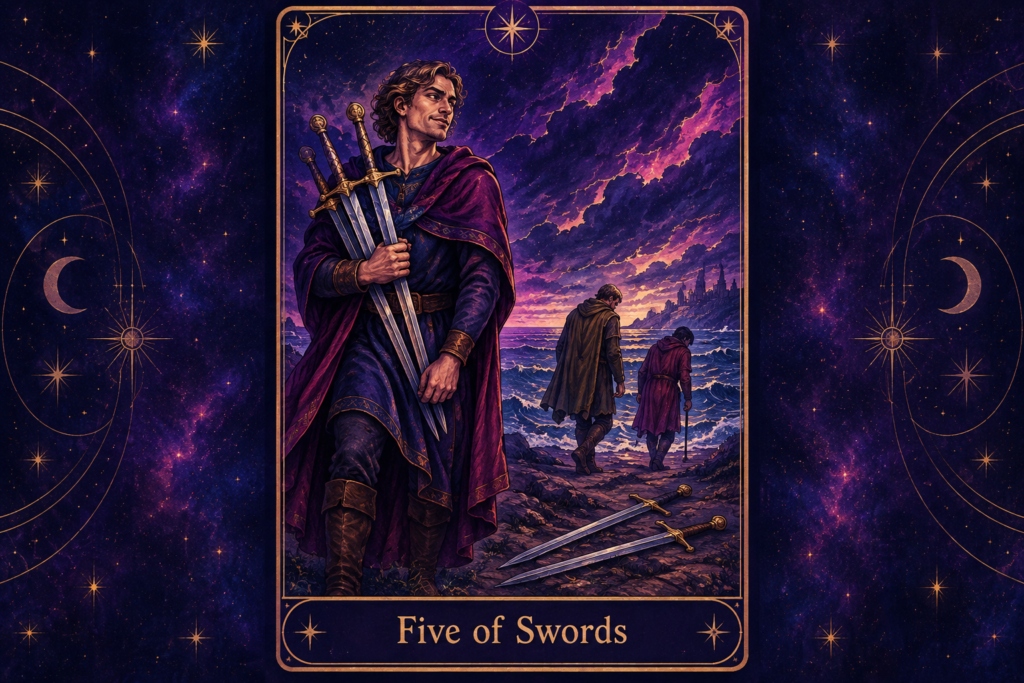
Five Of Swords: Yes or No Tarot Meaning
The Five of Swords answers a yes or no question with a flat no when upright, because any win it promises comes at a cost you will regret. Reversed, the answer shifts to a cautious yes, provided you are willing to drop the argument rather than win it. Below is the fast verdict, then the detail behind it for love, exes, family, career and spiritual questions.
Last reviewed: January 2026 by the site editorial team. Interpretations are based on the Rider-Waite-Smith deck, Waite’s Pictorial Key to the Tarot, and Golden Dawn correspondences.
Quick Answer
| Position | Verdict | Core reason |
|---|---|---|
| Upright | No | A hollow victory. You might get what you asked about, but through conflict that leaves you isolated. |
| Reversed | Yes (cautious) | The fight is ending. Reconciliation, apology and lessons learned open the door, slowly. |
If you only need one line: upright, do not proceed; reversed, proceed once you have genuinely let the grudge go.
Why the Upright Five of Swords Means No
Every Five in the Minor Arcana marks a point of instability, and the Suit of Swords puts that instability in the realm of thought, speech and conflict. The Five of Swords is the moment someone wins an argument and loses the room.
The reason it reads as no in a yes or no spread is not that failure is coming. Often the opposite. The card frequently shows you succeeding at the literal thing you asked about. The problem is the method and the aftermath. You get the promotion by undercutting a colleague. You get your ex to text back by wearing them down. You win the family dispute and nobody comes to dinner next year. Waite’s own keywords for the card were “degradation, destruction, revocation, infamy, dishonour, loss,” which is a strange list for a card that pictures a winner. That tension is the whole point.
Winning at all costs
The phrase that best captures this card is winning at all costs, and the costs are the part people skip. Ask yourself what the question is really about. If a yes requires outmanoeuvring someone, proving you were right, or walking away with the spoils while someone else leaves defeated, the card is telling you the prize is not worth the price. That is a no, even if the mechanics of the situation would technically let you have it.
Why the Reversed Five of Swords Means Yes
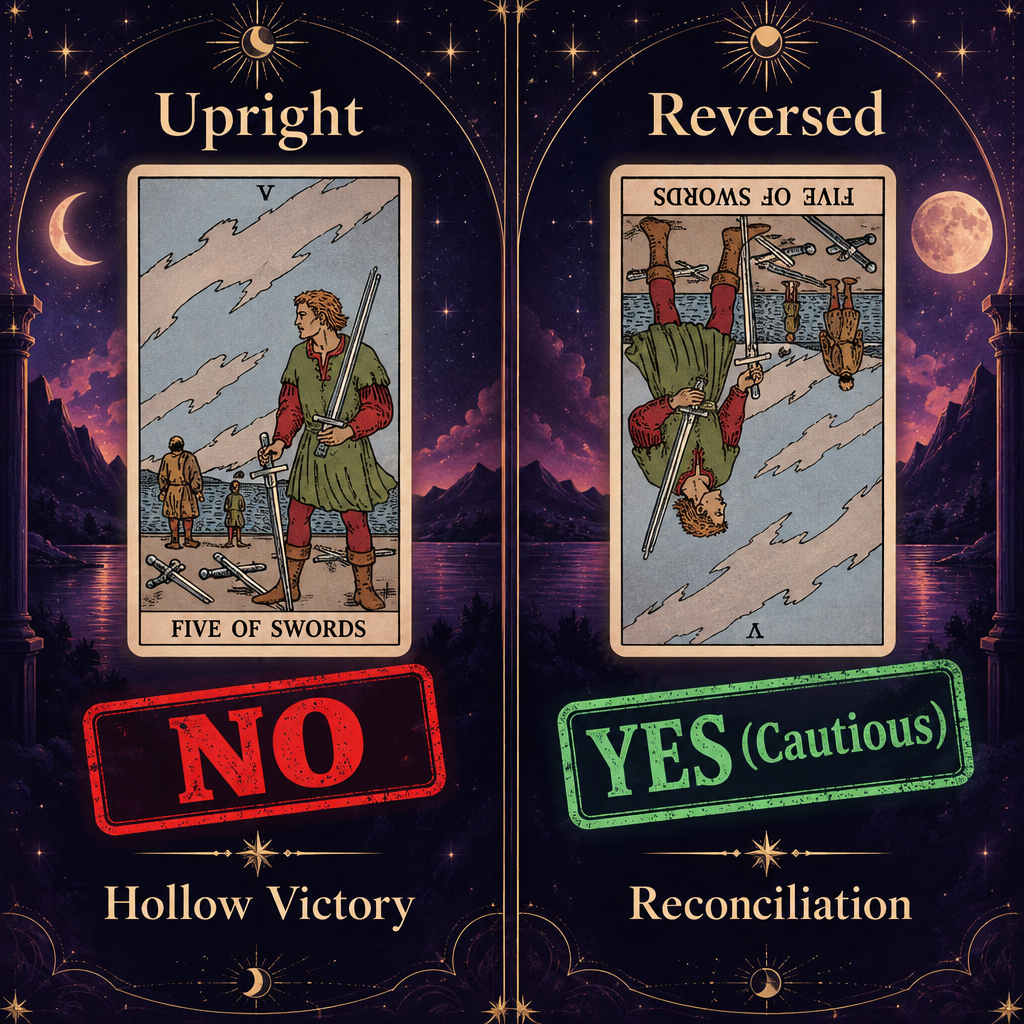
Reversed, the swords come down. The card now points to the end of hostilities: an apology offered or accepted, a grudge released, a decision to stop keeping score. In yes or no terms this is a yes, with two conditions attached.
First, it is slow. Reversed Swords cards rarely snap into resolution. Think weeks of thawing, not an overnight fix. Second, the yes depends on you choosing cooperation over being right. If you draw this reversed and you are still privately composing the perfect comeback, the yes has not arrived yet.
There is a harsher shade of the reversal that some readers flag: conflict that drags on because nobody will concede, or a loss that forces humility. Even then, the answer leans yes, because the lesson from defeat is exactly what clears the path. You lose the battle, you learn something, and the thing you asked about becomes possible on better terms.
What the Card Shows: Rider-Waite Imagery
Pamela Colman Smith’s illustration carries the whole yes or no logic, so it is worth reading closely.
- The foreground figure. A man with a sideways smirk gathers up three swords. He has won. He is also alone, and his expression is closer to contempt than joy. This is the “yes you can have it, but look at your face” warning behind the upright no.
- The two swords on the ground. Dropped by the losers. He cannot carry all five. Even the victor leaves something behind, a hint that the win is incomplete.
- The two departing figures. One walks away with slumped shoulders; the farther one has his head in his hands. These are the people the question involves. Upright, you may be the one making them leave. Reversed, imagine them turning around.
- The sky. Jagged, torn clouds over choppy water. The atmosphere is unsettled, and Swords as the Air element means this disturbance is mental and verbal: arguments, cutting words, rumours.
When the card is reversed the smirking man is at the bottom and the departing figures sit “above” him. Readers often take this as the losers gaining the higher ground, which fits the reconciliation reading.
Upright vs Reversed at a Glance
| Upright | Reversed | |
|---|---|---|
| Keyword | Hollow victory | Reconciliation |
| Yes/no | No | Cautious yes |
| Love | Power struggles, scorekeeping, someone has to lose | Apologies, making amends, dropping the need to win |
| Ex / reconciliation | No, unresolved ego conflict | Possible, if both sides have changed |
| Family | Feuds, taking sides, a relative who must be right | Olive branches, old grievances fading |
| Career | Office politics, credit stealing, Pyrrhic wins | Truce with a rival, learning from a loss |
| Trust | Someone is playing dirty | Trust rebuilt slowly |
| Timing | Fast, conflict peaks within days to weeks | Gradual, resolution over weeks to a couple of months |
Love and Relationships
New relationships: no upright, slow yes reversed
Upright, this card in an early-dating question is one of the clearer red flags in the deck. Look for someone who has to win every small disagreement, who tells stories where every ex was the villain, or who treats dates like negotiations. The card says no because the dynamic is adversarial from the start. Reversed, a connection that began with friction (a bad first impression, a rocky first date) can recover, but only if both people stop defending their position.
Existing relationships: no upright, yes reversed
In an established couple, the upright card describes arguments where the goal has quietly become beating your partner rather than solving anything. One person “wins” the discussion about money or chores and the other goes silent. The honest answer to “will this improve?” is no, as long as scorekeeping continues. Reversed, the card is one of the better signs for a couple in a rough patch: someone is ready to say sorry first.
Reconciliation with an ex
Upright, the answer is no. The same ego issues that ended things are still active. Reversed, the answer becomes a conditional yes. The condition is that the reunion is built on humility rather than one person finally being proven right. If you are hoping to get back together so they admit they were wrong, that is still the upright card wearing a disguise.
Family relationships
Family questions are where this card shows up most painfully, because family conflicts carry decades of history. Upright, it points to feuds, siblings taking sides over an inheritance or a parent’s care, or a relative who treats every gathering as a debate to be won. Asked “should I confront my mother about this?”, upright says no, not in a way that leaves her defeated. Reversed is a yes for mending fences: a sibling you have not spoken to in a year may be as tired of the silence as you are. The card advises you to make the first move without demanding an apology in return.
Career and Money
Upright in a work question, this is office politics at its ugliest: credit stolen in a meeting, a rival undermined, a win in a disciplinary dispute that leaves you marked as difficult. “Will I get the role?” may be answered with a technical yes and a practical no, because you will not have allies when you need them. A money question upright warns against a deal where the counterparty walks away feeling cheated; it will come back around.
Reversed, a workplace cold war ends. A lost promotion teaches you what you were missing. A negotiation that stalled gets restarted because someone compromises. These are yes answers, framed as recovery rather than triumph.
Trust, Deception and Manipulation
Alongside conflict, the Five of Swords carries themes of betrayal and underhanded tactics. The smirking victor did not necessarily fight fair. Upright, asked “can I trust this person?”, the answer is no. Watch for someone who flatters you while briefing against you, who twists your words back at you, or who agrees in person and reverses course by email. Pair this card with the Seven of Swords and the deception reading becomes explicit.
There is also an uncomfortable version where you are the manipulator. If the question is “should I use what I know about them to get my way?”, the card says no, and it is not being squeamish. It is pointing out that the victory will isolate you.
Reversed, trust can be rebuilt, but it is earned in small instalments. Someone who deceived you may genuinely want to make amends. Say yes to the process, not to instant forgiveness.
Advice: What to Do When You Draw It
Upright:
1. Stop trying to win. Ask what outcome you actually want in six months, not what would feel satisfying tonight.
2. Check your tactics. If you would be embarrassed to explain how you got the result, do not get it that way.
3. Walk away from no-win arguments. The departing figures are not weak; they are the ones who still have their peace.
4. Delay the answer. Swords move fast. Give it a week before committing to anything adversarial.
Reversed:
1. Make the first concession. The card rewards whoever lowers their sword first.
2. Name the lesson from the loss out loud. Defeat that is not examined repeats itself.
3. Accept a partial truce. Full resolution comes later; the yes is in the direction of travel.
Spiritual and Personal Growth
On a spiritual level this card is about the ego’s need to be right and what it costs the spirit. The upright figure has three swords and no one to talk to. Many readers treat the Five of Swords as the card of the Pyrrhic win in the inner life: proving a point to a friend about faith, politics or lifestyle and losing the friendship. The growth work is learning that being right and being at peace are different goals, and choosing peace more often than feels natural.
Reversed, the card describes humility learned honestly. You were wrong, or you won and discovered it felt empty, and either way you came out softer. That softness is the yes.
Air, Venus and Aquarius
The Suit of Swords belongs to the Air element, which governs intellect, communication and conflict carried out in words. In the Golden Dawn system the Five of Swords corresponds to Venus in the first decan of Aquarius, covering roughly 20 to 29 January. The pairing is a strange one: Venus wants harmony and relationships, Aquarius wants principle and independence. Put together they describe the person who would rather be right than be loved, which is the upright card exactly. Reversed, Venus wins out and the desire for connection overrides the desire to be correct.
Timing in Yes or No Readings
Swords are the fastest-moving suit, so upright the conflict the card describes is close: days or a few weeks. If you asked “will this resolve soon?”, upright says no, and the tension is likely to peak before it fades. Reversed timing is slower, typically a few weeks to a couple of months for a genuine thaw, and it tends to coincide with someone’s change of heart rather than an external event. The Aquarius decan, late January, is sometimes used as a literal timing marker when the spread supports it.
Supporting Cards and Crystals
Cards that sharpen the upright no: the Seven of Swords (deception), the Three of Swords (the hurt caused), the Tower (the fallout). Cards that soften it toward yes: the Six of Swords (leaving the conflict behind), Temperance (compromise), Justice (a fair settlement), and the Six of Cups when the question concerns reconciliation.
For readers who work with stones, blue lace agate is the usual pairing for calmer speech, and rose quartz is used when the reversed card calls for forgiveness. Treat these as optional tools, not as a change to the verdict.
FAQ
Is the Five of Swords a yes or no?
Upright, it is a no. The card promises a hollow victory: you may get the thing you asked about, but through conflict that leaves you isolated or damages the relationship involved.
Does the reversed Five of Swords change the answer?
Yes. Reversed, the card becomes a cautious yes. It points to reconciliation, apologies and letting go of grudges, with the condition that you stop trying to win and accept a slower, cooperative resolution.
What does the Five of Swords mean in love as a yes or no?
Upright it is a no for love questions, indicating power struggles and scorekeeping. Reversed it is a yes for couples willing to make amends, and a conditional yes for new relationships that got off to a rocky start.
Can the Five of Swords mean reconciliation with an ex?
Only reversed. Upright, the card says no, because the ego conflicts that ended things are unresolved. Reversed, reconciliation is possible if both people have genuinely moved past needing to be proven right.
Is the Five of Swords a bad card?
It is a warning card rather than a disaster card. Upright it tells you that a win you are chasing is not worth the cost. Reversed it is one of the more hopeful Swords cards, showing conflict ending and lessons being learned.