
Temperance: Yes or No Tarot Meaning
Last updated: February 2026
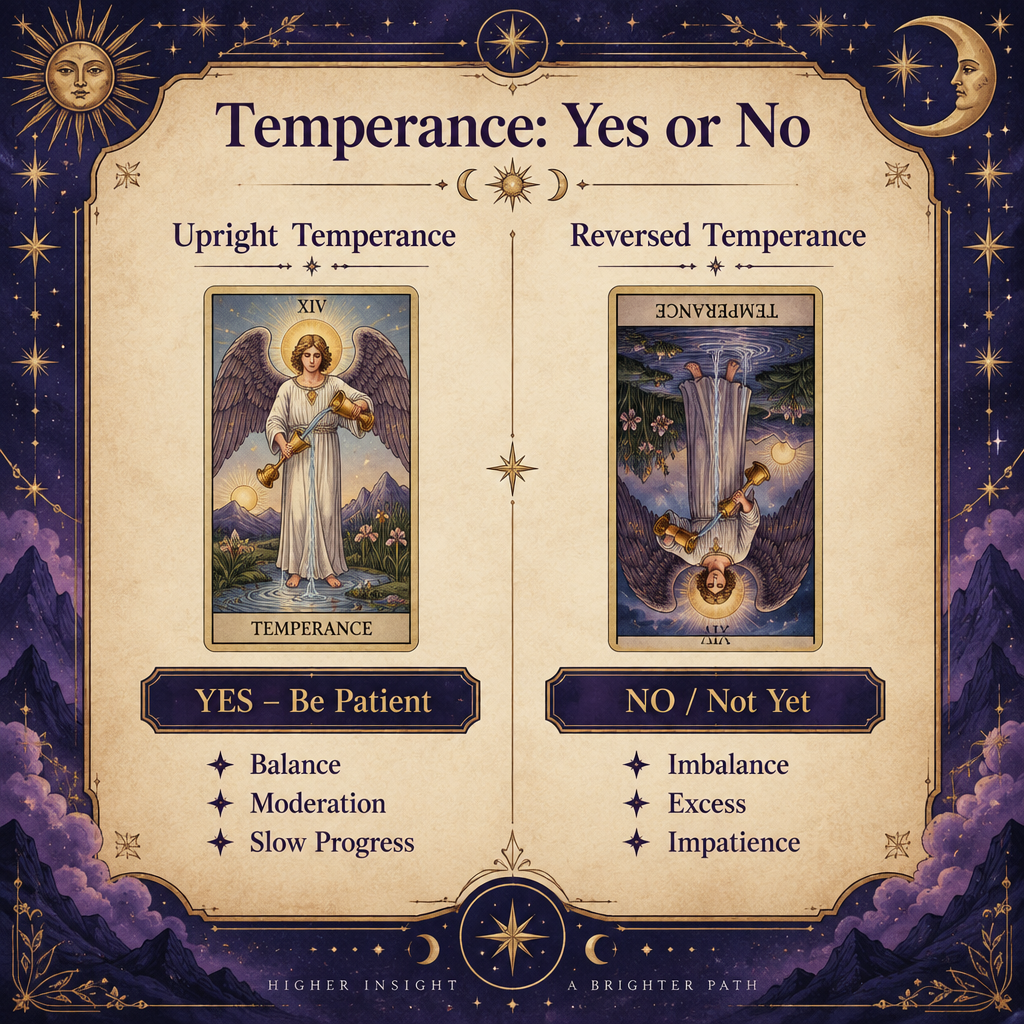
Temperance is one of the few Major Arcana cards that gives a genuinely positive answer without promising a quick one. Upright, it is a yes that comes with a timing condition. Reversed, it leans toward no, or at best a “not like this, not yet.”
The Quick Verdict
| Position | Yes or No | What it actually means |
|---|---|---|
| Upright Temperance | Yes, but be patient | The outcome is favourable if you keep your balance and let it develop at its own pace. Forcing it undoes the yes. |
| Reversed Temperance | No / Maybe | Something is out of proportion. Excess, impatience or conflicting priorities are blocking the result. Fix the imbalance before asking again. |
If you need a one-word answer: upright is yes, reversed is no. If you need the honest answer, upright is “yes, slowly,” and reversed is “not until something changes.”
Keyword Reference
| Upright | Reversed |
|---|---|
| Balance, moderation, patience | Imbalance, excess, extremes |
| Harmony, blending, compromise | Conflict, discord, clashing agendas |
| Healing, recovery, calm | Relapse, burnout, overindulgence |
| Purpose, the middle path | Lack of direction, scattered energy |
| Alchemy, integration | Fragmentation, self-sabotage |
| Slow steady progress | Rushing, impatience, false starts |
Why Temperance Is a “Patient Yes” Rather Than a Flat Yes
Older yes/no lists file Temperance under a simple yes. That is not wrong, but it skips the most useful part of the card. Temperance belongs to the group of Major Arcana that describe a process rather than an event. Compare it with The Sun, which is an unambiguous yes about something arriving, or The Wheel of Fortune, which is a yes about a turn already in motion. Temperance is a yes about something being made.
Picture the angel’s two cups. The water is in constant motion between them, and that motion is the point. Nothing has settled yet. So when you ask “Will I get the job?” and pull Temperance, the honest read is: yes, if you stay steady through a longer process than you expected, and if you resist the urge to oversell yourself or chase a faster alternative. The yes is real. The timeline is yours to protect.
Three conditions usually sit behind an upright Temperance yes:
- Timing. Weeks or months, not days. Temperance almost never signals a sudden result.
- Moderation. You get the yes by not overdoing it. Over-texting, overworking, over-promising all tip the card toward its reversal.
- Blending. The outcome depends on two things combining well: two people, two priorities, two parts of yourself. One side dominating spoils the mix.
When Temperance lands next to cards like the Eight of Pentacles, the Six of Cups or The Star, treat the yes as solid. Next to the Five of Pentacles, the Tower or the Seven of Swords, keep the yes but double the patience.
Temperance Card Symbolism (Rider-Waite-Smith)
Most yes/no readings are based on the imagery Pamela Colman Smith drew for the 1909 Rider-Waite-Smith deck under Arthur Edward Waite’s direction. Each element on the card shapes how the yes/no answer should be read.
The angel
A large winged figure stands at the centre, neither clearly male nor female. Waite identified the figure as an angel rather than a human, and many readers associate it with Archangel Michael. On the chest is a triangle inside a square, the classic alchemical sign for spirit held within matter. The forehead carries a solar disc. In yes/no terms the angel says: the answer involves something higher than impulse. Act from principle and the result holds.
The two cups
The angel pours water from one cup to another. In Smith’s illustration the stream appears to flow at an angle that defies gravity, which is intentional. This is the alchemical mixing of opposites. For a question, it means the outcome depends on two separate ingredients meeting in the right proportion. Ask yourself which two things need blending in your situation.
One foot on land, one in water
The angel’s right foot rests on the rocks, the left dips into the pool. Earth stands for the practical and material, water for emotion and intuition. The posture is deliberate balance. It is the clearest visual argument that Temperance’s yes is conditional: stay grounded and stay feeling at the same time, or you lose your footing.
The irises
Yellow irises grow beside the pool. Iris was the Greek messenger between gods and mortals and the personification of the rainbow, a bridge between heaven and earth. The flowers reinforce the theme of communication and connection across a divide, useful when the question concerns two people who are not currently in sync.
The path, the mountains and the rising sun
Behind the angel a path winds toward distant mountains, and above them a crown-like glow sits where the sun is rising. This is the journey element of the card. The destination is good, but it is far off and uphill. Every time Temperance says yes, the path is in the background reminding you the answer is a direction of travel, not a parcel on your doorstep.
Temperance Numerology, Zodiac and Element
Temperance is card XIV, number 14 in the Major Arcana. Reduce 14 to a single digit and you get 5, which links it to The Hierophant (V). Both cards concern tradition, discipline and finding a path that has already been walked by others. The Hierophant teaches the rules; Temperance applies them with flexibility. The number 14 also pairs 1 (initiative) with 4 (structure), which is a tidy summary of the card: act, but within a framework.
In the Golden Dawn system that underpins the Rider-Waite-Smith deck, Temperance corresponds to Sagittarius and the Hebrew letter Samekh. Sagittarius is a mutable Fire sign, ruled by Jupiter, concerned with aim, distance and the long journey toward meaning. That fiery link surprises people who see a watery-looking card, but it explains the “keep moving toward the mountains” energy. Fire tempered by water is exactly the alchemical operation on the card. Sagittarius season runs from roughly 22 November to 21 December, and readers who use timing often point to that window, or to a Jupiter transit, when Temperance appears in a “when” question.
Temperance Between Death and The Devil
Temperance sits at XIV, directly after Death (XIII) and directly before The Devil (XV). That placement is not decoration. Death ends something. Temperance is the recovery and recalibration that follows an ending. The Devil is what happens when that recalibration fails and a person slides into excess or dependence.
For yes/no readings this gives a built-in warning. An upright Temperance yes is the healthy middle state after a loss. A reversed Temperance “no” often means the querent is drifting toward Devil territory: obsession, overindulgence, or clinging to something that should have stayed buried with Death.
Upright Temperance Yes or No: By Area of Life
Love
Upright Temperance in a love question is a yes built on compatibility rather than fireworks. The card describes two people who are learning each other’s rhythms and adjusting without resentment. If you asked whether the relationship will work, the answer is yes, provided neither of you tries to rush the stage you are in.
New relationships. Yes, with a slow start. Temperance for a new connection points to a relationship that develops through steady contact rather than intense early declarations. If you are asking whether to text first or wait, the card favours waiting a beat. If you are asking whether this person is interested, the card says interest is present but measured. Do not read measured as cold.
Long-term relationships. Yes. This is one of Temperance’s strongest contexts. It describes partners who have found a working balance between independence and togetherness, who compromise without keeping score. For questions about moving in, marriage or starting a family, Temperance says the foundations are sound, and it favours a timeline you both agree on over one person’s deadline.
Reconciliation with an ex. A cautious yes, and the caution matters. Temperance says reunion is possible if both people have changed the proportions that broke things the first time. It does not endorse rushing back. If the breakup was recent, Temperance is telling you to cool down first. If you are asking “Will my ex come back?”, the card suggests slow re-contact rather than a dramatic return. If you are asking “Should I get back with my ex?”, the answer is yes only if you can honestly name what will be different.
Soulmate and twin flame questions. Temperance is often read as a soulmate indicator because of the two-cups imagery, and that is fair when the surrounding cards support it. For twin flame questions specifically, Temperance points to the harmonising phase after separation, not the initial intense recognition. It says the connection is moving toward balance and that the healthiest path forward involves both people doing their own inner work rather than chasing each other.
Career
Yes. Temperance in a career question favours the applicant, the employee or the business owner who has been consistent. If you asked about a promotion, the answer is yes, likely after a review cycle rather than next week. If you asked whether to take a new job, Temperance says yes if the role offers better work-life balance or a more collaborative team, and no if it mainly offers a bigger title with longer hours. The card rewards diplomacy, so in workplace conflict questions it means the situation resolves through mediation and mutual adjustment, not through one side winning.
Finances
Upright Temperance is a yes for financial questions that involve steady accumulation. Think consistent monthly saving, a diversified portfolio, debt paid down on schedule. It is a weaker yes, closer to maybe, for questions about windfalls, speculative investments or fast returns. If you asked “Will I be financially stable?”, Temperance says yes through moderation: spending less than you earn, mixing safe and growth assets, and not letting one expense category dominate. If you asked whether to make a large purchase, the card says yes if you can pay for it without disturbing your overall balance, and suggests waiting if you would have to stretch.
Health
Yes, with the emphasis on recovery over cure. Temperance is one of the most positive health cards in the deck because it describes the body returning to equilibrium. For questions about recovering from illness, injury or surgery, it indicates healing that progresses steadily when the person follows the plan. For lifestyle questions it is the moderation card: balanced eating rather than crash dieting, regular moderate exercise rather than extreme programmes, and attention to sleep and hydration. If the question concerns mental health, Temperance points to improvement through routine and gentle rebalancing, and it often appears when therapy or a stabilising practice is starting to work.
Temperance as Feelings
When Temperance represents how someone feels about you, the feeling is calm, settled and sincere. This person is not experiencing you as a thrill or a crisis. They see you as someone who steadies them. They feel the relationship is good for their life. In early dating that can read as lukewarm, and people often misread it. It is not lukewarm. It is considered. This person is weighing you carefully because they take you seriously.
As “how someone sees you,” Temperance means they see you as balanced, fair, reliable and emotionally mature. They may also see you as someone who holds back, which is worth knowing if you are wondering why they have not made a bolder move. They are matching your pace.
Temperance as Advice
As an advice card, Temperance is specific. It tells you to:
- Do less, more consistently. Whatever you are doing, scale the intensity down and the frequency up.
- Find the middle. If you are torn between two options, the card is asking whether a blended version exists. It usually does.
- Wait for the mix to settle. Do not make a permanent decision while emotions are still being poured from cup to cup.
- Keep one foot on the ground. Check the practical facts of the situation even when your feelings are loud.
- Mediate rather than fight. In any conflict, Temperance says be the person who proposes the compromise.
The advice is not passivity. The angel on the card is working. Temperance advises deliberate, measured action rather than no action.
Temperance Spiritual Meaning
Temperance is the alchemy card of the Major Arcana. Medieval alchemists used the term temperare, to mix in proper proportion, and the angel’s pouring is a literal image of that process. The spiritual message is integration: the parts of yourself that seem opposed, such as ambition and rest, logic and intuition, grief and gratitude, are not meant to be chosen between. They are meant to be combined into something new.
In a spiritual reading Temperance confirms that you are on the middle path and that the quiet, undramatic work you are doing is the right work. It frequently appears for people in the stretch after a major loss or awakening, when the intensity has faded and the real reshaping begins. The mountains in the background are the destination, but the card insists that the pouring, the daily practice, is where the transformation actually happens.
Reversed Temperance Yes or No
Reversed Temperance is a no in most contexts, and a maybe in situations where the imbalance can be corrected quickly. It describes excess, impatience and two things that refuse to blend. The angel has lost its footing. The water is spilling.
The key reversed question is: what is out of proportion? Identify it and the no can become a later yes.
Reversed Temperance in love
No, or not yet. Reversed Temperance in a love reading points to a relationship where one person is giving far more than the other, where arguments repeat without resolution, or where one partner is pushing for a pace the other cannot match. For “Does this person want a relationship with me?”, the reversal says their feelings are mixed or that their life is too chaotic to sustain one right now.
New relationships reversed. No. The connection is unbalanced from the start, often because of intensity that cannot be maintained. Love-bombing patterns show up here.
Long-term relationships reversed. A warning more than a flat no. Something has drifted: too much work, too little intimacy, one partner’s needs crowding out the other’s. The relationship can recover, but the card is telling you that the imbalance is now serious enough to need direct attention.
Reconciliation reversed. No. Reversed Temperance for an ex says the same disproportion that caused the breakup is still present. Getting back together now would replay the same pattern. If you are being pulled toward an ex while the card is reversed, that pull is closer to The Devil’s attachment than to Temperance’s harmony.
Reversed Temperance in career
No for now. The reversal shows burnout, overcommitment, or a workplace where factions will not cooperate. For “Will I get the promotion?”, it suggests you have been pushing too hard or spreading yourself too thin and it is showing. For “Should I take this job?”, it warns that the role will demand more than it gives. For business owners it flags overexpansion: too many products, too many hires, too much borrowed money relative to steady income.
Reversed Temperance in finances
No. This is the overspending card. Reversed Temperance describes a budget with no middle: feast and famine, impulse purchases followed by panic saving, or all money concentrated in one risky place. For investment questions it says the plan is unbalanced, often too aggressive. For “Will my finances improve?”, the answer is not until spending and income are brought back into proportion. The practical fix is dull and effective: track every expense for a month and rebuild the ratio.
Reversed Temperance in health
No, with a specific warning about extremes. The reversal often points to relapse, overindulgence in food, alcohol or substances, or the opposite problem of over-restriction and over-training. For recovery questions it signals a setback caused by doing too much too soon or abandoning the treatment plan. For mental health it shows mood swings and a loss of routine. The card does not predict a serious outcome on its own, but it is telling you clearly that the current pattern is unsustainable.
Reversed Temperance as feelings
The person feels conflicted, overwhelmed, or pulled between you and something else. They may be hot and cold because they genuinely have not resolved their own position. If you asked how someone sees you, the reversal suggests they see you as too much or too little of something: too intense, too distant, too demanding, too passive. Their view is distorted by their own imbalance more than by anything you did.
Reversed Temperance as advice
Stop. Reversed Temperance as advice tells you to halt whatever you are overdoing and restore the baseline before deciding anything. Sleep, eat regularly, reduce the number of commitments, and get a neutral perspective. Do not make the big decision this week.
Reading Temperance Yes or No in Practice
A few working rules that hold up across many readings:
- Temperance alone is a yes. If you pull a single card and it is upright Temperance, proceed, slowly.
- Temperance as the outcome card means the result is good but gradual. Do not set a short deadline on it.
- Temperance next to a strong no card softens the no. Beside the Tower or Ten of Swords it suggests recovery after the blow rather than cancelling the blow.
- Temperance next to a strong yes card adds a condition. Beside The Sun or Ace of Cups it says yes, and keep your balance so you do not spoil it.
- Reversed Temperance in the past position is good news. It means the imbalance is behind you and the question is now being asked from steadier ground.
FAQ
Is Temperance always a yes?
Upright, yes in almost every context, but it is a conditional yes tied to patience and moderation. It is not a yes to “Will this happen fast?” or “Should I go all in?” Those questions get a maybe from Temperance even upright.
Can Temperance mean no?
Yes, when reversed. Reversed Temperance is a no in love, money and health questions where excess or imbalance is present. Upright, the closest it comes to a no is in questions about rushing, gambling or forcing a result.
What does Temperance mean for love, yes or no?
Upright Temperance is a yes for love, strongest for long-term relationships and compatible partnerships. For new relationships it is a yes with a slow pace. Reversed, it is a no, or a warning that the relationship is out of balance.
Temperance reversed yes or no?
Reversed Temperance is a no in most readings. Treat it as a maybe only if you can identify the specific imbalance and correct it before acting.
Does Temperance mean an ex will come back?
Upright Temperance suggests reconciliation is possible if both people have changed and re-contact happens gradually. Reversed Temperance says no, the same problems remain.
What does Temperance mean as feelings?
Upright, the person feels calm, sincere and serious about you, even if they are not dramatic about it. Reversed, they feel conflicted or overwhelmed and cannot commit to a clear position.
Is Temperance a good card for health?
Upright, it is one of the best health cards, indicating recovery and balance. Reversed, it warns of relapse, overindulgence or extreme regimes.
What zodiac sign is Temperance?
Sagittarius, under the Golden Dawn correspondences used with the Rider-Waite-Smith deck. The element is Fire, which explains the card’s forward-moving, goal-oriented quality despite the water imagery.