
Emperor: Yes or No Tarot Meaning
The Emperor is a yes when upright and a no or not yet when reversed. That is the short answer, but the card carries a condition most quick-verdict lists skip: the yes only holds if you are willing to build the result through structure and discipline rather than wait for it to arrive on its own. Here is how that plays out in love, career, money, health, feelings, reconciliation, and every other question you are likely to bring to the card.
Quick Verdict
| Position | Answer | Why |
|---|---|---|
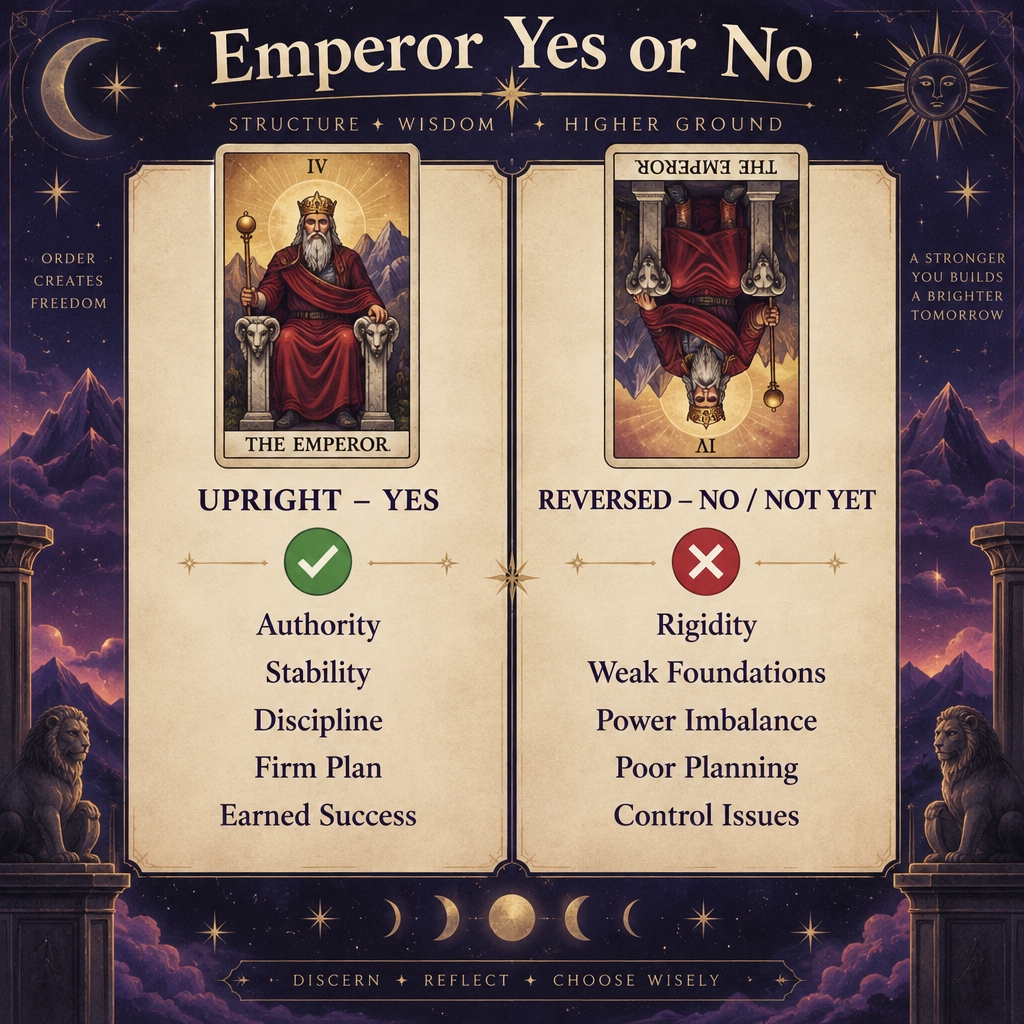
| Emperor upright | Yes | Stability, authority, and a plan that holds. Success comes through control and follow-through, not luck. |
| Emperor reversed | No / Not yet | Rigidity, weak foundations, misused control, or a power imbalance is blocking the outcome. Fix the structure first. |
If you pulled the card upright, you can stop reading here with a confident yes. If it landed reversed, or if the question involves feelings, timing, or another person’s intentions, the sections below give you the specific reading.
What the Emperor Card Shows
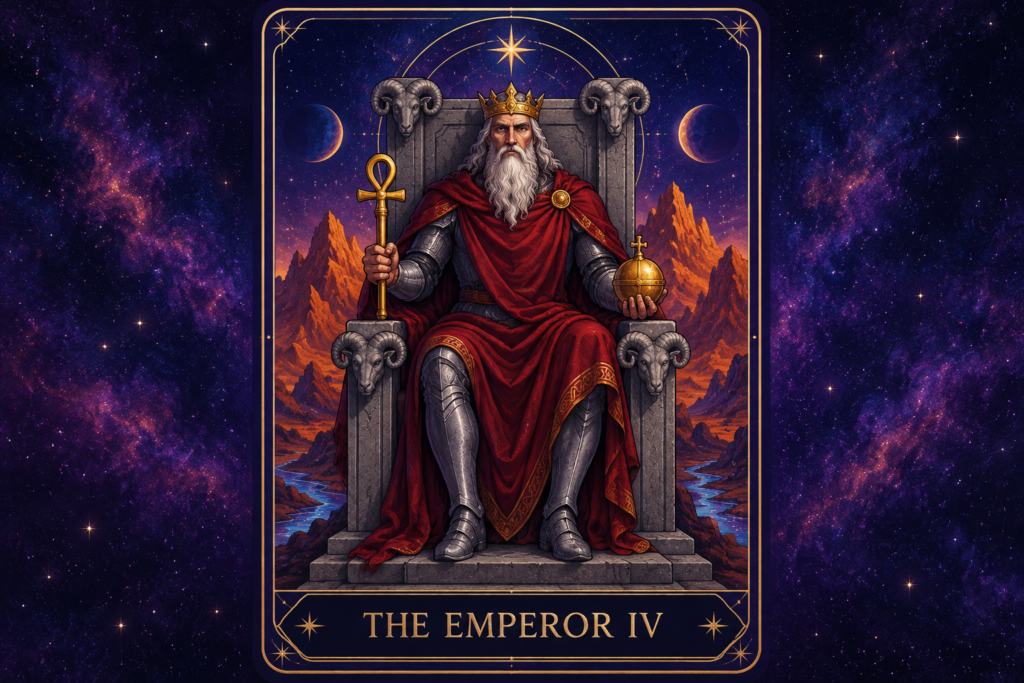
In the Rider-Waite-Smith deck, illustrated by Pamela Colman Smith and first published in 1909, the Emperor sits on a heavy grey stone throne decorated with four rams’ heads. He holds an ankh-topped scepter in his right hand and a golden orb in his left. Under a red robe he wears a full suit of armor, and his long white beard signals age and hard-won experience rather than youthful ambition. Behind him rise barren orange mountains, with a thin river running at their base.
Every one of those details feeds into the yes/no reading:
- The stone throne is immovable. Whatever the Emperor decides, it stays decided. This is why the upright card reads as a firm yes rather than a maybe.
- The rams’ heads tie the card to Aries, the sign of initiative and drive. Four of them reinforce the number of the card.
- The ankh is an Egyptian symbol of life, and in the Emperor’s hand it means life governed by rule and order.
- The orb represents dominion over a domain, whether that is a kingdom, a business, a household, or your own habits.
- The armor under the robe tells you this ruler is always prepared to defend what he has built. He is not relaxed. He is ready.
- The barren mountains are the card’s warning. Structure without warmth produces a landscape where nothing grows. The river is the only soft element, and it is far in the background.
Key Facts Table
| Attribute | Correspondence |
|---|---|
| Card number | IV (4) |
| Zodiac sign | Aries |
| Ruling planet | Mars |
| Element | Fire |
| Numerology | 4: foundations, order, four walls, four seasons, four directions |
| Archetype | Father figure, ruler, builder, masculine yang energy |
| Paired card | The Empress (III), his feminine counterpart |
| Yes or no upright | Yes |
| Yes or no reversed | No / Not yet |
The Aries and Mars attributions come from the Golden Dawn system that the RWS deck inherited, and they explain the card’s temperament. Aries starts things; Mars pushes through resistance. Combine that with the number 4, which in numerology means a completed structure, and you get a card that says: the thing you are asking about will stand if you build it properly.
Upright vs Reversed Keywords
| Upright | Reversed |
|---|---|
| Authority, stability, structure | Tyranny, rigidity, control issues |
| Discipline, leadership, protection | Weakness, lack of discipline, disorder |
| Father figure, provider | Absent or domineering father |
| Long-term planning | Poor planning, short-term thinking |
| Commitment, reliability | Coldness, emotional unavailability |
| Earned success | Abuse of power, lost authority |
Emperor Upright: A Yes You Have to Earn
The upright Emperor is one of the most reliable yes cards in the Major Arcana, sitting alongside the Sun, the World, and the Star. The difference is in the texture of the yes. The Sun says yes because the universe is smiling on you. The Emperor says yes because you have the systems in place to make it happen, or because the situation itself is governed by stable rules that favor you.
Concretely, an upright Emperor yes tends to mean:
- The outcome depends on someone in authority, and that authority is on your side or can be won over.
- Your plan is sound. Stop second-guessing it.
- Timing follows a schedule, not a whim. Expect results to arrive in an orderly way rather than as a sudden windfall.
- Commitment is real. In relationships, this is the card of someone who shows up every day, not the one who sends a passionate text at 2 a.m. and disappears for a week.
The “Not Yet” Debate
Not every reader treats the Emperor as an automatic yes. A vocal minority argue it is a conditional yes at best, or even a not yet, on the grounds that the Emperor represents preparation and control, and that if you are asking a yes/no question at all, you probably have not finished preparing. This reading has gained traction because it fits the card’s Aries energy, which favors action over passive hoping.
My position: the upright Emperor is a yes, but that minority view is pointing at something real. The card does not promise the outcome will drop in your lap. If you pull it and then do nothing, you will get nothing. Treat the Emperor’s yes as a green light with an instruction attached. Take the disciplined step the situation calls for, whether that is submitting the application, having the direct conversation, or setting the budget, and the yes materializes.
Emperor Reversed: No, Not Yet, or Caution
The reversed Emperor is where most short yes/no pages fail readers by collapsing everything into “no.” In practice the reversal produces three distinct answers, and the trigger behind each is different.
The Qualified No: Rigidity and Control
When the reversal points at rigidity, the answer is no, and the reason is that someone in the situation refuses to bend. This might be you. A reversed Emperor for “Will my boss approve my flexible schedule?” usually means the boss is stuck in an outdated rule, and no amount of good arguments will move them right now. In love, it often shows a partner whose need for control has become suffocating, or your own inability to let the other person breathe. The no here is not permanent, but it will not change until the rigid party changes.
The Not Yet: Poor Planning and Weak Foundations
The Emperor upside down is a ruler who has fallen off his throne. The structure is not there. If your question concerns a launch, a move, a marriage, or an investment, a reversed Emperor answering “not yet” means the plan has holes in it. You may have enthusiasm and even talent, but the budget is not finalized, the contract is not signed, or the conversation about what you both actually want has not happened. Return to the card once the foundation exists and you will often see it upright.
The Caution: Power Imbalance and Tyranny
The third reading is a warning rather than a verdict. Here the Emperor reversed flags a situation where power is being misused: a manager who takes credit for your work, a partner who controls the finances, a parent who cannot stop interfering in an adult child’s life, or your own tendency to bulldoze people when you feel insecure. The answer to your question is technically no, but the more useful message is to look at who holds the power and whether they deserve it. Push forward into a power imbalance and you will lose, even if you technically get what you asked for.
Emperor Yes or No in Love
Love questions are where the Emperor gets the most misread, because its energy is protective and steady rather than romantic. Do not expect roses. Expect someone who fixes your car without being asked.
New Relationships
Upright, the Emperor is a yes for a new connection, with a specific flavor. This person is looking for something durable. They will move at a measured pace, take dates seriously, and probably ask practical questions early about where you see your life going. If you want a slow burn with someone dependable, this is a strong yes. If you want a whirlwind, the yes comes with a mismatch warning.
Reversed, a new relationship gets a no. The most common reason is that one person wants to dictate the terms from day one. Watch for someone who decides where you eat, who you see, and how often you text, all within the first month.
Existing Relationships and Commitment
“Will he propose?” and “Is this relationship going to last?” both get a firm yes from the upright Emperor. It is one of the strongest commitment cards in the deck, second only to the Hierophant for questions specifically about marriage. It also tends to indicate a relationship where roles are clearly defined and both people know what they are responsible for.
Reversed, commitment questions get a no or a not yet. The classic modern interpretations are emotional unavailability (a partner who provides materially but cannot open up), authoritarian behavior, or a relationship where one person has quietly become the parent and the other the child.
Reconciliation With an Ex
Upright, the Emperor gives reconciliation a yes, provided the breakup was about circumstances rather than character. An ex who has become more stable, more settled in their career, and more willing to commit fits the upright Emperor perfectly. Expect the reunion to come with clear terms and a serious conversation rather than a spontaneous rush back together.
Reversed, reconciliation is a no, and the card is usually specific about why. The relationship ended because of control, rigidity, or emotional coldness, and nothing in the reversed card suggests those patterns have changed. If your ex was authoritarian, dismissive of your feelings, or unwilling to compromise, the reversed Emperor is telling you the same person is waiting on the other side of that door. Ask the card again in three months if you must, but do not reach out on the strength of this pull.
The Emperor as Feelings: How Someone Feels About You
When you ask how someone feels about you and the Emperor appears upright, they feel protective, serious, and invested. This person sees you as someone worth building a life around. They may not be saying it in words. The Emperor expresses feelings through provision and reliability: remembering your appointments, showing up when they said they would, defending you to others. If you are wondering whether they respect you, the answer is yes. If you are wondering whether they will say “I love you” first, that is less certain. This card feels deeply and speaks sparingly.
Reversed, the feelings are complicated in one of two directions. Either the person feels possessive and wants to control you more than they want to know you, or they feel powerless in the connection and are withdrawing because they cannot handle not being in charge. Both are a no for “do they feel healthy love for me right now.” The reversed Emperor can also show someone who is emotionally shut down, perhaps due to a father wound of their own, and who genuinely cannot access what they feel.
Emperor Yes or No for Career
Career is the Emperor’s home turf. Upright, it is a yes to promotions, leadership roles, business launches, and negotiations with authority figures. It also favors questions about stability: “Will I keep my job?” gets a yes, and “Should I take the corporate role over the freelance gig?” leans toward the corporate role.
The card does add a requirement. You need to be the most prepared person in the room. Walk into the interview with numbers. Bring the business plan to the bank in writing. The Emperor rewards the candidate with the spreadsheet, not the one with the vision board.
Reversed, career questions get a no, and the culprit is usually one of three things: a boss who abuses their position, a workplace with no clear structure or leadership, or your own reluctance to step into authority when the role demands it. If you asked about starting a business and pulled the reversal, your plan needs another draft.
Emperor Yes or No for Money and Finances
Upright, the Emperor is a yes for financial questions that involve saving, budgeting, property, pensions, and long-term security. It is a yes to “Will I be financially stable?” and “Should I buy the house?” It is a much weaker yes to “Will I win the lottery?” or “Should I put savings into this crypto coin?” because the Emperor distrusts anything that bypasses structure. The card favors index funds over meme stocks, fixed-rate mortgages over adjustable ones, and a written budget over a rough idea of what you spend.
Reversed, the financial answer is no. The specific warnings: overspending to maintain a controlling image, a partner or parent who holds the purse strings unfairly, or a total absence of planning that makes the financial goal impossible to reach by the date you asked about. A reversed Emperor for a loan or investment approval nearly always means rejection or terms you should not accept.
Emperor Yes or No for Health and Wellness
Health questions get a yes from the upright Emperor when the query is about recovery through discipline: sticking to a treatment plan, following a physiotherapy schedule, or maintaining a fitness routine. The card also points toward conventional medicine and authoritative professionals. If you asked whether to see a specialist, the upright Emperor says yes, and it says listen to them.
Reversed, health answers turn to caution. The card can indicate a body that has been pushed too hard by an overly rigid regime, stress-related issues from trying to control every variable, or a refusal to follow medical advice out of stubbornness. It is not a card of serious illness, but it is a no to “Is my current approach working?” Loosen the grip, and look at whether tension and control are showing up physically in the jaw, shoulders, or back.
Emperor Yes or No for Spirituality and Personal Growth
This is the Emperor’s weakest domain, and it pays to be honest about that. Upright, it is a yes for spiritual practices that require structure: a daily meditation schedule, a formal course of study, working within a tradition with clear teachings. It is a yes to “Will I grow if I commit to this practice?” It is a lukewarm answer to questions about intuition, surrender, and mystical experience, which belong to the High Priestess and the Moon.
Reversed, the card says no to your current spiritual approach, usually because it has become dogmatic. You may be following rules for their own sake, or treating self-improvement as another domain to conquer. The reversed Emperor in a spiritual reading is often asking you to stop trying to control your growth and let something softer in.
The Emperor as an Outcome Card
When the Emperor lands in the outcome position of a spread, or when you draw it specifically to ask “How will this end?”, the upright card promises an outcome that is stable, legally or formally recognized, and lasting. Court cases resolve in your favor. Contracts get signed. Relationships move toward official status. The result may take longer than you want, because the Emperor builds rather than sprints, but it holds once it arrives.
Reversed as an outcome, the situation ends in a collapse of authority or structure: a leader steps down, a business folds for lack of planning, a relationship breaks under the weight of one person’s control. Occasionally the reversed outcome is positive in disguise, showing the fall of a tyrant. If your question concerned escaping a domineering situation, the reversed Emperor as outcome is closer to a yes than a no.
The Emperor as Advice
Drawn as an advice card, the Emperor upright tells you to take charge. Set the boundary. Write the plan. Make the decision that everyone has been avoiding. Be the parent in the room, in the best sense of that phrase: calm, consistent, and willing to say no when it protects the people who depend on you. The Emperor’s advice is never “wait and see.”
Reversed as advice, the message flips: you are gripping too tightly. Delegate. Stop micromanaging your partner, your team, or your own healing. The reversed Emperor as advice can also mean you have handed your power to someone who does not deserve it, and it is time to take it back.
The Emperor as a Person
Upright, the Emperor describes a disciplined authority figure. In real readings this is often a father, a boss, a much older partner, or someone in law, the military, finance, or management. He is dependable, protective, somewhat formal, and not especially emotionally expressive. People describe him as “a rock.” He handles crises well and small talk badly.
Reversed, the same person becomes controlling, domineering, and defensive about his status. This is the boss who cannot admit a mistake, the father who ruled through fear, the partner who calls it protection when it is surveillance. Alternatively, the reversed Emperor as a person can be a man who has lost his authority: unemployed and bitter, or an older figure who has become weak and dependent. Which version you are dealing with depends on the surrounding cards.
How Surrounding Cards Change the Answer
A single Emperor gives a clear answer. Add a second card and the answer bends.
- Emperor + the Empress: the strongest yes in the deck for love, family, and fertility questions. Structure meets nurture.
- Emperor + the Lovers: yes to a committed partnership. Also a yes to a business partnership that requires a formal agreement.
- Emperor + the Hierophant: yes to marriage, formal agreements, and anything institutional.
- Emperor + the Tower: the Emperor’s structure is about to be shaken. Downgrade the yes to a not yet, or read it as a yes that comes only after an upheaval.
- Emperor + Death: an authority figure or a rigid structure is ending. For questions about leaving a controlling situation, this pairing is a yes. For questions about preserving the status quo, it is a no.
- Emperor + the Devil: control has become obsession. Even an upright Emperor turns into a caution here, especially in love readings.
- Emperor + Five of Swords or Seven of Swords: someone with authority is not acting honestly. Treat the yes with suspicion.
- Emperor + Ten of Pentacles: a yes for property, inheritance, and long-term financial security.
Notice that the Emperor rarely gets overruled outright. It is too heavy a card. What surrounding cards do is change the cost or the timing of the yes.
How to Use the Emperor in a One-Card Yes or No Pull
A yes/no pull works best when the question is genuinely binary and you decide the rules before you shuffle. Here is the method that produces the cleanest Emperor readings:
- Phrase the question so a yes has an obvious meaning. “Will I get the job I interviewed for on Tuesday?” works. “What about my career?” does not.
- Decide in advance whether you read reversals. If you do not, the Emperor is simply a yes, and you lose the not yet and caution readings. For a card with this much nuance in reversal, reading them is worth it.
- Shuffle until the deck feels settled, then cut once. Draw from the top of the cut.
- Read the position first, then the imagery. Upright equals yes. Reversed equals no or not yet. Only after that verdict do you look at the throne, the armor, the mountains, and ask which detail is speaking to your question.
- Ask the follow-up. If the Emperor is upright, pull one clarifier for “What do I need to build?” If it is reversed, pull one for “What is the block?” This second card usually names the exact problem.
- Do not re-ask the same question the same day. The Emperor hates being second-guessed. Give the card at least a week, or better, act on the advice first and then ask again.
FAQ
Is the Emperor a yes or no card?
Upright, the Emperor is a yes. Reversed, it is a no or a not yet. The upright yes comes with a condition: the outcome has to be built through structure, planning, and follow-through rather than waited for.
What does the Emperor reversed mean in a love yes or no reading?
Reversed in love, the Emperor is a no. It typically points to control issues, emotional unavailability, or a power imbalance in the relationship. For reconciliation questions, it indicates that the pattern that ended the relationship has not changed.
Can the Emperor mean “not yet” instead of “yes”?
Yes, particularly when reversed and the block is poor planning or weak foundations. A minority of readers also treat the upright card as a conditional yes, arguing that its Aries and Mars energy demands action before the result appears. The practical approach is to treat the upright card as a yes with homework attached.
How do surrounding cards affect the Emperor’s yes or no answer?
They rarely overturn it, but they change its timing and cost. The Empress, Lovers, and Hierophant strengthen the yes. The Tower and Death shift it toward not yet or signal that the structure must break first. The Devil turns even an upright Emperor into a caution about control.
Is the Emperor a good card?
In most contexts, yes. It is one of the strongest stability cards in the Major Arcana and a reliable yes for career, commitment, and financial security. Its weaknesses are spiritual and emotional questions, where its rigidity can be a liability, and any situation where the person asking is already too controlling.
What does the Emperor mean for how someone feels about you?
Upright, the person feels protective, serious, and committed, though they may show it through actions rather than words. Reversed, they feel possessive or emotionally shut down, and the answer to whether they hold healthy feelings for you right now is no.
What zodiac sign and element does the Emperor represent?
The Emperor corresponds to Aries, ruled by Mars, and to the element of Fire. It is card number IV, which in numerology represents foundations, order, and completed structure.