Nine Of Swords: Yes or No Tarot Meaning
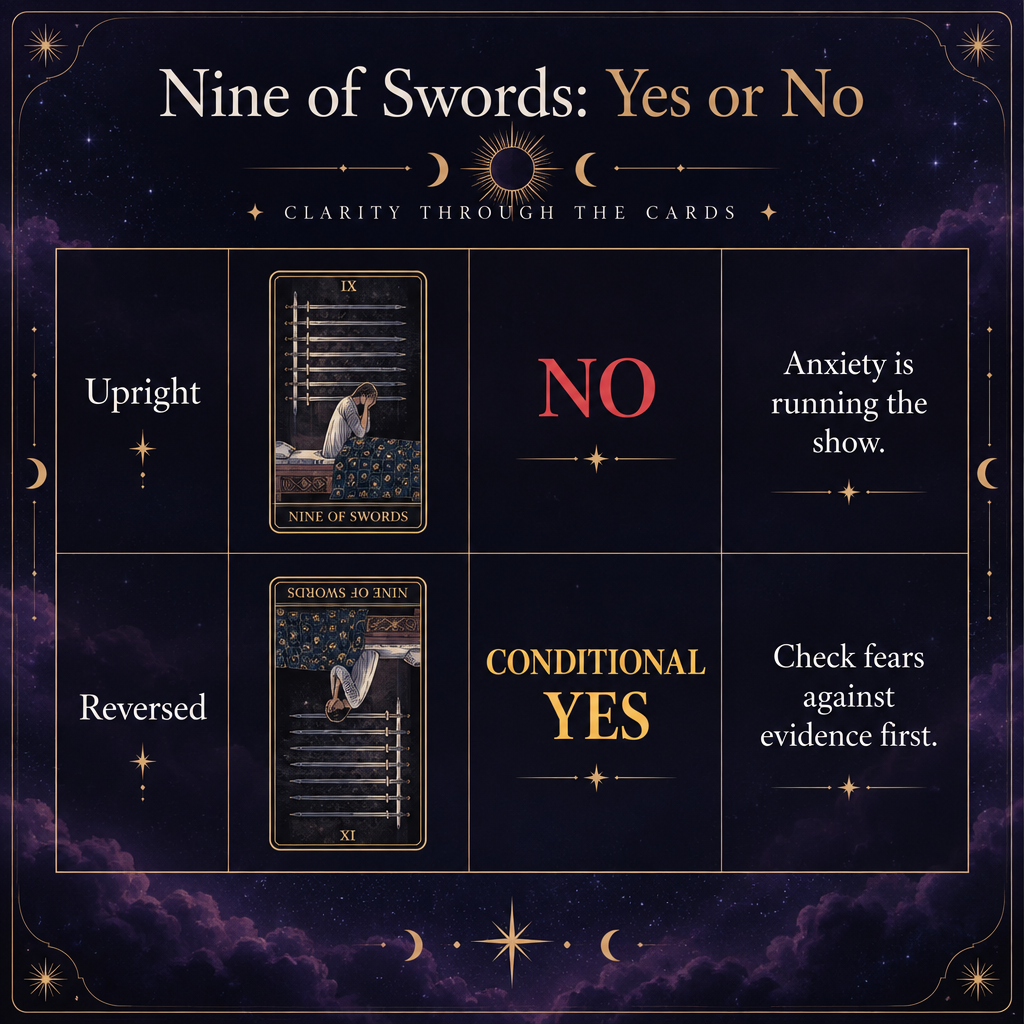
The Nine of Swords is a no when it lands upright and a conditional yes when it appears reversed. Upright, the card describes a mind so saturated with worry that any decision made right now will be built on fear rather than fact. Reversed, the panic is breaking and the answer leans yes, provided you act from the calmer version of yourself that is only just emerging.
Quick Answer
| Position | Yes or No | One-line reason |
|---|---|---|
| Upright | No | Anxiety is running the show. The outcome you fear is unlikely to be as bad as you imagine, but the moment is wrong for a yes. |
| Reversed | Conditional yes | The worst of the dread is lifting. Proceed once you have checked your fears against evidence, not before. |
Read on for how this verdict shifts across love, career, and health questions, and what the card’s imagery, astrology, and position in a spread add to the answer.
Nine of Swords at a Glance
| Attribute | Detail |
|---|---|
| Upright keywords | Anxiety, insomnia, guilt, dread, catastrophising, nightmares, isolation |
| Reversed keywords | Release, recovery, perspective regained, or in shadow form: suppressed pain, hidden despair |
| Yes or no | Upright no, reversed conditional yes |
| Element | Air (thought, mental activity, language) |
| Astrology | Mars in Gemini, second decan of Gemini |
| Numerology | Nine, the number of culmination and near-completion |
| Golden Dawn title | Lord of Cruelty |
| Deck attribution | Rider-Waite-Smith, illustrated by Pamela Colman Smith, published 1909 |
What the Card Shows
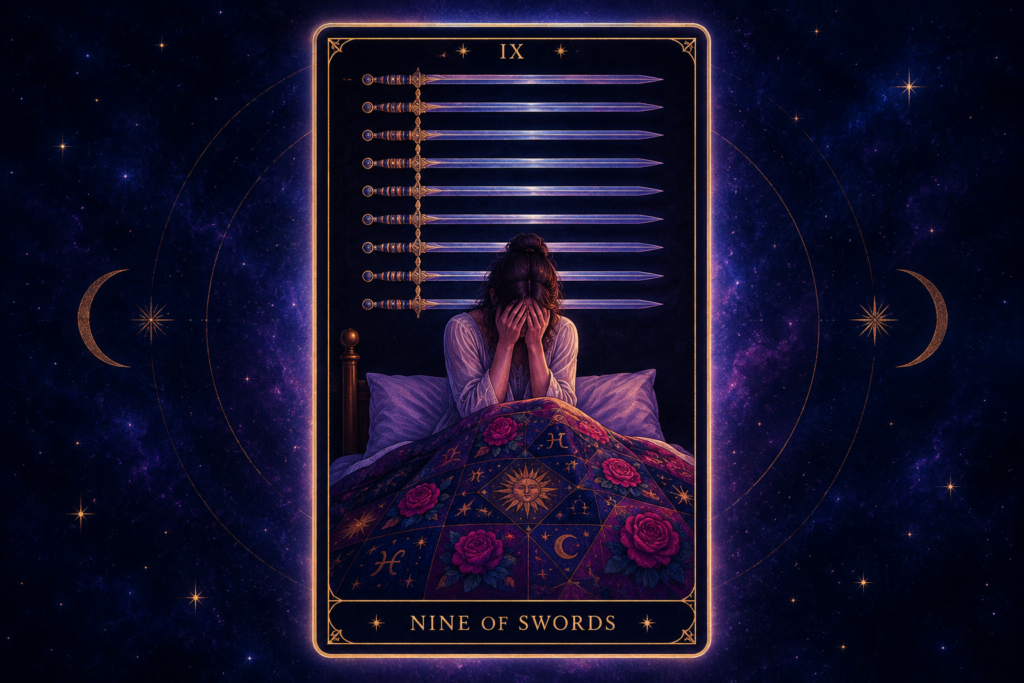
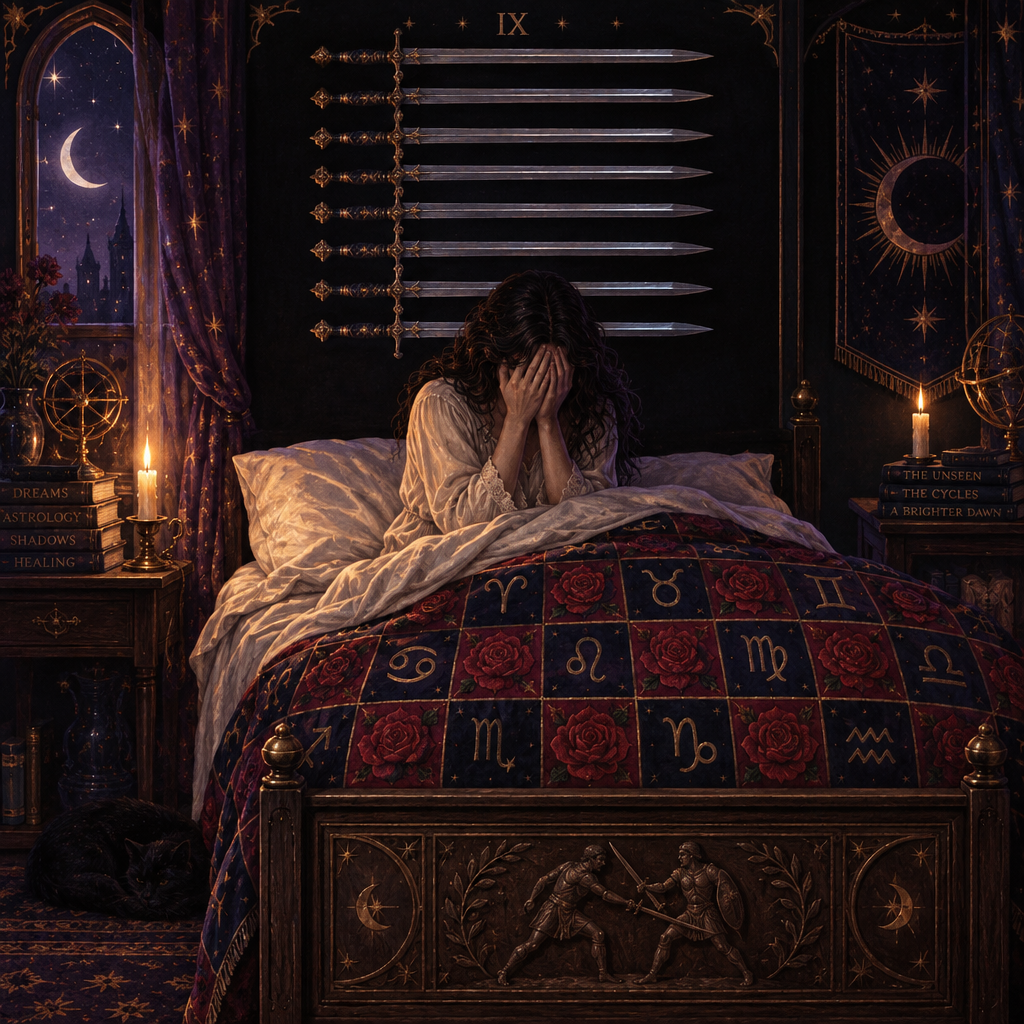
Pamela Colman Smith’s illustration puts almost nothing in the frame except a person, a bed, and a wall. A figure sits bolt upright, face buried in both hands, the way you do at three in the morning when sleep has refused to come. The background is solid black. There is no window, no door, no clock. That absence is the point: the figure has lost all sense of the outside world and lives entirely inside their own head.
Nine swords hang horizontally on the wall above. None of them touch the figure. They are arranged in a neat stack, the sort of pattern a mind makes when it lines up every possible disaster in order. The swords are threats in theory, not wounds in fact.
The quilt is the detail most people miss. Its squares alternate between red roses and astrological glyphs for the zodiac signs. Roses point to passion and the heart; the planetary and zodiac symbols point to the ordered cosmos, to meaning and pattern. The figure is literally covered in reasons for hope and still cannot see them, because their hands are over their eyes.
Carved into the base of the bed is a small panel showing one person defeating another in a fight. Waite’s own commentary in The Pictorial Key to the Tarot calls this “a card of utter desolation,” but the carving suggests the desolation has a source: a conflict, a loss, or an act the figure regrets and keeps replaying.
For a yes or no reading, the imagery tells you three things. The threat is above the head, not in the body. The comfort is already present but unseen. And the darkness is total only because the figure refuses to look up.
Why the Upright Nine of Swords Is a No
Upright, this card describes a questioner who cannot currently tell the difference between what is happening and what they are afraid will happen. That alone disqualifies a yes. A yes from the Nine of Swords would be a yes given under duress, by someone who has not slept and is bargaining with their own fear.
It also carries specific warnings worth taking literally:
- Guilt that distorts judgement. The card frequently appears when the questioner did something they regret and is now making decisions to compensate for it rather than because they are right.
- Isolation. Nobody else is in the picture. Choices made without a second opinion while in this state tend to be poor ones.
- Insomnia and depletion. Chronic lack of sleep degrades decision-making in measurable ways. If the card is describing your sleep, the no is partly a medical no.
The no is rarely a verdict on the external situation. It is a verdict on your current capacity to judge it. Ask again when you have slept and talked to someone.
Do this now: postpone any decision with a deadline you control. Write the exact scenario you fear in one sentence, then write the evidence for and against it in two columns. Send a message to one person you trust and tell them what is keeping you awake.
Why the Reversed Nine of Swords Is a Conditional Yes
Reversed, the swords on the wall fall away. The figure has, in effect, dropped their hands and looked up. The classic reading is recovery: the anxiety attack has passed, perspective is returning, and you can see the roses on the quilt again. In that state the answer tilts to yes.
The conditions matter, though, because the card is reversed, not transformed into the Sun. A conditional yes from the Nine of Swords reversed means:
- Healing is underway, not finished. You are in the first clear-headed hours after a bad night. Move forward, but at the pace of someone who has just stopped shaking.
- Check fears against facts before acting. The yes depends on confirming that the thing you dreaded really was smaller than it felt. If you have not checked, you have not met the condition.
- Clarity is partial. Say yes to the next step, not to the whole plan.
There is also a shadow reading of the reversal that current practice treats as standard, and it changes the answer. Sometimes the inverted card shows the figure lying down with the swords beneath them, which reads as pain pushed below the surface: someone who has stopped admitting they are suffering, who tells everyone they are fine, who is sliding from acute anxiety into a flatter depression. Waite’s own reversed keywords, “imprisonment, suspicion, doubt, reasonable fear, shame,” sit closer to this darker reading than to the gentle “release” interpretation.
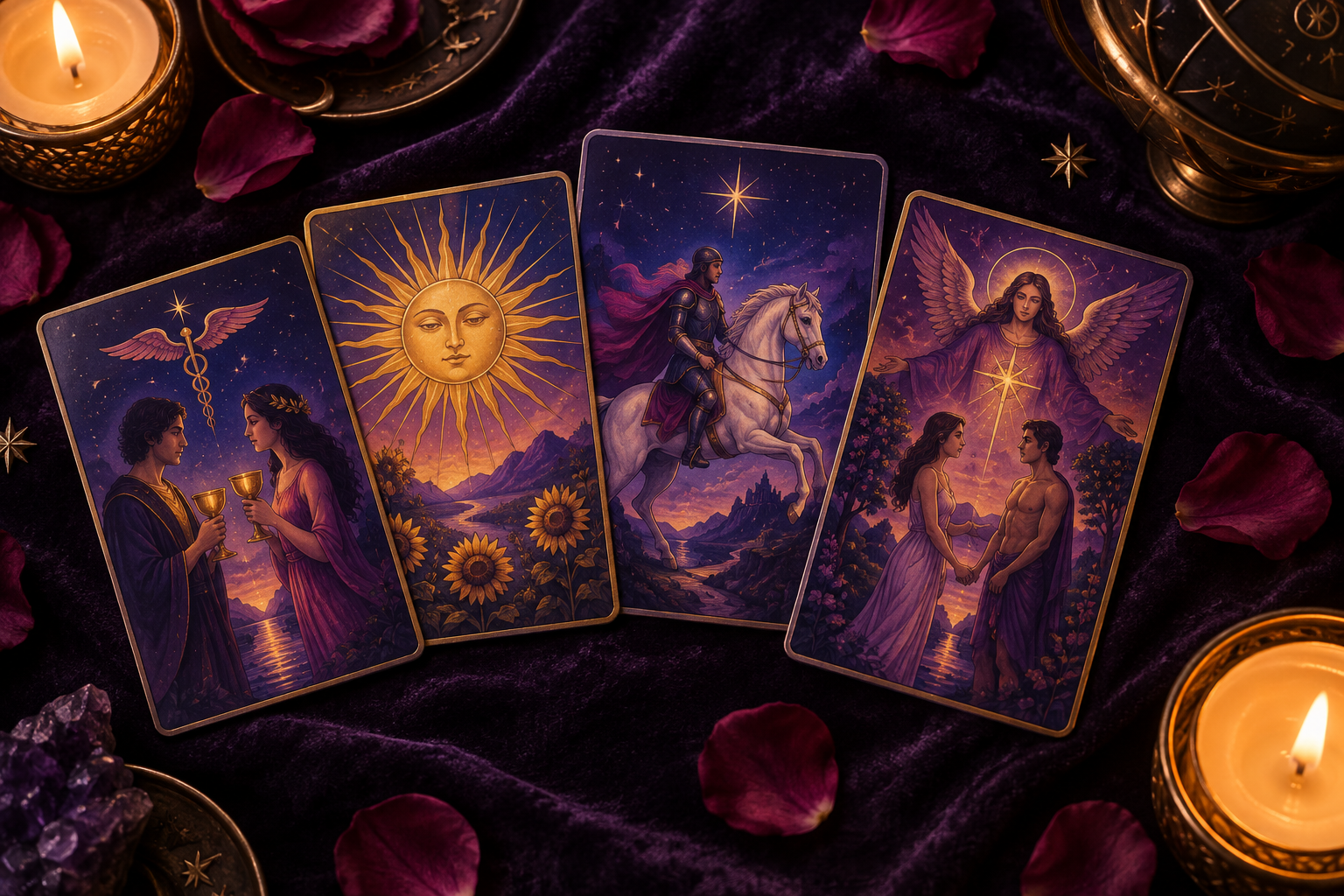
How to tell the two apart: look at the surrounding cards and at the questioner. Reversed next to the Star, the Six of Swords, or Temperance, read recovery and give the conditional yes. Reversed beside the Five of Cups, the Hermit, or the Ten of Swords, or when the person asking insists everything is fine while clearly not sleeping, read suppression and treat the answer as a no that needs a conversation, not a card.
Do this now: name one concrete thing that is better than it was a week ago. Take the smallest reversible step toward your question. If you cannot find anything that is better, treat the card as the shadow reversal and talk to someone.
Thoughts Are Not Facts: The Card’s Core Teaching
The single most useful thing the Nine of Swords teaches is the distinction between a bad situation and a distorted perception of a situation. Almost every time this card appears, the second is more true than the first.
Think of the swords as nine thoughts. “They have not replied because they are leaving me.” “The silence from the recruiter means I failed.” “This ache is something serious.” Each is a sword on the wall: sharp, real as a thought, and completely unverified. The card does not say the fears are baseless. It says they are untested, and that the figure has mistaken the feeling of certainty for actual certainty.
This is why the upright answer is no rather than “disaster confirmed.” A no from the Nine of Swords protects you from acting on a prediction your anxious brain generated at 3 a.m. It is far closer to “not like this, not yet” than to “you were right to be afraid.”
The practical test is simple. For each fear, ask: what would I need to see to know this is true? If the answer is “nothing, I just know,” you are holding a sword, not a fact. If the answer is something you can check tomorrow, check it tomorrow, then ask the cards again.
Nine of Swords Yes or No for Love
Upright: no. In love readings the Nine of Swords almost always describes the questioner’s inner state rather than the partner’s behaviour. The common presentations are jealousy without evidence, rereading messages for hidden meanings, lying awake imagining an affair, or guilt over something you said in an argument that your partner has already forgotten.
Specific questions and how the card answers them:
- Will they come back? No for now. You are asking from a place that would accept any answer just to end the uncertainty, which is not the place to rebuild from.
- Are they cheating? The card does not confirm infidelity. It confirms that you are tormented by the idea. Those are different, and the card is pointing at the torment.
- Should I confess what I did? Upright, the card says your guilt is distorting the scale of the thing. Reversed, it leans yes: honesty will relieve more than it costs.
- Should I commit to this person? No, not while the relationship is this frightening to you. A healthy yes should not feel like this.
Reversed: conditional yes. The obsessive loop has started to break. You have perhaps had an honest conversation, or you have finally slept and realised the three-day silence was a dead phone, not a dead relationship. The yes holds if you can name what actually changed. If the only thing that changed is your mood, wait a week.
Watch for the shadow reversal in love: someone who has stopped expressing hurt in a relationship because they have given up on being heard. That is not healing, and the answer there is no until the silence is addressed.
Do this now: before confronting a partner, write down the specific behaviour that worries you, separate from your interpretation of it. Ask one direct question instead of running surveillance. If jealousy is a pattern across relationships rather than specific to this one, that pattern is the real subject of the reading.
Nine of Swords Yes or No for Career
Upright: no. Professionally, the card shows overthinking that has crossed into burnout: rehearsing a presentation at midnight, dreading Monday from Saturday afternoon, convinced a quiet manager means a coming dismissal. Impostor syndrome lives here too. Decisions made in this state tend to be either paralysed or impulsive, and both read as no.
- Should I take this job offer? No, if you are taking it to escape dread rather than because you want it. Fear-driven exits usually relocate the fear.
- Should I resign? The card says you are too exhausted to make a resignation a strategic act right now. Fix your sleep and talk to someone before you hand anything in.
- Will I get the promotion or pass the interview? The card does not predict the outcome. It predicts that you will suffer badly during the wait. Treat that suffering as the thing to address.
- Should I confront my boss or colleague? No while the grievance is this inflamed in your head. Write it down, sleep, reread.
Reversed: conditional yes. A career question with the reversed Nine of Swords suggests you have identified the actual problem beneath the panic, whether that is a toxic team, a mismatched role, or simply chronic overwork, and are ready to act on it. The yes applies to deliberate moves: a planned job search, a boundary around hours, a conversation you have prepared for. It does not apply to a resignation email sent in a surge of relief.
The shadow reversal at work looks like presenteeism: showing up, performing fine, and quietly falling apart. If that is what the card is describing, the answer to “should I keep pushing through” is no.
Do this now: list what you fear will happen at work and date each fear. Revisit the list in two weeks and count how many materialised. Book a holiday or at least a full weekend offline before making any decision with a notice period attached.
Nine of Swords Yes or No for Health and Mental Wellness
This is the card’s home territory, and the yes or no here needs careful handling.
Upright: no, with a strong recommendation to seek help. The card describes anxiety severe enough to disrupt sleep, which is both a symptom and an amplifier. Health anxiety specifically, where every symptom becomes evidence of something catastrophic, is a textbook Nine of Swords presentation.
- Is my health worse than I think? The card points to perception, not pathology. It does not diagnose anything. It does say your worry has outrun your evidence, and the fix for that is a doctor’s appointment, not another tarot pull.
- Will I recover? The card declines to answer physical questions and redirects to the mental one: you will not recover your equilibrium until the rumination is treated as its own problem.
- Should I start therapy or medication? The upright card is one of the few places where the no does not apply to the obvious supportive action. Read the card itself as the referral.
Reversed: conditional yes. Panic attacks spacing out, sleep returning, a first good session with a therapist, the realisation that the symptom you were sure was fatal has a boring explanation. The conditional part is consistency: the yes applies as long as you keep doing whatever started working.
The shadow reversal here is the most serious in the deck. It describes someone who has stopped reaching out because reaching out felt pointless. Readers working with the card today increasingly treat it as a prompt to ask directly about the questioner’s wellbeing rather than to deliver an interpretation and move on. If you are reading for yourself and this description fits, the card is not the right tool for the next step. A person is.
Do this now: keep a sleep and worry log for seven nights, noting bedtime, wake time, and the dominant 3 a.m. thought. Book a GP or counsellor if the log shows fewer than six hours on most nights. Tell one person the actual content of your fear, out loud.
Mars in Gemini, Air, and the Number 9
The Nine of Swords belongs to the suit of Air, which governs thought, language, and analysis. Every sword card is about the mind, and the nine shows the mind at its most self-destructive: intelligence turned entirely inward, analysing and re-analysing until there is nothing left to analyse except the analysis.
The Hermetic Order of the Golden Dawn assigned the card to the second decan of Gemini, ruled by Mars, roughly the first ten days of June. Gemini is restless, verbal, dual-minded; Mars is force, friction, and aggression. Put them together and you get mental energy with a blade on it: arguments rehearsed in the shower, cutting self-talk, a brain that attacks itself because it has nothing external to fight. The Golden Dawn’s title for the decan, Lord of Cruelty, names this precisely. The cruelty in the card is almost always the questioner’s cruelty toward themselves.
Nine in tarot is culmination, the point just before completion. In the Pentacles it is the garden in full fruit; in the Cups, the smug contentment of a wish fulfilled. In the Swords, the same number brings a mental process to its peak, and the peak of unchecked thought is dread. The good news hidden in the numerology: nine is not ten. The cycle has not finished. The Ten of Swords lies ahead if nothing changes, but the nine is still a card of thought, not consequence, and thought can be interrupted.
Eight, Nine, Ten of Swords: Reading the Sequence
The three cards form a clear progression and reading them together sharpens the yes or no.
| Card | Image | Theme | Yes or no |
|---|---|---|---|
| Eight of Swords | Bound, blindfolded figure surrounded by swords, with an open path behind | Feeling trapped by circumstances that are more escapable than they look | No, but mobile: the restraints are loose |
| Nine of Swords | Figure upright in bed, swords on the wall | The trap has moved inside the head; the external situation barely matters | No upright, conditional yes reversed |
| Ten of Swords | Figure face down with ten swords in the back, dawn on the horizon | The feared ending actually arrives, and with it, release | No for the question as asked, yes for the new chapter |
The movement from eight to nine is the movement from “I am stuck” to “I cannot stop thinking about being stuck.” The movement from nine to ten is the point where the imagined worst case either happens or is finally confronted, and the sky starts to lighten.
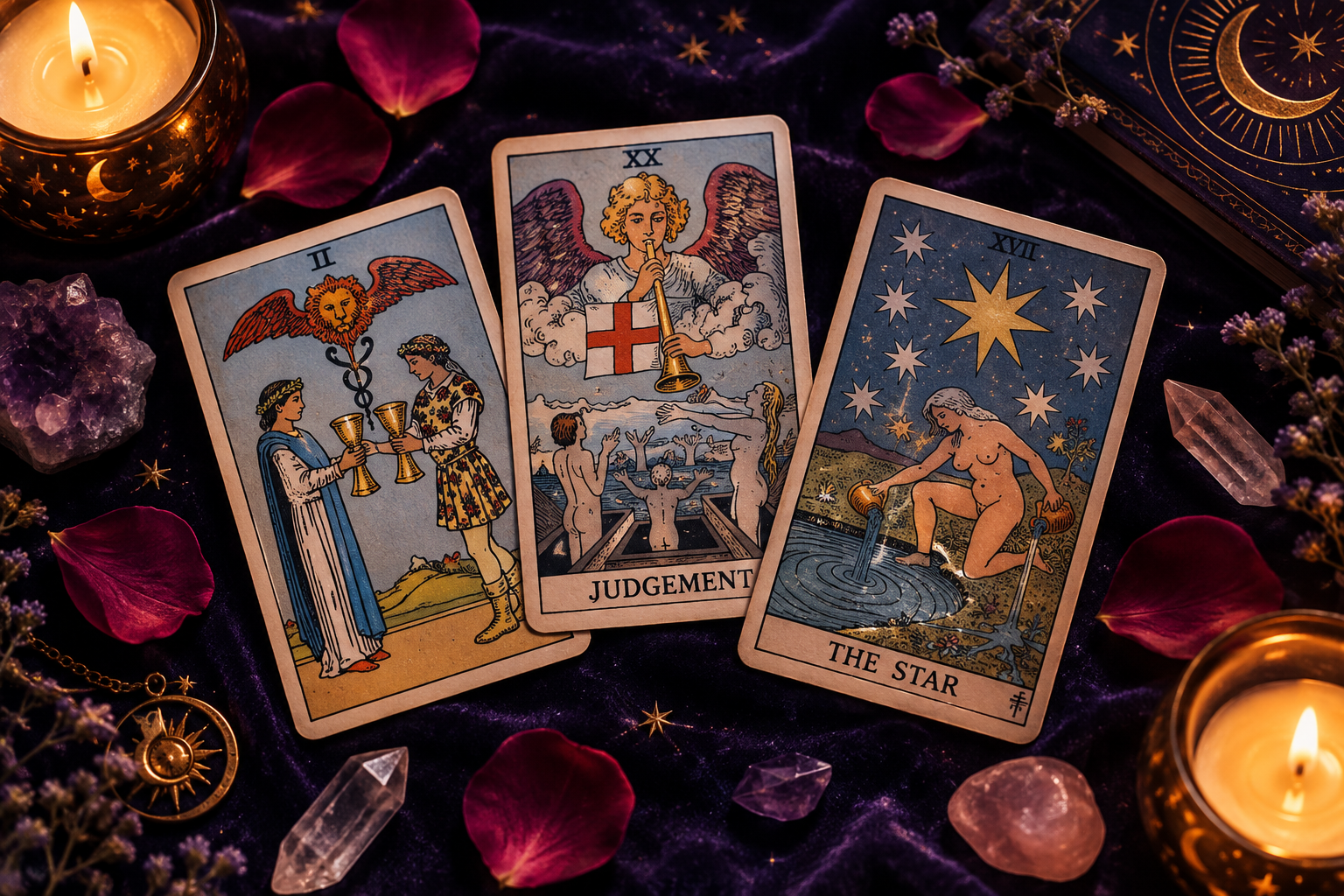
If the Nine of Swords appears alongside the Eight, the fear is about powerlessness and the no is about waiting for options to become visible. Alongside the Ten, the no is firmer: the card is telling you that an ending is near and fighting it will only prolong the night. Alongside the Six of Swords, the no softens considerably; a way out exists and the anxiety is the last thing to leave.
Reading the Card by Spread Position
Past position. The worst is behind you, even if it did not feel like it at the time. A yes or no question with the Nine of Swords in the past position answers mainly on the strength of the present and future cards. The card tells you why you are asking so fearfully.
Present position. Here the verdict applies at full strength: upright no, reversed conditional yes. You are in the bed right now, and the present card is where this reading lives.
Future position. A warning rather than a sentence. Upright, it says the path you are on leads to sleepless nights, so the yes or no becomes “not this way.” Reversed in the future, it is one of the more encouraging placements: whatever you are dreading will pass, and the question earns a yes on patience.
Advice or outcome position. As advice, the card instructs you to stop and examine your fear before acting, which is itself the no. As the outcome card for a yes or no question, upright means the outcome will cost you more mental peace than it is worth, which is a no even if the external result is technically achievable.
What to Do When You Draw the Nine of Swords
The answer is no (or a cautious yes), but the card is more interested in what you do next than in the question you asked. Across all contexts, the actions that fit the card are the same five:
- Separate the fear from the fact. One column for what you know, one for what you dread. Most people find the first column nearly empty.
- Fix the sleep first. Nothing in the reading improves on four hours. Treat the insomnia as the first problem, not the symptom.
- Break the isolation in the image. The figure is alone. Put another person in the room, whether a friend, a partner, or a professional.
- Pause anything irreversible. Resignations, confrontations, breakups, big purchases. Give each a 72-hour hold.
- Ask the question again in a week. The Nine of Swords is a card about a state, and states change. The no you got today is a no for today.
FAQ
Is the Nine of Swords a yes or no card?
It is a no upright and a conditional yes reversed. Upright, it shows anxiety distorting judgement badly enough that no decision should be made yet. Reversed, the panic is lifting and the answer leans yes, as long as you have checked your fears against real evidence before acting.
Does the Nine of Swords confirm my worst fears?
No. The card confirms that you are suffering from your fears, not that the fears are accurate. The nine swords hang on the wall above the figure without touching them. The card’s central message is that thoughts, however vivid at 3 a.m., are not facts, and the right response is to verify rather than react.
What does the Nine of Swords reversed mean in love?
Reversed in a love reading, it suggests the obsessive worry, jealousy, or guilt that was consuming you is easing and you can see the relationship more clearly. The answer to most love questions becomes a conditional yes. The condition is that something concrete has changed, such as an honest conversation, rather than just a shift in mood. Be alert to the shadow reversal, where someone has stopped expressing hurt because they have given up on being heard.
Is the Nine of Swords always about anxiety?
Almost always. It can also point to guilt, grief, insomnia, nightmares, or regret over a specific act, which the small carving of a fight on the bed hints at. Whatever the trigger, the card describes mental suffering disproportionate to the external situation.
What is the astrological meaning of the Nine of Swords?
The Golden Dawn assigned it to Mars in Gemini, the second decan of Gemini, and titled it Lord of Cruelty. Mars brings aggression and friction; Gemini brings restless, dual thinking. Together they describe a mind at war with itself. The card belongs to the element of Air.
Should I make a decision after drawing the Nine of Swords?
Not immediately. Pause anything irreversible, sleep, talk to someone, and test your fear against evidence. Then ask again. The card describes a temporary state, and the no it gives is a no for the state you are in, not a permanent ruling on the question.