Eight Of Pentacles: Yes or No Tarot Meaning
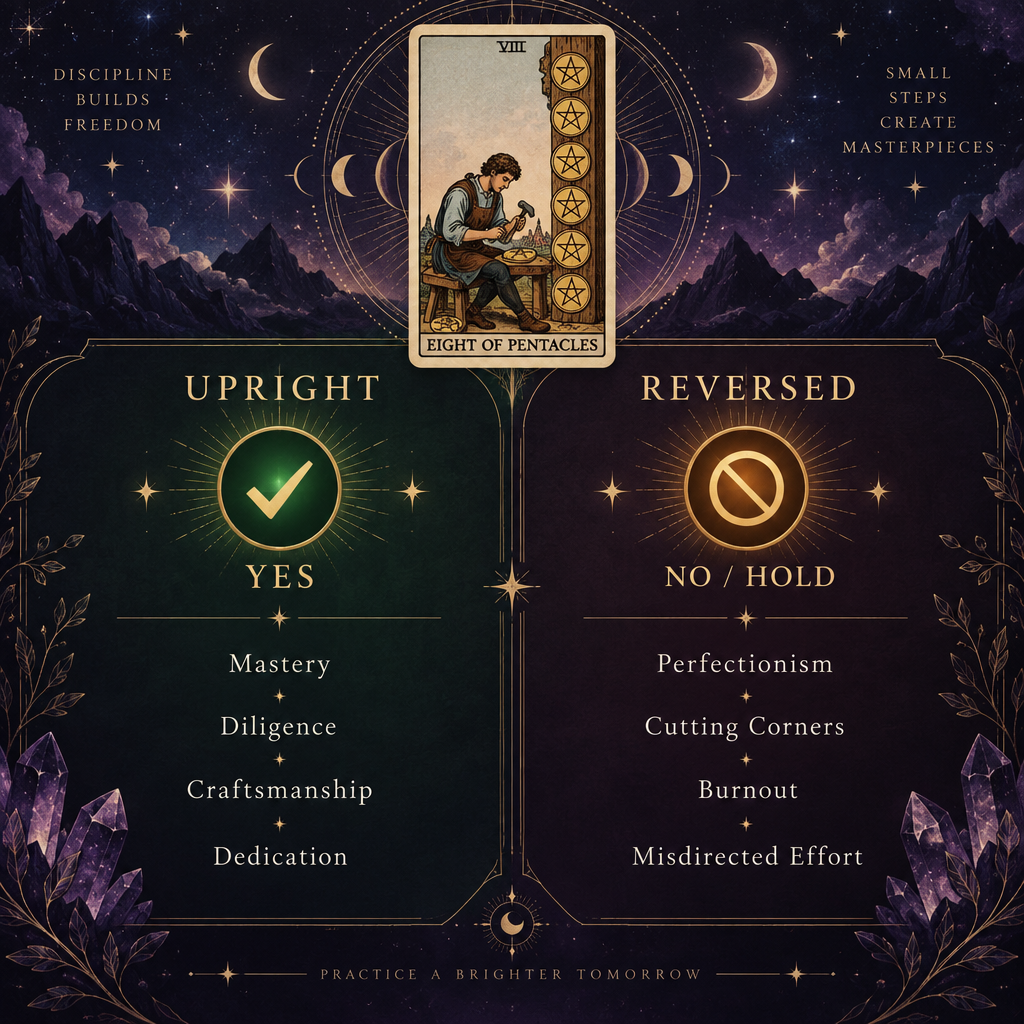
The Eight of Pentacles is a yes card. It belongs to the craftsman, the apprentice who shows up every day and gets better, and in a yes or no reading it says the outcome you want is available to anyone willing to do the work with care. Reversed, the answer softens to a “not yet” or a conditional no, because the effort is either missing, misdirected, or being poisoned by perfectionism.
Quick Answer
| Position | Verdict | Core Keywords |
|---|---|---|
| Upright | Yes (earned through effort) | Mastery, apprenticeship, craftsmanship, diligence, skill development, dedication |
| Reversed | No / Hold (conditional on changing approach) | Perfectionism, cutting corners, poor workmanship, burnout, misdirected effort, going through the motions |
The upright yes is one of the most dependable in the Minor Arcana for questions about work, study, money, and long-term commitment. It is a slower yes than the Ace of Wands or the Sun, but it is also a sturdier one. The reversed reading is rarely an absolute no. It is closer to a foreman handing your work back and saying “redo this properly.”
Card at a Glance
| Attribute | Detail |
|---|---|
| Suit | Pentacles (also called Coins or Disks) |
| Element | Earth |
| Number | Eight |
| Astrological association (Golden Dawn) | Sun in Virgo |
| Archetype | The apprentice becoming a master |
| Upright energy | Focused, patient, methodical, improving |
| Reversed energy | Stuck, sloppy, obsessive, or exhausted |
Earth is the element of the material world: bodies, money, buildings, routines, and anything that takes time to grow. Earth cards do not deliver instant results, and the Eight of Pentacles is the purest expression of that patience. The number eight carries the meaning of rhythm, momentum, and material power. Turn the numeral on its side and you get the infinity symbol, the same loop that floats above the figures on the Magician and Strength cards. Eight is repetition with purpose: each cycle builds on the last. Sun in Virgo adds the precise, detail-oriented, quietly perfectionist quality that makes this card both a gift (when upright) and a trap (when reversed).
What the Card Shows
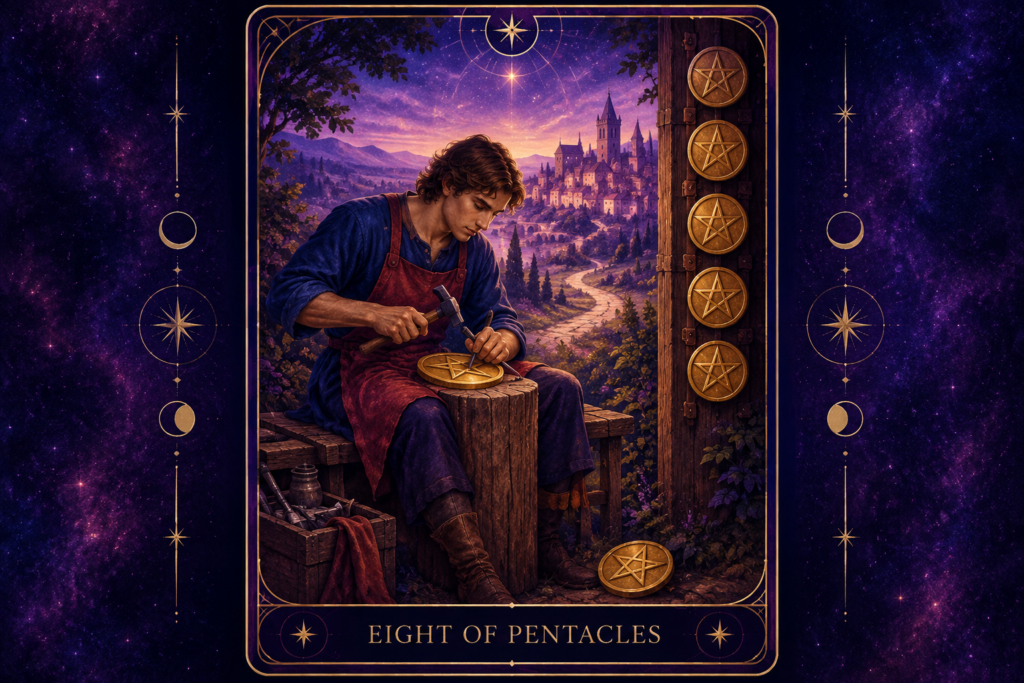
In the Rider-Waite Smith deck, illustrated by Pamela Colman Smith and first published in 1909, a young craftsman sits on a wooden bench with a chisel and hammer, carving a pentacle into a golden disc. Five finished pentacles hang on the post beside him, displayed like a growing portfolio. Another rests at his feet, waiting to be hung. He wears a simple blue tunic and a red apron, working clothes, and his eyes are fixed entirely on the disc in his hands.
Behind him, far in the distance, is a town. A pale road runs toward it but the craftsman has his back to both. He is not thinking about the market, the tavern, or what anyone else is doing. He has removed himself from distraction to do one thing well.
Three details anchor the yes or no verdict. First, the finished pentacles prove he has already produced results; this is not a beginner hoping to succeed, it is someone with a track record. Second, the pentacle at his feet shows the work is not finished, so the yes comes with the understanding that more effort is still required. Third, the distance from the town tells you the answer depends on your own focus, not on other people, luck, or timing.
Why the Eight of Pentacles Upright Is a Yes
The card’s core archetype is apprenticeship turning into mastery. It is not about hard work in the vague, motivational sense. It is about skill development: doing a specific thing repeatedly, paying attention to the details, and becoming measurably better at it. Craftsmanship is the point. The craftsman is not chiselling faster than everyone else; he is chiselling more carefully.
That distinction matters for your question. The Eight of Pentacles says yes when the outcome is something you can build. Will I pass the certification? Will the business become profitable? Will this relationship grow into something solid? Will I get the promotion if I keep going? All of these are yes, because they respond to diligence and improving skill.
The card is less reliable for outcomes that depend on chance or on someone else’s sudden decision. Will I win the lottery? Will my ex text me tonight? The Eight of Pentacles has nothing to grip onto in those questions. It will still lean yes because of its overall positive weight, but the honest reading is “yes, to the extent that your effort influences this.”
Traditional keywords for the upright card include dedication, diligence, attention to detail, quality over quantity, practice, education, and commitment to a craft. In a yes or no reading, all of them collapse into a single message: the door is open, and you are the one who walks through it.
Eight of Pentacles Reversed: No, or Hold?
Older yes or no guides flatten the reversed Eight of Pentacles into a flat no. That is too blunt. The reversed card describes a problem with how the work is being done, and problems with method can be fixed. The more accurate verdict is no for now, or yes only if you change your approach.
The reversed card has several distinct faces, and they point to different fixes.
Perfectionism. The craftsman keeps polishing the same pentacle and never hangs it on the post. Nothing ships. If you have been redrafting the application for six weeks or refusing to commit until conditions are flawless, this is your card. The answer is no, because you are blocking your own outcome, and it becomes yes the moment you accept “good enough” and act.
Cutting corners. The opposite failure. The pentacles are getting hung, but they are lopsided and rushed. Poor workmanship shows up as the job done half-heartedly, the relationship where you stopped paying attention, or the diet you follow only on weekdays. The answer is no because the result will not hold. Redo it properly and ask again.
Misdirected effort. Working very hard at the wrong thing. You are getting extremely good at a skill nobody needs, or pouring energy into a person or project that will not return it. The no here is protective. It tells you the goal itself is off, not your work ethic.
Skill gaps. You want the outcome but have not yet built the competence to earn it. The card is not saying never; it is saying you are still an apprentice and are asking a master’s question. Go learn the thing first.
Going through the motions. Showing up but not really present. Clocking in, doing the minimum, repeating without improving. Eight is the number of cycles that build; reversed, it becomes cycles that merely repeat. The answer is a hold until you re-engage.
Burnout and lack of motivation. This is the meaning most people already know. You have worked too long without rest and the tank is empty. The verdict is no, not as a judgment but as a prescription. Recover first.
So how do you tell which reversed meaning applies? Look at your own situation honestly. If you have been working relentlessly, it is burnout. If you have been avoiding the final step, it is perfectionism. If you have been coasting, it is cutting corners. The card reflects the reader more than most in the deck, because the craftsman is alone with his work and nobody else is in the frame.
Eight of Pentacles Yes or No by Question Type
Love: New Relationships
Upright: Yes. A new connection under the Eight of Pentacles has substance. This person, or you, is willing to put in steady effort rather than rely on chemistry alone. Expect slow-burn attraction, consistent texts, plans that actually happen, and someone who wants to learn you rather than perform for you. If you are asking whether a new interest is worth pursuing, the card says yes, and it hints the relationship will be built rather than ignited. Do not expect fireworks in week one.
Reversed: Hold. Someone is not putting in the work. Either one of you is emotionally coasting, or one of you is over-analysing every message and never letting things breathe (perfectionism in dating looks like a checklist nobody could pass). The answer to “will this become a relationship” is no unless the effort becomes mutual. Have the direct conversation about what you both want before investing more.
Love: Existing Relationships
Upright: Yes. The relationship is being tended. This is the card of couples who still date each other after ten years, who work on their communication, who treat the partnership as a craft. Questions like “will we get through this rough patch,” “should we move in together,” or “is he committed” all draw a yes. The card does not promise ease, but it promises that the work you both put in will produce a stronger bond.
Reversed: No, with a caveat. The relationship is running on routine. Someone has stopped paying attention to detail: forgotten plans, phone-scrolling through dinner, affection that arrives on autopilot. Alternatively, one partner has become impossibly demanding and the other has stopped trying because nothing is ever right. Asking “will things improve” gets a no while the pattern continues. Asking “can we fix this” gets a yes, provided both of you re-engage deliberately.
Career and Work
Upright: Yes. This is the Eight of Pentacles at home. Promotions, passing exams, completing apprenticeships or training programmes, landing the client, growing a freelance practice: yes to all of it, earned by competence. The card particularly favours skilled trades, technical work, medicine, engineering, crafts, and any role where quality is visible. If you are asking whether to take a job that involves further learning, the card says yes even if the pay starts lower.
Reversed: No or not yet. You are either burned out and about to make mistakes, or you have been coasting and your work quality shows it, or you are chasing a role you are not yet qualified for. A reversed Eight of Pentacles on “will I get the promotion” usually means someone with sharper skills or better focus will. Address the gap before asking again.
Money and Finances
Upright: Yes. Finances improve through discipline, not windfalls. The card supports paying down debt through a steady plan, building savings by automatic transfer, increasing income by upgrading a skill, and investments that compound over years. If you are asking whether a side business will become profitable, yes, provided you treat it as a craft rather than a lottery ticket.
Reversed: No. Money is leaking through carelessness (the cutting-corners face) or being hoarded through anxiety (the perfectionist face who never invests because conditions are never right). Financial setbacks under this card usually trace back to a lapse in attention: a missed payment, a rushed decision, a skill that went stale while the market moved. The fix is unglamorous: return to the ledger and rebuild the routine.
Health
Upright: Yes. Recovery and improvement come through consistent routine. The card favours physiotherapy done every day, medication taken on schedule, gradual training programmes, and slow dietary change over crash fixes. Asking “will I recover” or “will the new regimen work” draws a yes with the explicit condition that you follow through. It also favours health professionals: the card often turns up for nurses, physios, and anyone in training.
Reversed: No, and take it seriously. Health is being neglected because work has swallowed everything, or a fitness or diet regime has tipped into obsessive over-correction. Repetitive strain, stress-related illness, and exhaustion all sit under this card. The no is a warning to rest and re-establish balance before something forces the issue.
Family Relationships
Upright: Yes. Family bonds strengthen through steady, unshowy effort: the weekly phone call, the shared project, the patient rebuilding of trust after a fallout. If you are asking whether a family rift can heal, the card says yes, slowly, through repeated small acts rather than one dramatic reconciliation. It also supports family businesses and passing skills between generations.
Reversed: Hold. Someone is putting in the minimum. Obligations are being met mechanically, without warmth, or one family member is demanding a standard the others cannot reach. Improvement stalls until the effort becomes genuine again.
Advice Questions
When the question is “should I,” the Eight of Pentacles upright says yes if the path involves learning, practising, or committing long-term, and it says the reward will match the effort. Reversed, the advice is to stop and audit your method before continuing.
Eight of Pentacles as Feelings
Asked how someone feels about you, the upright Eight of Pentacles describes a person who is focused, committed, and steady. They are not swept away, but they are serious. They think about the relationship as something worth building and they intend to keep showing up. This is a person who remembers small details and follows through. If you were hoping for passion, the card offers something more durable: intention.
Reversed, the feelings turn to frustration and overwhelm. The person feels their effort is not being noticed or returned, or they are so consumed by work or stress that there is nothing left for the relationship. They may feel unappreciated, or they may have quietly disengaged and are simply going through the motions. If you asked how someone feels and got this card reversed, the honest reading is that they are tired, distracted, or checked out, and the situation will not improve on its own.
The Spiritual and Emotional Layer
There is a devotional quality to the craftsman that most yes or no readings skip. He is alone, and he is content. The card suggests that self-improvement is itself a kind of practice, in the meditative sense: the discipline of attention, the willingness to be a beginner, the humility to make the same thing a hundred times until it is right. Upright, the spiritual message is that the work in front of you is the path, not a detour from it. Mastery of a craft and maturity of the self develop together.
Reversed, the spiritual message concerns the ego’s relationship with effort. Perfectionism is fear of being judged dressed up as high standards. Cutting corners is a refusal to be fully present. Burnout is the belief that your worth depends on output. The reversed card asks you to separate who you are from what you produce, rest without guilt, and return to the bench because you want to, not because you are afraid of what happens if you stop.
How to Frame Your Question for a Clean Answer
The Eight of Pentacles gives its clearest yes to questions that are:
- Single-subject. “Will I pass the exam in June” rather than “will my career and love life both improve this year.” Compound questions muddle any card.
- Within your influence. The card measures effort and skill, so ask about outcomes those affect. “Will my business be profitable if I keep going” gets a firmer answer than “will a rich investor find me.”
- Time-generous. Earth cards move slowly. “Will this work out over the next six months” suits the card; “will it happen this week” fights its nature and the yes becomes less reliable.
- Honest about your current effort. The card is essentially a mirror. If you ask “will I succeed” while knowing you have not been trying, expect the reversed reading to show up or the upright to feel hollow.
Avoid asking the Eight of Pentacles about pure luck, sudden reversals, or other people’s unpredictable choices. It will still answer, but the answer will be a lukewarm yes rather than a confident one. And if the card lands reversed, reframe before redrawing: instead of “will I get the job,” try “what do I need to fix to get the job.” The reversed craftsman is happy to tell you.
FAQ
Is the Eight of Pentacles a yes or no card?
Upright, it is a yes. The card represents mastery, apprenticeship, and diligent skill development, and it indicates that the outcome you want can be earned through consistent, careful effort. It is one of the more reliable yes cards for questions about work, study, money, and long-term commitment.
What does the Eight of Pentacles reversed mean in a yes or no reading?
Reversed, the answer is no or hold, and it is conditional. The card points to a problem with method: perfectionism that prevents finishing, cutting corners and poor workmanship, misdirected effort, skill gaps, going through the motions, or burnout. Fix the underlying issue and the answer can turn to yes.
Is the Eight of Pentacles good for love?
Yes, especially for existing relationships and for new connections you want to become serious. It describes a partner who is committed and willing to work on the relationship. It favours slow, steady growth over instant passion. Reversed, it warns that someone has stopped putting in effort or is demanding an impossible standard.
What element is the Eight of Pentacles?
Earth. Pentacles govern the material world: money, the body, work, and anything built over time. The Golden Dawn system also assigns the card to Sun in Virgo, which explains its precise, methodical, detail-focused character.
Does the Eight of Pentacles mean yes for career questions?
Strongly yes. It is the card of apprenticeship, training, craftsmanship, and earned promotion. Reversed, it signals that you are either burned out, coasting, or not yet qualified for the role you are asking about, and the answer is not yet.
What does the Eight of Pentacles mean for health?
Upright, health improves through disciplined routine: consistent treatment, gradual training, and steady lifestyle change. Reversed, it warns that health is being neglected under the weight of work, or that a health regime has become obsessive, and it advises rest and rebalancing.