
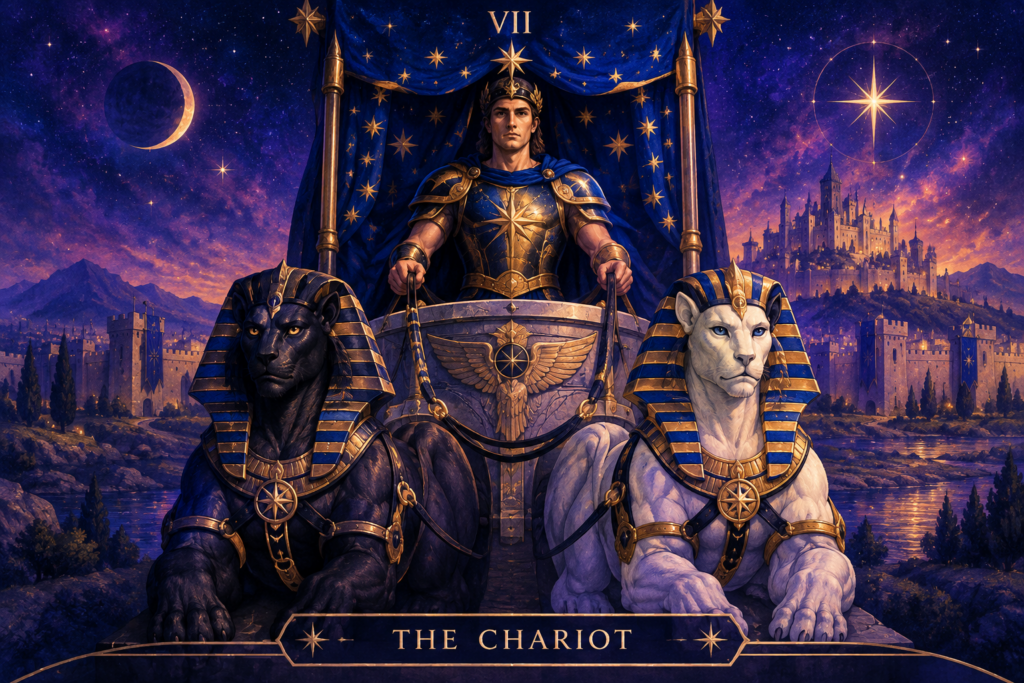
Chariot: Yes or No Tarot Meaning
The Chariot is one of the clearest yes cards in the Major Arcana, and one of the most misread when it turns up reversed. This guide gives you the straight verdict first, then the reasoning behind it for love, career, money, travel, reconciliation, and how other people see you.
Quick Answer
| Position | Verdict | One-line reason |
|---|---|---|
| Chariot upright | YES | Willpower, momentum, and victory through focused effort. Act now. |
| Chariot reversed | NO, or NOT YET | Scattered energy, internal conflict, or loss of control. Regroup before you push. |
If you only need the headline: upright means go, reversed means the vehicle is not roadworthy yet. Everything below explains when that “not yet” softens into a conditional yes and when it hardens into a firm no.
Why the Chariot Reads as a Yes
The Chariot is card number VII in the Major Arcana, and in the Rider-Waite-Smith deck (illustrated by Pamela Colman Smith in 1909) it shows a young warrior standing in a stone chariot, drawn by two sphinxes, with a walled city behind him and a canopy of stars overhead. It follows the Lovers (VI), a card about choosing, and it depicts what happens after the choice is made: forward motion.
That sequence matters for yes/no readings. The Chariot does not represent luck, gifts, or things falling into your lap. It represents an outcome you drive toward and win. So the “yes” it gives is conditional on your effort, but it is still a yes, because the card is telling you the effort will pay off.
Symbolism that shapes the verdict
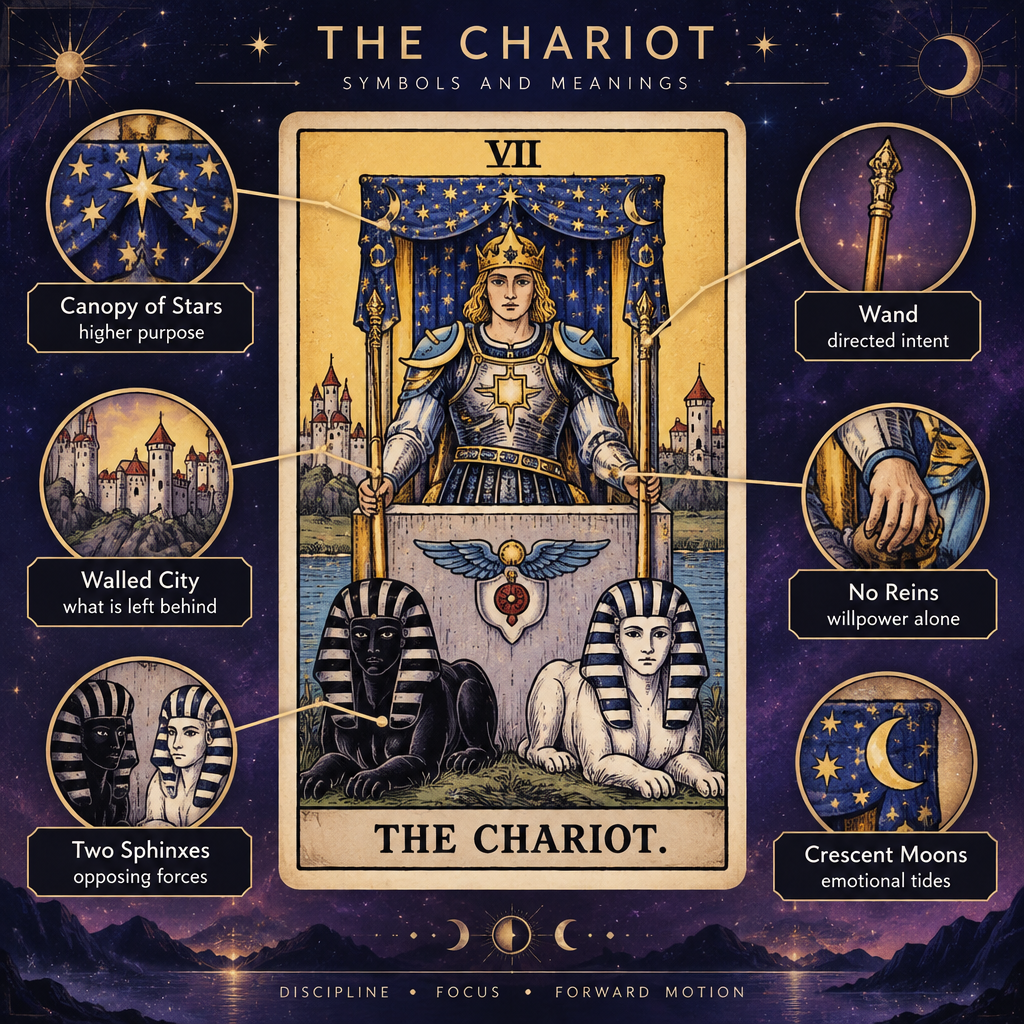
Each detail on the card feeds directly into how you answer a yes/no question.
- The two sphinxes. One black, one white, sitting at slightly different angles as if pulling in different directions. They represent opposing forces: instinct and reason, desire and duty, the unconscious and the conscious mind. Upright, the charioteer holds them in balance and they move as one. Reversed, they pull apart and the chariot goes nowhere.
- No reins. Look closely at the RWS image and you will notice the charioteer holds no reins. He steers by will alone. This is the core of the card’s yes: the answer depends on your focus, not on external permission.
- The wand. Held in his right hand, echoing the Magician’s wand. It signals directed intent and mastery of the tools at hand.
- The armor and crescent moons. He wears plate armor decorated with a square on the chest (a symbol of earth and stability) and two crescent moons on the shoulders, one waxing and one waning. The moons tie the card to emotional tides that must be managed rather than ignored.
- The canopy of stars. A blue canopy covered in six-pointed stars stretches over him, representing celestial guidance and higher purpose. His crown also bears a star. The message: the goal is aligned with something larger than ego.
- The city and the river. The walled city behind him is what he is leaving; the river at his back connects the card to Water and to emotion flowing beneath the armor.
- The winged sun and the lingam-yoni symbol. On the front of the chariot sit a winged solar disk (Egyptian in origin, symbolizing spirit) and a shield with a lingam-yoni motif, the union of masculine and feminine. Both underline the theme of integrating opposites to move forward.
Numerology and correspondences
- Number: 7. In tarot numerology, seven is the number of testing, assessment, and self-discipline. It follows the harmony of six with a challenge that must be met through inner strength. The Sevens in the Minor Arcana (Seven of Wands, Seven of Pentacles, Seven of Swords, Seven of Cups) all involve a test of resolve, and the Chariot is the Major Arcana version of passing that test.
- Element: Water.
- Zodiac sign: Cancer, in the Golden Dawn system of correspondences that most modern readers use.
- Ruling planet: The Moon (as the ruler of Cancer), which is why the crescents appear on the armor.
The Cancer and Water connection surprises people, because the card looks so martial. The point is that the Chariot’s victory comes from emotional self-command, not from suppressing feeling. A Cancer moves sideways like a crab, protected by a shell, but it never stops moving toward what it wants. That is exactly the energy of the card.
The Chariot Upright as Yes or No
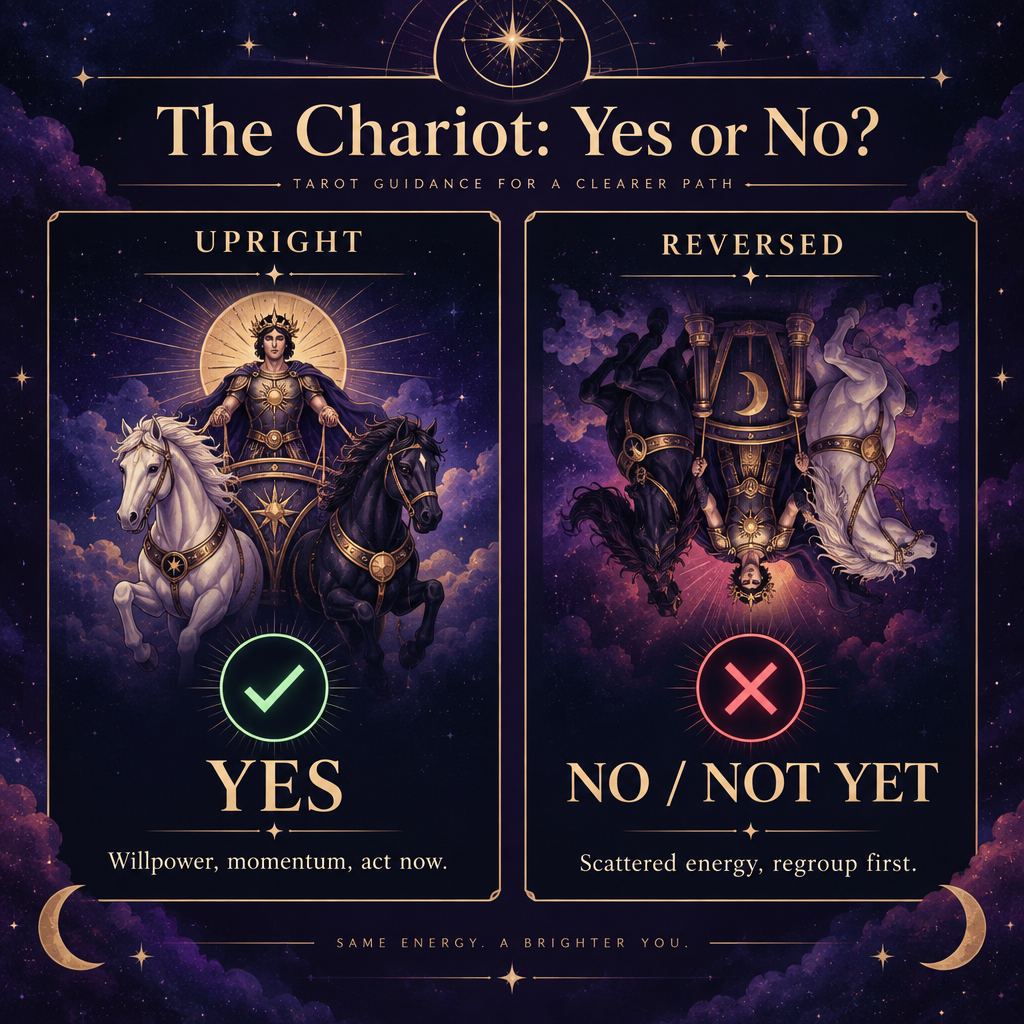
Upright, the Chariot is a strong yes. It is one of the most reliable affirmative cards in the deck, alongside the Sun, the Star, and the Ace of Wands.
The upright Chariot says three things at once:
- The outcome you are asking about is achievable.
- You already have the drive and resources to reach it.
- The window is open now, and hesitation is the only real threat.
The yes carries an expectation. If your question is “Will I get the promotion?” the Chariot says yes, provided you keep applying for it, keep performing, and do not let office politics knock you off course. If your question is “Should I do this?” the answer is yes, decisively. Half-measures are where the Chariot fails; the sphinxes only move when you commit to one direction.
What to do: Pick the goal, commit fully, and act within days rather than weeks. Cut the distractions competing for your attention. The card rewards a single-minded push.
The Chariot Reversed as Yes or No
Reversed, the Chariot is a no in most readings, but it is rarely a permanent no. The more accurate reading is “not yet, and not like this.” Understanding why the card has flipped tells you which version of the answer you are getting.
Root causes behind the reversed no
- Scattered energy. You are chasing three things at once and the sphinxes are pulling apart. Nothing moves. This is the mildest reversal and the easiest to fix: choose one lane.
- Internal conflict. Your head says one thing and your gut says another. The reins are slack because you have not decided what you actually want. Until that resolves, the answer stays no.
- Loss of control. Circumstances are driving you rather than the other way round. You may be reacting to other people’s timelines or emergencies. The Chariot cannot deliver a yes when you are a passenger.
- Burnout. You have been pushing hard for so long that there is nothing left in the tank. The card reversed can be a warning that continuing to force the issue will damage your health or your relationships.
- Aggression and steamrolling. The shadow side of willpower. You are getting what you want by bulldozing, and the reversed Chariot signals that this approach is about to backfire. The answer here is a firm no, because the method itself is the problem.
- Self-sabotage. You have the ability but keep undermining your own progress, missing deadlines, picking fights, or quitting just before the finish. The reversal points the finger inward.
- Forced outcomes. You are trying to make something happen that does not want to happen. This is the hardest no the reversed Chariot gives, and it usually shows up with cards like the Five of Wands, the Tower, or the Ten of Swords nearby.
When reversed softens to “yes, with blocks”
If the surrounding cards are supportive (the Star, the Six of Wands, the Ace of Pentacles, Temperance), the reversed Chariot becomes a conditional yes: the goal is still reachable, but you have to fix your approach first. Regain focus, rest, or resolve the inner argument, then ask again.
What to do: Stop pushing. Identify which of the seven causes above matches your situation. Address that one thing before you attempt to move forward again.
Chariot as Yes or No for Love
This is where the card’s upright meaning has been most muddled online, so here is the clear position.
Upright in love
Yes. The Chariot upright in a love question says the relationship can move forward and the person asking has the power to make that happen. It favors the bold: asking someone out, defining the relationship, proposing, moving in together, choosing between two suitors.
The nuance, and it is real, is that the Chariot is a Water card in armor. It can indicate someone who is driven but emotionally guarded, or a relationship progressing on determination more than tenderness. So the honest reading is “yes, balance the drive with emotion.” The old interpretation of a flat “no” in love comes from overweighting the armor and ignoring the crescent moons, the river, and the Cancer rulership. A Cancer-ruled card is not emotionally cold; it simply protects its feelings while it acts.
For singles, the upright Chariot says pursue the person, and expect competition or distance to be part of the story. For couples, it says the relationship survives a challenge (long distance, a move, a career shift) if you face it as a unit.
What to do: Make the move you have been putting off, but say how you feel while you make it.
Reversed in love
No, or not right now. Reversed in love, the Chariot points to stagnation, mismatched direction, or one person trying to control the pace. Common scenarios: you want commitment and they want freedom; one partner is steamrolling decisions; you keep having the same argument with no resolution; or you are chasing someone who has not decided whether they want to be caught.
There is no “hesitant yes” hiding in this reversal. The card is telling you the two sphinxes, the two of you, are not pulling together. If the question is “Will this relationship progress?” the answer is no until the direction is agreed on. If the question is “Should I keep pursuing them?” the reversed Chariot advises easing off.
What to do: Stop trying to drive the relationship forward alone. Have the conversation about where each of you actually wants to go.
Chariot as Yes or No for Reconciliation
Getting back together is a distinct question and the Chariot answers it distinctly.
Upright: yes, if you initiate. The Chariot rarely describes a reconciliation that simply happens. It describes one you drive. If you want your ex back, the upright card says the path is open, but you will need to make the first move, state clearly what has changed, and hold steady through some initial resistance. It also asks whether you are choosing reconciliation because you want the person or because you want to win. The Chariot’s competitive streak can confuse the two.
Reversed: no. Reversed, the Chariot describes a reunion that would be forced, controlling, or based on unresolved conflict. One of you would be dragging the other back into the same dynamic. The sphinxes were pulling apart before, and nothing has changed to make them move together now. The card can also indicate that your ex has already moved on and pursuing them would be a matter of ego rather than love.
What to do: Upright, reach out with a clear statement of intent and a concrete change in behavior. Reversed, redirect the energy into your own life.
Chariot as Yes or No for Career
Upright: strong yes. This is the Chariot’s home ground. It predicts promotion, a successful job change, winning a competitive contract, launching a business, or passing a demanding exam. It is especially favorable for questions involving competition, ambition, and leadership. If you are asking whether to go for the bigger role, the answer is yes and the card expects you to outwork the other candidates.
Industries the card resonates with: anything involving vehicles, logistics, transport, sales targets, athletics, the military, and roles where you set your own direction.
Reversed: no, for now. Reversed, the Chariot in career points to burnout, a project stalling, losing a competition, or a workplace where you have lost autonomy. It also warns against aggressive ladder-climbing that alienates colleagues. If the question is “Will I get this job?” the reversed Chariot usually means another candidate takes it, or the role falls through.
What to do: Upright, apply, pitch, or ask for the raise this week. Reversed, take stock of your energy and your reputation before making any big career move.
Chariot as Yes or No for Money and Finances
Upright: yes. Money arrives through effort, discipline, and decisive action. The Chariot favors goals like paying off a debt on an aggressive schedule, negotiating a higher fee, or committing to a savings target. It supports a purchase or investment if you have done the work and are ready to move quickly. It is less about windfalls (that is the Wheel of Fortune or the Nine of Pentacles) and more about earned gains.
A classic upright Chariot money outcome: you set a number, chase it single-mindedly, and hit it.
Reversed: no. Reversed, the Chariot signals money slipping through your fingers because of scattered spending, impulsive purchases, or overextending yourself on something you cannot control (a speculative investment, a business run on adrenaline). It can also flag a literal vehicle expense, such as a car breakdown or repair bill. If you are asking whether to make a large purchase or take a financial risk, the reversed Chariot says wait.
What to do: Upright, set a specific financial target with a deadline. Reversed, track where the money is actually going for thirty days before deciding anything.
Chariot as Yes or No for Travel and Relocation
The Chariot is literally a vehicle, so travel questions get an unusually direct answer.
Upright: yes, go. Trips, moves, relocations for work, and long-distance commutes are all favored. The card suggests the journey will be purposeful and successful, and that a move will improve your position. The walled city behind the charioteer is what he leaves; the open land ahead is what he gains. Upright, it also supports questions about buying a car or getting a driving license.
Reversed: no, or delays. Reversed, expect cancelled plans, transport problems, a relocation that stalls in paperwork, or a move made for the wrong reasons (running from something rather than toward something). It can also indicate travel that leaves you exhausted rather than refreshed. If the question is “Should I relocate?” the reversed Chariot says the timing or the motivation is off.
What to do: Upright, book it. Reversed, build in buffer time, double-check logistics, and ask yourself honestly why you want to leave.
The Chariot as How Someone Sees You
A frequent question in relationship spreads, and one where the card’s two faces show clearly.
Upright: They see you as strong, driven, confident, and going places. You come across as someone who knows what they want and goes after it, which most people find attractive and a few find intimidating. In a romantic context, they may see you as a prize worth competing for, or as someone slightly out of reach because of your independence. In a professional context, they see a leader or a rising star.
Reversed: They see you as controlling, pushy, or aggressive. Alternatively, they see you as someone who has lost direction, is burned out, or talks about goals without following through. In a romantic context, the reversed Chariot as “how they see you” often means they feel steamrolled or feel that you are trying to move faster than they are comfortable with.
What to do: Upright, keep the confidence but show some warmth so you do not read as armored. Reversed, ease the pressure you are putting on the situation, and on yourself.
Timing: When Does the Chariot’s Yes Arrive?
The Chariot is a fast card. When it appears upright as the answer to “when,” expect movement soon, usually within weeks rather than months, and often triggered by an action you take rather than something that happens to you. It is the tarot equivalent of “as soon as you start driving.”
Traditional timing methods give you a few options:
- By zodiac correspondence: Cancer season, roughly June 21 to July 22.
- By number: seven days, seven weeks, or the seventh month (July), depending on the scale of the question.
- By energy: immediately after you commit to one course of action. This is the reading most experienced readers rely on, because the Chariot’s timing is conditional on your decision.
Reversed, the timing stretches out or stalls entirely. The delay lasts as long as the internal conflict or exhaustion does. Fix the cause and the clock starts again.
Upright vs Reversed Comparison Table
| Context | Upright Answer | Reversed Answer | Key Advice |
|---|---|---|---|
| General question | Yes | No / not yet | Commit to one direction |
| Love (new or existing) | Yes, with emotional balance | No, stagnation or conflict | Move forward but say how you feel |
| Reconciliation | Yes, if you initiate | No | Check whether you want the person or the win |
| Career | Strong yes | No for now, burnout risk | Go for the competitive role |
| Money | Yes, through discipline | No, scattered spending | Set a target and a deadline |
| Travel / relocation | Yes, go | No, delays or wrong motive | Book it upright, buffer it reversed |
| How someone sees you | Strong, driven, victorious | Controlling, aggressive, directionless | Add warmth upright, ease pressure reversed |
| Timing | Fast, within weeks | Stalled until you regroup | Act, then expect results |
Upright keywords: victory, willpower, determination, momentum, control, focus, ambition, travel, success through effort.
Reversed keywords: lack of direction, scattered energy, internal conflict, burnout, aggression, self-sabotage, loss of control, forced outcomes, delays.
What to Do When You Draw the Chariot
Upright, the instructions are short. Decide, commit, act quickly, and do not look back at the city walls. The card does not promise an easy road, only a won one, so expect to work for the yes.
Reversed, resist the urge to push harder. The reversed Chariot almost always describes someone who is already pushing and getting nowhere. Diagnose which of the reversed causes fits (scattered energy, inner conflict, burnout, control issues, aggression, self-sabotage, or forcing an outcome), fix that, and then ask the question again in a week or two. The no is usually a redirection, not a verdict.
Either way, the Chariot puts the answer in your hands. It is the one yes/no card that tells you the outcome depends less on fate and more on whether you can get both sphinxes pulling the same way.
FAQ
Is the Chariot a yes or no card?
Yes. The Chariot upright is a strong yes, one of the most reliable affirmative cards in the Major Arcana. It signals victory through focused effort and tells you to act decisively. Reversed, the answer becomes no or not yet.
What does the Chariot reversed mean in a yes or no reading?
Reversed, the Chariot means no in most cases, though it is usually a temporary no. It points to scattered energy, internal conflict, burnout, loss of control, or trying to force an outcome. Once the underlying problem is resolved, the question can be asked again and the answer often changes.
Is the Chariot a yes or no for love?
Upright, yes. The Chariot supports taking the initiative in love and says the relationship can move forward, with the caveat that you should balance determination with genuine emotional openness. Reversed, it is a no, indicating stagnation, mismatched direction, or one partner pushing too hard.
Does the Chariot mean yes for career?
Upright, it is one of the strongest career yes cards in the deck, favoring promotions, job changes, competitive bids, and business launches. Reversed, it is a no for now, often linked to burnout or losing a competitive situation.
Is the Chariot a yes or no for getting back together?
Upright, yes if you are willing to initiate and can show something has changed. Reversed, no, because the reunion would be forced or would repeat the same conflict.
Is the Chariot a yes for travel or moving?
Upright, yes. The Chariot is the deck’s vehicle card and strongly favors trips, relocations, and journeys made with purpose. Reversed, expect delays, cancellations, or a move made for the wrong reasons.
What number, element, and zodiac sign is the Chariot?
The Chariot is card VII (7), associated with the element of Water, the zodiac sign Cancer, and the Moon as Cancer’s ruling planet. Its number links it to tests of discipline; its Water and Cancer correspondences explain why the card’s victory depends on emotional self-command rather than brute force.
How fast does the Chariot’s yes happen?
Quickly. The Chariot is an action card, and its outcomes tend to arrive within weeks, usually shortly after you commit to a single course of action. Traditional timing points to Cancer season (late June to late July) or a period of seven days or weeks.