

Three Of Wands: Yes or No Tarot Meaning
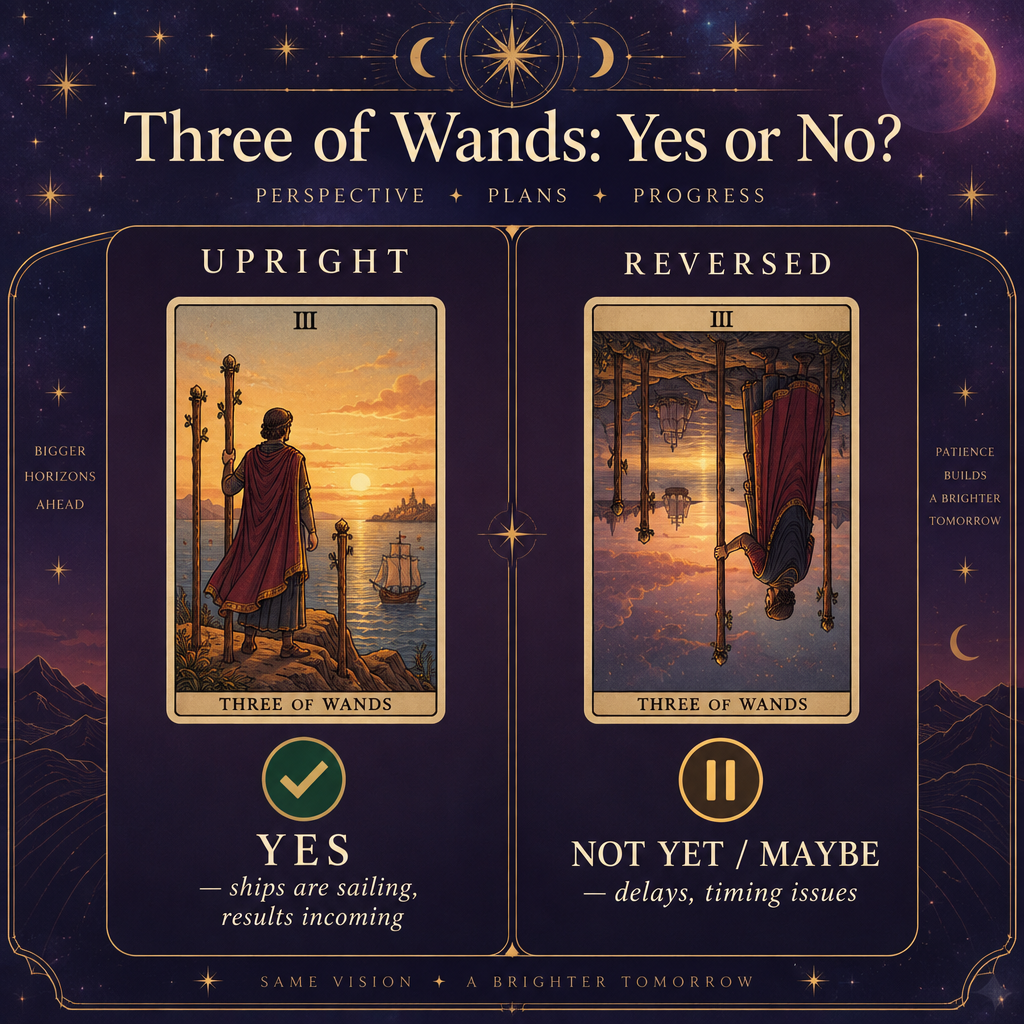
The Three of Wands is a yes card. Upright, it tells you the groundwork is done, the ships are already sailing, and the result you are asking about is on its way. Reversed, the answer shifts to “not yet” far more often than to a flat “no”, and knowing which of those applies is where most yes/no readings go wrong.
Quick Verdict
| Position | Answer | Why |
|---|---|---|
| Upright | Yes | Effort already invested is about to pay off. Expansion, trade, movement and results arriving from a distance. |
| Reversed | Not yet / Maybe (occasionally No) | Delays, a plan that stalled at the launch stage, or returns smaller than expected. A hard no only when the card sits with the Five of Wands, Ten of Swords or Tower. |
If you only need the headline: upright is one of the cleaner yeses in the Minor Arcana, sitting just behind the Ace of Wands and the Sun in terms of confidence. Reversed is a timing card, not a door slamming.
What the Card Actually Shows
In the Rider-Waite-Smith deck, drawn by Pamela Colman Smith in 1909 under Arthur Edward Waite’s direction, a robed figure stands on a cliff with his back to you. Three staves are planted upright in the ground. He rests a hand on one of them and looks out over a yellow sea where three small ships are crossing. The sky is a flat gold, the colour Smith used throughout the deck for clarity and success.
Three details drive the yes/no answer:
- His back is turned. He is not planning. He has already acted and is now watching the outcome arrive. That is the difference between this card and the Two of Wands, where the figure still holds a globe and weighs options.
- The wands are planted, not held. Established positions. Waite’s own keyword for the card was “established strength”, along with “enterprise, effort, trade, commerce, discovery”. These are not maybes.
- The ships are on the water, not in the harbour. Waite describes them as the figure’s own vessels, “bearing his merchandise”. Something you sent out is coming back. In a yes/no reading that is the whole message: the result is in transit.
Note what is missing. There is no visible destination for the ships and no reward in the figure’s hands. The yes is real, but it is a yes for something arriving, not something already in your possession. Keep that in mind when you ask “has it happened?” versus “will it happen?”
Fire and Aries: Why the Card Leans Yes
Wands are the Fire suit, the suit of will, initiative and forward motion. Fire cards as a group skew toward yes because they describe energy moving outward. The Three of Wands adds structure to that energy: three is the number of first results, the point where an idea (Ace) and a decision (Two) produce something visible.
The Golden Dawn assigned the Three of Wands to the second decan of Aries, roughly 31 March to 10 April, ruled by the Sun. Their title for the card was “Lord of Established Strength”. Sun in Aries is about as confident a placement as astrology offers: the Sun is exalted in Aries, meaning it operates at full power there. That is the astrological reason this card reads as a strong yes rather than a tentative one. The energy is not just willing, it is well-placed and effective.
Three of Wands Yes or No for Love
Upright: Yes
Upright, the Three of Wands says the relationship is moving forward and that something you have put in, whether vulnerability, patience or a direct conversation, is about to return a result. Specific situations it favours:
- “Will this new connection go somewhere?” Yes. The card often appears when someone is about to make a move or a relationship is about to move from casual to defined.
- “Will my long-distance relationship work?” Yes, and this is one of the card’s specialities. Ships crossing water, a figure watching the horizon: it is the Minor Arcana’s primary distance card.
- “Should I say yes to this trip, move or next step with my partner?” Yes. Expansion is the card’s core meaning.
For singles asking whether love is coming, the answer is yes, but with a condition: the figure is looking outward. The person you are asking about is not in your immediate circle. Travel, online dating across regions, or a connection through work abroad are the typical delivery routes.
Reversed: Not Yet
Reversed in a love question, the Three of Wands means the relationship has stalled at the launch stage. Plans were made and never executed. Someone said they would visit and didn’t. A conversation about the future keeps getting postponed. The answer is “not yet”, and the useful follow-up is “what did we agree to that never happened?”
It becomes a firmer no in two cases: when the question is about someone who has already left and shows no sign of movement toward you, or when the card appears alongside the Three of Swords or Five of Cups. Then the ships are not delayed, they are gone.
Three of Wands as Feelings
When you ask how someone feels about you and pull the Three of Wands upright, the person is interested and already thinking ahead. They see a future with you in it. The caution is that they may be thinking about that future more than they are showing up in the present. This is the person who talks about a holiday together in six months but hasn’t texted since Tuesday. Genuine intention, slow demonstration.
Reversed as feelings, the person is uncertain whether what they invested is going to come back. They may feel the relationship has drifted or that they have been waiting on you. The emotional tone is impatience or quiet disappointment, not hostility. For a yes/no question like “do they still want this?”, the reversed card is a maybe that depends heavily on whether either of you takes the next concrete step.
Three of Wands Yes or No for Reconciliation and Exes
This is where readers most often misread the card.
Upright: Yes, with distance. The Three of Wands upright says your ex is thinking about you and that movement back toward each other is possible. But notice the composition. The figure and the ships are separated by open water. Reconciliation under this card tends to be slow, often involves one person being physically away, and relies on messages sent across that gap. If you have reached out, the card says a response is coming. If you have not, it says the opening exists but someone has to launch the first ship.
Reversed: Not yet, and check your motive. Reversed here is a “not yet” that usually points to one of you not having done the work the Two of Wands demanded. Nothing has actually changed since the breakup except the passage of time. If the question is “will we get back together?”, the reversed card says the current approach won’t produce it. Change the approach and ask again in a few weeks. If the question is “should I reach out?”, the reversed card says wait until you have something new to say.
Three of Wands Yes or No for Career and Money
Upright: Yes
Career is the card’s home territory. Waite literally called it “trade” and “commerce”. Upright, it answers yes to:
- Job applications, especially for roles abroad, remote roles for overseas companies, or anything involving travel. The ships are your applications and they are reaching port.
- Business expansion. Opening a second location, selling into a new market, taking on international clients. The card was practically designed for this question.
- “Will my project succeed?” Yes, as long as it has actually launched. The Three of Wands rewards things already in motion. It does not reward plans still on paper.
- Promotions. Yes, particularly when the promotion involves broader responsibility or oversight of people in other locations.
For money questions, upright means returns on investment are coming, but they are returns on something you already committed to. An investment made months ago, an invoice already sent, a product already shipped. It is a weaker yes for “will I get a windfall?” because windfalls aren’t earned, and this card is entirely about earned results.
Reversed: Delay or Reassess
Reversed, career and money questions get a “not yet” in most cases:
- Payments late, not cancelled.
- A deal stuck in negotiation because one party overpromised at the planning stage.
- A relocation or transfer postponed for budget reasons.
- An expansion that is bleeding cash because the market research from the Two of Wands stage was skipped.
The hard no shows up when you ask “should I invest in this?” and the card is reversed. That is the deck telling you the ships for this particular venture are not going to come back with cargo. Look for a different vessel.
Three of Wands Yes or No for Health
Upright, the Three of Wands is a yes for recovery and progress. A treatment plan you committed to is working. Test results coming from a specialist elsewhere are likely to be positive or at least manageable. It is also a strong yes for “should I travel for treatment?” or “should I get a second opinion from someone outside my area?”
Because the card is Fire, it also speaks to energy levels. Upright says stamina is returning. If you are asking whether you are ready to resume exercise, training or travel after illness, the answer is yes, within reason.
Reversed, the health answer is “not yet”. Recovery is slower than you planned, often because you rushed the early stage. Burnout is a common reversed theme in Fire cards. The card is not predicting a serious outcome. It is telling you that the timeline you set for yourself was optimistic and that pushing harder now will delay things further.
Tarot does not replace a doctor, and the card is useless for diagnosis. It is reasonably good at answering “is this approach working?”
Three of Wands Yes or No for Family
Family questions under the Three of Wands tend to involve distance: a relative living abroad, a child leaving home, a parent considering a move.
Upright, it is a yes. The family member who moved away will stay in contact and the relationship will hold up across the distance. A planned visit will happen. A decision to relocate the household will work out. For questions about a family rift, upright says the other person is open to contact, and the gesture you have already made is going to receive a reply.
Reversed, the answer is “not yet”. Visits get cancelled, calls get shorter, and the family member who left has not followed through on promises to return or to stay in touch. It rarely signals permanent estrangement on its own. It signals that the connection needs an active decision rather than drifting on assumption.
The Three Reversed Answers: No, Not Yet, or Maybe
This is the distinction most yes/no guides flatten. The reversed Three of Wands can mean three different things, and the surrounding cards and the question decide which.
Not yet (most common, roughly two readings in three). The plan was sound and the launch happened, but the ships are delayed. External factors, slow responses, logistics. Nothing is wrong with the goal. Reversed Three of Wands next to the Wheel of Fortune, the Hanged Man or the Seven of Pentacles is almost always “not yet”. Action: wait, and keep your position on the cliff.
Maybe (reassess the strategy). The launch happened but the approach was flawed. You sent the ships to the wrong port. This reading shows up when the reversed Three of Wands appears with the Seven of Swords, the Five of Pentacles or the reversed Two of Wands. The goal is still reachable but not by this route. Action: go back one step and redo the planning you skipped.
No (wrong path). Rare, and it needs confirmation from neighbours. Reversed Three of Wands with the Tower, the Ten of Swords, the Five of Wands or the reversed Ace of Wands says the venture itself is misjudged. Action: redirect the energy to something else entirely.
Waite’s own reversed meanings, interestingly, were not negative. He listed “the end of troubles, suspension or cessation of adversity”. That older reading survives in the “not yet” interpretation: the delay is a pause, and pauses end.
Timing: When Will the Yes Arrive?
Yes/no readers often need a timeframe. The Three of Wands gives two usable signals.
By element, Wands correspond to days or weeks in most timing systems, so a three implies roughly three days to three weeks. By decan, the card points to the first third of April, or to the Aries season more broadly if the question is large.
The visual cue is the ships on the horizon. Not in port, but visible. Expect movement soon and arrival a little after that. Reversed, double the timeframe or wait for a new development before asking again.
How to Read a One-Card Pull
A single Three of Wands pulled for a yes/no question is one of the easier cards to interpret because its message is so directional. Use this sequence:
- Check orientation first. Upright, your answer is yes. Reversed, your default is “not yet”.
- Ask whether your question is about something you already launched. If yes, the card is confirming. If the thing hasn’t started, the upright card is telling you to start it now, which is a conditional yes.
- Look for distance in the question. Travel, relocation, long-distance love, overseas business, a person far away. If that element exists, the yes is stronger and the reversed “not yet” is more clearly about logistics than about the relationship or goal itself.
- Don’t pull clarifiers unless the card is reversed. Upright needs no help. Reversed, pull one more card to decide between “not yet”, “maybe” and “no” using the groupings above.
One-card pulls with the Three of Wands are a poor fit for questions about the past (“did they cheat?”, “was it my fault?”) because the figure faces forward and the card has nothing to say about what is behind him. Rephrase the question toward what comes next.
Where It Sits: Two of Wands, Three of Wands, Four of Wands
The yes/no weight of the Three of Wands makes more sense inside its sequence.
The Two of Wands is the planning card. The figure holds a globe and stands between two wands, one planted and one in hand. The decision is not fully made. As a yes/no card it is a “yes, if you decide”.
The Three of Wands is the execution and waiting card. Both hands are free, all three wands are planted, the ships have left. The decision is behind you. This is why it is a firmer yes than the Two: there is nothing left to choose.
The Four of Wands is the celebration card, a garlanded gateway and figures dancing. The ships have landed. It is an outright yes about something complete.
Read as a chain: Two asks “will I?”, Three answers “I have, and it’s working”, Four says “it worked”. If your reading contains the Three and you want to know how close the result is, look for the Four nearby.
Other Decks
The yes/no answer holds across most modern decks, but the imagery shifts the emphasis.
In the Thoth deck, Aleister Crowley titles the card “Virtue” and shows three lotus-topped wands radiating from a centre with ten flames. There is no figure and no sea. The Thoth Three of Wands is a yes about integrity and right action rather than commerce, so it suits ethical questions better and distance questions less.
The Marseille pattern shows three crossed batons and no scene at all. Readers working with Marseille decks lean on numerology: three as growth and first fruit. Still a yes.
Modern illustrated decks such as the Wild Unknown, the Modern Witch Tarot and the Light Seer’s Tarot keep the horizon motif, usually with a figure or animal looking outward. If your deck shows a figure looking toward something, the RWS reading applies directly. If it shows wands alone, lean on the Fire and number symbolism and the answer is the same: yes upright, wait reversed.
Summary Table by Context
| Question area | Upright | Reversed |
|---|---|---|
| Love (new) | Yes, often at a distance | Not yet; plans not acted on |
| Love (existing) | Yes to next steps, travel, moves | Not yet; stalled conversations |
| Feelings | Interested, future-focused | Uncertain, waiting on you |
| Reconciliation | Yes, slow and across distance | Not yet; change approach first |
| Career | Yes, especially abroad or expansion | Delay; reassess if investing |
| Money | Yes to returns on existing effort | Late, not lost |
| Health | Yes, recovery progressing | Not yet; slow down |
| Family | Yes, connection holds | Not yet; needs active effort |
| Timing | Days to weeks, or early April | Double it or re-ask |
FAQ
Is the Three of Wands a yes or no card?
Yes. Upright, the Three of Wands is a clear yes card, among the stronger yeses in the Minor Arcana. It shows a figure whose plans are already in motion and whose ships are returning with results. Reversed, it shifts to “not yet” or “maybe” rather than a hard no in most readings.
What does the reversed Three of Wands mean in a yes/no reading?
It means delay in about two out of three cases: the goal is fine, the timing is off. In the remaining cases it means the strategy needs rethinking (maybe) or, when surrounded by cards like the Tower or Ten of Swords, that the venture itself is misjudged (no). Pull one clarifying card to tell these apart.
Does the Three of Wands mean yes for love?
Yes, with a particular flavour. It favours long-distance relationships, connections that begin through travel or online, and relationships about to take a concrete next step. Reversed, it points to plans that were discussed but never carried out, and the answer becomes “not yet”.
Can the Three of Wands predict new ventures?
It confirms them more than it predicts them. The card describes a venture already launched and heading toward its first results. If you ask “should I start this?” and draw it upright, the answer is yes, and the card expects you to act promptly. If you ask about a business already running, it says expansion, new markets and returns are coming.
What does the Three of Wands mean for reconciliation with an ex?
Upright, your ex is open and movement toward each other is possible, but expect it to be slow and to involve communication across a gap rather than an immediate reunion. Reversed, nothing has changed since the breakup and the current approach won’t produce reconciliation. Wait until you have something genuinely new to offer before reaching out.
What element and zodiac sign is the Three of Wands?
Fire is the element. Astrologically it corresponds to the Sun in Aries, specifically the second decan of Aries (roughly 31 March to 10 April) in the Golden Dawn system, which titled the card “Lord of Established Strength”.