
Five Of Wands: Yes or No Tarot Meaning
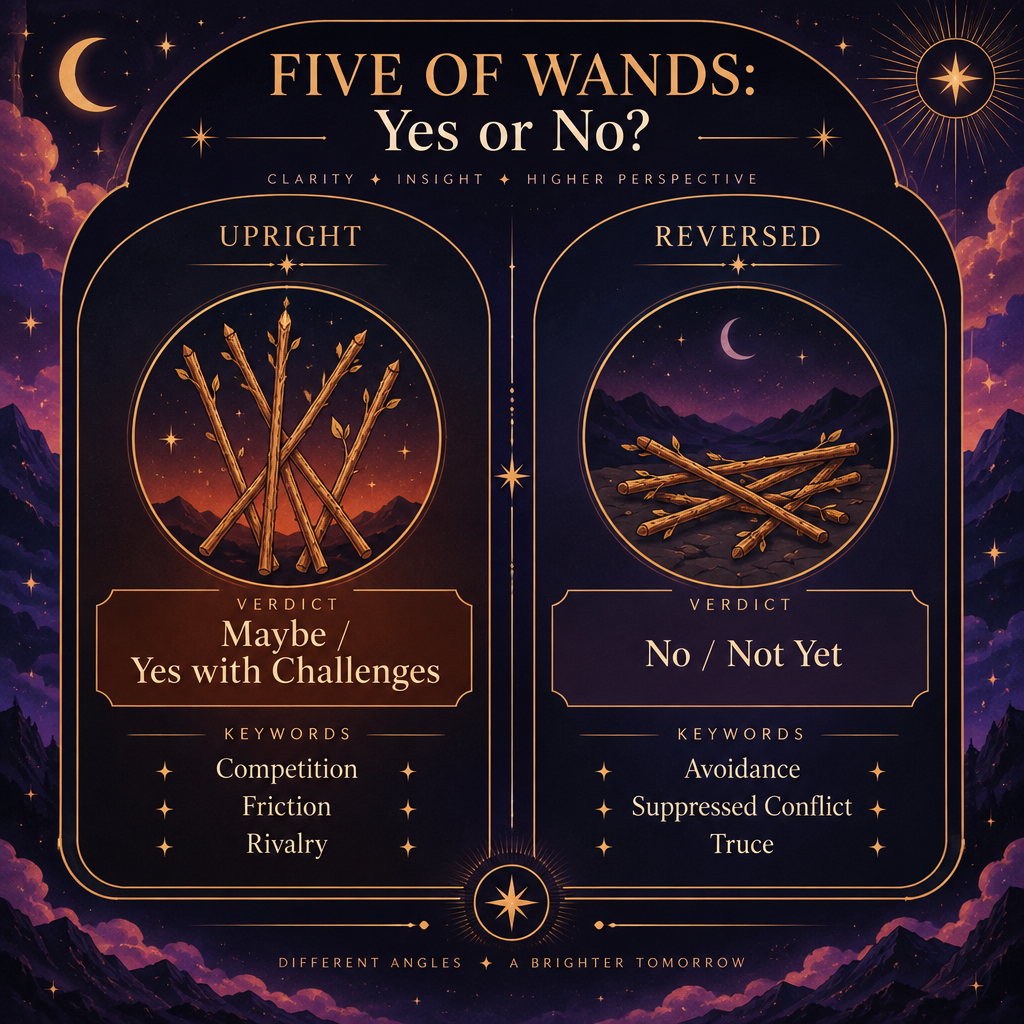
The Five of Wands is one of the few cards that refuses to hand you a clean yes or no. Upright, it reads as a conditional yes, or a “maybe, if you are willing to fight for it.” Reversed, the answer tips toward no, or at least not yet. Here is how to apply that to love, career, money, health and the specific question you actually asked.
Five of Wands at a Glance
| Upright | Reversed | |
|---|---|---|
| Yes or no verdict | Maybe / yes with challenges | No / not yet |
| Keywords | Competition, friction, rivalry, scattered energy, testing | Avoidance, suppressed conflict, passive aggression, truce, inner conflict |
| Element | Fire | Fire (blocked or turned inward) |
| Planet and sign | Saturn in Leo | Saturn in Leo |
| Decan and dates | First decan of Leo, roughly July 22 to August 1 | Same |
| Number | 5 (change, instability, growth through pressure) | Same |
| Timing | Fast, typically days to a few weeks | Delayed or stalled |
The Core Verdict: Why Upright Is Not a Flat No
Older yes/no guides, including an earlier version of this page, called the upright Five of Wands a resounding no. That reading has fallen out of favor, and for good reason. The card does not show failure. It shows a struggle that is still in progress with the outcome undecided.
Treat upright as a “yes, but it will not be easy” when your question involves something you can influence through effort. Treat it as a “maybe, leaning no” when the question depends entirely on other people cooperating smoothly, because smooth cooperation is exactly what this card lacks.
The practical test is simple. Ask yourself whether friction kills the thing you want or merely delays it. A job you are competing for survives competition. A fragile new romance that cannot handle a single disagreement probably does not.
Five of Wands Reversed: Yes or No
The reversed Five of Wands is a no, or more precisely a not yet. On the surface it looks calmer than the upright card. The sparring has stopped. The problem is that it has usually stopped because someone walked away from the conversation, not because anything got settled.
Three patterns show up again and again when this card appears reversed in a yes/no spread:
- Suppressed conflict. Everyone is being polite and nobody is being honest. The disagreement is still there, pushed under the table where it keeps growing.
- Passive aggression. Instead of open arguing you get sulking, delays, “forgotten” promises and sarcastic comments. The card says the fight has gone underground, which is harder to resolve than an open row.
- Avoidance. The querent, or the other person, is dodging a decision rather than making one. A question that cannot get a straight answer from the people involved will not get a straight yes from the cards either.
The one genuinely positive reversed reading is truce after exhaustion. If the surrounding cards are gentle (Temperance, the Star, Two of Cups, Six of Wands), the reversed Five of Wands can signal that a long-running battle is finally burning out and real resolution is possible. Even then, answer the question with “not yet” rather than “yes.” Peace that has been declared is not the same as peace that has been built.
What the Card Shows and Why It Matters for a Yes/No Reading
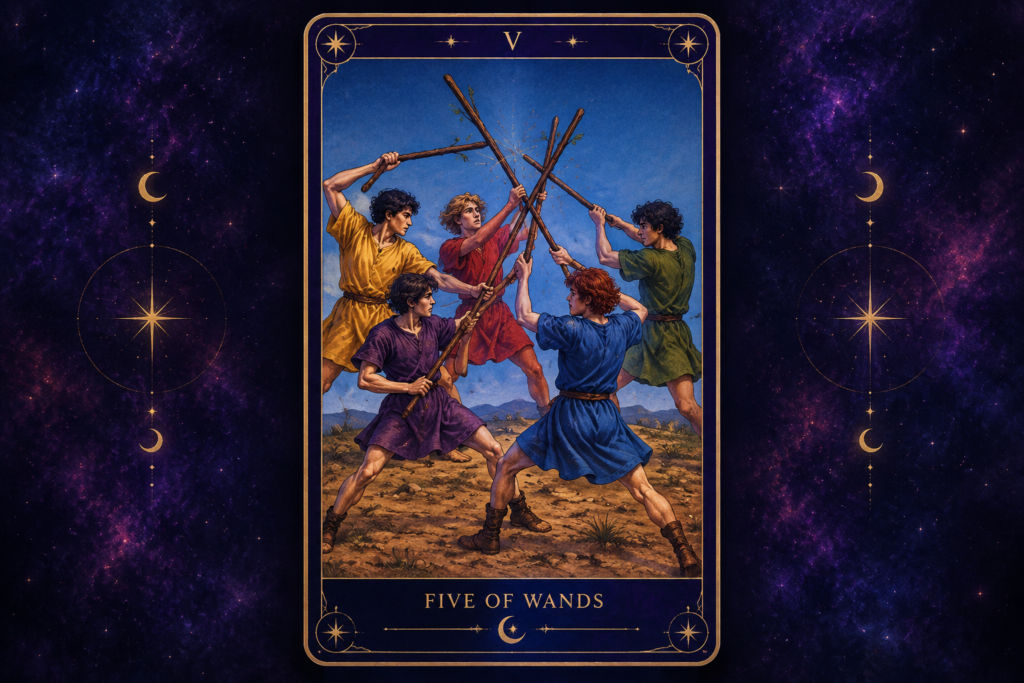
In the Rider-Waite-Smith deck, Pamela Colman Smith drew five young men on open ground, each holding a wooden staff, each swinging it in a different direction. Their clothes are different colors and patterns, which signals five separate agendas rather than two sides. Look closely and you will notice what is missing: nobody is bleeding, nobody is on the ground, and nobody is winning. The sky is clear and the land is bare.
That is the whole yes/no message in one picture. This is a mock battle, not a war. The staves clash but nothing is destroyed. Energy is being spent, loudly, without anyone landing a decisive blow.
For a yes/no question that means the matter is undecided and unlikely to decide itself. Someone has to step forward, coordinate the group, or stop swinging. If you are the one asking, that someone is probably you.
Astrology and Numerology Behind the Answer
The Golden Dawn system assigns the Five of Wands to Saturn in Leo, the first decan of Leo, covering roughly July 22 to August 1. That pairing explains the card’s personality better than any keyword list. Leo wants to shine, lead and be recognized. Saturn imposes limits, tests and delays. Put them together and you get ambition meeting resistance, which is exactly what the card depicts.
For yes/no work, Saturn is the detail that matters. Saturn rarely says no outright, but it always says “prove it” and “wait.” A Saturn-ruled card will not give you a free pass.
The number five adds instability. Fives in every suit mark the point where the comfortable structure of the four breaks apart: the Five of Pentacles loses money, the Five of Cups grieves, the Five of Swords wins dishonestly. In Wands, the fiery suit of ambition, willpower and creative drive, the five scatters that drive among competing interests. Growth comes through pressure, but only if the pressure is directed somewhere useful.
Five of Wands Yes or No in Love
New relationships
Verdict: maybe, with early friction. The upright card in a new-relationship question points to misunderstandings, mixed signals and small arguments in the first weeks. That is not a death sentence. Two strong-willed people often clash before they learn each other’s rhythms. The question to answer honestly is whether the fights feel like sparring (energetic, respectful, resolved by bedtime) or like a pattern (the same complaint, never fixed). The first is a workable yes. The second is a no dressed up as passion.
Reversed in a new-relationship question is a clearer no. One or both of you is avoiding the real conversation, and a relationship that starts with avoidance tends to stay there.
Existing relationships
Verdict: yes, if you both engage. For an established couple, upright Five of Wands says the relationship is rocky right now but alive. People who have stopped caring stop arguing. The card asks for a direct, scheduled conversation about the recurring flashpoint, not another round of the same argument at 11pm. Couples who do that tend to come out stronger. Couples who keep swinging without aiming do not.
Reversed here means the fighting has gone quiet in a bad way: separate evenings, clipped texts, a cold politeness. Answer no to “will things improve on their own” and yes to “do we need outside help or a frank reset.”
Singles and dating
Verdict: maybe, with competition. For a single person asking whether a connection will develop, the upright card frequently means rivalry. The person you like has other options, or you are one of several people they are talking to. It can also mean your own energy is scattered across too many dating-app conversations to let any one of them deepen. Either way, the answer improves the moment you focus. Pick one and pursue it properly.
Reconciliation with an ex
Verdict: upright, not yet; reversed, no. The upright Five of Wands in a reconciliation question says the old arguments are still fully loaded. Nothing has changed except the passage of time, and time alone does not resolve the issues that ended things. Getting back together now would restart the same fight from the same position. If you genuinely want to try again, the card’s demand is specific: name the one recurring conflict and agree on a different way to handle it before any reunion.
Reversed, the card points to unresolved resentment that neither party will say aloud. One of you is still angry and pretending not to be. That is a no.
Five of Wands as feelings
If you pulled the card for “how does this person feel about me,” upright means they feel competitive, challenged or stirred up. There is attraction mixed with irritation. They may see you as someone they have to win or argue with, which can be exciting but is rarely restful. It can also mean they feel pulled between you and something else and have not chosen.
Reversed as feelings means conflicted and avoidant. They are suppressing something, usually frustration or an unspoken grievance, and are more likely to go quiet than to tell you what is wrong.
Five of Wands Yes or No for Career
Verdict: yes with competition (upright); no or stalled (reversed).
Career is the context where the upright Five of Wands performs best as a yes. It describes a crowded field: several candidates for one job, several colleagues angling for one promotion, several opinions in one meeting. None of that is a no. Competition only matters if you lose it, and the card shows the contest still open.
For a job application, read it as “you are in the running, and so are others.” Sharpen the pitch, follow up, and assume the hiring manager is comparing you against three people with similar résumés.
For a promotion, expect ego clashes with a peer who wants the same role. The card favors whoever stays focused on results while everyone else is busy jostling.
For “should I take this job,” upright says the workplace is lively, argumentative and possibly disorganized. A yes if you thrive on debate; a maybe if you need calm.
Reversed in a career question is a no for now. It describes a team avoiding a necessary confrontation, a project stalled by passive resistance, or a querent who keeps their frustrations bottled up at work. Nothing moves until someone says the uncomfortable thing out loud.
Five of Wands Yes or No for Money and Finances
Verdict: maybe, and not without a dispute.
Financially, the upright Five of Wands rarely signals real loss. It signals argument about money: a disputed bill, a disagreement with a partner about spending, a contractor quote that keeps changing, a business partner who wants to invest differently than you do. Stressful, yes. Catastrophic, no.
It also appears when you are weighing competing options, such as three investment ideas or two mortgage offers, and your energy is scattered across all of them. The money question gets a yes once you commit to one path and stop reopening the decision.
Reversed, finances point to an avoided money conversation, the classic example being a couple where one person quietly knows the budget does not work and says nothing. Answer no until that conversation happens.
Five of Wands Yes or No for Health
Verdict: upright, a challenge you can meet; reversed, resolution or relief.
Health is the one area where the reversed card often reads more positively than the upright. Upright suggests a body under strain: stress-driven symptoms, inflammation, burnout from doing too much, or conflicting advice from different practitioners that leaves you unsure which to follow. For “will I recover” or “will this treatment work,” it is a yes that requires discipline and probably some trial and error.
Reversed in a health reading frequently indicates that an internal conflict is easing, stress is dropping, or a flare-up is subsiding. It can also mean you are ignoring a symptom rather than dealing with it. If the question is “is it safe to ignore this,” the answer is no. See someone.
Five of Wands Yes or No for Family
Verdict: maybe, with sibling-style friction.
The five figures on the card look a lot like a family argument: everyone talking, nobody listening, nobody actually trying to hurt anyone. In family questions the upright card means a loud but survivable dispute, often over an inheritance, a holiday plan, an elderly parent’s care or a sibling who feels overlooked. The relationship survives. The plan may need to change.
Reversed points to the family that never argues and never resolves anything either. Old grudges, unspoken resentment, the relative everyone tiptoes around. Answer no to “will this sort itself out quietly.”
Five of Wands for Advice: Should You Act or Wait?
When you pull the card as advice rather than as an outcome, read it like this:
- Upright: Act, but act with focus. The danger is not conflict itself, it is scattered effort. Pick the one battle that matters and let the other four go.
- Reversed: Stop avoiding. The advice is to say the uncomfortable thing, have the overdue conversation, or make the decision you have been dodging. Waiting is the problem, not the solution.
In both positions the card has no patience for people-pleasing. It rewards the person who steps into the ring with a clear objective.
Timing
Wands move fast. Many readers assign the suit a window of days to a few weeks, and a common rule of thumb for the Five of Wands specifically is one to three weeks before the situation shifts. Treat that as a tendency rather than a schedule. The astrological window of July 22 to August 1 is another clue some readers use for “when,” especially if the question is about an event rather than a process.
Reversed, timing stretches. Expect delays until someone breaks the silence.
How Surrounding Cards Change the Answer
A single card is a hint. The cards beside it are the sentence.
- Six of Wands nearby turns the maybe into a yes. The contest ends with you on top.
- Ten of Wands or Five of Swords turns it toward no. The struggle drags on or ends with a hollow win.
- Temperance or Two of Cups suggests the friction gets resolved through compromise. Yes, with patience.
- The Tower says the mock battle is about to become a real one. No.
- Ace of Wands or Knight of Wands means the energy is productive. Yes, if you channel it.
- Four of Cups or Hanged Man beside a reversed Five of Wands confirms stagnation. Not yet.
The Deeper Message: Conflict as a Forge
Underneath the yes/no mechanics, the Five of Wands makes an argument that most querents do not want to hear: friction is useful. The five figures are not enemies. In many readings they are five parts of one person, five competing wants pulling in five directions. Learning which of those wants deserves your staff is the real work the card is asking for.
People who draw this card repeatedly tend to be strong-willed, ambitious and easily drawn into arguments that do not serve them. The growth on offer is not to stop fighting. It is to fight for one thing, deliberately, and to notice when a disagreement is sparring that sharpens you versus noise that drains you.
FAQ
Is the Five of Wands a yes or no card?
Upright, it is a conditional yes or a maybe. The outcome is undecided and depends on how much effort and focus you bring. Reversed, it leans no or “not yet” because the real issue is being avoided rather than resolved.
What does the Five of Wands reversed mean in a yes or no reading?
It means no for now. The reversed card shows suppressed conflict, passive aggression or avoidance. The situation looks calm but has not actually been settled. In health questions specifically, reversed can signal relief as tension eases.
Does the Five of Wands mean yes or no in love?
For existing relationships it is a yes if both partners are willing to address the recurring argument directly. For new connections and reconciliation with an ex it is a maybe leaning no, because the card shows the old friction still fully active. As feelings, it means someone feels competitive, challenged or conflicted.
Is the Five of Wands yes or no for career?
Mostly yes. It describes competition for a role, promotion or contract that is still open. You are in the running, but so are others. Reversed, it points to a stalled situation where nobody is confronting the real problem.
What if the Five of Wands appears with other cards?
Supportive cards like the Six of Wands, Temperance or the Ace of Wands push the answer toward yes. Heavy cards like the Tower, Ten of Wands or Five of Swords push it toward no. Always read the Five of Wands as “undecided” and let the neighbors decide the direction.
Does the position in the spread matter?
Yes. In an outcome position it describes the result (a contested one). In an advice position it tells you to focus and engage rather than scatter your energy. In a “how they feel” position it describes competitive or conflicted feelings rather than an event.