How to Read Tarot Cards for Beginners: A Step-by-Step Guide
Reading tarot comes down to three learnable skills: knowing how the 78-card deck is organised, asking questions the cards can answer, and turning a few pictures into one coherent story. This guide takes you through all three in the order you actually need them, from a seven-step first reading you can do tonight to a 30-day plan that gets you reading for friends. You do not need to be psychic. You need a deck, a notebook and ten minutes a day.
Last updated January 2026. Price bands below reflect publisher list prices at that time; retailer discounts and app store tiers shift often, so check before you buy.
Your First Reading in Seven Steps
If you already own a deck, this is the entire process. Every section after this one unpacks a step.
- Pick one spread. A single card or a three-card line. Decide what each position means before you touch the deck (for example, past, present, advice).
- Write the question down. Open-ended, about you, about now. “What do I need to understand about my job search?” beats “Will I get the job?”
- Shuffle until the question feels settled. An overhand shuffle is fine. Stop when your mind goes quiet.
- Lay the cards face down, then turn them left to right. Flip each one sideways, not end over end, so you do not accidentally create a reversal.
- Describe each picture out loud before you interpret. “A man carries ten heavy sticks toward a town.” Only after that do you say “burden, nearly there.”
- Connect the cards into one sentence. Three cards are not three fortunes. They are the beginning, middle and end of one answer.
- Record it. Date, question, cards, your reading in two or three lines. Reread it in a week.
Step five is the one beginners skip, and it is the one that separates people who read tarot from people who look up tarot. It gets its own section next.
Look Before You Look It Up
Here is the method, stated plainly: for every card, spend thirty seconds with the image before you open any book or app. Say what you see. Then say what it feels like. Then, and only then, check the guidebook.
This works because the Rider-Waite-Smith images were drawn to be read. Pamela Colman Smith put the meaning into the scene. Take the Five of Pentacles: two people trudge through snow past a lit church window. One is on crutches. Neither looks up at the light. You do not need a glossary to feel what that card is about. Hardship, yes, but specifically hardship while help sits a few feet away, unnoticed. A keyword list gives you “poverty, loss.” The picture gives you the whole situation and a possible way out.
Three prompts to run on any card:
- What is literally happening? People, objects, weather, posture. “A woman blindfolds herself and crosses two swords over her chest. The sea is behind her. The moon is up.”
- Where is the energy going? Toward the viewer, away, upward, stuck? Figures facing left in RWS often read as looking back; figures facing right look ahead.
- If this were a frame from a film, what happened just before, and what happens next? The Eight of Cups shows a man walking away from a stack of cups. What he leaves behind matters as much as where he is headed.
Do this with every card for your first month and you will find that by week three you no longer need the book for most of them. The meanings arrived through your own eyes, which means they stick, and which means you can flex them when a card lands in an unusual position. Readers who memorise first and look second tend to recite definitions. Readers who look first tend to read.
Choosing Your First Deck
Buy a deck built on the Rider-Waite-Smith system. This is the one piece of tarot advice that is not up for debate. RWS underlies nearly every modern deck, beginner book, YouTube channel and app you will meet. Learn on it and every resource you find will match the cards in your hand.
Within that system you have real choice:
- Rider-Waite Tarot (U.S. Games Systems). The standard edition with Smith’s hand-lettered titles. Lists around $20 to $25, often discounted under $20.
- Universal Waite. Smith’s line art recoloured by Mary Hanson-Roberts in softer tones. The pick if the 1909 palette feels harsh. Same price band.
- Smith-Waite Centennial. A faithful reproduction of the original 1909 printing. Muted and vintage.
- Radiant Rider-Waite. High-contrast recolour. Symbols read clearly across a table.
- The Weiser Tarot (Weiser Books, 2022). A modern recolour of the Smith line art with a thick guidebook. The publisher has since added a mini edition and a companion journal. Around $25 to $30.
- The Light Seer’s Tarot by Chris-Anne (Hay House, 2019). Painterly and modern, keeps RWS structure. The guidebook is one of the best written for beginners. Mid-$20s.
- Modern Witch Tarot by Lisa Sterle (2019). Card-for-card RWS scenes recast with contemporary, diverse figures. The most direct translation of classic symbolism into a modern look. $25 to $30.
- Everyday Witch Tarot by Deborah Blake and Elisabeth Alba (Llewellyn, 2017). Friendly, cat-filled, RWS-faithful. Around $30 with the full guidebook.
- This Might Hurt Tarot by Isabella Rotman. Inclusive RWS reinterpretation with a plain-spoken guidebook. Sold independently, so expect $40 or more.
Rule of thumb: mass-market RWS decks from U.S. Games, Llewellyn, Hay House or Sterling run $20 to $35. Independent decks from the artist’s own shop run $40 to $65. Anything under $12 on a marketplace listing is almost certainly a bootleg with blurry art and thin card that splits at the edges within weeks.
Two gorgeous decks that are awkward as a first purchase: Botanica by Kevin Jay Stanton uses flowers rather than people on the pips, so scene-reading does not apply, and Tarot of the Divine by Yoshi Yoshitani maps each card to a folktale, which is wonderful once you know the cards and confusing before.
If flipping to a guidebook mid-spread sounds like a barrier, decks with keywords printed on the cards exist. U.S. Games’ Apprentice Tarot, based on the Universal Waite, is the best known. Treat these as training wheels and plan to move off them within a few months.
Two decks to avoid as a first purchase. The Thoth Tarot, designed by Aleister Crowley and painted by Lady Frieda Harris between 1938 and 1943, is dense with Kabbalistic, astrological and alchemical symbolism and uses different card titles. The Tarot de Marseille is historically important but has no illustrated pips, which puts you back to memorising tables.
One myth to discard: tarot decks do not need to be gifted to you. Buy your own.
Apps and AI Tools
Apps solve a real beginner problem: seeing the image and the meaning side by side without juggling a book. Labyrinthos, by designer Tina Gong, pairs card lessons and quizzes with a reading journal, and Golden Thread Tarot from the same creator exists as both an app and a physical deck. Both have been free to download with optional paid extras; tiers change, so confirm what is included before relying on a feature.
AI-generated tarot interpretations have multiplied since 2024, both as standalone apps and as features bolted onto journaling tools. Use them the way you would use a second guidebook: a prompt for your own thinking, not a replacement for it. An AI summary of “Three of Swords, Six of Cups, Knight of Wands” will give you a plausible paragraph. It will not have looked at your question, your week, or the fact that the Knight is riding away from the heartbreak rather than toward it. Do the describe-first step yourself every time, then compare.
Cleansing and Caring for a New Deck
A new deck needs two things: a reset and a home.
The reset is practical, not mystical. Sort the deck into order, Fool through World, then Wands Ace through King, Cups, Swords, Pentacles. This takes five minutes, confirms all 78 cards are present, and lets you look at every card once. Many readers do this again whenever a deck “feels muddy” after a run of heavy readings. It works because ordering is a mental reset for you, and that is the point.
Other common cleansing habits: knocking on the deck three times, leaving it on a windowsill overnight, holding it between your palms while you breathe. Do any of these if they help you focus. Skip burying the deck in salt; it dries the card stock and warps the edges.
Storage: keep the deck in its box or a cloth bag, out of direct sun (the inks fade), away from damp. Wash and dry your hands before shuffling. Riffle shuffling bends cards over time, so prefer overhand or a loose table-wash if you want a deck to last years.
Tarot vs. Oracle Cards
Tarot has a fixed structure: 78 cards, 22 Majors, four suits of 14. Any RWS-based deck can be read with any RWS book. Oracle decks have no shared structure. One has 44 animal cards, another 60 affirmations, and each comes with its own rules. Oracle cards are easy on day one and hard to grow with, because nothing you learn from one deck transfers to the next. Learn tarot first. Add an oracle deck later if you want a single summary card alongside a spread.
How the 78 Cards Are Organised
Every standard deck splits into two groups. The 22 Major Arcana cover life’s big themes. The 56 Minor Arcana cover daily life, in four suits of 14.
The terminology is Victorian rather than ancient. By the mid-1800s tarot was an established fortune-telling tool in occult circles, and that is when the trumps became the “major arcana” and the pips the “minor arcana.”
The Major Arcana: 22 Cards
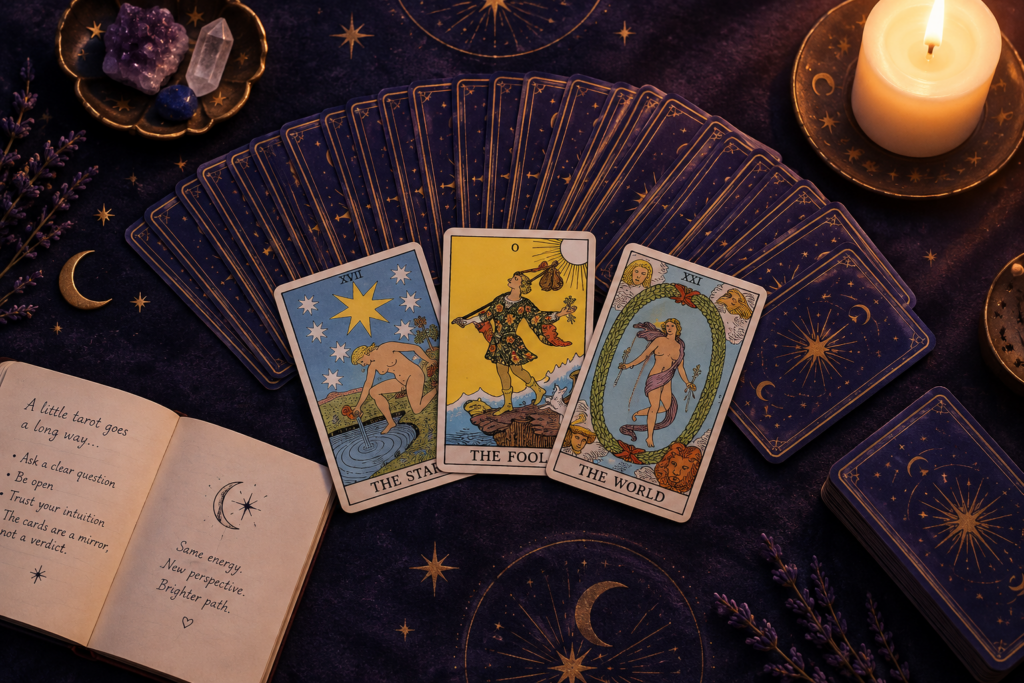
Numbered 0 (The Fool) through 21 (The World). Many teachers present them as one story, the Fool’s Journey, in which the innocent traveller of card 0 meets every archetype before reaching wholeness at The World. You do not have to believe the story to use it as a memory aid.
| No. | Card | Core meaning |
|---|---|---|
| 0 | The Fool | New beginnings, a leap of faith, innocence |
| 1 | The Magician | Skill, willpower, making things happen |
| 2 | The High Priestess | Intuition, mystery, inner knowledge |
| 3 | The Empress | Abundance, nurturing, creativity |
| 4 | The Emperor | Authority, structure, discipline |
| 5 | The Hierophant | Tradition, institutions, teaching |
| 6 | The Lovers | Union, values, a defining choice |
| 7 | The Chariot | Determination, victory through will |
| 8 | Strength | Courage, patience, gentle power |
| 9 | The Hermit | Solitude, introspection, guidance |
| 10 | Wheel of Fortune | Cycles, turning points, luck |
| 11 | Justice | Fairness, truth, cause and effect |
| 12 | The Hanged Man | Surrender, pause, a new perspective |
| 13 | Death | Endings, transformation, release |
| 14 | Temperance | Balance, moderation, healing |
| 15 | The Devil | Attachment, addiction, self-imposed limits |
| 16 | The Tower | Sudden upheaval, revelation |
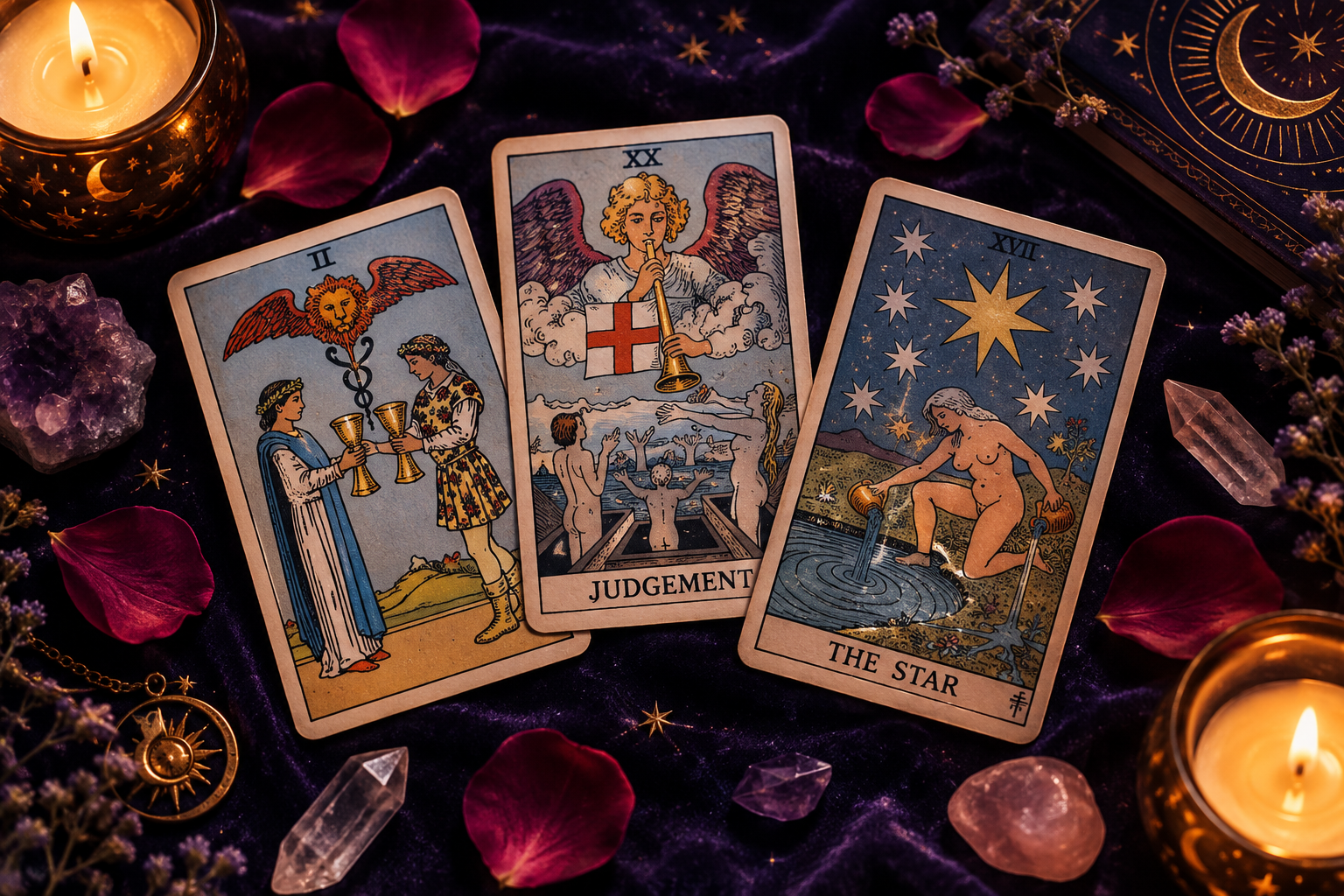
| 17 | The Star | Hope, renewal, faith |
| 18 | The Moon | Illusion, fear, the unconscious |
| 19 | The Sun | Joy, success, vitality |
| 20 | Judgement | Reckoning, awakening, a calling |
| 21 | The World | Completion, integration, accomplishment |
The Four Suits and Their Elements
Each suit governs one domain of life, and the RWS tradition (inherited from the Golden Dawn) ties each to a classical element. The element is not decoration. It tells you how the suit behaves, which is often more useful than what it is “about.”
| Suit | Element | Life domain | Tone and tempo | Watch for |
|---|---|---|---|---|
| Wands | Fire | Energy, ambition, creativity, work you care about | Fast, hot, forward-driving | Burnout, impatience, scattered effort |
| Cups | Water | Emotions, relationships, intuition, imagination | Flowing, receptive, deep | Flooding, escapism, wishful thinking |
| Swords | Air | Thought, communication, truth, decisions | Sharp, quick, cutting both ways | Anxiety, harsh words, overthinking |
| Pentacles | Earth | Money, work, body, home, anything tangible | Slow, steady, holds its shape | Stagnation, materialism, rigidity |
Fire moves fast and burns out. Water flows and floods. Air clarifies and wounds. Earth is slow and holds. When a Wands card and a Pentacles card sit next to each other, you are usually looking at urgency against patience, and that tension is often the heart of the question. Cups beside Swords is feeling versus thinking, the classic heart-and-head standoff.
A fast way to lock this in: hold one card from each suit, all the same number. The four Threes work well. Three of Wands is a man watching ships he sent out. Three of Cups is three women dancing. Three of Swords is a heart pierced by blades. Three of Pentacles is a craftsman at work in a cathedral. Same number, four elements, four completely different scenes. That contrast is the whole Minor Arcana in miniature.
The Numerology Shortcut: Suit + Number = Meaning
The biggest beginner anxiety is “I have to memorise 78 cards.” You do not. Forty of them, the Ace through Ten of each suit, follow a formula. Learn ten number meanings and four suit meanings, and you can build a reasonable reading of any pip card on the spot.
| Number | Theme | Think of it as |
|---|---|---|
| Ace | Pure potential, a seed, an offer | The suit’s energy arriving |
| Two | Balance, choice, partnership, waiting | Two forces meeting |
| Three | Growth, first results, collaboration | Something taking shape |
| Four | Stability, structure, rest, stagnation | Four walls: shelter or a box |
| Five | Conflict, loss, disruption, change | The comfortable structure breaks |
| Six | Harmony restored, cooperation, movement | Recovery after the Five |
| Seven | Assessment, testing, patience, strategy | Pausing to check progress |
| Eight | Mastery, momentum, hard work, movement | Energy at full strength |
| Nine | Near-completion, intensity, the wish | Almost there, for better or worse |
| Ten | Completion, culmination, excess | The suit taken to its end |
Now combine. Five is disruption. Five of Wands: disruption in the domain of energy and ambition, so competition, scuffles, too many ideas at once. Five of Cups: disruption of emotion, so grief, regret, focusing on what spilled. Five of Swords: disruption of thought and communication, so a hollow victory, an argument won at a cost. Five of Pentacles: disruption of material security, so hardship, illness, feeling shut out.
Try it with Eight. Eight is momentum and mastery. Eight of Wands: eight staves flying through the air, news and speed. Eight of Cups: walking away because you have mastered what this emotional situation can teach. Eight of Swords: mental momentum turned inward, the trap of your own thinking. Eight of Pentacles: craft, apprenticeship, hammering out the same coin again and again until it is right.
The formula gives you about 70 percent of each card. The picture gives you the rest. When the formula and the picture seem to disagree, which happens with the Six of Swords (number says harmony, image shows a sombre boat crossing), the gap is usually the card’s real message: harmony arriving by way of a difficult passage.
Court Cards: People or Modes
Each suit ends with Page, Knight, Queen and King. These are the sixteen cards beginners find hardest, because the guidebook says “a young brown-haired person” and nobody in your life matches.
Read them as ranks of maturity in the suit’s element:
- Page: the student. Messages, curiosity, early enthusiasm, a bit naive.
- Knight: the actor. Energy in motion, often to excess. Knight of Swords charges; Knight of Pentacles barely moves.
- Queen: inward mastery. Someone who embodies the element and nurtures it in others.
- King: outward mastery. Someone who directs the element in the world, with authority and sometimes rigidity.
A court card can be a person (your Queen of Pentacles boss), but more often for self-readings it is a mode you are in or need to adopt. Page of Cups in an advice position does not mean “meet a sensitive young person.” It means “approach this with openness and let yourself feel something new.”
Reversals: Skip Them for 30 Days
A reversed card is one that lands upside down. Guidebooks list separate meanings for each. For your first month, read everything upright. Turn reversals around as you lay them out. You are learning 78 images; doubling the workload on day one is how people quit.
When you are ready, add one reversal rule rather than 78 new definitions. The reversed card means the upright energy is blocked, delayed, turned inward, or taken too far. Reversed Knight of Wands: the energy is there but stuck, or reckless. Reversed Ten of Pentacles: the stability is cracking, or the family wealth comes with strings. Pick the version that fits the picture and the question.
Asking Questions the Cards Can Answer
Tarot is a mirror, not a timetable. It describes dynamics, motivations and likely trajectories. It does not do yes/no, dates, or other people’s private intentions well.
Weak question: “Will he text me back?”
Workable: “What do I need to understand about this connection?”
Weak: “Should I quit my job?”
Workable: “What am I not seeing about staying?” then “What am I not seeing about leaving?” as two separate pulls.
The pattern: start with “what,” “how” or “where,” keep the subject as yourself, and anchor it in the present. If you catch yourself asking the same question three times in a week, the deck has already answered and you did not like it. Journal that instead.
Four Spreads for Beginners
One Card
The best teaching spread. One question, one card, one paragraph in your journal. Use it daily.
Three-Card Line
Pick a position scheme before shuffling:
- Past / Present / Future
- Situation / Obstacle / Advice
- Mind / Body / Spirit
- You / Them / The relationship
Situation / Obstacle / Advice is the most useful of these because it always ends with something to do.
Five-Card Cross
Centre card: the heart of the matter. Left: what is behind you. Right: what is ahead. Below: the root or what you are not seeing. Above: what you can aim for. Read the centre first, then the horizontal line as a timeline, then the vertical as depth.
The Celtic Cross (Not Yet)
Ten positions, a century of variations, and almost every beginner lays it out before they can read three cards. Save it for month two.
Read the Pattern Before the Cards
Before interpreting any card in a multi-card spread, scan the whole layout and count. This is the fastest interpretive signal in tarot and almost nobody teaches it early.
- Suit dominance. Three Swords in a five-card spread mean the reading is fundamentally about thought, communication and conflict, whatever the question said out loud. Three Cups: it is emotional at the root. Three Pentacles: this is about money, work or the body, even if you asked about a relationship.
- Missing suits. A relationship question with no Cups at all is itself the answer. A career spread with no Pentacles suggests the problem is not practical.
- Major Arcana density. Two or more Majors in three cards: the situation is bigger than day-to-day choices and may be partly outside your control. No Majors at all: ordinary life, handle it with ordinary tools.
- Court card clusters. Several courts usually mean other people are driving the situation more than you think.
- Repeated numbers. Two Fives: disruption is the theme. Two Tens: something is ending or peaking.
Do this scan in fifteen seconds, say the headline out loud (“this is mostly a Swords reading with one Major”), then go card by card. Your individual interpretations will fit together far better.
Clarifying Cards: When to Pull One and How to Read It
Sometimes a card lands and you have no idea what it is doing there. The Hierophant in a question about your sister. The Two of Wands in an advice position when nothing feels like a decision. That is when you pull a clarifier.
The rules:
- One clarifier per confusing card, maximum. Pulling three more cards to explain one is how a three-card reading turns into a mess.
- Pull it from the top of the deck after the spread is laid. Do not reshuffle. Place it slightly below or overlapping the card it clarifies.
- Read it as “the bottom line.” Ask: how does this card narrow down the first one? Hierophant clarified by the Four of Cups: the issue with your sister is about family tradition you have grown bored of. Hierophant clarified by the Three of Pentacles: it is about a shared institution, a business or a parent’s care, where roles need defining.
- Do not pull a clarifier because you dislike the answer. If the Tower lands and you want it to be the Star, a clarifier will not change the reading. Journal your discomfort instead.
A second use: when a whole reading feels finished but unresolved, pull a single card as a summary. Place it beneath the spread and read it as the one-line takeaway.
A Full Worked Reading
Question, written down: “What do I need to understand about my job search right now?”
Spread: Situation / Obstacle / Advice. Cards drawn: Eight of Pentacles, Five of Wands, Six of Swords.
Pattern scan first. No Majors, so this is ordinary life. Three suits, no Cups, so emotion is not the root issue. Numbers run five, six, eight: disruption, recovery, momentum. Already a shape: something is breaking, then settling, then moving.
Situation: Eight of Pentacles. A craftsman carves the same pentacle over and over at a bench. Finished ones hang beside him. He is not looking up. Eight plus Earth: diligent, repetitive, tangible work. You have been applying, tailoring, grinding. The work is real and skill is building.
Obstacle: Five of Wands. Five youths wave staves at each other in what could be a fight or a game. Five plus Fire: competition, scattered energy, noise. The obstacle is not your skill. It is a crowded field and possibly your own scattered applications across too many directions at once.
Advice: Six of Swords. A ferryman poles a boat carrying a huddled woman and child across calm water toward a far shore. Six swords stand upright in the bow. Six plus Air: a transition in thinking, leaving a hard mental place for a quieter one. The advice is to stop fighting in the crowd and change the frame: a different sector, a different approach, letting someone help ferry you. The swords travel with them, meaning the skills come along.
One sentence. You have done the work and built the craft, but you are competing in a noisy pile; the way through is a deliberate shift in direction rather than more of the same effort.
Journal entry, dated. Reread in a week to see which part proved accurate.
Setting Up to Read: A Two-Minute Ritual
A pre-reading ritual does not make the cards more magical. It makes you more present, which is what the reading needs. Keep it short enough that you will actually do it.
- Clear the surface. A bare table or a cloth. Visual clutter leaks into your interpretations.
- Phone face down, in another room if possible. A notification mid-shuffle resets your attention to zero.
- Three slow breaths. In for four counts, out for six. By the third breath you are usually ready.
- Say the question out loud. Even alone. Hearing it tells you whether it is a real question or an anxiety in disguise.
- Optional: a candle, a particular cloth, the same chair. Repetition builds a cue. After a few weeks, lighting that candle will drop you into reading mode automatically.
Skip incense if it bothers you, skip crystals if you have none, and skip anyone who tells you the cards will not work without them.
The Card of the Day Practice
Separate from any structured plan, this is the single habit that builds fluency. Every morning, shuffle, pull one card, and spend two minutes describing it. Write three words in your journal. Then carry the card in your head through the day.
In the evening, write two lines: where did you see this card? The Seven of Swords in the morning, and by lunch you noticed yourself avoiding a conversation. The Empress, and a friend brought soup. Over a month, this does something no book can: it attaches each card to lived moments instead of definitions. By the time a card appears in a spread, you have met it in your own life.
Two refinements once the basic habit is set. First, pull in the evening instead and ask “what was today about?” which teaches you to read retrospectively, where the feedback is immediate. Second, once a week, lay out the seven cards from that week in a row and read them as a single spread. Patterns in your own month become visible.
Reading for Other People
By week three or four you will want to read for a friend. Good. Reading for someone else teaches you more in one evening than a week of solo pulls, because you cannot fudge the interpretation to fit what you already know.
Practical setup: have them shuffle, or shuffle while they hold the question in mind. Ask them to say the question out loud and write it down yourself. Describe each picture to them before interpreting, and watch their face. The card they react to is the card that matters. Ask “does that land?” after each card and adjust, which is not cheating; it is reading with the person rather than at them.
Ethics and Consent
Reading for others comes with responsibilities that most guidebooks skip.
Ask before you read. Do not pull cards about your partner, your ex, or a colleague without their knowledge. Beyond the privacy issue, third-party readings are unreliable, because the cards reflect your view of the person, not theirs. If you must, frame the question around yourself: “What do I need to understand about my role in this?”
Stay out of medicine, law and money. You are not qualified to tell someone whether a lump is cancer, whether to sign a contract, or whether to invest. If a card seems to point at health, say “the cards suggest paying attention to your body; please see a doctor,” and stop there. Never predict pregnancy, death, or a diagnosis.
Handle heavy cards with care. The Tower, Death and the Ten of Swords frighten people who do not know them. Explain what the card actually means (upheaval, endings, a cycle completing) before they spiral.
Know when to refer out. If someone is in crisis, grieving acutely, in a dangerous relationship, or asking the same question week after week, tarot is not what they need. Say so kindly and point them to a counsellor, a helpline, or a lawyer. A reading can open a door; it should not be the only door.
Do not read for children without a parent present, and keep readings for anyone under 18 light and reflective.
Be honest about what you are. You are a beginner reading for practice. Say so. It lowers the stakes for both of you and makes the reading better.
Mistakes That Stall Beginners
- Looking up every card before looking at it. Covered above, and still the number one problem.
- Reading the same question daily. The deck answered. Journal why you did not accept it.
- Buying a second deck in week one. Learn one set of images deeply before adding another.
- Treating the guidebook as law. It is one author’s interpretation of a symbol system with centuries of variation.
- Reading only when upset. You will build a vocabulary of crisis. Read on ordinary days too.
- Skipping the journal. Without it, you cannot check your accuracy or notice your growth.
- Pulling clarifier after clarifier. One, maximum, per confusing card.
A 30-Day Plan
Ten minutes a day. One deck, one notebook.
Week 1: Images and Majors. Daily card of the day, described before interpreted. Separately, study three Major Arcana per day in order, Fool through World, reading the picture first and the guidebook second. By day seven you have met all 22.
Week 2: The Pips by Formula. Card of the day continues. Learn the ten number meanings from the numerology table. Each day, lay out one suit, Ace through Ten, and build each card’s meaning from number plus element before checking the book. Wands days one and two, Cups three and four, Swords five and six, Pentacles day seven, then review.
Week 3: Courts and Three-Card Spreads. Card of the day continues. Learn the court ranks (Page, Knight, Queen, King) across all four suits over four days. From day fifteen onward, do one Situation / Obstacle / Advice spread every other day, always with the pattern scan first.
Week 4: Depth and Other People. Introduce reversals using the single blocked-or-excessive rule. Do two five-card cross readings. Read for one friend, with consent, using a three-card spread. On day 30, reread every journal entry from day one and note which readings held up. That review will teach you more than any single session.
Five Books Worth Owning
- Seventy-Eight Degrees of Wisdom by Rachel Pollack. The book most working readers name first. Deep, symbolic, card by card. Not a first-week read, but the one you grow into.
- Learning the Tarot by Joan Bunning. A structured course in book form, built around the RWS deck, with exercises. The most beginner-friendly of the five.
- The Ultimate Guide to Tarot by Liz Dean. Clear, visual, well organised for quick reference. Good next to the table during a reading.
- Everyday Tarot by Brigit Esselmont. Short, practical, focused on tarot as a daily reflective tool rather than fortune-telling. Pairs well with the card-of-the-day habit.
- Holistic Tarot by Benebell Wen. Enormous and rigorous. Buy it in month two or three when you want to go further into spreads, correspondences and professional practice.
The Next Level: Astrology and Kabbalah
Once the 78 images are familiar, you will notice guidebooks mentioning planets, zodiac signs and Hebrew letters. These come from the Golden Dawn system that shaped the RWS deck, and they are optional layers, not requirements.
The astrological layer assigns each Major a planet or sign: The Emperor to Aries, The Hierophant to Taurus, Strength to Leo, Death to Scorpio, The Star to Aquarius, and so on. The pip cards from Two to Ten are mapped to decans, ten-degree slices of the zodiac. If you already know astrology, this adds a timing and temperament vocabulary. If you do not, ignore it for now.
The Kabbalistic layer maps the 22 Majors to the 22 paths of the Tree of Life and the Ace through Ten of each suit to its ten sephiroth, which is why the numerology table above works: Ten sits at Malkuth, the material world, and Ace sits at Kether, pure source. Pollack’s book introduces this gently. Crowley’s Thoth deck is built on it entirely.
Neither layer will improve your readings in the first six months. Both will deepen them in year two.
Where Tarot Came From
Tarot’s mystical reputation is younger than the cards. The earliest surviving tarot cards date from 15th-century Italy, where courts used them for a trick-taking game. The oldest examples, the Visconti-Sforza cards, were commissioned by Filippo Maria Visconti, Duke of Milan, and his son-in-law Francesco Sforza, when the game was still called trionfi. Nobody read fortunes with them. They were expensive gaming decks for aristocrats.
Divination entered the picture in the 18th century. In 1781 the French clergyman Antoine Court de Gébelin published an essay on tarot’s symbolism in volume VIII of Le Monde primitif, claiming the cards descended from an ancient Egyptian Book of Thoth. He had no evidence and said so, yet the claim became the foundation of tarot mythology for two centuries. A Paris fortune-teller writing as Etteilla ran with it, wrote the first book of tarot divination methods, and by 1789 had published his own deck, the first designed specifically for occult use. His system already included the spread and fixed meanings for upright and reversed cards.
The deck you will almost certainly learn on arrived in 1909. Arthur Edward Waite commissioned Pamela Colman Smith to design a 78-card pack, published by William Rider & Son of London. It was the first widely distributed deck with full pictorial scenes on the Minor Arcana. In earlier decks the Three of Cups was three cups, so reading meant memorising a table. Smith’s scenes let you read the picture instead. Smith was paid a flat fee, earned no royalties, and saw the publisher’s name put on the deck instead of hers. The tarot community now calls it the Rider-Waite-Smith, or RWS, in her honour.
The practical takeaway: tarot is a symbolic vocabulary that accumulated over a few centuries, not a fixed ancient code. No card has one correct meaning. Beginners who accept that early relax faster and read better.
FAQ
Do I need to be psychic to read tarot?
No. Tarot reading is pattern recognition and storytelling applied to a structured set of images. Intuition in this context means noticing what you notice in a picture and trusting it enough to say it out loud. That is a skill, and it improves with repetition like any other.
Can I read tarot for myself?
Yes, and you should; it is how almost everyone learns. The one real difficulty is bias: you will be tempted to read the cards as saying what you hope. The describe-first method and a dated journal are the fixes. Describing the image before interpreting keeps you honest, and rereading entries a week later shows you where you fudged.
What does it mean when a card falls out while shuffling?
Readers call these jumpers. Treat a single card that leaps clearly out of the deck as a sidebar to the reading: set it face up beside the spread and read it as extra context or an answer to a question you did not ask. If several cards tumble out, that is just clumsy shuffling; put them back. Do not build a whole reading from jumpers.
Should I read reversals as a beginner?
Not for the first month. Turn every card upright and learn the 78 images first. When you add reversals, use one rule (the upright energy is blocked, delayed, internalised or excessive) rather than memorising a second set of meanings.
How often should I read tarot?
A single card daily plus one spread a week is the right rhythm for the first few months. Reading the same question repeatedly, or reading several spreads a day on the same issue, produces noise rather than insight. If you find yourself doing that, write about the anxiety instead.
Can I use more than one deck?
Yes, but not in your first month. Learn one RWS-based deck deeply, then add a second once the images are familiar. Many readers keep one deck for daily practice and a second, more atmospheric one for deeper monthly readings. Keep the first one RWS so that everything you learn transfers.
Is it bad luck to buy your own tarot deck?
No. The idea that a deck must be gifted is folklore with no historical basis. Buy the deck whose images you want to look at every day.
What is the fastest way to learn card meanings?
Combine three things: describe the image before checking the book, use the suit-plus-number formula for the 40 pip cards, and pull a card of the day so each meaning attaches to a real moment. Readers who do all three are typically off the guidebook for most cards within a month.