Hanged Man: Yes or No Tarot Meaning
The Hanged Man is one of the few tarot cards that refuses to give a clean yes or a clean no. Upright, it answers “maybe, not yet” and asks you to stop pushing. Reversed, it answers “no” to the way you are currently handling things, which often means the real message is “stop stalling and act.”
Quick Answer
| Position | Yes/No verdict | Why |
|---|---|---|
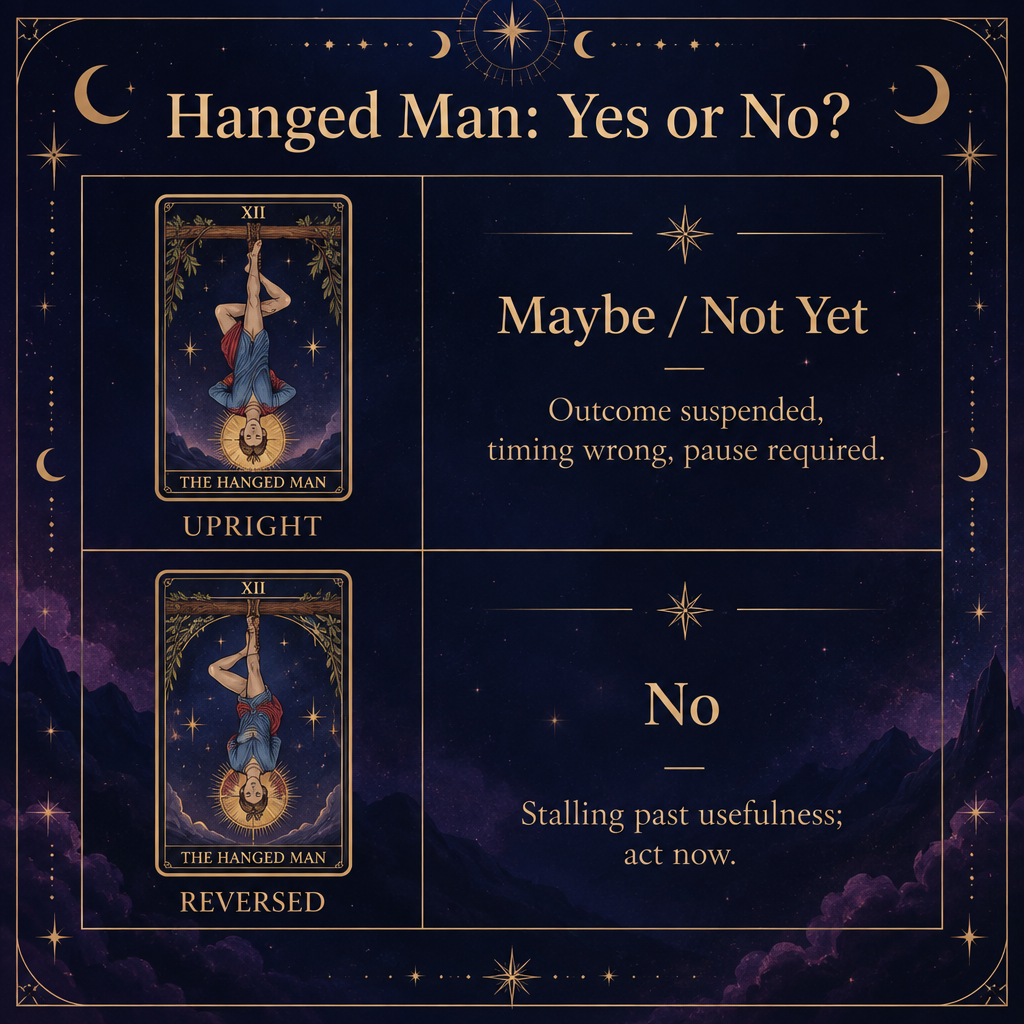
| Upright | Maybe / not yet | The outcome is suspended, not denied. Timing is wrong, not the goal. Forcing it now will backfire. |
| Reversed | No (to continued stalling) | You have waited past the point of usefulness. If the question is “should I finally act?”, the reversed card leans yes. |
If you need a one-line rule: the upright Hanged Man tells you to surrender the timeline, and the reversed Hanged Man tells you that the waiting has turned into avoidance.
The Hanged Man at a Glance
| Attribute | Detail |
|---|---|
| Number | XII (12) |
| Arcana | Major Arcana |
| Element | Water |
| Planet | Neptune |
| Hebrew letter (Golden Dawn system) | Mem |
| Upright keywords | Suspension, surrender, pause, new perspective, letting go, voluntary sacrifice, liminal space |
| Reversed keywords | Stalling, resistance, martyrdom, indecision, needless sacrifice, delay for its own sake |
| Yes/No | Upright: maybe / not yet. Reversed: no, or “act now” |
Neptune and Water explain a lot about why this card cannot say yes. Neptune dissolves boundaries, blurs timelines and favours intuition over action. Water flows around obstacles rather than through them. A card built on those two forces is never going to hand you a crisp confirmation.
Why the Honest Answer Is “Not Yet,” Not “No”
Most beginners read the Hanged Man as negative because the figure is upside down and the word “hanged” sounds like a verdict. Arthur Edward Waite, who commissioned the Rider-Waite-Smith deck in 1909 and wrote The Pictorial Key to the Tarot the following year, was explicit that the image “suggests life in suspension, but life and not death.” That phrase is the whole yes/no answer.
Suspension is a liminal state. You are between the old situation and the new one, and nothing has resolved yet. The person asking “will I get the job?” or “will they text back?” is in the doorway, not in the room and not shut out of it. Tarot readers in the Waite tradition therefore classify the upright card as “maybe” or “wait,” and that consensus holds across every major modern guide.
Here is the practical distinction that makes the card useful rather than frustrating:
- The Tower says no because something is being destroyed.
- The Five of Pentacles says no because resources are lacking.
- The Hanged Man says “not yet” because the outcome depends on you changing your angle, not on circumstances changing.
The sacrifice the card asks for is usually small and specific: your deadline, your need to control the sequence of events, your assumption about how the answer should arrive. Give that up and the suspension ends on its own.
What the Card Actually Shows (Rider-Waite-Smith)
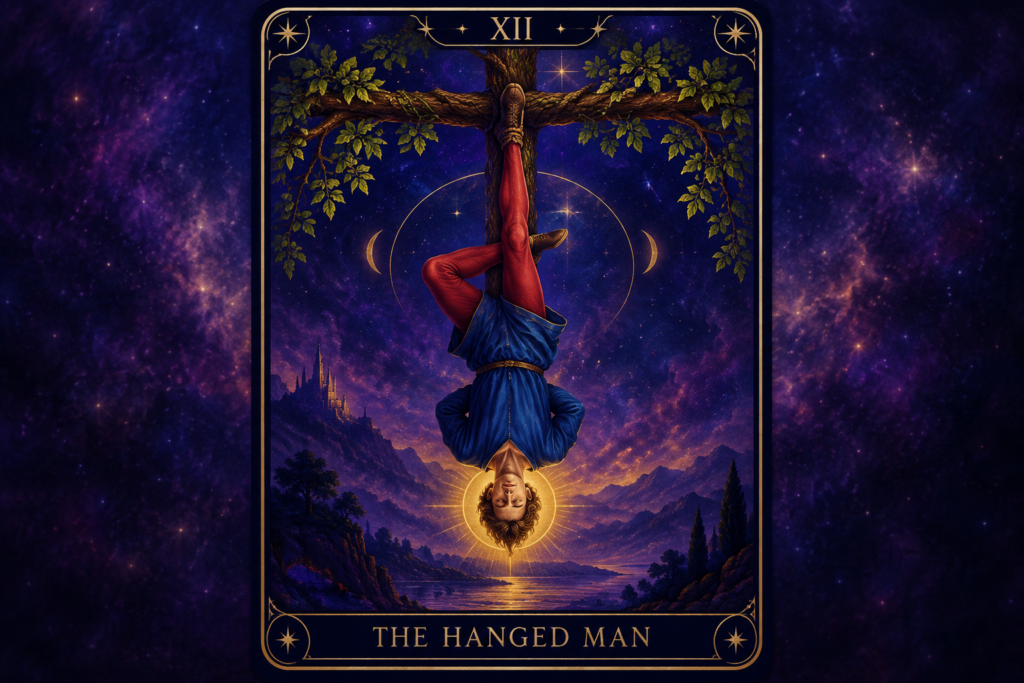
Pamela Colman Smith’s 1909 illustration packs the yes/no meaning into a handful of details, and knowing them makes the card far easier to read in a real spread.
The upside-down figure. He hangs by one ankle, not by the neck. This is not an execution. It is a deliberate change of vantage point. Everything the figure sees is inverted, and that is the point: the answer you want is visible only from a position you have not yet tried.
The T-shaped cross of living wood. The gallows is a Tau cross made from a tree that still has leaves on it. Waite notes the Tau shape directly. Living wood signals that the situation is alive and growing, not dead. Whatever you are waiting on has not been cancelled.
The halo. A nimbus surrounds the figure’s head. The suspension produces insight. In a yes/no reading, this is the clue that the “maybe” resolves into clarity once you stop struggling.
Red hose (legs) and blue tunic. Red on the lower body stands for the physical, the passionate, the part of you that wants to act now. Blue over the torso stands for knowledge and spiritual depth. The body is tied; the mind is free. That is the card instructing you to think before you move.
The bent leg and the arms behind the back. The free leg bends behind the tied one, forming a shape that resembles a figure 4 or an inverted triangle when combined with the arms. Waite describes the whole figure as forming a fylfot cross. Readers treat the inverted triangle as a water symbol, which links back to the card’s element.
The serene face. There is no struggle in his expression. This detail separates voluntary sacrifice from martyrdom. He chose this. When the card appears reversed, that serenity is the first thing lost.
When the Upright Hanged Man Can Lean Yes
The “maybe” is not fixed. There are three situations where I read the upright card as a soft yes:
-
You have already done the waiting. If the querent has spent months in reflection, therapy, or deliberate stillness about this exact question, the Hanged Man confirms the pause was the right call and the shift is close. Look for the Wheel of Fortune, the Star, or the Six of Wands nearby to confirm.
-
The question is about letting go. “Should I stop chasing this?” or “Should I release this grudge?” gets a clear yes from the upright Hanged Man. Surrender is the card’s native language.
-
The question is about a change of approach. “Should I try a different strategy?” is a yes. “Should I keep doing what I’m doing but harder?” is a no.
Outside those cases, hold the line on “not yet.” Readers who stretch the card into a yes to please a client are the reason it has a reputation for being unreliable.
Upright vs Reversed in a Yes/No Spread
The reversed Hanged Man has two legitimate readings, and the question determines which applies.
Reading one: no, because you are stuck. The suspension has gone on too long. You are not gaining perspective anymore; you are hiding in the pause. The sacrifice has become martyrdom, meaning you are giving things up for no return and quietly resenting it. If you ask “will this work out if I keep waiting?”, the answer is no.
Reading two: yes, it is time to act. Flip the question. “Should I finally make the decision?” The reversed card says yes, cut yourself down, your feet belong on the ground now.
Waite’s own reversed keywords for the card include “selfishness” and “the crowd,” which point to the martyr who sacrifices for approval rather than growth. Keep that in mind when the card shows up reversed in love or work questions.
The Hanged Man in Love
Upright: Productive Waiting
For singles, the upright Hanged Man says the person or situation you want is not ready, and neither are you. It is a “not yet” on new relationships and a firm “stop” on pursuing someone who has gone quiet. The surrender it asks for is the end of the chase. Delete the draft text. The halo appears after you do that, not before.
For couples, this card describes a relationship in a holding pattern that is actually healthy. One partner is dealing with grief, a job change, or a health issue, and the relationship needs to tolerate a season where it is not the priority. “Will we move in together this year?” gets a “not yet.” “Should I stop pressuring them about it?” gets a yes.
Reconciliation questions get a “maybe” with a condition attached: the reunion only works if one of you has changed their view of what went wrong.
Reversed: Stagnation and One-Sided Sacrifice
Reversed in a love reading, the Hanged Man is uncomfortable. The pause has curdled. Common patterns:
- One partner gives up friends, ambitions, or boundaries and calls it love. The other partner does not reciprocate. This is the martyrdom reading, and the answer to “is this relationship balanced?” is no.
- A couple that has been “taking a break” for over a year with no conversation about what the break is for.
- A single person who refuses to date because they are “working on themselves” but has not actually done any work.
“Should I stay and keep waiting for them to change?” is a no. “Should I have the hard conversation this week?” is a yes.
As Feelings: How Someone Feels About You
When the Hanged Man represents another person’s feelings, they are suspended about you. They are not cold and they are not committed. Specifically:
- They are seeing you differently than they used to, often more favourably, but they have not decided what to do with that.
- They feel they would have to give something up to be with you (freedom, an existing situation, a self-image) and they are weighing the cost.
- They are waiting for a sign and will not make the first move.
Reversed as feelings, the person is stuck in their own indecision and may be quietly resentful that you have not forced the issue. Or they feel like a martyr in the connection already, which is a warning sign about how they will behave later. Either way, do not read reversed Hanged Man feelings as “they have decided against you.” They have not decided at all, and they are tired of not deciding.
The Hanged Man in Career and Money
Upright: The Purposeful Pause
Career questions bring out the best in this card. “Will I get the promotion?” is a “not yet,” but the useful part is the instruction attached: use the delay to test the assumptions you have been operating on.
Concrete applications:
- A hiring process that stalls after the final interview. The card says the delay is on their side and your job is to stop refreshing your inbox. Pushing will not help.
- A business idea you have been sitting on. The Hanged Man favours a quiet prototype phase over a launch. Spend the suspension period talking to ten potential customers rather than building the product.
- A decision between two job offers. The card says you are evaluating them with the wrong criteria. Flip the frame: which one would you regret turning down in five years?
Financially, the upright Hanged Man is a “hold.” Do not make a major purchase, do not sell in a panic, do not take the loan this month. It is not a loss card. Money is simply frozen, and that is often protective.
Reversed: Stagnation and Martyrdom at Work
Reversed, the career Hanged Man describes the colleague who has been “about to leave” for three years, or the founder who keeps the business on life support because closing it feels like failure. Delays here are self-inflicted.
The martyrdom theme is loud in workplace readings. The person who covers everyone’s shifts, never takes holiday, and is bitter about it. The answer to “will my sacrifice be rewarded?” is no. The answer to “should I set a boundary or resign?” is yes.
In money questions, reversed means you have been avoiding a necessary decision: the debt you will not look at, the investment you will not sell at a loss, the price you will not raise. Act.
The Hanged Man and Health
Upright, the card is about rest. Not aspirational self-care, but the body telling you to stop. It appears for burnout, for recovery periods after surgery or illness, and for chronic conditions where the only effective strategy is pacing. “Will I recover quickly?” is a “not yet, and rushing will set you back.” The card also shows up when a diagnosis is pending and the waiting itself is the hard part.
Reversed, the health Hanged Man is the person who refuses to rest and is paying for it: the pulled muscle that keeps getting re-injured, the insomnia that is being treated with more caffeine, the appointment that keeps getting postponed. The body is forcing a pause that the mind keeps overriding. Book the appointment.
A word on ethics: tarot is not a diagnostic tool. The card can point to the pattern (exhaustion, avoidance), but a physician points to the cause.
Spirituality and Shadow Work
The Hanged Man is the Major Arcana’s clearest invitation to shadow work. Hanging upside down, the figure sees what was hidden by the normal angle of vision. Spiritually, the card marks the stage of a path where effort stops working and surrender starts working. Meditation practice goes flat, the usual rituals feel empty, and the instruction is to stay in the emptiness rather than fill it.
The Neptune rulership matters here. Neptune governs mysticism and dissolution, and also illusion. The upright card is genuine insight gained through stillness. The reversed card is spiritual bypassing: using “I’m just surrendering to the flow” as an excuse to avoid a decision that is plainly yours to make. If a reading on your spiritual life produces the reversed Hanged Man, the question to sit with is: what am I calling faith that is actually fear?
Reading the Card by Spread Position
As Advice
The Hanged Man as an advice card is one of the most direct in the deck. Stop. Do not send the email, do not make the offer, do not confront them this week. Change your vantage point first. If you need a practical translation, give the situation a fixed window (two weeks is a reasonable default) during which you take no action and only observe.
Reversed as advice: the opposite. Stop deliberating. The information you have is the information you are going to get.
As Outcome
In the outcome position, the upright Hanged Man means the situation will not resolve within the timeframe of the reading. That is not a failure of the reading. It is the answer. The outcome is a suspended state, and the matter will remain open until you change your approach. If you asked a yes/no question and this card lands in the outcome slot, record it as “maybe” and re-ask in a month.
Reversed as outcome: a resolution is coming, and it arrives because someone finally stops stalling. Whether that is good news depends on the surrounding cards.
Timing: When Will Things Move?
The Hanged Man is one of the worst cards in the deck for timing questions, and it is honest about that. Neptune dissolves schedules. If you must assign a timeframe, traditional readers lean on Water and suggest a period of weeks rather than days, but the better answer is “things move when you stop pushing,” which may be tomorrow or may be months. Cards that follow the Hanged Man in a sequence tell you more about timing than the Hanged Man itself. The Eight of Wands after it means fast movement once the shift happens. The Four of Swords after it means the pause is longer than you hoped.
The Hanged Man Compared to Neighbouring Cards
Four cards get confused with the Hanged Man, and contrasting them sharpens the yes/no reading.
Death (XIII). Death follows the Hanged Man in the sequence and finishes what it starts. Death is an ending, often a firm no to the old situation and a yes to transformation. The Hanged Man is the pause before that ending. If you pull both, the suspension is about to break.
Temperance (XIV). Temperance is also a slow, patient card, but it is active patience: mixing, blending, adjusting. Temperance says “yes, with balance.” The Hanged Man says “not yet, with stillness.” Temperance is a chemist; the Hanged Man is a monk.
The Tower (XVI). The Tower is involuntary disruption. The Hanged Man is voluntary suspension. Both involve a kind of falling, but the Hanged Man chose his position. The Tower is a hard no. The Hanged Man is a soft wait.
The Chariot (VII) and The Magician (I). Both are cards of will and forward motion. They are yes cards. The Hanged Man is their inversion: will suspended, motion stopped. If you are drawing the Hanged Man repeatedly and wishing it were the Chariot, that is the reading.
How to Use the Hanged Man in a Yes/No Spread
A practical method that stops the card from derailing a reading:
-
Ask a question that has a real yes or no. “Will we get back together?” is poor. “Should I reach out to them this month?” is better. The Hanged Man punishes vague questions by giving vague answers.
-
Pull one card. If it is the Hanged Man upright, record “not yet” and pull one clarifier. The clarifier tells you what the pause is for. A Swords card means the pause is mental (you need information). A Cups card means it is emotional (you need to process). Pentacles means practical (you need resources). Wands means the pause is about motivation and will.
-
If it is the Hanged Man reversed, ask yourself which question you actually asked. “Should I keep waiting?” is a no. “Should I act now?” is a yes. Reversed almost always means the stalling is the problem.
-
Do not pull again hoping for a cleaner answer. The Hanged Man appearing in a yes/no spread is itself the message. Redrawing is exactly the impatience the card is addressing.
-
Set a re-ask date. Thirty days is a sensible default for most questions. Write down what you will do differently in that time, because the card’s “not yet” is conditional on you shifting your perspective.
FAQ
Is the Hanged Man a yes or no card?
Upright, the Hanged Man is a “maybe” or “not yet,” not a yes and not a no. The situation is suspended, and the outcome depends on you changing your approach or waiting for better timing. Reversed, it is a “no” to continued stalling, which often translates to “yes, act now.”
What does the Hanged Man mean in love?
Upright, it signals a healthy pause: do not chase, do not force the relationship forward, let the other person come to their own decision. Reversed, it points to stagnation, one-sided sacrifice, and a partner who is not reciprocating. The reversed card in love is a prompt to have the overdue conversation.
Can the Hanged Man be a positive card?
Yes. The figure wears a halo and has a serene expression; the suspension produces insight. It is positive when the question concerns letting go, changing strategy, or resting after burnout. It also leans positive when the querent has already done the reflective work the card asks for.
What does the reversed Hanged Man mean?
Reversed, the Hanged Man describes resistance, indecision, and martyrdom: sacrifice that has stopped producing growth and started producing resentment. In practical terms it says the waiting period is over and the next step is action. It can also indicate someone using “patience” or “surrender” as a cover for avoidance.
How do I read the Hanged Man in a spread?
In the advice position it means stop and reconsider. In the outcome position it means the matter stays open beyond the reading’s timeframe. As someone’s feelings, it means they are undecided about you and waiting for a sign. For timing questions, it means things move when you stop pushing, and the following card gives a better clue to speed.
Which decks show the Hanged Man with a halo and a T-shaped cross?
The Rider-Waite-Smith deck, illustrated by Pamela Colman Smith in 1909 under the direction of Arthur Edward Waite, established those details. Most modern decks follow that template: an inverted figure hanging by one ankle from living wood, red lower garments, blue upper garments, and a nimbus around the head. Older Marseille-pattern decks show a similar figure without the halo.