
Four Of Pentacles: Yes or No Tarot Meaning
Last updated: March 2025
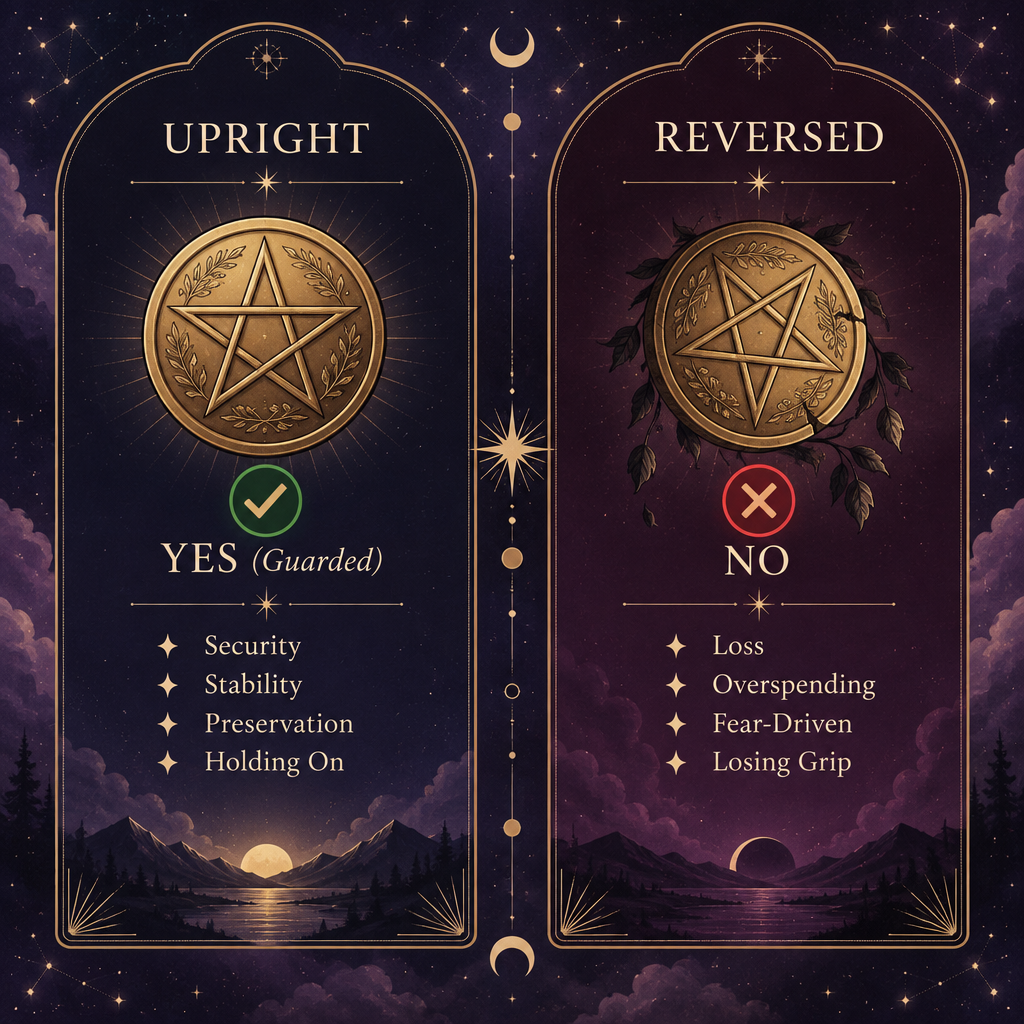
The Four of Pentacles upright is a yes in a yes or no reading, though a guarded one: it points to security, stability and holding on to what you already have. Reversed, it is a no, warning of loss, overspending, fear-driven decisions or a grip that is finally slipping. Here is how that verdict shifts across love, money, career, health and family, and what to do when this card lands on your table.
The quick answer
| Position | Yes or no | Core message |
|---|---|---|
| Upright | Yes (guarded) | What you have is safe. Keep it. Do not gamble it. |
| Reversed | No | Something is being lost, wasted or clung to past its usefulness. |
A note on the disagreement you will find online. A minority of readers flip this card, calling upright a no because of its possessive, closed-off energy, and reversed a yes because it can mean release. That reading is not wrong so much as narrow. The Four of Pentacles is the most stable card in the Minor Arcana, and stability is what most yes or no questions are secretly asking about. Will the money hold? Will the relationship last? Will I keep the job? Upright, the card answers all of those with a yes. The possessiveness is a side effect of the security, not the main message. Reversed, that security dissolves, which is why the balance tips to no.
What the card shows
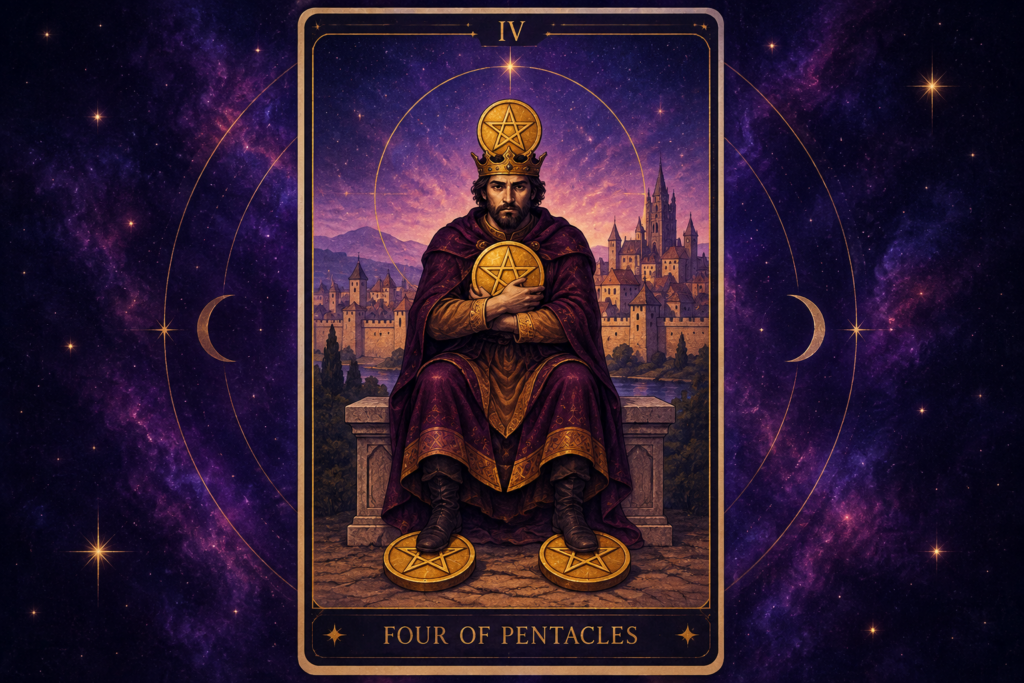
In the Rider-Waite-Smith deck, a man sits on a plain stone bench with a walled city behind him. He wears a crown topped by a single pentacle. A second pentacle is clamped against his chest with both arms wrapped around it. Two more sit under his feet, pinned to the ground. Four coins, four points of contact, nothing left unguarded.
Every element in that picture feeds the yes or no reading:
- The coin on the crown means his thinking is dominated by money, property and status. Material concerns sit at the top of the agenda.
- The coin at the chest blocks his heart. He has what he wants, but he cannot hug anyone while holding it. This is where the love-reading caution comes from.
- The coins under his feet mean he cannot walk anywhere without letting go. He is rooted, which is good for stability and bad for movement.
- The stone bench is cold and hard. He has chosen security over comfort.
- The city behind him shows that he has physically removed himself from other people. He is not poor. He has left town to protect what he owns.
Upright, this is a man who will not lose what he has. That is the yes. Reversed, the coins fall, the posture breaks, and either he loses his grip or he finally opens his hands. That is the no, with a small exception for questions about letting go, covered below.
Keywords at a glance
| Upright | Reversed |
|---|---|
| Security, stability | Loss, insecurity |
| Saving, conservation | Overspending, reckless risk |
| Control, boundaries | Loss of control, chaos |
| Possessiveness, holding tight | Greed turning destructive |
| Caution, consolidation | Stagnation, isolation |
| Material focus | Letting go, generosity (the one positive shade) |
Element and number
Pentacles are the suit of Earth: money, bodies, homes, land, routines, anything you can touch. Earth answers slowly and literally. When an Earth card gives a yes, the yes is solid but often unglamorous, and it rarely arrives fast.
Four is the number of foundations and structure. Think of the four legs of a table or the four walls of a room. Every Four in tarot marks a pause after the activity of the Three: the Four of Wands celebrates, the Four of Cups withdraws, the Four of Swords rests, and the Four of Pentacles locks the door. Fours are stable to the point of being stuck, which is exactly why this card says yes to questions about keeping things and hesitates on questions about changing them.
The traditional astrological attribution is the Sun in Capricorn, a Saturn-ruled sign. Saturn brings discipline, limits and long-term thinking, and Capricorn adds ambition and a fear of ending up with nothing. That combination explains the card’s whole personality.
When the upright card is a yes, and when it is a maybe
The upright Four of Pentacles is a clear yes to any question where the desired outcome is preservation:
- Will the deal, lease or contract hold? Yes.
- Is my money safe where it is? Yes.
- Will my partner stay? Yes.
- Should I keep my current job for now? Yes.
It becomes a maybe, leaning towards no, when the question is about expansion, risk or generosity:
- Should I invest in this new venture? Maybe. The card says protect capital, not deploy it.
- Should I move cities, quit, or start over? Maybe. The figure cannot walk without dropping a coin.
- Will they open up to me emotionally? Maybe. Something is being guarded.
- Should I lend money to a friend? Leaning no. The card does not share.
The practical rule: if a yes to your question means things stay as they are, the upright card confirms it. If a yes means things change, treat the card as a caution to slow down, not a green light.
Love and relationships
Upright: yes, with a cold spot
For “will this relationship last” or “are they committed”, upright is a yes. This is a loyal, steady partner who does not stray and does not leave. The downside is written on the card: the coin pressed against the heart. Expect someone who holds back emotionally, resists big spending on the relationship, or keeps score. Jealousy and possessiveness can appear, but they come from fear of loss rather than lack of love.
If you are single and asking “will I meet someone soon”, the upright card is a weak yes at best. It suggests you are not currently making room for anyone. Dating from a defensive crouch does not produce many first dates.
Reversed: no
Reversed in love is a no for questions about commitment or stability. Walls that were protecting the relationship are coming down, and that can mean a partner pulling away, a breakup over money, or a sudden reckless decision one of you cannot take back. The one exception is a question like “should I let go of this ex” or “is it time to stop clinging”, where the reversed card nods along. Release is the only thing it says yes to.
Career
Upright: yes
Asking whether your position is secure, whether a contract will be renewed, or whether a conservative decision is right? Yes. This card loves tenure, pensions, steady employers and roles with defined responsibilities. It also describes a manager who hoards information, resists delegating and distrusts new tools. If that is you, the card is still a yes on job security, but a nudge that your grip may be costing you promotion into roles that require trust in others.
For “should I take the new offer” or “should I go freelance”, read it as a maybe that leans no. Four of Pentacles energy says the known paycheck is worth more than the unknown upside, at least for now.
Reversed: no
Reversed career questions get a no. Something is leaking: a budget cut, a lost client, a layoff rumour that turns out to be true, or your own impulsive decision to walk out without a plan. If you are asking whether to invest savings in a business idea, the reversed card is the strongest no in the suit. Protect the runway first.
Money and finances
This is the card’s home ground, and the readings are the most literal.
Upright: yes
Will I have enough? Yes. Is my savings plan working? Yes. Will I get the loan, the mortgage, the refund? Yes, because the card describes assets that stay put. It favours emergency funds, index funds, paying down debt, and saying no to the group holiday you cannot afford. It does not favour speculation, lending, or gifts. If you asked “should I buy the car” and pulled this card, the answer is: only if you can pay cash and still sleep.
Reversed: no
Reversed money questions get a no. Either you are about to lose something through theft, a bad investment or an unexpected bill, or you are about to spend in a way you will regret. People sometimes pull this card reversed after a windfall and read it as “yes, enjoy it”. Do not. Reversed Four of Pentacles after a windfall is the card that shows up before the money is gone.
Health
Upright: yes
For “will I recover” or “is my condition stable”, upright is a yes. The body is holding. The card does carry a warning about rigidity: stiff joints, tension held in the chest and shoulders, constipation, or a fear-driven refusal to try a new treatment. If your question is “should I change my regime”, the answer is a maybe, because the card trusts routine over experimentation.
Reversed: no
Reversed health questions lean no. Defences are down, immunity is low, or a controlled condition is slipping. It can also flag the opposite pattern: finally releasing physical tension or abandoning a strict regime that was doing harm. If your question is specifically about letting go of stress, the reversed card is one of the few places it gives a yes. For anything else, see a professional and do not rely on a card.
Family and non-romantic relationships
Upright, the card says yes to questions about family stability: will the house stay in the family, will my parents be provided for, will the inheritance go through. It also describes the relative who controls the purse strings, keeps the thermostat at an exact number, and remembers every loan. Boundaries are firm, which is a yes for “will they respect my decision” and a maybe for “will they help me financially”.
Reversed, family questions get a no. Expect disputes over money or property, a sibling who overspends shared funds, or a long-standing arrangement collapsing. If you are asking “should I stop trying to control my adult child’s choices”, reversed says yes, and that is the card’s kinder face.
The spiritual lesson: scarcity versus abundance
Strip the coins away and the Four of Pentacles is about fear. The man on the bench is not greedy because he loves money. He is clutching because he believes there will never be more, and that belief has cost him his view of the city and the use of his arms.
Upright, the card asks you to notice where a scarcity mindset is running your decisions. Saying no to every invitation. Keeping money you will never spend. Refusing to say “I love you” first. These are rational if the world really is running out. Usually it is not.
Reversed, the lesson arrives one of two ways. Either life pries your fingers open through loss, which is the painful version and the reason for the no, or you choose to open them yourself. Giving a little, spending a little, trusting a little. The second path is the only one that turns this card’s reversal into something that feels like a yes.
What to do when you draw it
Upright:
1. Confirm the yes, then check what you are protecting. If your question was about keeping something, relax. If it was about getting something new, hold off and revisit in a month.
2. Audit your boundaries. Firm is good. Sealed shut is not. Pick one small place to loosen: one honest conversation, one modest purchase that brings pleasure, one yes to a plan.
3. Keep doing the boring, correct thing with money. Automate savings. Do not time the market.
Reversed:
1. Treat the no as a stop sign on any spending, lending or investing decision for the next two weeks.
2. Look for the leak. Check statements, contracts, subscriptions. Something is draining.
3. Ask whether you are clinging to anything past its expiry date. A job, a grudge, a relationship, a storage unit. If the answer is yes, that is the only thing this card is telling you to let go of.
How to ask better yes or no questions with this card
The Four of Pentacles exposes badly phrased questions faster than almost any other card. “Will I be happy?” produces a muddled answer because happiness and security are not the same thing. Try these instead:
- Replace “should I” with “will X stay stable if I do Y”. The card answers stability questions cleanly.
- Separate keeping from gaining. “Will I keep my job” and “will I get promoted” are two different questions and this card gives two different answers.
- Avoid questions where the yes requires generosity from someone else. The card is not a reliable predictor of other people opening their wallets or hearts.
- For one-card pulls in an app or a quick morning draw, read upright as “protect, do not expand” and reversed as “something is slipping, check your accounts”. That covers ninety percent of situations without a spread.
Neighbouring cards for context
Three of Pentacles comes before it and is about building with others: teamwork, apprenticeship, visible progress. The Four is what happens when the building is done and the owner locks up. If both appear, the yes is strong, and the project is finished and secure.
Five of Pentacles comes after it and shows two figures out in the snow, having lost everything. The Five is what the man on the bench is afraid of. Reversed Four next to an upright Five is a firm no on any financial question. Upright Four next to the Five says the fear is bigger than the danger.
Four of Cups is the emotional twin: a figure sitting alone, refusing what is offered. Together with the Four of Pentacles, the message is total withdrawal, and any question about connection gets a no regardless of orientation.
Six of Pentacles is the cure. The hand that gives. If it appears with the Four, the reading is pointing you towards release, and a question about generosity turns into a yes.
FAQ
Is the 4 of Pentacles a yes or no card?
Upright, yes. It signals security, stability and keeping what you have. Reversed, no, pointing to loss, overspending or something slipping out of your control.
Does the reversed Four of Pentacles mean yes?
Generally no. The reversal removes the stability that makes the upright a yes. The one exception is a question about letting go, releasing control or ending a pattern of clinging, where reversed gives a yes.
Is the Four of Pentacles a good card?
For questions about safety and keeping things, it is one of the best. For questions about growth, romance or generosity, it is a caution. Most readers call it a positive card with a warning attached, which is why “guarded yes” is the most honest label.
What does the Four of Pentacles mean in a love reading, yes or no?
Upright, yes to commitment and loyalty, with a warning about emotional guardedness or possessiveness. Reversed, no, suggesting walls coming down in a destructive way, a breakup over money, or one partner pulling back.
Why do some sites say the Four of Pentacles upright is a no?
They focus on the figure’s closed, miserly posture and read it as blocked energy. That is a valid shade of meaning, but it ignores the card’s core theme of stability, which answers most yes or no questions in the affirmative. Read it as a yes with conditions rather than a no.
What does the Four of Pentacles mean for money, yes or no?
Upright, yes: your finances are secure and saving is the right move. Reversed, no: expect a loss or a spending decision you will regret, and avoid investing or lending until the situation clears.