King Of Cups: Yes or No Tarot Meaning
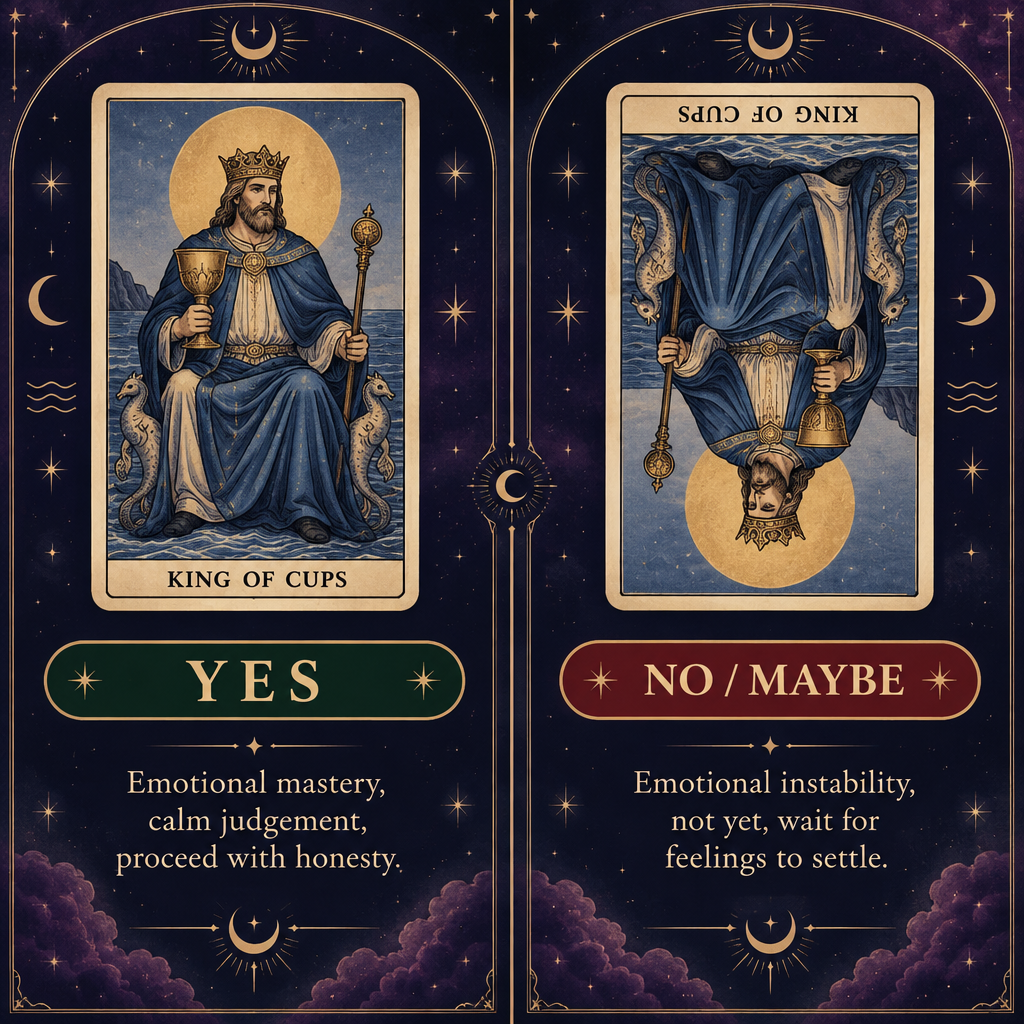
The King of Cups is one of the easiest court cards to read in a yes or no spread because his whole image is about staying steady while the water churns. Upright he is a yes, reversed he is a no that softens into a maybe once emotions settle. Here is the verdict first, then the detail for whatever you actually asked about.
Quick Answer
| Position | Verdict | Why |
|---|---|---|
| Upright | YES | Emotional mastery, calm judgement, a mature person or outcome. Proceed, but lead with honesty rather than force. |
| Reversed | NO, or MAYBE | Emotional instability, suppression or manipulation blocks the result. Not now, and not until the feelings in play are dealt with. |
If you drew the King of Cups upright, the answer to a straight question is yes. If reversed, treat it as a conditional no: the situation itself is not doomed, but the emotional ground under it is unstable, and acting now means acting on shaky footing.
Card Overview and Attributes
| Attribute | Detail |
|---|---|
| Suit | Cups |
| Element | Water (some Golden Dawn-based systems add a fiery, active quality to all Kings, giving “Fire of Water”) |
| Zodiac | Cancer most commonly; Scorpio and Pisces also cited by readers who use a three-sign water grouping |
| Season | Winter in the common modern Cups scheme (readers who go by Cancer sometimes use midsummer) |
| Court rank | King: mastery and outward expression of the suit’s energy |
| Upright keywords | Emotional maturity, compassion, diplomacy, calm under pressure, wise counsel, loyalty, control of feelings without denying them |
| Reversed keywords | Emotional suppression, volatility, moodiness, passive aggression, manipulation, coldness, using sympathy as leverage |
| Yes or no | Upright yes, reversed no/maybe |
Symbolism in the Rider-Waite Image
Pamela Colman Smith drew the King of Cups for the 1909 Rider-Waite deck, and almost every modern yes/no reading leans on details she chose. Knowing them makes the verdict less arbitrary.
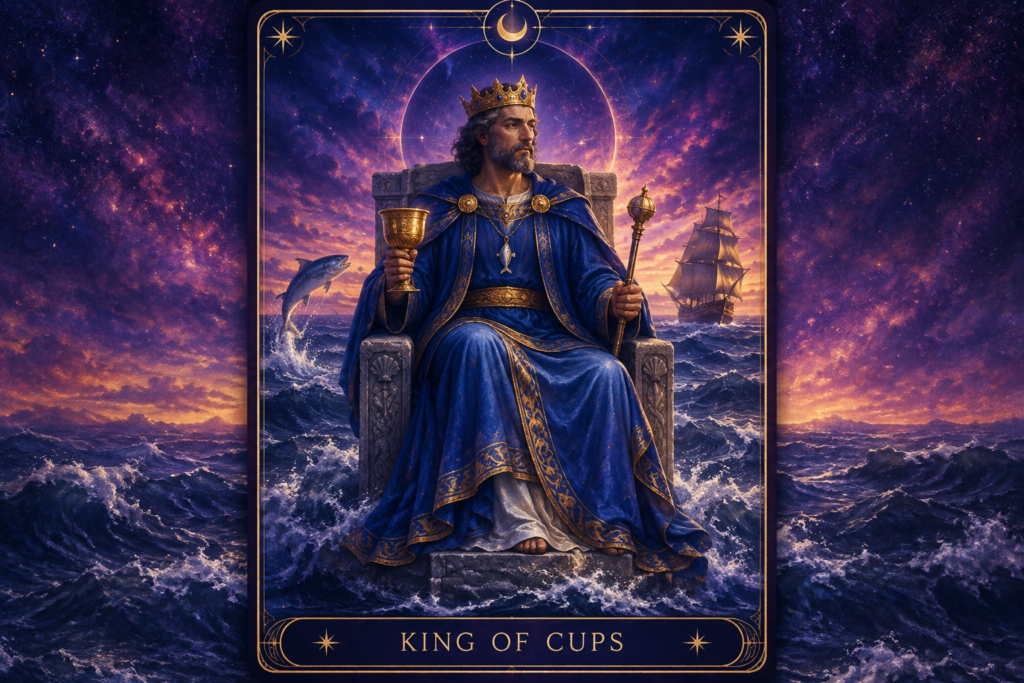
The throne on the water. The king sits on a stone seat that appears to float on a grey, rolling sea. Nothing is anchored, yet he is not gripping the armrests. The card’s whole argument is that you can be surrounded by emotional turbulence and still make a sound decision. That is why upright reads as yes: the question you asked lives inside a moving situation, and this card says you have the composure to handle it.
The cup and the scepter. His right hand holds a cup, his left a short scepter. One is feeling, the other is authority. He has both, and he holds them level. Compare that with the Page or Knight of Cups, who hold only the cup. The scepter is what turns raw emotion into a decision.
The fish amulet. A small fish hangs at his chest. Fish in the Cups suit represent the unconscious, intuition, the material that swims below the surface. Wearing it as a pendant means he has brought that material up and made peace with it rather than letting it drive him from below.
The leaping fish and the ship. Behind his left shoulder a fish breaks the waves; on the right a ship sails under full canvas. Life goes on around him. He is aware of it, not consumed by it. Reversed, picture the same scene upside down: the throne tips, the water pours over him, the amulet dangles uselessly. The feelings he had integrated are now running the show.
Other decks shift the emphasis. The Marseille Roi de Coupe sits on dry ground, cup raised, with none of the sea imagery, so Marseille readers lean on the rank (King equals command) rather than on calm-amid-chaos. In Crowley’s Thoth deck the equivalent card is the Knight of Cups, an armoured figure on a white horse carrying a cup with a crab, pointing directly at Cancer. Whatever deck you use, the yes/no logic holds: mastery of water upright, drowning in it reversed.
King of Cups Upright: Yes
Upright, this is a confident yes. Not a lucky-break yes like the Sun or the Ace of Cups, but a yes earned through good judgement and steady handling of people.
Expect the outcome to come through someone’s emotional intelligence, possibly your own. The question resolves because tempers are kept, because a difficult conversation is handled with tact, because someone chooses compassion over point-scoring.
What to do with an upright yes:
- Proceed, but do not rush. The king does not leap; he decides.
- Say the true thing kindly. The card rewards honesty delivered with care, not bluntness and not avoidance.
- If the question involves another person, trust the mature one in the room. If that is you, act like it.
- Watch the one risk: being so diplomatic that you never state what you actually want. The scepter matters as much as the cup.
King of Cups Reversed: No, Leaning Maybe
The old reading of this reversal as “laziness and selfishness” misses what the image actually shows. Reversed, the King of Cups is not lazy. He is overwhelmed, and he is managing that overwhelm badly. That looks like one of two things.
Suppression. The feelings are pushed down so hard that the person seems cold, detached, impossible to reach. Decisions get made with no emotional input at all, which is as unbalanced as being ruled by feeling. Think of the partner who says “I’m fine” through gritted teeth for three weeks.
Volatility and manipulation. The water floods in. Mood swings, sulking, guilt trips, passive-aggressive remarks, tears or anger used as leverage. In the worst expression the king’s gift for reading people becomes a tool for steering them.
Why the verdict is no-or-maybe rather than a flat no: the card is about state, not fate. The underlying situation may be perfectly viable. What blocks it is the emotional climate right now. Change the climate and the answer can change.
Treat it as a firm no if:
- The question is “should I act now?” or “should I trust this person as they are today?”
- Supporting cards are also heavy (Five of Cups, Seven of Swords, the Moon).
Treat it as a maybe if:
- You asked about a longer timeline, and the reversal is clearly pointing at your own current state.
- The cards around it are stabilising (Temperance, the Star, Four of Wands).
What to do with a reversed verdict: pause. Name what you are feeling before you do anything about the question. If someone else is the reversed king, stop trying to decode their moods and ask plainly what is going on. Make the decision only once the water is level again.
King of Cups Yes or No in Love
Upright: yes. For “does he/she care about me,” “will this relationship last,” or “should I open up,” upright is one of the warmest yeses in the deck short of the Lovers or Ten of Cups. It points to a partner (or a version of you) who listens, who does not punish vulnerability, and who stays loyal when things get difficult. For singles, it often describes the kind of person about to arrive: older or older-seeming, emotionally settled, likely in a caring or creative profession.
Reversed: no for now. Reversed in a love question, the answer is no while the current dynamic stands. Common patterns: a partner who shuts down rather than argues, hot-and-cold affection, emotional blackmail dressed up as sensitivity, or a person who is still carrying an unprocessed previous relationship. If you asked about reconciliation with an ex, the reversed king says the same emotional problem that ended things is still unresolved.
Action: upright, have the honest conversation you have been postponing; the card says it will land well. Reversed, stop managing the other person’s feelings for them, and be honest about whether you are the one going cold.
King of Cups Yes or No in Career and Money
Upright: yes. Especially for questions about leadership, people management, negotiations, or whether to take a role involving care, counselling, teaching, healthcare, HR or the arts. The card says the decision will succeed if you lead through steadiness and genuine interest in the people involved. For money, upright is a yes to measured, long-horizon choices: a balanced investment, a sensible loan agreement, a purchase made with a cool head.
Reversed: no. Reversed is a clear no to impulsive financial moves. Anything you are considering because you are anxious, flattered, resentful or trying to prove a point is the move this card warns against. In workplace questions it points to a manager who is moody or passive-aggressive, a team where feelings are never addressed and leak out as politics, or your own difficulty keeping emotions out of professional decisions.
Action: upright, go ahead and lead; your calm is the asset. Reversed, do not sign, quit, invest or confront this week. Sleep on it, then re-ask.
King of Cups Yes or No in Health and Well-being
Upright: yes. Questions about recovery, starting therapy, managing stress or whether a treatment plan suits you get a positive answer. The card specifically favours approaches that work with the mind-body link: counselling, consistent sleep, time near water, slow steady routines over crash efforts. If you asked whether a practitioner is right for you, upright describes exactly the kind of clinician you want: unhurried, attentive, not easily rattled.
Reversed: no, with a flag. Reversed suggests the emotional load is the health issue, or is making a physical one worse. Suppressed stress showing up as headaches, poor sleep, digestive trouble or a short fuse fits this card. It is also a warning about numbing: drinking, overeating or endless scrolling to avoid feeling something. The no is really “not until you address what you are not addressing.”
Action: upright, keep going with what is working and add something restorative. Reversed, book the appointment you have been avoiding, whether that is a doctor or a therapist, and tell them the real story.
King of Cups Yes or No in Family
Upright: yes. Family questions are home territory for this card. Will the holiday go smoothly, will a parent come round, should I be the one to make peace? Upright says yes, and it often identifies the peacemaker: a father, grandfather, uncle or older sibling (or you, in that role) who keeps everyone at the table. For questions about having or raising children, upright is a reassuring yes about your capacity to be a steady presence.
Reversed: no, or not yet. Reversed in a family reading typically names a relative who controls the room through moods, who gives the silent treatment, or who has never dealt with an old grievance that keeps surfacing at gatherings. It can also point to a father figure who was emotionally absent. Reconciliation questions get a “not yet”: the hurt is still live, and pushing for closure now will reopen it.
Action: upright, take the lead in the conversation nobody else wants to start. Reversed, set a boundary rather than attempting a fix, and refuse to be drawn into the guessing game.
King of Cups Yes or No in Spirituality and Personal Growth
Upright: yes. Should I commit to this practice, trust this teacher, follow this intuition? Upright says yes. The fish amulet is the key symbol here: the king wears his inner life openly and comfortably. For a reader asking whether they are ready for deeper inner work, this card says you have the stability to go into difficult material without being swept away.
Reversed: maybe. This is where the reversal is softest. Reversed in a spiritual question, it usually means you are either intellectualising your inner life (all study, no feeling) or being flooded by it (constant emotional processing with no integration). Neither is a dead end, which is why this reads as maybe rather than no. A teacher or guide who appears as the reversed king is one to be careful of: charismatic, intuitive, and inclined to use that intuition to create dependence.
Action: upright, deepen the practice you already have rather than adding another. Reversed, bring in grounding: a body-based practice, journalling with specific prompts, or a conversation with someone outside the spiritual context who will tell you the truth.
Advice Position: Should I Proceed?
When the King of Cups lands in the advice slot of a spread, it answers “how,” not just “whether.”
Upright: proceed, in his manner. Slow the tempo. Ask the other party how they feel before stating your position. Choose your words for their effect on the relationship, not for how good they feel to say. Decide once, calmly, and then hold the line without drama.
Reversed: do not proceed yet. The advice is to restore equilibrium first. Practically that means a short delay, a frank check-in with yourself about what you are feeling, and a refusal to act on a wave of emotion. Re-draw in a week; the card is remarkably responsive to a genuine change in state.
One-Card Pulls and Spread Positions
Single-card pull. Treat the quick-answer table literally. Upright yes, reversed no-to-maybe. For a daily draw, upright is a day for diplomacy and listening; reversed is a day to notice what you are swallowing before it comes out sideways.
Past position. Upright: a period of emotional stability, or a wise person’s influence, set up your current situation. Reversed: a past relationship or family dynamic of suppression or volatility is still shaping the question.
Present position. Upright: you (or the key person) are handling this well; keep the composure. Reversed: the emotional climate is the problem right now, whatever the surface issue appears to be.
Future position. Upright: a yes arriving through maturity, often via an older or calmer figure entering the picture. Reversed: a storm of feeling ahead that you can prepare for, which is the useful side of a reversed future card.
The King of Cups as a Person
Court cards very often describe actual people, and this one is distinctive.
Upright, he is the mentor who tells you the hard truth gently, the therapist who does not flinch, the manager everyone goes to when things go wrong, the partner who stays calm during your worst moment and does not bring it up later. He is usually older than the querent or carries himself that way. Professions that fit: counselling, medicine, teaching, the clergy, social work, music, writing, hospitality. He is not loud. People underestimate him until a crisis reveals who is actually steering.
Reversed, he is the same person with the controls jammed. The charming man whose moods set the household weather. The boss who never raises his voice but punishes with silence and reassignments. The friend who always knows exactly which nerve to press. He can also be the person who has mistaken emotional detachment for maturity and is quietly unreachable. Gender is not fixed; many women and non-binary people embody this archetype, though decks and tradition draw him as a mature man.
If you asked “who is this card?” and got the upright king, trust them. If reversed, protect your own emotional footing before engaging further.
How He Differs from the Queen, the Knight and the King of Wands
Queen of Cups shares his suit and his depth, but her mastery is inward. She feels, intuits and nurtures; he feels, decides and leads. In a yes/no reading both are upright yeses, but the Queen’s yes says “trust your intuition,” while the King’s says “trust your judgement.” Reversed, the Queen tends toward over-sensitivity and absorbing other people’s problems, the King toward control and coldness.
Knight of Cups has the cup but no scepter. He is romance, offers, proposals, the message that arrives. His yes is exciting and sometimes flimsy; the King’s yes is dependable and sometimes unexciting. If you drew the Knight and wanted the King, the situation is sincere but not yet settled.
King of Wands is the other mature male leader in the deck, and the contrast is sharp. Wands leads by energy and vision; Cups leads by understanding and composure. The King of Wands says yes, go, now. The King of Cups says yes, and here is how to do it without burning anyone. Reversed, Wands becomes domineering and reckless; Cups becomes manipulative and withdrawn.
FAQ
Is the King of Cups a yes or no card?
Upright, yes. Reversed, no or maybe depending on emotional readiness. The card measures composure, so the verdict follows whether feelings are being handled well (yes) or badly (no, until they are).
What does the King of Cups reversed mean in a yes or no reading?
A conditional no. The outcome is blocked by emotional instability, suppression or manipulation, either yours or another person’s. Resolve the emotional climate and re-ask; the answer frequently changes.
What does King of Cups reversed mean for love?
Not now. It points to a partner who shuts down, runs hot and cold, or uses feelings as leverage, or to your own unresolved emotional baggage affecting the relationship. For reconciliation questions it means the original problem is still unresolved.
Is the King of Cups a good card?
Yes. Upright it is one of the most reassuring court cards, signalling emotional maturity, loyalty and wise handling of a situation. Even reversed it is a warning rather than a disaster card, because it describes a state that can change.
What does the King of Cups mean for career?
Upright, success through compassionate leadership, diplomacy and steady decision-making, and a yes to roles in caring, creative or people-focused fields. Reversed, a no to impulsive moves and a warning about moody or passive-aggressive dynamics at work.
What zodiac sign is the King of Cups?
Cancer is the most common attribution, with Scorpio and Pisces also used by readers who link all three water signs to the Cups court. Crowley’s Thoth deck ties the equivalent card directly to Cancer through the crab on the cup.
Who is the King of Cups as a person?
An emotionally mature, calm, often older figure: a mentor, therapist, doctor, teacher, counsellor or steady partner. Reversed, the same person becomes controlling through moods, passive-aggressive or emotionally unreachable.