Knight Of Swords: Yes or No Tarot Meaning
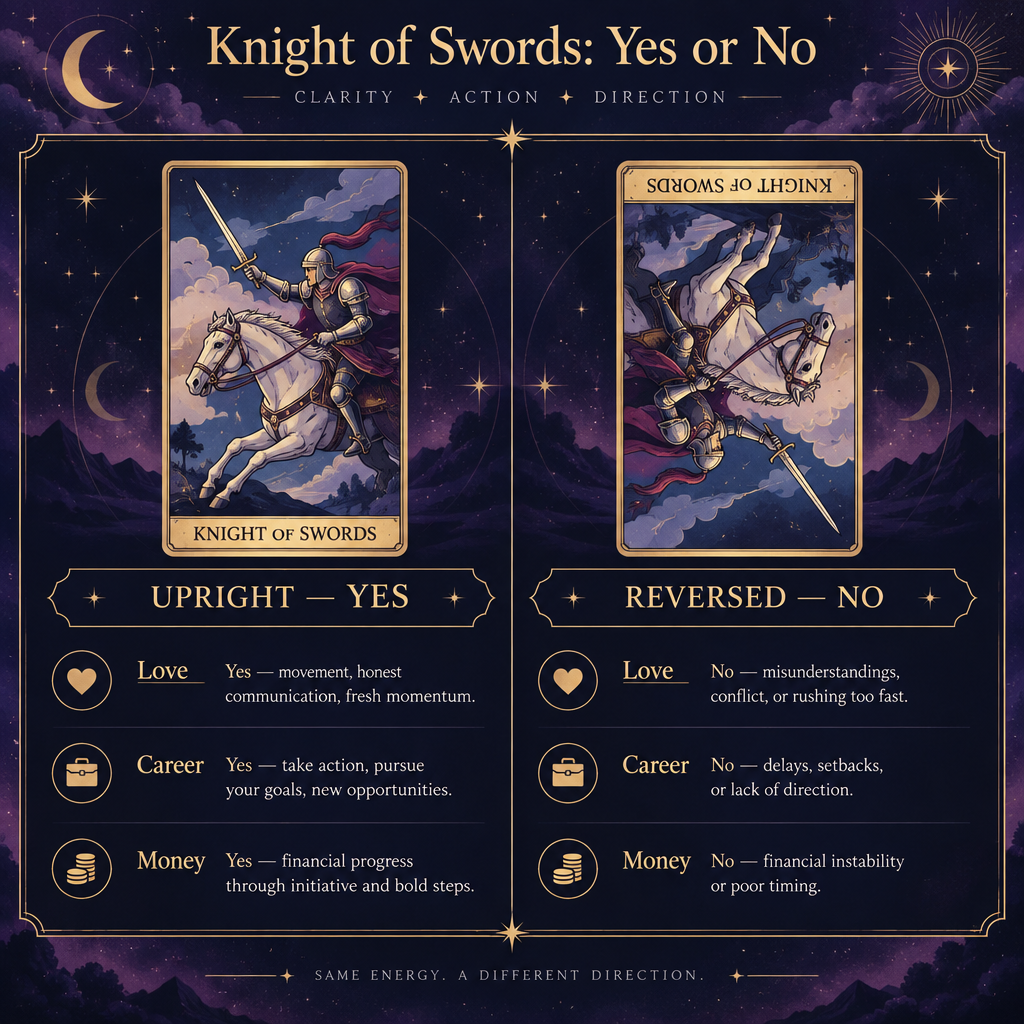
The Knight of Swords is a yes when upright and a no when reversed, and in both cases the card is about speed. Upright, it tells you the thing you asked about will happen fast if you act now. Reversed, it tells you that rushing is exactly the problem.
Quick Answer
| Position | Verdict | The condition attached |
|---|---|---|
| Upright | Yes | Act quickly and decisively. Delay weakens the answer. |
| Reversed | No (or “not like this”) | Slow down, gather facts, and stop forcing the outcome. |
| Upright, love | Yes | Someone is moving toward you with intent. Match the pace, don’t exceed it. |
| Upright, career | Yes | Go after the job, pitch, raise, or launch. Momentum is on your side. |
| Upright, money | Yes, with a caveat | Good for fast decisions, bad for impulse spending. |
| Reversed, love | No for now | Mixed signals, arguments, or someone backing away. |
| Reversed, career | No | Obstacles, scattered focus, or a plan that lacks groundwork. |
| Reversed, money | No | Impulsive risks and unchecked numbers. Wait. |
If you only read one line of this page: the Knight of Swords says yes, but only to a fast, committed version of your plan. A half-hearted version gets a different answer.
Why the Knight of Swords Reads as Yes
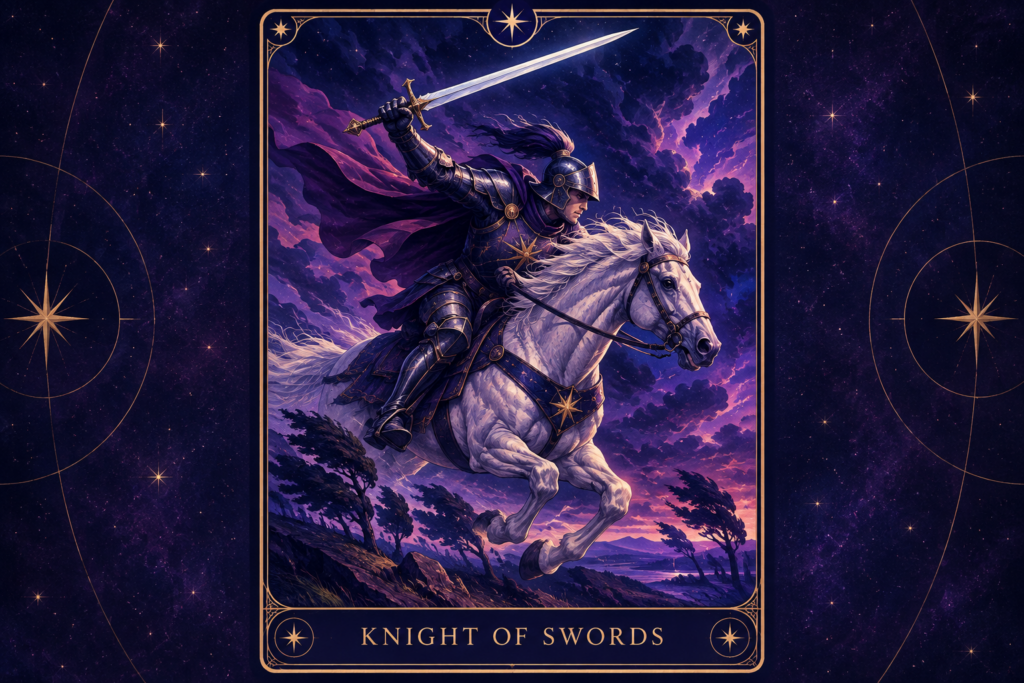
The Rider-Waite-Smith image, drawn by Pamela Colman Smith in 1909 under the direction of Arthur Edward Waite, is one of the most kinetic in the deck. A knight in full armour charges across the card on a white horse, body leaning forward, sword raised high. The horse’s legs are stretched at a full gallop and its mane and the knight’s plume both stream straight back. Behind them the sky is torn by jagged, low clouds, and the trees along the horizon bend hard in the wind. Smith added a small detail that most people miss: the horse’s harness is decorated with birds and butterflies, both creatures of the air.
Everything in the picture points the same direction. Nothing is stationary, nothing is hesitant. That is why readers across traditions treat the upright card as a yes. The question is not “will this happen” but “how fast.”
The same imagery explains the reversed meaning. Flip the card and the knight is charging headlong toward the ground. The speed is still there, but it no longer has anywhere useful to go. That is the reversed Knight of Swords in one picture: force without direction.
The Knight of Swords as a Person
Court cards often describe a real person in the querent’s life, and this one is easy to recognise. The Knight of Swords is the person who finishes your sentences, replies to a text in nine seconds, and has already booked the flights before you agreed to the trip. Sharp, articulate, often funny, frequently right, and exhausting to argue with.
In a yes/no reading, this matters because the answer may describe who is driving the situation. If you asked “Does he want to commit?” and pulled this knight upright, the yes is coming from someone who moves quickly and says what they think. If you asked “Should I trust this business partner?” the upright knight says yes, they are competent and motivated, but build in a check on their impulsiveness. Reversed, this person becomes tactless, reckless, or all talk. Deals announced and never closed. Promises made at speed and forgotten at the same speed.
Traditionally the Knight of Swords is pictured as a young adult, but the card is about temperament rather than age. The 55-year-old executive who fires off a company-wide email at midnight is a Knight of Swords.
Air Element and Zodiac Associations
Swords belong to the element of Air, which governs thought, speech, logic, and conflict. The Knight is the most mobile of the four Swords court cards, so this is Air in motion: a gale rather than a breeze. The Air zodiac signs are Gemini, Libra, and Aquarius, and the Knight of Swords carries the flavour of all three, with Gemini usually named as the closest match because of its restlessness and quick speech. The Golden Dawn system, which Waite drew on, assigns the Knight of Swords to the stretch of the zodiac running from late Taurus through most of Gemini.
For a yes/no reading, the elemental link gives you one practical rule. Air is fast but not durable. A yes from the Knight of Swords is reliable for the near term, roughly the next few weeks, and far less reliable as a prediction about where things stand a year from now.
Upright Knight of Swords: Yes or No by Question
Love
Yes. If you asked about a new connection, the person is interested and will say so, probably soon and probably bluntly. If you asked about an existing relationship, the yes points to a decision being made: moving in, a proposal, a hard conversation finally happening.
The caution is not about the answer but about the manner. This knight does not do slow courtship. If you are asking “Will they text back?” the answer is yes, and you may get three texts. If you are asking “Will this be a gentle, patient relationship?” the knight is honest: no, it will be direct and quick, and you should decide whether that suits you.
Career
Yes, and a strong one. The Knight of Swords is the best card in the suit for interviews, negotiations, pitches, and launches. It favours people who prepare their argument and then deliver it without hedging. If you asked whether to apply, apply today. If you asked whether to ask for the raise, ask this week with a specific number.
One practical note from experience with this card: it rewards the first mover. When it appears for a question about a competitive opportunity, the yes tends to belong to whoever acts first, not whoever is most qualified.
Finances
A yes, but read the question carefully. For “Should I make this decision now rather than later?” the Knight of Swords says yes, move. For “Will this quick investment pay off?” it is still a yes, with the warning that the knight sees the opportunity clearly and the risk poorly.
Where the card turns against you is impulse spending. If your question is really “Is it fine to buy this thing I saw twenty minutes ago?” the upright knight is describing your state of mind, not endorsing it. Treat the card as a yes for decisive action on things you have already researched and a flashing light on anything you haven’t.
Health
Yes for questions about recovery speed, test results arriving, or getting a diagnosis sorted out. The knight favours sharp, fast medical action: booking the appointment, pushing for the referral, starting the treatment.
It is a weaker yes for anything requiring rest. If you asked “Should I push through and keep training?” the card’s energy says yes, but the Swords suit carries a recurring warning about the mind running faster than the body. Stress, sleep loss, and burnout all sit under this card. The honest reading is: yes, you can act, and yes, you should also check whether you are running on adrenaline.
Spirituality and Personal Growth
Yes. The Knight of Swords is a breakthrough card for anyone stuck in indecision. It cuts through the fog, drops an old belief that stopped serving you, and gets you moving. If you asked whether to start a practice, take a course, or leave a community that no longer fits, the answer is go.
What it does not promise is depth. This knight has ideas rather than wisdom. Expect a fast shift in perspective followed by the slower work of integrating it, which belongs to other cards.
Reconciliation with an Ex
This gets asked more than almost any other yes/no question, so it deserves its own answer.
Upright, the Knight of Swords is a conditional yes. Contact will probably happen, and it will happen quickly: a message out of nowhere, a direct “can we talk.” The knight favours the person who initiates, so if you have been waiting for a sign, the sign is that the card is telling you to send the message yourself.
The condition is in the suit. Swords are the suit of conflict and difficult truths. A reconciliation under this knight is a reconciliation that starts with a frank conversation about what went wrong. If both of you can handle that conversation, yes. If one of you wants to skip it and pretend nothing happened, the yes collapses.
Reversed, the answer is no, at least on the current terms. Reversed, the knight describes the old arguments replaying, someone saying hurtful things in the heat of the moment, or one party pushing hard while the other retreats. If you pulled this reversed after reaching out and hearing nothing, the card is asking you to stop pushing.
Reversed Knight of Swords: Yes or No
Reversed, the card is a no. Not a tragic no, but a firm one: this is not working because it is being forced. The knight is still galloping, now with no clear destination. Three distinct flavours show up in readings:
- Reckless speed. Acting before thinking, saying things that cannot be unsaid.
- Stalled momentum. All the energy is there but nothing moves, like an engine revving in neutral.
- Scattered focus. Too many ideas, none finished.
Whichever version fits your situation, the remedy is the same: slow down, gather the facts you skipped, and let other people speak.
Love Reversed
No for now. In a new connection, the reversed knight points to hot-and-cold behaviour, someone who texts constantly and then disappears, or a person whose words are sharper than their intentions. In an established relationship it describes arguments that go in circles, one partner steamrolling the other, or a decision being pushed before both people are ready.
If your question was “Should I confront them about this?” the reversed knight gives an unusual answer: not yet, and not like you are planning to. The conversation needs to happen, but the version in your head right now is too sharp to land well.
Career Reversed
No. Obstacles, delays, or a plan that was announced before it was built. The reversed knight is the pitch that gets torn apart in the meeting because you did not anticipate the obvious question, or the job offer that evaporates after an overconfident interview.
It can also describe burnout from relentless pace. If you asked “Should I take on this extra project?” the reversed card is a clear no. You are already going too fast.
Finances Reversed
No, and this is one of the more useful no’s in the deck. The reversed Knight of Swords in a money question almost always describes an impulsive risk: the trade made on a tip, the loan to a friend who talks fast, the big purchase justified in the moment. Wait a week. If the decision still looks good with the numbers written down in front of you, ask again.
Health Reversed
No to pushing through. This is the card of ignoring symptoms, skipping rest, and letting stress run unchecked. Headaches, insomnia, racing thoughts, and anxiety all sit under the reversed knight. If your question was about a procedure or treatment, the card does not predict a bad outcome, it predicts a bad outcome from a rushed decision. Get the second opinion.
The Reversed Card’s Advice
Every reversed knight carries the same instruction: find the part of the plan you skipped. For the Knight of Swords that skipped part is nearly always listening. Ask the question you have been avoiding, read the contract you signed without reading, and let the other person finish their sentence.
How Surrounding Cards Change the Answer
A single-card yes/no reading gives you a direction. The cards around it tell you how much to trust that direction and what the yes or no will cost.
| Neighbouring card | Effect on the Knight of Swords verdict |
|---|---|
| The Tower | The yes still stands, but the fast action triggers an upheaval. Decide whether you want that. |
| The Lovers | Strengthens the yes in love questions and shifts it from attraction to actual choice. |
| Ten of Swords | Downgrades the yes. The charge ends badly. Treat as “yes, but regret.” |
| Four of Swords | Pulls the answer toward no, or toward “yes, after you rest.” A strong brake. |
| Ace of Swords | A clean, confident yes. Clarity plus speed. |
| Three of Swords | In relationship questions, the yes brings painful honesty with it. |
| The Star or Six of Wands | Softens the knight’s recklessness and points to a successful landing. |
| Seven of Swords | Suggests someone is acting fast and dishonestly. Check motives before accepting the yes. |
| The Hanged Man | Direct contradiction. Read as “not yet” regardless of orientation. |
A simple rule for multi-card pulls: when the Knight of Swords appears with other fast cards (Eight of Wands, Knight of Wands, The Chariot), the yes is nearly certain and will arrive sooner than you expect. When it appears with slow or stuck cards (Four of Swords, Hanged Man, Four of Cups), read the knight as frustration rather than progress.
Knight of Swords vs the Other Swords Court Cards
All four Swords court cards share the Air element, so all of them deal in thought and speech. Their yes/no behaviour differs sharply.
| Card | Yes/no tendency | How it differs from the Knight |
|---|---|---|
| Page of Swords | Lean yes, with uncertainty | Curious and watchful rather than charging. A “yes, investigate further.” |
| Knight of Swords | Firm yes upright, no reversed | Pure action. The least patient card in the suit. |
| Queen of Swords | Neutral, depends on the question | Clear-eyed judgement. She answers “yes if you’re being honest with yourself.” |
| King of Swords | Yes for anything legal, logical, or structured | Authority and strategy. He wins the case; the knight starts the fight. |
If you are deciding between two readings of a spread, remember that the Knight is the only one of the four who acts before deliberating. The Page gathers information, the Queen weighs it, the King rules on it. The Knight is already out the door.
How to Phrase Yes/No Questions for This Card
The Knight of Swords punishes vague questions because it answers the one thing it can see: motion. “Will things get better?” gets a confusing answer. “Should I send the email this week?” gets a precise one.
Three habits that improve your results with this card:
- Put a timeframe in the question. “Will I hear back within a month?” suits the knight’s short horizon. “Will I ever hear back?” does not.
- Ask about your action, not just the outcome. The card is strongest on “should I” questions because it is fundamentally a card about doing.
- Separate the decision from the mood. If you are already fired up, the upright knight may be reflecting your state rather than confirming the outcome. Pull a clarifier.
The Knight of Swords in Modern Decks and Apps
The card’s meaning has stayed remarkably stable across newer decks because the core idea, forward motion under a stormy sky, translates easily. The Light Seer’s Tarot keeps the rider and the wind. The Modern Witch Tarot keeps the charge but updates the figure. The Wild Unknown replaces the horseman entirely with an owl, a bird of sharp sight and silent speed, which is a clever reading of the same energy.
Tarot apps and AI reading tools have made single-card yes/no pulls far more common than they were a decade ago, and they tend to collapse this card to a flat “Yes.” That is accurate as far as it goes, but it drops the condition that makes the card useful. The Knight of Swords is not a yes that will happen to you. It is a yes that happens because you move. A reversed card flagged as a simple “No” by an app is similarly missing the point; it is a no to the current method, not necessarily to the goal.
FAQ
Is the Knight of Swords a yes or no card?
Yes when upright, no when reversed. The upright card indicates that what you asked about will happen quickly, especially if you take decisive action. The reversed card indicates obstacles caused by rushing, poor planning, or conflict.
What does the reversed Knight of Swords mean in love?
It means no for the moment. Expect mixed signals, arguments that repeat, or one person pushing while the other pulls away. The card advises pausing before confrontations and letting the other person speak rather than steamrolling them.
Does the Knight of Swords mean yes for reconciliation with an ex?
Upright, it is a conditional yes: contact is likely and will happen fast, but the reconciliation only holds if both people can have an honest conversation about what went wrong. Reversed, it is a no, pointing to old conflicts resurfacing and one party pushing too hard.
What does the Knight of Swords mean for money questions?
Upright, yes to fast, well-researched decisions and a warning against impulse spending. Reversed, no. It describes reckless financial risk and advises waiting a week before committing to anything.
What zodiac sign is the Knight of Swords?
The card belongs to the Air element and is most often linked to Gemini, with the broader Air signs Libra and Aquarius also associated. The Golden Dawn system places it across late Taurus and most of Gemini.
How fast will the Knight of Swords yes happen?
Quickly, often within days or weeks. This knight is one of the fastest-moving cards in the deck. If nothing has moved after a month, the window the card described has probably passed, and it is worth asking again.