Page Of Swords: Yes or No Tarot Meaning
Last updated: March 2026
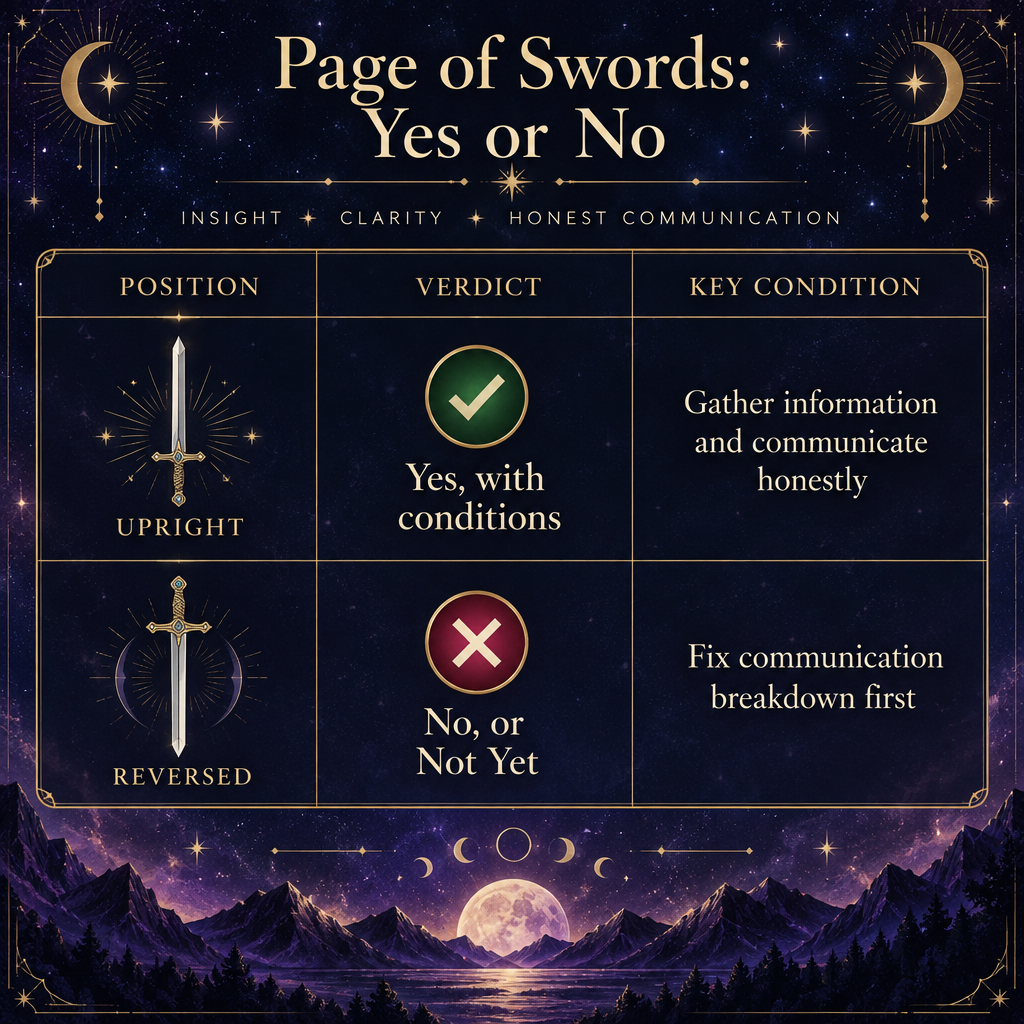
The Page of Swords is a yes in a yes-or-no reading, but it is a cautious yes that depends on what you do next. Upright, it tells you to gather information, speak plainly, and move once you understand the situation. Reversed, it shifts to “no” or “not yet,” usually because communication has broken down or someone is acting on half-formed thinking.
Quick Answer
| Position | Verdict | Why |
|---|---|---|
| Upright | Yes, with conditions | Clear thinking and honest communication favour you, but the outcome is not secured yet. Do your homework first. |
| Reversed | No, or not yet | Gossip, scattered thinking, impulsive words, or missing information are working against the question. Pause and fix the communication problem. |
| Key theme | Mental clarity and communication | The Page watches, learns, and asks questions. It does not yet act with authority. |
What the Card Shows and Why It Matters for Yes or No
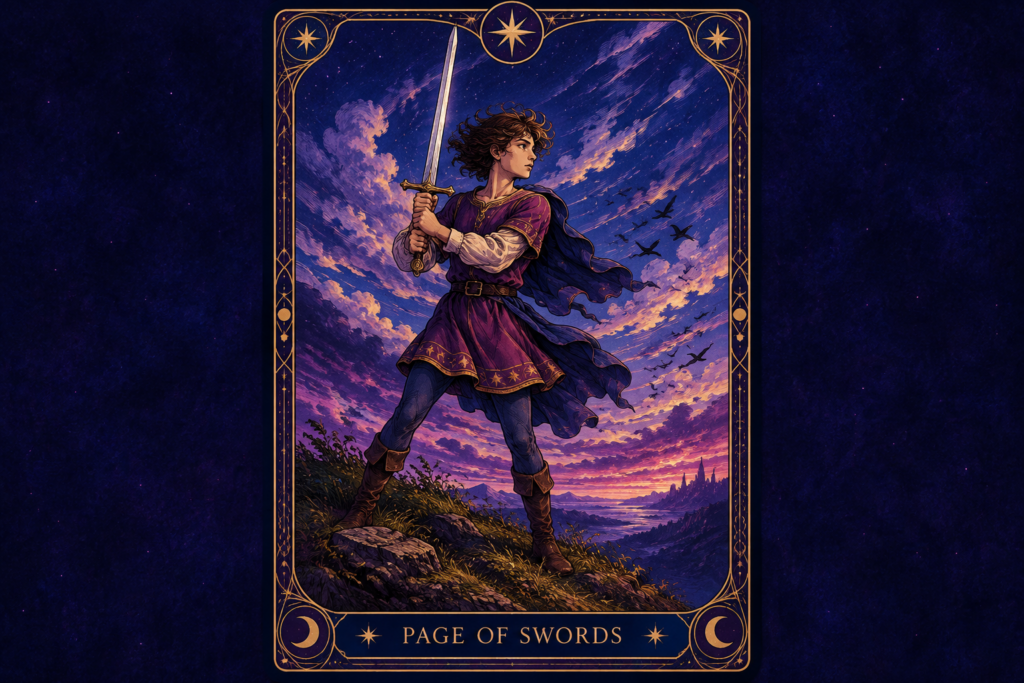
In the Waite-Smith deck, drawn by Pamela Colman Smith in 1909, the Page of Swords stands on uneven ground with a sword raised in both hands. The figure’s body faces one direction while the head turns the other way, as if listening for something behind. Wind pulls at the hair and tunic. The sky is streaked with fast-moving clouds, and a flock of birds scatters in the distance.
Every detail is about alertness rather than action. The sword is up but not swinging. The stance is ready but not advancing. This is someone watching for information, checking what is coming, deciding whether to commit.
That posture is the whole reason the yes-or-no answer is conditional. Nothing in the image says “done” or “won.” It says “prepared, if you pay attention.” When the Page appears in answer to a direct question, the card is telling you the mental conditions for success exist. The outcome still depends on whether you look before you leap.
The Suit of Swords and the Air Element
Swords belong to the element of Air, which in tarot governs the mind: thoughts, language, logic, truth, conflict, and judgement. Cups handle feelings, Pentacles handle material results, Wands handle drive and desire. Swords handle what you know, what you say, and whether it is accurate.
This shapes how the Page answers. A Swords yes is never an emotional yes or a financial guarantee. It is a yes grounded in clear thinking and honest words. If your question is about something that can be improved by asking better questions, communicating directly, or getting facts straight, the Page of Swords is on your side. If your question is about something that needs patience, deep feeling, or steady material effort, the Page is a weaker yes because that is simply not what this card governs.
Upright Page of Swords: Yes, but Gather Information First
The upright Page says the answer is favourable as long as you approach the situation with a sharp, open mind. Concretely, that means three things.
Find out what you do not know. The Page is the student of the Swords suit. Before you say yes to the job, the date, the investment, or the confrontation, ask the questions you have been avoiding. Read the contract. Check the person’s history. Confirm the dates.
Say what you mean. The Page communicates plainly, sometimes bluntly. If the question involves another person, the yes depends on honest conversation, not hints and assumptions.
Do not rush. The Page is young and quick. Enthusiasm is the gift here, but impulsiveness is the trap. The yes holds if you let your curiosity run slightly ahead of your actions rather than the other way around.
When those conditions are met, the upright Page is a genuine green light. It points toward new ideas, fresh starts, news arriving, and mental energy returning after a dull stretch.
Upright in Love
For an existing relationship, the Page says yes to questions about compatibility, repair, and growth, provided the two of you actually talk. Intellectual connection is the card’s love language. If you are asking “Is this relationship worth working on?” the answer is yes, and the work is conversation: honest, specific, slightly uncomfortable conversation.
New relationships and dating. Asked “Is this new person right for me?” the Page gives a cautious yes. The attraction is probably mental first: this is someone who makes you think, debate, laugh at clever things. The caution is that the Page is young. You do not know this person yet, and the card is telling you to keep observing before you decide what they are. Watch how they communicate when things get tense, not just when things are fun.
Reconciliation. Asked “Will we get back together?” the upright Page leans yes, but with a heavy condition: the reunion only works if the thing that broke you up gets discussed openly. The Page favours clearing the air. It does not favour sliding back into old patterns without a conversation. If you are not willing to have that conversation, read the card as “not in the way you are imagining.”
Upright in Career
Career questions get one of the Page’s stronger yeses. The card rewards curiosity, quick learning, and the ability to explain ideas clearly. Asked about a new role, a project, a course, or a pitch, the Page says go ahead, and bring your sharpest thinking.
The condition still applies. The Page is a junior figure. It can signal that you are at the start of something and need to prove yourself, or that there is news or a message about work coming soon that you should respond to carefully. It is also a card of research: if the question is “Should I take this offer?” the answer is yes after you have asked about salary bands, the manager’s track record, and why the last person left.
Upright in Money and Finances
The Page of Swords is a yes for financial questions that reward investigation. Should you look into the investment? Yes. Should you negotiate the bill, dispute the charge, or ask for a raise? Yes, and prepare your case with numbers.
It is a weaker yes for questions that need steady accumulation or material security, because Swords do not govern money directly. If you ask “Will I be financially stable this year?” the Page is a lukewarm yes that depends on you staying informed and making decisions based on facts rather than hope. Read it as “yes, if you manage it actively” rather than “yes, it will take care of itself.”
Upright in Health and Wellbeing
Here the Page is mostly about the mind. It says yes to questions about mental clarity returning, finding answers after a confusing period, or getting useful information from a test or a specialist. Vitality and sharpness come back.
The caution is nervous energy. Air cards can indicate an overactive mind, trouble switching off, and the kind of restlessness that masquerades as productivity. If your question is about rest or recovery, the Page’s yes comes with the instruction to slow your thoughts down, not just your body.
Upright in Spirituality and Personal Growth
The Page is a seeker, so for growth questions it is a comfortable yes. Should you start the practice, take the course, read the book, ask the hard question about your beliefs? Yes. The card favours inquiry over faith and testing ideas over accepting them. It also warns against intellectualising everything: you can study a spiritual path indefinitely without ever walking it. The yes becomes real when curiosity turns into practice.
Reversed Page of Swords: No, or Not Yet
Reversed, the watchful energy of the Page curdles. The alertness becomes suspicion, the quick mind becomes scattered, and the sharp tongue becomes careless or cruel. In a yes-or-no reading, this is a no, and more precisely a “not yet, and not like this.”
The reversed Page shows up around several specific problems.
Gossip and rumour. Information is circulating, but it is unreliable. Someone is talking about you, or you are talking about someone, and the chatter is distorting the real picture. If your question depends on what you have heard rather than what you have confirmed, the answer is no until you verify.
Manipulation and dishonesty. The reversed Page can be someone who twists words, withholds the relevant detail, or says what you want to hear. It can also be you, shading the truth to get a yes. Either way the foundation is bad.
Scattered thinking. Too many ideas, none followed through. The reversed Page starts five plans and finishes none. If you are asking whether a scheme will work, this card says your thinking is not organised enough yet to make it work.
Impulsive speech. Saying something sharp before thinking, sending the message you cannot unsend, arguing to win rather than to understand. The card warns that words spoken now will create problems later.
All talk, no action. Big plans, constant discussion, zero movement. The reversed Page can describe a person or a situation stuck in the planning stage indefinitely.
Defensiveness and paranoia. The upright Page watches for threats; the reversed Page sees them everywhere. Decisions made from this state are usually wrong.
Reversed in Love
For an existing relationship, the reversed Page is a no to questions like “Are we on the same page?” or “Is this misunderstanding resolved?” Something is being left unsaid, or said badly. Mixed signals, sarcasm, arguments that go in circles, or one person quietly building a case against the other are all typical.
For reconciliation, the reversed Page is a clear no for now. Unresolved resentment, third-party interference, or dishonesty about why things ended all block the path. For a new relationship, it warns that the person may not be who they present as, or that you are projecting onto someone you barely know. Treat the no as “stop and get the facts,” not “this is doomed forever.”
Reversed in Career and Money
Workplace questions under the reversed Page point to office politics, rumours, a colleague undermining you, or your own tendency to speak out of turn. Asked “Will this project succeed?” the answer is not yet, because the planning is scattered or the team is not communicating. Asked “Should I send that email?” the answer is no, or at least not that version.
For money, the reversed Page is a no to anything based on a tip, a rumour, or a pitch you have not independently checked. It also flags careless financial thinking: ignoring statements, impulsive purchases, or signing things you have not read.
Reversed in Health
Expect mental exhaustion rather than physical illness. Anxiety, racing thoughts, insomnia, overthinking symptoms, or confusion from too much conflicting information are the reversed Page’s territory. Asked “Am I on the right track?” it says not yet, and the correction is usually rest and fewer inputs, not more research.
How the Page Compares to the Knight and King of Swords
Understanding where the Page sits in its court explains why its yes is qualified.
The Knight of Swords charges. The figure on horseback leans forward, sword out, horse at full gallop. The Knight has stopped gathering information and is acting on it, fast and often without enough care. As a yes-or-no card, the Knight is a more decisive yes, with a warning about recklessness.
The King of Swords sits in judgement. Sword upright, posture still, expression severe. The King has mastered the element: he weighs evidence and delivers verdicts. His yes carries authority because the thinking is finished.
The Page has not yet mastered anything. The curiosity is real and the mind is sharp, but there is no track record and no settled judgement. That is why the Page’s yes is “yes, if you keep learning” while the King’s yes is “yes, and I have decided.” If you pull the Page and wish it were the King, the gap between them is exactly the work the card is asking you to do.
How Surrounding Cards Change the Answer
A one-card draw gives the baseline above. In a spread, neighbouring cards can firm the Page’s yes into something solid or tip it into a no.
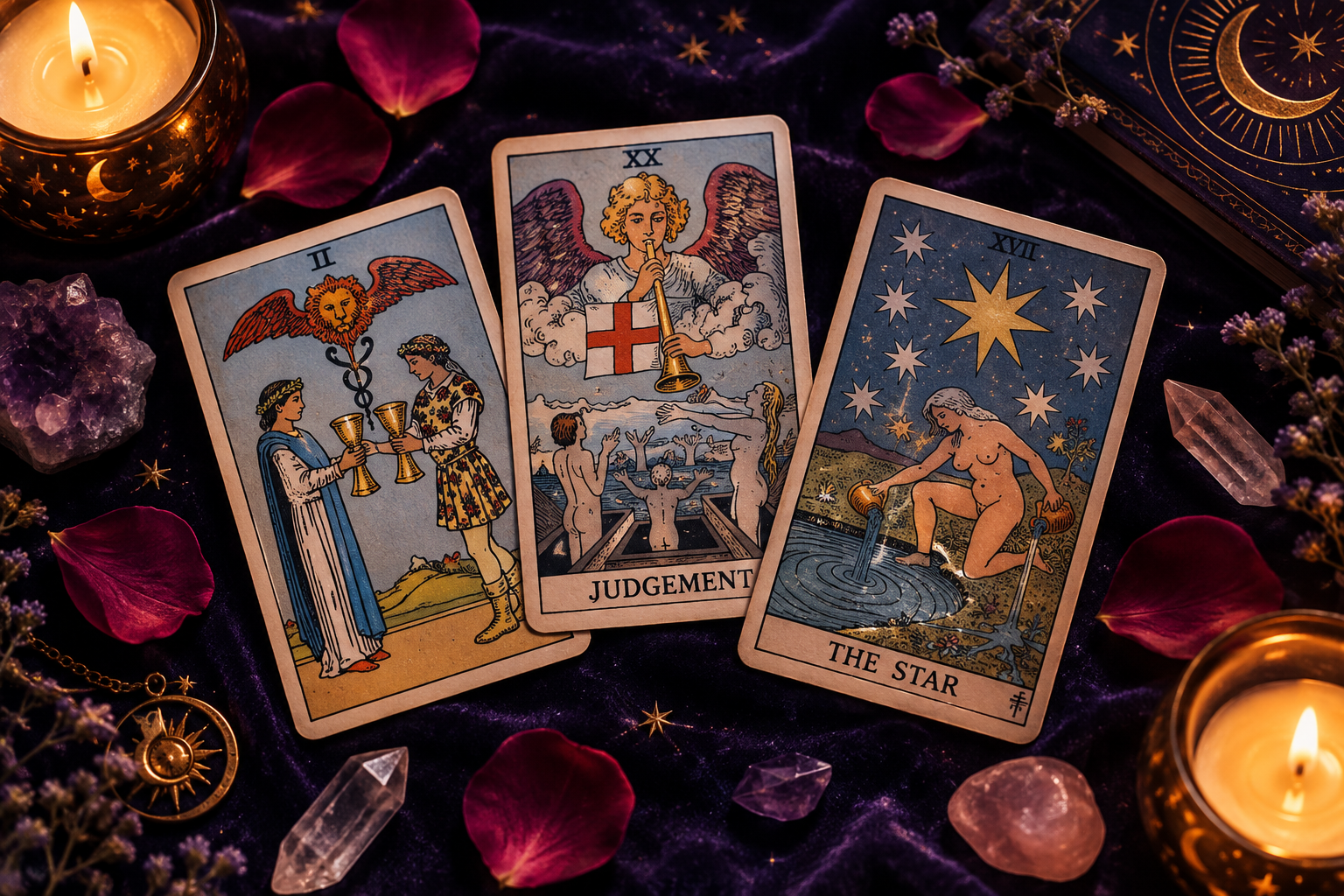
Cards that strengthen the yes: The Sun (clarity and success), the Ace of Swords (a breakthrough idea or decisive truth), The Star (hope and clear direction), the Three of Wands (plans working out), the Ace of Pentacles (a concrete opportunity arriving). With these, the Page’s conditions are likely to be met and the answer moves close to an unqualified yes.
Cards that push toward no: The Moon (deception, confusion, information you cannot trust), the Five of Swords (conflict where winning costs too much), the Seven of Swords (deceit or theft), the Ten of Swords (a painful ending), The Tower (sudden collapse). Alongside these, even an upright Page should be read as “the information you are getting is not reliable enough to proceed.”
Cards that reinforce “wait”: The Hanged Man, the Four of Swords, the Two of Swords, and the Seven of Pentacles all suggest the Page’s caution is the main message. The answer is still yes eventually, but not this week.
Reading the Page beside other court cards is also telling. Next to the Knight of Swords, it suggests a rush of communication, possibly an argument. Next to the Queen of Swords, it suggests you need to adopt a more experienced, discerning perspective before answering your own question.
Sample Questions and Worked Interpretations
“Should I go for it on this project at work?” Upright Page: yes. Your idea has merit and your ability to explain it is an asset. Before you commit, map out the scope and ask your manager what success looks like. The project will go well if you treat the first month as a research phase rather than assuming you already know the answer.
“Will my ex reach out?” Upright Page: probably yes, and the Page often signals a message arriving. The real question is what you do with it. The card suggests any contact will be verbal or written, and that the conversation needs to be honest about why things ended. Reversed Page: expect either silence or a message you should be sceptical of.
“Is this new person I’m dating being honest with me?” Upright Page: largely yes, but you do not have enough data yet. Keep paying attention to the small inconsistencies. Reversed Page: no, something is being misrepresented, or you are hearing things second-hand that you should check directly.
“Should I invest in this opportunity my friend told me about?” Upright Page: yes to investigating it thoroughly, not yet to putting money in. Read the documents, look at who is behind it, ask questions that make the person uncomfortable. Reversed Page: no. A tip from a friend is exactly the kind of unverified information the reversed Page warns about.
“Will I feel better soon?” Upright Page: yes, especially if the problem is mental fog, worry, or waiting on answers. Clarity is coming. Reversed Page: not until you cut down the noise. Stop researching symptoms at 2 a.m. and rest.
A Note on Interpretive Limits
Tarot is a tool for reflection and structured thinking, and the Page of Swords in particular is a card that asks you to go and find real information. It is not a substitute for medical, legal, or financial advice, and a reading should never be the only input into a decision that affects your health, your money, or your safety. Use the card to clarify the question. Use professionals and verified facts to answer it.
FAQ
Is the Page of Swords a yes or no card?
Upright, it is a yes with conditions: gather information, communicate clearly, and avoid rushing. Reversed, it is a no or “not yet,” usually because of gossip, miscommunication, or scattered thinking. It is one of the more conditional yes cards in the deck because the Page is a learner rather than an authority.
What does the Page of Swords reversed mean in a yes or no reading?
It means no for now. The reversed Page points to unreliable information, manipulation, impulsive words, plans that never leave the discussion stage, and anxious or defensive thinking. Fix the communication problem and ask again later.
Does the Page of Swords mean yes in love?
Upright, yes, particularly for questions about compatibility and new connections where the attraction is mental as much as physical. The condition is honest conversation. For reconciliation, it is a yes only if the real cause of the breakup gets discussed openly. Reversed, it is a no to both.
Is the Page of Swords a good card for money questions?
It is good for questions that reward research and negotiation, such as whether to look into an investment, dispute a charge, or ask for a raise. It is weaker for questions about long-term security because Swords govern thought rather than material results. Reversed, it warns against acting on tips or rumours.
How do surrounding cards affect the Page of Swords yes or no answer?
Bright, clear cards such as The Sun, the Ace of Swords, and The Star strengthen the yes. Cards of confusion or conflict such as The Moon, the Five of Swords, the Seven of Swords, and The Tower push the answer toward no. Cards of pause like the Four of Swords or The Hanged Man confirm the Page’s “not yet” message.
Does the Page of Swords mean a message is coming?
Often, yes. Pages are traditionally messengers, and the Page of Swords specifically points to news delivered through words: an email, a call, a conversation, a document. Upright, the message is useful even if blunt. Reversed, treat the message with scepticism until you can verify it.