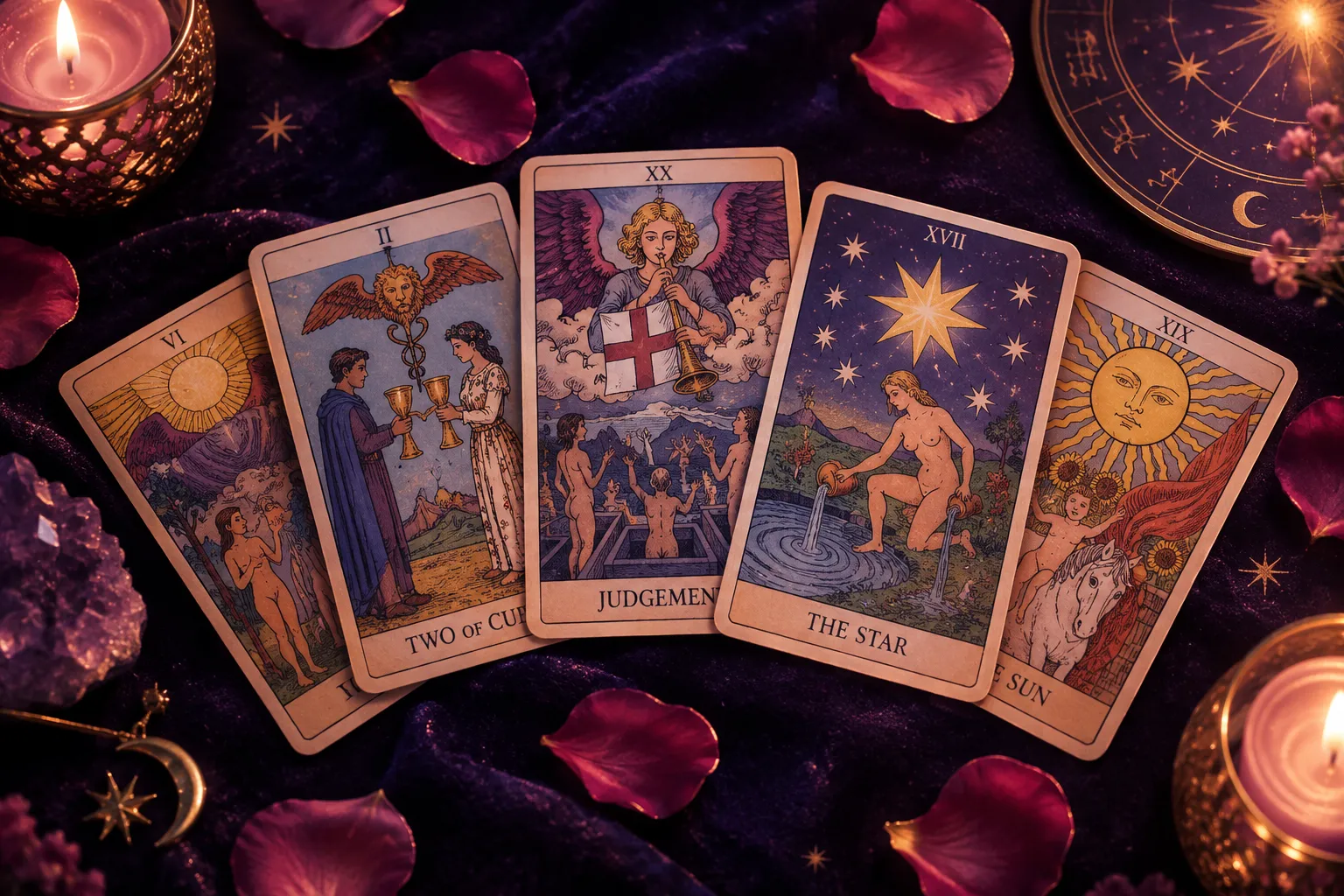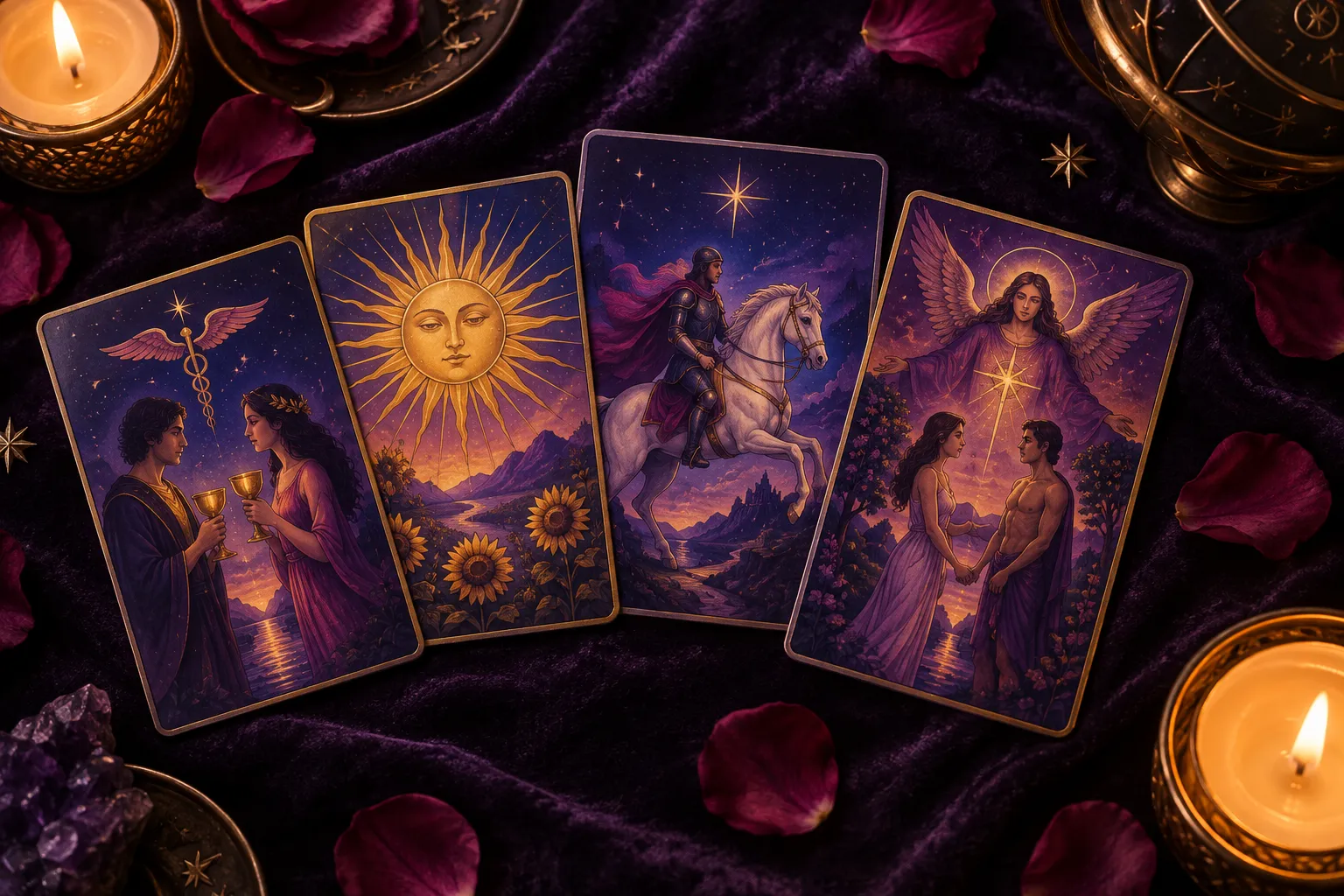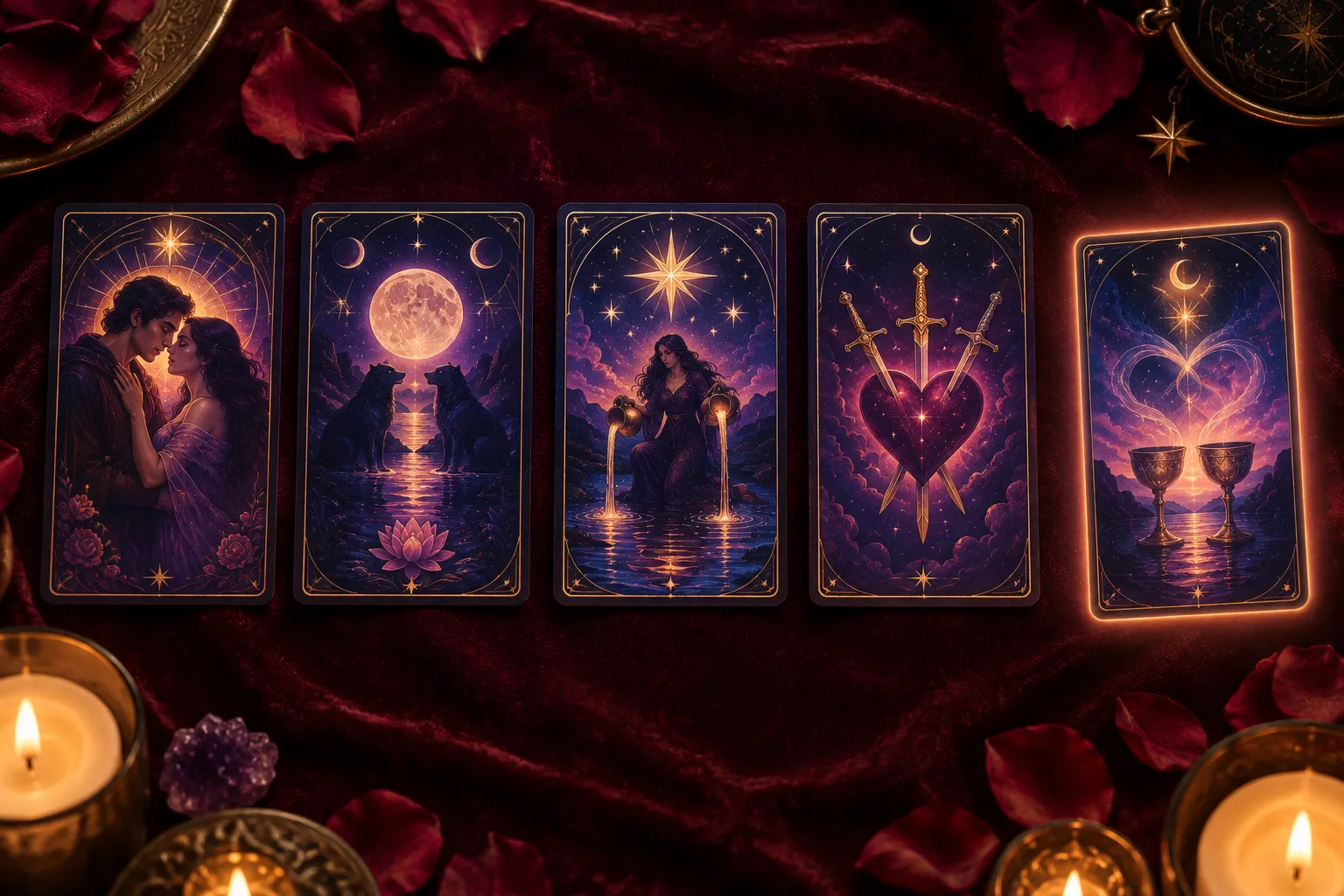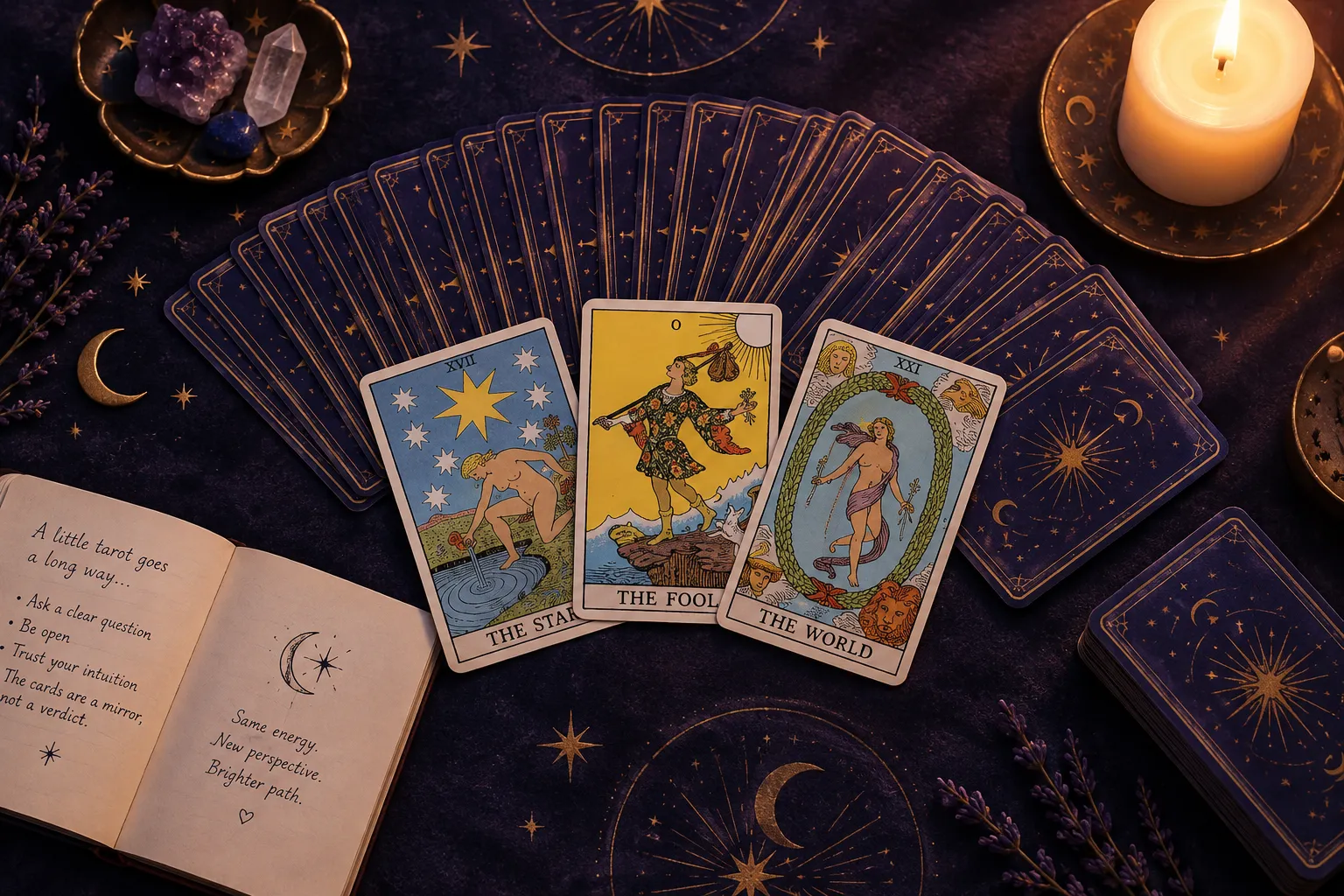

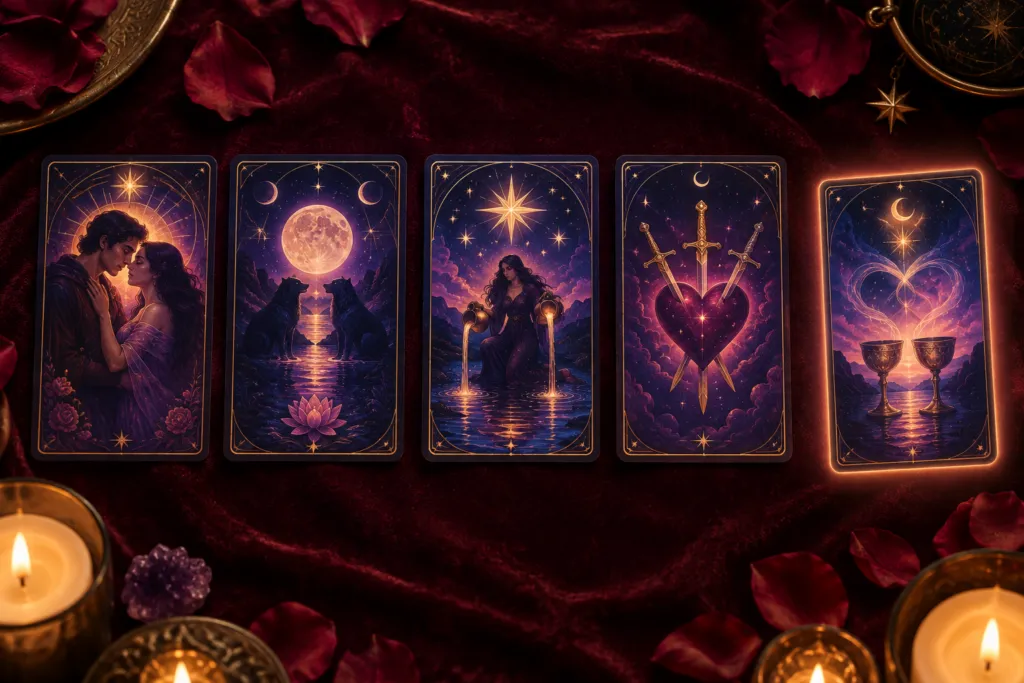
To get a yes or no on a love question, lay out five cards: the heart of the matter, your energy, their energy, the obstacle or help, and the answer. Card five gives the verdict. Upright cards with warm or stable images, such as The Sun or the Ace of Cups, mean yes. Reversed cards and cards about loss mean no. Cards like The Moon and The Hanged Man mean “not yet,” and the other four cards tell you why you got the answer you did.
Below you’ll find how to word the question for a crush, a partner, an ex, someone new or a decision, which cards mean yes, no or maybe, how reversals and the cards next to them change the answer, and what to do once you have it.
How the yes or no love spread works, step by step
The whole method takes five to ten minutes and any standard 78-card deck. Most people use the Rider-Waite-Smith deck, which Pamela Colman Smith illustrated and A. E. Waite designed, published by William Rider & Son in 1909.
- Write one binary question with a timeframe. For example: “Will we see each other again before the end of the year?”
- Shuffle until it feels done, then cut once. Decide before you shuffle whether you’ll read reversals. For yes/no work you should.
- Lay five cards left to right, with the fifth set slightly apart.
- Read card five first. Yes, no or not yet.
- Read cards one to four to see why, using the position meanings below.
- If card five is a maybe card, run the tie-break on cards three and four.
- Log the question, cards, date and verdict, and check back when the timeframe ends.
Why one card isn’t enough for love questions
One card is enough for “Should I text first today?” It isn’t enough for “Will he come back?” A love question involves two people, two sets of feelings and timing neither of you fully controls. A single draw squeezes all of that into a coin flip.
The five-card spread keeps a single answer card, so you still get a clear verdict. The other four positions check it. If card five says yes but card three shows the other person pulling away, you know the yes has conditions attached.
How to word your love question
How you word the question matters more than how you shuffle. Vague questions get vague cards, and questions about someone’s hidden thoughts get answers you can never check.
Three rules cover most cases:
- Keep it binary. “Does she want to see me again?” works. “What does she think of me?” needs a full reading, not a yes/no.
- Add a timeframe. Tarot reads the next six to twelve months far more cleanly than “ever.” “Will we move in together within a year?” beats “Will we ever live together?”
- Ask about things you can see happen. “Will he reach out this month?” can be checked. “Does he secretly regret leaving?” can’t.
Write the question down before you shuffle. People often lay out five cards and only then notice they had two different questions in their heads.
Questions that work for each situation
Each love situation has a version of the question that reads well and a version that doesn’t. Use this table to reword yours before you draw.
| Situation | Weak question | Stronger question | Positions to weigh most |
|---|---|---|---|
| A crush | “Does he like me?” | “If I ask him out this month, will he say yes?” | 3 (their energy) and 5 |
| Someone you’re texting | “Is she the one?” | “Is she looking for a relationship in the next three months?” | 3 and 4 |
| A partner | “Will we last forever?” | “Will we still be together and committed a year from now?” | 4 (obstacle) and 5 |
| An ex | “Does my ex still love me?” | “Will my ex and I get back together within six months?” | 1, 4 and 5 |
| Someone new | “Will I ever find love?” | “Will I meet someone I want to date seriously before summer?” | 3 (incoming energy) and 4 |
| A decision | “What should I do about him?” | “Is a second date with him a good idea?” | 2 (your energy) and 5 |
The ex row needs extra care. Questions about getting back together pull strongly toward the past, so position one often shows grief or nostalgia, not the present situation. Read it first, before the answer card.
The five positions
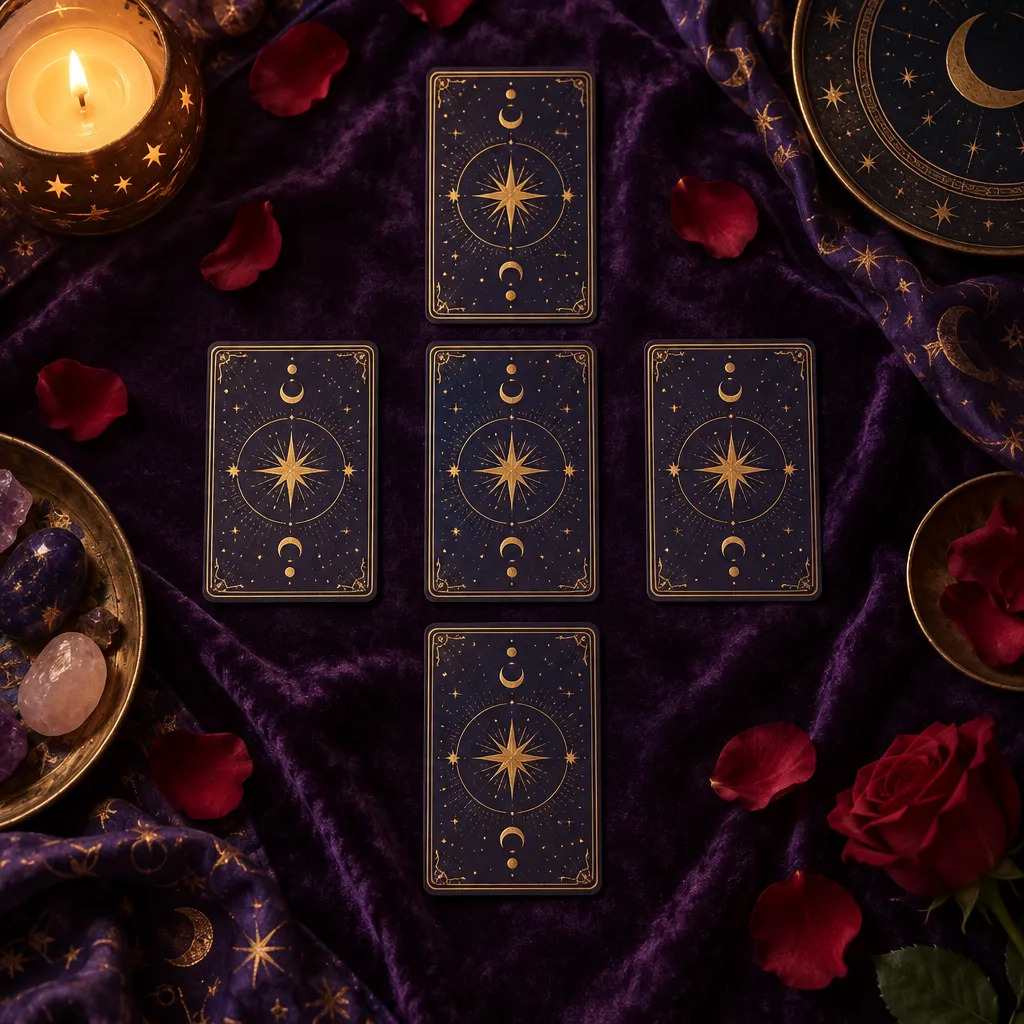
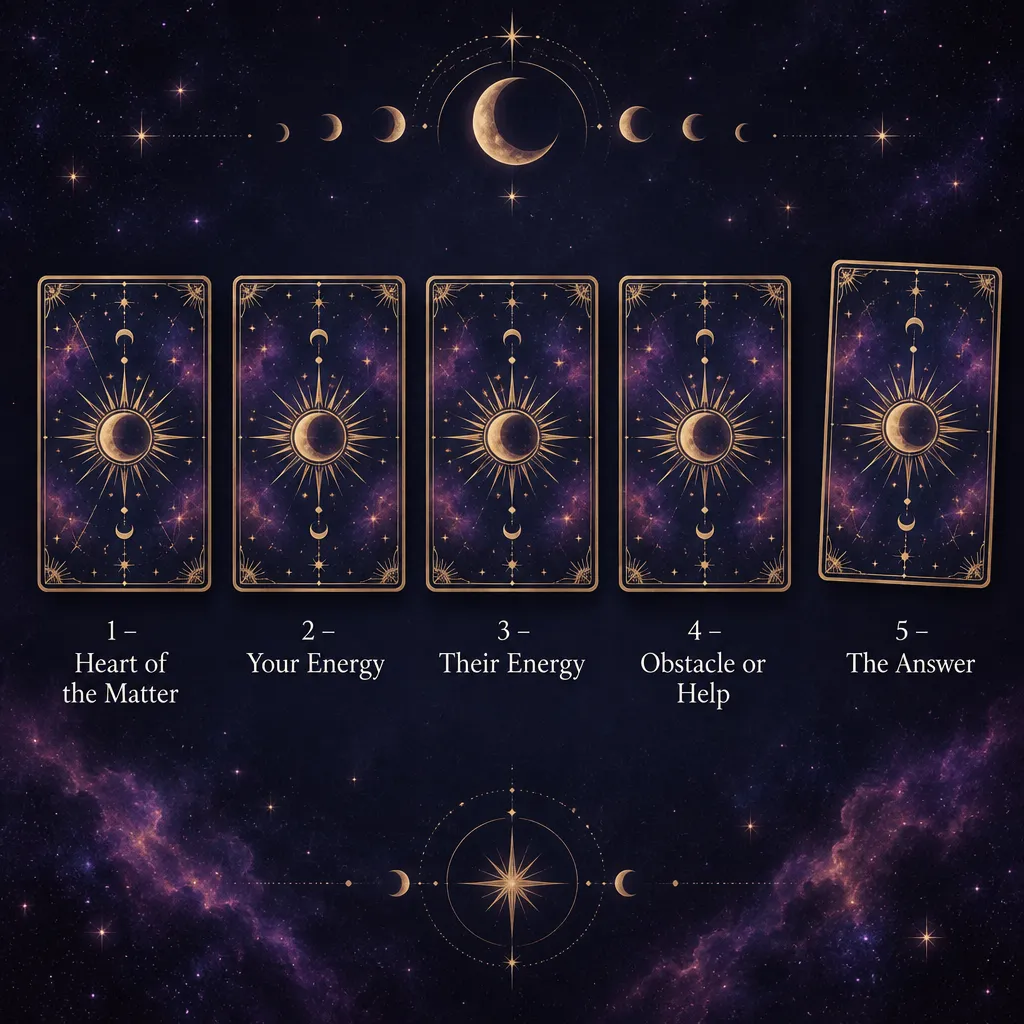
Each position has its own job. Only card five is the answer. Reading the other four as extra answers is the most common way this spread goes wrong.
1. The heart of the matter. What the question is really about. This card often surprises people. You ask whether someone will commit and the Five of Pentacles appears, pointing to a fear of being left out in the cold, not anything about them.
2. Your energy. What you’re bringing right now: hope, fear, pride, impatience. This card rarely flatters, and that’s useful.
3. Their energy. The other person’s current position. If you’re single and asking about meeting someone, read this as the energy heading toward you.
4. The obstacle or the help. What stands between you and a yes, or what’s quietly working in your favour. Reversed cards here often name the exact problem.
5. The answer. Yes, no or not yet. The other four explain it.
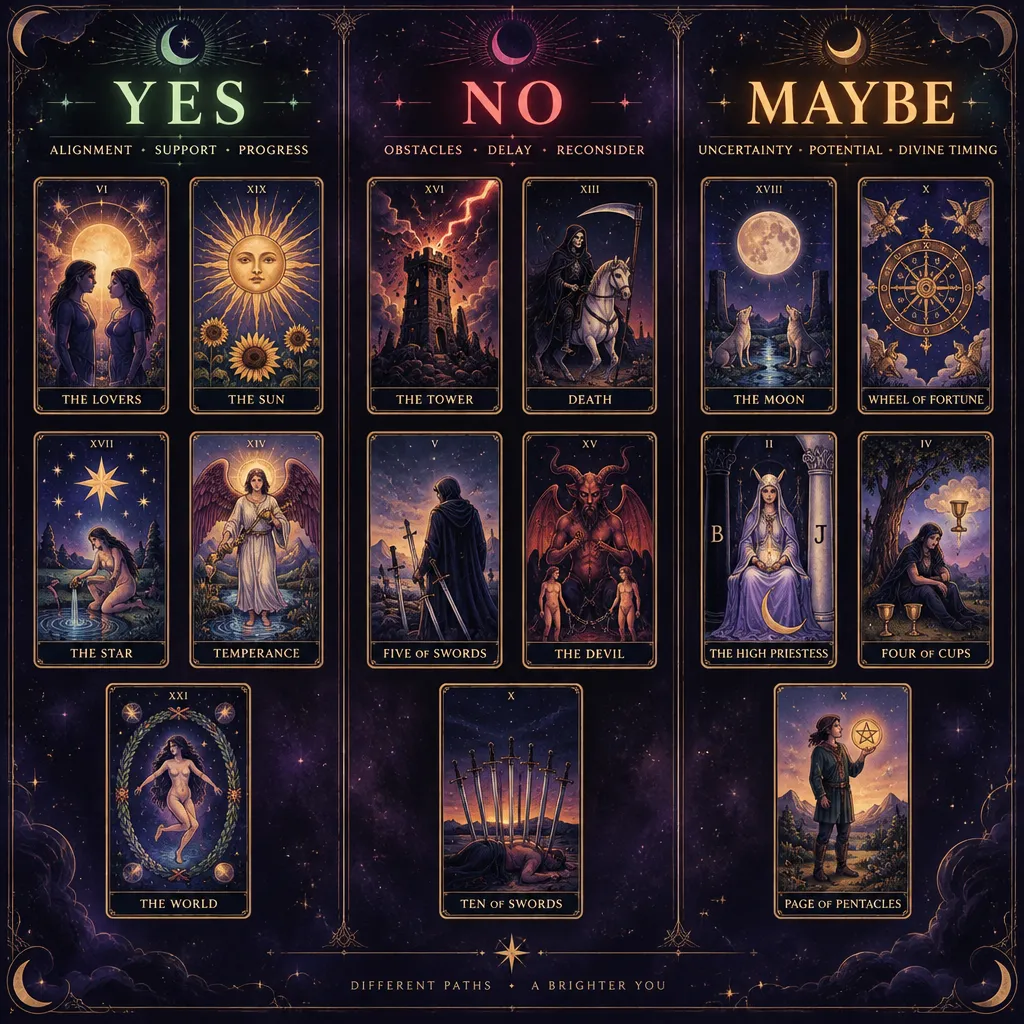
Which tarot cards mean yes, no and maybe in love
Upright cards with warm, stable or joyful imagery lean yes. Cards that show loss, conflict or being stuck lean no. A handful sit in “maybe” whichever way up they land. This sorting is a modern convention for yes/no reading. Waite didn’t write yes/no lists, so his book meanings, quoted below, sometimes complicate them.
Clear yes cards: The Lovers, The Sun, The Star, The Empress, The World, Ace of Cups, Two of Cups, Ten of Cups, Knight of Cups, Four of Wands, Six of Wands, Ten of Pentacles.
Clear no cards: The Tower, Three of Swords, Five of Cups, Five of Pentacles, Eight of Cups, Nine of Swords, Ten of Swords, Ten of Wands, and The Devil (a yes you won’t enjoy).
Maybe cards: The Moon, The High Priestess, The Hanged Man, Wheel of Fortune, Two of Swords, Seven of Cups, Judgement, Temperance.
Why The Moon is not a romantic card
The Moon turns up constantly in love readings, and people want to read it as romantic. It isn’t. In The Pictorial Key to the Tarot (1910), Waite lists “hidden enemies, danger, calumny, darkness, terror, deception, occult forces, error.” The Golden Dawn assigned it the Hebrew letter Qoph and the sign Pisces.
Smith’s image shows a path running between two towers, with a dog and a wolf howling and a crayfish crawling out of the water. Nothing is clear yet. If The Moon lands in position five, the honest answer is “you don’t know enough to decide.” Ask again once something real has happened.
Where Waite’s own meanings break the modern lists
Waite’s book doesn’t always agree with today’s yes/no lists. Three examples matter for love readings:
- The Star sits on every yes list, yet Waite’s first reading is “loss, theft, privation, abandonment,” with “hope and bright prospects” given only as “another reading.” In position five it’s still a yes, but a hopeful one, not a guaranteed one.
- The Ten of Swords looks like the most final card in the deck. Waite says it “is not especially a card of violent death” and gives its reversal as “advantage, profit, success, favour, but none of these are permanent.”
- Wheel of Fortune reversed is not a disaster in Waite’s text. He gives “increase, abundance, superfluity.” Many modern readers treat it as bad timing. If you follow Waite, a reversed Wheel softens toward yes.
Court cards in love readings
Read Cups courts as yes and Swords courts as no, unless the surrounding cards argue otherwise. Wands and Pentacles courts are neutral and take their meaning from their position.
Court cards in position three often stand for the person you’re asking about. A Knight there means they’re on the move. A Queen or King means they’ve settled into a position and won’t shift quickly.
Upright vs reversed: the cards that decide most love readings
A reversal doesn’t always turn yes into no. Sometimes it softens the card, and sometimes, in Waite’s text, it changes the meaning completely. The table below covers the cards that most often decide a love question, with Smith’s image, Waite’s meaning and the Golden Dawn attribution recorded in its manuscript Book T.
| Card | What Smith drew | Waite’s upright meaning | Golden Dawn attribution | Upright | Reversed |
|---|---|---|---|---|---|
| The Sun | Naked child on a white horse, red banner, sunflowers over a wall | “Material happiness, fortunate marriage, contentment” | The Sun | Strong yes | Softer yes (“the same in a lesser sense”) |
| Ace of Cups | Hand from a cloud holding a cup that pours five streams, a dove dropping a wafer into it | “House of the true heart, joy, content” | Root of the powers of Water | Yes, a new feeling | No: “house of the false heart, mutation, instability” |
| Queen of Cups | Queen at the sea’s edge gazing at an ornate, lidded cup | “Good, fair woman; honest, devoted,” “a perfect spouse” | Water of Water | Yes, emotionally available | Doubtful: Waite says “the accounts vary,” including “one not to be trusted” |
| Page of Wands | Young man in open country proclaiming with a tall staff | “A lover, an envoy, a postman” | Princess of Wands (Earth of Fire) | Yes, news or a message | Mixed: “evil news,” “indecision” |
| Eight of Wands | Eight staves flying through open country, no figures | Swiftness, “great hope,” “the arrows of love” | Mercury in Sagittarius, “Swiftness” | Yes, and fast | No: “arrows of jealousy,” “domestic disputes for persons who are married” |
| Four of Cups reversed | Man under a tree ignoring a cup offered from a cloud | Upright: “weariness, disgust, aversion” | Moon in Cancer, “Blended Pleasure” | Upright: no | Reversed: leans yes, “novelty,” “new relations” |
| Five of Cups | Cloaked figure over three spilled cups, two still standing behind, a bridge to a keep | “Loss, but something remains over” | Mars in Scorpio, “Loss in Pleasure” | No | Opens up: “news, alliances,” “return” |
| Two of Swords | Blindfolded woman holding two crossed swords, sea and crescent moon behind | “Conformity,” “concord in a state of arms”; another reading: “tenderness, affection, intimacy” | Moon in Libra, “Peace Restored” | Maybe, stalemate | No: “imposture, falsehood, duplicity, disloyalty” |
| The Hanged Man | Man hanging by one foot from a T-shaped tree, halo around his head | “Wisdom, circumspection,” “trials, sacrifice” | Element of Water | Not yet | Leans no: “selfishness” |
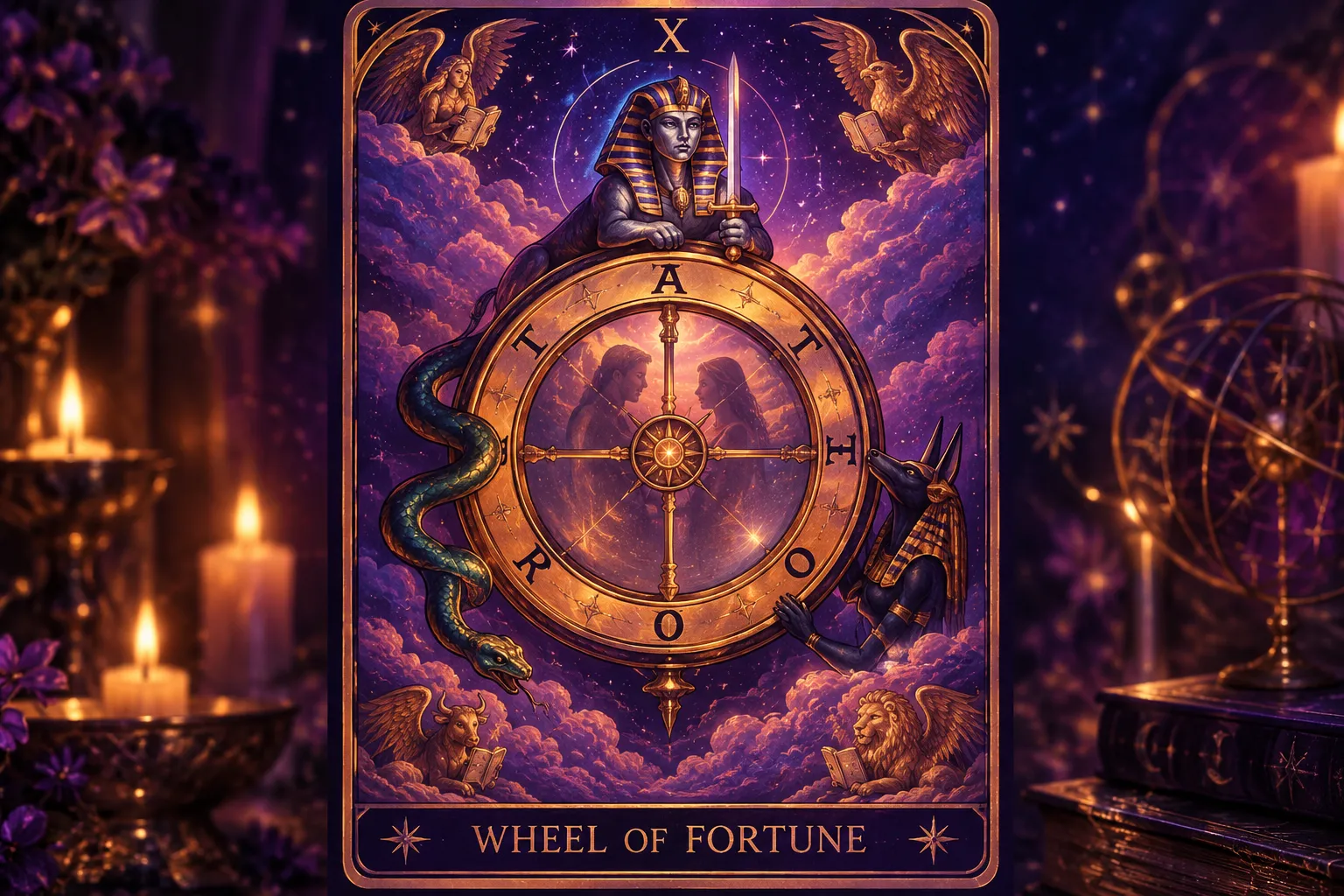
| Wheel of Fortune | Wheel marked TARO, sphinx on top, serpent descending, four winged creatures in the corners | “Destiny, fortune, success, elevation, luck” | Jupiter | Maybe leaning yes, timing | Waite: “increase, abundance” (modern readers often read it as delay) |
| The Devil | Horned figure on a pedestal, a chained man and woman below, both with horns and tails | “Ravage, violence, vehemence,” “that which is predestined but is not for this reason evil” | Capricorn | No to a healthy yes | Waite: “evil fatality, weakness, pettiness” (modern readers often read it as breaking free) |
The Devil: a yes you won’t enjoy
The Devil is the card most likely to give you the answer you asked for while warning you against it. “Will he keep seeing me?” can get a Devil yes: attraction and habit will keep things going, but the bond feels more like a hook than a choice.
Look at the chains in Smith’s drawing. They hang loosely around the couple’s necks, and many modern readers point out that the pair could lift them off. That is why a Devil answer is rarely final. It describes a pattern, and patterns can be broken.
The Hanged Man and Two of Swords: not yet, for different reasons
Both cards hold the answer back, but they point at different people. The Hanged Man is a pause that serves a purpose. Waite says the figure’s face “expresses deep entrancement, not suffering.” The situation needs time, and pushing won’t speed it up.
The Two of Swords is a refusal to look. The woman’s blindfold is something she has chosen to wear. In position two it usually means you are the one stalling. In position three, it’s them. Waite’s alternate reading, “tenderness, affection, intimacy,” is a reminder that a stalemate can hide real feeling.
How neighbouring cards change the answer
The cards around position five can strengthen, soften or flip the verdict. Waite set the example himself: he writes that the Page of Wands becomes “a dangerous rival, if followed by the Page of Cups.”
Common pairings in love spreads:
- The Sun with the Eight of Wands: yes, and soon. Expect movement within weeks, not months.
- The Sun with The Moon in position four: yes, but you’re missing a piece of information. Find it before you act.
- Ace of Cups with the Three of Swords: a new feeling arriving right after a hurt. Often a rebound. Yes, but go slowly.
- Queen of Cups in position three with the Seven of Swords in position four: they care, but something is being kept from you.
- Five of Cups with the Six of Cups: grief tied to the past. In a question about an ex, this pairing nearly always describes your feelings, not theirs.
- Wheel of Fortune with The Tower: sudden change that clears the board. Read it as no to the current shape of things.
- Two of Swords with the Page of Wands: the stalemate breaks when someone sends a message. Often that someone is you.
- The Devil with the Two of Cups: a real bond with an unhealthy pull. Yes to the attraction, a question mark over the relationship.
When position five and its neighbours disagree sharply, trust position four. It names the condition the answer depends on.
Reading the spread as a whole
Start with position five, then read one to four to explain it.
The maybe tie-break. If position five is a maybe card, read positions three and four together. Two yes-leaning cards there make it a soft yes. Two no-leaning cards make it a soft no. One of each means the situation is genuinely open, and your next move decides it.
Count the Major Arcana. Three or more of the 22 majors in five cards means the situation is bigger than the question. The answer can still be yes, but life is moving in ways you haven’t accounted for.
Don’t average the cards. Position two is about you, not the outcome. A gloomy card there doesn’t drag the answer down. It shows what you’re carrying into the room.
Worked readings by situation

These examples show how the positions interact in real situations. Read card five, then follow how the other cards shape it.
A crush: “If I ask her out this month, will she say yes?”
- Seven of Cups. 2. Nine of Wands. 3. Knight of Cups. 4. Eight of Wands. 5. Two of Cups.
Yes. The Two of Cups is the Golden Dawn’s “Lord of Love,” Venus in Cancer, and Waite gives it “love, passion, friendship, affinity, union.” The Knight of Cups in three shows her already moving toward you. The Eight of Wands in four means things will move fast once you ask. The Nine of Wands in two is the catch: you’re guarded after past knock-backs. The Seven of Cups in one shows you’ve been daydreaming instead of acting. Ask this week.
Someone you’re texting: “Is he interested in something real?”
- Seven of Cups. 2. Page of Cups. 3. Seven of Swords. 4. The Moon. 5. Five of Cups.
No. The Seven of Swords in three suggests he isn’t being straight with you. The Moon in four says you’ve been filling the gaps with your own hopes. The Seven of Cups in one names the issue: you’re in love with the possibility, not the person. It’s a hard reading, but a useful one.
Someone new: “Will I meet someone I want to date seriously in the next six months?”
- Eight of Cups. 2. Nine of Pentacles. 3. Knight of Cups. 4. The Hermit reversed. 5. Four of Cups reversed.
Leaning yes. Waite’s reversed meanings for the Four of Cups include “novelty” and “new relations,” which fits a question about someone new. The Knight of Cups in three confirms someone is approaching. The Hermit reversed in four is the obstacle: you’ve been on your own longer than is doing you good. The Eight of Cups in one asks whether you’re done grieving the last relationship. The answer is yes, if you start accepting invitations.
A partner: “Will my partner propose this year?”
- Ten of Pentacles. 2. Eight of Wands. 3. King of Pentacles. 4. Four of Pentacles. 5. The Hanged Man.
A maybe, so run the tie-break. The King of Pentacles in three leans yes: steady and committed. The Four of Pentacles in four leans no: holding on, reluctant to spend or change. One of each, so it’s open. The Eight of Wands in two says you want it fast. The King says they want it secure. The gap between those two speeds is the whole reading, and it’s worth talking about out loud.
A partner: “Is my relationship worth fighting for?”
- Temperance. 2. Nine of Wands. 3. Queen of Cups. 4. Five of Wands. 5. Ten of Cups.
Yes. Waite calls the Ten of Cups the “perfection of human love and friendship.” The Queen of Cups in three means your partner is emotionally present. The Five of Wands in four is bickering, not war. The Nine of Wands shows you’re exhausted and defensive. Temperance in one changes the question: this is about balance, not survival.
An ex: “Will we get back together within six months?”
- Three of Swords. 2. Six of Cups. 3. Four of Cups. 4. The Tower. 5. Ten of Swords.
No. The Six of Cups in your position is nostalgia; Waite calls it “a card of the past and of memories.” The Four of Cups in theirs means they’ve checked out. The Tower in four says the break was structural, not a bad week. The Ten of Swords closes the door for now. It offers little comfort, but it is clear.
If the Five of Cups reversed had landed in position five instead, the reading would shift. Waite lists “return” among its reversed meanings, which makes it one of the few cards that can say yes to an ex, usually after a period apart.
A decision: “Should I say yes to the second date?”
- Ace of Wands. 2. Two of Swords. 3. Page of Wands. 4. Four of Cups reversed. 5. The Sun.
Yes. The Sun is about as clear as tarot gets. The Two of Swords in your position shows you’re stalling for no good reason. The Page of Wands in three, Waite’s “lover” and “envoy,” says they’re keen and likely to get in touch. The reversed Four of Cups in four means your boredom is lifting. Go.
One card, three cards or five: which spread to use
Use one card for quick daily questions and the five-card spread for anything that would change your plans. The three-card spread is better kept for general readings.
| One-card pull | Three-card spread | Five-card love spread | |
|---|---|---|---|
| Time needed | Under a minute | Two to five minutes | Five to ten minutes |
| Best for | Daily check-ins, low-stakes questions | Past, present, future snapshots | Questions about two people |
| What it tells you | Yes or no | Yes or no with direction | Yes or no with both perspectives and the obstacle |
| Risk of misreading | High: no context to catch a bad draw | Medium: the timeline can blur the answer | Low: four cards cross-check the fifth |
| Weakness | No nuance | Positions aren’t love-specific | Overkill for small questions |
One-card pull. It’s fast, hard to overthink and good for building intuition. A single Moon or Hanged Man leaves you with nothing to work with, though.
Three-card spread. It shows how you got here and where things are heading. But past, present and future answer “what’s happening” better than “yes or no,” so you often end up with three descriptive cards and no verdict.
Five-card love spread. It has a dedicated answer position, both people are represented and the obstacle is named. It’s slower, and it tempts you to treat every card as the answer.
All three need nothing more than a deck you already own. You don’t need to pay for an app or a phone line to run any of them.
Common mistakes in yes/no love readings
Most bad readings come from the method, not the cards.
- Asking the same question twice. You get a no, reshuffle and ask again. The second answer is noise. Sit with the first for at least a week.
- Reading position two as the answer. If The Tower lands there, you’re in upheaval. It doesn’t mean the relationship is doomed.
- Ignoring reversals. For yes/no work, reversals are your most precise tool. They turn a soft yes into a soft no and name the block.
- Asking about a third person’s feelings. “Does his ex still love him?” can’t be answered or checked. Keep the question between you and the person you’re asking about.
- Treating a no as permanent. Most no cards describe current conditions. The Five of Cups is grief, and grief passes. The Tower and the Ten of Swords are the exceptions: they usually mean the ending has already happened.
When to use yes/no versus a full reading
Yes/no works when you already understand the situation and need a decision. It fails when the real question is “what’s going on here?”
A quick test: if you could explain the situation to a friend in two sentences, you’re ready for a yes/no. If it would take ten minutes, run a Celtic Cross or a relationship spread first, then come back to yes/no once you know what you’re deciding.
Tips for sharper readings
- Look at the picture before you check the meaning. Smith drew a scene on every card, including the 56 minor arcana, which was unusual in 1909. Your first reaction to the picture is usually the right one. Use the book to confirm it.
- Keep a log. Write down the question, the five cards, your reading and the date. Check it when the timeframe ends. Over a few months you’ll learn which cards reliably mean yes for you.
- Don’t read when you’re upset. Cards drawn at 2 a.m. after an argument reflect the argument, not the relationship. Wait a day.
- Don’t read for your partner without asking. The cards tend to show your anxiety about them, not how they actually feel.
Tarot and astrology together
If you use astrology, the spread pairs well with Venus transits, and the timing matters right now. Venus turned retrograde in Scorpio on 3 October 2026, moved back into Libra in late October and turns direct at 22° Libra on 13 November 2026 (14 November in UTC). Its shadow period runs until 15 December.
Astrologers treat Venus retrograde as a poor time for “will we get back together” questions, because exes and old feelings tend to resurface. Many readers hold off on love yes/no readings until Venus turns direct. If you read during this window, expect the Six of Cups and other backward-looking cards to turn up more often, and give them less weight.
The Golden Dawn also linked each suit to an element: Cups to water, Wands to fire, Swords to air, Pentacles to earth. If the person you’re asking about has a strongly fiery chart and position three shows a Wands court, that supports reading the card as them. It’s a cross-check, not proof.
What to do with your answer
The answer is only useful if you act on it within the timeframe you set.
- Yes: take the step the question was about, whether that’s asking, replying or committing, within the window you named. A yes you never act on can’t come true.
- No: read position four again. If the obstacle is something you can change, change it and wait out the full timeframe before asking again. If it’s The Tower or the Ten of Swords, treat the no as closure.
- Not yet: write down a specific date to ask again, usually four to six weeks away, and note what you’re waiting to see happen first.
Then check your log. After ten or so recorded readings you’ll have your own evidence of how these cards behave in your love life, and that’s worth more than any list of yes and no cards.
FAQ
What tarot cards mean yes in love?
The Lovers, The Sun, The Star, The Empress, The World, the Ace of Cups, Two of Cups and Ten of Cups are the strongest yes cards for love. Waite’s own meaning for The Sun includes “fortunate marriage,” and he describes the Ten of Cups as the “perfection of human love and friendship.” Upright Cups cards lean yes in general.
Which tarot card is a definite no in love?
The Tower, Three of Swords and Ten of Swords are the clearest no cards in love readings. The Tower and the Ten of Swords usually mean the ending has already happened. The Five of Cups is also a no, but a temporary one, since it describes grief more than a final verdict.
Does a reversed card always mean no?
No. Some reversals soften a card without flipping it: Waite gives The Sun reversed as “the same in a lesser sense,” which is still a yes. Others work the opposite way. Waite reads the Four of Cups reversed as “novelty” and “new relations,” which leans yes.
Can a tarot spread tell me if someone loves me?
It can show their current energy in position three, but it can’t read a private mind, and you can’t check the answer. You’ll get more from asking about something you’ll be able to see, such as “Will she reach out this month?” That gives the spread something real to answer.
How often can I ask the same yes or no love question?
Once per timeframe. Reshuffling straight after an answer you don’t like produces noise, not a better answer. Wait at least a week, or until the situation has visibly changed, before you ask again.
Is a yes or no love spread accurate?
Tarot isn’t a scientifically validated way to predict anything. Treat the spread as a structured way to think through a situation. Its real value is in positions one to four, which make you look at your own part, the other person’s position and the obstacle. A log of past readings will show you how well it works for you.
Which tarot spread is best for love?
For a yes/no decision, the five-card spread above. For understanding a relationship in depth, a relationship spread or the Celtic Cross works better. Pick based on whether you want a verdict or a description.
Add Yes No Tarot as a preferred source on Google, and the sites you pick are more likely to appear in your Top Stories.