King Of Pentacles: Yes or No Tarot Meaning
The King of Pentacles is one of the most reliable “yes” cards in the deck, and the one you want to see when your question involves money, a job, a home, or a partner you can count on. Reversed, it is rarely a flat no. It usually means the foundations are not finished, or that greed or control is quietly steering the outcome.
Quick verdict
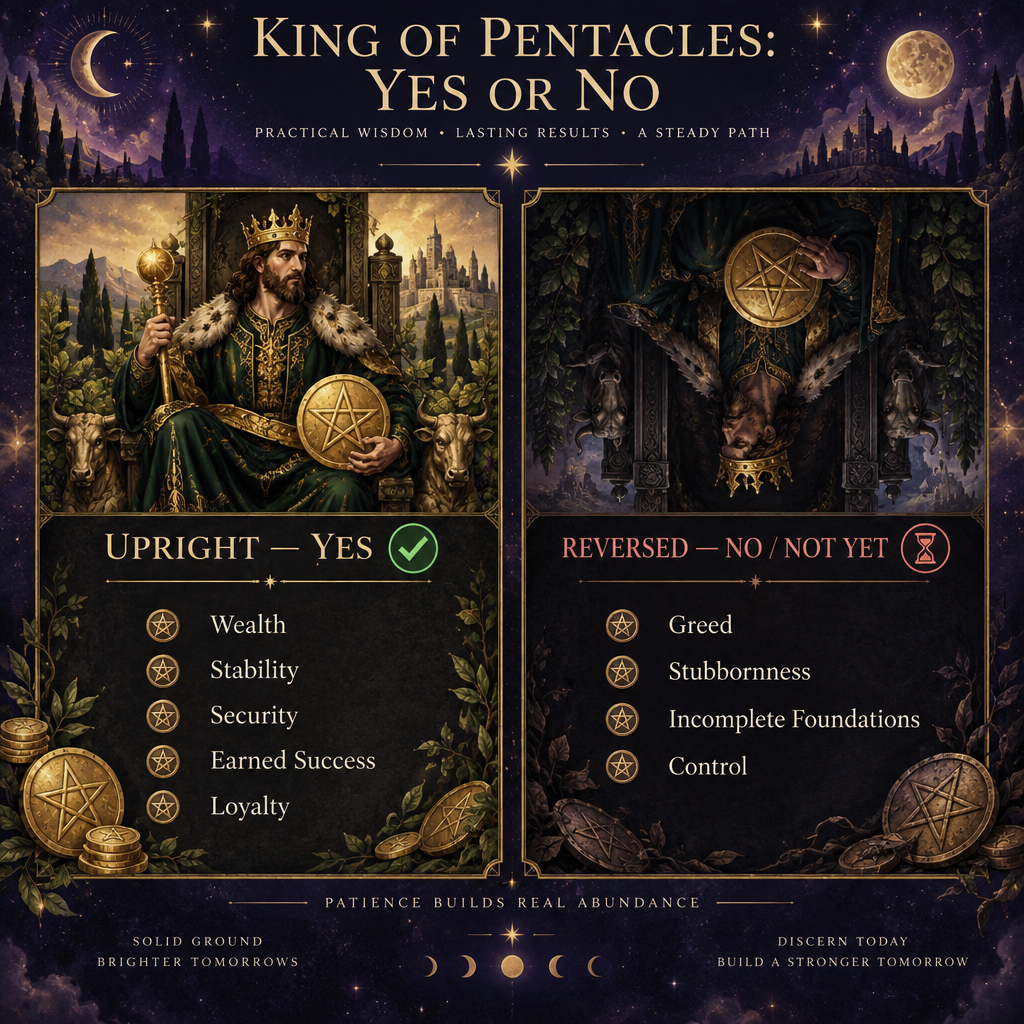
Upright: YES. Stable, earned, lasting success. The outcome holds up over time.
Reversed: NO / NOT YET. Either the groundwork is incomplete, or someone (possibly you) is being stubborn, materialistic, or controlling. Fix that first and the answer can flip.
Quick Reference Table
| King of Pentacles | |
|---|---|
| Yes or no (upright) | Yes |
| Yes or no (reversed) | No, or not yet; conditional in some contexts |
| Arcana | Minor Arcana, Suit of Pentacles (also called Coins or Disks) |
| Element | Earth |
| Court rank | King, the mature, outward-facing expression of the suit |
| Astrological association | Taurus (the bulls on his throne), with the fixed, patient qualities that sign implies |
| Upright keywords | Wealth, stability, security, authority, business savvy, abundance, leadership, generosity, discipline, loyalty |
| Reversed keywords | Greed, stubbornness, materialism, corruption, excessive control, financial recklessness, workaholism, rigidity, bribery |
| Timing feel | Slow and steady; results arrive, but not overnight |
What the Card Shows (Rider-Waite Imagery)
Pamela Colman Smith’s 1909 illustration for the Rider-Waite deck is the version most readers learn from, and its details explain why the card leans yes.
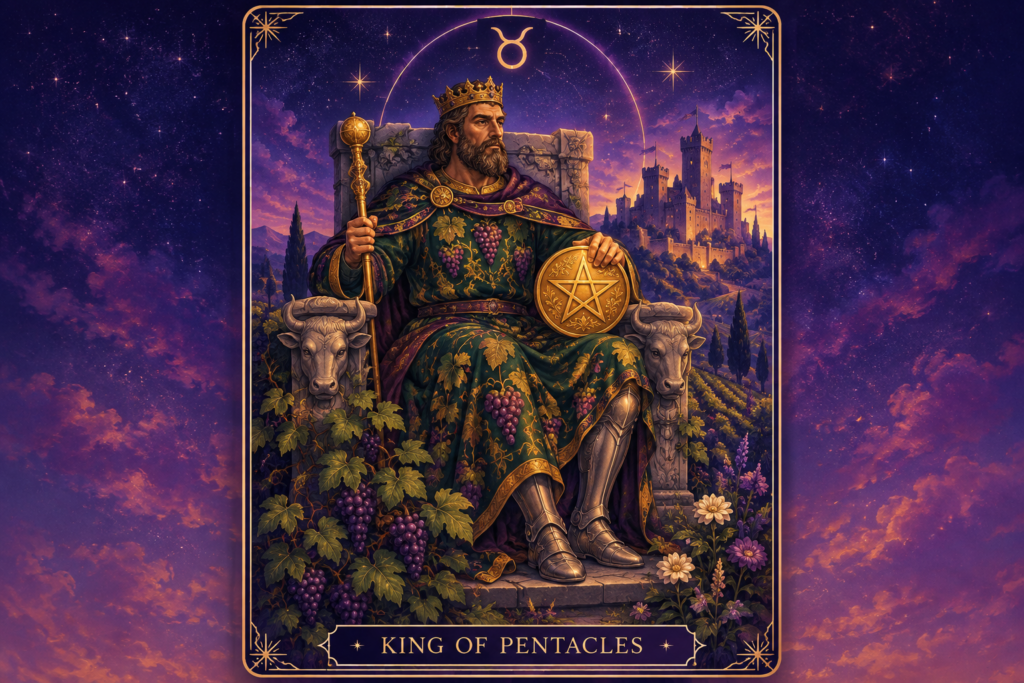
The King sits on a heavy stone throne carved with bull heads, a direct nod to Taurus and to stubborn, immovable strength. His robe is covered edge to edge in grapevines, leaves, and ripe bunches of grapes. Grapes are a harvest symbol: this is wealth that was planted, tended, and picked at the right moment, not won in a lottery.
Look at his feet and you see plate armour beneath the robe. He has fought for what he has, and he could fight again, but he chooses to sit in his garden rather than ride out. A castle rises behind him on the right, representing property, legacy, and a life that is built rather than borrowed. His right hand holds a sceptre topped with a globe (authority over the material world), while his left hand rests on a large pentacle balanced on his knee. He is not clutching the coin. He is holding it easily, which is the difference between wealth and greed.
Vines and flowers crowd the foreground. Everything around him is growing. That abundance is the core of the “yes”: when this King shows up, the environment supports growth.
Why Upright Means Yes
Court cards are often treated as neutral in yes-or-no readings because they describe people rather than events. The King of Pentacles is an exception. His entire character is about reaching a secure, finished state, so his presence implies that your situation can reach one too.
Three qualities make the upright yes trustworthy:
- Permanence. Pentacles are the slowest suit, and the King is its endpoint. A yes from him tends to stick, unlike the quick, flashy yes you might get from the Knight of Wands.
- Earned results. The card rewards work already done. If you have been putting in effort, it is telling you the payoff is real.
- Practical support. It often signals a helpful, established person: an employer, investor, mentor, father figure, or committed partner who has the resources to back you.
The one caveat: the upright King says yes to things that are sensible. If your question is about a reckless gamble, a get-rich-quick scheme, or walking away from something solid for a thrill, the card is still a yes, but a yes to the stable option, which may not be the option you were asking about.
Reversed: Three Different Kinds of “No”
Older yes-or-no guides treat the reversed King of Pentacles as a straight negative. Most experienced readers today split it into three states, and figuring out which one applies is the whole job.
Hard no: greed or corruption is driving the situation
When the surrounding cards point to deceit (Seven of Swords, Five of Swords, the Devil), the reversed King describes someone putting money or control ahead of everything else. A business partner cooking the numbers, a boss who has no intention of promoting you, a lover who sees the relationship as a transaction. This is the no you should act on, not wait out.
Not yet: the foundations are not finished
Far more common. The reversed King here is an unfinished building. You want the castle but you have not laid the stone. Examples: asking whether to buy a house with no emergency fund, whether a business will succeed before you have customers, whether a relationship will become permanent when you have known the person for six weeks. The answer is not never. It is “do the slow Pentacles work first.”
Conditional yes: address the control or materialism, then proceed
Sometimes the reversed King is pointing at your own behaviour. You are being stubborn, micromanaging, counting every dollar, or refusing to budge. The underlying situation is fine. Your approach to it is the problem. Loosen your grip, and the card effectively rights itself.
A quick way to tell them apart: if the reversed King is the only negative card in the spread, read it as “not yet” or “conditional.” If it is flanked by other reversals or Swords, treat it as a hard no.
Upright vs. Reversed Side by Side
| Question area | Upright | Reversed |
|---|---|---|
| General yes/no | Yes, lasting and earned | No or not yet; check for greed or missing groundwork |
| Love (new) | Yes, serious and committed potential | Not yet; one person is guarded, controlling, or treating it transactionally |
| Love (existing) | Yes, stable, provider energy | Conditional; stubbornness or work obsession is crowding out intimacy |
| Reconciliation | Yes, with a practical fresh start | Not yet; the money or control issues that ended it are unresolved |
| Career | Yes, promotion, security, recognition | No for now; skills, reputation, or politics need work |
| Money / investing | Yes for sound, long-term moves | No for speculation; yes only after you fix spending or debt |
| Health | Yes, steady recovery with discipline | Not yet; neglect, overindulgence, or stress is the obstacle |
| Family | Yes, support and provision are there | Conditional; a dominant or stingy figure is causing friction |
| Advice / action | Yes, act, but methodically | No to rushing; yes to patience and a plan |
King of Pentacles Yes or No in Love
New relationships and dating
Upright is a yes, and a specific kind of yes. This person wants something that lasts. They show affection by being dependable: remembering what you said, paying for dinner without making a show of it, turning up when they said they would. If you asked “Does this person want a real relationship with me?” the upright King says they do, and they are thinking long-term.
Reversed turns the question around. Is one of you keeping score? The reversed King in dating points to someone who is emotionally stingy, obsessed with status or income, or who wants to control the pace. It is a “not yet” if the hesitation is about security (they want stability before committing) and a hard no if the surrounding cards show deception.
Established relationships and commitment
For “Will we get engaged / move in / buy a home together?”, the upright King is among the best cards you can pull. It describes a partnership with shared resources, mutual loyalty, and a plan.
Reversed, the relationship itself is usually not doomed. The warning is about imbalance: one partner working constantly and treating provision as a substitute for presence, or one partner controlling the finances. The verdict is conditional. Address the control dynamic and the commitment question becomes a yes.
Reconciliation and ex-partners
If you asked whether an ex will come back, upright is a hopeful yes, and it tends to describe a mature return rather than a passionate one. Both people have grown up a bit. There is talk of practical things: where you would live, how you would handle money, whether you would do it properly this time.
Reversed is a not yet. Ask yourself what ended things. If it was money arguments, stubbornness, or one person refusing to compromise, the reversed King is telling you that pattern has not changed. Getting back together now would replay the same fight. The card is not saying never; it is saying the terms need to be different before the answer can be yes.
King of Pentacles Yes or No for Career and Money
This is the King’s home territory, and the card is at its most literal here.
Career questions
- “Will I get the promotion?” Upright: yes. You have proven reliability and leadership, and someone senior has noticed. Reversed: not this round. Either your results are not visible enough yet, or office politics (a controlling manager, a rival playing dirty) are in the way.
- “Should I take this job offer?” Upright: yes, especially if the offer trades excitement for security. Reversed: look at the employer. A reversed King can describe a company that squeezes staff, pays late, or promises growth it will not deliver.
- “Will my business succeed?” Upright: yes, through discipline and good management rather than luck. Reversed: not yet. Check your cash flow, pricing, and whether you are refusing advice out of stubbornness.
- “Should I ask for a raise?” Upright: yes, and ask for a specific number backed by results. Reversed: wait until you have a stronger case, or expect a tight-fisted no.
Money and investing questions
- “Should I invest in this?” Upright: yes for conservative, well-researched, long-horizon investments. Property, index funds, a business you understand. Reversed: no to anything speculative, leveraged, or pitched as urgent.
- “Will I be financially stable this year?” Upright: yes, provided you keep doing what you are doing. Reversed: not unless you address overspending or debt first. The card is naming the behaviour, not the fate.
- “Should I lend money to this person?” Upright: yes, with clear terms in writing. Reversed: no. The reversed King around a loan question frequently means the money will not come back.
- “Should I buy the house?” Upright: strong yes; this is the card of the castle in the background. Reversed: not yet. Your deposit, income stability, or the property itself has a structural problem.
King of Pentacles Yes or No for Health
Upright, the King of Pentacles is a yes for recovery, stamina, and long-term wellbeing, with an emphasis on routine. “Will I recover?” or “Will this treatment plan work?” both lean positive, as long as you stick with the boring parts: medication schedules, physiotherapy, sleep, regular meals. The King is not a miracle card. He is a consistent-habits card.
Reversed, the body is paying for excess or neglect. Classic associations include overindulgence in food or alcohol, sedentary work habits, and stress from money worries or overwork. “Will I feel better soon?” gets a not yet, with the clear instruction to change something practical. If the question is about a specific diagnosis or decision, this card is not a substitute for a clinician. Treat it as a prompt to book the appointment you have been postponing.
King of Pentacles Yes or No for Family
Upright describes a family where someone is holding things together financially and emotionally. Questions like “Will my family support my decision?” or “Will my parents help with the deposit?” get a yes. The card can also represent a father, grandfather, or patriarchal figure who provides steadily, if not always warmly.
Reversed, that same figure becomes the problem. Think of a parent who uses money as leverage, a relative who refuses to update a will or discuss an inheritance, or a household where one person’s rigidity blocks every change. “Will the family dispute resolve?” is a conditional yes: it resolves when the controlling party loosens their grip, which may require someone else to push.
King of Pentacles Yes or No for Advice and Action
When you ask “Should I do this?” the upright King says yes, and it tells you how: slowly, with a budget, with a written plan, and without cutting corners. It favours the choice that builds something you can still use in ten years.
Reversed, the advice is “not like this.” You are either rushing, being pig-headed about one way of doing things, or letting money dominate a decision that should be about something else. The action itself is not wrong. Your method is. Change the method and ask again.
When to Trust the Verdict and When to Qualify It
A single-card yes or no is a starting point, not a ruling. The King of Pentacles is particularly sensitive to context because he is slow, and surrounding cards can stretch or compress his timeline.
Spread position matters. In the outcome position, an upright King is a firm yes. In the obstacle or challenge position, even upright, he can mean “the stable thing is standing in your way” (a secure job you are afraid to leave, for instance). In the “advice” position, he describes how to act rather than whether the answer is yes.
Delay cards soften the yes. The Hanged Man, the Eight of Swords, the Four of Swords, or the Seven of Pentacles alongside the upright King turn “yes” into “yes, but later than you want.”
Secrecy and conflict cards sharpen the reversed no. The Seven of Swords, the Moon, the Five of Swords, or the Devil next to a reversed King push the reading toward the hard-no interpretation. Something is being hidden, probably about money or motives.
Other Pentacles court cards clarify who the King is. The Queen of Pentacles nearby often means the “yes” comes through a nurturing, practical partner or ally. The Ace of Pentacles beside the King is a new opportunity landing in experienced hands, a very strong yes. The Ten of Pentacles turns the yes generational: inheritance, family wealth, long legacy.
Fire cards add urgency. The King of Wands next to the King of Pentacles pits speed against caution. The yes still stands, but you are being told to combine ambition with the Pentacles King’s patience.
Question specificity decides the answer’s usefulness. “Will I be rich?” is too vague for any card. “Will I close the sale with this client by the end of the quarter?” gives the King something concrete to answer.
Digital and AI readings. Many people now pull a single card from an app or ask an AI tool for a yes-or-no verdict. Those tools are fine for the upright reading, which is straightforward. They are weaker on the reversed card, because the three-way split between hard no, not yet, and conditional yes depends on your actual circumstances. If an automated reading hands you a flat “no” for the reversed King, run through the three states above before accepting it.
A Note on Limits
Tarot is a reflective tool. The King of Pentacles cannot tell you whether a stock will rise, whether a diagnosis is serious, or whether a legal case will go your way. What it does well is show you the shape of a situation: whether it is built on solid ground, whether someone is acting from generosity or greed, whether you are being patient or just stuck. Use the yes or no as a prompt for better questions, and make financial, medical, and legal decisions with qualified professionals.
FAQ
Is the King of Pentacles a yes or no card?
Yes. Upright, it is one of the clearest yes cards in the Minor Arcana, especially for questions about money, work, property, and committed relationships. Reversed, it is a no or a not yet rather than a definitive never.
Can the King of Pentacles mean no upright?
Only in a narrow sense. If you ask about a reckless or speculative move, the upright King says yes to stability, which amounts to a no to the risky plan. In the obstacle position of a spread, it can also describe security that is holding you back. Outside those cases, treat upright as yes.
What does the King of Pentacles reversed mean in love?
It points to control, stinginess, or materialism in the relationship. One partner may be prioritising work or money over emotional presence, or treating the relationship as a transaction. The verdict is usually “not yet” or “fix this first.” It becomes a hard no when deception cards like the Seven of Swords appear alongside it.
Is the King of Pentacles good for money questions?
Upright, it is one of the best. It favours sound, long-term financial moves: buying property, steady investments, asking for a well-justified raise, building a business methodically. Reversed, it warns against speculation and lending, and it tells you to deal with overspending or debt before expecting a positive outcome.
When should I override the King of Pentacles verdict?
Qualify the yes when delay cards (Hanged Man, Four of Swords, Seven of Pentacles) sit beside it, or when the King lands in the obstacle position. Sharpen the reversed no when secrecy or conflict cards (Seven of Swords, Five of Swords, the Devil, the Moon) are nearby. And always weigh the verdict against what you know about the real situation; a card that contradicts obvious facts is describing your attitude, not your fate.
What does the King of Pentacles mean for timing?
Slow. Pentacles is the earth suit, and the King is its most settled card. A yes from him tends to arrive over months rather than days, and it lasts once it does.