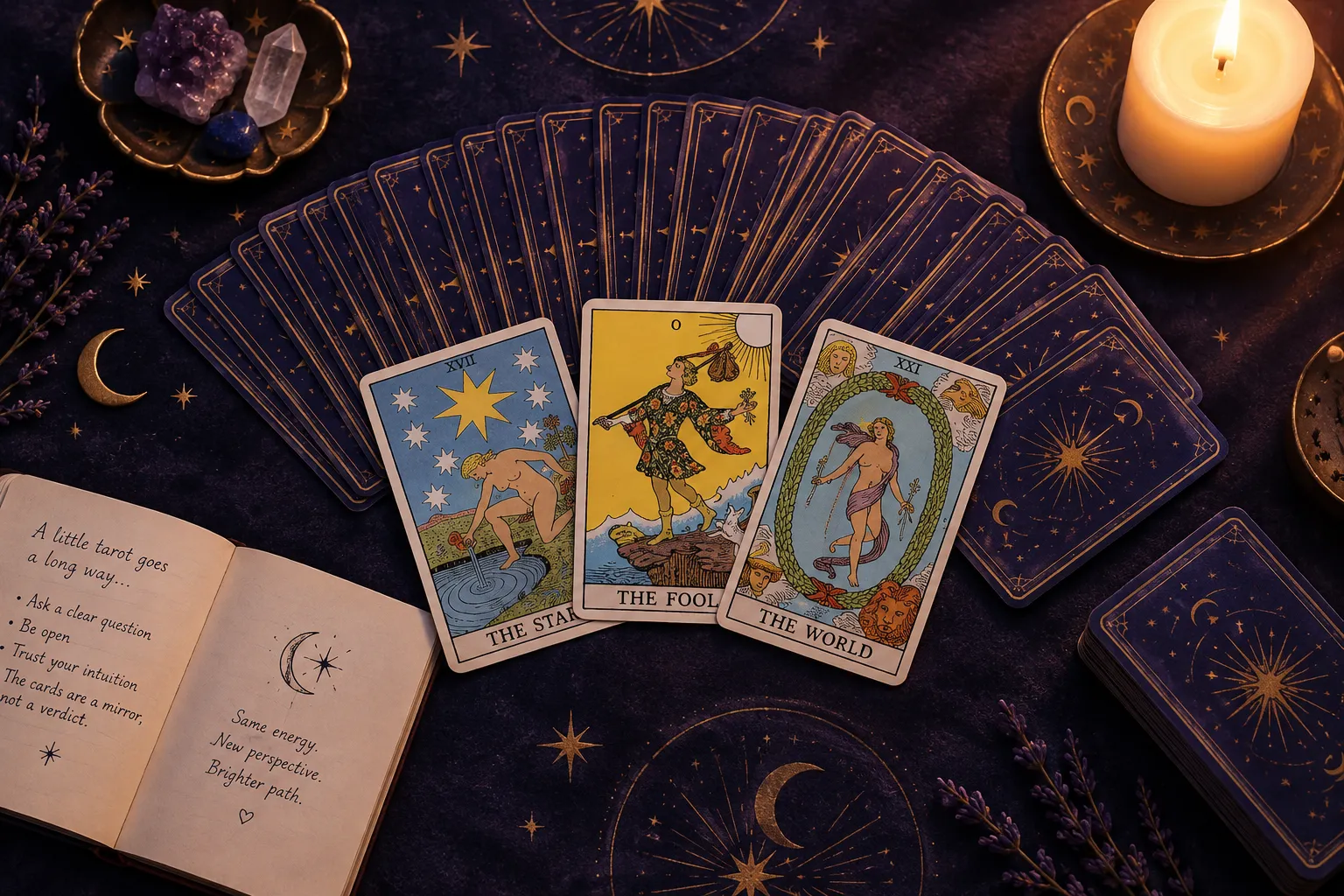


Upright, the Moon as feelings means this person feels more for you than they show, but they don’t trust those feelings. The attraction is real and it comes mixed with fear, guesswork about you and something they haven’t said. Reversed, the confusion is ending: either they are getting honest with themselves about what they want, or a hidden truth about the connection is about to come out.
Neither position means they don’t care. The Moon turns up when feelings are strong enough to scare someone. Indifference looks more like the Four of Cups. The rest of this guide covers what changes for a crush, a partner, an ex or someone new, which neighbouring cards tip the reading either way, and what to do next.
How they feel about you: the short answer
The Moon describes feelings that are real, unresolved and partly hidden, even from the person who has them. Their behaviour toward you looks inconsistent because what’s going on inside them is inconsistent.
- Upright: attraction plus anxiety. They replay conversations, read into your messages and swing between “this could be something” and “I’m imagining it.” They fill in the gaps with imagination, so part of what they feel is aimed at a version of you that lives in their head.
- Reversed: the fog is lifting. Most often they are coming out of a confused stretch and starting to see you clearly. Less often, something they concealed is about to surface. Sometimes it means the opposite of release: they felt something big, got scared and shut it down.
- Yes or no: upright means “not yet, too much is unclear.” Reversed is a cautious yes when the cards around it are positive.
The surrounding cards matter more with the Moon than with most Major Arcana cards. That is because the card describes a state of uncertainty, not a result.
The Moon card at a glance
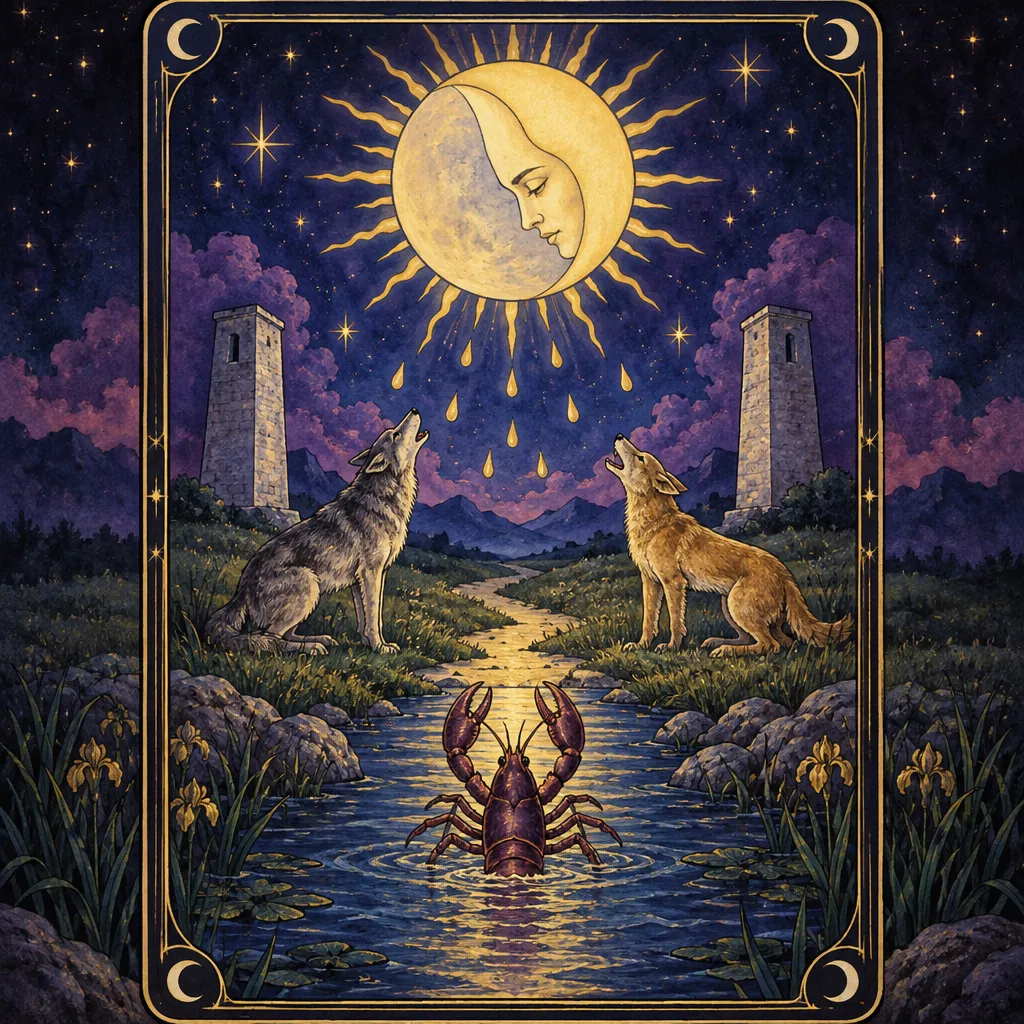
| Attribute | Detail |
|---|---|
| Arcana | Major Arcana, card XVIII (18) |
| Golden Dawn attribution | Pisces, Hebrew letter Qoph (“back of the head”), the 29th path linking Netzach and Malkuth |
| Golden Dawn title | “Ruler of Flux and Reflux, Child of the Sons of the Mighty” |
| Element | Water, through Pisces |
| Planetary note | Pisces is traditionally ruled by Jupiter and, in modern astrology, by Neptune. In the Golden Dawn system the planet Moon belongs to the High Priestess (II), not to card XVIII |
| Numerology | 1 + 8 = 9, echoing the solitary inner search of the Hermit (IX) |
| Waite’s upright meanings | “Hidden enemies, danger, calumny, darkness, terror, deception, occult forces, error” |
| Waite’s reversed meanings | “Instability, inconstancy, silence, lesser degrees of deception and error” |
| Keywords as feelings | Longing, confusion, idealization, fear of being seen, intuition, something unspoken |
| Source deck | Rider-Waite-Smith, published by William Rider & Son in 1909, drawn by Pamela Colman Smith |
The Water and Pisces links explain a lot. Water cards describe emotion rather than action. Pisces energy idealizes, merges and avoids hard edges. Someone whose feelings take that shape feels deeply but struggles to name the feeling, let alone act on it decisively.
Qoph, the “back of the head”, points the same way. The Golden Dawn tied this card to the part of the mind that works below conscious thought. So read the Moon as feelings someone has, not feelings they have decided on.
What Pamela Colman Smith painted, read as emotions
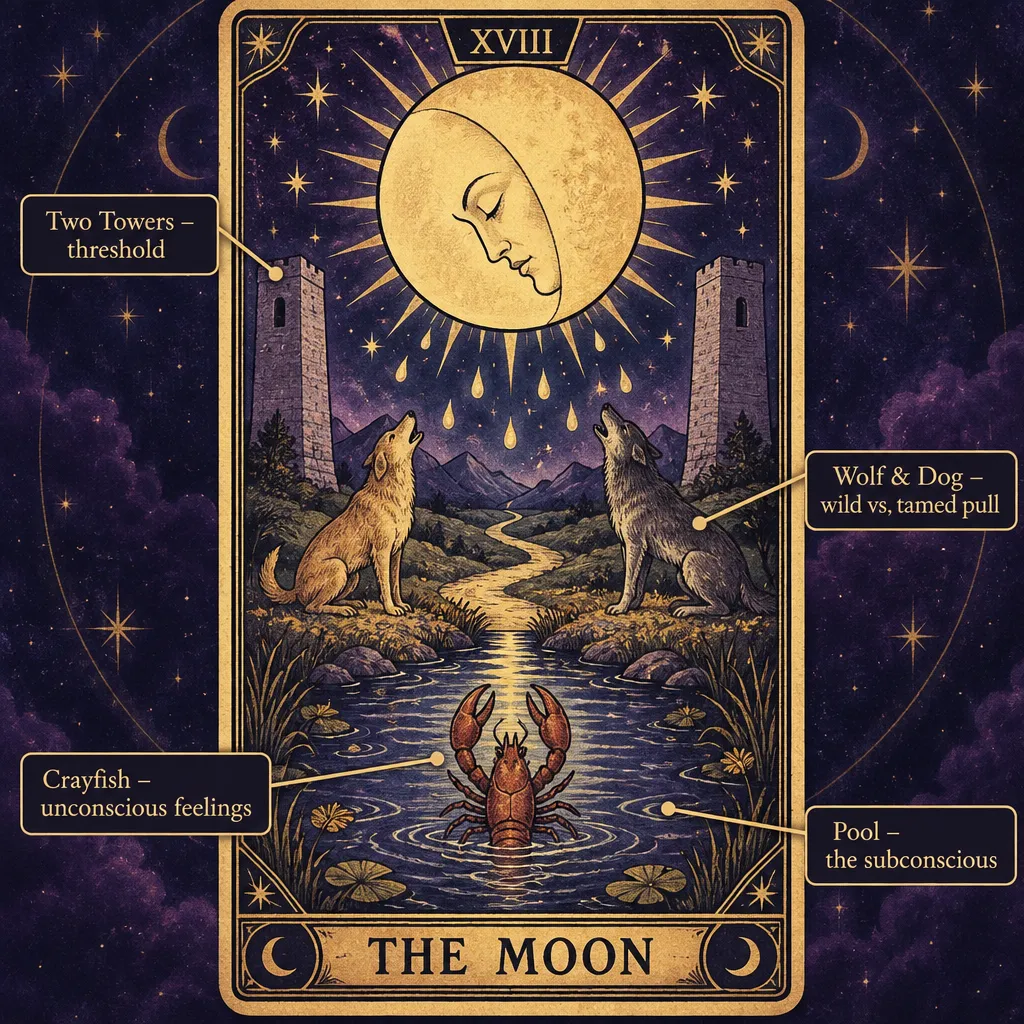
Each part of Smith’s design can be read as part of someone’s emotional inner world. A. E. Waite gave the key in The Pictorial Key to the Tarot (1911): the card “represents life of the imagination apart from life of the spirit.”
The creature climbing out of the pool. Readers call it the crayfish. Waite calls it “that which comes up out of the deeps” and notes that it “strives to attain manifestation” but “as a rule it sinks back whence it came.” As feelings, this is an emotion about you that is only starting to surface. Waite’s own detail matters here: half-surfaced feelings often go back under. That’s why Moon people send a revealing message and then go quiet.
The dog and the wolf. Waite wrote that they “are the fears of the natural mind in the presence of that place of exit, when there is only reflected light to guide it.” The dog is the tame response, the part that wants to behave sensibly and not get hurt. The wolf is the wild pull toward you. Both are howling, so this person isn’t calm about you.
The two towers and the path. Waite: “The path between the towers is the issue into the unknown.” Emotionally, the towers mark the line between the life this person knew before you and whatever comes next. They can see the path, but where it ends is hidden behind the hills.
The pool. Still, deep and reflective. It stands for the subconscious, and in a feelings reading for the way past relationships colour how this person sees you. They are partly reacting to you and partly to their own reflection.
The moon’s face and the falling drops. Waite describes the moon “increasing on what is called the side of mercy” with “sixteen chief and sixteen secondary rays.” He writes that “the face of the mind directs a calm gaze upon the unrest below; the dew of thought falls.” Smith drew 15 drops. The message Waite attaches is “Peace, be still.” Intuition is reaching this person, but the calm only comes once the animal fears below settle down.
What Waite said the Moon means, and how modern readers changed it
Waite’s divinatory meanings were bleak. Upright, he listed “hidden enemies, danger, calumny, darkness, terror, deception, occult forces, error.” Reversed, he gave “instability, inconstancy, silence, lesser degrees of deception and error.”
Two things follow for love readings:
- The “deception” reading has a real source. Readers who see lies or secrets in the Moon are following Waite. The card does carry that meaning. It just isn’t the only one, and in a feelings position it more often describes self-deception than lying to you.
- The “fog lifting” reversal is a modern reading. Waite’s reversal softens the card (“lesser degrees”) without turning it hopeful. Treating the reversed Moon as clarity arriving comes from later practice, which reads reversals as energy that is fading, resolving or turned inward. It’s a useful reading, but it isn’t Waite’s.
One word from Waite’s reversed list reads strikingly well today: silence. A reversed Moon in someone’s feelings position can describe a person who has gone quiet, the kind of ghosting that comes from not knowing what to say rather than not caring.
Moon upright as feelings for you
When someone’s feelings come up as the upright Moon, four things are usually true at the same time.
- They feel a pull they can’t explain. It isn’t checklist attraction. They think about you at odd hours and can’t say why.
- They’re afraid of the pull. It might be fear of getting hurt again, of not being enough, of losing independence, or of you not feeling the same. Which fear it is matters less than the fact that fear and attraction share the same space.
- They fill in the blanks. Where they don’t know something about you, they invent it. Sometimes they idealize you into someone who will fix everything. Sometimes they assume the worst about your intentions.
- They’re holding something back. It isn’t necessarily a lie. More often it’s a worry they haven’t voiced, an ex who isn’t fully gone, or a feeling they find embarrassing.
The honest summary: more than they say, less certain than you’d like, and clouded by their own history.
Moon reversed as feelings: three possible meanings
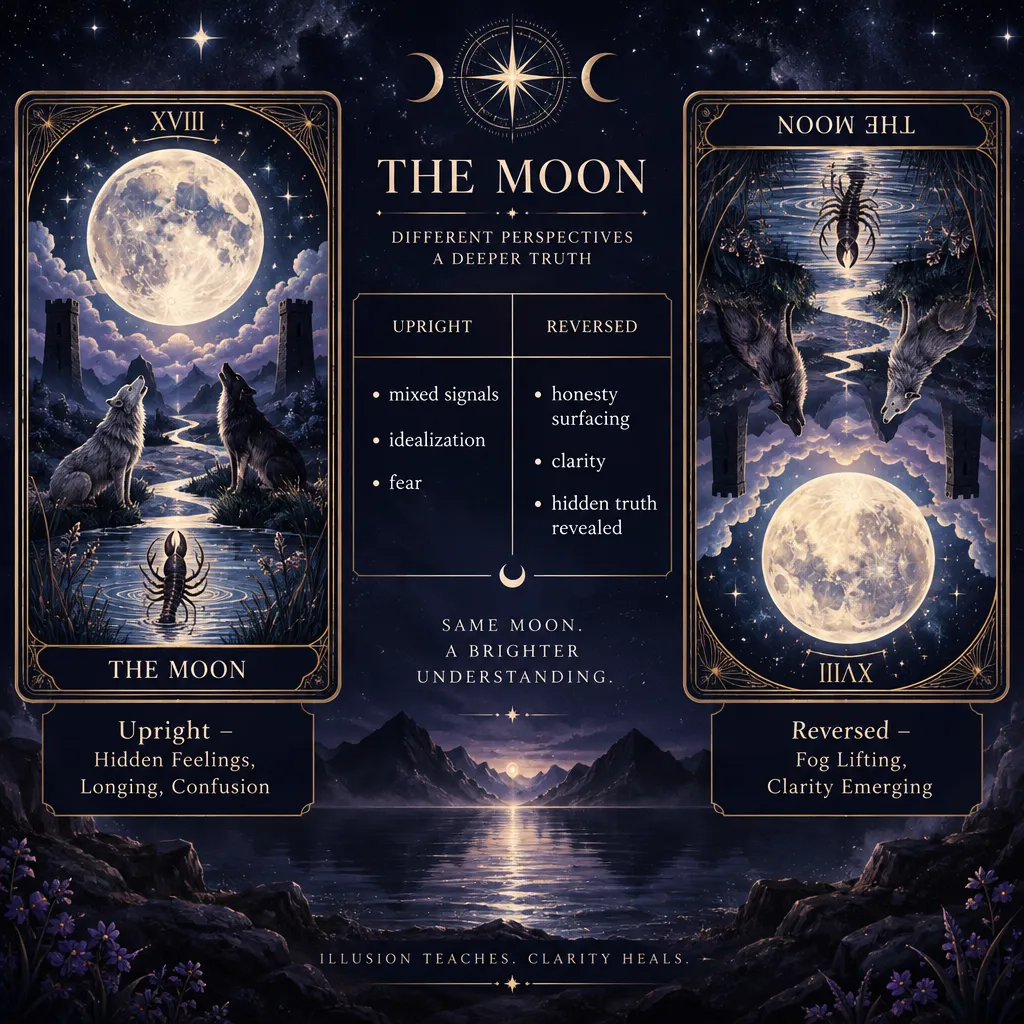
The reversed Moon has three faces, and the cards next to it tell you which one you’re looking at.
The fog lifts. This is the most common modern reading. The person is coming out of a confused period. They’ve stopped idealizing you and started seeing you as a real person, and they know what they want, or at least what they don’t. Alongside the Sun, the Star, or the Ace of Cups, this is a genuinely positive feelings card.
A hidden truth comes out. This is closer to Waite. Something concealed comes to light: another relationship, the real reason they pulled away, or an attachment they denied. Alongside the Seven of Swords, the Three of Swords, or the Devil, take this reading seriously.
Repression. The crayfish sinks back down, just as Waite said it usually does. They felt something, panicked, and now insist they feel nothing. Look for the Four of Swords, the Two of Swords or the Hanged Man nearby.
The practical difference: with the upright Moon, you’re waiting for them to work through their confusion. With the reversed Moon, the confusion is resolving one way or the other, and you’ll usually see which way soon.
Upright vs reversed by situation
| Who you’re asking about | Upright Moon | Reversed Moon |
|---|---|---|
| A crush | Likes you and is nervous about it; mixed signals | About to make a move, or to make clear the interest was never there |
| Someone new or a talking stage | Unsure what this is; testing the real you against their fantasy | Deciding; the label conversation is close |
| A partner | Something is unsaid: a worry, a doubt, an old wound | The unsaid thing gets said, as a relief or as a rupture |
| An ex | Unresolved, nostalgic, in limbo | Processing the breakup: honest outreach, real closure, or the truth about why it ended |
| Their intentions | No clear plan; they’re acting on mood | Intentions are forming and becoming visible |
| How they see you | Mysterious, hard to read, partly a projection | Starting to see the actual you |
| Your own feelings | You’re anxious and filling gaps with fear or fantasy | Your own clarity is arriving |
Moon as a crush’s feelings
The answer to “are they into me?” is yes, and they’re nervous about it. Early Moon feelings look like this: three days of enthusiastic texting followed by silence, warm in person but distant online, indirect questions about your dating life. Friends say “they obviously like you,” yet you have nothing concrete.
Underneath, they’ve built an image of you and are checking it against reality. The gap between the two makes them anxious. A recent rejection can also make them wait until they feel safer.
Reversed, the Moon is often good news for a crush: they’ve decided the risk is worth it and a clear signal is coming. Less often it means the interest you sensed was projection on your side, and that’s about to become clear.
Clarifiers that help:
- Moon + Page of Cups: they’re working up the courage to say something.
- Moon + Knight of Cups reversed: they like the idea of you more than the follow-through.
- Moon + Two of Cups: the attraction is mutual and they already sense it.
Moon as feelings from someone new
In the first weeks of dating, the upright Moon says they haven’t decided what this is, and asking for a label too early will scare them off. They’re comparing you with the fantasy and with whoever hurt them last.
Reversed, the in-between stage is ending. If the Two of Cups or Ace of Cups is nearby, expect a step toward commitment. With the Eight of Cups or the Five of Cups, they’re likely to drift away instead.
Moon as a partner’s feelings
In a committed relationship, the upright Moon says something hasn’t been said. It doesn’t say the relationship is in trouble. It says there is a conversation that hasn’t happened yet.
Common versions:
- A partner worried about money or work who pulls back emotionally without explaining why.
- A partner with doubts about the future who feels guilty for having them.
- A partner sensing a disconnect they can’t put into words, hoping you’ll notice.
- A partner whose past betrayal has started colouring how they read your behaviour.
The card also turns up when one partner suspects the other. If your gut has been uneasy, the Moon confirms the unease exists. It doesn’t confirm that the suspicion is correct. The pool reflects: some of the suspicion is theirs and some is yours.
Reversed, the unsaid thing gets said. That can be a relief or a rupture, but either way things are moving again.
Moon as an ex’s feelings
Your ex hasn’t settled their feelings about you. Upright, they think about you more than they admit and aren’t sure the breakup was right. Their nostalgia has probably edited out the reasons it ended.
The Moon doesn’t say they want you back. It says they’re in limbo. Expect ambiguous contact: a reaction to your story, a “hope you’re doing well” with no follow-up, a mutual friend mentioning that they asked about you. That’s the crayfish poking out of the water, not a decision.
Reversed, they’re working through the breakup. That leads either to honest outreach or to really letting go. If the ending was unexplained or involved a third party, the reversed Moon often comes before the explanation. Read it with Judgement nearby as an honest reckoning, and with the Tower as a revelation that lands hard.
Moon as their intentions
As intentions, the upright Moon means they don’t have a plan. They’re acting on mood, so their actions won’t match their words from week to week. Don’t read strategy into that. It’s drift.
Reversed, intentions are forming. Next to the Knight of Pentacles or the Four of Wands, they want something stable. Next to the Seven of Swords, part of their agenda is hidden.
Moon as how they see you
They find you hard to read: mysterious, interesting and a little intimidating. They’re unsure where they stand. Depending on their temperament, that either draws them in or makes them careful.
They may also have cast you in a role: the healer, the one who’s too good for them, the one who’ll leave like everyone else. The role says more about their history than about you. If you want to be seen clearly, be more direct than feels natural. Mystery isn’t helping you with this person.
Moon as your own feelings
When the Moon lands in your own position, the card is about you. You’re anxious, you’re reading every signal, and you may be building a story from very little evidence. Ask what you actually know, as opposed to what you fear or hope.
Moon for a love decision
If you asked “should I text them, move in, end it?”, the upright Moon advises waiting for more information. Big moves made in the fog tend to be undone later. Reversed, you’ll have enough clarity to decide soon, so prepare the conversation instead of forcing the outcome now.
Moon as reconciliation
Upright: not yet, not like this
At least one of you wants to reconnect, but the conditions are wrong. Neither of you has fully understood what went wrong, and you’d be communicating through hints and tests. A reunion attempted under the upright Moon tends to replay the confusion that caused the split.
There’s a sharper question underneath: do you want the actual person back, or the edited version in your memory? If you can’t name three concrete things that would have to change, you’re trying to reconcile with a reflection in the pool.
Reversed: illusions clearing on both sides
Among the difficult Majors, the reversed Moon is one of the better reconciliation cards. Each person starts seeing the other realistically, the misunderstandings get named, and an honest conversation becomes possible.
It still depends on what’s around it:
- Favours reconciliation: Sun (XIX), Star (XVII), Temperance, Six of Cups, Two of Cups, Judgement.
- Points to a final conversation: the Tower, Ten of Swords, Five of Pentacles, Eight of Cups. The clarity arriving is the clarity that it’s over.
Moon as the love outcome and yes-or-no
As an outcome, the upright Moon says things won’t resolve on your timeline. More information will come out, feelings will keep shifting, and the relationship stays in between. It isn’t a no. It’s a firm “unknown,” and a reason to hold off on permanent decisions.
Reversed, you’ll get your answer and the confusion ends. Whether it’s the answer you want depends on the cards around it, so draw one clarifier whenever the reversed Moon lands in the outcome position.
| Position | Yes or no |
|---|---|
| Upright Moon | Not yet. Too much is hidden for a clean yes |
| Reversed Moon with positive neighbours | A cautious yes |
| Reversed Moon with Swords or the Tower | No, and you’ll find out why |
The Moon next to common cards in a love reading
Two-card combinations settle most Moon readings. Read the second card as the direction the Moon’s fog is moving in.
| Combination | What it says about their feelings |
|---|---|
| Moon + The Lovers | Strong attraction tangled with a real dilemma; they may be choosing between you and someone or something else |
| Moon + Two of Cups | Mutual feeling they’re afraid to name; the hesitation is about vulnerability, not interest |
| Moon + Sun (XIX) | Confusion turning into warmth, especially if the Sun card follows the Moon |
| Moon + Star (XVII) | Hope beneath the fear; they want to trust this and are working toward it |
| Moon + Ace of Cups | A new feeling they don’t understand yet; a crush forming below their own awareness |
| Moon + Page of Cups | Shy, building up to a confession |
| Moon + Queen of Cups | Deep empathy and deep sensitivity; they feel everything and hide most of it |
| Moon + High Priestess | Intuitive attraction they won’t discuss; patience required |
| Moon + Six of Cups | Nostalgia; an ex or old flame idealizing the past |
| Moon + Two of Swords | Deliberately not deciding; avoidance |
| Moon + Three of Swords | Old pain distorting how they see you; grief, not indifference |
| Moon + Seven of Swords | Deception or a hidden agenda; the cautionary reading applies |
| Moon + Devil (XV) | Obsession, secrecy or an attachment they’re ashamed of |
| Moon + The Tower | A revelation that shakes the connection |
| Moon + Eight of Cups | Considering walking away because the uncertainty is exhausting them |
Intuition or anxiety: reading your own reaction
The Moon holds both intuition (Waite’s “dew of thought”) and fear (the howling animals). So when you pull it, check which one your gut reaction is.
Intuition is quiet, specific and stable. It says one thing and keeps saying it whatever your mood. Anxiety is loud, general and reactive. It changes its story depending on whether they texted back, and it fills in worst-case scenarios in detail.
A simple test: write down what your gut says about their feelings, then wait 48 hours without checking their social media or rereading messages. If the sense is the same afterwards, trust it. If it has already shifted twice, you’re hearing the animals, not the dew.
Modern readers often link the Moon to three psychological patterns: anxious attachment (over-reading signals, pursuing and then pulling back), projection (seeing your past in someone else) and idealization (the Pisces habit of putting people on pedestals that later wobble). None of these is a diagnosis. They’re useful lenses for why a Moon person acts inconsistently while still caring.
Questions worth journaling:
- What am I afraid is true about how they feel, and where did I learn to expect that?
- What qualities am I giving them without evidence?
- What am I not saying, and what would happen if I said it?
- Am I waiting for them to clarify because my own clarity would require me to act?
What to do when the Moon shows up
The Moon’s advice is the same in every situation: replace guessing with information. How you do that depends on where you stand.
- With a crush: stop decoding and send one clear, low-stakes signal, such as a specific invitation. Moon people respond to safety, and directness creates it. If they still can’t meet you halfway, the confusion is theirs to solve.
- Early in dating: slow down the commitment and speed up the honesty. Ask what they’re nervous about, and share your own nerves first if that helps.
- In a committed relationship: name the unsaid thing at a calm moment (“something has felt off and I want to understand it”). Talk before you go looking for evidence. Investigating first tends to confirm fears whether or not they’re true.
- With an ex: don’t reach out on the strength of this card alone. Contacting someone in limbo pulls you into it. If they reach out, answer honestly, not strategically.
- Before a decision: list what you know, what you suspect and what you’d need to find out. Act on the first list only.
- With the deck itself: draw once, add a single clarifier if you need one, and stop. Redrawing the same question until a friendlier card appears is the Moon’s confusion in action.
FAQ
Does the Moon mean someone likes you?
Usually yes, with a catch. The Moon shows attraction mixed with anxiety and hesitation, which is where the mixed signals come from. It doesn’t usually turn up for indifference. Cards like the Four of Cups describe that much better.
What does the Moon reversed mean as feelings?
Most often it means their confusion is clearing and they’re getting honest with themselves about you. Less often it means a hidden truth is about to come out, or that they’ve shut their feelings down. Sun (XIX) or Star (XVII) nearby points to clarity. The Seven of Swords or the Tower points to exposure.
Is the Moon a yes or no in love?
Upright, it’s “not yet”: too much is unresolved for a clean yes. Reversed, it’s a cautious yes when the cards around it are favourable, because the reversal signals that the uncertainty is ending. Draw a clarifier if the answer matters.
Does the Moon card mean cheating?
Not on its own. The Moon shows something hidden, which can be a fear, a doubt or a secret unrelated to anyone else. Cheating becomes a reasonable reading only when it sits next to cards like the Seven of Swords, the Three of Swords or Devil (XV), and even then a conversation is a better guide than a card.
What does the Moon mean for an ex’s feelings?
Your ex has unresolved feelings and is confused about what they want. Nostalgia, guilt and selective memory are all active, so any contact is likely to be ambiguous. Reversed, they’re working through the breakup and heading toward either honest reconnection or real closure.
Is the Moon a good or bad card for love?
It’s neither. It’s a weather report: fog over a real landscape. It won’t flatter you by saying someone is secretly in love, and it won’t make them a villain. It says the feelings exist, they’re tangled with fear and history, and the next step is a conversation one of you has been avoiding.
What does the Moon mean as advice in love?
As advice, the Moon tells you not to act on assumptions. Check what you think you know, notice where fear is doing the talking, and give things time to show themselves. Reversed as advice, it tells you to trust what’s becoming clear and stop second-guessing it.
About this guide
The imagery described here is the Rider-Waite-Smith Moon as Pamela Colman Smith drew it for the 1909 deck. Waite’s quotations and divinatory meanings come from The Pictorial Key to the Tarot (1911). The correspondences (Pisces, Qoph, the 29th path and the title “Ruler of Flux and Reflux”) follow the Hermetic Order of the Golden Dawn, whose system most modern decks inherit. Reversal and love-position readings reflect current practice, which treats reversals as fading, resolving or inward-turned energy. Where that differs from Waite, the guide says so, so you can decide how much weight each tradition gets in your own readings.
Add Yes No Tarot as a preferred source on Google, and the sites you pick are more likely to appear in your Top Stories.