
Hierophant: Yes or No Tarot Meaning
The Hierophant upright is a YES, with one condition attached: the outcome works out when you follow the established path, respect the rules of the situation, and accept guidance from someone who knows more than you do. The Hierophant reversed is a NO, or at best a “not yet,” because something in the picture is rigid, hypocritical, or rebellious in a way that blocks the result you want. Below you will find the full ruling for love, career, money, health, spirituality, and big life decisions, plus the handful of cases where this card lands on “maybe.”
Quick Verdict
| Position | Yes or No | One-line reason |
|---|---|---|
| Upright | YES (conditional) | The traditional route, a formal commitment, or a mentor’s advice carries you to the result. |
| Reversed | NO / not yet | Dogma, a broken institution, or your own refusal to listen is standing between you and the outcome. |
If you only needed the ruling, that is it. If you want to know how firm the yes is for your specific question, keep reading, because the Hierophant is more conditional than most Major Arcana cards.
The Hierophant at a Glance
| Attribute | Detail |
|---|---|
| Card number | V (5) |
| Arcana | Major Arcana |
| Alternate names | The High Priest, The Pope (older decks, including Tarot de Marseille) |
| Element | Earth |
| Zodiac sign | Taurus |
| Ruling planet | Venus (through Taurus) |
| Numerology | 5: structure meeting change, learning through instruction |
| Upright keywords | Tradition, institutions, mentorship, ceremony, marriage, shared belief, conformity |
| Reversed keywords | Dogma, rebellion, hypocrisy, outdated rules, unconventional path, personal belief |
| Yes or no | Upright YES (conditional), Reversed NO |
The Taurus and Earth associations explain the character of this card’s “yes.” Taurus is slow, loyal, and committed to things that last. Earth deals in the tangible and the proven. So the Hierophant does not promise a fast, exciting yes. It promises a durable one, earned by doing things properly.
Why the Symbolism Points to Yes
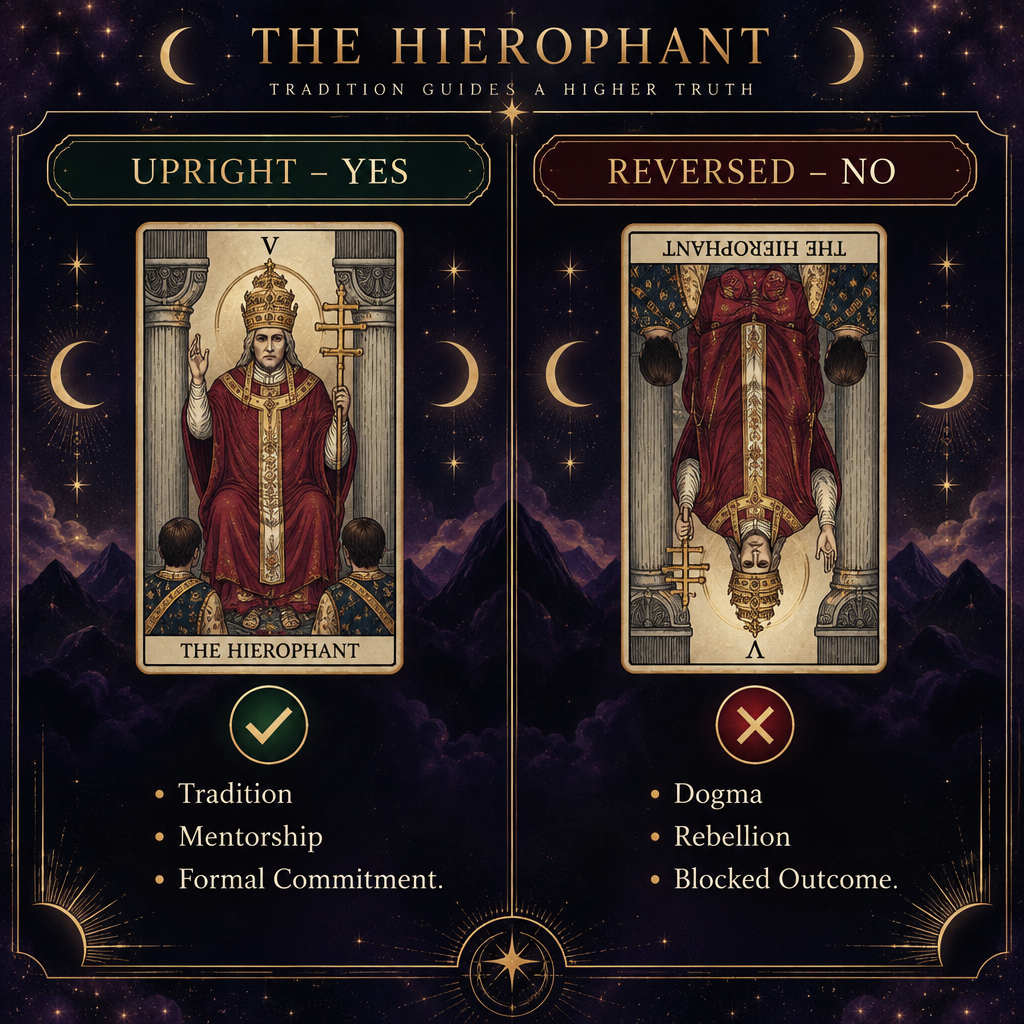
Look at the Rider-Waite-Smith image and nearly every element argues for an affirmative answer, as long as you are willing to work inside a system.
The papal figure on the throne. He sits between two pillars, like the High Priestess in card II, but where she guards hidden knowledge, he teaches public, codified knowledge. He represents the person or institution that has the authority to say yes: the officiant, the licensing board, the professor, the parent giving a blessing.
The triple crown and triple cross. Three tiers, three worlds (conscious, subconscious, superconscious in esoteric readings, or simply body, mind, spirit). The point for a yes/no question is completeness. The Hierophant deals in things that are formally finished and recognized, not half-done.
The raised right hand in benediction. Two fingers up, two down. This is a blessing. The card is literally giving approval. That gesture is the strongest single argument for reading the upright Hierophant as yes.
The crossed keys at his feet. Keys unlock. In the tradition these are the keys of Saint Peter, access to the kingdom. For a querent, they mean access is granted, but only through the proper door. You get the yes by being let in, not by breaking in.
The two acolytes (often called monks) kneeling before him. This is the teacher-student relationship at the heart of the card. One wears roses, the other lilies, desire and purity, both submitting to instruction. If your question involves learning from someone, joining a group, or accepting a mentor’s terms, the answer is yes.
Flip the card and every one of these symbols sours. The blessing hand becomes a wagging finger. The keys become locks. The teacher becomes a figure who demands obedience without deserving it. That is why the reversed Hierophant moves from yes to no.
Hierophant Upright: Yes
The upright Hierophant says yes to questions that are compatible with structure. You can test your question against these three markers:
- Is there a conventional, recognized way to get what you want? If yes, the card says take it and it will work.
- Is there someone qualified whose advice you have been avoiding? The card says go to them; their input tips the result in your favor.
- Are you asking about a commitment that involves ceremony or formal recognition? Marriage, graduation, ordination, a signed contract, a job offer letter. The Hierophant favors all of these.
Where the yes gets shaky is when your question is inherently unconventional. “Will my unregistered pop-up business take off this month?” draws a weaker yes from the Hierophant than “Will my application to the certified program be accepted?” The card does not dislike you for being different, but it is honest about where its power lies.
Upright Hierophant in Love
Yes, and often a yes with long-term weight. The Hierophant is one of the three or four cards in a 78-card deck that directly points to marriage (the others being the Ten of Cups, the Four of Wands, and the Two of Cups in some contexts). Specific rulings:
- “Will this relationship become serious?” Yes. The Hierophant signals a couple moving toward shared values, meeting families, and defining the relationship formally.
- “Will they propose / will we get engaged?” Yes, with a traditional flavor. Expect something conventional rather than spontaneous: a ring, a planned moment, family involvement.
- “Does this person want something real with me?” Yes. The Hierophant as feelings shows someone who views you as partner material, not a fling. Their feelings are steady rather than passionate.
- “Will my ex come back?” A yes that comes with conditions. Reconciliation happens if both of you commit to doing it properly, which often means counseling or honest conversations about long-term intentions. If you want a casual rekindling, this card is not describing that.
- “Should I date someone from a different faith or background?” This is the one love question where the upright Hierophant leans toward caution. It asks whether the two belief systems can coexist. Not a no, but a “work this out first.”
Upright Hierophant in Career
Yes. The strongest yes this card gives is in career questions involving institutions.
- Job applications to established companies, government roles, universities, hospitals, law firms: yes.
- Promotions within a hierarchy: yes, particularly if you have followed procedure and have a senior advocate.
- Certifications, licensing exams, degree programs: yes. The Hierophant is the card of accreditation.
- Finding a mentor: yes. Someone experienced is willing to teach you.
- Starting a business from scratch with no roadmap: a lukewarm yes at best. The upright Hierophant does not oppose the venture, but it tells you to franchise, follow a proven model, or hire an advisor rather than improvise.
Upright Hierophant in Money
Yes to conservative questions, no to speculative ones. “Will my savings plan work?” Yes. “Will I get approved for the mortgage?” Yes if your paperwork is in order. “Should I put money into this new coin a friend mentioned?” The Hierophant has nothing kind to say about that, and its yes evaporates. The card favors banks, pensions, index funds, and anything with a regulatory body behind it.
Upright Hierophant in Spirituality and Personal Growth
Yes, and this is its home ground. The Hierophant says yes to joining a tradition, finding a spiritual teacher, committing to a daily practice with a lineage behind it, or going back to a faith you left. If your question is “Will I find the spiritual community I am looking for?” the answer is yes, and it will probably be an organized one rather than a solo path.
For personal growth questions, the yes depends on your willingness to be taught. “Will therapy help me?” Yes. “Will I grow if I keep doing this on my own without feedback?” The card is quieter here. It believes in guidance.
Upright Hierophant in Health
Yes, with a clear instruction: follow the conventional medical route. The Hierophant favors seeing a licensed doctor, completing the prescribed course, attending the follow-up, and listening to specialists. “Will this treatment work?” Yes, if it is an established treatment and you adhere to it. The card does not favor skipping appointments or replacing a treatment plan with something you read online. If you asked about an alternative therapy, the card suggests running it past a qualified professional first. (Tarot is not medical advice; this is simply how the card reads.)
Upright Hierophant for General Life Decisions
- Moving house or relocating: Yes if the move fits a sensible plan (closer to family, a stable job, an established community). A weaker yes for a leap with no structure.
- Signing a contract or lease: Yes. The Hierophant likes documents.
- Legal matters: Yes in the sense that going through proper channels serves you. Hire a professional and follow procedure. Trying to shortcut the system weakens the answer.
- Going back to school: Yes. One of the most reliable yes rulings this card gives.
- A big commitment (buying property, adopting a pet, taking on a long-term responsibility): Yes if you are ready to honor the obligation. The Hierophant takes vows seriously.
Hierophant Reversed: No (or Not Yet)
The reversed Hierophant is a no. Older or more casual guides sometimes soften this into a “hesitant yes,” but that reading does not hold up against how the card actually behaves in practice or how most working readers interpret it. The reversed Hierophant describes one of four blockages, and each one produces a no:
- Dogma. A rule is being applied rigidly even though it no longer serves anyone. The institution says no because the institution cannot bend.
- A corrupt or hypocritical authority. The teacher, boss, pastor, or organization you are relying on is not worthy of trust. The outcome fails because the foundation is rotten. This theme has grown louder in modern readings, where the reversed Hierophant frequently points to a toxic workplace culture, a religious community that has lost its way, or a corporate structure protecting itself at your expense.
- Rejecting wise counsel. You have been told something sensible by someone qualified, and you are ignoring it. The no is a consequence of that.
- Rebellion for its own sake. You are breaking a rule to prove a point rather than because the rule is wrong. The situation cannot resolve in your favor while that energy drives it.
The “not yet” version applies when the reversal is about timing. The structure you need does not exist yet, or you have not yet freed yourself from a framework that is holding you back. Once that changes, re-ask the question.
Reversed Hierophant in Love
No. Specific readings:
- “Will this relationship last?” No. The two of you hold incompatible core values, or one of you refuses to commit in the way the other needs.
- “Will they marry me?” No, or not under the terms you are hoping for. The reversed Hierophant can show a partner who is actively against marriage as an institution, or a relationship where one person has stopped honoring the agreements that were made.
- “Does this person want a traditional relationship?” No. They may want something open, undefined, or unconventional. That is not inherently bad, but it is a no to the question as asked.
- “Should I follow my family’s expectations about who to be with?” The reversed Hierophant is the card of breaking from inherited rules. Here the no is a no to the pressure, not a no to your relationship. Context matters.
Reversed Hierophant in Career
No to anything that depends on climbing an established ladder. This is where the card has shifted most in contemporary interpretation. The reversed Hierophant is now widely read as the entrepreneur’s card, the freelancer’s card, the card of the person who leaves the firm to start their own practice.
- “Will I get the promotion?” No. You are clashing with the hierarchy or the hierarchy is dysfunctional.
- “Should I stay at this company?” No. The institution is not aligned with you, and the longer you stay the more it costs you.
- “Will my business succeed if I do it my own way?” This is the one career question where the reversal turns positive. Self-employment, breaking from industry convention, or building something without a corporate structure gets a qualified yes from the reversed Hierophant, provided you are not simply rebelling against a boss. The card says the old framework will not serve you; your own might.
- “Will my complaint against management be upheld?” No. The system protects itself.
Reversed Hierophant in Spirituality
No to the question “Will I find what I need inside this tradition?” The reversed Hierophant marks the point where inherited doctrine stops fitting. It appears when people leave a church, outgrow a guru, or realize that a practice they were raised in was more about control than growth.
As a yes/no card it says no to the institution. As a life card it often marks a spiritual awakening, the moment you stop borrowing beliefs and start building your own. Readers who treat the reversal as entirely negative miss this. The no is directed at the external authority, not at your inner development.
Reversed Hierophant in Health
No, and read this as a warning rather than a prediction. The reversed Hierophant in a health question tends to show one of two things: either you are not following the advice you were given, or the advice itself came from an unreliable source. “Will I recover if I keep doing what I am doing?” No. Change something: get a second opinion from a properly qualified practitioner, or actually complete the treatment you abandoned.
Reversed Hierophant for General Life Decisions
- Moving to please someone else or to fit expectations: No. The move is driven by an outside rule rather than your own needs.
- Signing a contract you have doubts about: No. Read the fine print; the terms are more restrictive than they appear.
- Legal matters: No, in the sense that the system is unlikely to deliver what you want through standard channels. Consider mediation or a different strategy.
- Breaking a long-standing family rule or expectation: The card supports this. The no is to the rule, not to you.
When the Hierophant Means “Maybe”
A handful of situations push this card into genuinely undecided territory.
The question itself is anti-traditional and the card is upright. “Will my elopement go smoothly?” The Hierophant approves of marriage but is lukewarm about skipping the ceremony. Expect a yes with friction.
The card is reversed but the question is about leaving something. “Should I quit the organization?” Reversed Hierophant leans yes here, which contradicts its usual no. The card is consistent (it is saying no to the institution), but the ruling on your question flips.
The Hierophant sits next to cards that argue with it. Upright Hierophant beside the Tower, the Devil, or the Five of Pentacles weakens its yes considerably; the structure it blesses is about to fall or is already harmful. Reversed Hierophant beside the Star, the Sun, or the Eight of Wands softens its no into “not this way, but soon another way.”
You have not yet sought the guidance the card is pointing at. An upright Hierophant can be read as “yes, after you consult someone.” Until you do, the answer is pending.
Upright vs Reversed: Full Comparison
| Area | Upright | Reversed |
|---|---|---|
| General | Follow tradition, respect structure, accept teaching | Challenge dogma, leave rigid systems, think for yourself |
| Love | Commitment, engagement, marriage, shared values | Incompatible values, refusal to commit, unconventional arrangement |
| Career | Institutions, promotions, certifications, mentors | Self-employment, clashing with management, toxic workplace |
| Money | Conservative, regulated, slow and steady | Avoid rigid plans; unconventional income; question “expert” advice |
| Spirituality | Organized religion, lineage, teacher | Leaving a tradition, personal belief, awakening |
| Health | Follow the doctor, complete treatment | Ignored advice or unreliable advice; change course |
| As feelings | Steady, serious, marriage-minded | Resistant to labels, rebelling against expectations |
| Yes or no | YES (conditional) | NO / not yet |
What to Do When You Pull the Hierophant
If upright:
- Identify the conventional path to your goal and commit to it fully rather than halfway.
- Name the one person whose advice you have been avoiding. Book the conversation.
- Formalize whatever is informal: get it in writing, make the proposal, enroll officially.
- Expect the result to take Taurus time. Weeks and months, not days.
If reversed:
- Ask which rule or authority you are deferring to and whether it has earned that deference.
- Separate rebellion from discernment. If you are breaking a rule just to break it, stop. If the rule is actually harming you, leave.
- Get a second opinion from someone outside the system you are stuck in.
- Re-ask your yes/no question in a week or two once you have made a change. “Not yet” rulings respond quickly to action.
Related Cards Worth Comparing
The Hierophant is often confused with three other cards in yes/no readings. The High Priestess (II) is a maybe card, holding knowledge back rather than giving a blessing. The Emperor (IV) is a firm yes through authority and control, with none of the Hierophant’s spiritual or ceremonial flavor. Justice (XI) is a yes only if you have acted fairly; it judges the past, where the Hierophant guides the future. If you pulled the Hierophant alongside any of these, the shared theme is structure, and the combined answer leans yes upright and no reversed with more weight than the Hierophant alone.
FAQ
Is the Hierophant a yes or no card?
Upright, yes. Reversed, no. The upright yes depends on taking the conventional route and accepting qualified guidance; the reversed no comes from dogma, a flawed institution, or your own refusal to listen.
Does the Hierophant mean marriage?
Yes. The upright Hierophant is one of the clearest marriage indicators in the deck, pointing to engagement, a formal ceremony, and a partnership built on shared values. Reversed, it points away from marriage or toward a partner who rejects it.
What does the reversed Hierophant mean in love?
A no to long-term commitment under traditional terms. It shows mismatched values, a partner unwilling to define the relationship, or pressure from family and religion that is damaging the bond. It can also validate leaving a relationship that only exists because of outside expectations.
Is the Hierophant a good card to get?
Upright, yes, especially for questions about commitment, education, career stability, and finding a mentor. It is less welcome if you were hoping for a fast or unconventional result. Reversed, it is a warning card rather than a disaster card; it tells you the system you are in is not working.
What does the Hierophant mean as feelings?
Upright, the person sees you as a serious, long-term partner and values stability over excitement. Reversed, they feel constrained by expectations, resist labels, or are questioning whether the relationship fits who they are becoming.
Why is the Hierophant also called the High Priest?
Older decks named the card The Pope, and later deck makers substituted The Hierophant (a Greek term for the priest who revealed sacred mysteries) or The High Priest to remove the explicitly Catholic reference. All three names describe the same role: the keeper and teacher of established tradition.
Does the Hierophant mean yes for career?
Upright, yes, and strongly so for jobs within institutions, promotions through proper channels, and professional qualifications. Reversed, no for climbing a conventional ladder, but a qualified yes for self-employment or leaving a workplace whose culture is working against you.