Knight Of Pentacles: Yes or No Tarot Meaning
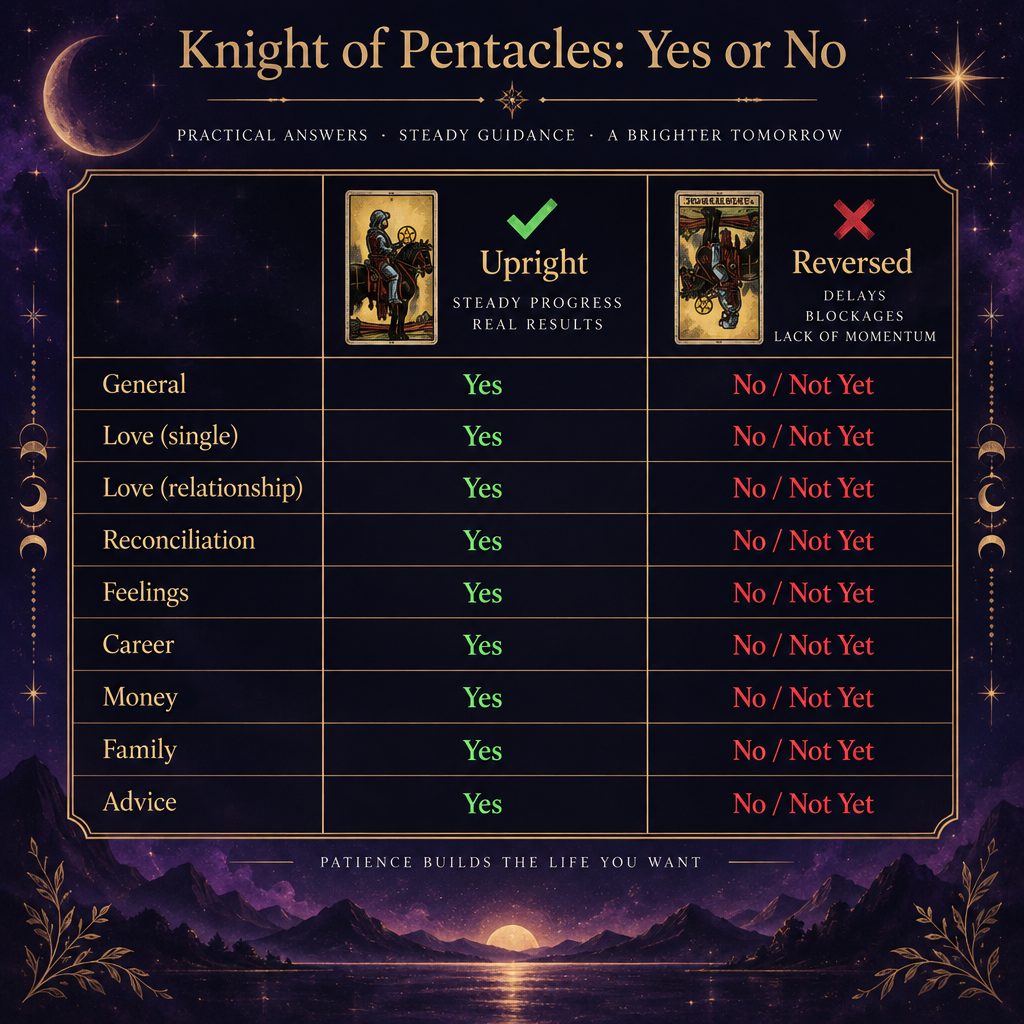
Upright, the Knight of Pentacles is a yes. Reversed, it is a no, or more precisely a “not yet.” The catch with this card is that even the yes comes with a condition: the outcome arrives slowly, through steady work, and only if you keep showing up for it.
Quick Answer Table
| Question type | Upright | Reversed |
|---|---|---|
| General yes or no | Yes, but slowly | No / not yet |
| Love (single) | Yes, a loyal partner is coming | No, you are stuck in a rut |
| Love (in a relationship) | Yes, the bond is stable | Not yet, boredom or neglect needs fixing |
| Reconciliation with an ex | Yes, with patience and proof of change | No, the old patterns are unresolved |
| Feelings | Yes, serious and committed | No, uncertain or indecisive |
| Career | Yes, through consistent effort | No, stagnation or procrastination |
| Money | Yes, steady growth | No, funds are stuck or mismanaged |
| Family | Yes, dependable support | No, responsibilities are being neglected |
| Advice / should I act? | Yes, take methodical action | No, pause and rebuild motivation first |
If you only need the one-line version: upright means proceed and be patient, reversed means something in you or your situation has stalled, and forcing a result now will not work.
What the Card Shows and Why It Matters for a Yes or No Reading
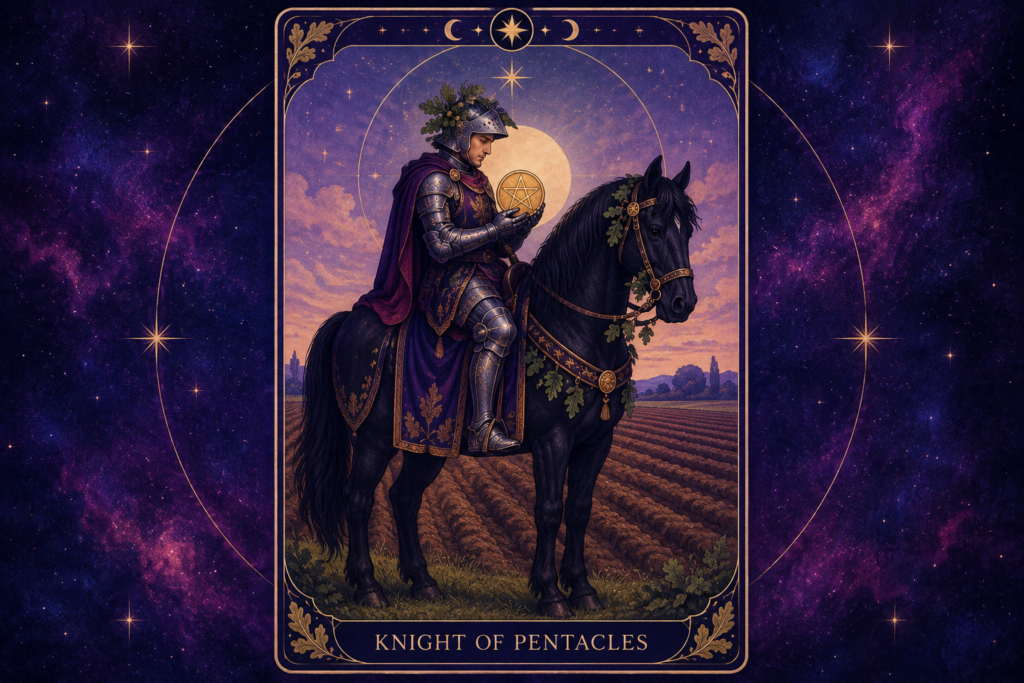
In the Rider-Waite-Smith deck, illustrated by Pamela Colman Smith in 1909, the Knight of Pentacles is the only one of the four knights whose horse is standing completely still. The other three are in motion. The Knight of Wands rears, the Knight of Swords charges, and the Knight of Cups walks forward. This knight sits on a heavy black horse with all four hooves planted on the ground.
He wears full armor and holds a single gold pentacle in his gloved hands, looking at it rather than at the road ahead. Behind him stretch rows of freshly ploughed earth. Both his helmet and the horse’s bridle are decorated with sprigs of oak leaves, a traditional symbol of endurance and slow-grown strength.
Each detail feeds directly into the yes or no interpretation:
- The stationary horse tells you the answer is not fast. A yes from this card is a yes that unfolds over weeks or months, not days.
- The ploughed field shows work already done and a harvest still to come. The ground is ready. Nothing has grown yet.
- The single pentacle points to one concrete, material goal. This card does not deal in vague hopes. It deals in paychecks, deposits, signed leases, and promises kept.
- The armor and oak leaves signal protection and persistence. Whatever you are asking about will hold up under pressure if it is built properly.
- The dark horse is the shadow side. Heaviness, inertia, and the risk of never moving at all. When the card flips, this is the energy that takes over.
So the card is a yes in the way that a well-planted field is a yes. The result is real and reliable, but you cannot speed it up by wanting it more.
Upright and Reversed Keywords
| Upright Knight of Pentacles | Reversed Knight of Pentacles |
|---|---|
| Practical | Stagnation |
| Reliable | Laziness |
| Patient | Procrastination |
| Hard-working | Boredom |
| Committed | Lack of progress |
| Methodical | Resistance to change |
| Slow and steady | Rigidness |
| Conservative | Perfectionism |
| Efficient | Workaholism |
| Loyal | Complacency |
| Stoic | Feeling stuck |
Notice that the reversed list is not the opposite of the upright list. It is the upright list taken too far or not far enough. Patience becomes procrastination. Methodical becomes rigid. Hard-working becomes workaholic. That is why reversed readings for this card are so often about being stuck rather than about dramatic failure.
Knight of Pentacles Upright: Yes, But Slowly
Upright, the Knight of Pentacles gives you a yes with a very specific texture. It is not the enthusiastic yes of the Sun or the Ace of Cups. It is the yes of a contractor telling you the house will be finished on schedule.
The card says three things at once:
- The thing you are asking about is achievable.
- It requires consistent effort, probably more than you expected.
- The timeline is longer than you want it to be.
A good example is asking “Will I pass this certification exam?” and pulling the Knight of Pentacles upright. The answer is yes, but the card is also telling you to keep to the study plan, not to cram, and not to expect a shortcut. If you asked “Will I get the promotion by the end of the month?” the card is still leaning yes on the promotion itself, but it is quietly disputing the deadline.
The strongest upright yes comes when your question involves anything built over time: a mortgage approval, a long-term relationship, a business that needs to become profitable, a fitness goal, a savings target. The weakest upright yes is for questions that need speed or spontaneity. If you ask “Should I book this last-minute trip?” the Knight of Pentacles is a lukewarm yes at best, because sudden decisions are not what this card does.
Knight of Pentacles Reversed: No, or Not Yet
This is where many readers get it wrong, and the older version of this page got it wrong too. Reversed, the Knight of Pentacles is a no. It is not a “yes with a craving for change.” The dominant energies of the reversal are stagnation, laziness, procrastination, perfectionism, and refusal to adapt.
Picture that still horse again. Upright, it is pausing before a long journey. Reversed, it has simply stopped. Nobody is steering, the field behind it has gone to seed, and the knight is staring at his coin instead of planting anything.
Reversed, the card points to one or more of these blocks:
- Procrastination. You know what needs doing and keep putting it off.
- Perfectionism. You will not launch, apply, or commit because the conditions are never quite right.
- Boredom and complacency. The routine has become a cage and you have stopped trying.
- Rigidness. You are refusing to change an approach that clearly is not working.
- Workaholism. You are busy, but the busyness is a way of avoiding the real decision.
The reason to read it as “not yet” rather than a flat, permanent no is that nothing in the card is destroyed. The field is still there. The knight still has the pentacle. The outcome you want is still possible, but it will not arrive until the blocking energy shifts. If you asked “Will my business turn a profit this year?” and drew the reversed Knight of Pentacles, the honest answer is no, not at the current pace, and the card is asking what you have been avoiding.
Knight of Pentacles Yes or No in Love
Love questions are where this card shows the biggest difference between upright and reversed, and between being single and being partnered.
If You Are Single
Upright, the answer to “Will I find love?” or “Will this turn into a relationship?” is yes. The person the card describes is loyal, slow to commit, and serious once they do. Expect someone who texts back reliably rather than someone who sweeps you off your feet in week one. If you are already seeing someone and asking whether it will become official, the card says yes, but on their timeline. Pushing for a label early will not speed this person up.
Reversed, the answer is no, and the card usually points the finger at you rather than at the dating pool. It describes someone stuck in routine, not putting themselves in new situations, or holding out for an impossibly perfect match. The “not yet” lifts once you actually change something about how you spend your weeks.
If You Are in a Relationship
Upright, questions like “Is my relationship solid?” or “Will we stay together?” get a clear yes. This is one of the most dependable commitment cards in the Minor Arcana. It describes shared effort, bills paid on time, and a partner who shows love through actions rather than declarations.
The one caution: if your question is “Will my relationship become more exciting?” the upright Knight of Pentacles is honestly a no. Stability is the gift here. Excitement is not.
Reversed in an existing relationship, the answer to “Are we okay?” is no, not at the moment. The usual culprits are boredom, one partner taking the other for granted, or a stubborn refusal to address a recurring problem. It rarely signals betrayal. It signals neglect.
Getting Back With an Ex
“Should I reconcile with my ex?” is one of the most common questions asked of this card.
Upright, the answer is yes, with conditions. Reconciliation is possible if both people are willing to do the slow, unglamorous work of rebuilding trust. The card favors a gradual return rather than a dramatic reunion. If your ex is reaching out with steady, consistent effort rather than a single emotional message, that matches the card.
Reversed, the answer is no. Whatever ended the relationship has not been addressed. One or both of you are stuck in the same patterns, and getting back together now would recreate the same problems within a few months. The card is not saying never. It is saying the groundwork has not been done.
Knight of Pentacles as Feelings
When you ask “How does this person feel about me?” the Knight of Pentacles answers in terms of commitment rather than passion.
Upright, the answer to “Do they have feelings for me?” is yes. The feelings are serious, steady, and oriented toward the long term. This person is thinking about whether you fit into their actual life, not just whether they enjoy your company. They are unlikely to say much about it quickly. Watch what they do, not what they say, because this card expresses affection through reliability.
Reversed, the answer is no, or at least not clearly. The person is indecisive, uncertain, or emotionally stalled. They might feel something but be too stuck in their own routine, fears, or work to act on it. Sometimes the reversal describes someone overwhelmed by responsibilities who has no bandwidth left for a relationship. In practice, a reversed Knight of Pentacles as feelings means you are waiting on someone who is not moving, and the card advises against waiting indefinitely.
Knight of Pentacles Yes or No for Career
Upright, career questions get a yes. Whether you are asking about a job offer, a promotion, a career change, or whether to stay in your current role, the card supports the path that rewards consistent effort. It is especially favorable for questions about job security, tenure, and roles that reward reliability over flash: accounting, engineering, trades, operations, project management, anything with a clear ladder.
Expect the yes to come through showing up and delivering, not through a single standout moment. If you asked “Will I get the job?” after an interview, the card says yes, and it also hints that the hiring process will be slower than advertised.
Reversed, career questions get a no. The card describes a position or a mindset that has stopped growing. You are either coasting in a job that no longer challenges you, procrastinating on an application or a difficult conversation, or so buried in routine tasks that you have lost sight of the goal. If the question is “Should I stay in this job?” the reversed card says no, but it also says you will not leave until you stop making excuses about timing.
Knight of Pentacles Yes or No for Money and Finances
Upright, money questions get a solid yes. This is a card of disciplined spending, steady income, and conservative investments that grow slowly. Questions like “Will my finances improve?”, “Will I be approved for the loan?”, or “Should I keep saving for this goal?” all lean yes. The card does not promise windfalls. It promises that the budget works if you stick to it.
For investment questions, upright favors low-risk, long-horizon choices. Index funds over day trading. Paying down debt over speculative purchases. If you are asking whether a get-rich-quick opportunity will pay off, the Knight of Pentacles upright is actually a soft no, because the card has no faith in shortcuts.
Reversed, money questions get a no. The card points to stagnant finances, income that has flatlined, or money sitting idle when it should be working. It can also describe the opposite problem: impulsive spending as a reaction to boredom, or a refusal to look at the accounts because the numbers are uncomfortable. “Will I get out of debt soon?” with the reversed Knight is a no until the spending plan changes.
Knight of Pentacles Yes or No for Family
Upright, family questions get a yes. The card describes a dependable relative, stable household routines, and support that shows up as practical help: someone who drives you to appointments, helps with the mortgage, or quietly handles the things nobody else wants to do. Questions about whether a family member will come through for you, or whether a household decision (moving, caring for a parent, taking in a relative) will work out, lean yes.
Reversed, the answer is no, and the problem is usually neglect rather than conflict. Responsibilities are being postponed, someone is taking the family’s stability for granted, or routine has hardened into coldness. A reversed Knight of Pentacles in a family question often points to a parent or sibling who provides materially but has checked out emotionally.
Knight of Pentacles Yes or No for Advice and Action
When the question is “Should I do this?” or “What should I do next?”, the card is unusually direct.
Upright: yes, act, but act methodically. Break the goal into steps. Set a realistic schedule. Do the boring parts first. The card actively warns against grand gestures, big risky leaps, and anything that depends on luck. If you are deciding between a flashy option and a sensible one, pick the sensible one.
Reversed: no, do not act yet. Not because the action is wrong, but because you are not in a state to carry it through. The card describes someone who would start and stall. Before acting, address the stagnation: rest if you are burned out, cut the perfectionism if you are overplanning, or shake up your routine if you are bored. The reversed card’s advice is to fix the engine before starting the journey.
Knight of Pentacles as a Person
As a personality, the Knight of Pentacles is the person who always arrives on time, never forgets a birthday, and has had the same job, car, or gym routine for a decade. Traditionally associated with the earth signs Taurus, Virgo, and Capricorn, this person values security over novelty and proves love and loyalty through follow-through.
Upright, this is someone you can build a life with. They are not exciting on paper, but they are the one still standing when everything else has fallen apart.
Reversed, the same person becomes stubborn, boring, or lazy. They resist every suggestion to change, dig in on small points, and either overwork to the point of neglecting everyone around them or stop trying altogether. If you asked whether a specific person is good for you and drew the reversal, the answer is no, at least in their current state.
Where the Knight Sits in the Suit of Pentacles
The Suit of Pentacles governs the material world: money, work, the body, home, and anything you can touch. The four court cards in the suit show different stages of relating to that world. The Page of Pentacles is the student who dreams of material goals. The Knight is the worker who grinds toward them. The Queen of Pentacles has achieved comfort and nurtures others with it. The King has built an empire and manages it.
That places the Knight at the effort stage. The reward is not yet in hand, which is exactly why the card’s yes is always conditional on continued work.
Comparing him to the other three knights sharpens the yes or no reading further. The Knight of Wands says yes and act immediately. The Knight of Swords says yes and cut through whatever is in the way. The Knight of Cups says yes and follow your heart. The Knight of Pentacles says yes, now make a plan and stick to it for as long as it takes.
The Timing Caveat Every Reading Needs
This is the single most important thing to understand about the Knight of Pentacles in a yes or no spread. The card is slow. If you ask “Will X happen soon?” and the card appears upright, the honest reading is that X will happen, but not soon. Readers who use the Pentacles suit for timing typically associate it with the longest timeframes in the deck, often months, or with the winter season.
That means an upright Knight of Pentacles can feel like a disappointment even though it is a yes. The thing you want is coming. Your job is to keep working while it does, and to stop checking the clock.
Reversed, the timing caveat becomes the whole answer. Nothing moves until something changes, and the card puts the responsibility for that change squarely on you.
FAQ
Is the Knight of Pentacles a yes or no card?
Yes. Upright, it is a yes that depends on steady effort and patience. Reversed, it is a no or a “not yet” caused by stagnation, laziness, procrastination, or perfectionism.
What does the reversed Knight of Pentacles mean in a yes or no reading?
Reversed, it means no for now. The situation has stalled, usually because of procrastination, boredom, rigid thinking, or a refusal to change course. The outcome is still possible later, but only after the blocking habit is addressed.
Is the Knight of Pentacles good for love?
Upright, it is one of the most reliable commitment cards in the deck. It points to a loyal partner and a stable relationship, though not a passionate or spontaneous one. Reversed, it signals a relationship stuck in routine or a single person not doing anything to meet someone new.
Is the Knight of Pentacles a yes or no for career?
Upright, yes. It supports job offers, promotions, and long-term security earned through consistent work. Reversed, no. It describes a stalled career, a job you have outgrown, or procrastination on the next step.
What does the Knight of Pentacles mean as feelings?
Upright, the person has serious, committed feelings and shows them through actions rather than words. Reversed, they are indecisive, uncertain, or too stuck in their own life to act on whatever they feel.
Does the Knight of Pentacles mean reconciliation with an ex?
Upright, reconciliation is possible if both people are willing to rebuild trust slowly. Reversed, no. The problems that ended the relationship have not been resolved and would return.
How long does the Knight of Pentacles take to deliver a yes?
Longer than you want. The card is tied to the slowest timeframes in tarot, often months rather than weeks. The result is dependable, but it arrives at the pace of a ploughed field turning into a harvest.