Ten Of Swords: Yes or No Tarot Meaning
Last updated: January 2026
Drawn the Ten of Swords in a yes or no spread? Upright, the answer is no, and it is one of the firmest refusals in the deck. Reversed, the answer softens to a cautious yes, with the condition that you stop clinging to whatever already ended.
The Short Answer
Upright Ten of Swords = NO. The situation has run its course. Whatever you are asking about is finished, or about to be, and no amount of effort will revive it in its current form.
Reversed Ten of Swords = Cautious YES. The worst has passed. Recovery is underway and forward movement is possible, provided you accept the ending rather than fight it.
If you only need the verdict, that is it. The rest of this page explains why the card answers this way, how the answer shifts for love, career, money and health, and what to do with a hard no when you were hoping for a yes.
What the Card Actually Shows
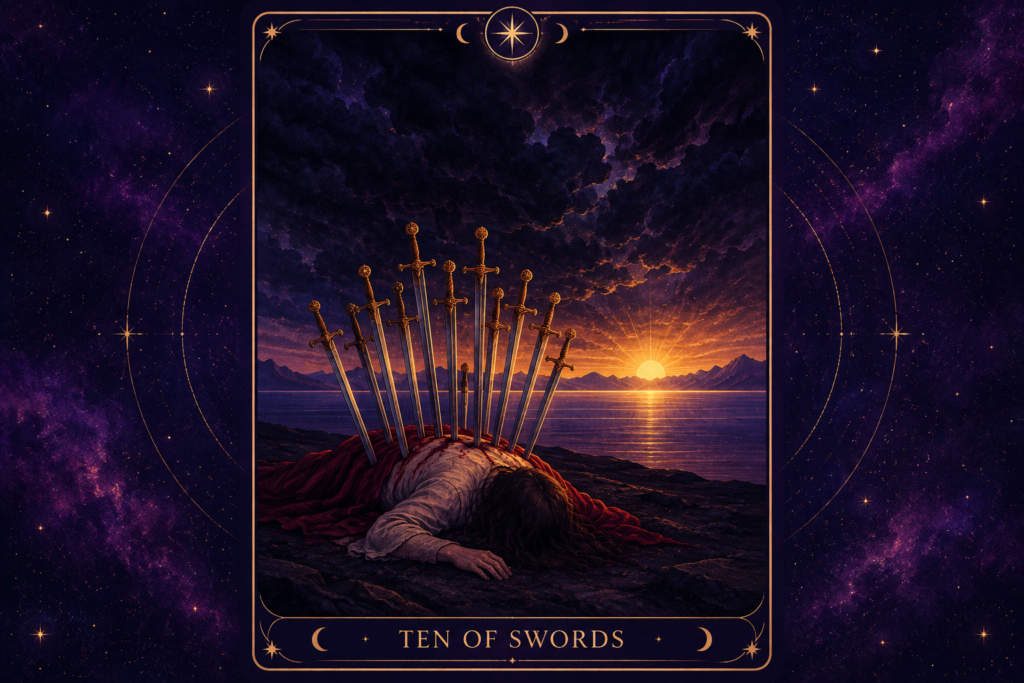
In the Rider-Waite-Smith deck, illustrated by Pamela Colman Smith in 1909, the Ten of Swords is the most brutal image in the Minor Arcana. A man lies face down on the ground with ten swords driven into his back and skull. A red drape covers his lower body. Above him the sky is black. That is the part everyone notices first.
Look at the horizon, though. Beneath the black band of cloud, the sky is turning yellow. Dawn is arriving over a flat, still body of water, and distant mountains are catching the first light. Smith painted the end of a night, not the middle of one.
Each element carries weight in a yes or no reading:
- Ten swords, not one. One sword would be a wound. Ten is overkill. The card is telling you there is nothing left to argue about. The matter is settled.
- The prone figure. He is not struggling, not reaching for help, not bargaining. The struggle is over. This is why the upright card refuses to say yes: there is no fight left to win.
- The black sky. This is the emotional reality right now. Grief, betrayal, rock bottom. The card does not minimise it.
- The lightening horizon. This is why the reversed card can say yes. The dawn is already built into the image. Nothing new has to happen for the sun to rise; time alone will do it.
- The still water. Swords are the suit of Air, of thought and conflict. Calm water in a Swords card signals that the storm of thinking has finally stopped. Clarity follows ruin.
- The hand gesture. The figure’s right hand is turned upward with two fingers extended, a position many readers interpret as a blessing or sign of acceptance. Even in defeat there is release.
The Golden Dawn title for this card was the Lord of Ruin, and Aleister Crowley kept “Ruin” as its keyword in the Thoth deck. Neither tradition softened it. The hope in this card is not that the ruin can be undone; it is that ruin clears the ground.
Upright Ten of Swords: Yes or No
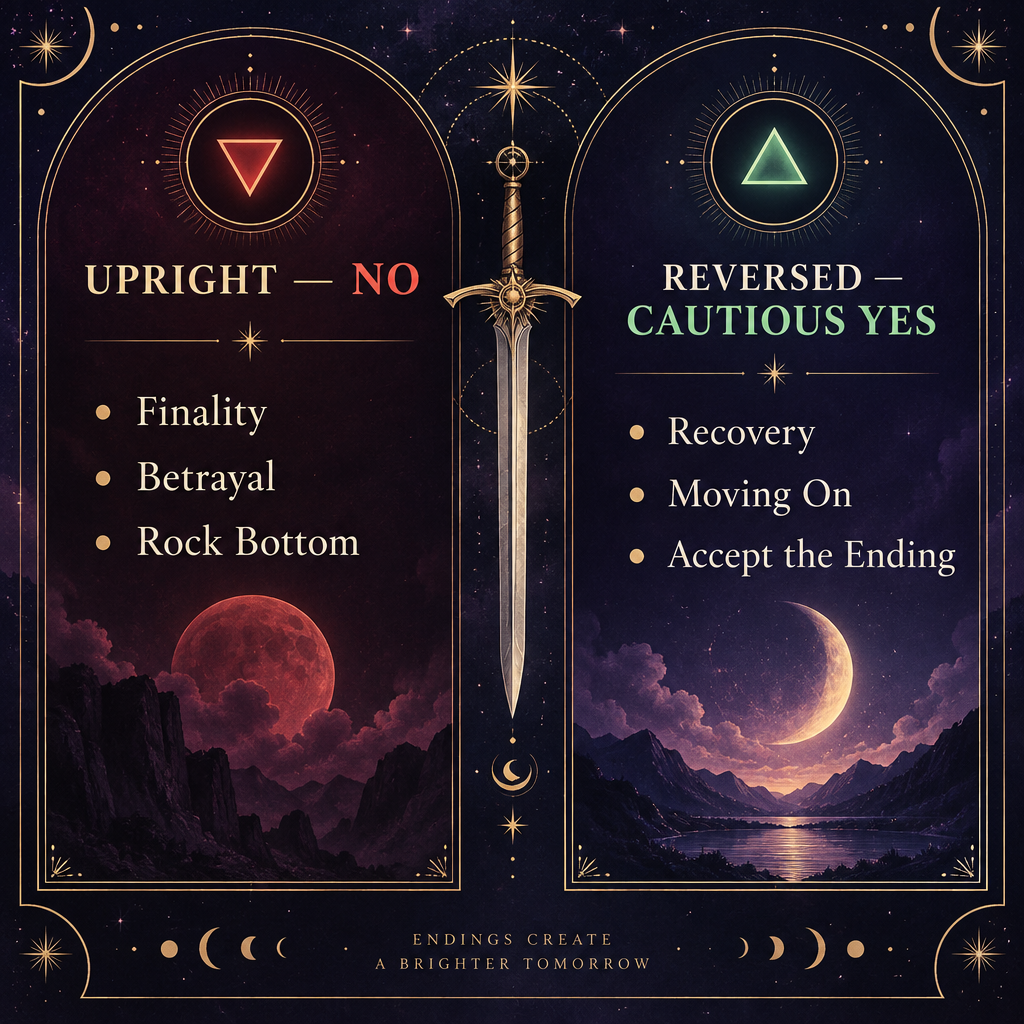
Verdict: No.
The upright Ten of Swords describes an ending that is complete, public and often painful. Think of the moment after the breakup text has been sent, after the redundancy meeting, after the friend’s betrayal has been confirmed. There is no ambiguity left, which is exactly why the card gives such a clean answer.
Three specific tones show up in upright readings:
- Finality. The question you asked has already been decided, usually not in your favour. “Will this work out?” No. “Will they change their mind?” No.
- Betrayal. Swords in the back are the oldest image of treachery there is. If your question involves trust, assume the trust has already been broken.
- Rock bottom with a floor under it. You cannot fall further. The card is the lowest point of the Swords suit, and the next card in the sequence is a court card, then a new Ace. Something new is coming, but not the thing you asked about.
The one case where upright reads as yes is when you ask whether something is truly over. “Is this finished?” Yes. “Should I stop trying?” Yes. The card confirms endings; it never confirms continuations.
Reversed Ten of Swords: Yes or No
Verdict: Cautious yes.
Reversed, the swords fall out of the figure’s back and the dawn takes over the image. This is the card of getting up off the ground. Recovery is real, the pain is receding, and forward movement is possible. For questions about healing, moving on, starting again or whether the worst is behind you, the reversed Ten of Swords says yes.
The caution matters. Two very different situations produce a reversed Ten of Swords, and you need to know which one you are in.
Recovery
The common reading. You have already absorbed the blow, grieved it, and are now rebuilding. The yes here is genuine. Health is improving, a new job search is gaining traction, you can think about your ex without your stomach dropping. Proceed.
Resisting an inevitable ending
The darker reading, and the one most quick-answer pages skip. Reversed cards can indicate blocked or delayed energy, and for the Ten of Swords that means refusing to let something die. You keep the relationship on life support. You stay in a role that has clearly been eliminated in all but name. You replay the betrayal rather than accept it.
In this case the “yes” has a sting: yes, you can move forward, but only once you stop resuscitating what is already gone. If your question was “Can I save this?” and the card appears reversed, read it as a warning that you are trying to save something that is not alive.
Tell the two apart by context. Surrounding cards like the Six of Swords, the Star or the Ace of Swords point to real recovery. The Eight of Swords, the Moon or the Seven of Cups beside a reversed Ten suggest you are still stuck in the story.
Why the Ten Is More Final Than the Eight or Nine
Readers often ask whether the Ten of Swords is really that different from its neighbours. It is, and the difference sharpens the yes or no answer considerably.
| Card | What is happening | Yes or no tendency |
|---|---|---|
| Eight of Swords | Blindfolded, loosely bound, swords around but not in the body. Trapped by perception, not reality. | Mostly no, but escapable. The restriction is mental. |
| Nine of Swords | Sitting up in bed at night, head in hands, swords on the wall. Anxiety, insomnia, dread of what might happen. | Mostly no, but the feared event has not occurred. Fear is louder than fact. |
| Ten of Swords | Face down, swords in the back. The feared event has happened. | Firm no. The outcome is already in. |
| Four of Swords | Lying down in a chapel, resting, three swords on the wall and one beneath. Chosen withdrawal. | Not yet, pause before deciding. |
The Eight says “you think you are stuck.” The Nine says “you are afraid it will happen.” The Ten says “it happened.” That progression is why the Ten is the most definitive no in the suit. There is nothing to prevent, because the thing already took place. Equally, this is why the reversed Ten is more hopeful than the reversed Eight or Nine: once the worst is behind you, there is nothing left to dread.
Ten of Swords in Love: Yes or No
Upright in love
No. The upright Ten of Swords in a love reading points to a breakup, a betrayal or a painful realisation that cannot be unlearned. Typical scenarios:
- You have discovered an affair, a lie or a second life.
- The relationship ended abruptly and completely, with the other person unwilling to discuss it.
- You are in a relationship where all affection has drained away and both of you know it.
For “Will we get back together?” the card says no. For “Does this relationship have a future?” no. For “Are they being honest with me?” no, and the card suggests you already suspect as much.
For single people asking “Will I meet someone soon?” the upright Ten says not until you have finished grieving the last one. It often appears when someone is dating with an unhealed wound and attracting repeats of the same pattern.
Reversed in love
Cautious yes, with a condition. Reversed in love, the card describes a heart that is reopening after serious damage. Forgiveness is becoming possible, either of an ex or of yourself. Trust can be rebuilt, slowly.
Question by question:
- “Will we reconcile?” A reversed Ten gives a weak yes only if both people have genuinely changed. More often it says you are ready to stop hurting, which is not the same as the relationship being viable. Check the surrounding cards before acting.
- “Am I ready to date again?” Yes. The reversed card is practically a green light for this question.
- “Can I trust them again?” Yes, cautiously, if the betrayal has been fully acknowledged by the person who committed it. If they have never admitted it, the reversed Ten is warning you that you are forgiving in a vacuum.
The resisting-the-ending trap applies hardest in love. If the reversed Ten appears when you are asking how to win someone back, hear it as “let go,” not “try harder.”
Ten of Swords as Feelings
A very common reason people pull this card is to ask how someone else feels about them.
Upright as feelings
The person feels defeated, drained or betrayed. Where you are concerned, they may feel the connection is over, that they were stabbed in the back, or that there is simply nothing left to give. Sometimes they are not thinking about you at all because they are overwhelmed by their own collapse. Either way, do not expect warmth or pursuit from someone represented by the upright Ten.
If you are asking how you feel and keep getting this card, you already know: wrung out, finished, and strangely relieved underneath the pain.
Reversed as feelings
They are beginning to heal. The bitterness is fading, they can think about the past without flinching, and they may be open to contact or closure. This does not automatically mean they want you back. It means they are no longer in crisis, and an honest conversation is now possible where it was not before. For a new connection, the reversed Ten says the person is ready to let their guard down for the first time in a while.
Ten of Swords in Career: Yes or No
Upright in career
No to continuation. Yes to leaving. Upright, the card marks job loss, a project that collapsed, a business that failed, or burnout so complete that you cannot pretend anymore. Betrayal at work is also common here: a colleague took credit, a manager promised a promotion and gave it to someone else, a partner walked away with the client list.
- “Will I get the job?” No. Expect a rejection or a role that falls through after the offer stage.
- “Will this project succeed?” No. If it is already underway, the card suggests it is beyond rescue.
- “Should I quit?” Yes. The Ten of Swords says the role is already over in every way that matters; your resignation would just make it official.
- “Will my business recover?” Not in its current form. Wind it down cleanly rather than bleed money keeping it alive.
Reversed in career
Cautious yes. Reversed, the professional damage is behind you. Redundancy has turned into a job search that is finally producing interviews. The failed launch has taught you what the market actually wants. Burnout is lifting because you set boundaries or changed roles.
- “Will I find new work?” Yes, though the card suggests the recovery has been slow and you should not expect it to accelerate dramatically.
- “Is the worst over at my company?” Yes. The layoffs or restructuring have happened; what remains is rebuilding.
- “Should I go back to my old employer?” Here the resisting-the-ending warning applies. Reversed Ten in response to this question usually means you are reaching backward because forward feels uncertain. Keep going forward.
Money and Health
Finances, upright: No. A financial loss has occurred or is unavoidable: a bad investment that is now worthless, a debt that cannot be restructured, a bankruptcy. Asking whether a risky venture will pay off? It will not. The constructive side is that the card favours cutting losses decisively. Stop pouring money into the sunk cost.
Finances, reversed: Cautious yes. You are climbing out. Debts are being paid down, the budget is holding, and the panic has passed. Avoid new risk until the recovery is further along; the swords are out of your back, but you have not finished healing.
Health, upright: The card points to exhaustion, burnout, and the physical toll of prolonged stress. It can indicate a diagnosis that confirms what you feared, or a collapse that forces rest you refused to take voluntarily. Yes or no for “Will I recover quickly?” is no, because the card describes hitting a limit. For “Do I need to stop?” the answer is yes, immediately.
Health, reversed: Yes. Recovery after a serious illness, surgery or breakdown. Energy is returning. The card also appears when someone has finally started treating a chronic issue they had been ignoring.
A reminder that tarot does not replace medical advice. If health is the question, the card’s practical message is to see a professional and rest, not to rely on the spread.
Specific Yes or No Questions
Here is how the card answers the questions people actually type into a search bar.
| Question | Upright | Reversed |
|---|---|---|
| Is this relationship over? | Yes | Yes, but you are coming to terms with it |
| Will we get back together? | No | Unlikely; focus on your own healing |
| Is this friendship finished? | Yes, and a betrayal is likely involved | It is salvageable only if the damage is addressed openly |
| Will I get the job? | No | Yes, after setbacks |
| Should I quit my job? | Yes, it is already over | Yes if you are staying out of fear |
| Will my business survive? | No in its current form | Yes, slowly |
| Is the worst over? | No, you are in it now | Yes |
| Can I trust this person? | No | Cautiously, if they have owned their actions |
| Will my health improve? | Not without a full stop | Yes |
| Should I keep fighting for this? | No | No, let it go and rebuild instead |
| Am I ready to start over? | Not yet, grieve first | Yes |
Reading the Ten of Swords with Other Cards
Context can sharpen or soften the verdict. A few combinations worth knowing:
- With the Three of Swords: Heartbreak that has reached its absolute end. Doubly no for reconciliation, but the grief is now fully out in the open and can be processed.
- With the Tower: Sudden, total collapse. If the question involves a structure (a company, a marriage, a house purchase), expect it to fall completely. No.
- With the Death card: The ending is transformational rather than merely painful. Still no to the old situation, but the new chapter is strongly indicated.
- With the Six of Swords: You are leaving the wreckage behind. Reads closer to a reversed Ten even when upright; the no becomes “no, and that is the point.”
- With the Sun or the Star: The dawn on the horizon takes over. The ending is real, but what follows is markedly better. Yes to questions about the future.
- With the Ace of Swords: The cycle has completed and the new beginning has arrived. Mental clarity after ruin. Yes to new ideas, new plans, new directions.
- With the Seven of Swords: The betrayal was deliberate and may still be ongoing. No, and check what you have not yet been told.
Number, Element and Astrology
The Ten of Swords belongs to the suit of Swords, which corresponds to the element of Air. Air governs thought, communication, judgement and conflict. A Swords ending is a mental and verbal one: the argument that ends everything, the truth that cannot be unspoken, the decision that is final once made. This is why the card’s no feels so absolute compared with a Cups ending, which is emotional and often reversible.
Numerologically, ten completes the cycle begun by the Ace. Every suit’s Ten shows the fullness of its element: the Ten of Cups is complete emotional fulfilment, the Ten of Pentacles complete material security, the Ten of Wands complete burden. The Ten of Swords is thought taken to its conclusion, where every conflict has been fought to the bitter end and there is nothing left to think about. Ten reduces to one (1 + 0), which is why the card always implies a new Ace just out of frame.
Astrologically, the Golden Dawn assigned the Ten of Swords to the Sun in the third decan of Gemini, roughly 11 to 20 June. Gemini is the sign of duality, communication and restless thought, and the Sun here burns through illusion. The attribution fits the card’s two faces: the brutal exposure of what is true, and the illumination that follows once the lies are gone.
The Spiritual Meaning
In shadow work, the Ten of Swords is the card of permission. It gives you permission to stop. To stop fixing, stop explaining, stop hoping that a toxic pattern will change if you try one more approach. The figure on the ground is not a failure; he is someone who has finally quit a fight that could not be won.
Many readers describe this card arriving when a client has been “dying” inside a situation for years and has not let themselves acknowledge it. The ten swords make it undeniable. The relief that follows an honest ending is the spiritual gift of this card, and it is why experienced readers rarely treat the Ten of Swords as the worst card in the deck. The worst cards are the ones that keep you stuck. This one releases you.
What to Do After Drawing It
If upright:
- Accept the answer. Do not pull again hoping for a different card. The Ten of Swords rewards acceptance and punishes bargaining.
- Name what ended. Say it out loud or write it down. Swords are the suit of words; putting the ending into language is how this suit heals.
- Stop the bleeding. Cancel the subscription, send the resignation, block the number, close the account. Whatever is still draining you, cut it.
- Rest. The figure is horizontal for a reason. Give yourself at least a few days of nothing before planning what comes next.
- Watch the horizon. Pull a single card in a week asking what is beginning. Expect an Ace.
If reversed:
- Check which reversed you have. Ask honestly: am I recovering, or am I refusing to let go? If the second, treat the card as upright and follow the steps above.
- Take one concrete forward step. Apply for the job, go on the date, book the appointment. The reversed Ten rewards motion.
- Keep your boundaries. The swords have come out, but the wounds are fresh. Do not re-enter the situation that caused them to prove you have healed.
- Mark the recovery. Acknowledge how far you have come. People at this stage tend to underestimate their own progress.
FAQ
Is the Ten of Swords a yes or no?
Upright, the Ten of Swords is a clear no. It describes an ending that is already complete and cannot be reversed. Reversed, it is a cautious yes that points to recovery and forward movement, as long as you are not clinging to something that has already ended.
Can the Ten of Swords be positive?
Yes, in two ways. Reversed, it marks recovery, healing and the end of a painful period. Upright, it is positive for questions about whether something is truly finished or whether you should walk away, because it confirms that the struggle is over and a new cycle is beginning.
What does the Ten of Swords mean in love yes or no?
Upright in love it means no: a breakup, betrayal or painful realisation that ends the relationship. Reversed it means a cautious yes to healing, forgiveness and being ready to love again, but it rarely supports getting back together unless both people have fundamentally changed.
Is the Ten of Swords the worst card in tarot?
It has the most violent image in the Rider-Waite-Smith deck, but most experienced readers do not consider it the worst card. The Ten of Swords shows the end of suffering rather than the middle of it, and the dawn on the horizon promises a new beginning. Cards that keep you trapped, like the Eight of Swords or the Devil, are harder to work with.
Does the Ten of Swords mean someone is betraying me?
Often, yes. Ten swords in the back is the classic image of treachery, and the card frequently appears when a betrayal has occurred or been discovered. Check for the Seven of Swords or the Moon nearby, which strengthen this reading.
What does the Ten of Swords reversed mean for a yes or no question?
A cautious yes. The reversed card indicates the worst is behind you and recovery is possible. The caution is that reversed can also show someone resisting an inevitable ending, so if your question involves saving or reviving something, read it as a warning to let go.
Will I get the job if I draw the Ten of Swords?
Upright, no. Expect a rejection or an offer that falls through. Reversed, yes, though the card suggests you have already been through setbacks in your search and the recovery will be gradual rather than sudden.