
Six Of Pentacles: Yes or No Tarot Meaning
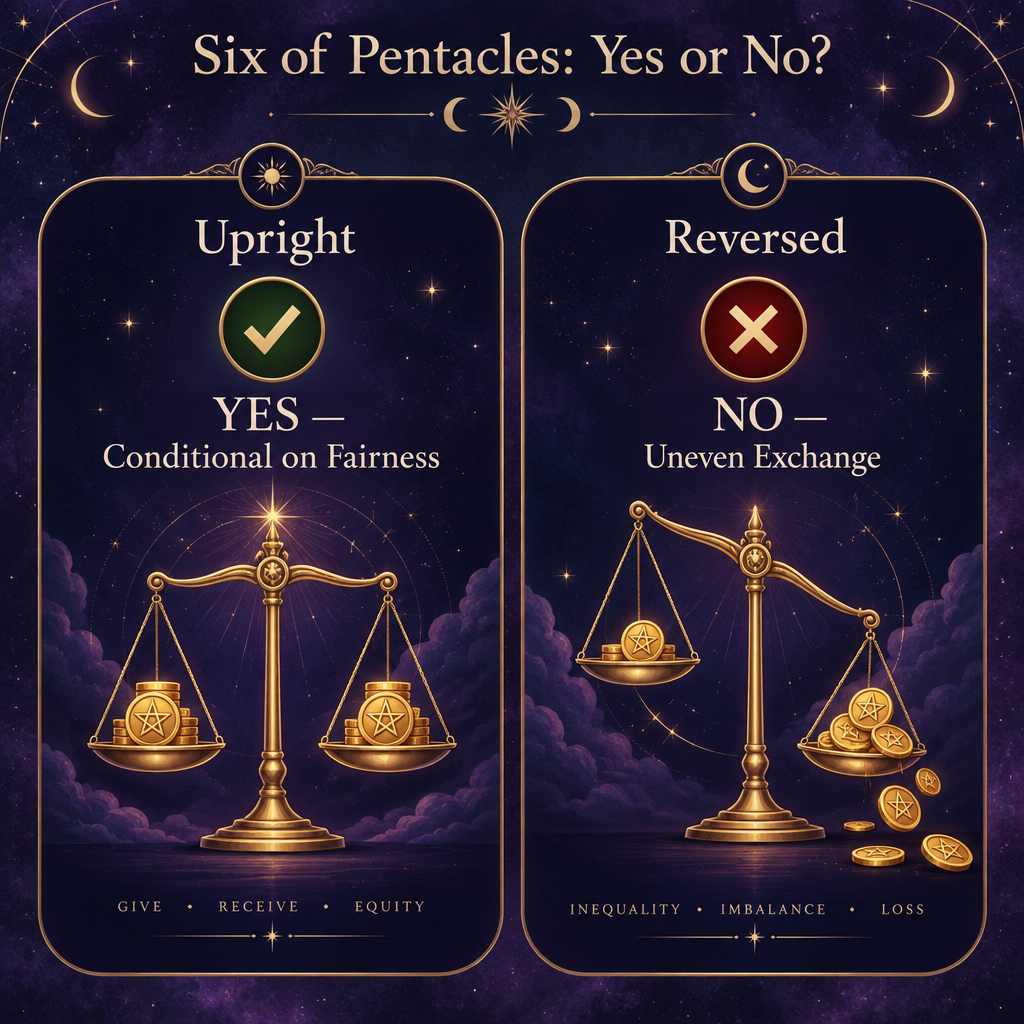
The Six of Pentacles is a yes card, but a yes with a condition attached: the exchange has to be fair. Upright, it answers yes to questions about love, money, work, and support. Reversed, it answers no, because the card’s whole logic of balanced giving collapses once it is flipped.
Last updated: 2025. Written by a working tarot reader using the Rider-Waite-Smith tradition.
Quick Answer
| Position | Verdict | One-line reason |
|---|---|---|
| Upright | Yes (conditional on fairness) | Resources, help, or affection are flowing, and both sides are getting something real. |
| Reversed | No (occasionally a weak maybe) | The flow is one-sided, has strings attached, or creates debt and dependency. |
If you only pulled one card and need a one-word answer: upright is yes, reversed is no. Everything below explains when that yes should be trusted and when it should be downgraded to a maybe.
Upright keywords: generosity, sharing, balance, charity, kindness, fair exchange, support arriving, patronage, gratitude
Reversed keywords: uneven exchange, selfishness, dependency, greed, exploitation, strings attached, debt, favoritism, false charity
Card Facts at a Glance
| Attribute | Detail |
|---|---|
| Suit | Pentacles (Coins, Disks) |
| Element | Earth |
| Number | 6 (harmony, equilibrium, responsibility) |
| Golden Dawn title | Lord of Material Success |
| Astrology | Moon in Taurus (Taurus is ruled by Venus) |
| Preceding card | Five of Pentacles (loss, exclusion) |
| Following card | Seven of Pentacles (patience, assessment) |
The Earth element matters for yes/no work. Earth cards describe things that are tangible and already in motion, not wishes or ideas. When the Six of Pentacles says yes, it is usually pointing at something you can measure: money in an account, a job offer in writing, a partner who shows up with time and effort. The number six adds the theme of balance, which is why fairness decides the verdict.
What the Card Shows and Why It Means Yes
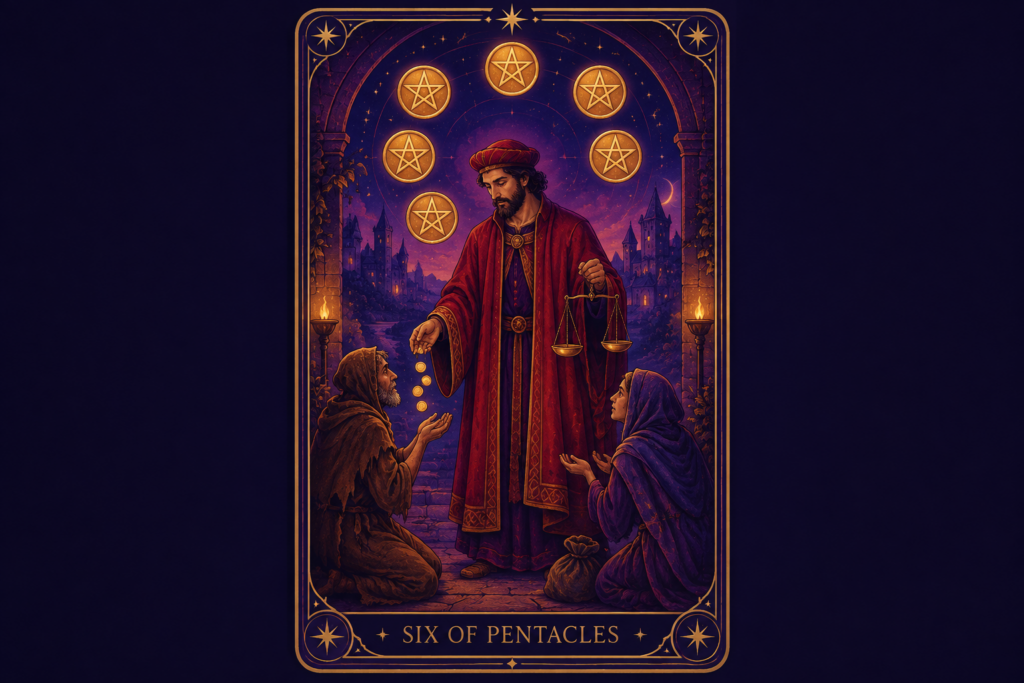
In the Rider-Waite-Smith deck, a merchant in red robes stands between two kneeling figures. He drops coins into the hands of one and holds a set of balanced scales in his other hand. Six pentacles float above the scene. The two kneeling figures are dressed in rags, one wrapped in a blue cloak, the other in yellow.
Each element carries weight in a yes/no reading.
The merchant. He has surplus and is choosing to share it. He is not giving everything away, and he is not giving blindly. This is deliberate, measured generosity from someone who can afford it. In a question about whether help or money is coming, the merchant is your yes.
The scales. This is the condition. The scales are level, and the merchant is weighing exactly how much to give to whom. The card is not about charity in the sentimental sense. It is about proportion. If your question involves an exchange that is lopsided, the scales are telling you the yes does not fully apply.
The two beggars. Only one of them is receiving coins in the moment the image captures. The second waits. This is the detail most quick-answer pages skip, and it is why the card is a conditional yes rather than a blanket one. Someone in the picture is still waiting their turn.
The six coins. Six is the number of harmony after the disruption of five. Six coins means enough to go around, provided the distribution stays fair.
Put together: resources exist, someone is willing to share them, and the system is designed to be equitable. That is a yes. The scales and the waiting beggar add the fine print.
The Conditional Yes: Balance Decides Everything
A Six of Pentacles yes is not the unconditional yes of the Sun or the Ace of Cups. Think of it as “yes, as long as the terms are fair.”
Are you the giver or the receiver?
Before you accept the yes, locate yourself in the image. The card describes a power dynamic, and your position inside it changes what the yes means.
You are probably the giver if your question is about lending money, mentoring someone, supporting a partner through a rough patch, or deciding whether to help. The card says yes, help. It also says to use the scales: give what you can spare, not what you cannot, and expect the gesture to be acknowledged.
You are probably the receiver if you are asking about a loan approval, a raise, a scholarship, a family member coming through for you, or whether someone cares enough to show up. The card says yes, support is coming. The caution is subtler. Receiving puts you in a dependent position for a while, and the merchant is the one holding the scales, not you.
A good test: if your question were answered yes tomorrow, would you be handing something over or picking something up? That tells you which kneeling figure, or which standing one, you are.
When the yes becomes a maybe
Downgrade the verdict to a maybe in these cases:
- The question is about whether something will happen equally for both people (a mutual proposal, a 50/50 business split, a reconciliation where both apologize). The card shows one person distributing and two receiving unequally, so true equality is not guaranteed.
- You are asking whether you will be the one in control. The receiver does not hold the scales.
- You are asking about something that must be unconditional, such as “Does this person love me with no agenda?” The merchant is kind, but he is also keeping accounts.
In most everyday questions, none of these apply, and the plain yes stands.
Six of Pentacles Reversed Yes or No: A Clear No
Flip the card and the merchant is on his head, the coins are falling away from the beggars, and the scales tip. The reversed Six of Pentacles is a no. Not a soft “proceed with caution,” a no.
The specific scenarios the reversed card describes:
Strings-attached giving. Someone is offering help, money, or affection as a way to control you later. A partner who pays for everything and then uses it as leverage. A parent whose financial support comes with veto power over your choices. Accepting the offer in your question will cost more than it gives.
One-sided relationships. You are the only one giving. The other person has become comfortable receiving and has no intention of reciprocating. The reversed card says no to continuing on current terms.
Debt and dependency. Questions about borrowing, co-signing, or taking money from someone who will hold it over you. The reversed Six says the arrangement will trap you. It is also a no for “Should I lend this money?” when the borrower has a history of not paying back.
Exploitation at work. Unpaid overtime, a boss who promises a promotion that never materializes, a role where you carry others without credit. “Will my hard work be rewarded here?” gets a no.
False charity. Giving to be seen giving, or receiving while resenting the giver. Either way the exchange is poisoned.
The only time reversed earns a weak maybe is when your question is about leaving an unfair situation. “Should I stop lending to my brother?” The reversed card essentially agrees that the imbalance is real, which supports your decision to stop. Treat that as a yes to ending the arrangement, which is the same thing as a no to continuing it.
Six of Pentacles Yes or No in Love
New relationships and someone you are dating
Upright: yes. The person you are asking about is willing to invest. Early on, this shows up as time, attention, small acts of generosity, and consistency rather than grand gestures. If you asked “Do they like me?” or “Will this go somewhere?”, the answer is yes, with one thing to watch: notice who is doing the giving. If it is all them, enjoy it but stay aware that generosity in the first months sometimes becomes expectation later.
Reversed: no. Someone is keeping score, love-bombing with an agenda, or treating the relationship as a transaction. If you asked “Should I pursue this?”, the card says no.
Existing relationships
Upright: yes. Both of you are putting effort in, and the relationship is on fair footing. “Will we work through this?” is a yes. “Do they still care?” is a yes. The card often appears when one partner has been carrying extra weight during a hard season (illness, job loss) and the other is stepping up. That is healthy and temporary.
Reversed: no. The relationship has settled into a giver and a taker. Resentment is building on one side, entitlement on the other. “Will things improve if I keep trying?” is a no unless the other person starts contributing.
Marriage and long-term commitment
Upright: yes to commitment, and a notably practical yes. The Six of Pentacles describes a partnership where resources, chores, money, and emotional labor are shared with intention. It is less romantic than the Two of Cups and more durable. A marriage shown by this card is one where both people know what they bring and feel it is valued.
Reversed: no. Marrying into imbalance locks it in. If you are asking whether to commit to someone who controls the money or who never reciprocates, the card says wait.
Six of Pentacles Yes or No for Career
Upright: yes. Expect recognition, a raise, a bonus, a mentor taking an interest in you, or an offer that reflects your worth. The merchant in the workplace is a boss or senior colleague with the power to allocate opportunities, and the card says they are choosing you. “Will I get the job?” is a yes. “Will I be promoted?” is a yes, usually with a fair salary attached.
If your question is about hiring, delegating, or managing others, you are the merchant. The card says yes to sharing credit and resources, and warns you to do it evenly across your team. Favoritism is the reversed version of this card.
Reversed: no. You are being underpaid, overlooked, or kept in a role that benefits everyone but you. “Will this company finally recognize me?” is a no. Start documenting your contributions and looking elsewhere.
Six of Pentacles Yes or No for Finances
This is the card’s home territory.
Upright: yes. Money comes in, often from an external source rather than your own labor: a loan approval, a grant, a gift, an inheritance share, a tax refund, a client finally paying an invoice. “Will I receive the money?” is a yes. “Should I lend or donate?” is also a yes, provided the amount leaves your own scales level.
Reversed: no. A loan will be denied, or approved on terms that hurt you. Money lent will not come back. Someone is being generous to you for reasons you should question. “Should I take this financial help?” is a no.
Six of Pentacles Yes or No for Health and Wellness
Upright: yes to seeking support. The card favors asking for help: booking the appointment, accepting the referral, letting a friend drive you, joining the support group. Recovery comes through received care rather than toughing it out. “Will I get the help I need?” is a yes. “Will treatment be affordable or covered?” leans yes.
Reversed: no, and specifically a no that points at self-neglect. You are pouring energy into everyone else and leaving nothing for your own body. Caregiver burnout, skipped meals, skipped check-ups. “Am I taking care of myself adequately?” is a no. The remedy is to move yourself to the receiving side of the card for a while.
The card does not predict illness. Treat any health reading as a prompt to see a professional, not as a diagnosis.
Six of Pentacles Yes or No for Family
Upright: yes. Family support is available and offered freely. A parent helps with a deposit, a sibling shares childcare, an older relative passes on something of value. “Will my family support my decision?” is a yes. “Will we repair this rift?” is a yes if one person is willing to make the first generous move, which the card says will happen.
Reversed: no. Family money or help is being used as a lever. The classic reversed Six scenario is a parent who funds an adult child’s life in exchange for obedience, or a sibling who always borrows and never repays. “Should I accept help from this relative?” is a no. “Will they ever stop keeping score?” is also a no.
Six of Pentacles as Advice
When the card lands in an advice or action position, it stops being a prediction and becomes an instruction.
- Give, measurably. Help the person in your question, but decide the amount in advance and stick to it.
- Accept the offer. If help has been extended, take it. Refusing out of pride is the Five of Pentacles energy the card has just moved past.
- Audit the balance. Write down what you give and receive in the relationship or job you are asking about. If one column is empty, act on that.
- Ask directly. Receivers in this card have their hands out. If you need something, say so.
- Share credit. If you are in a position of power, distribute opportunity evenly.
Reversed as advice: stop giving to someone who has stopped reciprocating, or stop accepting help that comes with conditions you resent.
The Spiritual and Karmic Angle
The Six of Pentacles sits immediately after the Five, where two figures limp past a lit church window in the snow, locked out of warmth they can see but cannot reach. The Six is the moment the door opens. Someone who has resources chooses to share them with people who recently had nothing.
Read karmically, the upright card says that generosity you extended in the past is circling back. If you have been the person who gave without keeping score, the universe is now the merchant and you are the one with open hands. If you have been struggling, the card says the hardship phase is ending and you are worthy of receiving. Worthiness is the real spiritual lesson here. Many people who pull this card struggle more with accepting help than with giving it.
Reversed, the karmic reading is a warning rather than a punishment: hoarding, manipulating through gifts, or taking without gratitude sets up a debt that will come due. The scales always level eventually.
Card Combinations That Change the Answer
| Paired with | Shift in verdict | Why |
|---|---|---|
| The Star | Stronger yes | Hope and healing join fair exchange. Help arrives and restores you. |
| Five of Pentacles | Yes, but delayed | The hardship is not fully over. Support comes after a difficult stretch. |
| Ten of Pentacles | Firm yes | Family wealth, inheritance, long-term security. Money with staying power. |
| The Devil | No | Generosity is a trap. Strings attached, dependency, control. Overrides the upright yes. |
| Seven of Swords | No | Someone in the exchange is not being honest about what they want in return. |
| Ace of Cups | Yes | Emotional and material generosity together. Excellent for love questions. |
| Four of Pentacles | Maybe | One party wants to give, the other hoards. The balance is in question. |
| Justice | Yes, with accountability | Fairness is enforced. Good for legal, settlement, or custody questions. |
When a reversed Six of Pentacles sits next to a strongly positive card like The Sun, read it as a problem that will be resolved rather than a hard no. When an upright Six sits beside The Tower or the Ten of Swords, the help is real but it arrives in the aftermath of something painful.
Single Card Pull vs. a Spread
A single card is the purest yes/no format. Upright Six of Pentacles: yes. Reversed: no. Do not overthink it.
In a three-card past, present, future spread, position changes the meaning. In the past, the card says you were helped or you helped someone, and the current question is downstream of that. In the present, the exchange is happening now and the answer is yes. In the future, help is on its way, which is a yes with a timeline, typically within the next few weeks to a couple of months given the Earth element’s slower pace.
In a Celtic Cross, the Six of Pentacles in the “hopes and fears” position often reveals that the querent is afraid of being dependent, or afraid that generosity will not be returned. Read the yes/no of the outcome card in light of that.
FAQ
Is the 6 of Pentacles a yes or no?
Upright, it is a yes, conditional on the exchange being fair. Reversed, it is a no.
What does the Six of Pentacles mean in a love reading, yes or no?
Yes for new relationships (the person is willing to invest), yes for existing relationships (both are putting in effort), and yes for commitment. Reversed is a no in all three, because it describes a relationship where one person gives and the other takes.
Is the Six of Pentacles reversed a definite no?
Yes, treat it as a no. The one exception is when your question is about ending an unfair arrangement, in which case the card supports leaving.
Does the Six of Pentacles mean money is coming?
Upright, yes, often from an outside source such as a loan, gift, bonus, or payment owed to you. Reversed, no, or money that arrives with conditions you will regret.
Is the Six of Pentacles a yes for getting a job?
Yes. The card points to an employer who recognizes your value and offers fair terms. Reversed suggests the role is underpaid or the recognition will not come.
What zodiac sign is the Six of Pentacles?
Taurus. The Golden Dawn system assigns it to the Moon in Taurus, and Taurus is ruled by Venus, which is why the card blends material security with giving and receiving.
How do I know if I am the giver or the receiver in the Six of Pentacles?
Ask what a yes would look like tomorrow. If you would be handing something over, you are the merchant. If you would be receiving money, help, or attention, you are one of the kneeling figures. Givers should check their limits; receivers should accept with gratitude but stay aware of who holds the scales.