Seven Of Cups: Yes or No Tarot Meaning
The Seven of Cups is a “maybe” card, and pretending otherwise gives you a worse reading. Upright, it says you are not ready to decide yet because you cannot see the situation clearly. Reversed, the fog is lifting and the answer tilts toward yes, provided you act on what you now know rather than what you wished were true.
The Quick Verdict
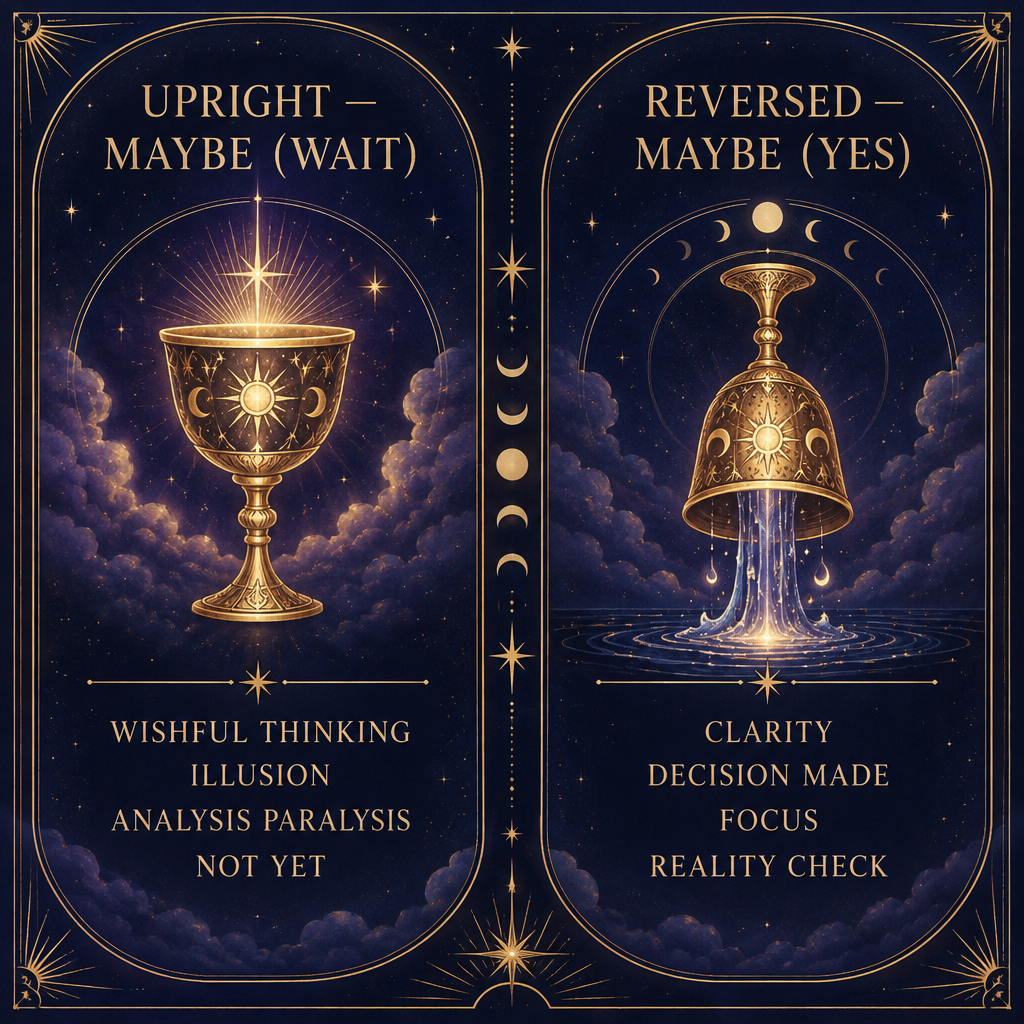
Upright: Maybe, leaning toward “not yet.” The card describes fantasy, wishful thinking and too many options. It does not say your wish will fail. It says you have not done the sober thinking required to know. Treat it as a pause, not a rejection.
Reversed: Maybe, leaning yes. Illusions are falling away. You are choosing one cup and putting the others down. If your question is about committing, deciding or getting real, the reversed card supports you. If your question is about whether a fantasy will come true exactly as pictured, the reversed card says that version is dissolving, and that is a good thing.
If you want a one-word shorthand for a quick pull: upright is “wait,” reversed is “probably, if you commit.”
Seven of Cups at a Glance
| Attribute | Detail |
|---|---|
| Arcana | Minor Arcana, suit of Cups |
| Element | Water (emotion, imagination, the subconscious) |
| Astrology (Golden Dawn system) | Venus in Scorpio, titled “Lord of Illusionary Success” |
| Alternative modern association | Neptune and Pisces energy (dreams, glamour, escapism) |
| Numerology | 7: reflection, inner searching, the gap between appearance and reality |
| Upright keywords | Wishful thinking, illusion, daydreaming, analysis paralysis, temptation, options |
| Reversed keywords | Clarity, decision made, disillusionment, focus, reality check, decision fatigue breaking |
| Yes/no shorthand | Upright: maybe (wait). Reversed: maybe leaning yes |
| Timing | Slow and unclear upright; movement resumes reversed |
The Venus in Scorpio attribution matters more than it looks. Venus wants pleasure and ease. Scorpio wants depth and intensity. Put them together and you get desire that fixates on a glittering image without checking what lies underneath. That is the whole card in one phrase.
What the Card Actually Shows
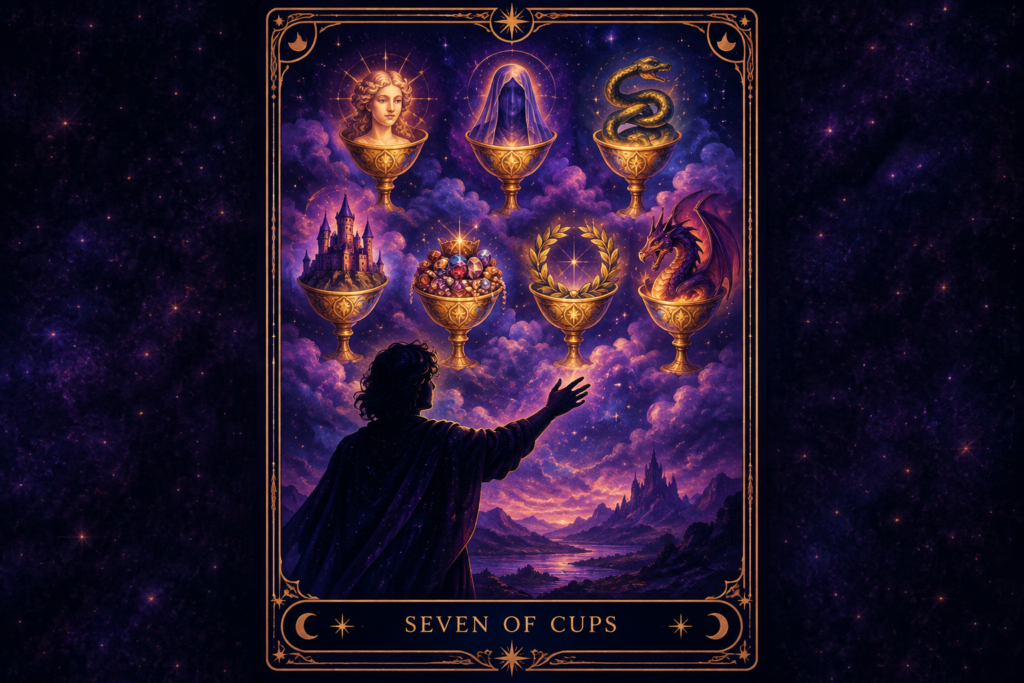
Pamela Colman Smith painted this scene for the Rider-Waite-Smith deck, first published by William Rider & Son in 1909 under the direction of Arthur Edward Waite. Most yes/no interpretations trace back to her choices here, so it pays to look closely.
A figure stands in the foreground, rendered as a solid black silhouette with its back to us. We never see the face, which is the first clue. This person has no identity in the scene other than “the one who wants.” One arm reaches toward a bank of clouds where seven golden cups float, each holding something different:
- A human head, usually read as a beautiful face. Romantic infatuation, the idealised partner, the lover you have invented rather than met.
- A veiled, glowing figure. Spiritual promise, a mystery that may be enlightenment or may be nothing under the sheet. This cup sits at the centre and is the one most readers treat as the “real” prize, though the card refuses to confirm it.
- A snake. Knowledge, sexuality, temptation, and the risk of being bitten by what you reach for.
- A castle or tower on a crag. Security, status, the fortress of achievement. Impressive from a distance, cold up close.
- A heap of jewels. Wealth, obvious and immediate. Also the easiest thing to fake.
- A laurel wreath, with a faint skull on the cup beneath it. Victory and recognition, with mortality drawn right into the trophy.
- A dragon or lizard. Power, fear, and the fantasy of controlling something that cannot be controlled.
Waite described the cups in his Pictorial Key as “strange chalices of vision” and called their contents “fairy favours” and “images of reflection.” The crucial point is that every cup sits on cloud. Nothing has a floor. Nothing can be picked up. Whatever the figure chooses, the first step has to be made in the dark, which is exactly why a yes/no question lands on “maybe” when this card arrives.
Seven of Cups Upright: Yes or No
Upright, the answer is maybe, and the useful part is understanding why.
The card is describing your state of mind more than your circumstances. You are looking at your situation the way the silhouette looks at the clouds: hopeful, a bit dazzled, and not yet in possession of facts. Three patterns show up again and again when this card answers a yes/no question:
- Wishful thinking. You already know what you want the answer to be, and the question is a bid for permission. The card declines to give it.
- Analysis paralysis. You have five or six possible paths and have researched all of them into a blur. More thinking will not fix this. Choosing will.
- Escapism. The thing you are asking about is a daydream you visit to avoid a dull or difficult reality. Asking “will I move to Lisbon?” while your current lease, job and relationship go unexamined is a Seven of Cups question.
So the upright card is not a no. Outcomes are open. But the card insists that the deciding factor is still missing, and that factor is you doing the unglamorous work of checking each cup for a false bottom.
A practical test: can you write down, in one plain sentence, what you would have to give up to get the thing you are asking about? If you cannot, the answer is “not yet,” and the card is correct.
Seven of Cups Reversed: Yes or No
Reversed, the answer is maybe leaning yes.
Turn the image upside down and the cups spill. The clouds no longer hold them. What tumbles out is what was actually inside, and the figure finally gets to see it. Readers call this the moment of disillusionment, and it is unpleasant for about a week before it becomes a relief.
The reversed card supports a yes when your question involves:
- Committing to one option after a long period of dithering
- Ending a fantasy that has been running your decisions (a crush, a get-rich plan, an idealised version of a job)
- Getting back to practical reality after an escapist stretch
- Clearing decision fatigue by eliminating choices rather than adding them
It leans toward no only when the question itself is the fantasy. “Will the dream exactly as I pictured it come true?” draws a reversed no, because the card’s job here is to replace the picture with something real. Most people who get the reversed card are better off for the correction within a few months, even if the first reaction is disappointment.
Seven of Cups Yes or No in Love
Upright in love
Verdict: maybe, do not commit yet.
Upright, the Seven of Cups in a love question describes romantic idealism. You are in love with potential. Either you are weighing several people and cannot settle, or you are projecting a complete personality onto someone you have met twice. The classic version is the person who keeps a mental list of “what if” partners while technically in a relationship, daydreaming about alternatives rather than fixing or ending what they have.
For singles: “Will I meet someone?” gets a maybe because you have not decided what you actually want. Your list of requirements contradicts itself (spontaneous but reliable, ambitious but always available).
For couples: “Should we take the next step?” gets a maybe because at least one of you is still half-looking at other cups. Moving in together or getting engaged on Seven of Cups energy tends to produce a lot of “I didn’t expect you to be like this” a year later.
Reversed in love
Verdict: maybe leaning yes, especially for commitment.
Reversed, the illusion drops. You see the person as they are and decide, with clear eyes, whether to stay or go. Both outcomes count as a yes to the real question, which is “will I get clarity?” If you are asking “will they commit to me?”, the reversed card says they are narrowing their focus and you are likely the choice, provided you are not asking them to choose between you and their fantasy of someone else.
The reversed card also shows up when someone finally stops chasing an unavailable person. That is a yes to moving on and a no to the unavailable person, delivered at the same time.
How Someone Feels About You
This is one of the most common questions this card is pulled for, and the answer is specific.
Upright, they feel a mix of attraction and confusion. You occupy one of their cups, and it is a nice cup, but you are sharing cloud space with other options, their career, an ex, a fantasy of being single, or simply the idea of you rather than the fact of you. They are not lying when they say they like you. They also are not ready, and they may not know it. “Overwhelmed” is the honest summary. Do not read it as rejection, and do not read it as a promise.
Reversed, they have been through the sorting process and are landing somewhere. If the surrounding cards are warm (Two of Cups, Ten of Cups, The Lovers), they have chosen you and feel relieved about it. If the surrounding cards are cold (Five of Cups, Eight of Cups, Three of Swords), they have realised you were a fantasy and are pulling back. Either way, you will know soon, which is more than the upright card offers.
Seven of Cups Yes or No for Career
Upright in career
Verdict: maybe, not the moment for a risky move.
Scattered energy. You have a side project, a course you half-started, an application you keep meaning to send and a vague plan to go freelance. None of these are bad. All of them together are a cloud bank. “Should I take this new job?” draws a maybe because you have not compared the actual offer (salary, commute, manager, scope) against your actual current situation. You have compared your fantasy of the new job against your frustration with the old one, which is a different exercise.
The upright card warns specifically against “shiny” opportunities: the startup with no revenue and a brilliant pitch deck, the role that promises rapid promotion without a written path, the business idea that depends on a market you have not tested. Ask for the numbers. If they are not forthcoming, you have your answer.
Reversed in career
Verdict: maybe leaning yes.
You pick a lane. The reversed card shows someone deleting four of their five tabs and doing the one thing properly. “Will I get the promotion?” leans yes if you have already focused your efforts. “Should I start the business?” leans yes if you have a plan that survives contact with a spreadsheet. The reversed card also describes recovering from stagnation: you have been stuck because you were waiting for the perfect option, and you realise a good option, acted on, beats a perfect option imagined.
Seven of Cups Yes or No for Money
Upright in money
Verdict: no to the spend, maybe to the plan.
Upright, this is the card of impulsive spending and financial fantasy. Buying the course that promises passive income. Putting a chunk of savings into a coin because a stranger online is sure about it. Planning a holiday to feel better rather than because you can afford it. “Should I buy this?” gets a clear no when the Seven of Cups upright arrives alone, because the card is telling you the purchase is a cup on a cloud.
“Will my finances improve?” gets a maybe. They can, but not while money is being used to purchase feelings.
Reversed in money
Verdict: yes to grounded planning.
Reversed, you sit down with the actual numbers. The budget gets written. The subscriptions get cancelled. The speculative position gets closed, sometimes at a loss, which stings but stops the bleeding. “Will I get out of debt?” leans yes because you have stopped pretending the debt is temporary. The reversed card does not promise a windfall. It promises that your relationship with money moves from fantasy to arithmetic, and arithmetic is where financial recovery happens.
Seven of Cups Yes or No for Health
Upright in health
Verdict: maybe, with a caution about avoidance.
Upright, the card describes someone exploring every wellness option at once: a new supplement stack, three podcasts’ worth of contradictory diet advice, an app for sleep, a plan to start running next month. Exploration is fine. The problem is that researching health can become a way of not doing anything about it. If your question is “will this new approach work?”, the answer is maybe, because you have not given any single approach long enough to show results. If your question concerns a symptom, the upright card says see a professional and stop self-diagnosing from forums.
Escapism also sits in this position: using food, screens, substances or sleep to avoid feelings. The card does not judge, but it does point.
Reversed in health
Verdict: yes to commitment, yes to listening to the body.
Reversed, you stop collecting methods and commit to one. You see the doctor you have been avoiding. You pick the exercise you will actually do rather than the one you admire. “Will I recover?” leans yes when the reversed Seven of Cups appears, because recovery requires consistency and the card shows consistency returning. The reversed card also describes a reality check about a habit you have been romanticising, which is uncomfortable and useful.
The Seven of Cups in a One-Card Pull
A single Seven of Cups, with no other cards for context, is the purest “maybe” in the deck. Here is how to read it without over-interpreting:
- Upright, single card: The universe is handing the question back to you. The answer depends on a choice you have not made. Your job is to make it.
- Reversed, single card: Something you believed about this situation is about to be corrected. Lean toward yes, but expect the yes to look different from the one you imagined.
Do not pull a second card to “clarify” a Seven of Cups into a yes or no. The card is already telling you that your relationship with the question is the issue. Pulling again is reaching for another cup.
How to Reframe Your Question
When the Seven of Cups appears in response to a yes/no question, the binary itself is usually the problem. The card is saying: you want a verdict so you can stop thinking, but thinking is exactly what you have been avoiding by fantasising.
Useful reframes that this card responds to well:
- “Will I get the job?” becomes “What do I actually know about this job, and what am I assuming?”
- “Does he love me?” becomes “What has he done, not said, in the last month?”
- “Should I move?” becomes “What would have to be true about my current life for me to stay?”
- “Will this investment pay off?” becomes “What is the worst realistic outcome, and can I afford it?”
Pull again with the reframed question, if you want. More often, the reframe answers itself before you shuffle.
Seven of Cups Compared with Other “Maybe” Cards
Several cards get filed under “maybe,” and they mean different things.
The Moon is also about illusion, but it is illusion imposed from outside: deception, hidden information, fear in the dark. The Seven of Cups is illusion you are generating yourself. The Moon says “someone is not telling you something.” The Seven of Cups says “you are not telling yourself something.”
The Two of Swords is a stalemate with eyes deliberately covered. The figure knows a decision is needed and refuses to look. The Seven of Cups figure is looking too much, at too many things. Two of Swords is paralysis by refusal. Seven of Cups is paralysis by abundance.
The Wheel of Fortune is a maybe because outcomes genuinely depend on timing and factors beyond you. The Seven of Cups is a maybe because the outcome depends on you. That difference tells you where to put your effort: with the Wheel, wait; with the Seven, decide.
What To Do Next
If the card is upright
- List every option you are considering. All of them, including the embarrassing ones.
- Next to each, write the cost. Not the benefit, the cost. Money, time, what you would give up.
- Cross out any option where you could not fill in the cost. Those are cloud cups.
- Give yourself a deadline to choose among what remains. A week is usually enough. A month is avoidance.
- Stop consuming new information about the decision until the deadline. Research is the upright Seven of Cups’s favourite hiding place.
If the card is reversed
- Name the illusion that just collapsed. Say it plainly, even if only to yourself.
- Grieve it briefly. Disillusionment is a loss, even when it is a healthy one.
- Act on the one option left standing within 72 hours. Reversed energy fades if unused.
- Expect the result to be plainer than the fantasy. Plain is what you can build on.
FAQ
Is the Seven of Cups a yes or no card?
It is a maybe card. Upright means “not yet, you cannot see clearly.” Reversed leans toward yes because clarity is returning and a decision is being made. Readers who force it into a flat yes or no lose the card’s actual message, which is that the answer depends on a choice you have not yet committed to.
What does the Seven of Cups reversed mean in a yes or no reading?
Reversed, the card leans yes. Illusions are breaking down, options are narrowing, and you are choosing. If your question is about committing, deciding or facing reality, read it as supportive. If your question is whether a specific fantasy will come true exactly as imagined, read it as a no to the fantasy and a yes to something more realistic.
Can the Seven of Cups ever mean a clear yes?
Yes, in a narrow set of cases. Reversed, paired with decisive cards like the Ace of Swords, the Chariot or the Eight of Pentacles, it signals a firm commitment and reads as yes. Upright it almost never reads as a clean yes, because the card’s core meaning is that the deciding factor is still unresolved.
Is the Seven of Cups a good card?
It is neutral and honest. It is good when you need permission to stop rushing. It is uncomfortable when you wanted the deck to endorse a fantasy. The reversed card is often the better outcome long-term, since disillusionment leads to grounded decisions, even though it feels worse in the moment.
What does the Seven of Cups mean for how someone feels about me?
Upright, they are attracted but confused, weighing you against other options or against an idealised version of you. Reversed, they have sorted through those options and are landing on a decision. Surrounding cards show which way: warm Cups cards mean they chose you, Swords and departing cards mean they are pulling back.
Does the Seven of Cups mean I should wait?
Upright, yes. Waiting is the correct move, but wait actively: clarify what you want, check your assumptions, and set a deadline to decide. Reversed, no. The waiting is over and the card is asking you to act on the clarity you now have.