Tower: Yes or No Tarot Meaning
The Tower is one of the few cards in the deck that gives a yes or no reading almost no room to wriggle. Upright, it is a no, and a loud one. Reversed, the answer is genuinely contested among readers, and this guide explains why, takes a position, and then walks through what the card means for love, career, money, health, family and spiritual questions.
The Short Answer
Upright Tower: No. Not “not yet,” not “maybe with effort.” The situation you are asking about is built on something that will not hold, and the card predicts collapse rather than success. If you asked “Will this work out the way I want?”, the Tower says the structure itself is the problem.
Reversed Tower: a cautious no, leaning toward “not in its current form.” This is where the honest disagreement lives. Some readers call it a flat no, some call it a maybe, and a minority treat it as a weak yes because the worst has already happened and rebuilding has begun. The position taken here, and explained below, is that the reversed Tower rarely supports the outcome you are asking about, but it does not slam the door the way the upright card does.
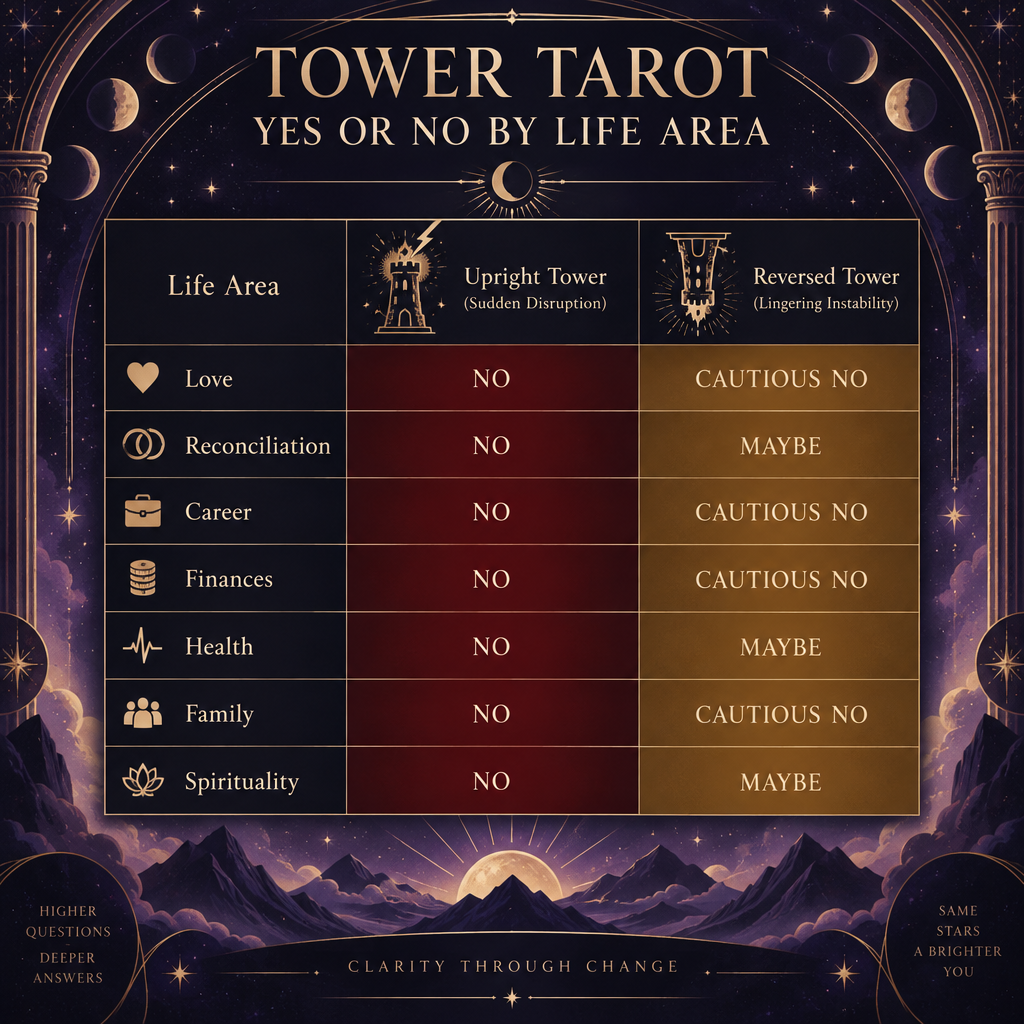
Quick-Reference Table
| Life area | Upright Tower | Reversed Tower |
|---|---|---|
| Love (new or existing) | No. Expect a rupture or a revelation | Cautious no. Something is being avoided or quietly crumbling |
| Reconciliation with an ex | No. The old foundation is gone | No for now. Aftershocks still settling |
| Career / job offer | No, or a yes that ends in upheaval | Lean no. Change is being delayed, not avoided |
| Finances / money | No. Sudden loss or forced restructuring | Cautious no. Loss averted narrowly, or a crisis postponed |
| Health | No for “will this resolve smoothly.” Seek attention | Maybe. Scare passes, but the warning stands |
| Family | No. A secret surfaces or a role shifts abruptly | Lean no. Tension suppressed rather than resolved |
| Spirituality / growth | Yes to awakening, no to comfort | Yes, slowly. Resistance is softening |
The table is the fast version. The rest of the article explains why each cell reads the way it does, and when you should override it.
Why the Reversed Tower Splits Readers Three Ways
The upright Tower is near-unanimous as a no. The reversed card is where published guides contradict each other, and the earlier version of this page did it inside a single paragraph. Here are the three legitimate positions and the reasoning behind each.
Camp one: still a no
A reversed card does not reverse the card’s subject. The Tower is still about collapse; reversal only changes how the collapse plays out. This camp reads the reversed Tower as destruction that is delayed, denied or dragged out. The person asking is clinging to a structure that is already failing. From that view, the answer to “Will I get what I want?” is still no, and arguably a worse no, because the fall is slow and the person cannot see it coming.
Camp two: a maybe
This camp focuses on the Tower’s reversed keywords of “disaster avoided” and “resisting change.” If the lightning has not struck yet, there is still a window. The outcome depends on whether the querent acts before the structure gives way. That makes it a conditional answer rather than a prediction. Will the job work out? It can, if you address the problem you have been pretending is not there.
Camp three: a quiet yes
A smaller group reads the reversed Tower as the aftermath. The explosion already happened, the dust is settling, and the person is standing in the rubble starting to rebuild. On that reading, a question like “Will I recover from this?” earns a yes, because the card marks the turning point after the worst day.
The position taken here
All three readings are internally consistent, which is exactly why you should not treat any single keyword list as gospel. The practical rule is to look at what you asked. If the question is about keeping, winning or starting something, the reversed Tower is a cautious no. If the question is about recovering, surviving or rebuilding, it tilts toward yes. The card’s essence is unchanged either way: whatever is false in the situation is going to come down. Reversal just tells you the timing is messier.
What the Imagery Tells You (Rider-Waite-Smith)
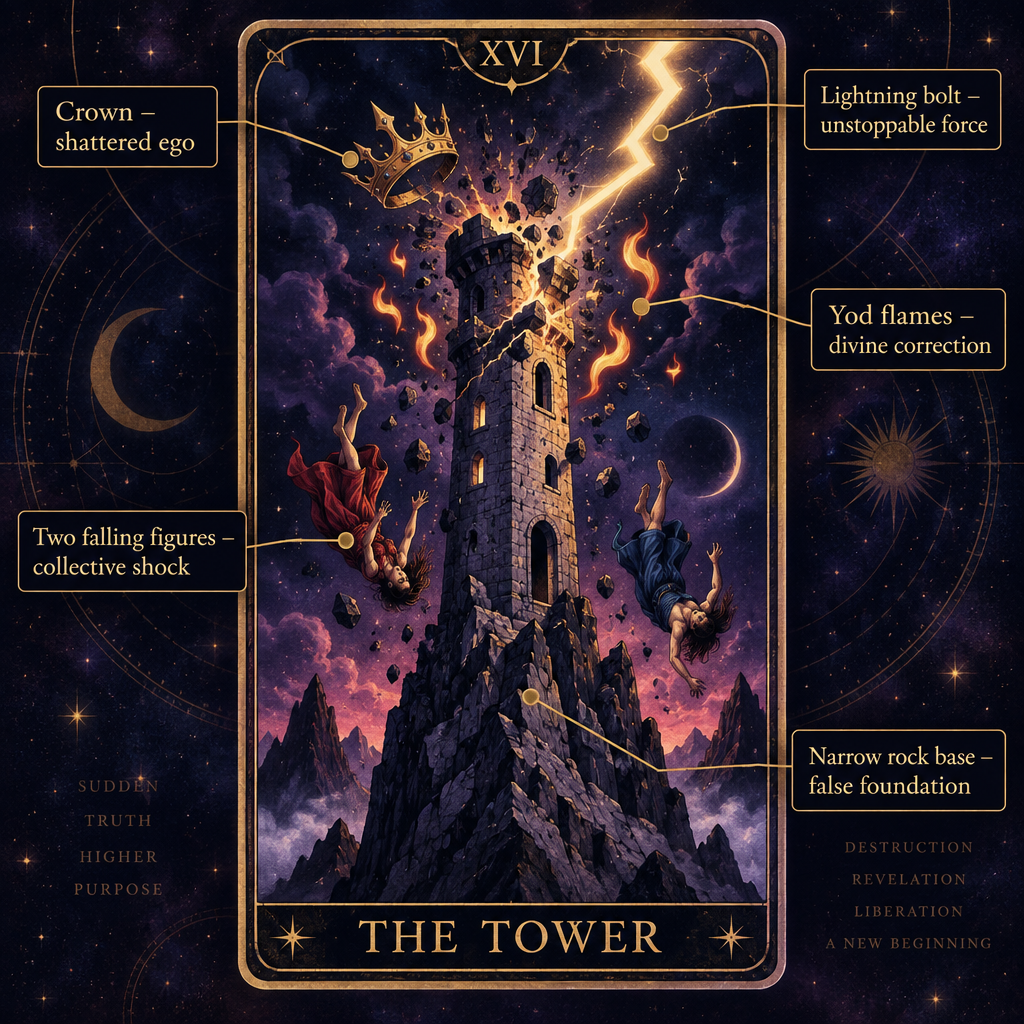
The image most people picture comes from the Rider-Waite-Smith deck, published in 1909 and illustrated by Pamela Colman Smith under Arthur Edward Waite’s direction. Older Marseille-pattern decks call the card La Maison Dieu, the House of God, and show a similar scene. Every element in the Smith version reinforces the yes or no reading.
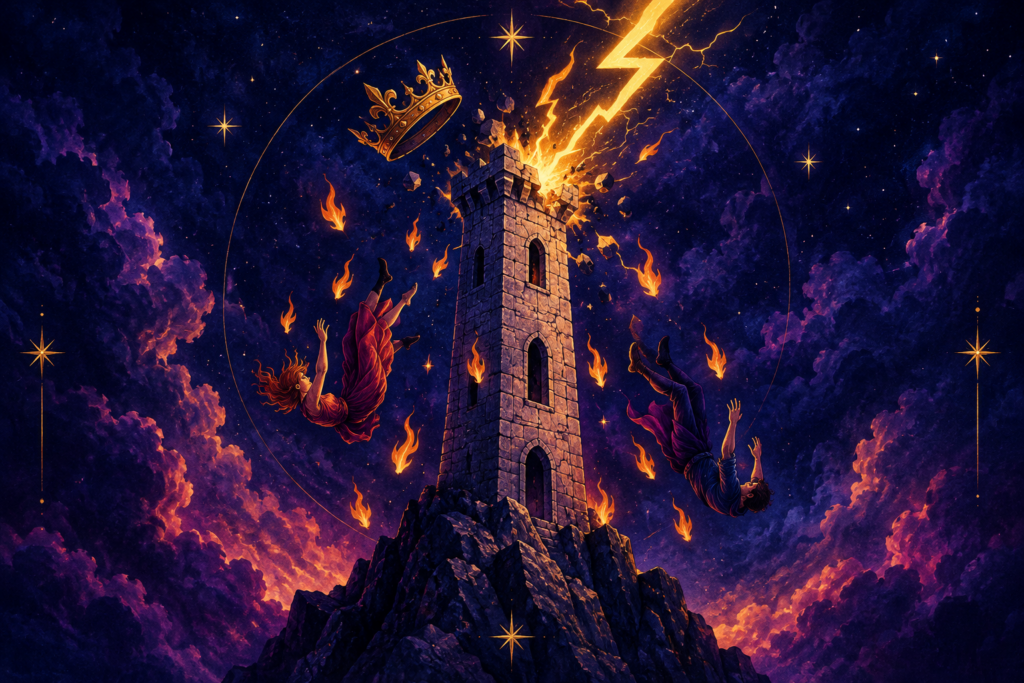
The lightning bolt. It comes from outside the frame, from a force the people inside the tower never saw and could not have blocked. This is the heart of why the Tower is a no: the disruption is not something you negotiate with. It arrives on its own schedule.
The crown. The bolt knocks a gold crown clean off the top of the tower. The crown is the ego, the assumed authority, the belief that you had this situation handled. When you ask a yes or no question and the Tower appears, the card is usually targeting the assumption underneath the question, not just the outcome.
The two falling figures. One is dressed in blue, one in red, and one wears a crown. They fall headfirst, which matters. Nobody chose to jump. Nobody is landing gracefully. If your question involves other people (a partner, a boss, a family member), the two figures suggest the shock lands on everyone involved, not just you.
The flames and the Yods. Fire pours from the three windows, and scattered around the tower are small flame shapes. Many readers count 22 of them, matching the 22 cards of the Major Arcana, and identify them as Yods, the Hebrew letter associated with the divine spark. The implication is that the destruction is not random. Something larger is intervening to correct a course.
The tower itself. It is built on a narrow rock outcrop with no visible door and windows only near the top. It was never a livable building. It was a fortress of isolation, and that is the detail that answers most “will it last?” questions. The card is saying the thing you are asking about was constructed to keep reality out.
The grey sky. Smith painted the background a flat, dark grey rather than a dramatic storm. The mood is not epic battle. It is the dull shock of the moment after.
Correspondences: Mars, Fire, and the Number 16
The Golden Dawn system that shaped the Rider-Waite-Smith deck assigns the Tower to Mars, the planet of force, conflict and sudden action. Mars does not persuade. It breaks through. This is the astrological backbone of the “no” verdict: Mars energy favours rupture over compromise.
Because Mars traditionally rules both Aries and Scorpio, those signs are often linked to the card. Aries carries the impulsive, explosive side (the strike). Scorpio carries the hidden-truth side (what the strike exposes). If a querent’s question involves someone with strong placements in either sign, the Tower’s volatility tends to feel personal.
The card’s element is Fire, visible in the flames and consistent with Mars. Fire in tarot destroys to clear ground. It is the same element behind the Wands suit, which is why the Tower in a spread heavy with Wands reads as fast, hot and irreversible.
Numerologically, the Tower is XVI, 16, which reduces to 7 (1 + 6). Seven is the number of the Chariot, a card about control and directed will. The connection is pointed: the Tower is what happens when the Chariot’s control was an illusion. Some readers also note that 16 follows 15, the Devil, and precedes 17, the Star, and that sequence is covered below because it changes how you read the Tower’s answer.
Tower Yes or No by Life Area
Love and relationships
Upright: No. In a new relationship, the Tower warns that the attraction is built on a projection or a concealed fact, and the truth is about to surface. In an established relationship, it points to a revelation (an affair, a financial secret, a confession) or a sudden exit. Readers sometimes soften this to “no, but you will be better off,” and that is fair as long-term consolation, but it does not change the near-term answer.
Reversed: Cautious no. One or both people know the relationship has a crack in it and are declining to look at it. The reversed Tower in a love reading often describes couples who stay together for years past the point where honesty would have ended things. The answer to “Will we be okay?” is no unless the avoided conversation happens.
Reconciliation with an ex: Upright Tower is one of the clearest no cards for getting back together. The structure that held you two together has already been struck. Reversed, it is still a no for now. The common reversed pattern is a half-reconciliation that falls apart again because nothing underneath was rebuilt. If the Star or Six of Cups sits beside it, reconsider, but the Tower alone does not support a return.
Career and work
Upright: No. A job offer that appears alongside the upright Tower tends to involve a company in trouble, a role that will be restructured away, or a manager whose position is about to change. For “Will I be promoted?” or “Will my business succeed?”, the card predicts a shock that undoes the current plan. The one case where the upright Tower reads positively in career is when the question is “Should I leave?” There, the collapse is the answer you were already looking for.
Reversed: Lean no. The reversed Tower at work usually means a layoff or reorganisation that everyone can feel coming and nobody is announcing. If you are asking whether to stay, the card suggests the change will come either way, so your real choice is whether you leave on your terms.
Finances and money
Upright: No. This is the card of the sudden bill, the market drop, the business partner who vanishes with the money, or the lender calling in a loan. If you are asking about an investment, a purchase, or whether a financial plan will hold, the upright Tower says the plan has a flaw you have not stress-tested. It is also the classic card for bankruptcy as a forced reset.
Reversed: Cautious no. Two scenarios show up repeatedly. In the first, you narrowly avoid a financial disaster, perhaps backing out of a deal at the last minute, and the answer to “Will I lose money?” is a relieved no. In the second, you are propping up a failing situation with borrowing or denial, and the answer to “Will this work out?” is no, just later. Which one applies depends on whether you have actually changed anything.
Health and wellness
Upright: No to “Will this resolve on its own?” The Tower in a health question is a wake-up call: a sudden diagnosis, an accident, a collapse from stress that had been ignored. It is one of the few cards where the practical reading is simply “see a professional, now.” It can also describe a symptom that forces a lifestyle change you had been putting off. A tarot card is not a diagnostic tool, and no reader should treat it as one, but the Tower’s message about urgency is consistent.
Reversed: Maybe, and closer to a yes than any other area. The reversed Tower often marks a health scare that turns out less severe than feared, or a recovery that follows a crisis. The caution is that the underlying issue, whether that is burnout, a bad habit, or an untreated condition, is still present. The scare passed. The warning did not.
Family
Upright: No. Family questions with the Tower usually involve a secret coming out (paternity, inheritance, a relative’s hidden situation) or a sudden shift in roles, such as a parent’s health event that reorganises the whole household. If you asked “Will the family stay united through this?”, the honest answer is that the current arrangement will not survive intact, even if something healthier replaces it.
Reversed: Lean no. The reversed Tower in family readings is the elephant in the room. Everyone knows about the conflict, the addiction, the money problem, and the family has an unspoken agreement not to discuss it. The answer to “Will this blow up?” is “not yet,” which is not the same as no.
Spirituality and personal growth
Upright: Yes, with a caveat. Spiritual questions are where the Tower flips. “Am I about to go through an awakening?” earns a yes. “Will my beliefs be challenged?” Yes. The caveat is that the Tower’s version of awakening is ego dissolution, and it feels like loss while it happens. Many readers describe it as the card of the dark night of the soul: the moment a belief system you built your identity around stops working. If your question was “Will this spiritual path be comfortable?”, the answer is no.
Reversed: Yes, slowly. The reversed Tower here describes someone who sensed the ground shifting and resisted. The awakening is still coming, but in stages rather than one night. For questions about personal growth, this is one of the more hopeful placements the card has.
Tower as Advice Versus Tower as Outcome
The yes or no verdict changes depending on what the card is doing in the spread.
As advice, the Tower is not predicting anything. It is telling you what to do, and the instruction is to stop reinforcing the structure. If you drew the Tower in an advice position about a stale job, the card is not saying “you will be fired.” It is saying “quit, or at least stop pretending the job is fine.” As advice, the Tower is a yes to radical action and a no to patience.
As outcome, the Tower is predictive and reads as the standard no. The situation ends in collapse or revelation. The only softening is time: in a twelve-month outcome position, the Tower describes a year with a clear before and after, and most people, looking back, are glad of the after.
As a clarifier (a card drawn to explain another card), the Tower sharpens whatever it sits next to. A hopeful Two of Cups clarified by the Tower means the relationship is real but unstable. A grim Five of Pentacles clarified by the Tower means the hardship arrives suddenly rather than slowly.
One-Card Pull Versus Spread Position
In a single-card yes or no pull, the Tower upright is a no and the reversed Tower is a cautious no. There is nothing else in the picture to modify it, so you take the card at face value. Readers who pull one card for a quick answer should not talk themselves into a yes.
In a multi-card spread, surrounding cards matter more than with almost any other Major Arcana, because the Tower describes an event rather than a mood. Some patterns worth knowing:
- Tower followed by the Star: The collapse happens, and the recovery is genuine. The overall answer shifts from “no” to “no, then better than before.”
- Tower with the Devil before it: The structure coming down was a trap or an addiction. The no is a relief.
- Tower with the Ten of Swords or Three of Swords: The painful reading is confirmed. The no is emphatic.
- Tower with the Sun or the World: The disruption clears the way for a significant positive result. Treat the overall spread as a yes with a hard middle chapter.
- Tower with the Hierophant or Four of Pentacles: The thing collapsing is tradition, institution or hoarded security. The no applies to the old structure specifically.
- Tower with the Fool: A total reset. The answer is no to the current question, yes to starting over.
Reversed, the Tower is more influenced by its neighbours. A reversed Tower beside the Star reads close to a yes. Beside the Moon or the Seven of Swords, it reads as denial and stays a no.
The Tower Compared With Death, the Devil and the Star
Readers often group the Tower with Death as the deck’s two “endings” cards, but they answer yes or no questions differently.
Death (XIII) describes transformation that is gradual and in some sense natural. A relationship that runs its course, a chapter closing because it is finished. Death is a no to “Will things stay as they are?” but often a yes to “Is this the right ending?” The Tower, by contrast, is abrupt and external. Death is the season changing. The Tower is the roof caving in.
The Devil (XV) sits directly before the Tower, and the sequence is deliberate. The Devil shows two figures chained to a block, but the chains are loose; they could walk away and do not. The Tower is what happens when they refuse long enough. The Devil’s no is about chosen bondage. The Tower’s no is about the choice being taken away. If you draw both, the message is that the thing you would not release is about to be removed for you.
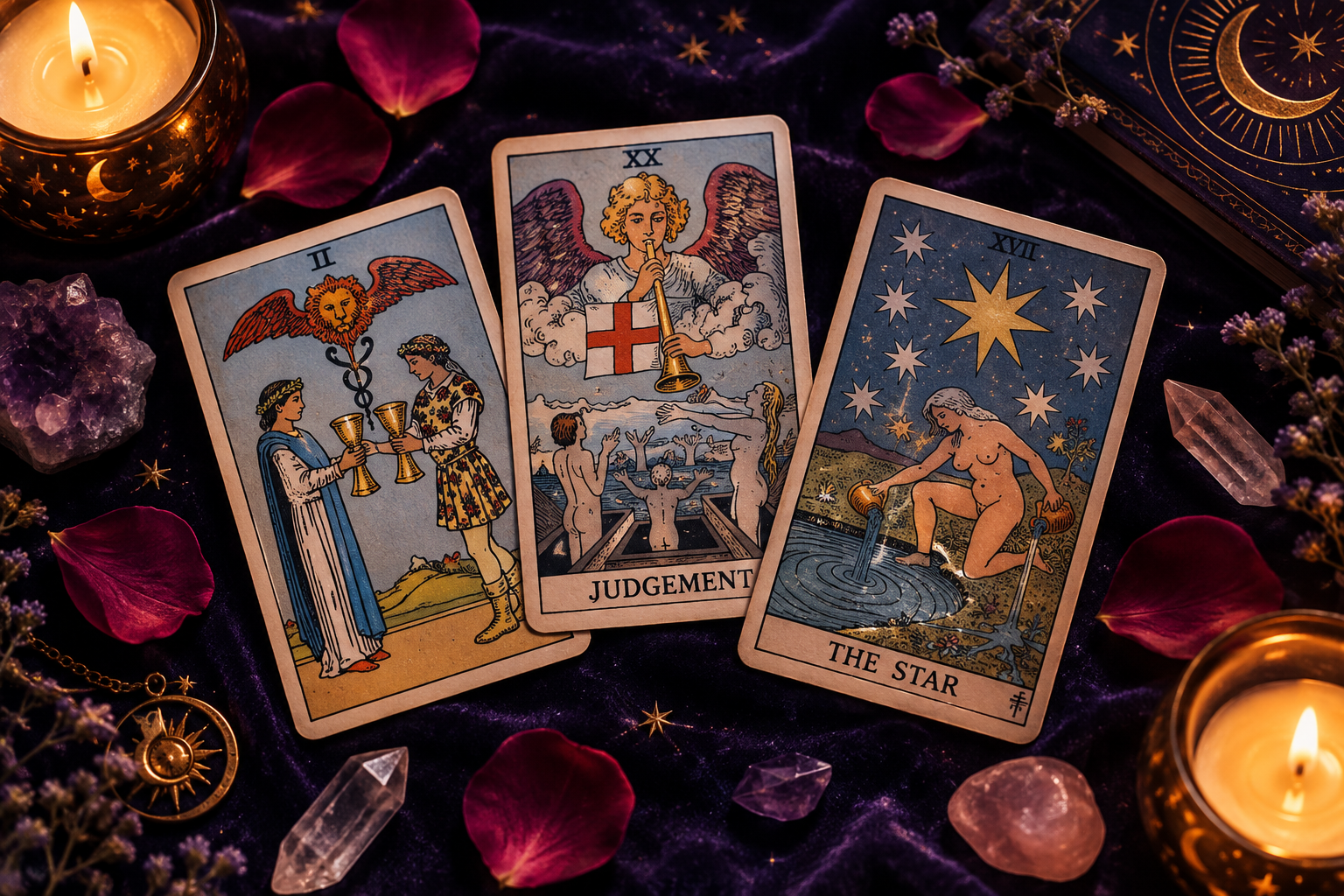
The Star (XVII) comes immediately after. It shows a figure kneeling calmly by water under an open sky, pouring without fear. The Star is the deck’s promise that the Tower is not the end of the story. In yes or no terms, the Star is a soft yes, and when it appears with the Tower it changes the tone of the whole reading from catastrophe to clearing.
Knowing the sequence helps you read the Tower’s no properly. It is a no to the structure, not a no to you.
Modern Decks and How They Handle the Tower
Contemporary decks keep the verdict but shift the mood. Chris-Anne’s Light Seer’s Tarot (2019) paints the Tower as a figure in freefall with a visible release in their posture, leaning into the “liberation” reading without pretending the fall is pleasant. The Modern Witch Tarot by Lisa Sterle keeps the Smith composition nearly intact, lightning and falling figures included, which is why it reads as faithfully as the original for yes or no work. If you are learning the card, start with the Rider-Waite-Smith image because every modern variant is in conversation with it, and the symbolic details above are all present there.
FAQ
Is the Tower always a no?
Upright, yes, with the single exception of spiritual or awakening questions, where the Tower confirms that a profound shift is coming. Reversed, it is a cautious no that can soften to a maybe depending on whether your question is about keeping something or recovering from something.
Can the Tower ever mean yes?
Yes in three situations: when the question is “Should I leave or end this?”, when the question is about spiritual awakening or confronting truth, and when the Tower sits beside strongly positive cards such as the Star, the Sun or the World in a spread. Even then, the yes comes with disruption attached.
What does the Tower mean in a one-card yes or no pull?
Upright: no. Reversed: a cautious no leaning toward “not in its current form.” With only one card there is nothing to modify the reading, so avoid reinterpreting it into the answer you wanted.
How do surrounding cards change the Tower’s answer?
The Star, Sun, World or Fool after the Tower turn the reading into “no, then a genuine fresh start.” The Devil before it suggests the collapse is a release from something harmful. Swords cards (Three, Ten) confirm the pain. The Moon or Seven of Swords beside a reversed Tower point to denial, which keeps the answer a no.
Why do different sources give different answers for the reversed Tower?
Because the reversed Tower can describe three distinct phases: collapse delayed, collapse avoided, or collapse already finished. Each phase gives a different yes or no. The fix is to read it against your actual question rather than a keyword list.
Is the Tower the worst card in tarot?
No. It is the most shocking, but it is honest and it is temporary. The Ten of Swords describes a deeper low, and the Devil describes a longer one. The Tower is a bad day, not a bad life, and the card directly after it is the Star.
What should I do when the Tower comes up in a yes or no reading?
Stop defending the structure in question. Have the conversation you have been avoiding, check the finances you have been assuming are fine, book the appointment you have postponed. The Tower’s practical advice is always the same: let the false thing fall before it falls on you.