
Seven Of Pentacles: Yes or No Tarot Meaning
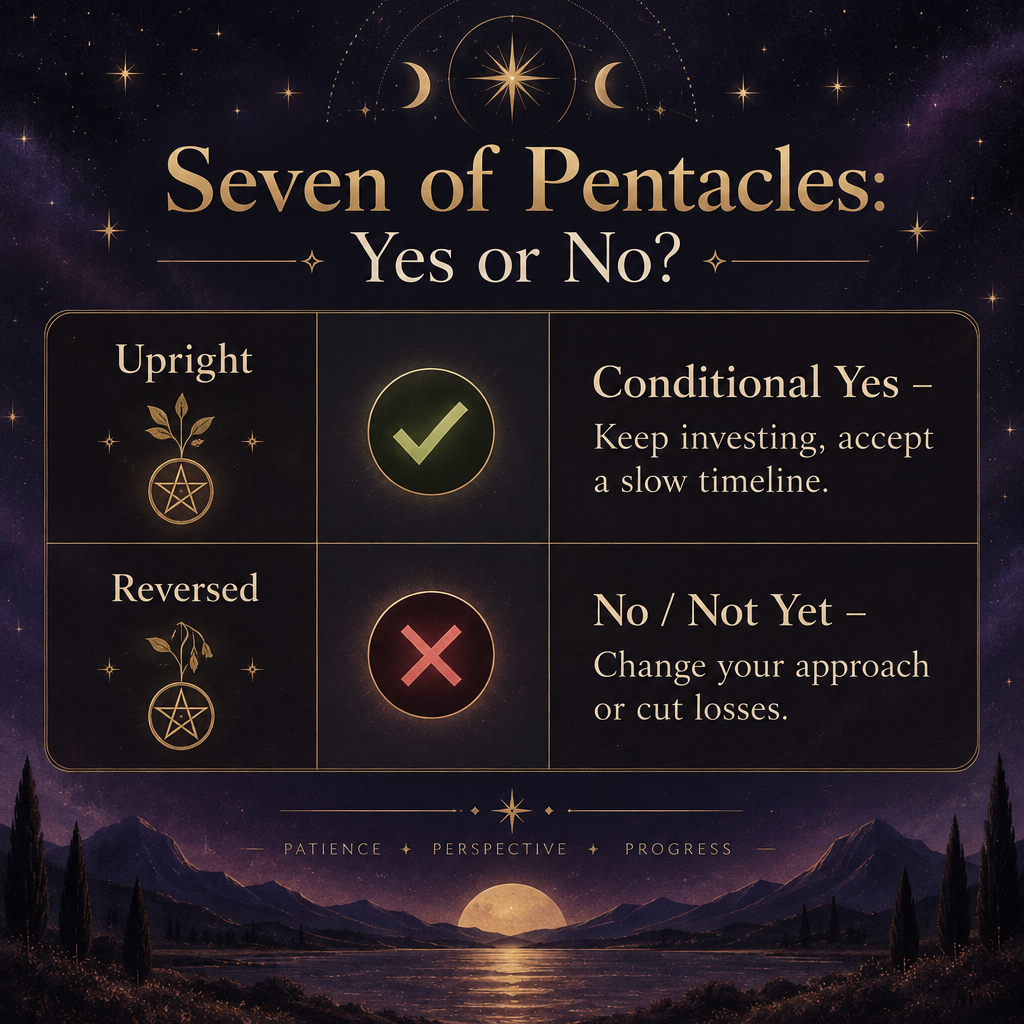
The Seven of Pentacles is one of the few cards that refuses to give a clean yes or no, and that refusal is the answer. Upright, it means a conditional yes: the outcome you want is possible, but only if you keep investing and accept a slow timeline. Reversed, it leans firmly toward no, or at least not with the approach you are using now.
The Short Verdict
| Orientation | Yes/No Answer | What It Depends On |
|---|---|---|
| Upright | Maybe / conditional yes | Your willingness to wait and keep working |
| Reversed | No / not yet | Whether you can change course or cut losses |
If you pulled this card for a question like “Will I get the job?” or “Will we get back together?”, read the upright version as “the seeds are planted, but harvest is not here.” Read the reversed version as “the field is not producing, and more of the same will not fix it.”
The Card Image, and Why It Matters for Yes/No Questions
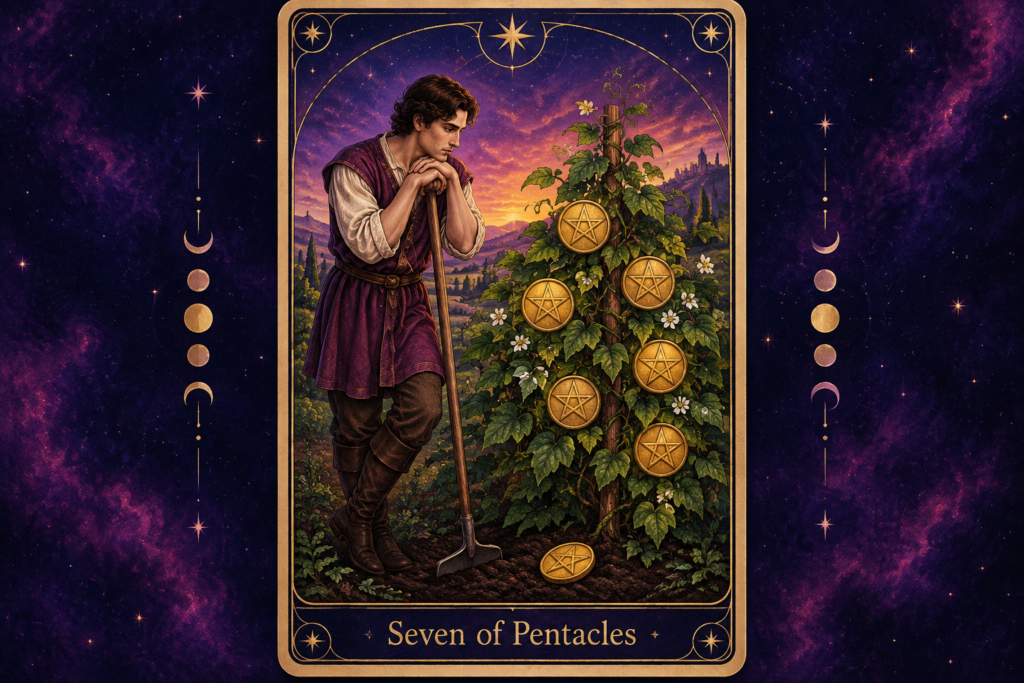
In the Rider-Waite-Smith deck, Pamela Colman Smith painted a young farmer leaning on his hoe, staring at a leafy bush heavy with pentacles. Six of them hang on the vine. The seventh sits at his feet in the dirt. He is not digging. He is not picking. He is pausing, chin resting on his hands, measuring how far he has come against how far he still has to go.
That pause is the whole card. He has clearly done real work, because the plant is thriving. But the coins are not yet in his pocket. He cannot tell yet whether this crop will feed him through winter or fall short. Every yes/no reading with this card carries that same tension: evidence of growth, no guaranteed payoff, and a decision about whether to keep tending the field.
The single pentacle on the ground is often read as a small return already received, or as the one coin he has to decide whether to reinvest. Either way, it signals that something tangible exists. You are not starting from zero.
Numerology and Suit: Why Sevens Test You and Pentacles Slow You Down
The number seven in the Minor Arcana
Across all four suits, the Sevens mark a stress test. The Seven of Wands defends a position against challengers. The Seven of Cups confronts illusion and too many choices. The Seven of Swords deals with strategy and deception. The Seven of Pentacles asks whether your effort has been worth it. Each Seven sits past the halfway point of the suit’s story, after the stability of the Four and the recovery of the Six, but before the mastery of the Eight and the fulfilment of the Nine and Ten.
So when a Seven answers a yes/no question, it rarely says “done.” It says “you are being evaluated, and so is your plan.”
What Pentacles add
Pentacles belong to the element of earth. They govern money, work, property, physical health, and anything that grows at the speed of the material world rather than the speed of thought or desire. Earth does not hurry. A Pentacles card answering your question tells you the timeline is set by reality, not by hope. That is why the Seven of Pentacles so often lands as “maybe” rather than “yes.” The yes is available, but the earth sets the pace.
Keyword Tables
Upright keywords
| Keyword | How It Shapes the Yes/No Answer |
|---|---|
| Assessment | Pause and audit before committing further |
| Patience | The outcome needs more time than you expected |
| Evaluation | Decide whether returns justify continued effort |
| Progress | Visible growth exists, even if incomplete |
| Long-term investment | Think in seasons, not days |
Reversed keywords
| Keyword | How It Shapes the Yes/No Answer |
|---|---|
| Impatience | You want results faster than the situation allows |
| Stagnation | Effort is going in, nothing is coming out |
| Wasted effort | The wrong field is being tended |
| Disappointment | Expectations outran what was planted |
| Regret | Sunk costs are keeping you in a losing position |
Seven of Pentacles Upright: The Conditional Yes Explained
Treat the upright card as a yes with two attached questions. First: are you prepared to wait longer than feels comfortable? Second: have you already put in real effort, or are you hoping the plant grows on its own?
If you can answer yes to both, the card tilts positive. The farmer’s bush is healthy. Something you built is working. The reason the card stops short of a full yes is that it appears at the moment before the payoff, when quitting is tempting and the result is still uncertain.
A concrete example. You ask, “Will my side business become profitable this year?” You have been running it for eight months, revenue is growing a little each month, and you are still covering costs out of pocket. Upright Seven of Pentacles says: yes, probably, if you hold the course and review your numbers honestly. It does not say “quit your day job next week.”
The card also carries a quiet instruction to check your methods. The farmer is assessing, not just resting. Are you watering the right plants? A conditional yes becomes a real yes faster when you redirect effort toward what is actually producing.
Seven of Pentacles Reversed: Why It Reads as No
Reversed, the farmer has either walked away from the field or kept working a plot that will never yield. Both scenarios point to no.
The most useful thing this card does in reverse is name the sunk-cost trap. You have put so much time, money, or emotion into something that stopping feels like admitting it was all wasted. The card says the waste is in continuing, not in stopping. Six months of effort does not oblige you to a seventh if the soil is dead.
Three practical responses when the reversed Seven of Pentacles answers your question:
- Separate the effort from the outcome. Write down what you have invested and what has actually returned. If the return column is near empty after a reasonable period, the card is confirming what the numbers say.
- Look for the plant that is growing. Reversed does not always mean abandon everything. Often one part of the situation shows life while the rest is barren. Move your energy there.
- Set a hard review date. If you cannot bring yourself to stop now, pick a specific date, four to twelve weeks out, and commit to a decision then. The reversed card punishes open-ended waiting.
Sometimes the reversed card is less about failure and more about impatience ruining a good thing. If you ask “Should I pull my money out of this investment?” and get the reversed Seven of Pentacles, consider whether you are the one being hasty. Context cards around it will clarify which version you are dealing with.
Seven of Pentacles Yes or No for Love
New relationships and dating
Upright: a soft yes, with a slow fuse. This connection has potential but will not rush to a label. If you asked “Will this turn into something serious?”, the card says it can, provided both people keep showing up consistently. Expect weeks or months of steady dates rather than a whirlwind.
Reversed: no, or not right now. One person is not putting in effort, or you are investing heavily in someone who gives little back. If you have been texting first for a month and getting delayed, lukewarm replies, the reversed card is telling you what you already suspect.
Existing relationships
Upright: yes, the relationship is worth continued effort. Long partnerships go through plateaus where nothing feels exciting but nothing is broken either. The card recognizes that plateau and says the foundation is solid. If your question is “Is this relationship going to last?”, the answer is yes if both of you keep tending it.
Reversed: no, as the relationship currently operates. The classic reversed scenario is one partner doing all the emotional labour and quietly resenting it. The card does not necessarily predict a breakup, but it does say that continuing exactly as you are leads to resentment and stagnation. Something structural has to change.
Reconciliation with an ex
This is the context where people most often pull the card, and where the answer needs the most care.
Upright: maybe, and the delay is the point. The card suggests your ex (or you) is in a period of real self-work, and reconciliation attempted now would be premature. If you asked “Will my ex come back?”, the honest reading is: possibly, but not before the growth that caused the split has had time to take root. Rushing contact typically resets the clock.
Reversed: no. You are tending a relationship that is no longer growing, and the effort you are spending on hope would produce far more if directed at your own life. The reversed card in a reconciliation reading is one of the clearer no answers in the deck, because it combines wasted effort with regret.
Seven of Pentacles as Feelings
When you ask how someone feels about you and draw this card, the answer is more thoughtful than romantic.
Upright, the person is weighing things. They are not indifferent; they have invested emotionally and are assessing whether the relationship is heading somewhere worth their continued commitment. This often looks like someone who has gone a little quiet, not from disinterest, but because they are thinking seriously. It is a cautious, patient, evaluative feeling rather than passion.
Reversed, the feeling tips toward frustration. The person feels their effort has not been matched or rewarded. They may be considering pulling back, or they may already have. If you sense someone has become impatient or disappointed with how things are going, the reversed Seven of Pentacles confirms it.
Seven of Pentacles Yes or No for Career
Upright: conditional yes. You are mid-project, mid-promotion track, or mid-career-change, and the card confirms the trajectory is sound. The caveat is that recognition arrives later than you want. If you asked “Will I get the promotion?”, read it as “yes, probably in the next review cycle rather than this one, if your work keeps speaking for itself.”
For questions about changing jobs, the card asks you to audit first. Make a list of what your current role has actually given you in skills, contacts, and money, then compare it to the realistic offer elsewhere. The card favours decisions made from that kind of inventory.
Reversed: no. You are grinding in a role or company that has stopped paying you back, whether in salary, growth, or satisfaction. Or you are chasing a career goal you no longer want and have not admitted it yet. The reversed card in a career reading is often the push people need to stop waiting for a payoff that is not coming.
Seven of Pentacles Yes or No for Money and Finances
Upright: yes to slow, steady strategies. Index funds, pension contributions, paying down a mortgage, building an emergency fund over a year rather than a month. The card endorses anything compounding. It is a weak answer for “Will I get rich quickly?” and a strong answer for “Is my savings plan working?”
If you are asking whether to make a specific purchase or investment, the upright card says proceed only after you have done the arithmetic. It will not bless an impulse.
Reversed: no. This is the card of money poured into a venture that keeps promising returns next quarter. It is also the card of lending to someone who never repays, or paying for a course or coaching program that has produced nothing. If your question is about continuing to fund something, the reversed card says stop and reassess before another payment goes out.
Seven of Pentacles Yes or No for Health
Upright: yes, with a lifestyle focus. Health improvements under this card come from sustained habits rather than a single fix. If you asked “Will my health improve?”, the card says yes if you keep up the consistent effort: regular movement, sleep, food choices, follow-up appointments. It also recommends an honest review. What has actually helped over the last few months? Keep doing that and drop what has not moved the needle.
Reversed: a warning no. The reversed Seven of Pentacles in a health reading points to neglect, usually through overwork. You have been investing everything in your job or caregiving and nothing in your own body. It can also show someone frustrated that a diet or recovery is taking too long and abandoning it right before it would have worked. Either way, the card calls for a recommitment to basics, and for professional advice if symptoms are involved rather than guesswork.
Seven of Pentacles Yes or No for Family
Upright: conditional yes. Family relationships that have been strained are repairable, but through patient, repeated small efforts rather than one big conversation. If you asked “Will my relationship with my sibling improve?”, the answer is yes over months of consistent, low-pressure contact. The card also favours long family projects: saving for a child’s education, caring for an ageing parent, building a home.
Reversed: no, as things stand. Someone in the family is carrying a disproportionate load, or a long-running feud has calcified past the point where effort changes anything. The reversed card suggests stepping back from a dynamic that drains you without returning anything. That is not the same as cutting people off; it is redirecting your energy to the family members who reciprocate.
Seven of Pentacles as a Person
When the card represents a person, it describes the patient investor type. This is someone who plans in years, keeps a budget, reads the long-term forecast, and finds flashy risks unappealing. They are reliable and a little slow to commit, because they want to see how things develop before they put more in. In relationships they are steady rather than exciting. At work they are the colleague who quietly finishes the five-year plan while others chase quarterly wins.
Reversed, this person has soured. They feel they did everything right and got nothing for it. They can become resentful, risk-averse to the point of paralysis, or stuck in a job or relationship purely because leaving would mean admitting the years were wasted.
Timing: When Will It Happen?
The Seven of Pentacles is one of the slower timing cards in the deck. Its energy is agricultural, so think in growing seasons: roughly three to six months at minimum, and often a full year. Some readers associate the card with late summer, the period just before harvest, which fits its imagery of fruit on the vine but not yet picked.
If you asked “When will I hear back?” or “When will this resolve?”, the card is not promising this week. A reasonable reading is “after the current cycle completes,” whether that is a financial quarter, a school term, or a project deadline. In a reversed position, timing becomes “not on the current path,” which is less a date and more a redirection.
A practical note for anyone using tarot apps or one-card online pulls: the Seven of Pentacles answers poorly in isolation because its whole message is “it depends.” If you are getting it on a quick digital draw, pull one clarifying card to see what the conditions are before accepting a plain yes or no.
FAQ
Is the Seven of Pentacles a yes or no card?
Upright, it is a conditional yes, often read as “maybe, if you keep going.” Reversed, it is a no or “not yet.” It is one of the least absolute yes/no cards in the deck, and that ambiguity is its actual message.
Is the Seven of Pentacles a good card?
Mostly, yes. It confirms that effort already made has produced real growth. The discomfort comes from the waiting, not from any bad outcome. Reversed, it is less favourable because it signals effort going nowhere.
What does the Seven of Pentacles mean in love yes or no?
Upright: yes for relationships built slowly and with mutual effort; a cautious maybe for reconciliation. Reversed: no, usually because one person is investing far more than the other.
What does the Seven of Pentacles mean as feelings?
Upright, the person is thoughtfully assessing the relationship and whether to commit further. Reversed, they feel frustrated or unrewarded and may be pulling back.
What should I do if I get the Seven of Pentacles reversed?
Audit what you have invested against what has returned. Identify the one area still showing life and move your energy there. Set a firm review date so the waiting has an end.
How long does the Seven of Pentacles mean I will wait?
Think in months, not weeks. Three to six months is a reasonable minimum, and a year is common for larger goals. The card points to the end of a natural cycle rather than a specific date.
Does the Seven of Pentacles mean I should give up?
Upright, no. It means keep going and review your methods. Reversed, it may mean stop, but only after checking whether impatience rather than a failed plan is driving the urge to quit.