

Eight Of Cups: Yes or No Tarot Meaning
The Eight of Cups is one of the few Minor Arcana cards where a flat “no” is the honest answer to most yes or no questions, because the card is about walking away from something that stopped feeding you. The reversed card is not the cheerful flip that many older guides describe; it points to hesitation, avoidance and a change you keep postponing. Here is the verdict first, then how it shifts for love, career, money, health and feelings.
Quick Answer
| Orientation | Yes or No verdict | What it really means |
|---|---|---|
| Upright | No (to staying, continuing, or hoping things improve as they are) | Something has run its course. The answer to “should I leave?” is yes; the answer to almost everything else is no. |
| Reversed | Cautious Maybe, leaning No | You are avoiding a decision you already know the answer to. Fear of change, not genuine contentment, is keeping you in place. |
If you asked “Will this work out if I stay?” the upright card says no. If you asked “Is it time to move on?” the same card says yes. Read the rest of this page with that dual framing in mind, because it resolves most of the confusion around this card.
Why the Upright Eight of Cups Is a No
The upright card shows someone who has already made their choice. They are not weighing options at the water’s edge. They have turned their back on what they built and are climbing into the hills at night. That posture answers a yes or no question with finality: the situation you are asking about is not going to deliver what you want from it, and the card wants you to stop waiting for it to change.
This is a “no” with a specific texture. It is not the harsh refusal of the Five of Cups or the blocked door of the Ten of Swords. It is the quiet no of someone who tried, gave it real effort, and finally accepted the ceiling. Readers often pull this card about a relationship they have been “working on” for years, a job they keep telling themselves will get better after the next reorganisation, or a friendship that runs entirely on their effort. In every case the card says the same thing: you already know.
Expect grief with this no. Leaving something that half-worked is harder than leaving something that clearly failed, and the Eight of Cups acknowledges that.
Why the Reversed Eight of Cups Is Not a Clean Yes
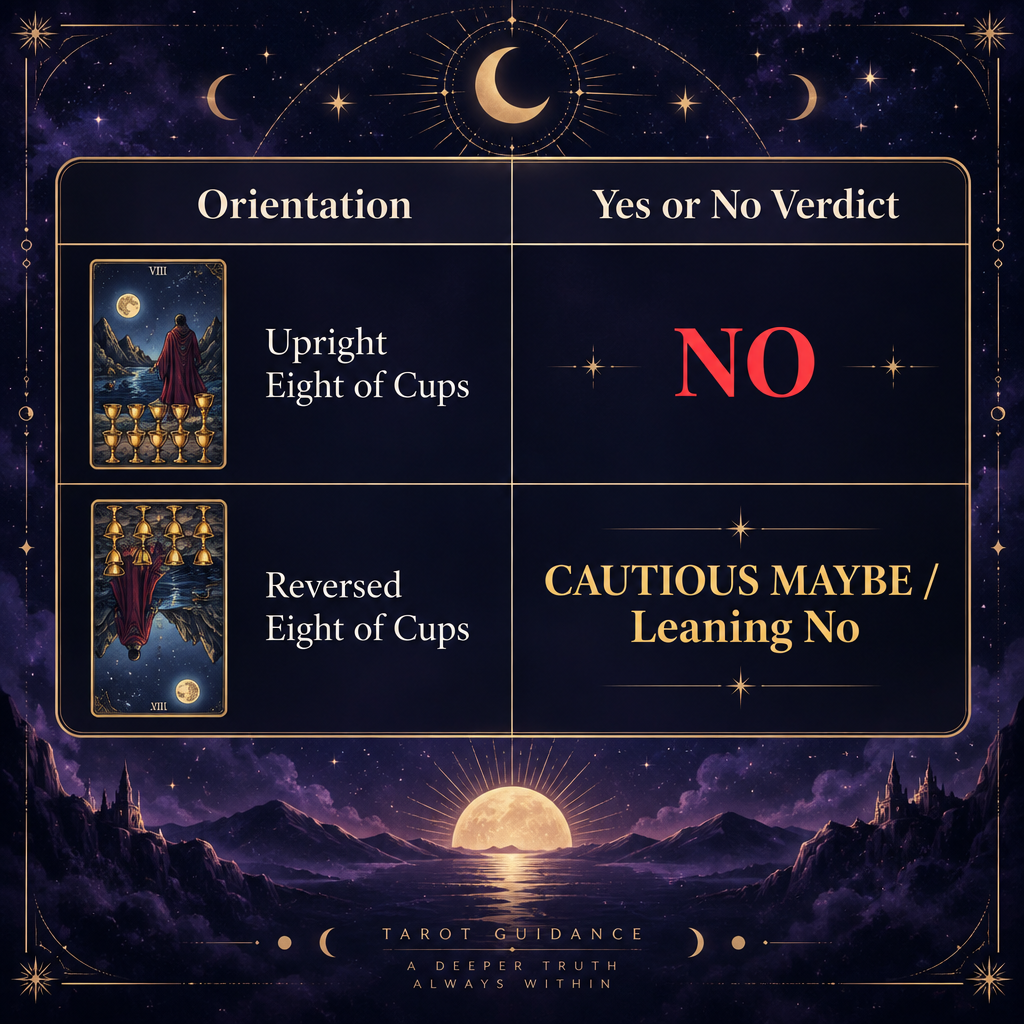
Older interpretations, including the previous version of this page, painted the reversed Eight of Cups as “the path clearing” and a return to positive energy. That reading is out of step with how experienced readers use the card today, and it can mislead you badly if you take it as encouragement to stay.
When the Eight of Cups reverses, the traveller turns back toward the cups. Sometimes that is a legitimate return after realising you left too soon. Far more often it is the person who packed the bag, stood at the door, and then unpacked. The reversed card’s core keywords are:
- Fear of change
- Avoidance and procrastination
- Stagnation, drifting without deciding
- Reluctance to leave a situation you have outgrown
- Clinging to the familiar because it is familiar
- Occasionally: aimless wandering, leaving without a plan, or returning to something abandoned
So the yes or no verdict for the reversed card is a cautious maybe that leans toward no. If your question is “Should I stay?” the answer is still no, but the card notes that you probably will stay for a while anyway. If your question is “Will I finally make this change?” the reversed card says not yet, not until you stop negotiating with your own fear.
There is one situation where the reversed card can be read as a soft yes: when you have already left something and are asking whether to return. If the leaving was impulsive and the reversed Eight of Cups appears, going back and finishing what you started is worth considering. Check the surrounding cards. A Six of Cups or Four of Wands nearby supports the return; a Five of Pentacles or Seven of Swords does not.
Card Symbolism: What the Image Tells You
The Rider-Waite-Smith version drawn by Pamela Colman Smith contains four details that shape the yes or no reading.
The cloaked figure. A traveller in a red cloak walks away from the viewer, leaning on a staff, face hidden. Red is action and will; the hidden face means the decision is private and already made. The figure does not look back. In yes or no terms, that is your answer: no second-guessing, no return.
Eight cups with a gap. The cups are stacked in the foreground, five on the bottom row and three on top, arranged so that a ninth cup would complete the pattern. The gap is the whole card. Everything looked nearly complete, and the figure realised that “nearly” was as good as it was going to get. Something essential was always missing.
The eclipsed moon. In the sky, a moon overlaps a sun, or a full moon sits inside a crescent depending on how you read the engraving. Either way it is a moment of eclipse, a turning point where the usual light is obscured. The figure travels at night, guided by intuition rather than proof. That is why this card rarely comes with external evidence that leaving is right. You feel it before you can prove it.
The rocky mountains and the water. The traveller crosses a stream and heads into barren, steep terrain. The path ahead is harder than the one behind. The card does not promise that leaving will be easy, only that staying would cost more.
Elemental, Astrological and Numerological Correspondences
| Correspondence | Attribution | Effect on the reading |
|---|---|---|
| Element | Water | Emotional truth over logic. The “no” is felt, not calculated. |
| Astrology | Saturn in Pisces (first decan of Pisces, roughly the first ten days of the sign) | Saturn’s discipline and limits meet Pisces’ longing. Structure applied to feeling: the mature choice to end something. |
| Number | Eight | Movement, cycles, and the consequences of effort. Eights in the Minors show momentum that cannot be paused. |
| Golden Dawn title | Lord of Abandoned Success | The clearest one-line summary of the card: success achieved, then set down. |
Saturn in Pisces is the key to the card’s mood. Saturn asks “what is this really worth?” and Pisces answers with feeling rather than numbers. The result is a slow, heavy realisation that the emotional return on your investment has stopped, and a Saturnian willingness to accept that instead of pretending.
The number eight matters too. In the Minor Arcana, the sevens are tests and the nines are near-completion. The eights sit between them as the point where you must act on what the seven revealed. In the Cups suit specifically, the Seven of Cups showed illusions and too many options; the Eight is the sober morning after, when you pick one road and walk it.
Eight of Cups Yes or No in Love
Love questions are the most common context for this card, and the answer depends heavily on whether you are single or partnered.
If You Are Single
Upright: No to the person or situation you are asking about. If you asked “Will they come back?” or “Is there a future with this person?” the card says the door has closed, and probably from your side even if you have not admitted it. There is an exception worth naming: if your question is “Should I stop waiting on this person and move on?” the upright card is an emphatic yes. The energy is about releasing an attachment to someone unavailable, an ex, or a pattern of chasing people who give you eight cups and never the ninth.
Reversed: Maybe, leaning no. You are hovering. Perhaps you keep checking an ex’s profile, keep “one more” conversation going with someone who has shown you who they are, or avoid dating altogether because the last ending hurt. The reversed card does not say a new relationship is coming. It says you are not yet free enough to receive one.
If You Are in a Relationship
Upright: No to the relationship continuing in its current form. This does not always mean a breakup. Couples pull this card when one partner has emotionally left while physically staying, or when a long-distance arrangement or a stalled engagement has quietly ended without anyone saying so. Asked “Will we stay together?” the answer is no unless something fundamental changes. Asked “Should I leave?” the answer is yes, and the card suggests you have been asking yourself that for longer than you have told anyone.
Reversed: No, with a delay. You know the relationship is not working and you are staying anyway, out of fear of being alone, financial entanglement, or guilt. The reversed card shows the partner who keeps saying “we’ll talk about it after the holidays.” The verdict on “will things improve if I stay?” is still no. The only reversed reading that supports staying is when you previously walked out in anger and are now asking whether to return and do the work. In that narrow case, and only with supportive surrounding cards, the answer is a qualified yes.
Eight of Cups Yes or No in Career
Upright: No to staying in the role, company or professional path you are asking about. This is the card of the senior employee who has the title, the salary and the pension contributions, and who feels nothing on Monday morning. If you asked “Should I accept the counteroffer and stay?” the answer is no. If you asked “Will things improve under the new manager?” the answer is no. If you asked “Should I take the pay cut to do something I care about?” the card says yes, with the honest warning that the mountains ahead are rocky.
Notice that the card often appears for people who are objectively successful. The Lord of Abandoned Success is not about failure. It is about the moment competence stopped being enough.
Reversed: No to change happening soon, and a clear warning about why. You are staying in a dead-end job because leaving feels riskier than the slow erosion of staying. The reversed card can also show someone who quit impulsively, without savings or a plan, and is now drifting. Asked “Should I leave my job?” the reversed card says yes eventually, but not by resigning tomorrow without a destination. Build the bridge first, then cross.
Eight of Cups Yes or No for Money and Finances
Upright: No to continuing a financial commitment that has stopped paying off. This includes a business partnership that only one person is carrying, an investment you keep topping up out of sunk-cost thinking, or a property that drains more than it returns. The card says cut the loss. Asked “Will this investment recover?” the answer is no. Asked “Should I walk away from this deal?” the answer is yes.
Reversed: Maybe, and be careful. You may be avoiding a financial reality, such as ignoring statements or delaying a hard conversation about shared money. Alternatively you may be about to abandon a plan that only needs more time. Distinguish between the two by asking whether your reluctance to look at the numbers is the problem. If you cannot bring yourself to open the account, the card is about avoidance, and the answer to “is this fine?” is no.
Eight of Cups Yes or No for Health
Health questions deserve a disclaimer that no tarot card replaces a clinician. With that said:
Upright: No to continuing a habit, environment or treatment approach that has stopped working, and yes to changing it. The card frequently shows up for burnout, for people who need to leave a stressful workplace or living situation for the sake of their nervous system, or for someone finally ready to walk away from a substance or a pattern. Asked “Will I feel better if I keep going as I am?” the answer is no.
Reversed: No to improvement while you avoid the issue. The reversed card in a health position often means postponed appointments, ignored symptoms, or knowing exactly what lifestyle change is needed and not making it. It can also flag emotional exhaustion so deep that the person cannot summon the energy to leave the situation causing it. The answer is not hopeless, but it requires acting rather than waiting.
Eight of Cups as Feelings
When you ask how someone feels about you and draw this card, the answer is uncomfortable but useful.
Upright: They are emotionally withdrawing or have already left. They may still be present, still texting, still showing up, but their heart has started the climb into the hills. Often they feel that something was always missing between you, that ninth cup, and they have stopped hoping it will appear. It is rarely about anger. It is disappointment that has matured into acceptance.
If you are asking about your own feelings, the upright card says you are done and have been for a while. You are looking for permission to leave. This is it.
Reversed: They feel stuck. They want to leave, or want to return, and cannot commit to either. Expect mixed signals, long silences followed by sudden reappearances, and a general sense that they are waiting for you to make the decision they cannot. If you are asking about your own feelings, the reversed card says you are afraid of what you would have to face if you admitted how you really feel.
Timing: When Should You Act?
The Eight of Cups is not a “someday” card. The figure is mid-journey, already past the cups and across the water. Upright, the moment of departure is now or within the very near term. If you have been waiting for a sign, this is the card that tells you the waiting period is over.
For readers who use astrological timing, the card corresponds to the first decan of Pisces, which the sun passes through in roughly the third week of February. Some readers use this as a literal timing window. Most treat it symbolically: act at the end of a cycle, during a period of emotional clarity, often at night or in a quiet moment rather than in the heat of conflict.
Reversed, timing stretches. The change you are asking about will not happen until you address the fear behind the delay. The card does not set a deadline because you are the one holding it open.
How Spread Position Changes the Answer
A single-card pull gives the verdicts above. In a larger spread, position matters.
- Past position: A departure has already happened and is shaping the current question. The yes or no answer comes from the present and future cards, not this one.
- Present position: You are in the middle of leaving, whether you have admitted it or not. Upright, the answer to “should I continue?” is no.
- Future or outcome position: The situation will end with someone walking away. If you asked “Will this last?” the answer is no.
- Advice position: The card is instructing you to leave. This is the one placement where the Eight of Cups reads as a clear, encouraging yes to change.
- Obstacle or crossing position: Reversed here almost always means your own reluctance to move on is the obstacle.
Nearby cards adjust the tone. The Star or the Sun following the Eight of Cups suggests the departure leads somewhere good quickly. The Hermit alongside it means a longer period of solitude first. The Ten of Cups reversed nearby confirms the situation you are leaving was never going to become the happy ending you hoped for.
Upright vs. Reversed at a Glance
| Upright | Reversed | |
|---|---|---|
| Yes or no | No (to staying) / Yes (to leaving) | Cautious maybe, leaning no |
| Core theme | Deliberate departure | Avoided departure |
| Emotional state | Sad but certain | Stuck and anxious |
| Love | Ending or emotional withdrawal | Clinging, fear of being alone, or a tentative return |
| Career | Leaving success for meaning | Staying in a dead-end role out of fear |
| Money | Cut the sunk cost | Avoiding the numbers |
| Health | Leave what is burning you out | Ignoring the problem |
| Feelings | Disappointed, moving on | Torn, waiting for you to decide |
| Timing | Now or imminent | Delayed until fear is addressed |
Is the Eight of Cups a Good Card?
It is a good card for people who are ready to be honest and a hard card for people who are not. Nobody enjoys pulling it. But among the “no” cards in the deck, it is one of the most constructive, because it carries a built-in next step: leave, and go find the cup that was missing. Compare that to the Five of Cups, which is pure grief, or the Ten of Swords, which is an ending you did not choose. The Eight of Cups hands you the staff and the cloak. What you do with them is up to you.
FAQ
Is the Eight of Cups a yes or no?
Upright, it is a no to continuing the situation you asked about and a yes to leaving it. Reversed, it is a cautious maybe that leans toward no, because the card signals fear of change and avoidance rather than resolution.
What does the Eight of Cups reversed mean for love?
It means staying in a relationship you know is over because leaving feels frightening, or hovering around an ex you should release. In rare cases, with supportive surrounding cards, it can suggest returning to a relationship you left too hastily.
What does the Eight of Cups mean as feelings?
Upright, the person feels emotionally finished and is withdrawing, often quietly. Reversed, they feel stuck between leaving and staying and are likely waiting for you to decide.
Does the Eight of Cups mean someone will come back?
Upright, no. The figure walks away and does not look back. Reversed, a return is possible but unstable, usually driven by fear of being alone rather than genuine resolution.
What planet rules the Eight of Cups?
Saturn in Pisces, according to the Golden Dawn attributions used by most modern readers. Saturn brings discipline and limits; Pisces brings emotional depth. Together they describe the mature decision to end something that no longer fulfils you.
Is the Eight of Cups a breakup card?
Often, yes. It shows one partner emotionally leaving, and it frequently precedes a physical separation. It can also describe a relationship that has ended in every way except the formal announcement.
What should I do if I pull the Eight of Cups?
Upright: stop waiting for the situation to change and start planning your exit. Reversed: name the fear that is keeping you in place, then take one concrete step toward the change you have been postponing.