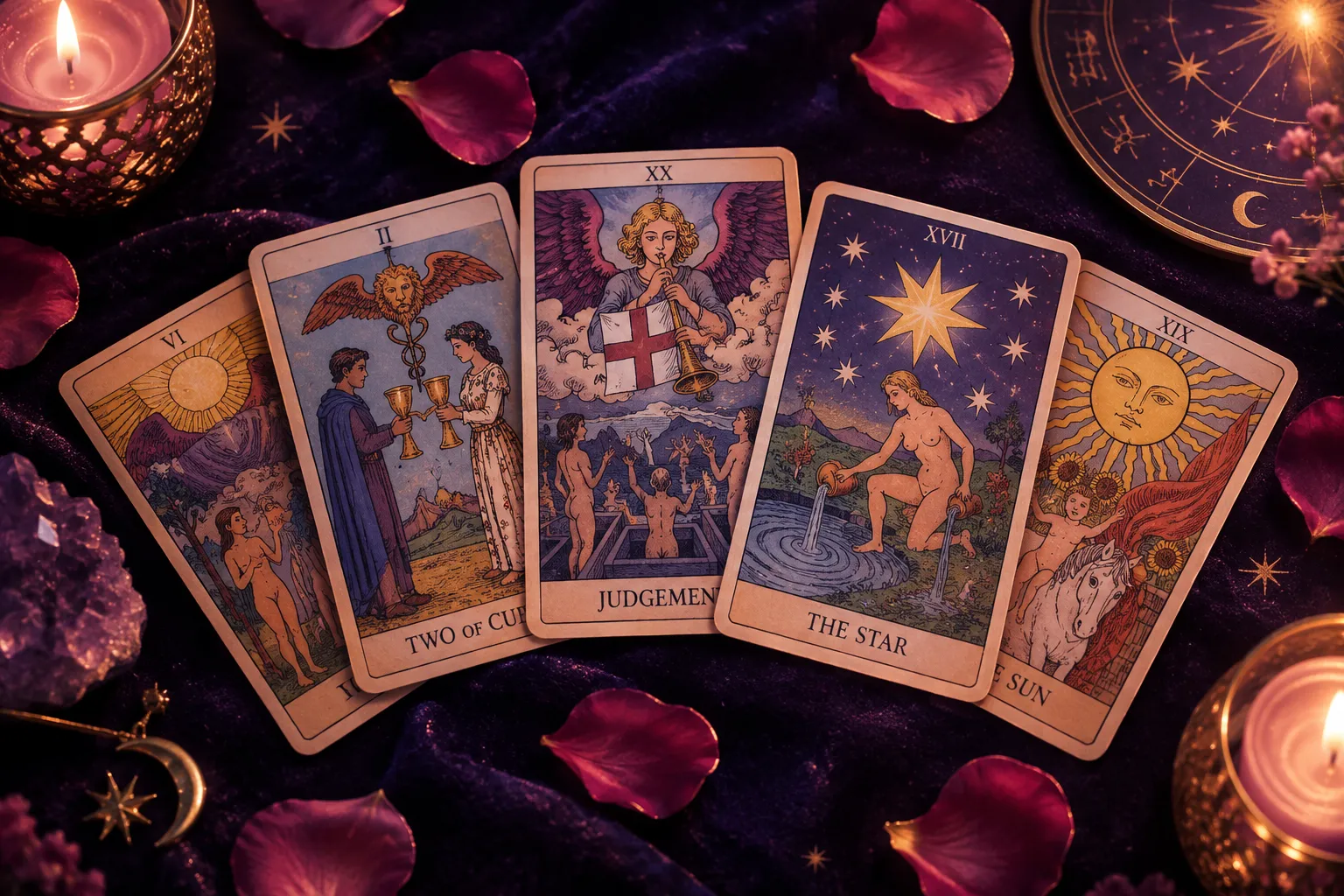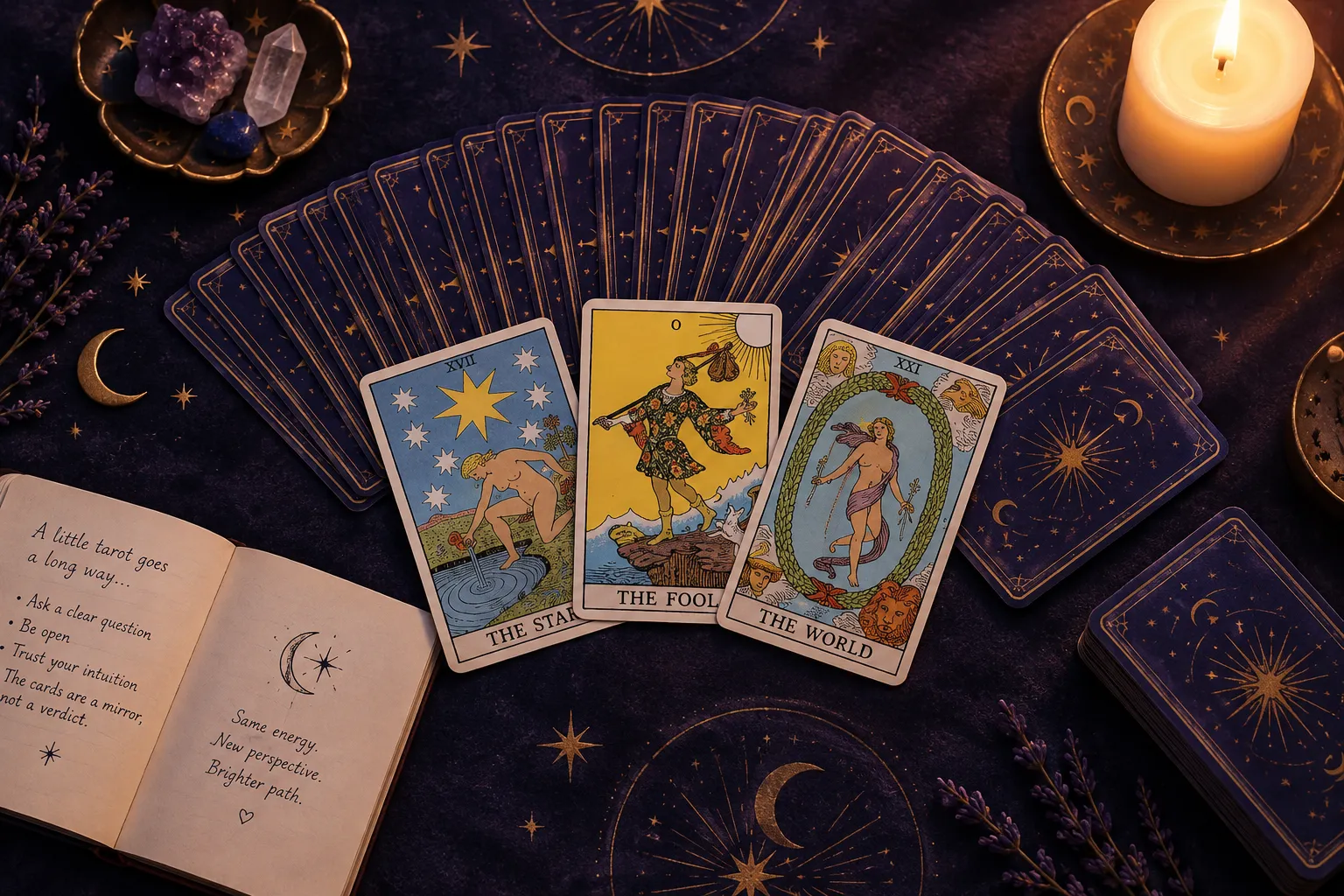

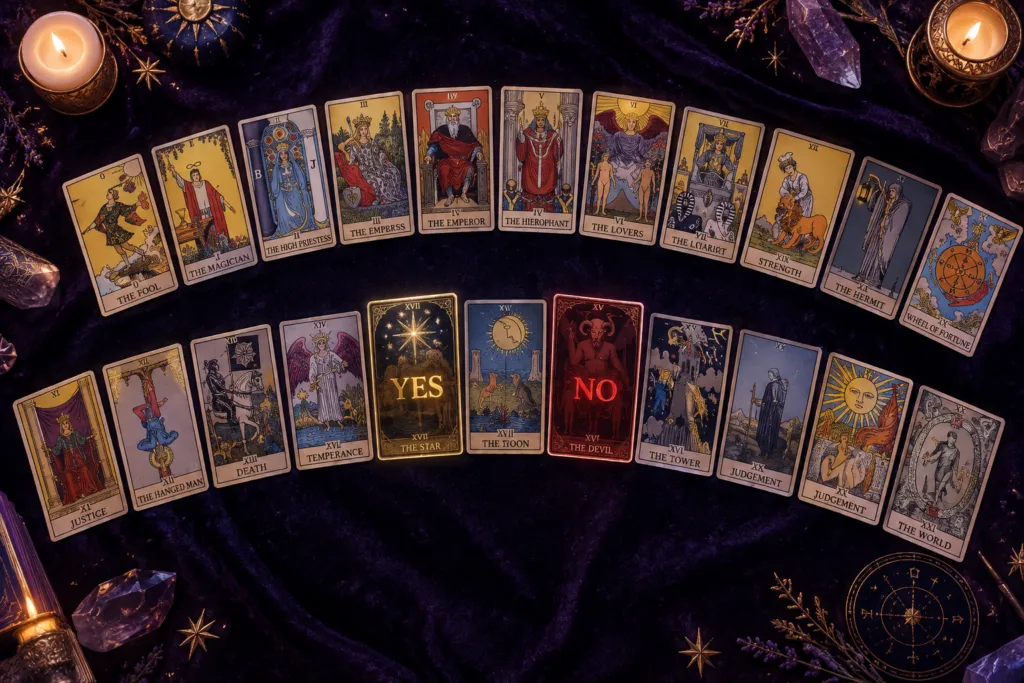
Upright, 15 of the 22 Major Arcana cards answer yes, five answer maybe and only two, the Devil and the Tower, answer no. The Sun is the clearest yes and the Tower is the firmest no. Reversed, 14 cards turn to no, five become not yet, and three answer yes: the Devil, the Moon and the Sun.
The table below gives every card’s answer in both positions, with a one-line reason. After it you’ll find what each card means for a crush, a partner, an ex or a decision, how nearby cards change the answer, and what to do when you get a maybe or a not yet.
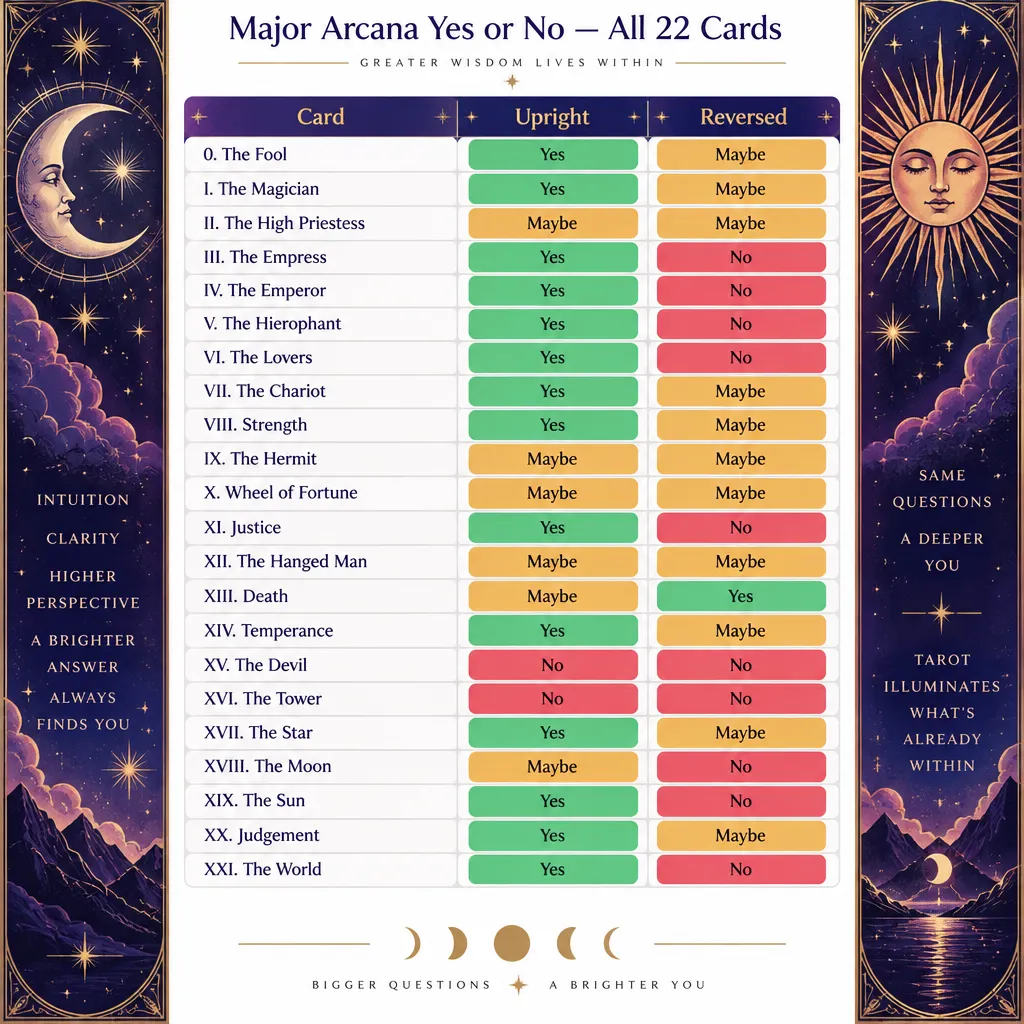
Major Arcana Yes or No Table: All 22 Cards
Keep this table next to your deck. The “Why” column matters more than the verdicts. Once you know why a card says yes or no, you won’t need the table.
Not yet is its own answer here, separate from maybe and no. It means a yes that needs more time, more work or one thing settled first.
| # | Card | Upright | Reversed | Why |
|---|---|---|---|---|
| 0 | The Fool | Yes | No | A leap forward is favoured; reversed, the leap is reckless |
| I | The Magician | Yes | No | You have the tools; reversed, the tools are being misused |
| II | The High Priestess | Maybe | No | Information is hidden; reversed, it stays hidden |
| III | The Empress | Yes | Not yet | Growth and abundance; reversed, the growth needs tending before it arrives |
| IV | The Emperor | Yes | No | Structure delivers results; reversed, control is slipping |
| V | The Hierophant | Yes | No | The established path is favoured; reversed, the rules or the institution stand against you |
| VI | The Lovers | Yes | Not yet | Alignment and a choice made with the heart; reversed, values need to line up first |
| VII | The Chariot | Yes | No | Willpower wins; reversed, the sphinxes pull in opposite directions |
| VIII | Strength | Yes | Not yet | Patience and inner resolve prevail; reversed, your confidence needs rebuilding first |
| IX | The Hermit | Maybe | No | The answer depends on what reflection shows; reversed, withdrawal shuts the door |
| X | Wheel of Fortune | Yes | No | Luck is turning your way; reversed, the cycle is against you |
| XI | Justice | Yes | No | A fair outcome you have earned; reversed, the scales tip against you |
| XII | The Hanged Man | Maybe | No | Suspended until you see it differently; reversed, the stall leads nowhere |
| XIII | Death | Maybe | No | One chapter ends so another can begin; reversed, you’re clinging to what’s over |
| XIV | Temperance | Yes | No | A slow, balanced yes; reversed, excess ruins it |
| XV | The Devil | No | Yes | Bondage and bad bargains; reversed, you break free |
| XVI | The Tower | No | No | Collapse; reversed, the collapse is resisted but still coming |
| XVII | The Star | Yes | No | Hope confirmed; reversed, faith is lost |
| XVIII | The Moon | Maybe | Yes | Too much fog to see the answer; reversed, the fog clears |
| XIX | The Sun | Yes | Yes | The clearest yes in the deck; reversed, still a yes, only smaller |
| XX | Judgement | Yes | Not yet | A verdict in your favour; reversed, self-doubt must be settled before you act |
| XXI | The World | Yes | Not yet | Completion; reversed, one last piece is still unfinished |
Totals: 15 yes, 5 maybe and 2 no upright. Reversed: 3 yes (the Devil, the Moon, the Sun), 5 not yet (the Empress, the Lovers, Strength, Judgement, the World) and 14 no.
How Each Card’s Yes or No Is Decided
The answers come from three things, weighed in this order: the picture Pamela Colman Smith painted for the Rider-Waite-Smith deck, the way modern readers commonly use each card, and A. E. Waite’s own meanings in The Pictorial Key to the Tarot. The picture carries the most weight because it is what you actually look at when you turn a card over.
The Image Test
Three questions settle most cards:
- Is the figure moving, still or falling? The Chariot moves, the Hanged Man is still and the Tower’s figures fall.
- Is the light bright, dim or absent? Compare the Sun’s open sky with the Moon’s half-lit night.
- Does the scene end well, badly, or not at all? The World’s dancer has finished the journey. The High Priestess keeps her scroll half-covered.
Movement, light and a good ending point to yes. Collapse, chains and falling point to no. Stillness, half-light or a scene still in progress point to maybe.
Where Waite’s Own Text Disagrees
Few yes/no guides mention this: Waite’s printed meanings don’t always match the modern yes/no lists. In The Pictorial Key to the Tarot (1911), the Star’s first meaning is “loss, theft, privation, abandonment”. Hope and bright prospects come only as “another reading”. His reversed Wheel of Fortune reads “increase, abundance, superfluity”, which is nothing like the downswing modern readers see.
Waite himself said that, beyond their obvious surface meanings, the fortune-telling meanings of the trumps were largely artificial and arbitrary. That’s why this guide, like most working readers, puts Smith’s imagery first. Where Waite’s text supports a verdict, as it does for the Sun, Justice and the reversed Moon, you’ll see it quoted below.
Why the Major Arcana Carry More Weight in a Yes/No Reading
The 22 Majors are the trump cards of a 78-card deck. They describe the large forces in your situation. The other 56 cards, the Minor Arcana, split into four suits (Wands, Cups, Swords, Pentacles) and describe day-to-day circumstances.
That difference matters when you ask a yes or no question. The Three of Swords says this particular situation hurts. The Tower says the whole structure is coming down. If you draw three cards and only one is a Major, let it set the answer and let the minor cards add detail.
The Deck Behind These Answers
Most readers learn on the Rider-Waite-Smith deck, first published in December 1909 by William Rider & Son in London. Arthur Edward Waite designed the system and commissioned Pamela Colman Smith to illustrate it. His guide, The Key to the Tarot, also appeared in December 1909, and it grew into The Pictorial Key to the Tarot, released in 1910 with a title page dated 1911.
Waite also changed the order of the cards. Strength became VIII and Justice became XI, so that they lined up with the Hermetic Order of the Golden Dawn’s astrological attributions: Leo for Strength, Libra for Justice. In older Marseille-pattern decks, Justice is VIII and Strength is XI. The yes/no answers stay with the card, not the number.
If You Use a Different Deck
Aleister Crowley’s Thoth deck, painted by Lady Frieda Harris, renames several Majors. Strength becomes Lust, Justice becomes Adjustment, Temperance becomes Art and Judgement becomes The Aeon. The broad yes/no leanings mostly carry over.
Still, check that your deck’s picture tells the same story before you borrow an answer. A redrawn modern Moon with a calm, bright sky can’t really be read as fog.
The Fifteen Yes Cards
A yes card shows energy moving the way you want. The figures are active, the light is good and the scene ends well. Each card below has the reason behind its answer and the situations where the yes is strongest.
Reversed, nine of these turn to no, five become not yet, and only the Sun stays yes.
The Fool: Yes
The Fool stands at a cliff edge holding a white rose, with a bag on a staff over his shoulder and a small white dog at his heels. The answer is yes because the whole card is about saying yes. It favours any question about a start, a trip, a risk or a fresh attempt.
The catch is that the Fool promises the adventure, not the outcome. Waite’s own list starts with “folly, mania, extravagance”, a reminder that the yes comes without a safety net. If you asked “Will I succeed?” rather than “Should I try?”, read it as a yes to trying with no guarantee attached.
The Magician: Yes
One hand raises a wand to the sky and the other points to the earth. The symbols of all four suits sit on his table. You have everything you need.
Waite’s keywords are “skill, diplomacy, address, subtlety”, and the card says yes to questions about ability, launching a project or pulling something off. In a romance reading, the Magician means yes with a warning: someone is doing the pursuing and is very good at it. Make sure there’s substance behind the charm.
The Empress: Yes
Wheat, flowing water, a crown of twelve stars and a heart-shaped shield marked with the sign of Venus. The Golden Dawn gave this card to Venus, and it is one of the warmest yeses in the deck. Waite opens her meaning with “fruitfulness”.
She’s strongest for pregnancy, creative projects, home, money that grows over time, and relationships built on care. Reversed, she says not yet: the growth is still there in the soil, but it needs tending, rest or patience before it comes up.
The Emperor: Yes
The Emperor’s yes has a condition: you get it through order, planning and following the rules. He sits on a stone throne carved with rams’ heads (the Golden Dawn gave him Aries). Waite’s words are “stability, power, protection, realization”.
For career, property, contracts and anything involving an authority figure, this is a confident yes. For a spontaneous romance it is still yes, but it tells you to slow down and do it properly.
The Hierophant: Yes
A religious figure in papal robes blesses two kneeling ministers, with crossed keys at his feet. Waite’s first meaning is “marriage alliance”, and the card says yes through the established path.
That means marriage rather than living together, the accredited course rather than the shortcut, the institution rather than the startup. If your question is about breaking with tradition, the yes still stands, but the card tells you the route that works is the one done by the book.
Reversed, it’s a no. The rules, the gatekeeper or the institution itself stands between you and what you want.
The Lovers: Yes
A winged figure spreads its arms over a naked man and woman in a garden. Behind the woman is a tree with a serpent, and behind the man a tree of flames. Waite’s meaning is “attraction, love, beauty, trials overcome”.
This is the obvious yes for romance, and also a good yes for any choice you have to make with your whole self. If you asked whether two people, partners or plans belong together, the Lovers says they do.
Reversed, it says not yet. The bond is real, but values, timing or one unmade choice need to line up before the yes arrives.
The Chariot: Yes
A crowned, armoured figure stands in a chariot drawn by a black sphinx and a white sphinx, with no reins in sight. This is the yes you earn through will.
Travel, competitions, job applications, moving house and anything that needs drive all get a yes. The card doesn’t hand you the result. It tells you the result is within reach if you keep your focus.
Strength: Yes
A woman with an infinity sign over her head closes a lion’s jaws with her bare hands, without visible strain. The answer is yes, and it comes through patience, not force. Waite’s list includes “courage, magnanimity; also complete success and honours”.
Strength is a dependable yes for recovering health, for conflicts you need to handle calmly, and for questions where you doubt your own resolve. Reversed, it’s not yet: the strength is there, but self-doubt has to be dealt with before you can use it.
Wheel of Fortune: Yes
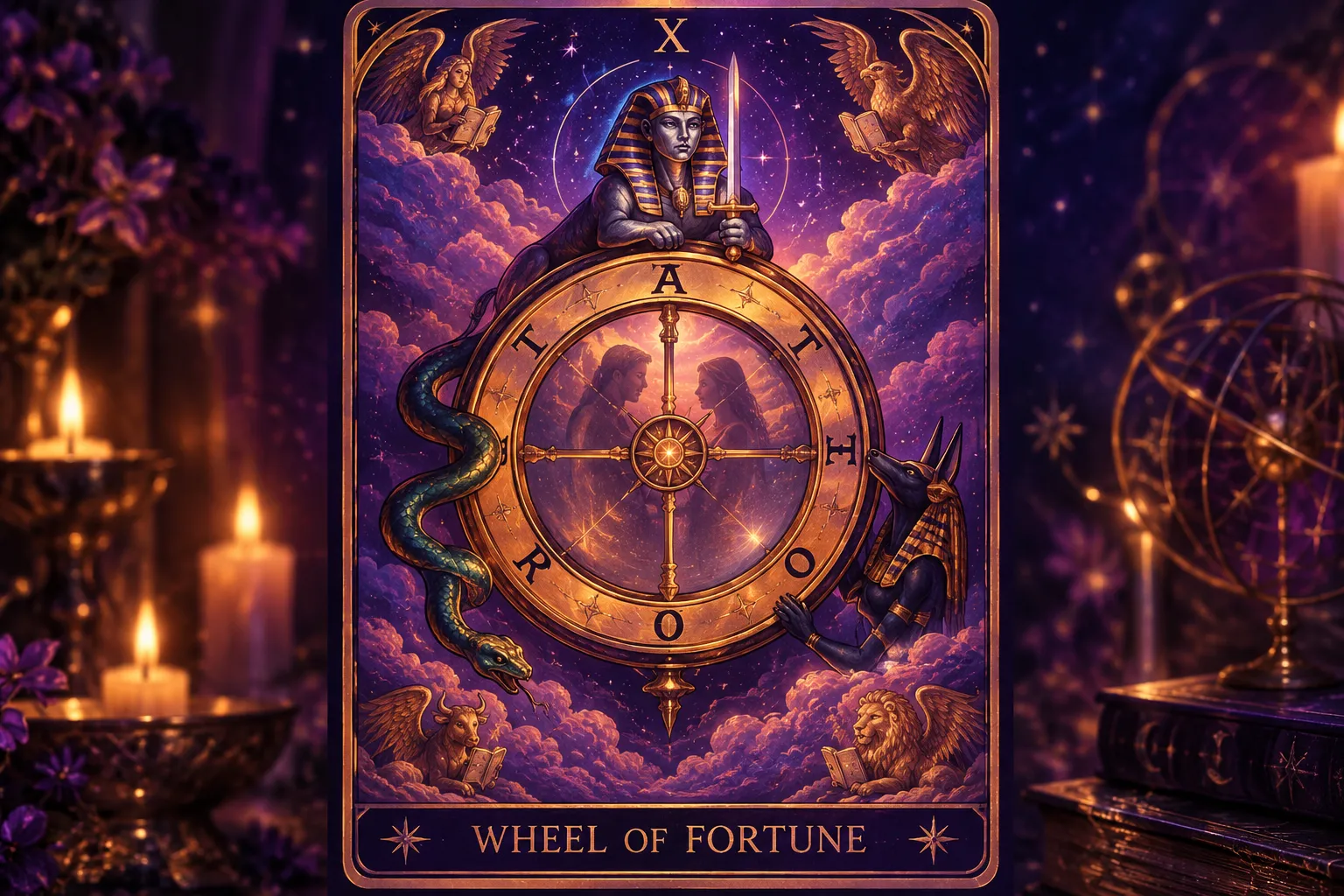
The deck’s clearest “luck is on your side” card. A sphinx sits on top of the turning wheel, and the four winged creatures read their books in the corners. The Golden Dawn gave it Jupiter, the traditional bringer of good fortune.
Upright, the cycle is turning your way. The timing is often sooner than you expect, and the result usually comes from a change in circumstances rather than your own effort. It’s a yes, with the reminder that wheels keep turning.
Justice: Yes
A figure sits between two pillars with an upright sword and a set of scales. Waite gives “equity, rightness, probity” and “triumph of the deserving side in law”, and that second phrase is why the card answers yes.
You get what you’ve earned. If you’ve done the work, paid the debt and been honest, the outcome lands in your favour. It’s an especially clear yes for contracts, legal matters, fair hearings and any question about being treated fairly.
The yes belongs to the deserving side, so treat it as a check on your own conduct too. Reversed, Justice is a no: bias, an unfair decision or accountability dodged tips the scales against you.
Temperance: Yes
An angel with one foot on land and one in the water pours liquid between two cups without spilling a drop. Waite’s meanings, “economy, moderation, frugality, management”, tell you what kind of yes this is: measured and gradual.
It suits questions about healing, combining two things, or whether a slow approach will work. If you need an answer by Friday, this yes may arrive on a Friday three weeks from now.
The Star: Yes
After the Tower’s wreckage comes the Star. A naked figure kneels at a pool under one large eight-pointed star and seven smaller ones, pouring water onto the land and back into the pool. Modern practice reads it as hope confirmed, and that’s the verdict here, even though Waite listed hope only as a second reading.
It’s a strong yes for recovery, renewed faith, creative inspiration and anything you’ve been quietly wishing for. Of all the yes cards, this is the one most likely to feel like relief.
The Sun: Yes
A child rides a white horse under a huge, radiant sun, with sunflowers behind a wall. This is the most straightforward yes in the deck. Waite’s meaning, “material happiness, fortunate marriage, contentment”, is just as positive.
If you draw one card and it’s the Sun, you have your answer. It covers success, happiness, clarity, children and good news, with no hidden catch. It is also the only Major that says yes in both positions.
Judgement: Yes
An angel blows a trumpet, and a man, a woman and a child rise from their coffins with their arms open. Waite’s meaning is “change of position, renewal, outcome”. Judgement says yes to second chances, to a decision going your way, and to being called to something bigger.
Some readers mark Judgement as a maybe because a verdict could go either way. The image settles it: the figures are rising, not cowering. It’s an especially good yes for legal matters, reconciliations and career moves that feel like a calling.
Reversed, it says not yet. The call is still there, but harsh self-judgement or an unresolved past has to be settled before you answer it.
The World: Yes
A dancer holding two wands moves inside an oval laurel wreath, with the four living creatures in the corners. Waite opens with “assured success”. The World says yes with a sense of completion.
If you asked whether something will come together, succeed or reach its natural end, the answer is yes, and it will probably feel like closure when it happens. Reversed, it’s not yet: the circle is almost closed, but one loose end needs finishing first.
The Two No Cards
Only two Majors say no upright. Both show energy that is trapped or collapsing, heading somewhere you don’t want it to go. In a full reading neither is simply a “bad” card. In a yes/no reading, they mean no.
The Devil: No
A horned figure squats on a pedestal above a naked man and woman with chains around their necks. Waite’s list starts with “ravage, violence, vehemence”. The Golden Dawn gave the card Capricorn.
It’s a no for commitments, deals, relationships and habits, because it shows being tied to something that costs you. Look closely, though: in Smith’s drawing the chains hang loosely enough to lift off. That detail explains why the reversed Devil turns into a yes.
The Tower: No
Lightning strikes a tower, knocks off its crown, and two figures fall headfirst among falling flames. Waite calls it “a card in particular of unforeseen catastrophe”. The Golden Dawn gave it Mars.
It’s the firmest no among the Majors: whatever you asked about rests on a foundation that is about to give way. It is also the only Major that says no in both positions. Reversed, the collapse is resisted or delayed, but the weak foundation is still there.
The only comfort is that what comes after the Tower is solid ground.
The Five Maybe Cards
These five won’t commit, and that is the answer. A maybe from the Major Arcana usually means the outcome depends on something you control, or on information you don’t have yet.
Reversed, four of them fall to no. The Moon is the exception and becomes a yes.
The High Priestess: Maybe
She sits between pillars marked B and J, with a crescent moon at her feet and a scroll marked TORA half-hidden in her robe. Waite’s phrase for her is “the future as yet unrevealed”.
The answer exists, but it isn’t being shown to you yet. In a romance reading, this often means the feelings are real but unspoken. In business, it means something hasn’t been disclosed.
The Hermit: Maybe
An old man stands on a mountain peak holding a lantern with a six-pointed star inside. The Golden Dawn gave him Virgo, and Waite’s meaning opens with “prudence, circumspection”.
The Hermit doesn’t refuse, and it doesn’t promise a yes after the wait either. What you find when you step back and think decides the answer. For questions about going public, launching, committing or confronting someone, it means “reflect first, then ask again”.
Reversed, it becomes a no. Healthy solitude has turned into isolation, or you’re ignoring advice you need.
The Hanged Man: Maybe
A man hangs upside down by one foot from a T-shaped cross of living wood, calm, with a halo around his head. Nothing moves on this card, and nothing moves on your question yet.
Waite connects it with “wisdom, circumspection, discernment, trials, sacrifice”. The pause has a purpose: the answer depends on seeing the situation from a new angle, or on giving something up. Once that happens, the maybe resolves.
Reversed, it’s a no. The stall serves nothing, or the sacrifice is pointless.
Death: Maybe
An armoured skeleton rides a white horse carrying a black banner with a white rose, and a king lies fallen in its path. Waite’s meaning is “end, mortality, destruction”.
Death is a maybe because its answer depends on which way you asked. To “Will this continue as it is?” it leans firmly against. To “Will things change?” or “Should I leave?” it leans yes, because the ending itself is what the card promises. Something closes, and what opens next is still unwritten.
Reversed, it’s a no. You’re holding on to something that is already over, and nothing new can start until you let go.
The Moon: Maybe
A path winds between two towers under the moon. A dog and a wolf howl, and a crayfish crawls out of a pool. Waite’s meaning, “hidden enemies, danger, calumny, darkness, terror, deception”, explains the caution.
You can’t see clearly, and the answer is hidden in the fog rather than settled against you. Don’t act on a yes given in fog. If your question was about trusting someone, hold back until you know more.
Reversed, the fog lifts and the Moon becomes a yes.
How Reversed Major Arcana Change the Answer
A reversed card doesn’t simply mean the opposite. Across the Majors, the pattern is:
- Yes cards reversed mostly become no, because the good energy is blocked or misused (nine cards). Five become not yet: the Empress, the Lovers, Strength, Judgement and the World. The Sun stays yes.
- Maybe cards reversed fall to no (the High Priestess, the Hermit, the Hanged Man, Death), except the Moon, which turns to yes.
- No cards reversed split: the Devil flips to yes, and the Tower stays no.
| Card | Reversed answer | What’s happening |
|---|---|---|
| The Fool | No | Recklessness, poor timing, a leap taken without looking |
| The Magician | No | Trickery, scattered effort, or talent being wasted |
| The High Priestess | No | Secrets are being kept from you, or you’re ignoring your gut |
| The Empress | Not yet | Growth is slowed by neglect or burnout; tend it and it comes |
| The Emperor | No | Rigidity or a loss of control; the structure doesn’t hold |
| The Hierophant | No | The rules, the gatekeeper or the institution blocks the way |
| The Lovers | Not yet | Values or timing are out of step; align them first |
| The Chariot | No | Lost direction, lack of discipline, forces pulling apart |
| Strength | Not yet | Self-doubt or a loss of nerve; rebuild your confidence first |
| The Hermit | No | Isolation, or refusing guidance you need |
| Wheel of Fortune | No | A downswing in the cycle, bad timing, resistance to change |
| Justice | No | Unfairness, a decision going against you, accountability dodged |
| The Hanged Man | No | Stalling that leads nowhere, or a sacrifice made in vain |
| Death | No | Refusing to let go; the ending is still coming, just slower |
| Temperance | No | Excess, imbalance, impatience undoing the progress |
| The Devil | Yes | Chains loosening; freedom from a habit, debt, or bad arrangement |
| The Tower | No | Disaster delayed or resisted; the weak foundation is still there |
| The Star | No | Hope has drained out; disappointment or a loss of faith |
| The Moon | Yes | Clarity returning; the confusion lifts and you can proceed |
| The Sun | Yes | Still a yes, only smaller, quieter or more modest than hoped |
| Judgement | Not yet | Self-criticism holds you back; settle it, then answer the call |
| The World | Not yet | One piece is unfinished; complete it and the circle closes |
What a Not Yet Answer Means
A not yet is a yes with a condition attached: more time, more work, or one thing settled first. It is not a softened no, and it is not a maybe, because the direction is already clear.
Each of the five not yet cards names its own condition. The reversed Empress asks for care and patience. The Lovers asks for values to line up. Strength asks for your confidence back. Judgement asks you to stop judging yourself so harshly. The World asks you to finish the last piece.
Read a not yet as an instruction. Work on the condition, then ask again in a few weeks.
The Two Cards That Improve: The Devil and the Moon
The Devil reversed is the one true flip in the set. Upright it’s a chain; reversed, the chain comes off. If you asked whether you’ll get free of a debt, a dependency, a controlling person or a contract you regret, the reversed Devil says yes.
If you asked whether to sign up for something new, read the yes carefully: the card is about getting out of bondage, not walking into a new deal. Waite’s reversed meaning, “evil fatality, weakness, pettiness, blindness”, is darker than modern practice. Most readers today follow the loosened chains in Smith’s image instead.
The Moon reversed goes from maybe to yes because the Moon’s whole problem is visibility. Reverse it and the fog thins. Waite’s reversed meaning includes “lesser degrees of deception and error”, which is exactly that kind of easing. It isn’t a yes as strong as the Sun’s. It means you can finally see well enough to move.
Why the Reversed Sun Stays a Yes
Waite’s entry for the reversed Sun is short: “the same in a lesser sense.” The good news is still coming, only smaller or quieter than you hoped. That’s why the reversed Sun stays a yes, and why it isn’t a not yet: nothing has to be fixed first.
If You Don’t Read Reversals
You have two consistent options. Read every card upright and use the maybe cards for nuance. Or use the reversed column as a softer “this could change” reading when cards appear next to strongly positive or negative minor cards.
Either works. Reading reversals only when it suits you doesn’t.
Crush, Partner, Ex or Decision: What the Key Cards Say
The card’s verdict stays the same, but its meaning shifts with the situation you ask about. Romance generates most yes/no readings, so this table covers the 12 Majors that cause the most confusion in love questions, plus the “should I do it” decision.
| Card (upright) | A crush or someone new | Your current partner | An ex coming back | A big decision |
|---|---|---|---|---|
| The Lovers | Yes, the attraction is mutual | Yes, you’re aligned | Yes if the values gap has closed | Yes, choose with your whole self |
| The Sun | Yes, open and warm | Yes, a happy phase | Yes, and it feels easy | Yes, go ahead |
| The Star | Yes, slowly and hopefully | Yes, healing after a hard patch | Yes, after real repair | Yes, follow the long-term hope |
| The Empress | Yes, affection grows | Yes, nurturing; family themes | Yes if care was the missing piece | Yes for anything that needs to grow |
| Wheel of Fortune | Yes, timing is on your side | Yes, a good turn is coming | Yes, circumstances bring you back into contact | Yes, act while the luck runs |
| Judgement | Yes, a sense of being called to each other | Yes, a renewal | Yes, the classic reconciliation card | Yes, answer the call |
| The High Priestess | Maybe, feelings exist but go unspoken | Maybe, something unsaid | Maybe, they think of you but won’t show it | Maybe, gather information first |
| The Hermit | Maybe, they’re withdrawn for now | Maybe, space is needed before you know | Maybe, they’re still processing alone | Maybe, reflect before deciding |
| The Moon | Maybe, you may be seeing a projection | Maybe, something is hidden | Maybe, the signals are mixed | Maybe, the facts aren’t clear yet |
| The Devil | No, intense but unhealthy | No, the bond costs you | No, the return would be a relapse | No, the deal traps you |
| The Tower | No, it collapses early | No, a shock is coming | No, it ended for a reason | No, the plan can’t hold |
| Death | Maybe, an old attachment has to end first | Maybe, the old version ends; what follows is open | Maybe, only a changed relationship could return | Maybe, and yes if the decision is to leave |
Reading a Crush or Someone New
For someone you’ve only just met, the most useful cards to watch for are the High Priestess and the Moon. Both say the person isn’t fully visible to you yet.
The High Priestess means real feelings that haven’t been spoken. The Moon means you may be filling the gaps with hopes of your own. Get to know them better and ask again in a month.
Reading an Ex
Judgement and the Wheel of Fortune are the two strongest “they come back” cards. Even so, a return isn’t the same as a good return.
If the Devil or the Tower shows up next to either one, the reunion is a repeat of the old pattern. Ask a second question: “Would getting back together improve my life by summer?”
Reading a Decision
For decisions, phrase the question as the action: “Should I take the job in Manchester?” Then the Fool and the Chariot become active yes cards, and Death’s maybe leans yes, because each is about leaving one state for another.
Death leans yes only to the ending, so it suits “Should I leave?” much better than “Will it work out?”
When Neighbouring Cards Change the Answer
In a spread, a Major’s verdict is the anchor, and the cards next to it decide how firm, how fast and how clean the answer is. When two Majors disagree, read the first as where things are now and the second as where they’re heading.
| Combination | Overall answer | Why |
|---|---|---|
| The Tower + the Star | No now, yes later | The collapse comes first, recovery follows |
| The Sun + the Moon | Yes, once the facts are clear | The Moon’s fog delays the Sun’s yes but doesn’t cancel it |
| The Lovers + the Devil | No | Strong attraction tied to an unhealthy pattern |
| Death + any Ace | Yes to the new start | The Ace tips Death’s maybe to yes: one door closes and the next opens |
| The Hermit + Three of Cups | Yes, after a pause | Time alone first, then a return to people and celebration |
| Wheel of Fortune + Ten of Pentacles | Strong yes | Good timing meets lasting material security |
| The Lovers + Three of Swords | No | A third party or a painful truth splits the pair |
| The High Priestess + Page of Cups | Leans yes | The hidden feeling is about to be voiced |
| Judgement + Six of Cups | Yes for an ex returning | Renewal plus nostalgia for the past |
| Temperance + Eight of Wands | Yes, faster than expected | The Eight of Wands speeds up Temperance’s slow yes |
The general rule: Swords next to a yes Major add conflict or delay. Cups add emotional warmth. Pentacles make the result concrete and slow. Wands speed things up. Court cards often point to a specific person who influences the outcome.
How to Ask a Yes/No Question That Gets a Clear Answer
Most unsatisfying yes/no readings fail because of the question, not the cards. Ask something vague and the answer will be vague too.
Three Tests for a Good Question
- One subject. “Will I get the job?” has one subject. “Will I get the job and will I like it?” has two, and a single card can’t answer both.
- An outcome, not a feeling. “Will the contract be signed?” works better than “Is this a good idea?” Cards are much clearer about events than about judgements of worth.
- A time limit. “Will I hear back about the loan by the end of the month?” gives the Wheel of Fortune and Temperance something to work with. Without one, “yes” could mean 2031.
Rewriting Weak Questions
| Weak question | Better question | What changed |
|---|---|---|
| Does he love me? | Will he reach out to me this month? | A feeling became an observable event with a time limit |
| Should I move? | Will moving to Leeds before next summer improve my work situation? | Added a place, a time and a measurable outcome |
| Is my business going to work? | Will the business cover its own costs within twelve months? | “Work” became a specific benchmark |
| Am I on the right path? | Will staying on this course lead to the qualification I want? | A vague path became a concrete goal |
| Will I be happy? | Will leaving this job improve my daily life by spring? | An abstract state became a comparison with a deadline |
Putting the Time Frame in the Question
Put the time frame into the question itself. The Majors are poor timing indicators on their own.
One widely used convention gives the suits their own speeds: Wands for days or weeks, Swords for weeks, Cups for months, Pentacles for the slowest, sometimes a year or more. If you want a Major to give the yes/no and a minor card to give the when, draw two cards and decide which does what before you turn them over.
One to three months is a reasonable window for most questions. Asking about something a year away really means asking about dozens of decisions you haven’t made yet, which is why the High Priestess and the Hermit turn up so often for those questions.
Questions to Keep Away From the Cards
- Health diagnoses. “Do I have X?” is a question for a doctor. The cards can tell you whether to book the appointment, not read a scan.
- Other people’s private choices. “Will she cheat?” turns a reading into surveillance. Ask about yourself instead: “Will I get clarity about this relationship by the end of the month?”
- The same question asked again. If you draw the Tower and reshuffle to ask again, you’ve stopped reading and started bargaining. Accept the card or wait a week.
- Questions with a hidden “should”. “Will I win the case?” is fine. “Should I sue?” is a question about values dressed up as a prediction. Use a three-card spread for those.
- Legal and financial decisions with real consequences. A yes from the Magician is no reason to remortgage. Use the cards to examine your thinking, not to replace it.
What to Do When a Maybe Comes Up
A maybe from the High Priestess, the Hermit, the Hanged Man, Death or the Moon is a prompt to ask a sharper question, not a dead end. Here are three ways to handle it, in order of preference.
- Refine the question and ask once more. Death, for example, is asking which direction you meant. Ask again with the action named (“Will leaving this job by spring improve my daily life?”) and you’ll usually get a clear card.
- Draw a clarifier. Draw one more card as the tie-breaker. A Major overrides. Among the minor cards, Wands and Cups generally tip towards yes, Swords towards no, and Pentacles towards “yes, but slowly”. Aces, Tens and court cards give stronger signals than the middle numbered cards.
- Leave it. Some questions aren’t ready. Note the date and the card and come back in a fortnight. The High Priestess in particular tends to appear when the situation hasn’t finished taking shape.
A not yet needs different handling. It has already told you the direction, so don’t ask again straight away. Work on the condition the card names, then return to the question.
Three Spreads That Work With the Major Arcana
The Single Card
Shuffle, cut and draw one card, then read it from the table. It’s the fastest format, and it works best when your question passes the three tests above and you’ve already decided what a maybe and a not yet mean for you.
The Majors-Only Draw
Take out the 22 Majors and shuffle only those. Draw one. This forces a big-picture answer and strips away the gentler shading of the minor cards.
It’s good for major crossroads and bad for small daily questions, where the Tower turning up for “Will the bus be late?” feels absurd.
The Three-Card Weighted Draw
Draw three cards from the full deck. Count yes cards against no cards using this table and a minor-card list you trust, and count any Major twice. A maybe counts as nothing, and a not yet counts as a yes that arrives later.
A single minor-card yes plus the Tower makes a no. The Sun with one Cups card and one Swords card makes a yes. If it’s a tie, the middle card decides.
This spread teaches you the most, because you see how the Majors behave alongside everyday cards.
Making the List Your Own
Other yes/no lists differ from this one in a few places. The four cards readers argue about most are the Hierophant, Justice, the Moon and Judgement. The disagreement always comes down to how much weight you give the picture compared with the card’s broader meaning.
Go through the 22 cards using the image test above and write one word next to each. Where your answer differs from this guide, trust your own, and use it every time. Consistency matters more than agreement, because a yes/no system only works if you apply it the same way in every reading.
Your Next Step: Test the Table for a Month
The quickest way to make these answers reliable is to check them against real outcomes. For 30 days, ask one low-stakes question each morning that you’ll know the answer to within a day or two: “Will the parcel arrive today?” “Will the meeting run over?” Write down the card, its orientation and what actually happened.
By the end of the month you’ll know how the maybes and not yets resolve for you, whether reversals add anything to your readings, and which of the 22 cards you can trust without looking them up. After that, take the cards to a question that matters.
FAQ
Which Major Arcana card is the strongest yes?
The Sun. It has no negative side upright, and Waite’s reversed meaning is only “the same in a lesser sense”, which is why it stays a yes even reversed. It is the only Major that answers yes in both positions. The World and the Star come close upright, but both carry a sense of “eventually” that the Sun doesn’t.
Which Major Arcana card is the strongest no?
The Tower. Waite called it a card of “unforeseen catastrophe”, and it is the only Major that answers no both upright and reversed. The Devil is the only other upright no, and it turns to yes when reversed.
Can you do a yes or no reading with only the Major Arcana?
Yes. Take out the 22 Majors, shuffle and draw one card. The answers are bolder because there are no minor cards to soften them. In a full-deck draw the Majors still carry the most weight, so most readers let any Major set the answer and count it double in a three-card draw.
Is Death a yes or no card?
Upright, Death is a maybe, because the answer depends on how you asked. To “Will this continue?” it leans against; to “Should I leave?” or “Will this change?” it leans yes, since the ending is what the card promises. Reversed, it’s a no: you’re holding on to something that is already over.
Is the Lovers a yes card for relationships?
Yes, and a strong one. Waite’s meaning is “attraction, love, beauty, trials overcome”, and the image shows the couple blessed by a winged figure. Reversed it says not yet, pointing to values or timing that need to line up before the yes arrives.
What does “not yet” mean in a yes/no reading?
It’s a yes that needs more time, more work or one thing settled first. Five Majors give it when reversed: the Empress, the Lovers, Strength, Judgement and the World. Unlike a maybe, the direction is already clear, so focus on the condition the card names rather than asking again.
What does it mean if you keep getting maybe cards?
Usually the question isn’t fully formed, or the outcome depends on a choice you haven’t made yet. The High Priestess means wait for more information, the Hermit means reflect first, the Hanged Man means look at it from a new angle, Death means name the direction you’re asking about, and the Moon means get the facts. Make the question more specific or leave it for a week.
Should you read reversed cards in a yes/no reading?
Only if you read them consistently in all your other readings. Reversals add precision, especially for the Devil, the Moon and the five not yet cards, but they double the number of meanings you have to remember. If you’re new, read everything upright and use the maybe cards plus a clarifier for nuance. Add reversals once your upright answers feel reliable.
Related readings
- 10 Best Tarot Cards for a Yes Answer (And What They Really Mean)
- The 10 Best Tarot Cards for a ‘Yes’ Answer (Ranked by Strength)
Add Yes No Tarot as a preferred source on Google, and the sites you pick are more likely to appear in your Top Stories.