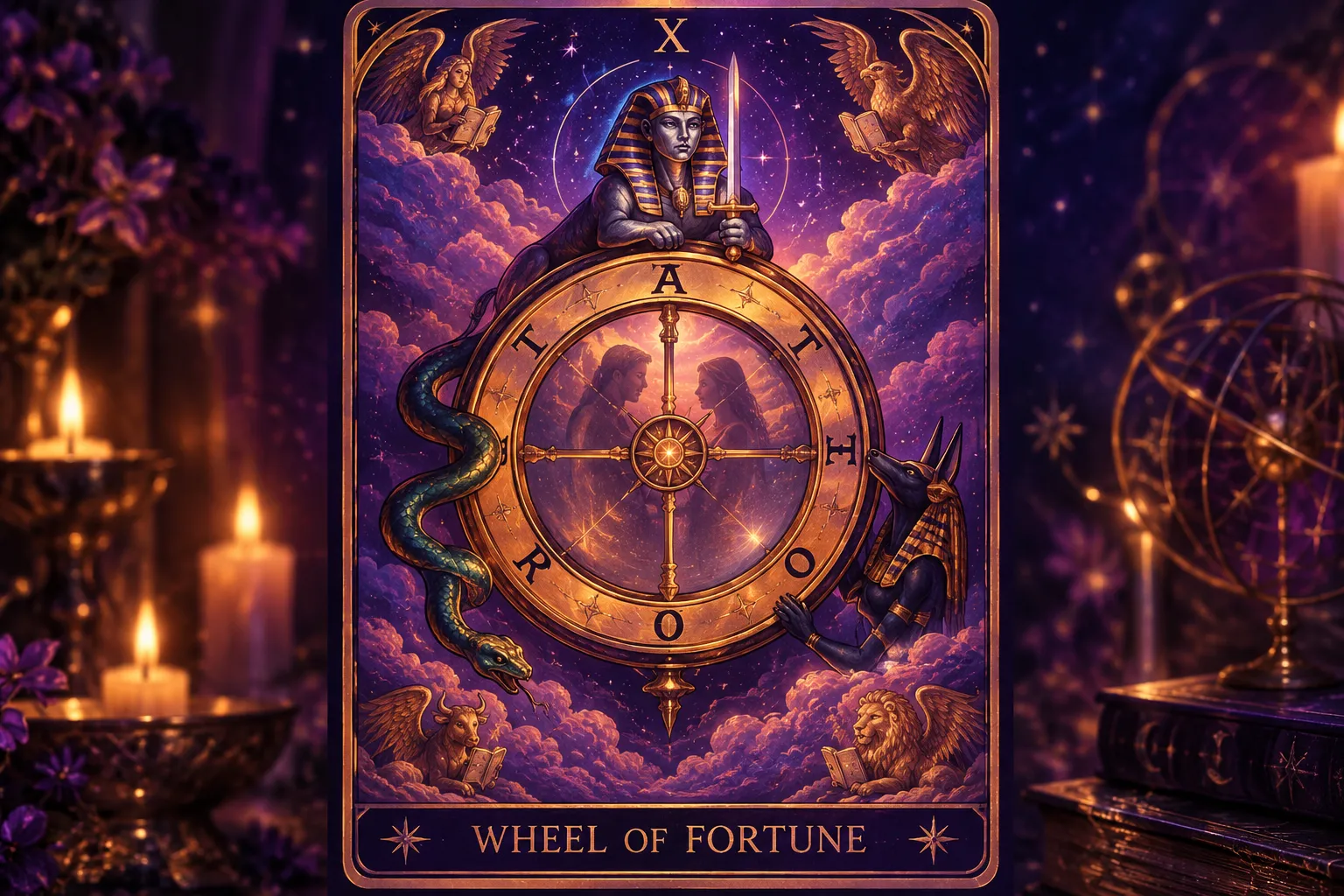


The best yes or no tarot career questions name one action you control, one specific job, company or person, and a time window. Word them so that “yes” means you act. “Should I accept the offer from [Company] before Friday’s deadline?” works. “Is this the right career for me?” doesn’t. The seven questions below cover the decisions people bring to the cards most often: an offer, a promotion, quitting, a launch, a career change, staying put and a workplace conflict.
Each question comes with the cards that answer it most clearly, what changes when those cards come up reversed or next to certain other cards, and what to do after a no. The meanings follow the Rider-Waite-Smith tradition. A. E. Waite’s own wording from The Pictorial Key to the Tarot and the Golden Dawn attributions are named wherever they sharpen the answer.
The 7 Questions at a Glance
Each of these questions has a time window built in, and each is worded so that “yes” means action. Swap in your own company names, roles and dates.
| # | Question | Time window | Strongest yes card | Clearest no card | What a no usually means |
|---|---|---|---|---|---|
| 1 | Should I accept the job offer from [Company]? | Offer deadline | Ten of Pentacles | Seven of Cups | Check or renegotiate the terms |
| 2 | Is my next review the right time to ask for a promotion? | Next review cycle | The Emperor | Two of Swords | Build your case, then ask |
| 3 | Should I hand in my notice in the next three months? | Three months | Eight of Cups | Five of Pentacles | Build your savings before you leave |
| 4 | Is my business idea ready to launch within six months? | Six months | The Magician | The Moon | Test the idea before you launch |
| 5 | Am I ready to change careers into [field] this year? | This year | Judgement | Nine of Swords | Research more, or check your motives |
| 6 | Should I commit to my current role for another year? | 12 months | Eight of Pentacles | The Tower | Stay alert and build a safety net |
| 7 | Should I raise this conflict with HR or my manager this month? | This month | Justice | Five of Swords | Gather facts or try a direct talk first |
What Makes a Career Question Answerable
A single card can carry one decision, made by you, inside a known timeframe. If a question fails any of those three tests, you will usually get a muddy maybe.
| Test | Weak version | Strong version |
|---|---|---|
| One action you control | “Will the hiring manager pick me?” | “Should I apply for the senior analyst role at [Company] this week?” |
| One decision only | “Should I quit and go freelance?” | “Should I hand in my notice before March?” (Ask about freelancing in its own pull.) |
| A time window | “Will I ever get promoted?” | “Is my next review the right time to ask for a promotion?” |
Tarot answers near-term questions, up to about six months, more cleanly than open-ended ones. A career change is the exception: retraining takes time, so a one-year window is realistic there.
The Direction Problem: Make “Yes” Mean Action
Some cards flip their answer depending on how you word the question. This causes more confused career readings than anything else.
The Eight of Cups is the classic case. Pamela Colman Smith drew a cloaked figure with a staff walking away from eight stacked cups toward barren hills under a waning moon. Waite describes him as “deserting the cups of his felicity, enterprise, undertaking or previous concern.” The Golden Dawn’s title for the card is the Lord of Abandoned Success (Saturn in Pisces). Ask “Should I stay in this job?” and it reads as a clear no. Ask “Should I leave?” and the same card reads as yes.
The card didn’t change. The question did.
The fix is one rule: always word the question so that “yes” means taking action. Yes means accept, apply, ask, launch or leave. No means hold, wait or decline. Keep to that and the “exit cards” become easy to read: the Eight of Cups, Death, the Six of Swords and the Tower. They lean yes on any question about leaving and no on any question about staying.
Before You Pull
Most career readings go wrong before a single card is turned. Have these in place first.
- A deck you know. The Rider-Waite-Smith deck is the safest choice. William Rider & Son published it in London in 1909, with art by Pamela Colman Smith working under Waite’s direction. Most yes/no conventions are built on its imagery, and decks based on it work just as well.
- A rule on reversals. Decide before you shuffle whether upside-down cards count as reversed. Never decide after you see the card.
- A written question. One sentence, on paper.
- A timeframe. “In the next three months” or “before the end of this year.”
- The hard facts. The offer letter, your current salary, your notice period, your savings, the contract terms. The cards work alongside this information, not instead of it.
- A notebook. You’ll want to compare each pull with what actually happened.
- Ten quiet minutes. Not straight after a tense meeting, and not with your work inbox open.
How to Ask a Career Yes or No Tarot Question: Step by Step

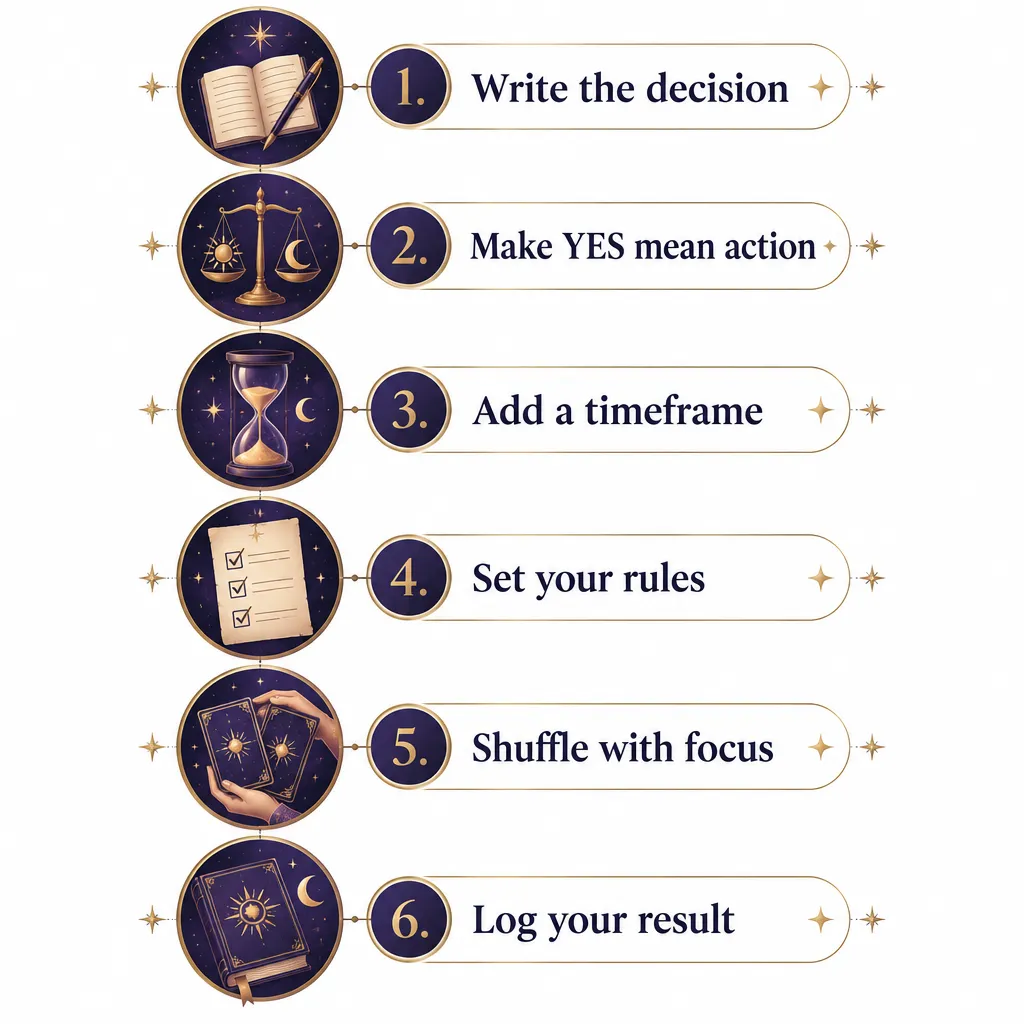
The first three steps do most of the work. Follow them in order.
- Write the decision in one line. Strip out the backstory. “My manager has been odd since the reorg, a recruiter messaged me and I don’t know” becomes “Should I reply to the recruiter from [Company] this week?”
- Make “yes” mean action. Rewrite until a yes clearly tells you to do something.
- Add a time window. Tie the question to a real event where you can: an offer deadline, a review date, the end of a quarter.
- Set your rules. Reversals on or off. One card, or one card plus a clarifier if you get a maybe.
- Shuffle with the question in mind. Say it aloud or hold the written version. There’s no correct number of shuffles.
- Draw one card. Take it off the top, or cut the deck and take the top card of the bottom pile. Pick one method and keep using it.
- Read the lean first, then the picture. Is it yes, no or maybe? Then look at what the figure is doing. A yes from the Seven of Wands, where a figure defends high ground against six staves, is a different yes from the Six of Wands, where a laurelled rider leads a victory parade.
- Log it. Write down the date, the question, the card, your gut reaction and your reading of it. If a no brought relief, take that seriously.
How the Deck Leans on Work Questions
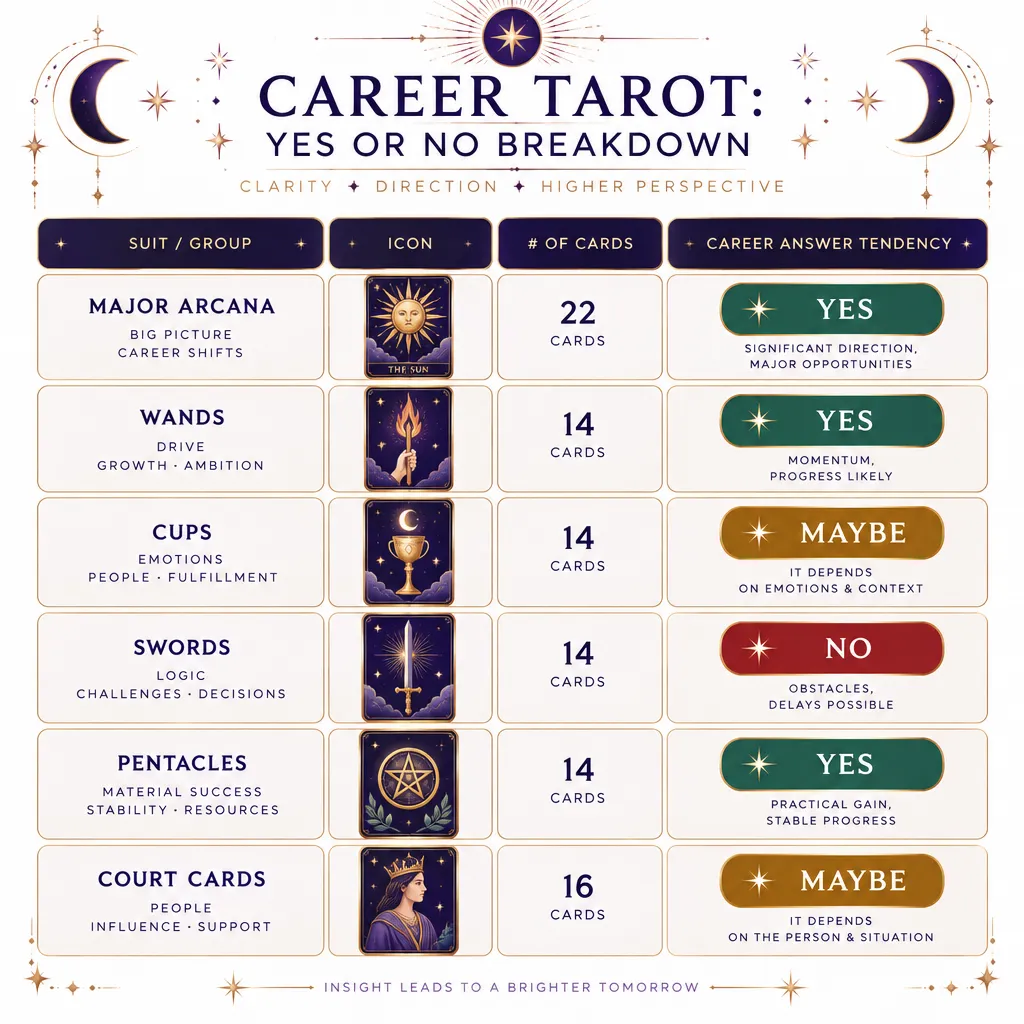
Every one of the 78 cards leans yes, no or maybe, based on its traditional meaning. These leanings are conventions, not laws. A handful of cards (the Hermit, Justice, the Wheel of Fortune) are classed differently by different readers. What matters is that you stick to one system.
| Deck section | Cards | Golden Dawn element | Typical lean | What it speaks to at work |
|---|---|---|---|---|
| Major Arcana | 22 | Each card has its own planet, sign or element | Strong yes or strong no | Turning points, career direction, the long-term path |
| Wands | 14 | Fire | Mostly yes | Ambition, initiative, new projects, leadership |
| Cups | 14 | Water | Mixed | Satisfaction, team relationships, burnout |
| Swords | 14 | Air | Mostly no or caution | Conflict, hard decisions, stress, office politics |
| Pentacles | 14 | Earth | Mostly yes, but slow | Salary, skills, stability, business money |
| Court cards (within the suits) | 16 | Elemental combinations | Often maybe | The people involved, or the approach you need |
Pentacles turn up constantly in work readings because the suit governs money and craft. A yes from this suit usually means “this pays off, slowly.” If you need a quick win, treat that as a warning.
Court cards are the other thing to watch. When you pull a King or Queen, read it first as a person (a manager, a client, a mentor) or as the attitude the situation needs. Read it as yes or no only after that.
What Yes, No and Maybe Mean at Work
A yes is rarely a guarantee, and a no is rarely a dead end. In career readings, each answer points you toward a specific next move.
| Answer | Example cards | What it usually means | Best next move |
|---|---|---|---|
| Strong yes | The Sun, the World, Ace of Pentacles, Six of Wands, the Chariot | Conditions support the move and your energy matches it | Act within your timeframe |
| Soft yes | Eight of Pentacles, Three of Pentacles, Temperance, Page of Pentacles | Yes, through steady effort | Act, and plan for a slower build |
| Maybe | Justice, the High Priestess, Two of Swords, Wheel of Fortune | Information is missing, or the outcome depends on someone else | Gather facts, then pull a clarifier |
| Soft no | Four of Pentacles, the Hermit, Seven of Cups, Four of Cups | Not now, or not in this form | Wait, refine the plan, ask again later |
| Strong no | The Tower, Ten of Swords, Five of Pentacles, Three of Swords, the Devil | The move as framed carries real risk | Pause and look at what the card shows |
For a deck-wide view of which cards point to yes on any kind of question, a list of tarot cards for yes answers is a useful companion to the career-specific cards below.
The 7 Best Yes or No Tarot Career Questions
Each question below follows the three tests. The yes and no cards listed are the ones most likely to give you a clear lean for that decision.
1. “Should I accept the job offer from [Company] before the deadline?”
This question is specific, the offer deadline sets the time window, and yes means accept. Compare it with “Is this the right job for me?”, which has no action and no end date.
Yes cards:
- Ten of Pentacles: long-term security. Smith drew three generations and two dogs under an archway hung with pentacles, and the Golden Dawn calls it the Lord of Wealth.
- Three of Pentacles: your skills will be respected. Waite describes “a sculptor at his work in a monastery,” consulting with the people who commissioned him.
- Six of Wands: recognition and a strong start.
- The Chariot: forward motion with real momentum.
No cards:
- Seven of Cups: the offer looks better than it is. Waite says the card suggests “nothing permanent or substantial,” and the Golden Dawn titles it the Lord of Illusionary Success.
- Five of Pentacles: money trouble, which may mean an underpaid offer or an unstable company.
- The Devil: golden handcuffs. Great pay, poor culture, hard to leave.
Reversed: a reversed Ace of Pentacles still leans yes in many systems, but it suggests the money or start date isn’t quite what was promised. Get it in writing.
If you get a no: Don’t decline on the spot. A no here often points to something you can negotiate. The Five of Pentacles can mean “not at this salary” rather than “never.” Pull a clarifier for “What would make this offer a yes?” If it points to money, title or remote work, go back with a specific counter-offer.
2. “Is my next review the right time to ask for a promotion?”
Promotions depend on other people’s decisions, so “Will I get promoted?” invites a vague maybe. Asking about your own timing puts the action back in your hands.
Yes cards:
- The Emperor: structure and authority are on your side. The Golden Dawn links the card to Aries, the sign of initiative.
- Strength: calm confidence will carry the conversation.
- Nine of Pentacles: you have earned this and can prove it.
- Knight of Wands: go now, with energy.
No cards:
- Two of Swords: decision-makers are stuck, often because of budget or a reorganisation.
- Four of Pentacles: money is being held tight. The Golden Dawn title is the Lord of Earthly Power: the people who control the budget aren’t letting go.
- Seven of Swords: someone may be playing politics. Document your wins first.
If you get a no: Treat it as a preparation note. Over the next cycle, track your results, gather numbers and line up a senior sponsor. A no on timing is the gentlest no in career tarot.
3. “Should I hand in my notice in the next three months?”
Quitting questions carry the most emotion, so they need the tightest wording. “Should I quit?” reads differently on a bad Monday than on a good Friday. A three-month window keeps both you and the cards on the practical horizon.
Yes cards:
- Eight of Cups: you have already outgrown this.
- Death: a natural ending. The Golden Dawn assigns it to Scorpio, the sign of transformation, and on leaving questions it confirms that a chapter has closed.
- Six of Swords: a ferryman carries passengers toward calmer water. The transition will be quieter than you fear.
- The Fool: a leap, ideally with your savings in order.
No cards:
- Four of Pentacles: hold on to the security for now.
- Five of Pentacles: leaving would cost you more than you can afford right now.
- The Hanged Man: pause. Your view needs to shift before you move.
The Eight of Swords twist. Smith drew a blindfolded woman, loosely bound, standing among eight swords with a castle behind her. The swords don’t actually close her in. Waite calls it “rather a card of temporary durance than of irretrievable bondage,” and the Golden Dawn titles it the Lord of Shortened Force. On a quitting question it reads as no for now, with a clear message: you feel more trapped than you are. The thing holding you back is often a belief (“no one else would hire me”) rather than a fact. A fuller eight of swords yes or no breakdown explains why many readers treat it as “not yet, but you are freer than you think.” Reversed, it leans toward release and a cautious yes.
If you get a no: Ask what you’d need in place to leave safely. That might be three to six months of expenses saved, a signed offer elsewhere or a finished certification. A no on quitting is usually a no on quitting unprepared.
4. “Is my business idea ready to launch within six months?”
“Will my business succeed?” is too big for one card, because success depends on hundreds of later choices. Whether the idea is ready within a set window is something a single card can actually speak to.
Yes cards:
- The Magician: you have the tools. Smith drew all four suit symbols on his table, ready for use.
- Ace of Pentacles: a real financial opening, the seed of income.
- Three of Wands: Waite reads it as “established strength, enterprise, effort, trade, commerce, discovery.” Your plans are ready to reach outward.
- Ace of Wands: creative spark with energy behind it.
No cards:
- Seven of Cups: too many ideas, not enough focus.
- Five of Wands: a crowded market. The Golden Dawn calls it the Lord of Strife.
- The Moon: something isn’t clear yet, such as hidden costs or assumptions you haven’t tested.
- Ten of Wands: you’ll burn out carrying this alone. Waite reads the card as “oppression,” the weight of your own success.
If you get a no: Read the card for the gap. The Seven of Cups says narrow down. The Moon says test your assumptions with paying customers. The Ten of Wands says get help or cut the scope. Fix the gap, then ask again with a new window.
5. “Am I ready to change careers into [field] this year?”
Naming the field stops the card from answering a vague “should I change something?” Career changes usually involve retraining, so a one-year window is realistic.
Yes cards:
- Judgement: a calling you can’t ignore. Waite’s meaning is “change of position, renewal, outcome,” and the Golden Dawn assigns the card to the element of Fire. It’s one of the strongest career-change cards in the deck. A dedicated judgment tarot yes or no guide covers its reversed form, which usually points to self-doubt delaying the move rather than a firm no.
- Page of Pentacles: the student phase. Start learning now.
- The Star: hope and alignment returning after a hard stretch.
- Wheel of Fortune: a cycle is turning in your favour.
No cards:
- The Hermit: more research and reflection needed first.
- Four of Cups: you may be bored rather than called.
- Nine of Swords: anxiety is driving the change, not desire.
If you get a no: Work out which kind of no it is. The Hermit means look before you leap: talk to people in the field, shadow them, take a short course. The Four of Cups means the new field may not be the answer, and a change of projects or team might fix what’s missing.
6. “Should I commit to my current role for at least another year?”
This is the counterweight to question 3. It suits people who aren’t unhappy but feel restless. Because committing is an action, the “yes means action” rule still holds.
Yes cards:
- Eight of Pentacles: you are building skills that will pay off. Smith shows “an artist in stone at his work, which he exhibits in the form of trophies,” in Waite’s words. The Golden Dawn calls the card the Lord of Prudence.
- Ten of Pentacles: the long-term stability and benefits are worth staying for.
- Temperance: the balance is working. Don’t break what’s healthy.
- Knight of Pentacles: slow, reliable progress.
No cards:
- Eight of Cups: you have already checked out emotionally.
- Five of Cups: you are mourning what the job used to be.
- The Tower: instability ahead, possibly outside your control. Waite calls it a card “of unforeseen catastrophe,” and the Golden Dawn assigns it to Mars.
If you get a no: A Tower answer calls for a practical response, not panic. Update your CV, get back in touch with your network and check your emergency fund. If nothing happens, you have lost nothing.
7. “Should I raise this conflict with HR or my manager this month?”
Workplace conflict drains more energy than most job decisions. This question gives the cards a concrete action (escalating) and a short window. It also avoids asking about the other person’s motives, which only pulls you into guessing what someone else is thinking.
Yes cards:
- Justice: facts and fairness will carry weight. Waite’s meaning includes “triumph of the deserving side in law.” Document everything.
- King of Swords: clear, calm communication will work.
- Queen of Swords: be direct and set the boundary.
- The Sun: bringing it into the open will clear the air.
No cards:
- Five of Swords: Smith drew a smirking figure gathering swords while two others walk away, and Waite calls him “the master in possession of the field.” You might win, but at a cost to relationships or reputation. The Golden Dawn title is blunt: the Lord of Defeat. A five of swords yes or no reading explains why most readers class it as a no with a mixed message.
- Seven of Swords: you don’t have the full picture yet.
- Three of Swords: the conversation will hurt more than it helps right now.
If you get a no: Keep documenting. A no is often a no to escalating this month or this way. Try a direct, private conversation first, or wait for clearer evidence. If the issue involves harassment, discrimination or safety, report it through the proper channels whatever the card says. Some things aren’t questions for tarot.
Upright vs Reversed: The Career Cards That Change Most
A reversed card usually weakens, delays or turns its upright answer inward. It rarely produces a clean opposite. The cards below shift the most on work questions.
| Card | Upright on a work question | Reversed on a work question | Tradition note |
|---|---|---|---|
| The Sun | Strong yes | Still yes, smaller or later | Waite’s reversed meaning: “the same in a lesser sense” |
| Eight of Cups | Yes to leaving | Hesitating, or drifting back to something you have outgrown | Golden Dawn: Lord of Abandoned Success |
| Eight of Swords | No for now, the trap is mostly mental | Release, the constraint lifts, cautious yes | Waite: “temporary durance” |
| Five of Swords | No, an empty victory | Conflict cooling, a chance to make peace | Golden Dawn: Lord of Defeat |
| Death | Yes to ending a role | Resisting an ending that’s already happening | Waite’s reversed meaning includes “inertia” and “lethargy” |
| The Tower | Strong no, disruption | Disruption delayed or partly avoided, still caution | Golden Dawn: Mars |
| Three of Pentacles | Soft yes, skilled teamwork | Weak work or a weak team | Waite’s reversed meaning: “mediocrity, in work and otherwise” |
| Ten of Wands | No, overload | Yes to putting the weight down or delegating | Golden Dawn: Lord of Oppression |
| Four of Pentacles | Hold, don’t spend | Loosening up, sometimes overspending | Golden Dawn: Lord of Earthly Power |
If reversals confuse you, read upright only. That’s a long-standing practice and it won’t make your pulls less useful.
How Neighbouring Cards Change the Answer
When you pull a clarifier, read the two cards as a pair. A Major Arcana card outweighs a Minor one, and a reversed clarifier softens rather than cancels the first card.
| First card + clarifier | What the pair says | Practical next step |
|---|---|---|
| Eight of Cups + Six of Swords | Leave. The move will be calmer than you fear | Set a resignation date |
| Eight of Cups + Five of Pentacles | Leaving is right, but the money timing isn’t | Build three to six months of savings first |
| Ace of Pentacles + Seven of Cups | The offer is real, but some promises are vague | Get salary, bonus and remote terms in writing |
| Six of Wands + Seven of Wands | You win, then have to defend it | Expect pushback from peers and prepare your case |
| The Tower + the Star | Disruption followed by recovery | Treat a restructure as a chance to find a better fit |
| Death + Ace of Wands | An ending clears space for something new | Start the side project now |
| Five of Swords + Justice | Use the formal process, not a personal fight | Bring documentation to HR |
| Ten of Wands + Three of Pentacles | Yes, but only with a team | Hire, partner or delegate before you commit |
| Four of Pentacles + Two of Pentacles | Keep the job while you test new income | Cap the side work at a few hours a week |
Career Questions About People: a Crush, a Partner, an Ex-Employer, a New Boss
Questions about people at work get clearer when you ask about your own action instead of their feelings. Here is how to word the situations readers ask about most.
A crush on a coworker. Ask about your move, not their feelings: “Should I ask [name] for a coffee outside work this month?” Check your employer’s policy and the reporting lines first, then ask the career-risk question in its own pull. Two of Cups and the Lovers lean yes. The Seven of Swords or the Five of Pentacles warn about professional fallout. For the romantic side, tarot spreads for love questions give a fuller picture than a single card.
A partner. This might be a business partner or a spouse affected by your move. “Should I sign the partnership agreement with [name] before quarter end?” or “Should I raise the relocation offer with my partner this week?” The Three of Pentacles and the Two of Cups support the partnership. The Seven of Swords says look again at the terms, and the Five of Wands says you’ll keep clashing over who’s in charge.
An ex-employer. Returning to a former company is common enough to deserve its own question: “Should I accept [Company]’s offer to return before the deadline?” Judgement and the Wheel of Fortune lean yes. The Eight of Cups and the Five of Cups remind you that you left for a reason, so check whether that reason has changed.
Someone new. That could be a recruiter, a new manager or a prospective client. “Should I take the recruiter’s call this week?” The Ace of Wands, the Three of Wands and the Knight of Cups (an offer arriving) lean yes. The Moon and the Seven of Swords say ask more questions before you share anything sensitive.
A decision with no one else involved. Use the seven core questions above. They are built for exactly this.
How to Work With a “No”

In career readings, a no is almost never a verdict on your talent. It usually means one of three things, and the card itself tells you which.
- Timing: not now, but later. Typical cards are the Hermit, the Hanged Man and the Four of Pentacles.
- Method: not this way, but another. Typical cards are the Seven of Cups, the Five of Wands and the Ten of Wands.
- Clarity: you don’t have enough information. Typical cards are the Moon, the Seven of Swords and the Two of Swords.
Most people pull a no and immediately reshuffle. That’s the fastest way to learn nothing.
The Three-Card Follow-Up
Wait at least a few hours after a no. Then lay three cards left to right with the same deck.
- The obstacle: What’s blocking the yes?
- The lever: What can I change or influence?
- The next step: What is one concrete action for the next two weeks?
Read card 2 most carefully. It points to something within your control.
A worked example. You ask, “Should I accept the offer from the agency before Friday?” and draw the Five of Pentacles: no. The follow-up gives you the Four of Pentacles as the obstacle (the offer is tight-fisted), the Page of Swords as the lever (Waite’s meanings for this card include “vigilance” and “examination,” so ask sharp questions and do your research) and the Two of Pentacles as the next step (weigh the options against each other). Together they make a plan. Look up the market rate for the role, ask the agency directly about salary and benefits, and compare their answer with your current package. The no has become a negotiation brief.
Questions That Turn a No Into a Plan
These work well as single-card follow-ups:
- “What would need to change for this to become a yes?”
- “What am I not seeing about this situation?”
- “What should I focus on for the next month instead?”
- “Is this a no to the goal, or a no to this route?”
The last one matters most. A no to the route is common. A no to the goal is rare.
Mistakes That Blur Career Readings
Most unclear career pulls come from a handful of habits that are easy to fix.
Re-asking until you get a yes. Each redraw makes the next one mean less. Pull once, then wait a week or until something real changes. If you must ask again, change the question, not just the shuffle.
Asking about other people’s choices. Rephrase around your own action: “Is applying for this role a good use of my time this month?”
Asking two things at once. “Should I quit and start my own business?” is two decisions. Ask them one at a time.
Ignoring the picture. The yes/no lean is a starting point. The image tells you what that yes will actually feel like.
Letting a card override hard facts. If the offer is 20% below your current pay and the commute doubles, the Sun doesn’t erase that.
Switching systems. If one guide calls the Hermit a no and another calls it a maybe, pick one and stick with it.
Troubleshooting Unclear Pulls
You keep getting maybes. Your question probably hides an “and” or an “or,” or depends on someone else. Split it, or reword it around your own action.
The card contradicts your gut. Write both down and notice which one you hope is right. That hope tells you what you actually want.
You pulled a court card. Ask who in the situation matches its personality. If no one does, read it as the approach to take. The Queen of Pentacles, for example, says lead with practicality and care.
Keeping the Reading Grounded
Tarot is a reflection tool. It’s good at bringing up what you already half-know. It isn’t financial, legal or employment advice.
Before you act on any card, run this check:
- Money: Do the numbers work? Could you cover rent and bills for a few months if things go wrong?
- Contract: What’s your notice period? Are there non-compete or clawback clauses?
- Information: Have you spoken to someone already doing the work, or checked pay ranges for the role?
- People: Who else does this decision affect, and have you talked to them?
- Reversibility: If it goes badly, how hard is it to undo?
If the card and the check agree, move with confidence. If they clash, let the check decide the action, and use the card to name the emotional or practical piece you were overlooking.
Keep a Career Tarot Log
For each career pull, record the date, the exact question, the card (and whether it was reversed), your one-sentence reading, your gut reaction, what you decided and, later, what actually happened. After a few months, patterns show up. You may find you keep misreading certain cards, or that your gut reaction predicted outcomes better than your interpretation did. The log also stops you re-asking a question you already have an answer to.
Your Next Step
Pick the one career decision that has been looping in your head this week. Write it as a single question that passes all three tests: your action, one decision, a deadline. Pull one card, log it, and set a reminder to review the entry in 30 days. The value comes from the honest question and what you do in the next two weeks, not from the card alone.
FAQ
Can yes or no tarot tell me if I’ll get the job?
It can give a lean, but it’s a weak question. Hiring depends on other candidates, budgets and a manager’s priorities. You’ll get a more useful answer by asking about your own action, such as “Is this role worth my best application this week?”
Which tarot card means a new job is coming?
The Ace of Pentacles is the classic sign of a new paid opportunity. The Three of Wands points to plans that are about to expand, and the Six of Wands to recognition and success. Messenger cards such as the Page of Pentacles and the Knight of Cups often show up when an offer or invitation is on its way.
Should I use reversed cards for career questions?
Use them if you already read reversals in other spreads. Most yes/no systems treat a reversed card as weakening or delaying its upright answer. A few cards stay positive reversed: Waite gives the Sun reversed as “the same in a lesser sense.” If you’re newer to tarot, read upright only.
How often can I ask the same career question?
Ask again only when something meaningful has changed, and at most about once a week for an ongoing question. A counter-offer, a key conversation or a new savings milestone justifies a fresh pull. Asking again with nothing changed only produces noise.
What is the best tarot spread for career decisions?
For a single decision, one card with the question worded so that yes means action, followed by the three-card follow-up if you get a no, is usually enough. For a major crossroads, such as changing fields or starting a business, a bigger spread like the Celtic Cross gives more context. Ask the yes or no question first, then go deeper.
Is it bad luck to pull the Tower or Death on a career question?
No. The Tower signals sudden disruption, which at work can mean a restructure, a shock announcement or a plan that won’t hold. That’s a reason to prepare, not panic. Death signals an ending, and on a “should I leave” question it often reads as yes.
What if my career question involves a romantic relationship at work?
Split it. Ask the work question (reporting lines, policy, career risk) in its own pull, and ask about the relationship separately. If you mix the two in one card, you won’t know which part it’s answering.
Add Yes No Tarot as a preferred source on Google, and the sites you pick are more likely to appear in your Top Stories.