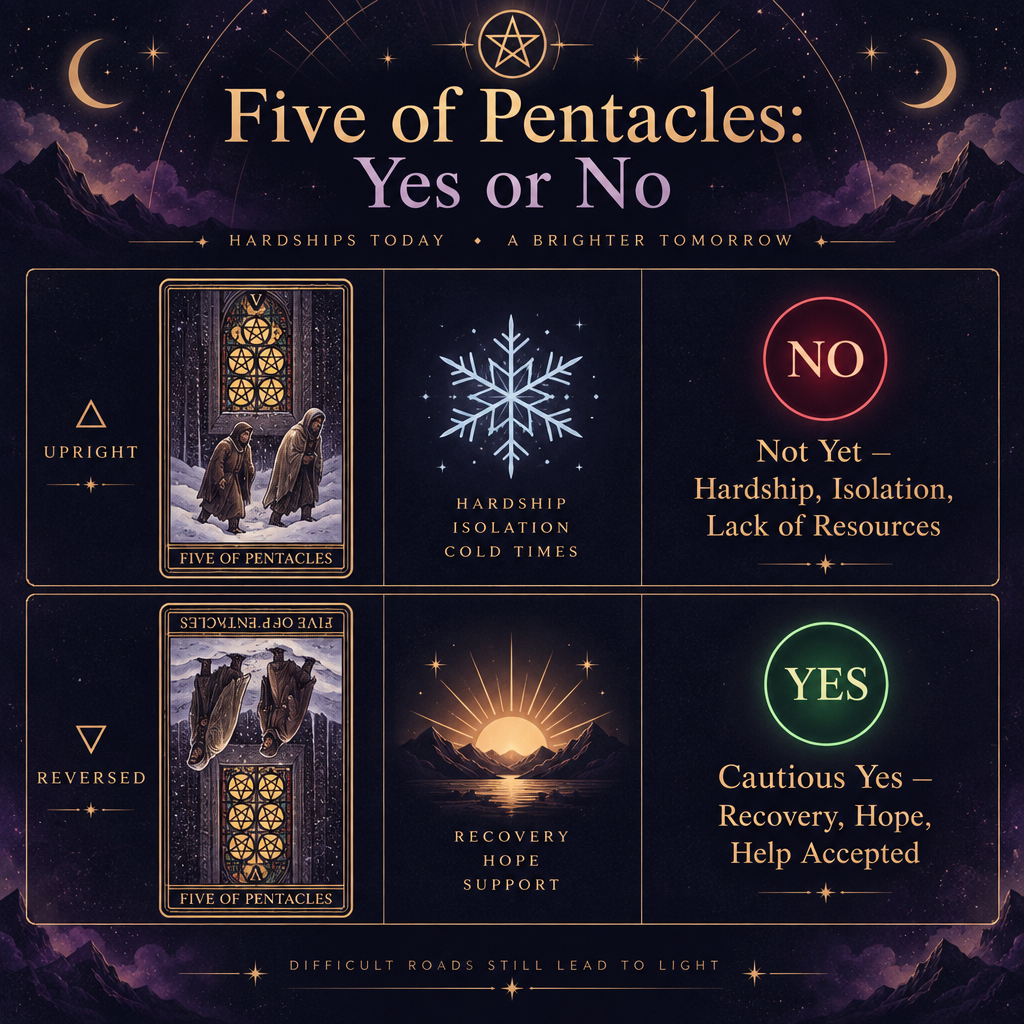
The Five of Pentacles is a no in a yes or no reading, but it is rarely a permanent one. Upright, the card says conditions are not right yet and that pushing forward now will cost you. Reversed, it flips to a cautious yes, with recovery underway and help finally being accepted.
Updated for 2026.
The Short Answer
| Position | Yes or No | What it really means |
|---|---|---|
| Upright | No (not yet) | Hardship, lack, isolation. The timing and the resources are not in place. |
| Reversed | Yes (with caution) | Recovery, renewed hope, help accepted. Momentum is returning but still fragile. |
If you asked a single question and pulled this card upright, treat the answer as no for now. If you pulled it reversed, treat it as yes, as long as you are willing to do the rebuilding work the card implies.
Card Facts at a Glance
| Attribute | Detail |
|---|---|
| Arcana | Minor |
| Suit | Pentacles (also called Coins or Disks) |
| Number | Five |
| Element | Earth |
| Zodiac | Taurus (Golden Dawn attribution: Mercury in the first decan of Taurus) |
| Upright keywords | Hardship, poverty, loss, illness, isolation, insecurity, feeling left out in the cold |
| Reversed keywords | Recovery, hope, improvement, help accepted, end of a lean period, spiritual poverty |
Why the Five of Pentacles Means No
Two layers of the card’s structure explain the verdict, and understanding them makes the answer easier to trust and apply.
The number five: stability knocked off balance
In the Minor Arcana, the Fours are the cards of structure and holding steady. The Four of Pentacles is the figure clutching his coins, secure but rigid. The Five arrives and disrupts that. Every Five in tarot carries friction: the Five of Wands is conflict, the Five of Cups is grief, the Five of Swords is a hollow victory, and the Five of Pentacles is material loss. Fives are the midpoint of the suit, the moment when the easy early momentum runs out and something has to be tested. A Five answering a yes or no question is telling you that the thing you want is currently in a state of disruption, not readiness.
Earth: the suit where loss is tangible
Pentacles govern the physical world: money, work, property, the body, and the practical security that lets everything else function. When the disruptive Five lands in this suit, the trouble is not abstract. It shows up as a bank balance, a job, a diagnosis, a lease. That is why the Five of Pentacles reads as a harder no than, say, the Five of Cups. Emotional loss can be reframed quickly. Material lack has to be rebuilt brick by brick, and that takes time. The card is honest about that.
Taurus: comfort under threat
Taurus is the sign of steadiness, physical comfort, and holding onto what you have. The Five of Pentacles sits in Taurus’s first decan under Mercury, and the picture is of a Taurean need for security meeting a situation where security has evaporated. The fixed-sign quality also explains the card’s stubbornness. The figures on the card are not adapting; they are trudging along the same path, which is exactly what keeps them stuck.
What the Imagery Tells You
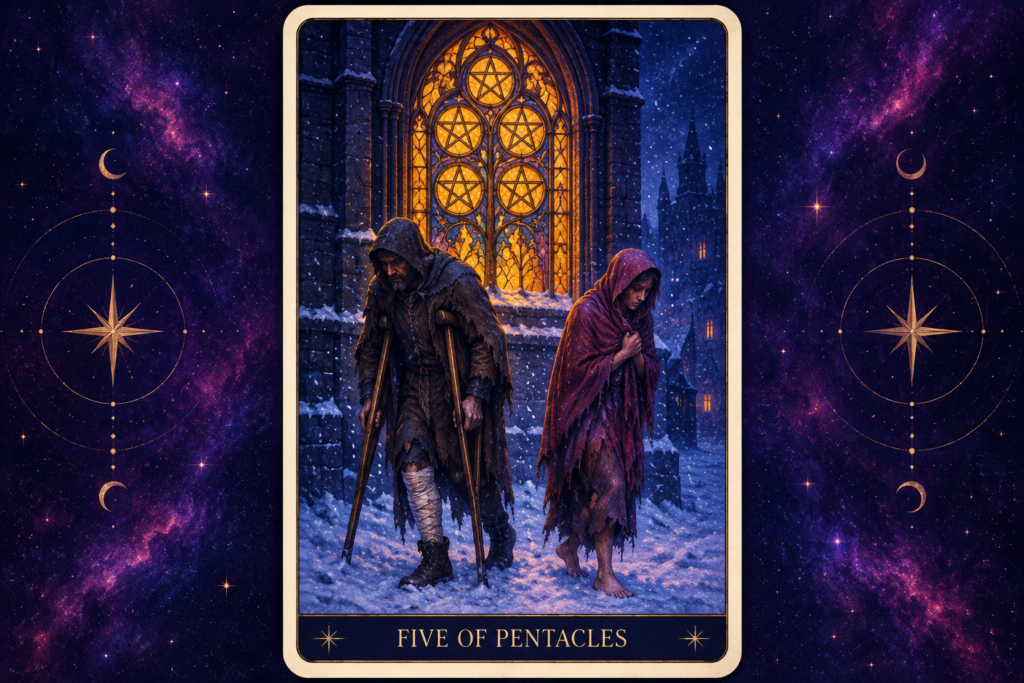
In the Rider-Waite-Smith deck, drawn by Pamela Colman Smith in 1909, two figures move through falling snow. One is on crutches with a bandaged leg. The other, wrapped in a thin shawl, is barefoot and hunched against the cold. Behind them, a stained-glass window glows with five pentacles arranged in a tree-like pattern. The window belongs to a church, and the light inside is warm.
The detail that matters most for a yes or no reading is this: neither figure looks at the window. Help is a few feet away, lit up, and they walk straight past it.
That single choice by the artist carries the whole message. The hardship is real, but it is being prolonged by not asking for help, not noticing an open door, or being too proud or too defeated to go inside. Upright, the answer is no because you are still outside in the snow. Reversed, the answer softens because, symbolically, someone has finally turned toward the light.
Other decks keep the theme but change the picture. The Thoth deck names the Five of Disks “Worry” and shows five disks straining on a geometric lattice, stressing mental anxiety about material matters rather than literal poverty. Marseille-style decks have no scene at all, just five coins, so readers lean on the number and suit for meaning. Many modern decks swap the church for a doorway, a lit shop window, or a warm house, but the pattern of unseen help nearly always survives.
Upright Five of Pentacles: No, and Here Is Why
The upright card answers no because the foundation your question depends on is currently missing. The figures are not refusing to walk; they are walking without shoes. Whatever you are asking about, the card says you lack a resource you need: money, health, confidence, support, or simply time.
There is a second reason the answer is no, and it is about motive. Decisions made from the snow are made from scarcity. People take bad jobs because the rent is due, text an ex because the flat is too quiet, and sign up for things they cannot afford because being left out feels worse than debt. The Five of Pentacles upright is warning you that a yes given now would be a yes given out of desperation, and those rarely hold.
Permanent no or conditional no?
This is the distinction most readings miss. The Five of Pentacles is almost never a door slammed shut forever. The lit window on the card proves it. The card is a conditional no: no while you are isolated, no while you are refusing help, no while your resources are depleted.
A rough guide to telling them apart:
- Conditional no (most common): The card appears alone or with cards of slow progress like the Seven of Pentacles, the Hanged Man, or the Eight of Pentacles. The answer is “not yet, fix the foundation first.”
- Hard no: The card appears with the Ten of Swords, the Tower, or the Three of Swords. The situation has ended or is about to, and the kindest reading is to let it go.
- No, but help is coming: Paired with the Six of Pentacles, the Star, or the Six of Cups, the hardship is real but temporary, and someone or something is about to offer the warmth the figures keep missing.
Reversed Five of Pentacles: A Cautious Yes
When the card is reversed, the figures are, in effect, finally stepping through the church door. The reversed Five of Pentacles answers yes because the worst of the lean period is behind you and the resources you lacked are starting to return. Recovery is the keyword. Debts shrink, health improves, a job offer lands, someone offers a hand and you take it.
The yes is cautious for one reason: recovery is not the same as being recovered. The card describes the first warm meal after a hard winter, not a full pantry. Say yes to the question, but keep your plans modest and your reserves protected for a while.
Spiritual poverty: the reversed card’s hidden warning
The reversed card has a second, less comfortable meaning. Sometimes material conditions improve and the mindset does not. You get the job, the money arrives, the relationship starts, and you still feel like the figure in the snow. You hoard, you expect it to vanish, you cannot enjoy any of it. Readers call this spiritual poverty: having enough and still living in lack.
In a yes or no reading this matters because the external answer can be yes while the internal readiness is no. If the reversed card arrives alongside the Four of Pentacles, the Devil, or the Nine of Swords, take the spiritual poverty reading seriously. The thing you asked about is available; the question is whether you can receive it.
Five of Pentacles Yes or No for Love
Upright: No. The card describes someone who is emotionally out in the cold. Walls are high, trust is low, and there is a real risk of getting involved because loneliness hurts rather than because the connection is good. If you are asking “will this person commit?” or “should I pursue this?”, the upright card says the emotional resources for a healthy relationship are not currently there, on one side or both.
Within an existing relationship, the upright card points to a couple going through hardship together but not actually leaning on each other. Money stress, illness, or job loss has created distance. The two figures walk side by side but neither looks at the other.
Reversed: Yes. Healing has begun. One or both partners are opening up, the external pressure is lifting, and the relationship has room to breathe again. New relationships that start under the reversed card tend to be built on genuine warmth rather than need, which is a strong sign.
What to do if it appears upright:
– Hold off on any major relationship decision for at least a few weeks. Decisions made in the snow are expensive.
– Identify the “window” you are walking past. A friend you have not called, a counsellor, a conversation you keep avoiding.
– Separate the loneliness from the attraction. Ask yourself honestly whether you would want this person if your life felt full.
Five of Pentacles Yes or No for Reconciliation
This is one of the most common questions this card is pulled for, and the answer depends heavily on position.
Upright: No, not now. The card shows two people who have been through something hard and are still cold and depleted from it. Reconciling under these conditions tends to repeat the original pattern because nothing underneath has been rebuilt. One party is often still carrying the wound (the bandaged leg) while the other is exposed and vulnerable (the bare feet). Neither is in a position to offer what the other needs. If you are asking “will my ex come back?”, the honest upright answer is that even if they did, the relationship would struggle to survive the same weather that ended it.
Reversed: Yes, with conditions. The reversed card is one of the more encouraging reconciliation cards in the Minor Arcana because its entire theme is recovery after loss. Wounds are healing. Both people have had time outside in the cold to understand what they lost. If the Two of Cups, the Six of Cups, or the Lovers appears alongside it, the chances of a genuine second attempt are good. If it appears with the Eight of Cups or the Three of Swords reversed, the healing is yours alone, and the reconciliation is with your own peace rather than with the person.
What to do:
– Upright: Work on your own stability before reopening contact. Financial, emotional, and physical footing all count.
– Reversed: Reach out, but with specifics about what will be different. Vague warmth is not a plan.
– Either position: Notice whether you want this person back or whether you want to stop feeling cold. They are different wants.
Five of Pentacles Yes or No for Money and Finances
Money is the card’s home ground, and it is the most searched reason people pull it.
Upright: No. Whatever you are asking about financially, the card says the resources are not there. Should I make this purchase? No. Will this investment pay off? Not in the current conditions. Will the money come through? Not yet, and you should plan as if it will not. The card frequently appears around debt, unexpected bills, a drop in income, or the sinking feeling of being one problem away from real trouble.
The upright card also points to a specific blind spot: unused help. Hardship programmes, payment plans, benefits you qualify for, a relative who has offered support, a free financial counsellor. The lit window is any of these. The figures walk past because asking feels like failure.
Reversed: Yes. The lean stretch is ending. A new income source appears, a debt is restructured or cleared, a payment finally arrives. Yes to the question, with the standing advice to rebuild your buffer before expanding your spending. The reversed card is the first paycheque after unemployment, not the bonus.
What to do if it appears upright:
– Audit every outgoing cost this week. Write the numbers down; the card’s figures are suffering partly because they are not looking at anything clearly.
– Apply for or ask about one form of help you have been avoiding. Just one.
– Delay any discretionary spending decision by thirty days. If the want survives, revisit it.
Five of Pentacles Yes or No for Career
Upright: No. The card says this is not the moment for the promotion, the big pitch, or the leap into self-employment. Efforts feel unnoticed, workplace conditions are draining, and there may be real insecurity about whether the job itself will last. In a period when many industries are cutting back and the cost of living keeps pressure on every household, this card often lands for people who are overworked, underpaid, and too tired to job-hunt effectively. It is not a judgment on your ability. It is a report on conditions.
The upright card can also show up for people who left a job and are finding the search longer and colder than expected. Again, look for the window: a former colleague who could refer you, a retraining scheme, a mentor you have not contacted.
Reversed: Yes. Stability returns. The new role materialises, the probation period ends well, the business starts covering its costs. Motivation comes back with it. Say yes to the opportunity in front of you, and treat the first few months as consolidation rather than expansion.
What to do if it appears upright:
– Stop measuring yourself against a market you cannot control. Measure applications sent, skills practised, contacts made.
– Ask directly for feedback or support at work. The card’s isolation is partly self-imposed.
– Protect your health. Career Fives of Pentacles very often arrive alongside burnout.
Five of Pentacles Yes or No for Health
Upright: No, or not yet. The bandaged figure on crutches makes this the clearest health card in the deck. For questions like “will I recover quickly?” or “is now a good time to push my training?”, the upright card says the body is depleted and needs support rather than strain. It also frequently points to the mental side of illness: feeling isolated by a condition, avoiding appointments, or carrying on through pain because stopping feels like giving up.
A tarot card is never a diagnosis. What this card can do is nudge you toward the lit window, which in health questions almost always means a professional you have been putting off seeing.
Reversed: Yes. Recovery is underway. Energy returns, treatment is working, the worst has passed. Say yes to gentle return to activity, no to anything that risks a setback.
What to do if it appears upright:
– Book the appointment you have been postponing.
– Tell one person how you are actually feeling. Isolation makes recovery slower.
– Treat rest as the task, not as the absence of a task.
When the Answer Is “Maybe”
Some readers want a third option, and the Five of Pentacles supports one in two situations.
The card lands sideways or ambiguously. If your deck fell in a way that leaves the orientation unclear, read the card as a genuine maybe: the outcome depends on whether you go toward the window or keep walking.
The question is about timing rather than outcome. “Will I get the money?” is a yes or no question. “Will I get the money this month?” is a timing question, and the Five of Pentacles answers timing questions with “not yet.” Earth cards are slow. If a yes is possible at all, expect it to arrive on a Taurus timetable: gradual, delayed, and only after the groundwork is done. Many readers associate Pentacles with a span of months rather than days or weeks, and the Five’s disruption adds further delay on top.
In practice, a “maybe” from this card almost always resolves into “yes, once you have done X,” where X is accepting help, rebuilding a resource, or waiting for a season to change.
Card Combinations That Change the Verdict
| Paired with | Effect on the yes or no |
|---|---|
| Six of Pentacles | No becomes “not yet, help is arriving.” Accept the offer. |
| Seven of Pentacles | Strongly “not yet.” Slow results after patient work. |
| Four of Pentacles | No, caused by clinging. Letting go of control changes the answer. |
| Ten of Pentacles | A hard period inside an otherwise secure long-term picture. Temporary no. |
| The Star | No for now, but genuine hope. Recovery is coming. |
| The Tower | Firm no. Something is collapsing and should be allowed to. |
| Three of Swords | No in matters of the heart. Grief must be processed first. |
| Ace of Pentacles | Reversed Five plus the Ace is a clear yes for new financial or career starts. |
| The Hermit | No because isolation is being chosen. Reach out and the answer shifts. |
| Knight of Pentacles | Slow, steady no that becomes yes with consistent effort. |
How to Act on This Card
Regardless of the question, the Five of Pentacles leaves you with the same three jobs.
- Find the window. Name the help you have been walking past. Write it down. The card insists it exists.
- Stop deciding from the snow. Any major yes you are tempted to give right now, defer. Scarcity makes poor decisions look urgent.
- Rebuild the foundation before the ambition. Pentacles reward groundwork. Pay down the debt, see the doctor, mend the friendship, learn the skill. The Six of Pentacles follows the Five in sequence, and it is a card of resources flowing again. You get there by turning toward the light, not by walking faster.
FAQ
Is the Five of Pentacles a yes or no card?
Upright, it is a no. Reversed, it is a cautious yes. The upright no is usually conditional rather than permanent: it means the resources, timing, or support you need are not currently in place.
What does the reversed Five of Pentacles mean for love?
Reversed, it indicates healing after a cold or lonely period. Emotional walls are coming down, external stress on the relationship is easing, and new connections are forming from genuine warmth rather than loneliness. It is a yes for love questions, with the advice to build slowly.
Does the Five of Pentacles mean reconciliation?
Upright, no. Both people are still depleted and reconciling now would repeat the original problems. Reversed, yes with conditions: it is a card of recovery after loss, and alongside the Two of Cups or Six of Cups it points to a real second chance.
Is the Five of Pentacles a maybe?
It can be, when the question is about timing rather than outcome. The card answers “not yet” more often than a flat no. Earth energy is slow, and the Five adds disruption, so any yes tends to arrive late and only after practical groundwork is done.
What does the Five of Pentacles mean for money?
Upright, it is a no for spending, investing, or expecting money to arrive on time. It points to debt, reduced income, or insecurity, and to help that is available but unused. Reversed, it is a yes: the lean period is ending and finances are recovering.
Why does the Five of Pentacles mean no?
Because the number five represents disruption of the stability established by the four, and the suit of Pentacles governs the material world. Material disruption means money, work, health, or security has been knocked off balance, which is not the condition for a confident yes.
What is the lit window on the Five of Pentacles?
It is a church window with five pentacles glowing in stained glass. The two figures walk past it without looking. It represents help that is close and available but not noticed or not accepted, which is the card’s central message.