Three Of Swords As Love Outcome (Upright & Reversed) Tarot Card Meaning
The Three of Swords as a love outcome points to heartbreak, betrayal, grief, or a painful truth coming to the surface. Upright, it is one of the hardest cards to pull for a relationship question, and pretending otherwise helps no one. Reversed, it shifts toward healing, forgiveness, and a slow recovery, though sometimes it warns that the pain is being buried rather than processed.
Quick Answer: Yes or No
Upright: No. The relationship question you asked is unlikely to resolve the way you hoped. Expect separation, a disappointing truth, or a period of real sorrow before anything improves.
Reversed: A cautious yes. The worst of the pain is behind you or about to be. Reconciliation and recovery are possible, but only if the wound is actually dealt with rather than papered over.
If you asked “will we get back together?” or “does this person love me?”, treat the upright card as a clear no for now and the reversed card as a maybe that depends on how both people behave next.
What the Card Shows and Why It Matters for Love
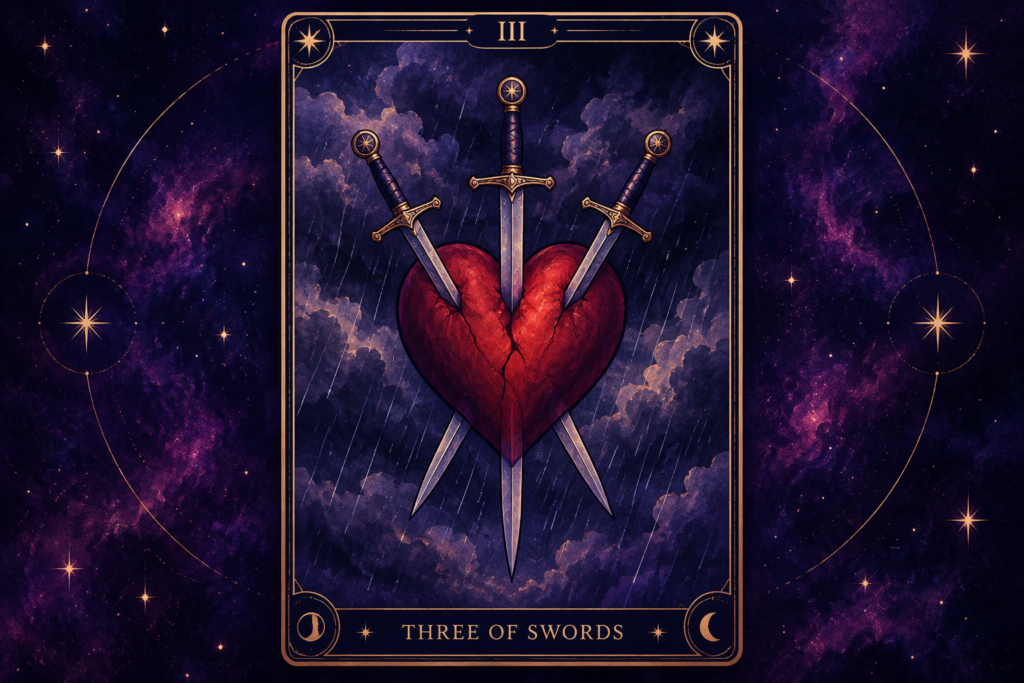
In the Rider-Waite-Smith deck, Pamela Colman Smith’s Three of Swords is almost brutally simple. A large red heart floats against a grey sky. Three swords pierce it from above, crossing through its centre. Rain falls, and storm clouds fill the background. There are no people, no landscape, no comfort.
Each element carries weight in a love reading.
The heart is you, or the relationship itself. It is exposed, with no shield and no body around it. The card is saying the emotional core of the situation is what takes the damage, not your pride, finances, or routine.
The three swords belong to the suit of thought, words, and truth. The wound here is not physical and not vague. It comes from something said, discovered, or realised. In love readings this usually means a confession, an admission, a discovered message, or a moment of clarity you cannot un-see. Three blades rather than one also hints at a triangle: a third party, a divided loyalty, or two people and one painful fact between them.
The storm and rain show the grief has to be felt. Rain in tarot often represents emotional release. The clouds will pass, but not before they empty.
The absence of figures matters too. Nobody in the image is walking away or fighting back. The card describes the pain itself, not the response to it. What you do next is still your choice.
The Golden Dawn gave this card the title Lord of Sorrow, and Aleister Crowley’s Thoth deck simply labels it “Sorrow”. Older sources never softened this card, and neither should a love reading.
Upright and Reversed Keywords at a Glance
| Position | Core keywords for love |
|---|---|
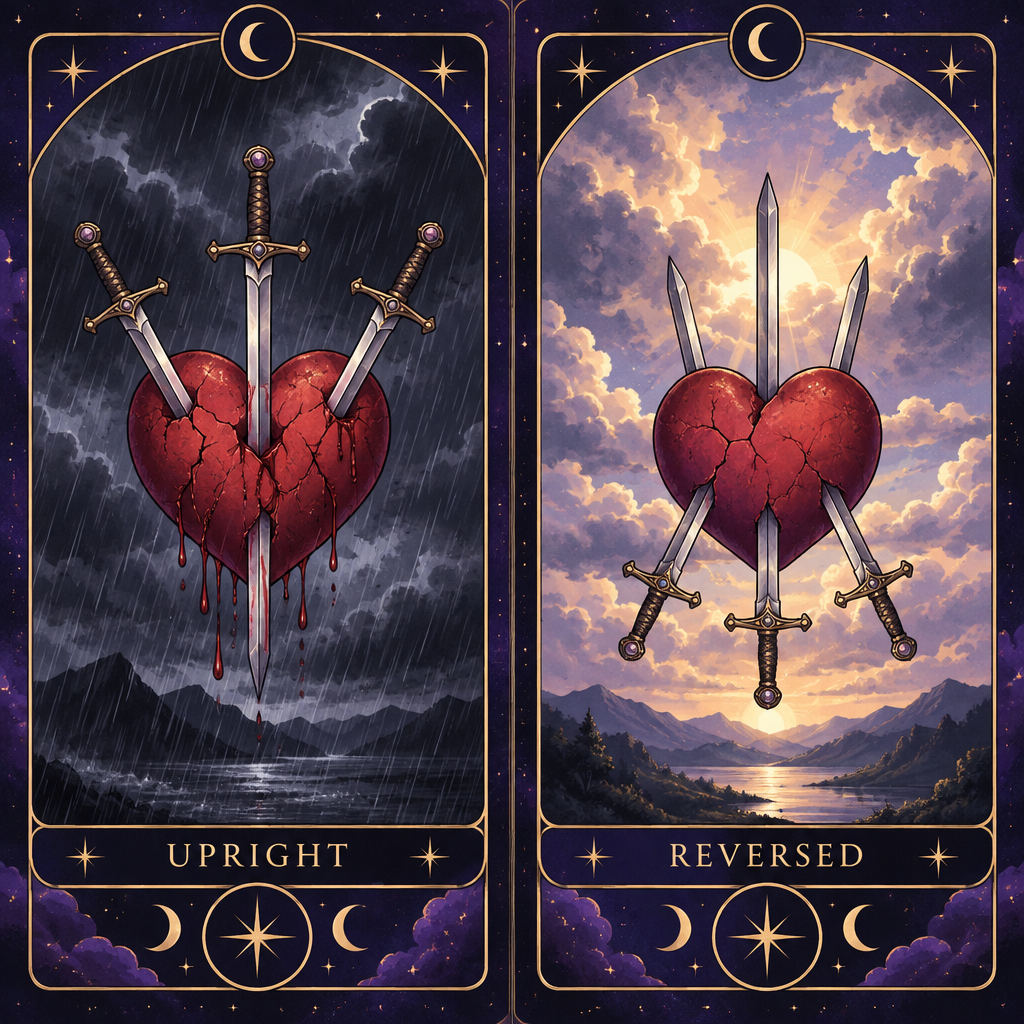
| Upright | Heartbreak, betrayal, grief, sorrow, conflict, painful truth, separation, third party, rejection |
| Reversed | Healing, forgiveness, emotional release, reconciliation, recovery, releasing pain, or (shadow side) repressed grief, avoidance, holding a grudge |
Upright Three of Swords as a Love Outcome
If You Are Single
Upright, this card says new love is not arriving yet, and the reason is usually internal. Unprocessed grief from a past relationship is still occupying the space a new partner would fill. You may be dating, swiping, and meeting people, but the heart in the card is still bleeding from the last set of swords, and anyone new will feel that distance.
It can also act as a warning about someone currently on your radar. If you asked about a new connection and pulled this card, expect disappointment: they may be emotionally unavailable, already attached, or honest about not wanting what you want. The painful truth arrives early in this case, which is actually a mercy.
What to do:
- Stop dating for a defined period, even just a month, and use it to actually grieve the last relationship rather than numbing it with attention from new people.
- Write down what hurt most in the past relationship. Patterns you can name are patterns you can refuse to repeat.
- If someone new has shown a red flag such as inconsistency, vagueness about their status, or hot-and-cold contact, believe it. This card confirms your instinct is correct.
If You Are in a Relationship
This is the scenario where the Three of Swords lands hardest. As an outcome card for an existing relationship, it points to one of three things: a betrayal surfacing, a truth one partner has been avoiding finally being spoken, or a conflict that cuts deeper than the usual argument.
Betrayal here does not always mean a physical affair. Emotional affairs, financial secrets, lies about the past, or discovering your partner has been talking to an ex all fit the three swords through the heart. The card does not tell you which, but it tells you the discovery is coming or has already happened.
The relationship can survive this, but not by default. Survival requires both partners naming the wound out loud. Couples who try to skip the storm and go straight to “let’s move on” tend to pull this card again six months later.
What to do:
- Have the conversation you have been postponing. Pick a time without distractions and say the thing directly. The Swords suit rewards honesty and punishes hints.
- If you discovered a betrayal, do not make the stay-or-leave decision in the first week. Grief distorts judgment. Give yourself space to feel it before deciding.
- Set one clear boundary about what cannot happen again, and make sure it is specific enough to be checked, such as “no deleting message histories” rather than “be more honest”.
If You Are Separated, in No Contact, or Waiting on an Ex
Readers asking “will my ex come back?” and pulling the upright Three of Swords want a straight answer, so here it is: this card does not indicate a return. If anything, it suggests the separation is final, or that any contact that does happen will reopen the wound rather than heal it.
It can also reveal why the separation happened. If you were blindsided by a breakup, the Three of Swords as outcome often confirms a hidden truth, a third party, or a decision your ex made long before they told you. That knowledge hurts, but it ends the limbo of wondering.
Sometimes the card describes your ex rather than you. They may be grieving too, which is not the same as wanting to reconcile. Shared sorrow is not a reconciliation signal.
What to do:
- Maintain no contact if you have started it. Reaching out while this card is active brings a second round of rain, not resolution.
- Replace the question “will they come back?” with “what did I learn about what I need?” and pull again in a few weeks with that framing.
- Lean on people who are not your ex. The card shows a heart alone in a storm; the practical fix is to not be alone.
Reversed Three of Swords as a Love Outcome
The reversed Three of Swords is far more hopeful, but it is not a simple flip to “good news”. Picture the RWS image upside down: the swords now fall out of the heart under their own weight. The heart is still scarred, the sky is still grey, but the piercing has stopped. That is the honest picture of this card reversed: recovery in progress, not completed.
If You Are Single
Reversed, the card says you are finally releasing an old wound. The breakup you could not stop thinking about has lost its grip. You may notice you went a whole day without checking their profile, or you heard their name and felt nothing sharp.
This is the right time to start opening up again, with one condition. Healing from past wounds has to be genuine before a new relationship can hold. If you are dating to prove you are over someone, the card is likely showing its shadow side rather than its healing side.
What to do:
- Date slowly. Two or three low-pressure meetings before any exclusivity talk lets you test whether the old pain flares up.
- Tell a new person about the past hurt only when it is relevant, not as a warning label on the first date.
- Keep doing whatever got you here, whether that was therapy, journaling, time with friends, or simply distance. Recovery is a habit, not a milestone.
If You Are in a Relationship
For existing couples, the reversed Three of Swords describes the rebuilding phase after a hard truth has come out. The affair was confessed, the argument happened, the secret is known. Now the question is whether forgiveness is real or performed.
Real forgiveness here looks like both people being able to reference the painful event without it detonating the conversation. Performed forgiveness looks like one partner saying “it’s fine” while keeping score.
The card as an outcome says the relationship can be repaired, provided the wounded partner is given the time and space to reconcile on their own schedule rather than being rushed.
What to do:
- Agree on a check-in, perhaps weekly, where either of you can raise lingering hurt without being accused of “bringing it up again”.
- If you are the one who caused the hurt, stop asking whether you are forgiven. Show consistency instead and let the answer arrive.
- Consider couples counselling if the betrayal was serious. This card reversed supports repair work; it does not promise it happens automatically.
If You Are Separated or Hoping for Reconciliation
Can the Three of Swords mean reconciliation? Reversed, yes, under specific conditions. The card indicates both parties have moved through the acute grief stage and the anger has softened. Contact may resume, often initiated by the person who did the hurting, with an apology that is more complete than anything offered at the time.
The conditions matter. Reconciliation shown by this card works when the original wound has been named and owned. It fails when the ex returns because they are lonely, because the person they left you for did not work out, or because enough time passed that they assume you forgot. Those returns bring the upright card back within months.
What to do:
- If an ex reaches out, ask directly what has changed. Vague answers mean nothing has.
- Give any reconciliation a probationary period in your own mind, roughly three months, before letting old routines fully resume.
- If you are the one hoping to reach out, write the message and sit on it for a week. The reversed card favours healing, and healing sometimes means letting the apology be the ending rather than a new beginning.
The Shadow Side of the Reversed Card
Not every reversal is recovery. Three signs you are looking at the shadow meaning instead:
Suppressed grief. You insist you are fine, you have not cried, and you cannot explain why you snap at people. The swords are still in the heart; you have just stopped looking at them.
Attachment anxiety and paranoia. After a betrayal, the reversed card can show hypervigilance: checking phones, demanding reassurance, reading hidden meanings into neutral texts. This is pain turned into surveillance, and it corrodes even a faithful partner’s goodwill.
Avoidance disguised as peace. Some people respond to heartbreak by refusing all intimacy and calling it independence. If you pulled this reversed and feel proud of how little you need anyone, that is worth questioning.
Surrounding cards usually settle which version you are seeing. The Star or Six of Cups nearby confirms healing. The Nine of Swords, Five of Pentacles, or Moon nearby points to the shadow side.
Card Combinations That Change the Outcome
| Combination | Love outcome |
|---|---|
| Three of Swords + Ten of Swords | The ending is total and already decided. Stop waiting for a different answer and begin closure. |
| Three of Swords + Death | Separation that is also transformation. The relationship as it was is over; something unrecognisably different follows, with or without this person. |
| Three of Swords + Tower | Sudden, shocking revelation. Often the discovery of a betrayal in a single moment rather than a slow realisation. |
| Three of Swords + Temperance | The healing path. Pain is present but both people are willing to work toward balance. Reconciliation has a real chance. |
| Three of Swords + The Lovers | A major decision point. A choice between two people, or between staying and leaving, that will cause real hurt whichever way it goes. |
| Three of Swords + Two of Cups | Heartbreak inside a connection that was genuinely loving. Grief here is about losing something real, not escaping something bad. |
| Three of Swords + The Star | Hope after sorrow. Expect a period of grief followed by renewal, usually with a new partner or a profoundly changed self. |
| Three of Swords + Seven of Swords | Deception is the source of the pain. Someone has been lying, and the lie is close to being exposed. |
| Three of Swords + Six of Swords | Moving away from the pain. A separation that is sad but necessary, often involving physical distance or relocation. |
| Three of Swords + Ace of Cups | A new emotional beginning on the other side of loss. The order matters: grief first, then an open heart. |
Saturn in Libra and the Number Three
The Golden Dawn assigned the Three of Swords to the first decan of Libra, ruled by Saturn. Libra governs partnership, fairness, and the one-to-one bond. Saturn governs limits, consequence, time, and lessons learned the hard way. Saturn in Libra therefore reads as the hard reckoning inside a relationship: the moment the imbalance becomes impossible to ignore and a price has to be paid.
This is where the “karmic lesson” interpretation comes from, and it is legitimate as a secondary layer. Saturn does teach. But the teaching happens through loss, not instead of it. A love reading that leads with “karmic growth” and skips “you are about to be hurt” is reading Saturn without reading Libra.
The number three in tarot marks the first result of a union. One is the spark, two is the pairing, three is what the pairing produces. In Cups that produces celebration. In Pentacles it produces skilled work. In Swords, the suit of the mind, it produces the first painful truth that thinking clearly about a relationship reveals. Three is growth, and growth in this suit is a growing pain.
The Card in Modern Contexts and Modern Decks
Readings for situationships pull this card constantly, and it reads a little differently there. The painful truth in a situationship is usually the realisation that the other person was never going to define things, and that you knew. The three swords are the three conversations you did not have. Outcome upright: the arrangement ends or quietly fades, and the grief is real even though the relationship was never official.
In online readings and app-based connections, the betrayal angle often involves discovery through a screen: a message seen, a profile still active, a photo with someone else. The Swords suit has always been about words and information, which fits how modern heartbreak tends to arrive.
Deck choice shapes how the card feels without changing what it means. Lisa Sterle’s Modern Witch Tarot keeps Smith’s pierced heart almost exactly, redrawn in flat, bright colour, which makes the card feel more like a bold statement than a Gothic tragedy. Kim Krans’s Wild Unknown replaces the heart with three swords bound tightly together by red thread, shifting the emphasis from wound to entanglement, which suits readings about triangles and tangled loyalties. The Thoth deck’s version shows swords meeting at a dark bloom-like centre under a stormy sky, and its stark title leaves no room to soften the message. Whatever deck you use, if the artist kept storm clouds, kept three blades, and kept something tender at the centre, the love meaning holds.
What to Do When This Card Appears in a Love Reading
Regardless of scenario, four moves apply.
Take the card at face value first. Resist the urge to find the hopeful reading immediately. If you pulled it upright, something hurts or is about to. Let that be true before adding nuance.
Identify the truth. The Swords suit is about information. Ask yourself what you already suspect and have not said out loud. That is nearly always the sword.
Allow the storm. Grief that is felt passes. Grief that is managed becomes the shadow side of the reversed card. Cry, talk, write, walk. Do not rush.
Decide only after the rain. The card shows no figures making choices because the choice comes later. Give yourself two to four weeks after a painful revelation before deciding to stay, leave, reach out, or block.
Pull a clarifying card if you need direction on the next step rather than the outcome. The Three of Swords tells you what is happening to the heart; a second card can tell you what to do with it.
FAQ
Does the Three of Swords mean a breakup?
Upright, usually yes, or at minimum a serious rupture. It does not guarantee a breakup, but as a love outcome card it signals that the relationship question resolves through pain and separation rather than reunion. Reversed, it points more often to a breakup you are recovering from than one that is coming.
Is the Three of Swords a bad card for love?
Upright, it is one of the most difficult cards in the deck for love readings, alongside the Ten of Swords and the Tower. Its one gift is honesty: it never lets you stay in denial. Reversed, it is a genuinely encouraging card about healing and forgiveness, as long as the surrounding cards do not point to suppressed grief.
What does the Three of Swords reversed mean in love?
Healing, forgiveness, emotional release, and the possibility of reconciliation. It shows the acute pain of a betrayal or breakup is easing. Its shadow meaning is repressed pain, holding a grudge, or anxious attachment after a hurt, so look to nearby cards to confirm which version you have.
Can the Three of Swords mean reconciliation?
Reversed, yes, especially next to Temperance, the Star, or the Six of Cups. Upright, no. Reconciliation shown by the reversed card only lasts when the original hurt has been openly acknowledged by the person who caused it.
Does the Three of Swords mean cheating?
It can, and it is one of the cards most associated with infidelity, particularly beside the Seven of Swords, the Devil, or the Three of Cups. It does not always mean cheating, though. Any painful truth, including rejection, incompatibility, or a secret unrelated to another person, fits the card.
Will my ex come back if I pull the Three of Swords?
Upright, do not expect a return, and be cautious about any contact that does happen. Reversed, a return is possible, but ask what has changed before reopening the door. Loneliness is not change.