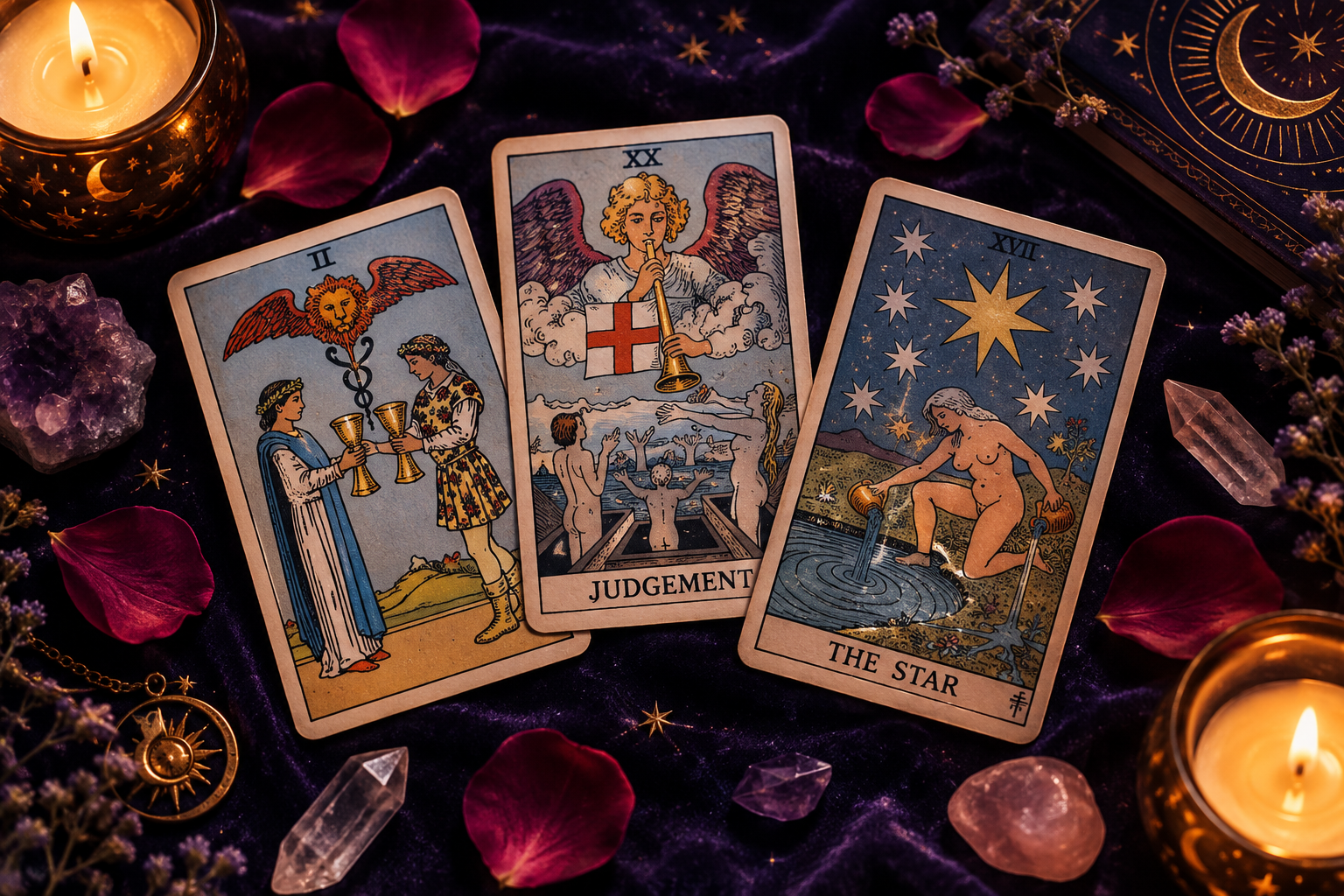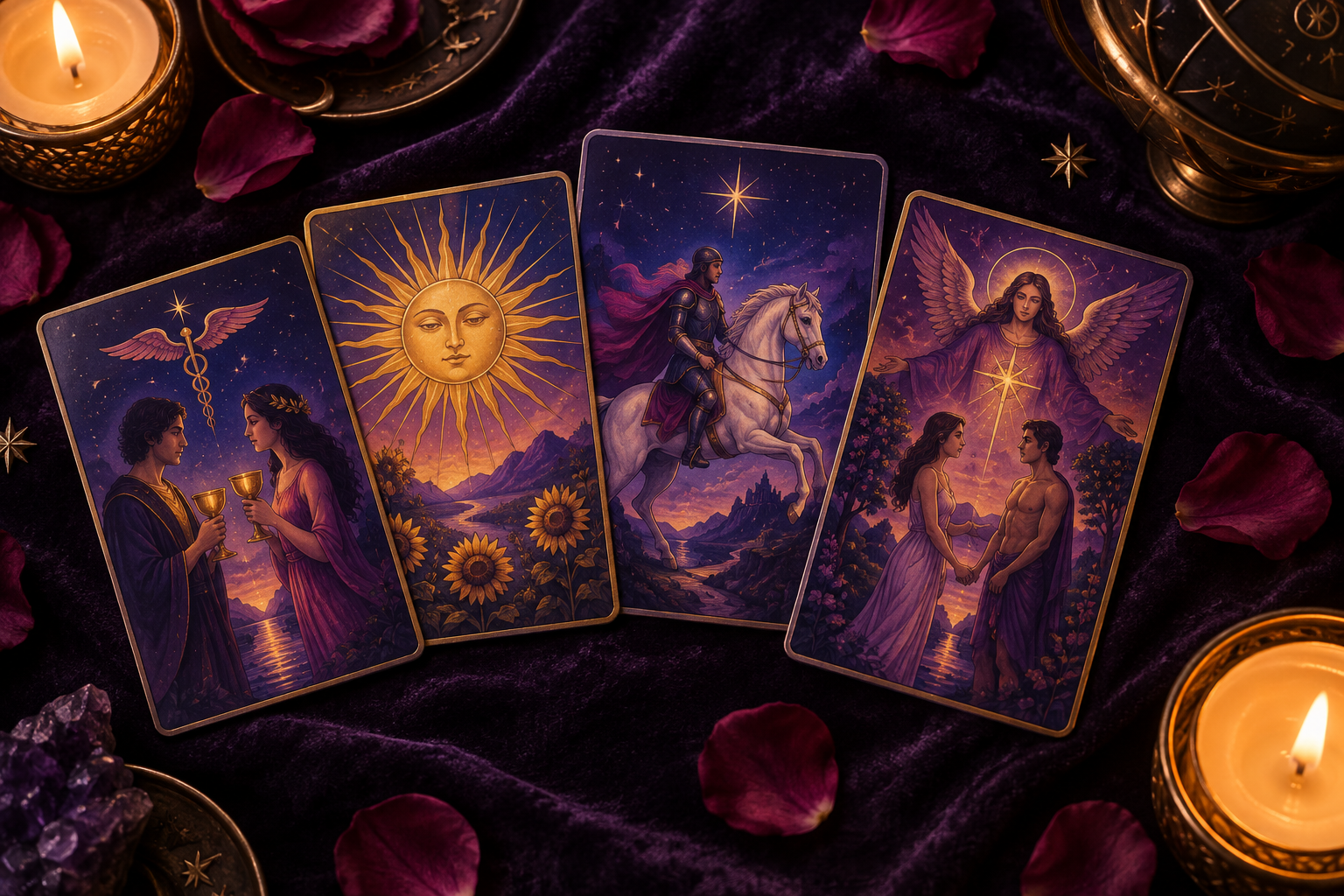
Death As Love Outcome (Upright & Reversed) Tarot Card Meaning
Drawing Death as the outcome card in a love reading tends to stop people cold. It shouldn’t. In the Rider-Waite-Smith tradition this card is about endings that make room for something more honest, and in relationship readings it points far more often to a shift in how you love than to the loss of who you love.
Fast answer: Death as a love outcome does not predict a breakup by default. Upright, it signals a chapter of the relationship (or of your single life) closing so a healthier one can begin. Reversed, it warns that you are clinging to a version of love that has already expired. A breakup is only one of several possible readings, and usually not the most likely one.
The Card at a Glance
Death is card XIII of the Major Arcana, sitting between The Hanged Man (XII) and Temperance (XIV). That placement matters. The Hanged Man is surrender, Death is release, Temperance is integration. In a love context you can read the three as: stop fighting the situation, let the old form go, then rebuild with balance.
Its astrological ruler is Scorpio, a Water sign governing intimacy, sexuality, shared resources, jealousy and rebirth. Scorpio’s whole symbolic arc is the scorpion becoming the eagle becoming the phoenix, and that is exactly the emotional journey Death describes in relationships. Water adds depth of feeling and the message that this transformation happens underneath the surface first.
Numerologically, 13 reduces to 4 (1 + 3), the number of The Emperor. That is a quiet reassurance hidden in the card: what survives the ending is structure. A relationship that passes through Death and comes out the other side is usually more stable, not less.
Decoding the Symbolism for Love Readings
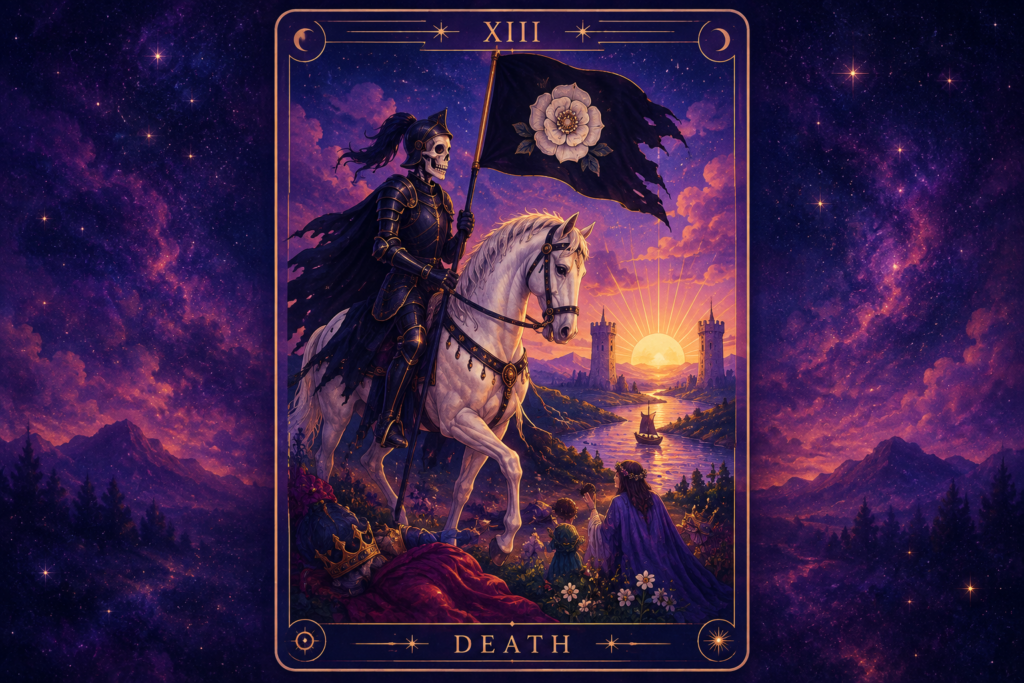
Pamela Colman Smith’s 1909 illustration for the Rider-Waite-Smith deck packed this card with detail, and each element maps cleanly onto relationship dynamics.
The Skeleton in Black Armour
The rider is a skeleton, the part of the body that outlasts everything soft. In love, this is the bare truth of the relationship once pretense, habit and performance are stripped away. The black armour is protection, and it asks a pointed question: what are you armouring yourself against with this person? Death upright suggests the armour is about to come off. Reversed, it suggests you are refusing to remove it.
The White Horse
Death rides a white horse, the traditional colour of purity and spirit. The ending it brings is clean, not cruel. For couples, this is the difference between a relationship dying of neglect and a relationship deliberately shedding a pattern that no longer works. The horse moves steadily rather than charging. Change here is inevitable but not violent.
The Black Banner with the White Rose
The banner shows a five-petalled white rose, often called the Mystic Rose, on a black field. Five petals echo the five senses and the physical, embodied nature of love. White on black is life within death. In relationship terms, this is the promise that whatever is ending contains the seed of what comes next. Readers who draw Death for a struggling partnership should look at this symbol first: something beautiful is being carried through the ending, not lost to it.
The Fallen King, the Bishop, the Maiden and the Child
At the horse’s feet lie a dead king, a pleading bishop, a swooning young woman and a kneeling child holding flowers. Death treats all four identically. The king is status and power, and the message is that money, position or being the “prize” partner will not exempt anyone from this change. The bishop bargains with Death and fails, which speaks to people who try to negotiate their way out of an obvious ending. The maiden turns her face away, the classic posture of denial. Only the child looks straight at the rider. Meet this card with the child’s openness rather than the king’s pride or the bishop’s bargaining.
The Rising Sun Between Two Towers
Behind the scene a sun rises (or sets, depending on your reading) between two pillars. Most readers treat it as dawn, and in a love reading it is the most hopeful element on the card. Whatever is ending, daylight is coming. The two towers are the same pair seen on The Moon card, which links Death to the theme of emerging from illusion.
The Boat and the River
A small boat drifts on the river in the background, a nod to the ferryman of Greek myth carrying souls to the next shore. In love readings this is the transition itself: the awkward, uncertain middle stretch between the old relationship dynamic and the new one. You cannot skip the river.
Death Upright as a Love Outcome
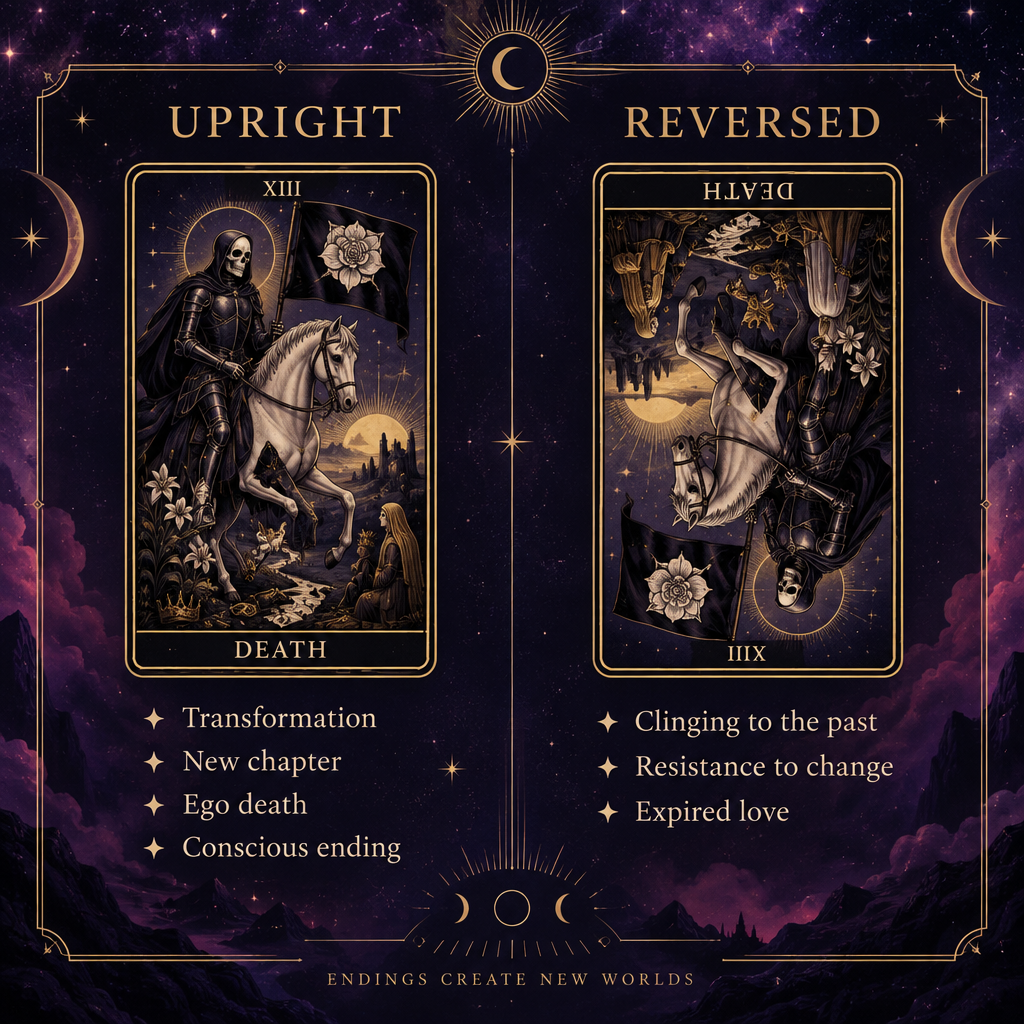
Upright Death is a card of necessary, ultimately healthy transformation. The exact shape of that transformation depends heavily on your situation.
For Established Couples
The most common upright reading for a committed couple is evolution rather than separation. A relationship that has been running on autopilot gets a jolt. This often coincides with a real-world threshold: moving in together, marriage, a pregnancy, a serious illness in the family, one partner changing careers, or the end of a long conflict cycle.
The key concept here is ego death. Long relationships stall when both people defend their positions instead of the partnership. Death upright asks one or both partners to let a fixed self-image die: the one who is always right, the one who never needs help, the one who keeps score. Compromise in this card’s language is not losing. It is allowing the version of you that could not bend to be buried so the relationship can live.
When Death does point toward the end of a committed relationship, it describes what modern readers call conscious uncoupling: a deliberate, mutually acknowledged ending without the scorched earth. Both people recognise the relationship has completed its purpose. There is grief, but not war.
For Singles Seeking Love
For someone single, Death upright is genuinely good news with a condition attached. New love is coming, but only after something old is cleared. Usually that something is a story you tell yourself: that you are unlucky in love, that you always pick the wrong type, that you need to be a certain weight or income bracket first. Death asks you to let that identity die.
Practically, this card often shows up in the months before someone meets a significantly different kind of partner than they have dated before. If you have been chasing the same profile for years with the same result, Death is the signal that the pattern is over, whether you feel ready or not.
For Potential or Very New Relationships
Here the reading is more mixed. Death as the outcome for a connection that has barely started usually means the relationship as currently framed will not continue. That could mean a crush fades, a situationship ends, or a first few dates go nowhere.
It can also mean the connection changes category. A flirtation becomes a friendship. A casual arrangement becomes something serious once both people drop the “keeping it light” act. Look at the surrounding cards: Death next to the Two of Cups or The Lovers points to deepening, while Death next to the Five of Cups or Eight of Cups points to release.
For Reconciliation With an Ex
This is the question readers most often bring to this card, and Death gives a firm answer: you cannot go back to what was. Reconciliation is only possible if the old relationship is fully dead and something new is built in its place. If your ex has not changed and you have not changed, Death upright says no.
If both people have done real work, Death can support a reunion, but it will not look like the first attempt. Expect different terms, different boundaries and probably a different pace. The card also frequently appears for people who want an ex back and receive, instead, closure. Closure is Death’s specialty.
Death Reversed as a Love Outcome
Reversed Death is not the opposite of transformation. It is transformation refused, delayed or twisted into something unhealthy. The Scorpio shadow runs through every sub-meaning below.
Fear of Being Alone
The most common reversed reading. You know the relationship is over and you stay anyway because the alternative feels like a void. The card is not judging you for this, but it is telling you that the fear is costing more than the loneliness would.
Codependency
Two people fused so tightly that neither can imagine a separate identity. Reversed Death in this position often accompanies a couple who fight constantly but describe themselves as inseparable. The relationship is not being held together by love so much as by the terror of what each person would have to face alone.
Obsession and Possessiveness
Scorpio at its worst: jealousy, monitoring a partner’s phone, needing to know where they are, treating a partner as property. If you drew this card and recognise yourself here, the transformation being blocked is your own. If you recognise your partner, the card is a warning that this dynamic will not soften on its own.
Financial Dependence
Scorpio also rules shared resources, and reversed Death frequently flags a relationship kept alive by money. One partner cannot afford to leave. One partner uses money to maintain control. Joint assets, a mortgage or a business make the ending feel impossible. The card acknowledges the practical trap and still insists that a relationship sustained only by finances has already died emotionally.
Delayed Grief and Stagnation
Sometimes reversed Death describes a relationship that ended in every meaningful sense months or years ago, but nobody has said the words. The couple still shares a home and a calendar and nothing else. Alternatively, it shows a single person who has not grieved a past relationship and therefore cannot open to a new one. Either way, the grief is overdue, and paying it is the only way forward.
Upright vs. Reversed at a Glance
| Death Upright | Death Reversed | |
|---|---|---|
| Core keywords | Transformation, release, rebirth, closure | Resistance, stagnation, fear, clinging |
| Emotional state | Grieving but clear; a sense of inevitability | Anxious, stuck, numb or obsessive |
| Communication style | Honest, sometimes painfully direct | Avoidant, controlling or circular |
| Typical relationship scenario | A pattern ends; the couple evolves or parts cleanly | A dead relationship continues out of fear or dependence |
| Best action | Accept the ending, name it, let the old form go | Identify what you are afraid of and face it directly |
| Timing | Change is already underway | Change is overdue and being blocked |
Is Death a Yes or No Card for Love?
Death is not a clean yes or no card, but it leans in predictable directions depending on the question.
| Question | Leaning | Why |
|---|---|---|
| Will we stay together? | Qualified yes (upright) | Only if the relationship changes form |
| Will we break up? | Not by default | Ending of a pattern, not necessarily the partnership |
| Will my ex come back? | Leaning no | The old relationship is finished; something new would have to replace it |
| Will I find new love soon? | Yes, after release | New love follows a genuine letting go |
| Should I stay in this relationship? | No (reversed) | Reversed Death describes staying past the expiry date |
| Is this new connection going anywhere? | Leaning no | Unless supported by cards of union nearby |
How Death Reads in Different Spread Positions
The outcome position is not the only place this card lands, and its meaning shifts with context.
Three-card spread (Past, Present, Future): Death in the Past position means the relationship already survived a major transformation and the current dynamic was born from it. In the Present, you are mid-transition and should not make permanent decisions yet. In the Future or Outcome position, the change described above is coming regardless of what you do now.
Five-card relationship spread (You, Them, The Connection, Challenge, Outcome): Death in the “You” or “Them” position identifies which partner is undergoing personal transformation. In the “Connection” position, the relationship itself is reshaping. As the Challenge, the obstacle is a refusal to let something go. As the Outcome, apply the upright or reversed readings above.
Seven-card or Celtic Cross: Death in the “Crossing” position (the card laid across the significator) is the central tension of the reading. In the “Hopes and Fears” position it usually means the querent fears a breakup more than the cards actually suggest one. In the “Final Outcome” position of a Celtic Cross, weigh it against the “Near Future” card: Death with Temperance or The Star following it is a strongly positive sequence.
Death Compared With Related Cards
Death vs. The Tower
Both are cards of ending, but the speed and texture differ completely. The Tower (XVI) is sudden, external and shocking: discovering an affair, a partner announcing they want a divorce out of nowhere, a crisis that arrives in a single afternoon. Death is gradual, internal and in some sense expected. The relationship has been changing for a while and Death names what is already happening. If you draw Death, you probably already knew.
Death vs. The Hanged Man
The Hanged Man (XII) comes directly before Death and describes the suspended, waiting state that precedes real change. In love readings, The Hanged Man is the couple who know something has to shift and are stalling. Reversed Death shares this stagnation but adds fear and refusal. The difference: The Hanged Man is pausing to gain perspective, while reversed Death is refusing to move despite already having the perspective.
Death With The Lovers
This pairing is among the most misread combinations in love tarot. It does not mean a relationship dies. It means a relationship transforms into a deeper form of union, or that a choice about love (The Lovers is also a card of choice) requires letting go of an alternative path. For singles, Death and The Lovers together strongly suggest new love arriving after a decisive break with the past. For couples, it points to recommitment on new terms.
Death With the Ten of Cups or Two of Cups
Cups cards of harmony soften Death considerably. This combination almost always reads as evolution within the relationship rather than separation. Death with the Three of Swords or the Ten of Swords, by contrast, confirms that a painful ending is the most likely reading.
What to Do After Drawing Death in a Love Reading
The card describes a transition. Your job is to move through it deliberately rather than getting dragged.
-
Name the thing that is ending. Write it down in one sentence. “The phase where I did all the emotional labour.” “My hope that he will change.” “My belief that I am unlovable.” Vagueness is what turns Death upright into Death reversed.
-
Separate the pattern from the person. Ask honestly whether the relationship needs to end or whether a dynamic inside it needs to end. These are different decisions with different consequences.
-
Do not make irreversible moves during the river crossing. If Death appears in a Present position, you are mid-transition. Give it time before filing paperwork or sending the long message.
-
If reversed, identify the specific fear. Being alone, money, judgement from family, starting over at your age. Name it precisely, then ask whether staying actually protects you from it or just postpones it.
-
Grieve properly. Even good endings deserve mourning. Skipping this step is how people carry a dead relationship into the next one.
-
Draw a follow-up spread. A three-card “What is ending / What is being born / What do I need to release” spread works well after Death appears. So does the Celtic Cross if the situation is complex and involves shared assets or children.
FAQ
Does the Death card mean a breakup in love?
Not by default. Death upright most often describes the end of a phase, pattern or self-image within a relationship, not the end of the relationship itself. It only points toward separation when supported by other cards of loss (Three of Swords, Ten of Swords, Five of Cups) or when it appears reversed alongside cards of stagnation.
Is Death a good card in a love reading?
Upright, yes, in the way that surgery is good. It brings necessary change that leads to something healthier. Reversed, it is a warning rather than a bad omen: it tells you that you are resisting a change you already know is needed.
What does Death reversed mean in a relationship?
Reversed Death points to a relationship or pattern being kept alive past its natural end. Common causes are fear of being alone, codependency, possessive jealousy, financial dependence, or unprocessed grief. The card is asking what you are afraid will happen if you let go.
Can the Death card mean reconciliation with an ex?
Occasionally, but never a return to the old relationship. Death allows reconciliation only when the previous version has fully ended and both people have changed enough to build something new. More often it signals closure rather than reunion.
Is Death a yes or no card?
It resists a simple answer. For “will this end?” questions it leans yes, a phase is ending. For “will we stay together?” it gives a qualified yes if the relationship can transform. For “will my ex return?” it leans no. Read the surrounding cards for confirmation.
Can the Death card mean literal death?
In practice, almost never. Experienced readers do not interpret Death as physical death in love readings or in most other contexts. Its meaning in the Rider-Waite-Smith tradition is transformation, and predicting literal death from a single card is considered irresponsible practice.
What zodiac sign is the Death card?
Scorpio, a Water sign associated with intimacy, sexuality, shared resources and rebirth. The Scorpio connection explains why Death in love readings so often touches on jealousy, deep bonding, money entanglements and the need to transform rather than simply move on.