Ten Of Swords As Love Outcome (Upright & Reversed) Tarot Card Meaning
The Ten of Swords in an outcome position is one of the hardest cards to pull about love, and softening it does you no favors. Upright, it points to a painful ending, a betrayal that cannot be unseen, or a final blow to something that was already failing. The dawn on the horizon is real, but it only arrives after the ending has been accepted, and that order matters.
The Short Version
If you asked “where is this relationship heading?” and drew the Ten of Swords upright, the most likely answer is that it ends, and it ends in a way that hurts. If you asked about an ex coming back, the card says the relationship you had is finished. Reversed, the card splits into two very different stories: slow recovery after the worst has passed, or someone refusing to let a dead relationship die. The rest of this guide shows you how to tell which one you are looking at.
What the Card Actually Shows
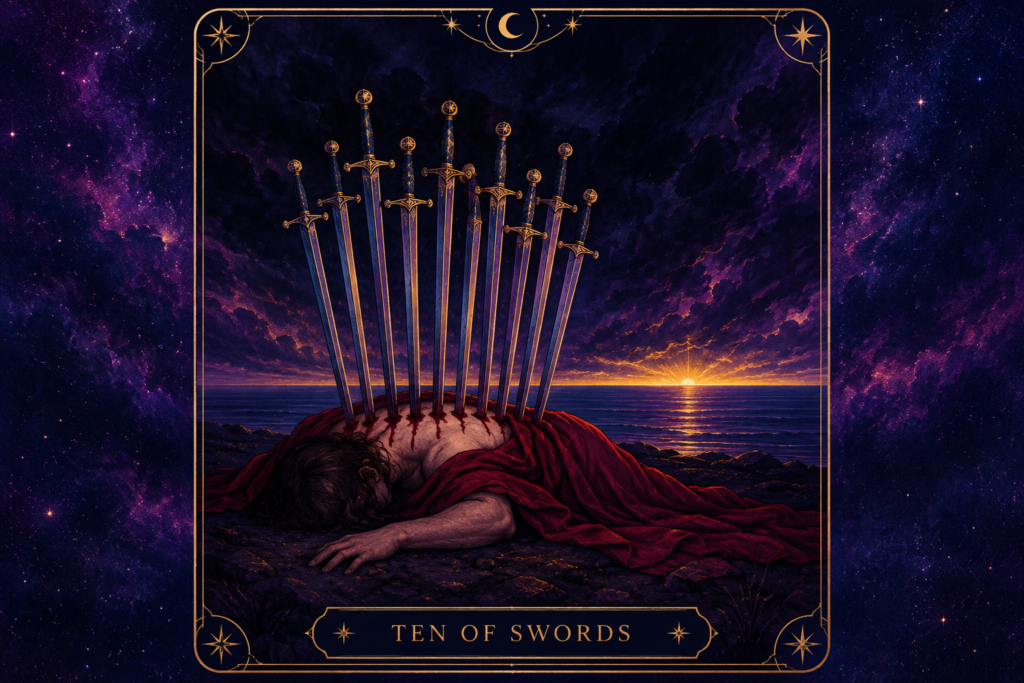
In the Rider-Waite-Smith deck, Pamela Colman Smith painted a figure lying face down on bare ground with ten swords driven into their back. Ten is excessive. One sword would have done the job. The surplus is the point: this is overkill, a wound inflicted long after the outcome was decided. In love, that usually translates to the final argument that repeats everything already said, the discovery of a second affair after forgiving the first, or the text message that makes a breakup official when both people already knew.
The sky above the figure is black, pressed down like a lid. Beneath it, a thin band of yellow light sits on the horizon above a still sea. A.E. Waite described the card in The Pictorial Key to the Tarot (1911) as “pain, affliction, tears, sadness, desolation,” and added that it “is not especially a card of violent death.” That line is useful for love readings. The card is not about sudden catastrophe. It is about the moment a long decline becomes undeniable.
Here is how the main symbols map onto relationship outcomes:
| Symbol | What it means in a love outcome |
|---|---|
| Ten swords in the back | Betrayal, or a wound delivered from behind: lies, infidelity, a decision made without you |
| Figure face down | You cannot see this coming, or you are refusing to look. Either way, the ending is already in motion |
| Black sky | The emotional reality right now: grief, shock, no visibility on what comes next |
| Dawn on the horizon | Recovery is certain, but it belongs to a future chapter, not to this relationship |
| Calm sea | The storm has already happened. What remains is the aftermath, not the fight |
| Red drapery over the body | The dignity and warmth that remain in you even after the worst. You survive this |
Some readers point out that the figure’s right hand forms a gesture resembling a blessing sign. Whether Smith intended that or not, the reading it supports holds up: the person on the ground is not destroyed, only finished with this particular story.
Upright Ten of Swords as a Love Outcome
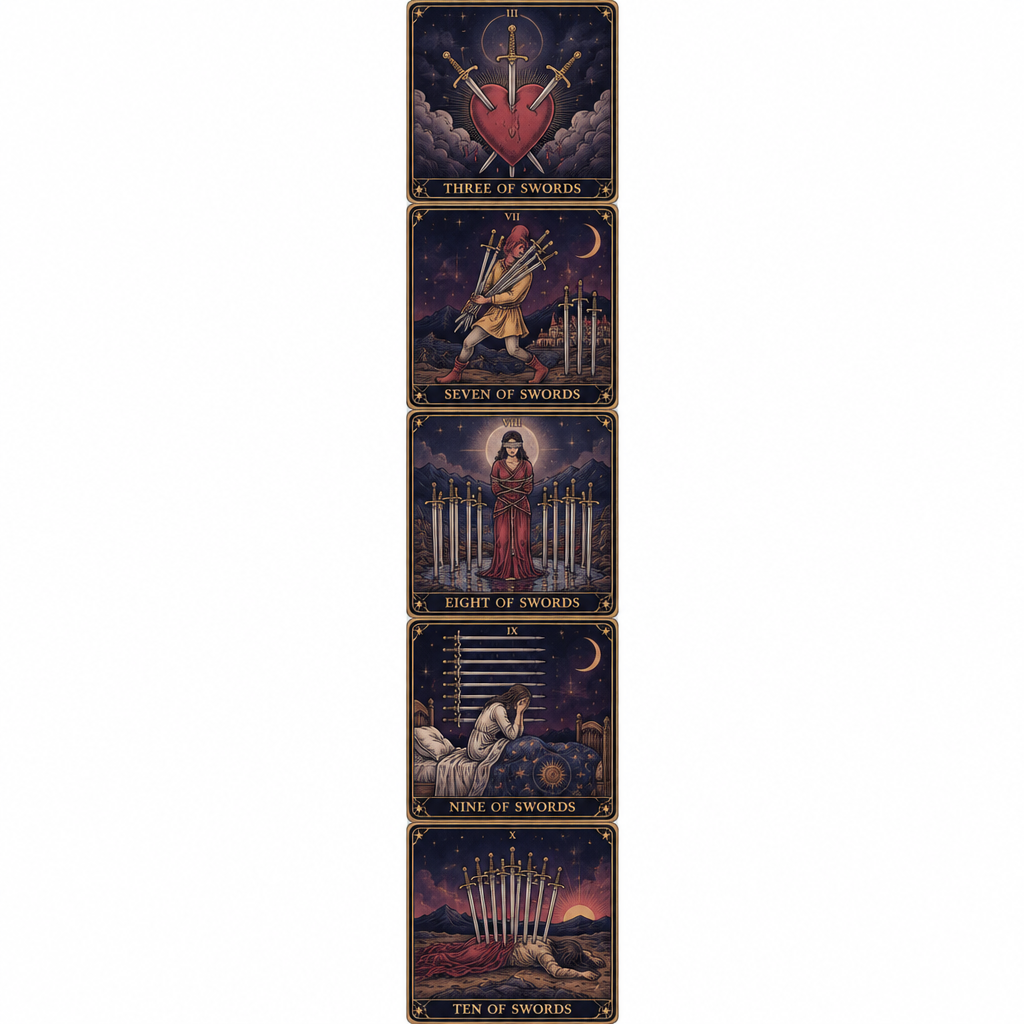
Start with the hard truth and work outward from there. Upright, the Ten of Swords as an outcome card means:
- A relationship ends, usually for good
- The ending involves betrayal, deception, or a breach of trust severe enough that the old relationship cannot be restored
- You hit an emotional floor: the lowest point of this situation
- Something you believed about the other person, or about yourself in love, is proven false
It is the completion of the Swords suit, and the Swords tell a story of the mind turning against itself. The Three is the first cut of heartbreak. The Seven is deception. The Eight is feeling trapped by your own thinking. The Nine is the sleepless anxiety that something is terribly wrong. The Ten is the confirmation that it was. All that mental torment finally lands in reality.
The Rock Bottom Paradox
The one genuine consolation in this card is structural, not sentimental. Ten is the last number in the suit. There is no Eleven of Swords. Whatever you are dreading, this card says you are at the bottom of it, not halfway down.
For love readings that changes the question from “will this get worse?” to “what do I do now that it cannot?” People who pull this card during a drawn-out, on-and-off relationship often describe the result as a relief they feel guilty about. The guilt is misplaced. The dawn on the card is only visible because the figure has stopped fighting. Acceptance is the hinge between the black sky and the yellow light.
What the card does not promise: that the relationship survives, that the other person changes, or that the ending is painless. Pages that lead with “fresh start” are describing the Ace of Swords or The Fool. The Ten of Swords is the card you pull before those become possible.
For Singles
If you are single and asked about your love life in general, the Ten of Swords usually points backward before it points forward. One of these is likely true:
- You are in the aftermath of a breakup that was worse than you have admitted, and you are trying to date before the swords are out
- A pattern you repeat in love (choosing emotionally unavailable people, ignoring early red flags, over-giving) has just collapsed completely, and the old approach is dead
- Someone you are talking to or recently dated is about to disappoint you in a decisive way: ghosting, a hidden partner, a lie that unravels
The useful move is to stop looking for the next person and let the ending finish. The Ten of Swords for singles is the death of a version of you in love. That version does not need to be resurrected.
For Existing Relationships
This is where honesty matters most, because the stakes are highest. Upright Ten of Swords as the outcome of a committed relationship or marriage most often means separation, divorce, or the exposure of infidelity. The relationship as you have known it does not continue.
There is a narrow exception. Occasionally the card describes a survivable crisis: a confession, a bankruptcy, a devastating argument that finally forces the truth into the open. The relationship survives the Ten of Swords only when both people are willing to let the old version of it die. If one partner wants to go back to how things were, the card is reading as an ending.
How to tell the difference in a spread: look at the cards around it. A Ten of Swords flanked by the Two of Cups or Temperance can mean “the old marriage ends, something is rebuilt.” A Ten of Swords next to the Three of Swords, the Tower, or the Five of Cups is an ending with no second act in that relationship.
For Reconciliation With an Ex
This is the highest-intent question people bring to this card, so here is the direct answer: the relationship you had with your ex is over. Not paused, not on a break. Over.
That does not make a future with the same person impossible, but it rewrites what “getting back together” would have to mean. The Ten of Swords rules out picking up where you left off, forgiving the same thing one more time, or hoping distance fixed what communication could not. If two people who have been through this card ever build something together again, it has to be assembled from the ground up, with the old dynamic fully buried: new boundaries, new terms, often a long gap with real separation first.
In practice, most people who pull this card about an ex are being told to stop waiting. If you want to test that, ask a follow-up question: “What would need to change for a new relationship with this person to work?” If the answer is another Sword or a Major Arcana card like the Tower or Death, you have your answer twice.
Ten of Swords Yes or No
For love outcome questions, the Ten of Swords is a No.
“Will we get back together?” No, not as you were. “Does this relationship have a future?” No, not in its current form. “Is this person being faithful?” The card leans toward no, though verify with clarifying cards before acting on it. “Will I meet someone new soon?” No, not until the current wound has closed.
The only version of yes this card supports is “Yes, this is finally over,” which is sometimes exactly the confirmation a querent needs.
Reversed Ten of Swords as a Love Outcome
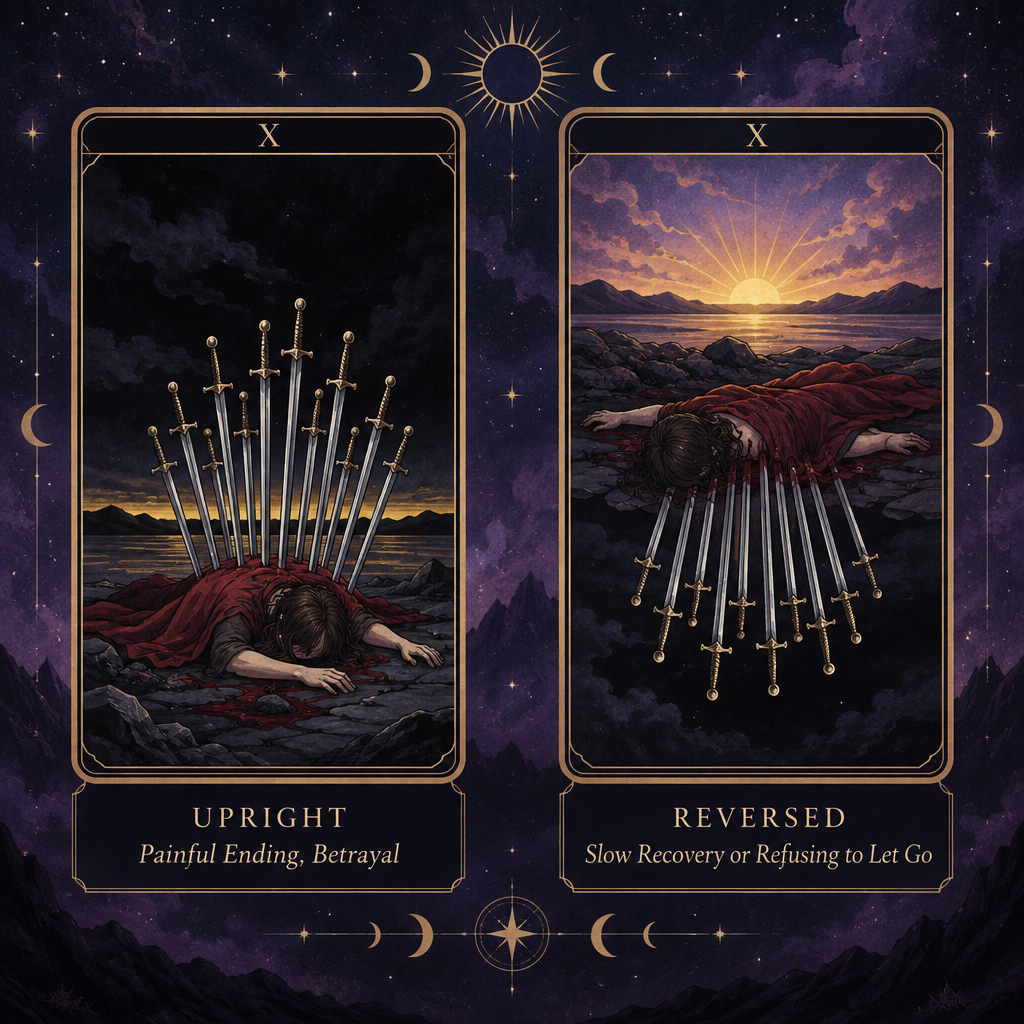
Reversed, the card has two faces, and the original version of this page only described one. Waite’s own reversed meaning was “advantage, profit, success, favour, but none of these are permanent.” Note the second half. Even the hopeful reversal comes with a shelf life.
The Healing Reading
The first face is recovery. The swords are coming out. You are getting up off the ground after a betrayal or breakup, and the acute pain is behind you. For singles this means you are about to be ready to date again, properly this time. For couples it can mean the two of you have survived the worst and are rebuilding with clearer eyes. It is a slow card even when positive: healing is happening, not finished.
The Clinging Reading
The second face is the one to take seriously. Reversed Ten of Swords can mean refusing an ending that has already happened. The figure is trying to stand up with the swords still in. In love this looks like:
- Staying in a relationship that is emotionally over because leaving feels more frightening than being unhappy
- Convincing yourself a betrayal was a misunderstanding when you know it was not
- Pursuing an ex who has moved on, interpreting silence as a sign to try harder
- Rushing into a new relationship weeks after a devastating one to avoid feeling the wound
The tell is fear. If you are holding on out of love and the other person is holding on too, the healing reading applies. If you are holding on because you cannot face the alternative, you are reading the clinging version, and the card is asking you to let the ending land.
Reversed by Relationship Status
Singles: Either you are finally over the last person and ready to meet someone with the pattern broken, or you have skipped the grieving and are carrying the old swords into every first date. Ask yourself whether you have actually been alone with the loss.
Existing relationships: Either a crisis has passed and you are rebuilding, or one of you is pretending the crisis never happened. A reversed Ten of Swords with the Devil or the Eight of Swords nearby is almost always the second one.
Reconciliation with an ex: The reversal does not make reunion more likely. It raises the question of who is refusing to accept the ending. If it is you, the card is a warning. If both of you have genuinely healed apart and are considering something new, the reversal can support a cautious, slow re-approach, with the emphasis on slow.
Ten of Swords Card Combinations in Love
Surrounding cards do not erase the Ten of Swords, but they tell you what kind of ending it is and what follows it.
| Combination | Love outcome reading |
|---|---|
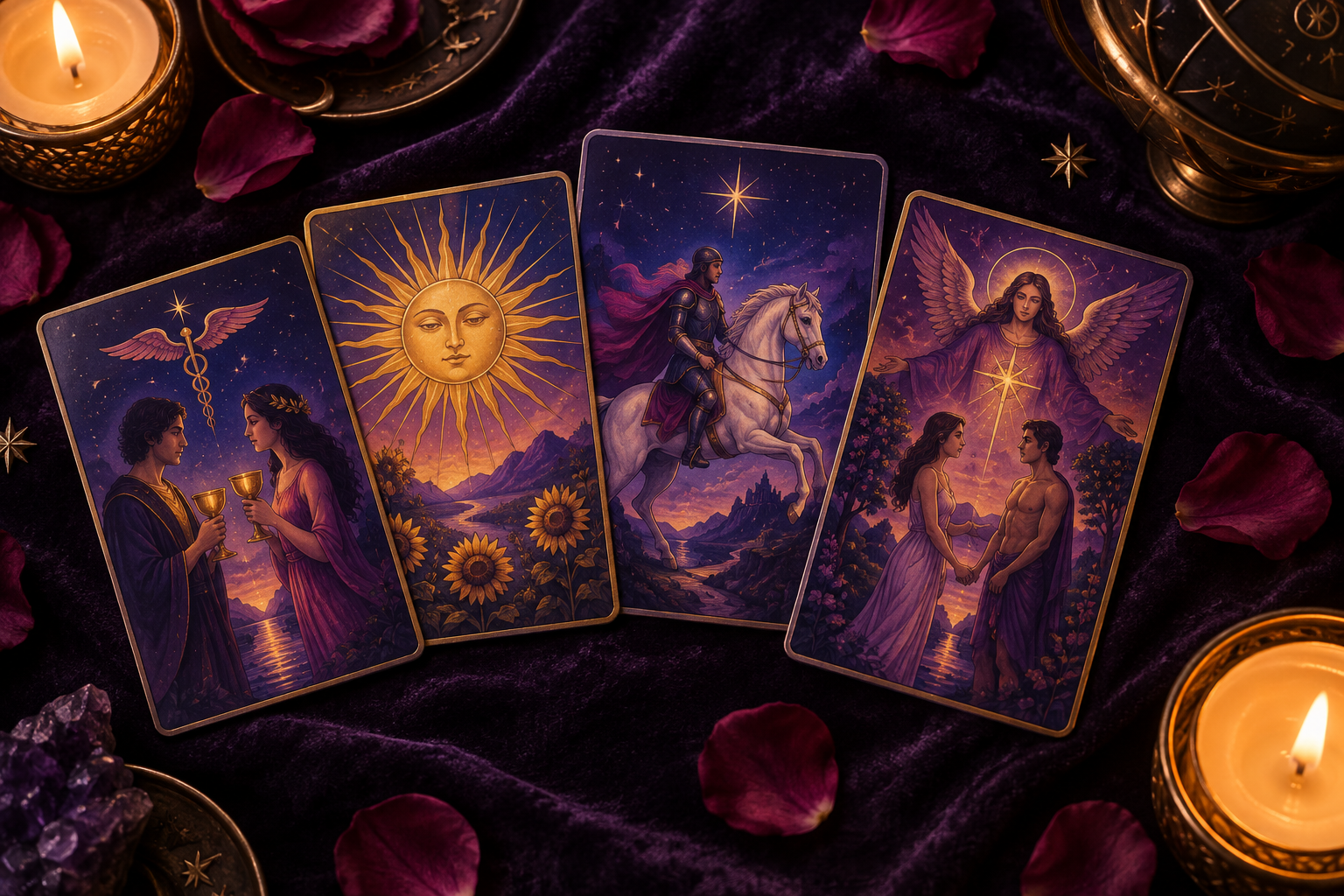
| Ten of Swords + The Sun | The clearest “ending, then genuine happiness.” The breakup is real, and so is the recovery. Often means the person you lose was blocking your light |
| Ten of Swords + Ace of Cups | New love or renewed emotional capacity after loss. The Ace is almost always a different person or a reborn version of yourself, not a repair of the old relationship |
| Ten of Swords + The Star | Healing that takes time and faith. You will recover, and you will trust again, but not quickly. Good card for the aftermath of betrayal |
| Ten of Swords + The Lovers | A choice has reached its painful conclusion. Often the end of a love triangle, or a relationship that ends because one person chose someone or something else |
| Ten of Swords + The Fool | A leap after the fall. You start over with no plan and no baggage. Can also warn against jumping into something new before the ground has settled |
| Ten of Swords + Three of Swords | Heartbreak confirmed and compounded. Infidelity or a devastating revelation. No reconciliation energy here |
| Ten of Swords + The Tower | Sudden, total collapse. Discovery of a secret life, abrupt abandonment. Painful, but there is nothing hidden left after it |
| Ten of Swords + Death | Complete transformation. The relationship ends so decisively that both people are changed. If any card pairing allows “new relationship with the same person,” it is this one, and only after full separation |
| Ten of Swords + Two of Cups | The rare survival signal. The partnership ends in one form and continues in another. Still requires both people to agree the old version is dead |
| Ten of Swords + Six of Cups | Nostalgia for an ex. Usually a warning that you are romanticizing something that ended for good reasons |
| Ten of Swords + Four of Swords | Rest is required. Do not date, do not reach out, do not decide anything yet |
Correspondences and Context
Tarot correspondences are not decoration. They explain why the card behaves the way it does.
Element: Air. The Swords suit governs thought, communication, and truth. The Ten of Swords ending is not about passion fading (that would be Cups) or practical incompatibility (Pentacles). It is about something known, said, or discovered. In love readings that points to words, lies, revelations, and the mind’s refusal to keep pretending.
Astrology: Sun in Gemini. The Golden Dawn assigned the Ten of Swords to the third decan of Gemini, roughly June 11 to June 20, ruled by the Sun. Gemini is the sign of duality and communication; the Sun illuminates. Put together: the truth comes out, and it has two sides. Double lives, mixed messages, and two people telling different stories about the same relationship all belong to this card. The Sun placement also explains the dawn: light is intrinsic to the card, even if it arrives last.
Golden Dawn title: Lord of Ruin. Aleister Crowley’s Thoth deck keeps it as simply “Ruin.” The Golden Dawn titles are blunt by design, and this one is a corrective to any modern reading that leads with fresh starts.
Position in the suit. As the tenth and final pip card, the Ten of Swords carries the weight of the whole suit. Tens in tarot represent culmination. The Ten of Cups is fulfilled love; the Ten of Pentacles is lasting legacy; the Ten of Wands is the burden of too much. The Ten of Swords is where the mind’s war ends because there is nothing left to fight about.
Nine of Swords vs. Ten of Swords in Love
These two are often confused because they share the dark palette and the sense of dread, but they describe different moments.
The Nine of Swords is the night before. The figure sits up in bed, head in hands, swords hanging on the wall but not touching them. In love, the Nine is the 3 a.m. certainty that your partner is pulling away, the obsessive re-reading of messages, the fear of betrayal. Crucially, the Nine’s fears are not always confirmed. Sometimes the anxiety is the whole problem.
The Ten of Swords is the morning the fear turned out to be true. The swords are in. There is no more speculating. If you pulled the Nine of Swords about your relationship last month and the Ten this month, the card is telling you the thing you feared has happened or is about to.
The practical difference: the Nine calls for a conversation or a reality check. The Ten calls for acceptance and recovery.
How Spread Position and Surrounding Cards Change the Reading
The Ten of Swords in the outcome position carries its full weight. In other positions it can be softer or more specific:
- Past position: The ending already happened. The reading is about what you are carrying from it
- Present position: You are in the middle of the collapse right now. Do not make permanent decisions this week
- Advice position: Let it end. Stop negotiating. Lie down and let the swords finish their work so you can get up clean
- Obstacle position: Fear of a painful ending is itself the block. You are staying because leaving looks like the card, not because staying is good
- Outcome position: Ending, betrayal, or rock bottom, as described throughout this guide
Majors around it set the scale. The Ten of Swords with The Empress or Ten of Cups elsewhere in the spread suggests the ending clears the way for the kind of love you actually want. With the Moon, there is still something you have not been told. With Judgement, the ending is a calling to a different life entirely.
Is the Ten of Swords Outcome Reversible?
This question circulates constantly in tarot communities on Reddit and older forums, and the debate usually splits into two camps. One holds that outcome cards describe trajectory, not fate, so changing your behavior changes the outcome. The other holds that the Ten of Swords specifically describes a point already past, and the only choice left is how you respond.
Both are partly right, and the distinction is about what you are trying to reverse. You cannot un-know a betrayal, un-say the final words, or make the other person want a relationship they have left. In that sense the Ten of Swords is not reversible. What you can change is everything after: whether you repeat the pattern, how long you lie on the ground, and whether you read the dawn as a promise or ignore it.
Readers who have sat with this card over many years tend to converge on the same position. The Ten of Swords is almost never wrong about the ending. It is sometimes wrong about the timing, and it is always right about the dawn.
Shadow Work and Journal Prompts for the Ten of Swords
The card asks for honesty you may have been avoiding. These prompts are for the week after you pull it, not the hour.
- What did I already know about this relationship before the card confirmed it?
- Which of the ten swords did I put there myself, by staying silent, by ignoring evidence, by accepting less?
- If I imagine the relationship is completely over, what is the first thing I feel: grief, relief, or fear? What does that tell me?
- What belief about love died with this relationship? Was it worth keeping?
- Who am I when I am not trying to save this?
- What would the version of me standing in the dawn tell the version lying on the ground?
- Am I waiting for this person to come back, or waiting for permission to stop waiting?
FAQ
What does the Ten of Swords mean for love?
Upright, the Ten of Swords in a love reading means a painful ending, usually involving betrayal, deception, or a final collapse of trust. It marks the lowest point of the relationship, after which the only direction left is recovery. The dawn on the card represents healing that comes after acceptance, not a rescue of the relationship itself.
Is the Ten of Swords a breakup card?
Yes. For questions about where a relationship is heading, the Ten of Swords upright is one of the clearest breakup, separation, or divorce cards in the deck, alongside the Three of Swords and the Tower. It differs from those two by emphasizing finality: this is the last blow, not the first.
What does the Ten of Swords mean for reconciliation?
It means the original relationship is over. Reunion in the old form is not supported by this card. A new relationship between the same two people is theoretically possible only if both have fully separated, healed, and are willing to build something from scratch with different terms. In most readings, the card is advising the querent to stop waiting.
Ten of Swords love outcome: yes or no?
No. For “will we get back together,” “does this have a future,” and “will this work out,” the Ten of Swords is a No. The one yes it offers is “yes, this is finished,” which can be a relief after a long, uncertain decline.
What does the Ten of Swords reversed mean as a love outcome?
Reversed, it carries two possible meanings. The hopeful one is slow healing after the worst has passed: you are getting up, and recovery is under way. The warning one is refusal to accept an ending: staying in a dead relationship out of fear, chasing an ex who has moved on, or rushing into new love to avoid grief. Surrounding cards and honest self-assessment tell you which applies.
Does the Ten of Swords always mean cheating?
No, but it points that way more often than most cards. Its Air element and Sun in Gemini correspondence both relate to hidden truths and double lives. If infidelity is your concern, pull a clarifier. Ten of Swords with the Seven of Swords, the Moon, or the Three of Swords strengthens the suspicion. With the Five of Cups or Four of Swords, the ending is more about exhaustion and loss than deceit.
How is the Ten of Swords different from the Nine of Swords in love?
The Nine of Swords is anxiety about a betrayal or ending that may or may not be real. The Ten of Swords is the betrayal or ending confirmed. The Nine calls for a reality check and a conversation. The Ten calls for acceptance and time to heal.