Ten Of Swords As Feelings In Love & Relationships (Upright & Reversed)
The Ten of Swords as feelings means someone has hit an emotional floor: they feel finished, wounded past the point of argument, and unwilling to pick the relationship back up. It is one of the hardest cards to pull when you ask how a person feels about you, but it is also one of the most honest, and the sunrise on the horizon is not decoration.
What Does the Ten of Swords Mean as Feelings?
Pulled as a feelings card, the Ten of Swords says the person feels drained, betrayed, or defeated regarding the connection, and has mentally declared it over even if nothing has been said out loud. Upright, that ending feels total and final. Reversed, the pain is either slowly lifting or being pushed down and refused, which looks like recovery but isn’t yet.
That is the short answer. The rest of this page breaks it down by who the card is describing, what stage the relationship is in, and what the card asks you to do about it.
The Imagery First: Why the Card Looks the Way It Does
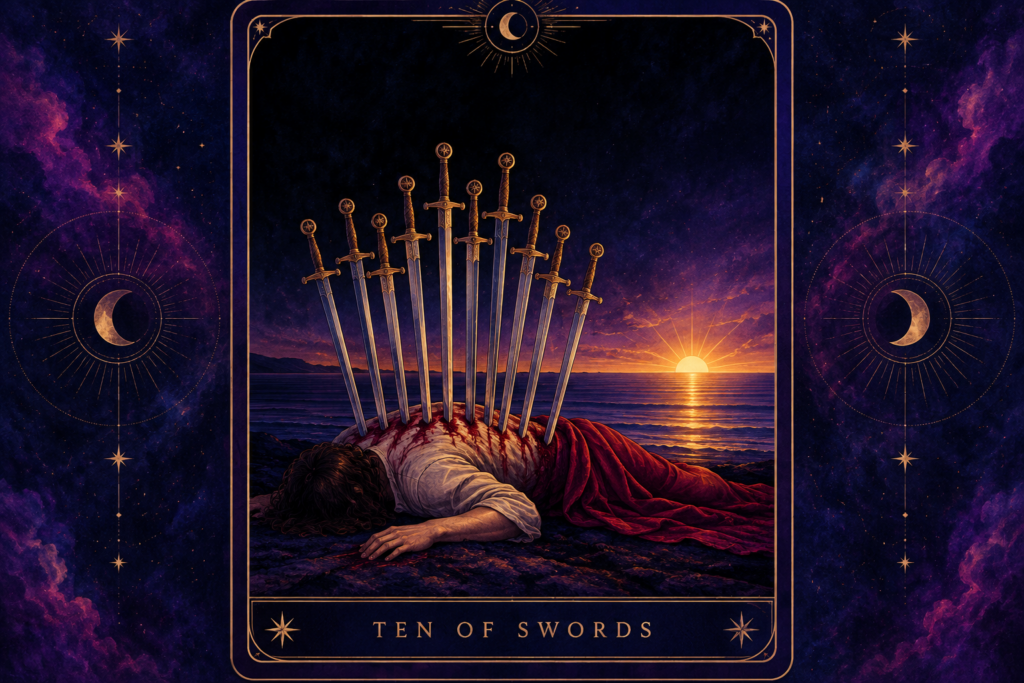
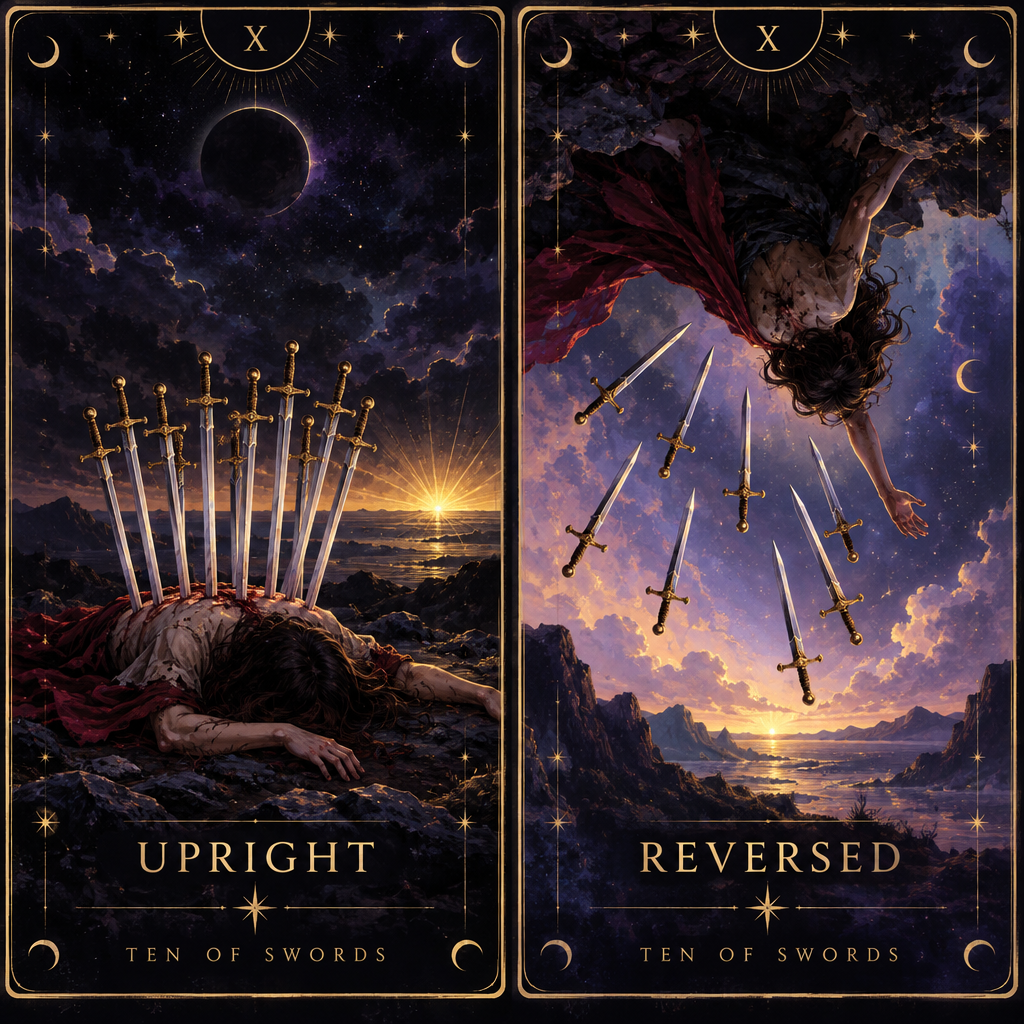
In the Rider-Waite-Smith deck, drawn by Pamela Colman Smith in 1909, a figure lies face-down on bare ground with ten swords planted along their spine from skull to hip. A red cloth is draped over the lower body. The sky above is solid black. Below that black, a band of yellow light is breaking over calm water and a line of distant mountains.
Every one of those details carries weight in a love reading.
The face-down figure. The person isn’t fighting, running, or even looking at what hurt them. They have stopped. As a feelings card, this is the emotional posture of someone who has given up on the relationship, not out of indifference but because resisting took everything they had.
Ten swords. One sword would do the job. Ten is excess. Rachel Pollack makes this point in Seventy-Eight Degrees of Wisdom: the sheer number of blades turns the scene toward melodrama. The suit of Swords is the suit of thought and speech, so ten of them in the back describes someone killed by words, by overthinking, by replaying every argument until there is nothing left. It can also describe someone who has made the hurt bigger in their mind than it was in the room. More on that below.
The hand gesture. Look closely at the figure’s right hand. Two fingers are extended in a position that echoes the Hierophant’s blessing. Pollack and other commentators read this as a quiet signal that the person is, on some level, consenting to the ending. They are letting it be over.
The black sky. Night at its deepest. In feelings terms, this is the moment where the person can’t imagine the relationship ever being good again.
The calm water and the dawn. The sea is flat. The storm has already passed. And the horizon is turning gold. Nothing in the card is getting worse. The worst has happened, and the next thing on the schedule is morning. A.E. Waite, writing in The Pictorial Key to the Tarot (1910), listed the card’s meanings as pain, affliction, tears, sadness and desolation, but added that it is not especially a card of violent death. The ending is emotional, not physical, and it is survivable.
How They Feel About You: The Ten of Swords as Someone Else’s Feelings
When you ask “how does this person feel about me” and the Ten of Swords lands, the answer has three layers.
They feel the relationship has already ended. Whatever the current status says, in their head it’s done. They may still be texting you. They may still be living with you. Emotionally they have left the building and are lying in the dirt outside it.
They feel you did something to them, or that the situation did. The swords are in the back. This person feels blindsided, stabbed from behind, let down by someone they trusted. Sometimes that someone is you. Sometimes it’s an ex they haven’t healed from and you are getting the aftermath. Sometimes it’s a pattern of their own catastrophising. The card alone won’t tell you which; surrounding cards and plain honesty will.
They don’t have the energy to repair it. This is the piece people most want to argue with. “But if I explain, if I show them, if I just try harder.” The Ten of Swords describes someone who has stopped trying. You can’t out-effort another person’s emotional bankruptcy.
The dawn still matters here. A person in Ten of Swords mode about you is at their lowest, which means their feelings have nowhere to go but up. That does not mean they will come back to you. It means they will recover, and whether that recovery includes you depends on choices neither of you has made yet.
Ten of Swords Upright as Feelings
Upright, the card describes four distinct emotional states that often overlap.
Exhaustion rather than anger. Anger has energy in it. The Ten of Swords has none. If the person you’re asking about has gone flat, stopped arguing, stopped reacting to things that used to set them off, this card is describing that flatness. Couples therapists sometimes call it the point where one partner has “checked out,” and it is a worse sign than fighting.
Finality. They feel done, and the word “done” is doing specific work. Not “we need a break.” Not “I need space.” Done. The person has moved from deciding whether to leave to grieving the fact that they already have.
A sense of annihilation. Ordinary heartbreak hurts. The Ten of Swords feels like being erased. The person may feel that something they built their identity on (the future they planned with you, the version of themselves that trusted) has been destroyed. This is why it so often shows up after infidelity, a secret coming out, or a long slow betrayal finally being named.
Acceptance underneath it all. That blessing hand. Some part of them knows this is the end and is quietly relieved to stop fighting it. If you’re the one feeling this way, notice that relief. It’s information.
Ten of Swords Reversed as Feelings
The old reading of the reversed Ten of Swords is “healing has begun, hope returns.” That’s true some of the time and dangerously incomplete the rest of it. Waite’s reversed meanings (advantage, profit, success, but “none of these are permanent”) already hint that the upside is unstable. Modern readers tend to split the reversal into three possibilities.
Slow, genuine recovery. The swords are being pulled out one by one. The person still hurts but is getting up. In a love reading this can mean they’re starting to think about you without the stab of pain, which is a precondition for any kind of reconnection but is not reconnection itself.
Suppressed pain that hasn’t been dealt with. The card is upside down, so the figure is on top and the swords are underneath. The person has gotten up by pretending they were never knocked down. They say they’re over it. They are not over it. Watch for someone who insists everything is fine while refusing to discuss what happened, or who jumps into a new relationship within weeks of the last one ending.
Refusal to admit it’s over. Here the reversal shows someone clinging to a relationship that has already died, stuffing the swords back in because at least the pain is familiar. They may feel the ending coming and be fighting it with everything they have. In an ex reading, this is the person who keeps “accidentally” reaching out.
The honest test for which version you’re looking at: can the person talk about the hurt in a complete sentence? If yes, it’s recovery. If they deflect, change the subject or get brittle, the swords are still in.
Ten of Swords Feelings by Relationship Scenario
New or potential relationship
Upright, the Ten of Swords in a brand-new connection almost never describes feelings about you. It describes feelings about the last person. Your love interest is bracing for the same ending they just lived through, expecting the knife before the first real conversation. They may be warm in person and then disappear for days, because closeness triggers the memory of being wounded. If you’re the one feeling this, you’re not ready to date and you probably know it.
Reversed in a new relationship, the person is cautiously letting their guard down. They’ve started to believe this might not end the way the last one did. Go slowly; the trust is real but new.
Existing long-term relationship
Upright, one partner has reached breaking point. They are contemplating leaving or have decided to and are waiting for the right moment, the right conversation or just the nerve. The relationship has been running on history rather than feeling for a while. If the card describes your partner, the kindest and most useful thing you can do is ask them directly, without defensiveness, whether they still want to be here. You may not like the answer. You deserve a real one.
Reversed, the relationship has survived something it shouldn’t have been able to survive and both people are shaky. The reversal here is encouraging if there is open conversation about what happened. It’s a warning if the crisis has been papered over and nobody is allowed to mention it.
Ex or old flame
This is the scenario people ask about most, and the card is blunt about it.
Upright, your ex still feels gutted. Not nostalgic, not wistful. Gutted. They associate you with the single most painful thing that happened to them in recent memory, which means contact from you right now reopens the wound rather than healing it. The Ten of Swords upright for an ex’s feelings is a clear no on reconciliation at this time. The dawn says they will eventually feel differently; it does not say they’ll feel differently about you.
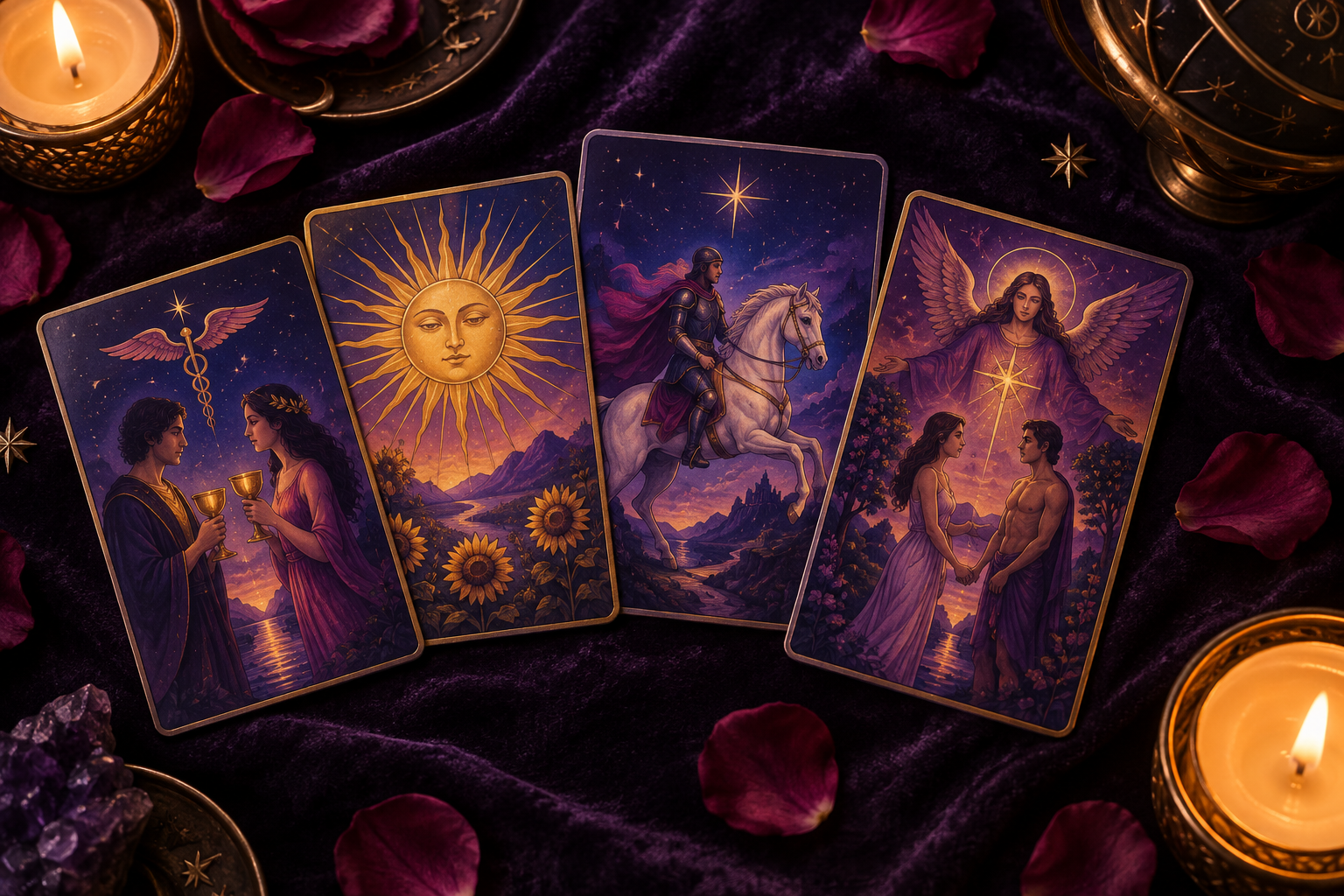
Reversed, the ex is somewhere in the recovery process. They may be able to think about you without flinching. They may even miss you. But remember the suppressed-pain reading: an ex who seems fine and reaches out quickly may be acting from unprocessed hurt, and getting back together on that foundation usually reproduces the original ending. If you want to test reconciliation, pull a clarifier. Two of Cups or Six of Cups beside a reversed Ten of Swords is a different conversation than Five of Cups or the Tower.
Friendship or platonic connection
Upright, your friend feels betrayed or badly let down. This is the card of the secret that got shared, the loyalty that wasn’t returned, the pattern of being the one who always shows up for someone who never shows up for you. They may be quietly pulling away. Friendships rarely end with a conversation; they end with the Ten of Swords and then silence.
Reversed, the friend is trying to forgive and not quite managing it. The friendship can be repaired, but only if the person who did the hurting names it first.
“Does he love me?” or “Does she love me?”
The direct answer: the Ten of Swords says this person does not feel capable of love for you right now, because they’re either too wounded or they’ve already closed the door. It’s not a card of indifference. You matter to them enough to have hurt them. But love in the present tense, the kind that reaches toward you, is not what this card describes.
Two caveats. If the person is newly out of something else, their incapacity is about their state, not your worth. And if this card describes your feelings when you ask whether they love you, the real question is why you’re still asking someone who makes you feel like this.
Their intentions toward you
Upright, their intention is to leave, or to not begin. They may not have said it. They may not even be fully conscious of it. But the direction they’re facing is away. Reversed, their intentions are confused and they may send mixed signals for a while, warm one week and gone the next, as they sort through pain they haven’t finished feeling.
Sun in Gemini: The Card’s Astrological Signature
In the Golden Dawn system that underpins most modern decks, the Ten of Swords is titled the Lord of Ruin and assigned to the Sun in the third decan of Gemini (roughly 20 to 30 degrees, about June 11 to June 20). This matters for love readings because Gemini is the sign of communication, and the Sun illuminates whatever it touches.
Put those together and you get the mechanism of the Ten of Swords in relationships: something was said, written, discovered or finally understood, and once it was out in the light it couldn’t be unsaid. Gemini’s doubleness also shows up as the gap between what someone says and what they feel, the two-facedness that leaves someone stabbed in the back. The remedy the correspondence points toward is Geminian too: honest, complete speech. Not more talking. Clearer talking.
The Overkill Reading: When Ten Swords Means Drama, Not Death
Pollack’s observation about the excessive number of swords opens up a second, less flattering interpretation that experienced readers use often. Sometimes the Ten of Swords describes a person who is performing their pain, who has cast themselves as the murdered party in a situation that, viewed from outside, was a normal disagreement or a reasonable boundary.
Signs you’re dealing with the overkill reading: the hurt is narrated in extremes (“you’ve destroyed me,” “I’ll never trust anyone again”) over something proportionate; the person’s distress escalates when it stops getting a response; past relationships also ended in dramatic betrayals where they were always the victim. This reading doesn’t mean the pain isn’t real to them. It means the pain is partly a story they’re telling, and you can’t fix a story by changing your behaviour.
If you pulled the card for your own feelings, this is worth sitting with honestly. Is this relationship actually ruined, or does it feel ruined because that’s the only ending you know how to imagine?
Why People Stay: The Psychology Behind the Card
Caryl Rusbult’s Investment Model, first published in 1980, explains something the Ten of Swords shows visually: why people remain in relationships that have already died emotionally. Rusbult found that commitment depends on three things, satisfaction, the quality of perceived alternatives, and the size of investment already made (time, shared housing, children, mutual friends, identity). Satisfaction can hit zero while commitment stays high if the investment is large and the alternatives feel poor.
That’s the figure on the ground who hasn’t technically left yet. The relationship no longer gives them anything, but the thought of walking away from fifteen years, a mortgage and a shared friend group holds them in place. Attachment theory adds another layer. People with anxious attachment often react to a dying relationship with protest behaviour, escalating contact and emotional intensity, which can look like the overkill reading from outside. People with avoidant attachment go flat and leave quietly, which looks like the exhausted upright reading.
Neither framework replaces the card. Both help you understand that “they feel done but haven’t left” is a common, explicable human state and not a mixed signal to decode.
Ten of Swords vs. Nine of Swords vs. Three of Swords
These three cards get confused in feelings readings because all of them hurt. They describe different stages.
| Card | What the person feels | Stage | What it asks for |
|---|---|---|---|
| Three of Swords | Acute, fresh heartbreak; a specific wound | The moment of hurt | Grieve the specific loss |
| Nine of Swords | Anxiety, dread, sleepless rumination; fear of what might happen | Anticipation | Reality-test the fear |
| Ten of Swords | Finality, exhaustion, total collapse; the feared thing has happened | Aftermath | Accept the ending, wait for dawn |
The Nine of Swords person is sitting up in bed at 3am imagining the end. The Ten of Swords person has lived through it and is lying down. Oddly, the Ten is the more hopeful card of the two, because there’s nothing left to dread.
The Ten of Cups makes a useful contrast too. It’s the rainbow-and-family card, the picture of a relationship where feelings are shared and settled. If your reading gives you Ten of Swords for their feelings and Ten of Cups for yours, you’re living in two different relationships and only one of you knows it.
What to Do When the Ten of Swords Appears in a Love Reading
- Believe the card about the present, not the future. It describes where someone is now. It does not predict they’ll feel this way forever. Both halves of that sentence matter.
- Stop trying to argue them out of it. If someone feels done, explaining why they shouldn’t feel done pushes another sword in. Ask what they need instead of defending what you did.
- Ask the direct question. “Do you want to be in this relationship?” is terrifying and necessary. The Sun in Gemini correspondence is pointing you toward one honest conversation rather than fifty anxious ones.
- Let yourself grieve, properly, even if nothing is official. Mourning a relationship that’s emotionally over but still technically on is confusing and legitimate. Don’t wait for permission.
- Set a boundary on contact if the card is about an ex. Upright for an ex’s feelings means your messages land as wounds. Thirty to ninety days of genuine no-contact serves both of you better than another check-in.
- Check the overkill reading against your own behaviour. If every relationship ends in your total destruction, the common factor is worth looking at with a therapist rather than a deck.
- Watch the horizon. Set a date, a few weeks out, to pull again. The Ten of Swords is the only card in the suit where the next thing that happens is sunrise. Give it time to arrive.
A Three-Card Spread for the Ten of Swords in Love
Use this when the Ten of Swords has shown up as a feelings card and you need to know what to do with it. Shuffle, then lay three cards left to right.
Card 1: What has actually ended. Not what you fear has ended. What’s genuinely over. This card tells you whether the Ten of Swords is describing the whole relationship or one phase of it.
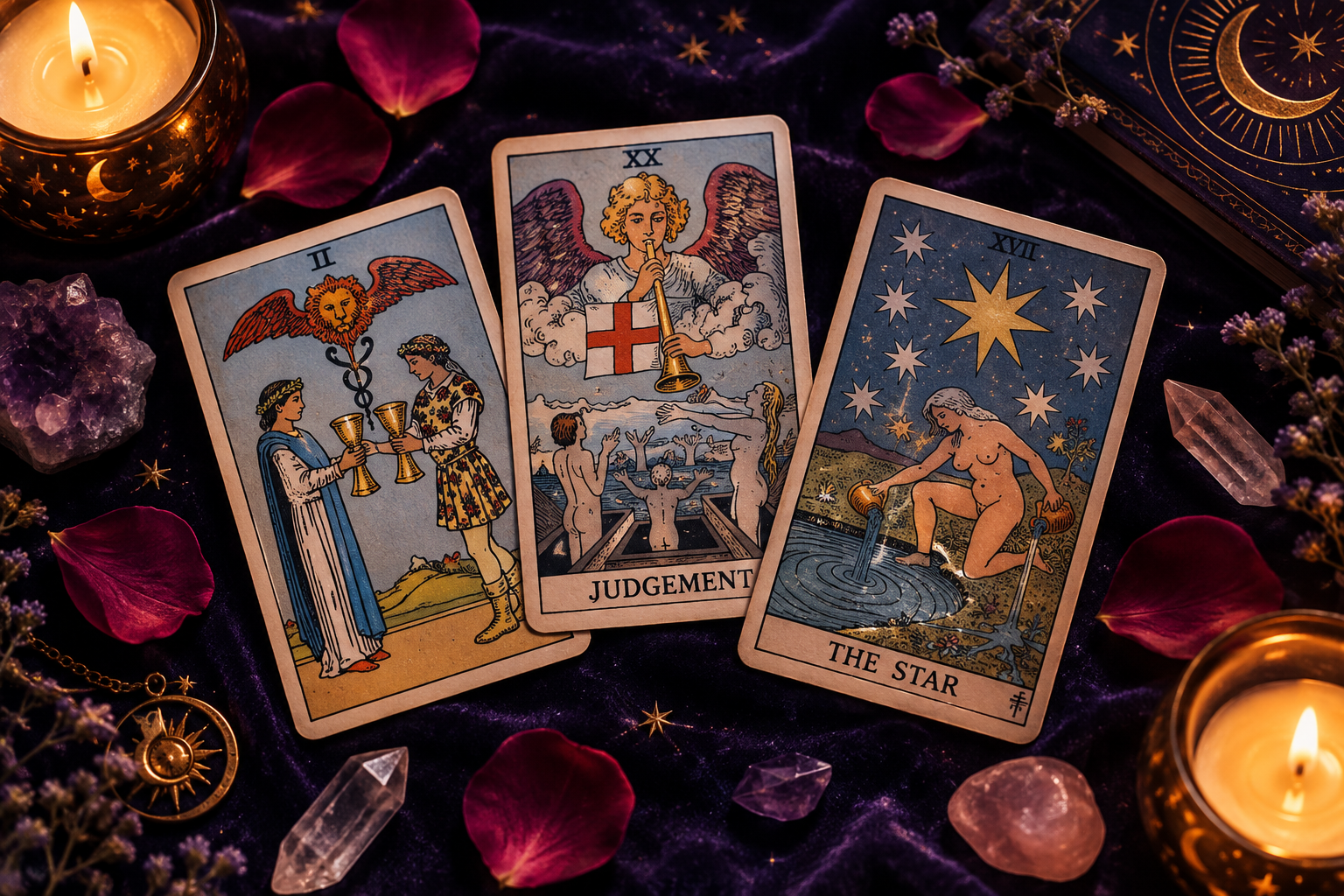
Card 2: What is being exaggerated. The overkill check. This position shows where the pain has been inflated, either by them or by you. A gentle card here (Star, Temperance, Six of Swords) means the ending is cleaner than it feels. A heavy card (Tower, Devil, Five of Pentacles) means the damage is as bad as it looks.
Card 3: What the dawn looks like. The first thing that gets better and when. Court cards here often describe a person; Pentacles suggest practical rebuilding; Cups point to emotional recovery with or without the other person.
Read the three together. The spread is not asking “will they come back.” It’s asking what’s true, what’s inflated, and what comes next.
FAQ
What does the Ten of Swords mean as feelings?
Someone feels emotionally finished with the connection: exhausted, betrayed or defeated to the point of giving up. Upright, that feeling is final and total. Reversed, the person is either slowly recovering or suppressing pain they haven’t dealt with. It is not a card of indifference; the person was hurt because they cared.
Is the Ten of Swords a yes or no card in love?
No. For questions about reconciliation, whether someone loves you now, or whether a relationship will continue in its current form, the Ten of Swords is a clear no. The one exception is a question like “is the worst over?”, where the dawn on the horizon makes it a yes.
What does the Ten of Swords reversed mean for feelings?
It means one of three things: genuine but slow recovery from the hurt, pain being suppressed and denied rather than healed, or refusal to accept that the relationship is over. Tell them apart by whether the person can speak openly about what happened. Open speech means recovery; deflection means the swords are still in.
How do I deal with the Ten of Swords in a reading?
Accept it as an accurate description of the present without treating it as a life sentence. Have one honest conversation instead of many anxious ones, allow yourself to grieve even if nothing is official, step back from an ex who is still wounded, and pull again in a few weeks to see whether the dawn has moved closer.
Does the Ten of Swords mean my ex still has feelings for me?
Upright, your ex still feels deeply hurt in connection with you, which is a form of feeling but not one that supports reconciliation right now. Reversed, they are somewhere in the healing process and may be able to think of you more warmly, though any reconnection built on unprocessed pain tends to repeat the original ending.