Death As Feelings In Love & Relationships (Upright & Reversed)
Pulling Death in the feelings position of a love reading almost always lands like a punch, but the card rarely means what the name suggests. In a feelings spot, Death describes someone whose emotions are going through an ending, a shedding, or a hard reset, and whether that is bad news for you depends on what surrounds it and where the relationship already stands. This guide covers the upright and reversed meanings for a partner, an ex, a crush, and for you when you are single, plus the combinations that change the answer.
The Card Itself Before the Interpretation
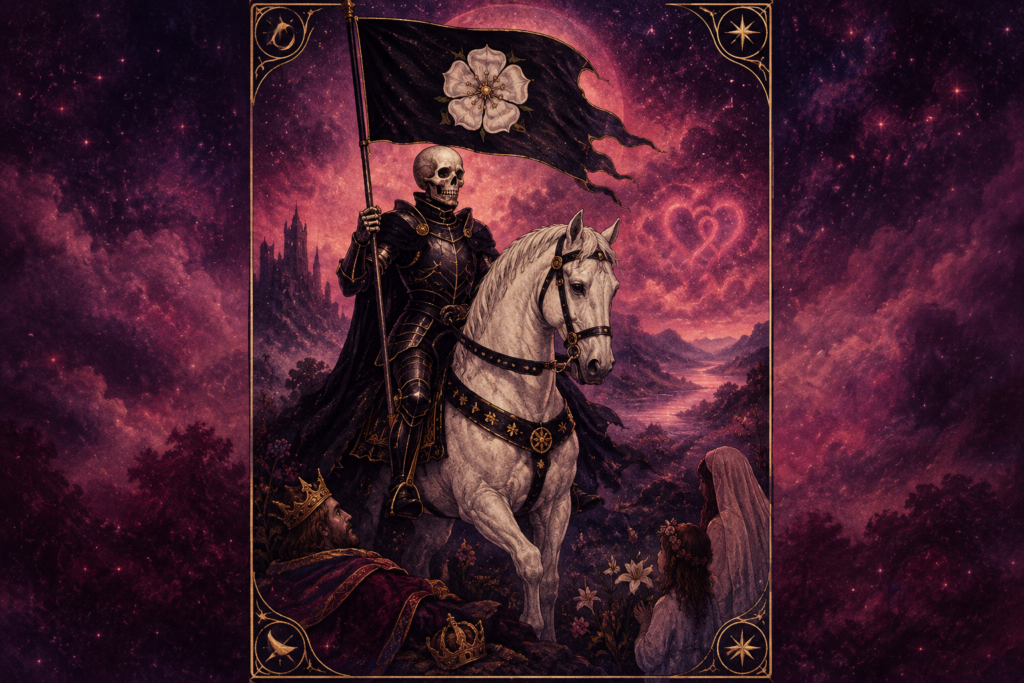
The Death card most people are holding comes from the Rider-Waite-Smith deck, drawn by Pamela Colman Smith and directed by Arthur Edward Waite, first published in 1909. Smith painted a skeleton in black plate armor riding a white horse. He carries a black banner bearing a white five-petaled rose. Beneath the horse a crowned king lies dead. A bishop in yellow robes faces the rider with his hands raised, a young woman kneels and turns her face away, and a small child holds out flowers, the only figure who looks directly at Death without fear. In the background a river runs toward the sea, a boat drifts on it, and the sun rises (or sets, Waite left it ambiguous on purpose) between two grey towers.
Each of those details carries into the feelings interpretation:
- Black armor: the change is impersonal and unstoppable. It is not about you being unlovable. It comes for the king as readily as the child.
- White horse: purity of intent. The ending clears rather than punishes.
- White rose on a black flag: something clean and living survives the loss. This is the single most reassuring symbol on the card.
- The rising sun between two towers: there is a morning after. The towers reappear on The Moon card, a reminder that what feels like an ending is a passage.
- The river and boat: feelings are in motion. Water is Death’s element, and Water in tarot is always emotion.
Death is numbered XIII. In tarot numerology 13 reduces to 4, the number of The Emperor, which is why readers often say Death removes what is unstable so that a sturdier structure can take its place. Astrologically the card is assigned to Scorpio, the fixed Water sign associated with intimacy, jealousy, obsession, and the kind of loyalty that either transforms or destroys a bond. That Scorpio energy is the reason Death as feelings is so often about intensity rather than absence.
Waite’s own divinatory meaning in The Pictorial Key to the Tarot is blunt: “End, mortality, destruction, corruption.” His reversed keywords are “Inertia, sleep, lethargy, petrifaction, somnambulism; hope destroyed.” Modern readers have softened the upright card into “transformation,” and that softening is fair, but keep Waite’s original in mind. He did not mean gentle change. He meant something is over.
Death as Feelings Is Not the Same as Death in a Love Reading
Most pages blur these together, and the confusion makes readers more anxious than they need to be.
Death in a general love reading speaks to the relationship as a whole: its stage, its future, whether it survives.
Death as feelings is a positional meaning. You asked “How does this person feel about me?” and the deck answered with Death. The card is now describing the internal emotional state of one specific person, not predicting the outcome of the relationship.
That matters because a person can be undergoing a total emotional overhaul while the relationship continues, and a relationship can end while the person’s feelings remain steady. When Death shows up in the feelings position, read it as a report on their inner weather. Use the outcome position, or a clarifier, for what happens next.
Death Upright as Feelings
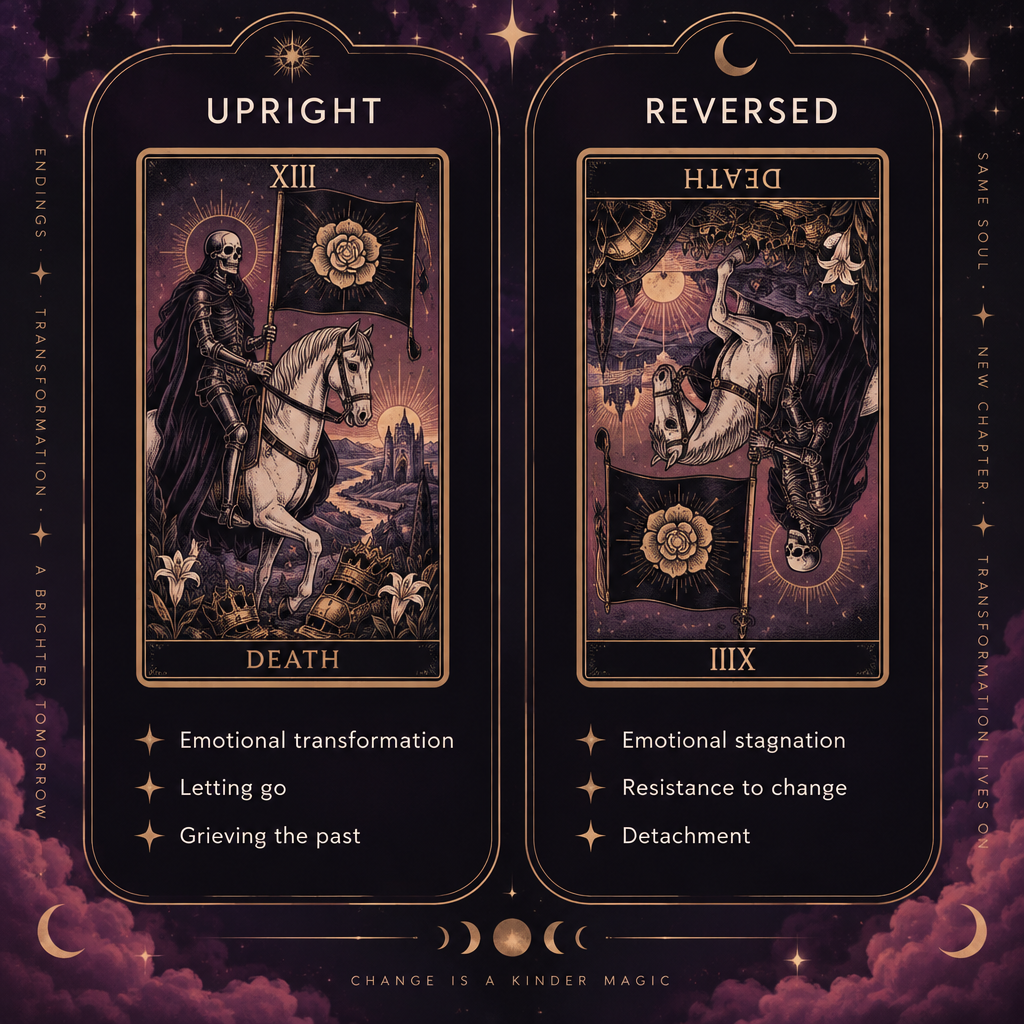
Upright, Death as feelings means this person’s emotions toward you have reached a point of no return. Something in how they felt has ended. The three most common versions in practice:
- They have let go of an old version of the connection. The infatuation stage died, or the resentment died, or the fantasy died. What remains is more honest than what came before.
- They are grieving something between you. A trust that broke, a future they had pictured, a role they used to play. Grief in the feelings position is not indifference. People do not grieve what they never cared about.
- They have detached. The feelings have run their course. This is the reading nobody wants, and it does happen, especially when Death sits next to cards of departure or completion (more on that below).
Notice that all three involve a person who is emotionally engaged. Death upright is a card of intensity being resolved, not a card of emptiness. Emptiness shows up as reversed Death, the Four of Cups, or the Two of Swords.
For an existing partner
Your partner is not feeling the same way they did a year ago, and pretending otherwise is over. Death here often coincides with a real-life threshold: moving in together, a health scare, a job loss, a baby, a betrayal that was discovered rather than confessed. Their feelings are reorganizing around that event.
The honest question to ask is whether the two of you have been having the conversation this card is describing. If your partner has been saying “I don’t think I can keep doing things this way” and you have been hearing it as a mood, Death is telling you it is not a mood. If instead the relationship has felt stale and quiet, Death can be the more welcome message that they are ready to bury the stale version and try something new with you.
For an ex
This is where the old version of this article was too optimistic, and the current tarot community is far more cautious. Death as your ex’s feelings means their emotional attachment to the relationship, as it was, has died. They have stopped replaying it. If contact has already ended, Death is confirming the ending has settled in for them, not hinting at a comeback.
Reconciliation is not impossible with Death, but it is conditional, and the conditions are strict:
- They are still in communication with you, voluntarily, and not only when drunk or lonely.
- Both people can name the specific pattern that killed the first version (not “we grew apart,” but “I shut down every time you raised money” or “you kept a door open to someone else”).
- Each person has already changed behavior, not promised to.
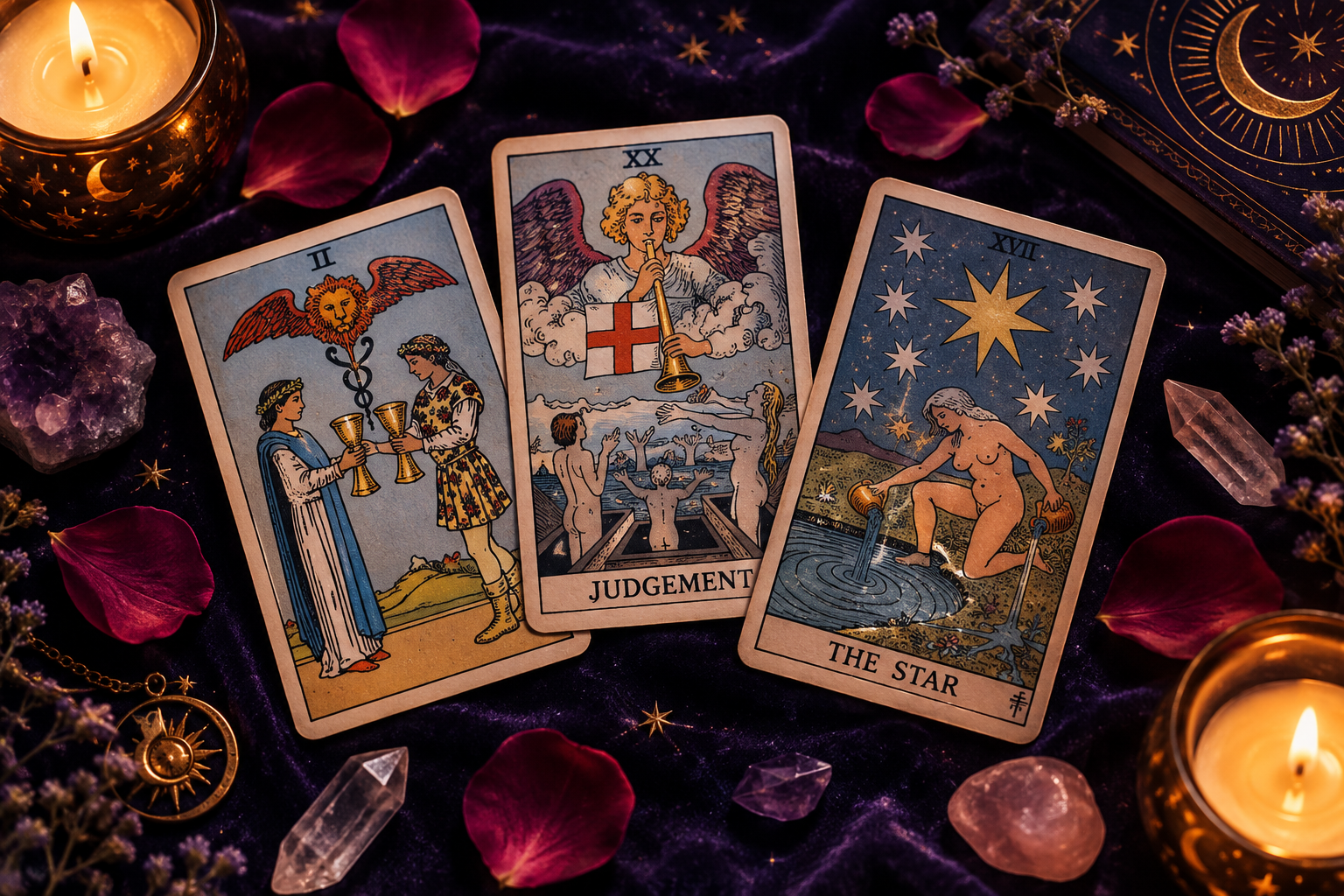
- Cards of renewal (The Star, Six of Cups, Ace of Cups, Judgement) appear alongside Death, not cards of departure.
Without those, Death beside an ex’s name is a closed chapter. Treat it as permission to stop checking their stories.
For a crush or a new love interest
Early-stage connections get Death more often than people expect, and it usually means one of two things.
The first is that your crush is coming out of something. A recent breakup, a divorce that is finalizing, a long situationship that just collapsed. Their feelings toward you are real but arriving during their own transition, which means they will be inconsistent for a while. They like you and they are also not fully available yet. Both things are true.
The second is that their perception of you just changed sharply. A conversation, a first date, a screenshot. Whatever the trigger, the person they thought you were is gone and they are recalibrating. This can flip either way. Death followed by the Knight of Cups or the Two of Cups says the recalibration landed in your favor. Death followed by the Eight of Cups or the Four of Swords says they are pulling back to think.
What Death almost never means for a crush is casual disinterest. Casual disinterest is the Four of Cups or the Page of Swords. Death is too heavy a card for someone who barely registers you.
When you are single
Death as your own feelings while single means you have finished mourning. The ex, the pattern, the fantasy of a specific type of person: it has died and you can feel the space it left. Readers frequently pull this card in the weeks right before meeting someone significant, because the psychological room finally exists.
It can also flag that you are the one who has to end something before love can arrive. A friends-with-benefits arrangement that quietly hurts. A text thread with an ex you keep alive “just to be friendly.” A dating app habit that has turned into a way of avoiding actual intimacy. The white rose says what you want is on the other side of that ending.
For him, for her, for them
The card does not change by gender, but the way it shows up in behavior often does, and readers ask these separately for a reason.
Death as his feelings tends to manifest as withdrawal that looks like coldness from the outside. He is processing an ending internally and saying almost nothing. Do not read silence as absence. Watch what he does over the following month rather than what he says this week.
Death as her feelings more often surfaces as an explicit conversation or a sudden change in how she talks about the future. She has reached a decision about what she can and cannot carry forward, and the change is already underway.
Death as their feelings (for a non-binary partner, or when you simply want a neutral read) keeps the core meaning: this person’s emotional relationship with you is being rebuilt from the foundation, and the old blueprint is gone.
These are tendencies, not laws. Use them as a check against your own assumptions, not as a substitute for asking the person.
Does Death Mean They Have No Feelings for Me?
No. This is the question behind nearly every search for this card, so it deserves a direct answer.
Death as feelings means their feelings are transforming, not that they are absent. Absence of feeling in tarot is quiet: the Four of Cups (bored), the Two of Swords (walled off), the Hermit (elsewhere entirely), reversed Ace of Cups (nothing flowing). Death is loud. It describes someone whose emotional life around you is in upheaval, and upheaval requires investment.
That said, transformation includes the possibility that romantic love is transforming into something else: respect, friendship, nostalgia, or a clean release. Death does not guarantee the new form is romantic. It guarantees the old form is finished. If you need to know which direction it went, pull a clarifier. A Cup card says the feeling survived in some form. A Sword card says they have thought their way out of it. A Pentacle says practical realities are deciding for them. A Wand says passion is still alive but restless.
Death Reversed as Feelings
The old version of this article stopped at “resistance to change.” Waite’s reversed keywords, inertia, sleep, petrifaction, point to something wider. Death reversed as feelings covers a spectrum, and where a person sits on it changes your next move.
Stagnation. They know something has to end and refuse to let it. Every conversation about the relationship circles the same three sentences. This is the most common reversed meaning and the most fixable, because the awareness is there.
Fear of commitment. Death reversed frequently appears for someone who wants you but cannot let their single identity die. They keep one foot in the old life. The white rose is still on the flag, but the rider has dismounted and is standing around.
Lack of vulnerability. Related but distinct. They cannot let the guarded version of themselves die, so intimacy stays shallow no matter how long you have been together. Look for the Knight of Swords or the Seven of Swords nearby.
Unhealthy attachment or obsession. This is the Scorpio shadow. They cannot release a version of the relationship (or of you) that no longer exists. With an ex this looks like monitoring, showing up, or reopening old wounds on a schedule. It is a form of strong feeling, and it is not a healthy one.
Emotional numbness. They went through the ending badly and never processed it, so now nothing gets through. Waite’s “petrifaction.” They are not against you; they are not feeling much of anything.
Indifference. At the far end, reversed Death is the one reading where “they don’t care anymore” is a fair interpretation, particularly when it sits beside the Four of Cups or the Five of Pentacles. The difference from upright Death is that nothing is transforming. It simply stalled and hollowed out.
Reversed Death as your own feelings while single is worth a hard look. It usually means you are still emotionally married to a past relationship or to a story about why you are alone, and the deck is telling you the delay is self-imposed.
How Surrounding Cards Change the Answer
Death rarely sits alone. The card next to it, especially the one drawn immediately after, decides which of the meanings above applies.
| Death with… | What it does to the feelings reading |
|---|---|
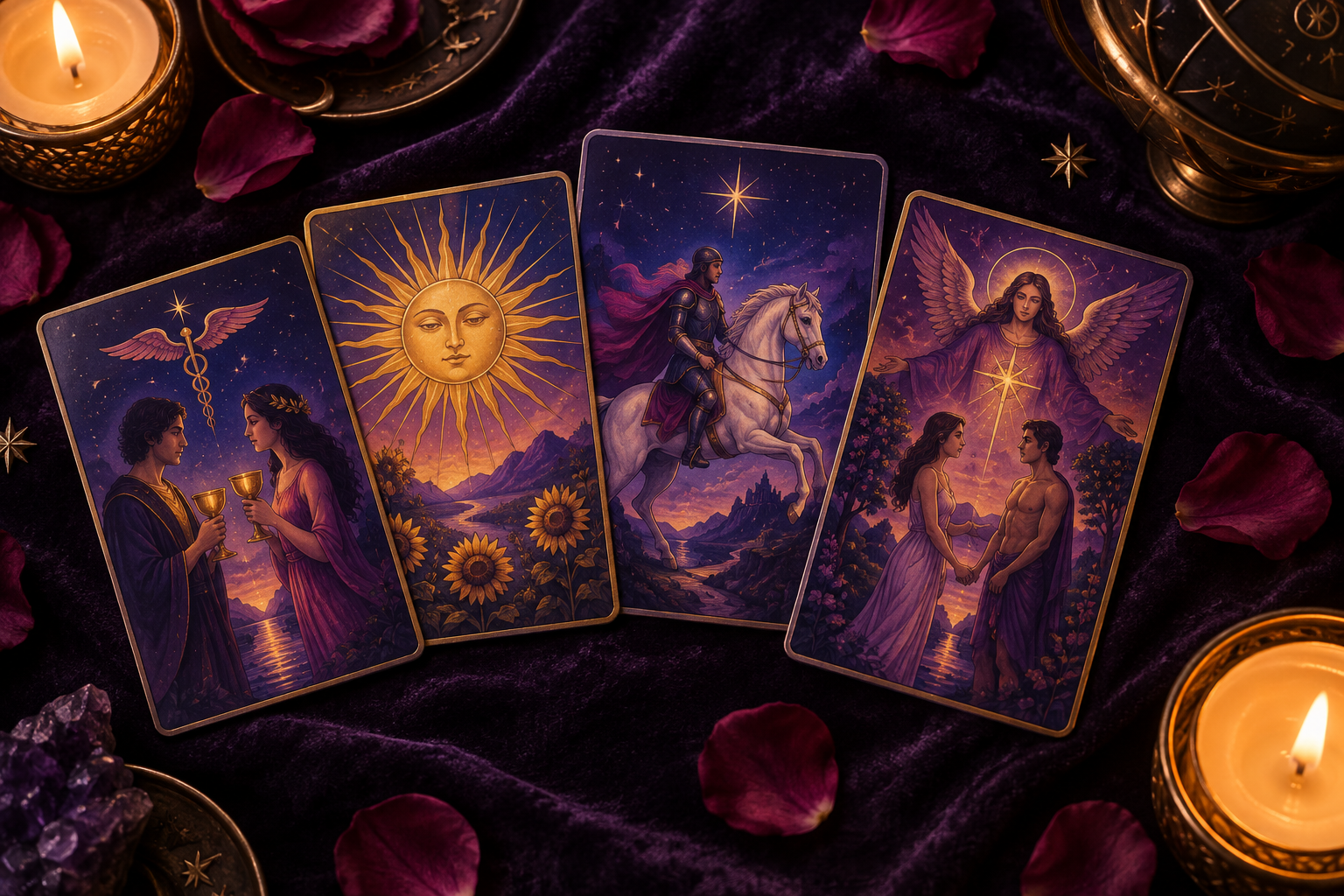
| Two of Cups | The old version died so a real partnership can form. One of the strongest positive combinations for Death. Their feelings have deepened past attraction into commitment. |
| Eight of Cups | They are walking away, and they have made peace with it. Read as an ending unless reconciliation cards also appear. |
| Ten of Swords | The ending was painful and, in their mind, absolute. Betrayal or exhaustion is the story. Do not chase. |
| The Tower | The change was sudden and external. Something happened, they did not choose it, and their feelings are in shock rather than in resolution. Give it time before drawing conclusions. |
| The Star | Healing after the loss. Whatever died, hope for you specifically survived it. Frequently seen when an ex is genuinely reconsidering. |
| Three of Swords | Grief over the relationship, often with lingering hurt directed at you. Feelings present but wounded. |
| The Lovers | A conscious choice to end one thing in order to choose you. Very favorable. |
| Six of Cups | Nostalgia. They are letting the present version die while romanticizing the past. Common with exes who text on anniversaries. |
| Four of Cups | Stalled and bored. With reversed Death this is indifference confirmed. |
| Judgement | A final reckoning with the relationship, followed by clarity. Whatever they decide, they will not waver. |
What Death Feelings Are Not
Three cards get confused with Death in the feelings position, and separating them sharpens the reading.
Ten of Swords is a defeat. The person feels finished off, betrayed, flat on the ground. Death is a passage; Ten of Swords is a wall. Ten of Swords feelings contain blame. Death feelings usually do not.
Eight of Cups is a departure by choice. The person is leaving something that is still technically fine because it stopped being enough. Death does not require a choice. It arrives. Eight of Cups feelings are wistful and deliberate; Death feelings are more like being carried by the river on the card.
The Tower is a shock. Feelings under The Tower are chaotic and reactive, often in the first days after a revelation. Death is what comes afterward, when the dust has settled and the person has accepted that the structure is gone.
Is Death a Yes or a No for Feelings?
For “Do they have feelings for me?” Death is a yes, but changed. Something real exists and it is not what it used to be.
For “Will we get back together?” Death upright is a no unless renewal cards accompany it and real-world behavior matches. Reversed, it is a no with an asterisk: they are stuck, not moving toward you.
For “Are they falling for me?” in a new connection, Death is a not yet. They are clearing something out first.
Yes-or-no readings flatten a card this layered, so use the answer as a headline and read the surrounding cards for the article.
A Three-Card Spread for Death as Feelings
When Death lands in a feelings position and you want to understand it rather than just react, lay three more cards below it:
- What is ending for them. The specific feeling, belief, or pattern Death is clearing.
- What is forming in its place. The white rose. What survives or grows.
- What they need from me right now. Space, honesty, patience, or distance.
Pull these from the same shuffled deck without reshuffling so the reading stays connected. If the third card is the Hermit, the Four of Swords, or the Eight of Cups, the answer is space, and the kindest thing you can do is give it.
What to Do After Pulling Death as Feelings
Whether you read with a physical deck, through an online reader, or with one of the AI tarot apps that have become common since 2024, the card asks the same thing of you: stop negotiating with the ending.
- If it is a partner, open the conversation the card is describing. “I feel like something shifted for you, and I would rather hear it than guess.” Then listen without defending.
- If it is an ex and contact has ended, take Death as the answer. It is not a loophole. Block the impulse to reach out for at least thirty days and watch how the grief changes when you stop feeding it.
- If it is an ex and you are still talking, name the pattern that killed the first version and ask whether they can name it too. If they cannot, there is nothing to rebuild on.
- If it is a crush, hold steady and give them room to finish whatever they are exiting. Do not audition for a role in a life that is still being rebuilt.
- If it is you, and you are single, identify the one attachment you have not let die, and end it this week.
Death rewards people who act like the child on the card: looking straight at it, flowers in hand.
FAQ
What does Death mean as someone’s feelings for me?
Their feelings toward you are undergoing an ending and a reorganization. The way they used to feel is over. Whether what replaces it is deeper love, friendship, or release depends on the surrounding cards, but the card confirms real emotional investment. Indifferent people do not pull Death.
Does Death mean they love me?
Not on its own. Death says their emotional relationship with you is transforming, which is compatible with love deepening (especially beside the Two of Cups, The Lovers, or The Star) and also with love fading into something quieter (beside the Eight of Cups or Six of Cups). Pull a clarifier to see the direction.
Is Death a yes or no as feelings?
For “Do they feel something?” it leans yes, with the caveat that the feeling has changed. For “Will we reconcile?” it leans no unless renewal cards appear and their real-life behavior has changed.
What does Death reversed mean for feelings?
A stuck state somewhere between resistance and numbness. The person either refuses to let something end (stagnation, fear of commitment, obsession) or has shut down after an ending they never processed (numbness, indifference). Neighboring cards tell you which end of the spectrum they are on.
Can Death as feelings mean reconciliation with an ex?
Only conditionally. If you are still in voluntary contact, both of you can name what broke the relationship, behavior has already changed, and cards like The Star or Judgement sit nearby, Death can mark the death of the old relationship so a new one can begin. If contact has ended, Death confirms the ending has settled for them.
Does Death mean they have moved on?
Sometimes, but “moved on” and “stopped caring” are different things. Death frequently describes someone who has accepted the relationship is over while still carrying real feeling about it. Beside the Eight of Cups or Ten of Swords, yes, they have moved on. Beside the Three of Swords or Six of Cups, they are still grieving.
Why does Death keep showing up in my love readings?
Repeated Death pulls usually mean you are asking about something that has already ended and looking for a different answer. The deck is not changing its mind. Consider reading on what you should release instead of how they feel.
What zodiac sign is the Death card?
Scorpio, the fixed Water sign. This is why Death as feelings carries intensity, depth, and occasionally possessiveness rather than the emptiness the name implies.