

The Hierophant As Feelings In Love & Relationships (Upright & Reversed)
Pulling the Hierophant in a feelings position means the person you asked about is thinking about you in terms of commitment, loyalty, and the long game, not a fling. This guide breaks down what that looks like upright and reversed, and how it changes depending on whether you are single, newly dating, years into a relationship, or wondering about an ex.
What the Hierophant Actually Is
Before reading the Hierophant as an emotion, it helps to know what the card is built from, because every feelings interpretation grows out of its imagery.
The Hierophant is card V of the Major Arcana. In older Marseille-style decks it was simply called The Pope, and the Rider-Waite-Smith version keeps that look: a robed figure wearing the triple papal crown, seated between two stone pillars, right hand raised in a two-fingered blessing, left hand holding a triple-barred cross. Two acolytes kneel at his feet, one wearing roses (desire, the body) and one wearing lilies (purity, the spirit). Between them lie two crossed keys, the keys that unlock sacred knowledge and, in a love reading, the knowledge of how to make a bond last.
Astrologically the card belongs to Taurus, a fixed Earth sign ruled by Venus. That pairing matters more than people realise. Taurus is slow, loyal, sensual, stubborn, and allergic to change. Venus is love and pleasure. Put them together and you get affection that moves at a glacier’s pace but, once settled, does not move at all. That is the emotional signature of the Hierophant.
The other name for the card, the High Priest, points to its role as keeper of rules and rituals. In relationships that translates into vows, family approval, anniversaries, religious or cultural traditions, and the unspoken contract of “this is how we do things.”
The Short Answer: What They Feel About You
If you asked “how does this person feel about me?” and the Hierophant came up upright, they see you as someone worth being serious about. Not necessarily passionate about yet, and not necessarily head over heels, but serious. They are weighing you against their idea of a life partner, and so far you fit.
Specific feelings the upright Hierophant carries in the third-person position:
- Respect that borders on reverence. They admire your values, your steadiness, or the way you treat people.
- Trust. They believe you would not betray them, and that belief is a big part of the attraction.
- A desire for legitimacy. They want the relationship to be recognised: by friends, by family, by law, or by the small rituals of a shared life.
- Protectiveness mixed with duty. They feel responsible for you and would feel guilty letting you down.
What the upright Hierophant does not carry is spontaneity or fireworks. If you were hoping for “they are crazy about me,” this card will feel lukewarm. Read it correctly and it is actually one of the most reassuring cards for long-term potential, because the feelings it describes are the ones that still exist after the chemistry fades.
Reversed, the picture flips. They feel pressure, boredom, or a pull toward something less conventional than what you (or the situation) seem to require. More on that below.
Upright Hierophant as Feelings
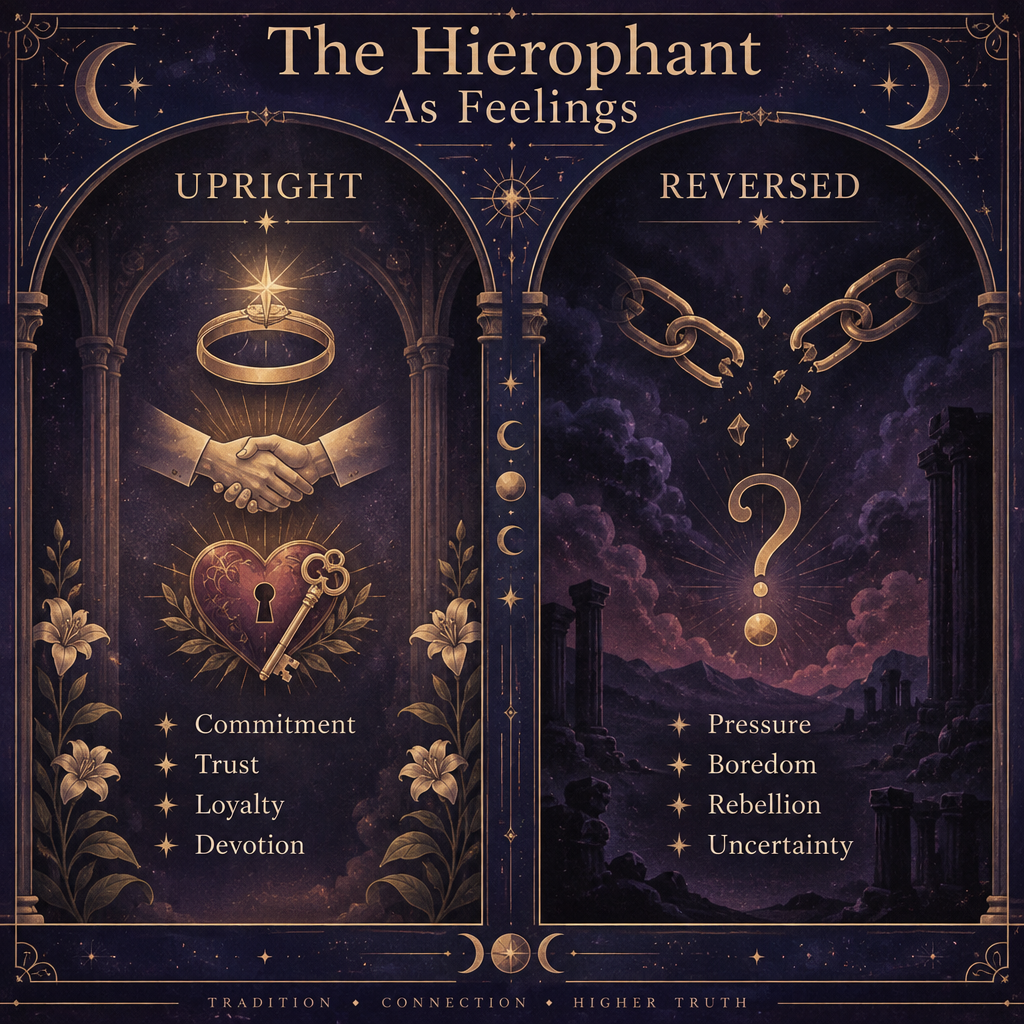
At its core, the upright Hierophant describes love that wants structure. The person feels drawn to you in a way that makes them think about the future, about doing things “properly,” and about whether you share their beliefs. The emotional temperature is warm rather than hot. Think devotion, not infatuation.
For Singles, Crushes, and Someone You Just Met
When you ask how a new acquaintance or crush feels about you and get the Hierophant, they are not treating this casually. Either they have already imagined introducing you to their parents, or they are consciously holding back because they only date with intention. Many people who pull this card about a crush are frustrated by how slowly things move. That slowness is the Taurus influence: the person wants to be sure before they commit even a text.
There is a second possibility to rule out. The Hierophant can indicate that the person feels friendship, mentorship, or a kind of elder-sibling fondness rather than attraction. Check the surrounding cards. The Hierophant next to the Two of Cups, the Ace of Cups, or the Knight of Cups is romantic interest moving at a deliberate pace. Next to the Hermit or the Three of Pentacles, it leans toward respect without romance.
What to do:
- Let them set the tempo for the first few weeks. Pushing a Hierophant-type into fast intimacy makes them retreat.
- Signal your own seriousness through consistency rather than grand gestures. Reply when you say you will. Show up on time.
- Talk about values early. This person is quietly assessing compatibility on religion, family, money, and life goals, and they appreciate someone who brings it up openly.
In a New Relationship
In the early months, the Hierophant as their feelings means they have mentally shifted you from “dating” to “partner.” They want exclusivity if it has not been agreed yet, and they want to define the relationship in plain terms. Expect conversations about meeting families, holidays together, and how you each see the next few years.
They also feel a need to follow the proper order of things. Living together before certain milestones, or skipping steps they consider important, may genuinely bother them even if they cannot articulate why. This is not controlling behaviour (that would be the Emperor or the Devil). It is a belief that doing things in sequence protects the relationship.
What to do:
- Ask directly what commitment means to them. Their answer will be concrete: a label, a timeline, a shared lease, an introduction to a specific relative.
- Match their effort in building rituals. Weekly dinners, a shared calendar, a standing call with family. These feel like love to a Hierophant partner.
- Avoid treating their traditionalism as a flaw to fix. If your values genuinely clash, say so now, because this card does not bend easily later.
In an Existing or Long-Term Relationship
Here the Hierophant is one of the best cards you can pull. Your partner’s feelings have settled into what psychologist Robert Sternberg calls companionate love in his Triangular Theory: high intimacy, high commitment, lower passion. They are not going anywhere. They see you as family in the deepest sense, and the relationship is part of how they understand themselves.
For married couples the card frequently shows up when the partner is thinking about renewing vows, having children, buying a home, or deepening a shared faith practice. For unmarried long-term couples it is the classic “they are thinking about proposing” card, especially alongside the Four of Wands, the Ten of Cups, or the Ten of Pentacles.
The shadow side of upright Hierophant feelings in a long relationship is complacency. Your partner may love you steadily and still have stopped noticing you. The devotion is real; the attention is on autopilot.
What to do:
- If passion has dropped, address it as a project rather than a crisis. Hierophant partners respond well to structure, so schedule the date nights and the trips.
- Celebrate the rituals they care about. Forgetting an anniversary wounds this person more than most.
- Use their loyalty as a base for honest conversations. They are not going to leave because you raised a hard topic.
About an Ex or Reconciliation
When you ask what an ex feels and the Hierophant appears upright, they still regard the relationship as significant, possibly as the standard they measure others against. There is often lingering guilt about how it ended, particularly if they believe they broke a promise. In some readings the ex feels the two of you had a bond that was almost sacred and that ending it was a kind of transgression.
Does that mean they want you back? Not automatically. The Hierophant describes how they frame the relationship, not necessarily what they intend to do about it. Reconciliation is more likely when the card sits beside the Six of Cups, the Two of Cups, or Judgement. If it sits beside the Five of Cups or the Three of Swords, the ex respects what you had but has filed it under lessons learned.
What to do:
- If you want reconciliation, approach it formally. A long, honest message or a face-to-face conversation suits this card. A casual “hey stranger” text does not.
- Be ready for them to raise the issue that broke the structure the first time. They will want evidence it has changed.
- If you do not want them back, know that this card suggests they will not spiral or lash out. Their feelings are stable, even in disappointment.
Reversed Hierophant as Feelings
The reversed Hierophant is where this card gets interesting, and where most short interpretations fail readers. The reversal does not simply mean “no commitment.” It describes a specific set of emotional states, and you need to work out which one applies.
Rebellion against expectation. The person feels suffocated by what the relationship is supposed to look like. The pressure may come from you, from their family, from their religion, or from their own earlier promises. Their feelings toward you can be genuinely warm while their feelings toward the structure around you are hostile.
Fear of commitment. This is the most common reading. They like you, perhaps a lot, but the thought of being locked in triggers a flight response. The reversed Hierophant differs from the Fool or the Knight of Wands here: it is not carefree avoidance, it is anxious avoidance. They have watched commitment go wrong, often in their own parents’ marriage, and they associate vows with traps.
Stagnation and boredom. In established relationships, the reversed card frequently means the person feels the routines have hardened into a cage. Same conversations, same Sunday lunch, same scripts. They may be mentally checked out while still showing up.
Non-conformity and unconventional structures. Sometimes the reversal is not negative at all. The person wants a relationship that does not follow the standard template: no marriage, living apart together, non-monogamy, a partnership that crosses faith or cultural lines their families would reject. Their feelings for you are real; they just refuse to express them in the expected form.
Hypocrisy. The darkest reading. The person says they value loyalty and tradition but acts otherwise. They preach fidelity and cheat, or demand respect they do not give. If this card appears with the Seven of Swords, the Moon, or the Devil, take the hypocrisy reading seriously.
Reversed for Singles and New Connections
A new person who comes up as the reversed Hierophant is attracted to you but allergic to anything that smells like a path to the altar. They may be recently out of a controlling relationship or a strict upbringing and are deliberately keeping things undefined. Alternatively, they may see you as “too conventional” for them, or themselves as too unconventional for you.
What to do:
- Do not force a label in the first month. Let the connection prove itself before you ask it to name itself.
- Ask what commitment has looked like in their past. The answer usually explains the reversal.
- Decide what you can live with. If you need marriage and they are openly against it, the card is telling you now, which is a gift.
Reversed in a Couple
For established couples, the reversed Hierophant as your partner’s feelings signals restlessness with the form of the relationship rather than with you. They may want to renegotiate roles, drop traditions that feel empty, or reject outside interference from in-laws or community. Occasionally it means they are questioning a shared belief system, which can feel like a betrayal if faith was part of your bond.
What to do:
- Open the question of which rules in your relationship are chosen and which are inherited. Many couples find half their routines came from nobody’s actual preference.
- Watch for double standards. If they want freedom they are unwilling to extend to you, name it.
- Treat boredom as information, not insult. The reversed Hierophant rarely means they have fallen out of love. It means the container needs redesigning.
Reversed About an Ex
An ex showing up as the reversed Hierophant feels the old relationship was too confining, or regrets how rigid they themselves were inside it. Some exes with this card have rejected the whole framework the relationship was built on, such as a religion or family expectation, and cannot separate you from it. Others have swung the opposite way and now resent having let the relationship end over rules that no longer matter to them.
Reconciliation under this card is possible only if the new version of the relationship is noticeably different from the old one. The same structure will produce the same break.
What to do:
- If they reach out, ask what they want to be different. If the answer is “nothing, I just miss you,” expect a repeat.
- Do not accept vague promises of change. The reversed card is specifically about commitment that does not hold.
- If they left because of outside pressure (family, faith), find out whether that pressure has actually gone.
Upright vs Reversed at a Glance
| Upright Hierophant | Reversed Hierophant | |
|---|---|---|
| Core feeling toward you | Respect, devotion, desire for legitimacy | Attraction tangled with pressure or restlessness |
| Emotional tone | Steady, warm, formal | Conflicted, bored, or defiant |
| Love language they express | Acts of service, reliability, keeping promises | Inconsistent; may withhold the gestures tradition expects |
| Relationship outlook | Long-term, marriage-minded, slow build | Undefined, unconventional, or stalled |
| Attachment pattern | Secure, sometimes rigid | Avoidant or anxious-avoidant |
| Conflict triggers | Broken promises, disrespect toward family or faith | Being labelled, scheduled, or told how things “should” be |
| Best supporting cards | Two of Cups, Four of Wands, Ten of Pentacles | Judgement, the Star (for genuine renewal) |
| Warning cards | Hermit, Four of Cups (respect without romance) | Seven of Swords, Devil (hypocrisy, deceit) |
The Psychology Behind Hierophant Feelings
Tarot readers increasingly cross-reference cards with relationship psychology, and the Hierophant maps onto several frameworks cleanly.
Attachment style. Upright, the card is the closest thing in the deck to secure attachment: the person feels safe in closeness, does not panic at commitment, and expects relationships to last. Pushed too far, it tips into rigidity, where security depends on everyone following the rules. Reversed, you are looking at avoidant attachment, specifically the dismissive kind that treats structure as a threat to autonomy.
Love languages. Gary Chapman’s framework gives the Hierophant two native tongues: acts of service and, more subtly, the language of reliability. Hierophant feelings are expressed by fixing the car, remembering the appointment, paying the bill, and showing up at the family event. Words of affirmation come less naturally, which is why partners of Hierophant types sometimes feel unloved despite being extremely well cared for.
Sternberg’s Triangular Theory. Of the three components (intimacy, passion, commitment), the Hierophant is overwhelmingly weighted toward commitment, with intimacy second and passion a distant third. That makes it companionate love in Sternberg’s terms when upright. Reversed, the commitment leg collapses, leaving either liking (intimacy alone) or infatuation (passion alone) with no structure to hold them.
How Hierophant Feelings Differ From the Lovers, the Emperor, and the Devil
These four cards are routinely confused in feelings readings because all can indicate strong attachment. They describe very different emotions.
| Card | What they feel | How it shows up |
|---|---|---|
| The Hierophant | Devotion and the wish to formalise | Talks about the future, family, doing things properly |
| The Lovers | Passionate attraction and a sense of choice | Intense chemistry, feels like fate, but may still be deciding |
| The Emperor | Protective desire to provide and lead | Takes charge, plans, can tip into control |
| The Devil | Obsessive attraction, often physical | Cannot stay away, jealousy, feels bound rather than committed |
The Lovers is choice; the Hierophant is the vow after the choice. The Emperor wants to build the household; the Hierophant wants it blessed. The Devil wants you and resents wanting you; the Hierophant wants you and is at peace with it.
Is the Hierophant a Yes or No for Feelings?
Upright, yes. It confirms genuine, durable feelings and an intention to commit. It is a yes with a built-in condition: things will happen on their timeline and inside their value system.
Reversed, it is a conditional no. Feelings may exist, but the person is not willing or able to commit in the form you want right now. Whether that changes depends on whether the obstacle is external (family, faith, timing) or internal (fear, boredom, hypocrisy). External obstacles can shift. Internal ones require the person to do the work, and the card gives no promise they will.
Twin Flames and Soulmates
The Hierophant is more a soulmate card than a twin flame card. Twin flame readings run on intensity, separation, and mirroring, which belong to the Lovers, the Tower, and the Two of Cups. The Hierophant describes the quieter recognition of someone you could build a whole life around. People in Hierophant-coded relationships often say “it just felt right” rather than “it was electric.” In a twin flame context, the upright card points to the union phase, when the drama has settled into shared daily life. Reversed, it suggests one party is resisting the structure the connection seems to demand.
What to Do When You Pull the Hierophant in a Feelings Reading
- Check the orientation and neighbours first. The same card means marriage-minded devotion next to the Four of Wands and friendly respect next to the Hermit.
- Translate their love language. If the person expresses care through reliability and you need verbal reassurance, say so plainly. Hierophant types respond to clear requests.
- Audit your own values. The card asks whether you actually want a traditional, commitment-first relationship. If you want freedom and spontaneity, an upright Hierophant partner will frustrate you even though their feelings are sincere.
- Slow down your expectations. Taurus energy does not rush. Give the connection a season, not a week.
- If reversed, identify which reversal. Fear, boredom, rebellion, non-conformity, and hypocrisy require five different responses. Pull a clarifier if needed.
A Three-Card Hierophant Feelings Spread
Lay three cards in a row after the Hierophant appears:
- Card 1: What they value most in a partner. Compare it against what you offer.
- Card 2: What structure they want the relationship to take. Marriage, exclusivity, something looser, something hidden.
- Card 3: What would make them break or deepen the commitment. This is the card to act on.
Read the three together with the Hierophant above them. The Hierophant tells you commitment is the theme; the spread tells you what commitment specifically means to this person.
FAQ
Does the Hierophant mean he wants to marry me?
Upright, in a feelings position, it means marriage or an equivalent formal commitment is on his mind as a serious possibility. It does not mean a proposal is imminent. Look for the Four of Wands, Ten of Cups, Ten of Pentacles, or Two of Cups nearby to confirm intent moving toward action. The Hierophant alone describes the frame of mind, not the date.
Is the Hierophant a yes or no card for feelings?
Yes when upright: the feelings are real, loyal, and commitment-oriented. A conditional no when reversed: feelings may be present but the person is resisting the commitment the situation calls for.
What does the Hierophant reversed mean for an ex’s feelings?
Your ex feels the relationship was too restrictive, or regrets rules they imposed on it. They may be rejecting the whole value system the relationship sat inside. Reconciliation is only realistic if the new relationship would look structurally different from the old one.
How is the Hierophant different from the Lovers as feelings?
The Lovers describes attraction and a choice being made, usually with strong chemistry. The Hierophant describes the settled commitment that follows a choice already made. The Lovers feels like falling; the Hierophant feels like landing.
Can the Hierophant mean they only see me as a friend?
Occasionally. The card can show respect, mentorship, or deep friendship without romantic desire. Surrounding cards decide it. Cups cards push it toward romance; the Hermit, Three of Pentacles, or Four of Cups push it toward respect without attraction.
Does the Hierophant as feelings mean they are religious or conservative?
Not necessarily. It means they take commitment and shared values seriously. For some people those values are religious; for others they are about family, culture, or personal ethics. The reversed card is more likely to show someone actively rejecting a religious or conservative framework.
What does the Hierophant mean for how someone feels after a first date?
They enjoyed it and are already evaluating you as potential long-term material rather than a casual option. Expect them to move carefully and to be more interested in your values and life plans than in rapid physical escalation.