Ten Of Cups As Love Advice (Upright & Reversed) Tarot Card Meaning
You pulled the Ten of Cups in a love reading and want to know what it is actually telling you, not a vague promise of “happiness.” This guide walks through the card’s imagery, its upright and reversed messages, and specific advice for singles, new couples, long-term partners and anyone weighing a reconciliation. It also covers the Ten of Cups as feelings, as a yes-or-no answer, and how it differs from its near neighbours in the deck.
What the Ten of Cups Shows
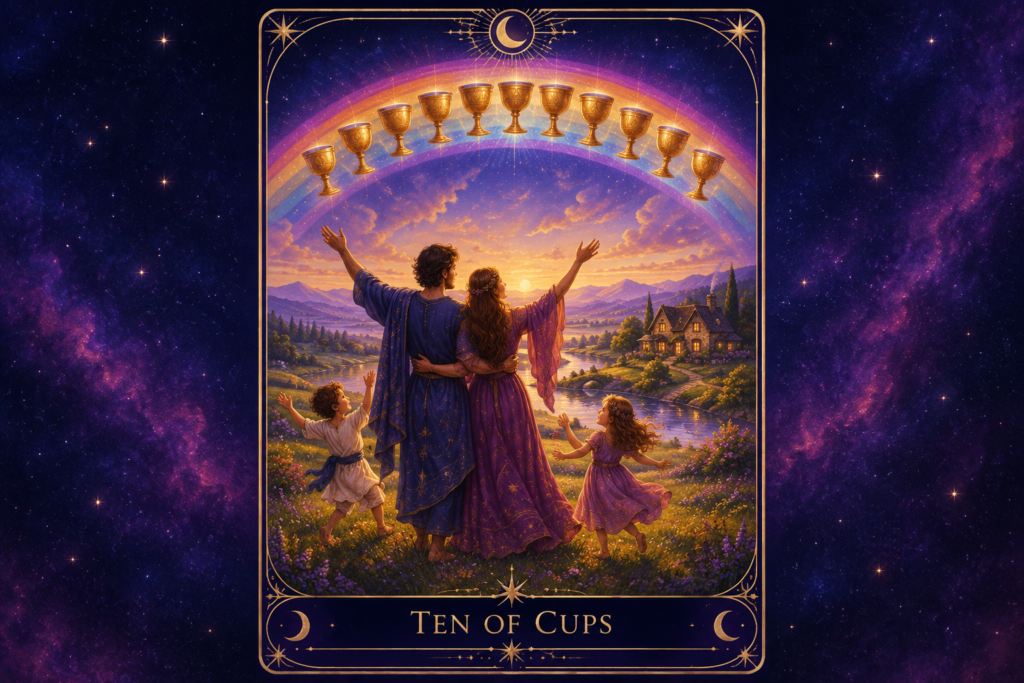
In the Rider-Waite-Smith deck, a couple stands with their backs to you, arms raised toward a rainbow holding ten golden cups. Beside them, two children dance and hold hands. A modest house sits on a rise in the distance, with a river and green hills running through the scene. Nobody in this image is looking at the viewer. They are looking at their life together.
Each detail carries a specific piece of love advice:
- The rainbow appears after rain. The card does not promise a relationship without storms. It promises that a relationship can come through them and be better for it.
- The ten cups in an arc show emotion that has been fully poured, sorted and settled. Nothing is spilling, nothing is hidden behind the couple’s backs.
- The couple’s open arms signal gratitude and shared vision. They face the same direction, which is the real test of compatibility. Shared values matter more than shared hobbies.
- The dancing children represent play, legacy and the future, whether that means literal children, pets, a creative project, or a chosen family you build together.
- The house and river ground the whole picture in daily life. This is not a honeymoon card. It is a Tuesday-evening, dinner-on-the-table, we-are-fine card.
Other decks handle it differently, and it helps to know this if you do not read with the RWS. The Thoth deck titles it “Satiety” and shows ten cups arranged on the Tree of Life with water overflowing, hinting that the fullness can tip into excess. The Marseille deck gives you ten plain cups with no figures at all, so readers lean on the number and suit alone. The advice below works across all three, but the family imagery is RWS-specific.
Ten of Cups Keywords in Love
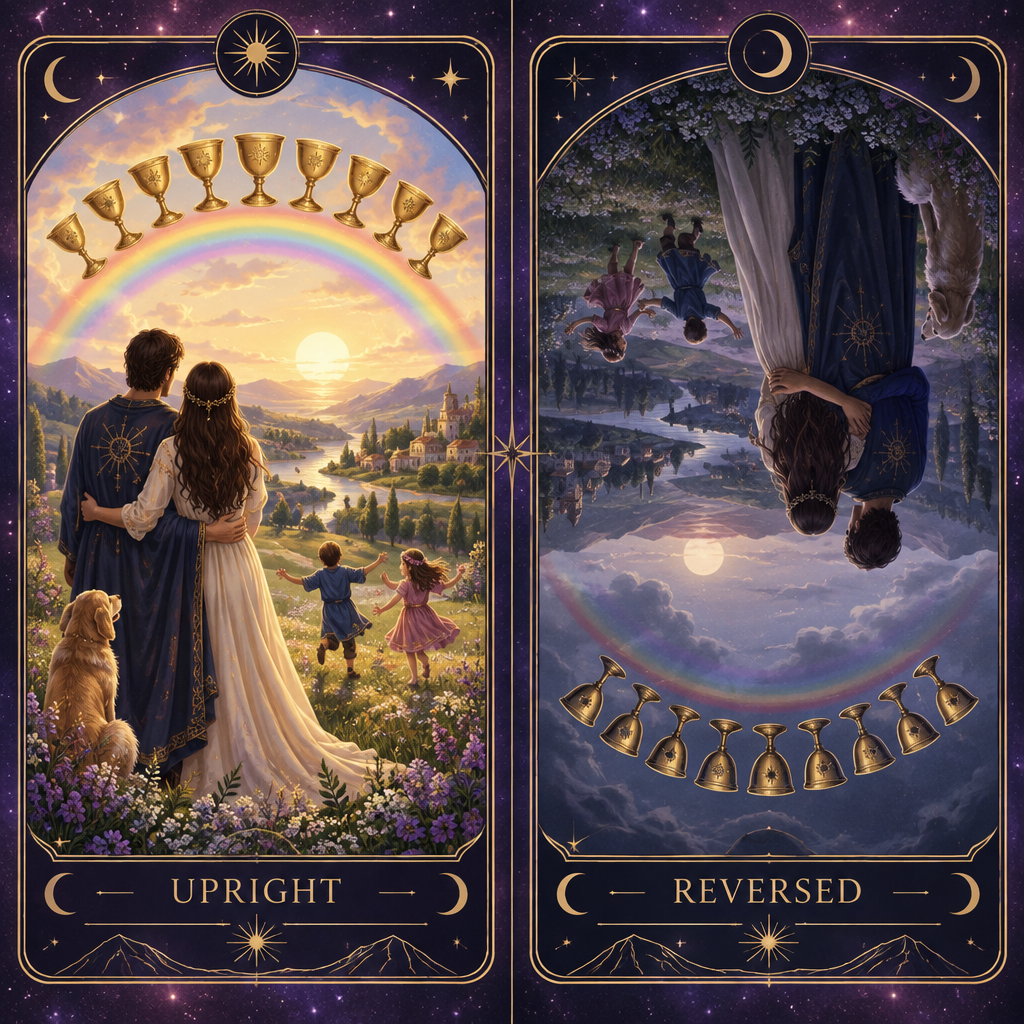
Upright
| Theme | What it points to in a love reading |
|---|---|
| Divine or lasting love | A bond that feels fated and holds up under pressure |
| Harmony | Low conflict, high trust, easy repair after arguments |
| Alignment | Shared values about money, family, home and the future |
| Soulmate connection | Being fully seen and accepted, not just desired |
| Marriage and commitment | Engagement, moving in together, legal or spiritual union |
| Family and home | Children, blending families, building a household |
| Emotional fulfilment | Feeling complete rather than constantly chasing more |
Reversed
| Theme | What it points to in a love reading |
|---|---|
| Emotional disconnection | Living side by side without real intimacy |
| Misaligned values | Fundamental disagreements about kids, religion, lifestyle or money |
| Going through the motions | A relationship running on habit and obligation |
| Seeking happiness outside | Affairs, emotional affairs, or escaping into work and friends |
| Domestic tension | Frequent fights at home, a house that does not feel safe |
| Broken home | Separation, divorce, estrangement from family |
| Unrealistic ideals | Chasing a fantasy of love no real partner can match |
The Number, Element and Astrology Behind the Advice
Numerology. Ten is the final numbered card in each suit, so it marks the completion of the emotional journey that began with the Ace of Cups. The Ace was the first stirring of feeling; the Ten is that feeling fully built out into a shared life. In numerology, ten reduces to one (1 + 0), which is why this card also quietly points at a new beginning. A couple who reaches the Ten of Cups is not finished. They are starting the next cycle from a far stronger base. For a single person, it can mean one chapter of heartbreak is complete and a cleaner start is available.
Element. The Cups suit belongs to Water: feelings, intuition, memory and empathy. Water advice in love is always some version of “feel it, name it, share it.” The Ten of Cups asks you to do that at the deepest level, with no emotional cards held back.
Astrology. In the Golden Dawn system used by most modern decks, the Ten of Cups is assigned to Mars in the third decan of Pisces, roughly 11 to 20 March. Pisces is the sign of boundless compassion and romantic idealism. Mars adds drive, protectiveness and the willingness to fight for what you love. Together they describe a love that is tender but not passive. You defend the home you are building. The card also resonates with the other Water signs, Cancer (home and family) and Scorpio (deep bonding), and readers often see it appear for people with strong placements in those signs.
Ten of Cups Love Advice for Singles
Upright
For a single querent, the Ten of Cups is one of the most encouraging cards you can draw, but it rarely means “a stranger will appear tomorrow.” It means you are in the right internal state to attract and sustain a lasting partnership, and that the kind of love you want (committed, domestic, family-oriented) is realistic for you.
Practical advice:
- Lead with your real life, not a dating persona. The couple on the card are not performing. Show up to dates talking about what you actually want: a home, kids or no kids, where you want to live. People who want the same things will lean in. People who do not will self-select out, which saves you months.
- Look at your existing circle. This card often points to someone already in your life who shares your values, such as a friend of a friend or someone from your community. The admiration is already there; the move has not been made yet.
- Evaluate for alignment, not chemistry alone. Ask early about family relationships, money habits and what a good weekend looks like. The Ten of Cups rewards people who screen for compatibility.
- Repair your relationship with your own family or chosen family. Water flows between all your bonds. Someone at peace with their roots is far more available for partnership.
Reversed
Reversed for a single person, the Ten of Cups points at an idealised picture of love that no human being can meet. You may be comparing every date to a fantasy built from films, a past relationship, or someone else’s marriage. Alternatively, it can show a family wound, a painful divorce in your past, or a childhood home that taught you love is unstable.
Practical advice:
- Write down your must-haves and separate them from your nice-to-haves. If the list has twenty items, you are protecting yourself from intimacy, not seeking it.
- Address the home-life pattern directly. If you grew up in conflict, consider therapy or at least honest conversations with a trusted friend before dating seriously again.
- Stop dating to fill a void. The reversed Ten says the cup is being poured from the outside in. Build a life you enjoy first; a partner then adds to it rather than rescues it.
Ten of Cups Love Advice for New Relationships
Upright
In the early stages, the Ten of Cups says this relationship has long-term architecture. It is not just infatuation. The card frequently appears when a couple has started talking seriously about the future, met each other’s families, or begun making plans beyond the next few weeks.
Practical advice:
- Have the big conversations now, not at year three. Kids, marriage, where you want to live, how you handle money, how you handle your families. The card confirms you are both ready for these talks and that the answers will likely line up.
- Include your people early. Introduce your partner to friends and family, including chosen family. The Ten of Cups thrives on community support, and seeing how your partner treats the people you love tells you more than any date.
- Let the relationship be calm. New couples sometimes manufacture drama because the absence of conflict feels suspicious. This card says peace is the point, not a warning sign.
- For long-distance couples, this card is a strong sign that closing the distance is both wanted and workable. Set a target date and start the practical planning.
Reversed
Reversed in a new relationship, the Ten of Cups flags early incompatibility that attraction is masking. Common versions: one of you wants children and the other does not, your families disapprove and one partner caves to that pressure, or you have different definitions of commitment entirely.
Practical advice:
- Name the mismatch out loud within the next few weeks. Delaying only makes the eventual split more painful.
- Watch for a partner who talks about the future constantly but takes no concrete steps. Love-bombing and the reversed Ten of Cups travel together.
- Check whether you are in love with the person or with the idea of being settled. Rushing to move in or get engaged to “lock it down” is exactly what the reversed card warns against.
- If the issue is purely communication rather than values, this is fixable. Agree on one rule: no important conversation happens over text.
Ten of Cups Love Advice for Long-Term and Married Couples
Upright
For established couples, the upright Ten of Cups is a confirmation card. It says the foundation is solid, the love is mutual, and the relationship can carry weight. It commonly shows up around specific milestones: an engagement after years together, buying a home, deciding to have a child, adopting, a vow renewal, or coming through a serious illness or financial crisis with the bond intact.
Practical advice:
- Protect the harmony deliberately. The rainbow is a result of good weather after bad. Keep the habits that got you here: regular time together without screens, honest talk about money, and appreciation said out loud.
- Make the next decision together. If you have been circling a big step (marriage, children, a move, retirement plans), this card gives a green light. The timing is aligned.
- Widen the circle. Host, build traditions, support each other’s extended families or community. Couples at the Ten of Cups stage have surplus love, and sharing it keeps the relationship from turning inward and stale.
- Do not confuse stable with boring. If one of you feels restless, treat it as a sign to add novelty inside the relationship, not a sign that the relationship is wrong.
Reversed
Reversed for a long-term couple, the Ten of Cups is a serious card. The picture is intact from the outside, but the people in it have stopped looking in the same direction. You might be co-parenting efficiently while barely speaking as partners. One of you may be looking for emotional connection elsewhere, through a friendship that has become a confidant role, through work, or through an affair. Misaligned values that were ignored years ago are now daily friction.
Practical advice:
- Audit where each of you gets your emotional needs met. If the honest answer is “not from my partner,” say so. The reversed Ten of Cups surfaces the problem so it can be worked on; it does not predict divorce on its own.
- Separate the house from the home. Couples often stay for the mortgage, the kids’ school, or the shared business. Those are logistics. Ask whether the emotional home still exists.
- Book structured help. Couples counselling works best before contempt sets in. Six to eight sessions is a reasonable first commitment.
- Watch domestic tension around children and in-laws. The card regularly points to the extended family as the source of strain. Set boundaries as a unit.
- If the reversal appears alongside the Three of Swords, Five of Cups or Tower, treat it as a sign that the relationship is at a genuine crossroads and decisions should not be postponed.
Ten of Cups Love Advice for Reconciliation With an Ex
Upright
Upright in a reconciliation question, the Ten of Cups is among the most favourable answers in the deck. It suggests both people have done some growing, the original bond was real, and a second attempt could produce something more stable than the first. It often appears when the breakup was caused by circumstances (distance, timing, outside pressure) rather than by fundamental incompatibility.
Practical advice:
- Check your own readiness honestly. Reconciliation works when you miss the person, not when you miss being partnered. If you have been single less than a few months and lonely, wait.
- Agree on what broke and what is different now. A single, concrete conversation about the old pattern is the price of entry. If either of you cannot name what changed, nothing has.
- Rebuild slowly and in the open. Tell friends and family. Secrecy around a reunion is the reversed card’s territory.
- Set a review point. Agree to check in at three months on whether the old dynamics have resurfaced.
Reversed
Reversed, the Ten of Cups in a reconciliation reading usually means one of two things: the hope is one-sided, or you are nostalgic for a version of the relationship that never fully existed. It can also point to family interference as the original cause and a sign that it has not been resolved.
Practical advice:
- Ask whether your ex has actually reached out or whether you are reading intent into silence. The reversed card frequently appears for wishful thinking.
- Give the healing a real timeline. If the breakup involved betrayal or a broken household, expect a year or more before trust can be rebuilt, if it can be at all.
- If the values gap that ended things (children, religion, location, money) has not changed, the answer is no, regardless of how strong the feelings remain.
- Redirect the energy. The reversed Ten says the emotional home is not currently with this person. Build it elsewhere, in friendships, family and your own life, and revisit the question only if your ex makes a clear, consistent effort.
Ten of Cups as Feelings
When you ask how someone feels about you and draw the Ten of Cups upright, the answer is about as strong as the deck offers. This person sees you as a potential life partner. They feel safe with you, picture a future that includes you, and are likely thinking about introducing you to their family or already have. They are not weighing options; they feel settled.
A few nuances:
- In a very early connection, the card can mean they are projecting an ideal onto you. The feelings are real and warm, but not yet based on knowing you fully.
- For an ex, it means they remember the relationship fondly and consider it one of the significant loves of their life, even if they are not actively trying to come back.
- For a long-term partner, it is reassurance: they are content and grateful, not restless.
Reversed as feelings, the Ten of Cups suggests the person feels disconnected, disappointed, or torn between you and their family’s expectations. They may still care but feel the relationship is not giving them the home they wanted. It can also mean they are emotionally focused on someone or something else right now.
Ten of Cups Yes or No in Love
Upright: yes. This is a firm, uncomplicated yes for love questions. Will this relationship last? Yes. Should I say yes to the proposal? Yes. Is this person serious about me? Yes. Will we get back together? Yes, provided you both do the work described above.
Reversed: no, or not yet. The reversed card is a no for questions about whether a relationship is currently healthy or whether an ex is coming back. For questions like “Can this be fixed?” it is a conditional no that becomes a yes only if the underlying misalignment is addressed directly. It is not a card of permanent doom, but it refuses to let you proceed on hope alone.
Ten of Cups Compared With Its Neighbours
Nine of Cups vs Ten of Cups. The Nine is the “wish card,” and it is about personal satisfaction. The figure sits alone, arms crossed, pleased with his nine cups. In love, the Nine says you will get what you want, but the fulfilment is centred on you. The Ten is shared. If you ask about a relationship and get the Nine, you are happy; if you get the Ten, you are both happy, and the happiness has a structure around it.
Ten of Pentacles vs Ten of Cups. Both show family and permanence. The Pentacles version is material: property, inheritance, security, a marriage that works as a partnership of assets and legacy. The Cups version is emotional. A relationship can have one without the other. Getting both together in a reading about a partner is a strong marriage signal.
Ace of Cups vs Ten of Cups. The Ace is the first drop of new feeling, often a crush, a first date, or a pregnancy announcement. The Ten is the completed vessel. If you draw them together, the reading describes a relationship with both a fresh spark and long-term potential.
FAQ
Is the Ten of Cups a soulmate card?
Yes, in the sense most people mean. It describes a partner who shares your values, feels like home, and wants to build a life with you. It is less about a dramatic, fated meeting and more about a connection that holds steady over years.
Does the Ten of Cups mean marriage?
Often. It is one of the clearest marriage and engagement indicators in the deck, especially alongside the Four of Wands, the Lovers, the Hierophant, or the Ten of Pentacles. On its own it means a committed partnership with family-level permanence, which may or may not involve a legal ceremony.
Is the Ten of Cups a yes or no?
Upright is a strong yes. Reversed is a no or a “not until the underlying problem is fixed.”
What does the Ten of Cups reversed mean in love?
It points to emotional disconnection, misaligned values, going through the motions, or looking for fulfilment outside the relationship. For singles it can mean unrealistic expectations or unresolved family wounds. It is a warning card, not a verdict.
What does the Ten of Cups mean for reconciliation?
Upright, it is a favourable sign that both people have grown and a second attempt could last. Reversed, it suggests the hope is one-sided or nostalgic, and that the original cause of the breakup has not changed.
Does the Ten of Cups mean he or she loves me?
Upright, yes. The person feels safe and settled with you and sees you as long-term. Reversed, they may still have feelings but are disconnected, disappointed, or pulled in another direction.
Does the Ten of Cups mean children or pregnancy?
It can. The dancing children on the RWS card make it a common indicator of family planning, pregnancy, adoption or blending families. Read it alongside the Empress, the Ace of Cups or the Page of Cups for stronger confirmation. On its own, treat it as “family is central to this relationship” rather than a definite pregnancy prediction.