Five Of Cups As Love Advice (Upright & Reversed) Tarot Card Meaning
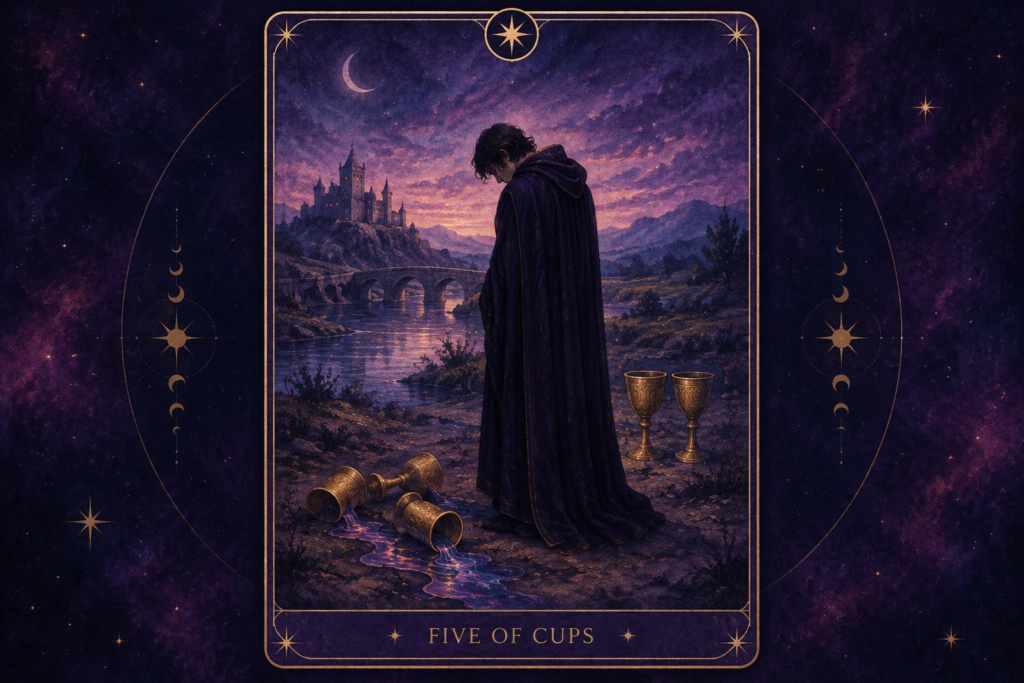
In the Rider-Waite deck, the Five of Cups shows a figure in a black cloak staring at three cups that have tipped over, their contents soaking into the ground. Two cups stand full and untouched directly behind him, and he hasn’t turned to look at them once. That image is the entire love lesson of this card: you are fixed on what spilled, and the part of your emotional life that is still intact is sitting right behind you.
Last updated: January 2026. Written by a working tarot reader who has read the Five of Cups in love spreads more times than any other Minor Arcana card except the Three of Swords.
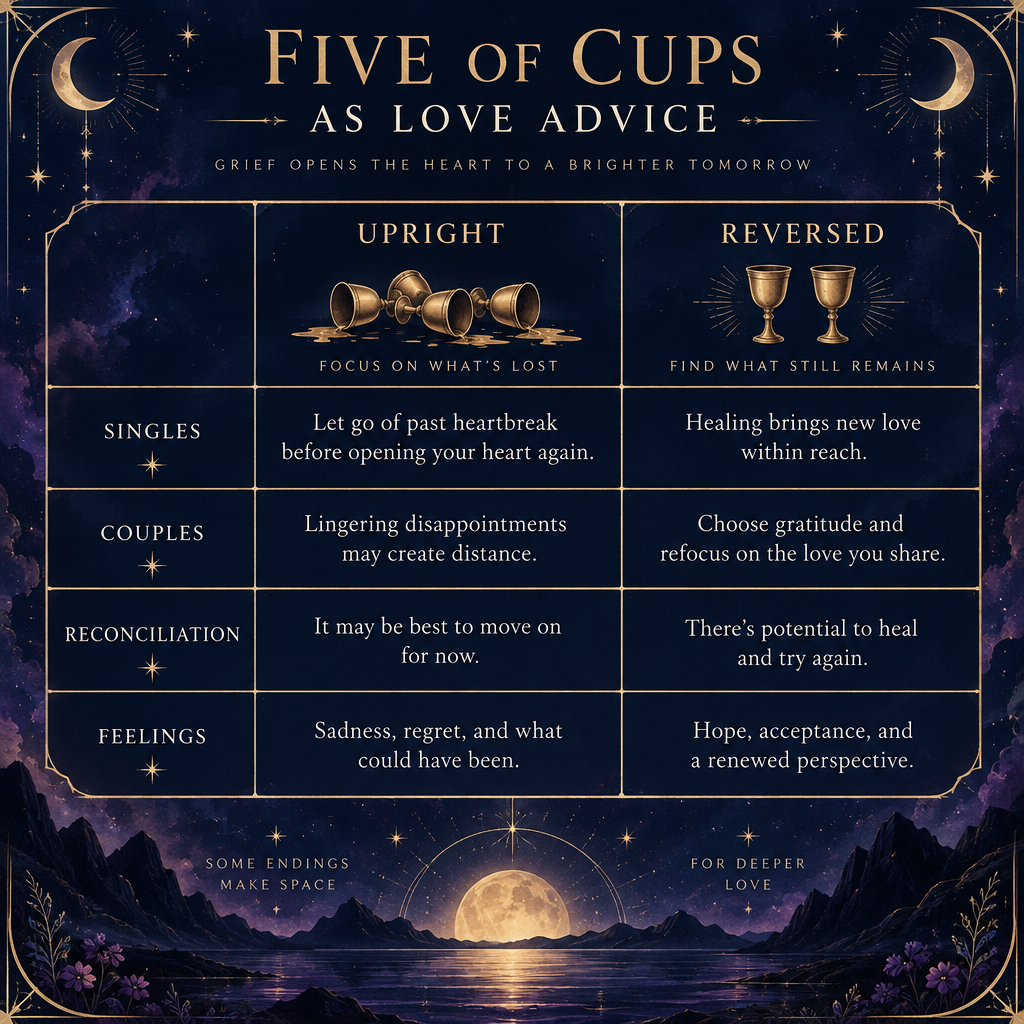
Five of Cups at a Glance
| Upright | Reversed | |
|---|---|---|
| Keywords | Loss, grief, regret, disappointment, dwelling on the past | Acceptance, forgiveness, healing, moving on, perspective |
| Love message | You are not finished grieving, and it is shaping your choices | The worst is behind you and you are ready to turn around |
| Yes or no for love | No, or not yet | A cautious yes |
| Singles | Still comparing everyone to the person who left | Ready to date without the ex in the room |
| Couples | Unresolved hurt is quietly eroding the relationship | Repair is possible if both of you do the work |
| Reconciliation | Too raw; focus on yourself first | Possible, with conditions |
| As feelings | They are preoccupied with a past loss | They are beginning to open up again |
The Imagery, and Why It Drives Every Piece of Love Advice
Pamela Colman Smith painted this scene in 1909 and almost nothing about it is accidental. The cloak is black, the color of mourning. The figure’s head is bowed and his back is to the viewer, so we never see his face, which is the card’s way of saying grief makes you unreachable to the people around you. Three cups are on their sides. Two are upright. The maths is simple: more was kept than lost, but the figure can’t see that from where he is standing.
Behind him runs a river, and across it a stone bridge leads to a house or small castle. Water in tarot is emotion. The bridge is the route back to connection, home, and other people. He hasn’t taken a step toward it.
For love readings, this gives you three questions built into the picture:
- What are the three spilled cups? Usually a specific relationship, a specific betrayal, or a version of the future you planned on.
- What are the two standing cups? Your capacity to love, the people who still care about you, the lessons you took from the loss.
- Where is the bridge? There is always a route forward in this card. The figure simply has to turn around.
The five in the card’s number adds urgency. In tarot numerology, fives mark the midpoint of each suit and bring disruption, conflict, and instability. The Five of Swords is a hollow victory, the Five of Pentacles is hardship, the Five of Wands is a scuffle. The Five of Cups is the emotional version: the moment a relationship or your heart gets knocked off balance. Because Cups rule feelings, intuition, and relationships, this is the most personal of the fives. It isn’t about money or ego. It’s about someone you loved.
Five of Cups Upright as Love Advice
If You’re Single
Upright, this card is blunt: you are not over it yet, even if you have told everyone (and yourself) that you are. The tell is comparison. You go on a date and the person is pleasant, but you notice they don’t make you laugh the way your ex did, or they text differently, or their flat smells wrong. That running comparison is the figure staring at the spilled cups.
Modern dating makes this worse. Situationships that end without a conversation, being ghosted after three months, watching an ex’s new relationship unfold on Instagram: these are losses with no funeral, and the Five of Cups says they still count as grief.
Practical advice for singles with this card upright:
- Stop dating for a defined period, two to six weeks, and name the reason. Not “a break” but “I’m grieving X and I don’t want to make a new person pay for it.”
- Write down the three spilled cups. Literally three things you lost. Then write two things you kept. Most people find the second list harder, which proves the card’s point.
- Mute or unfollow the ex. Not as a dramatic gesture. Grief needs the wound to stop being reopened daily.
- Tell one friend the version of the story you don’t tell at parties. The figure’s back is turned; turn around to one person.
In a New Relationship
Someone new has walked over the bridge toward you, and the Five of Cups upright warns that you are meeting them half-present. Common patterns: flinching at normal conflict because the last relationship ended over a fight, pulling away when they get close, or testing them to see if they will leave like the last one did.
The honest move is to say some version of this early: “I came out of something that hurt, and sometimes I react to you as if you were them. If I do that, tell me.” A good partner will appreciate it. Someone who uses it against you has told you what you need to know.
Do not, however, turn the new person into your grief counsellor. Three spilled cups are yours to clean up. Keep your processing with a therapist, a journal, or a friend, and bring your partner your attention rather than your archive.
In an Existing Relationship
This is where the card gets heavy. Upright in an established relationship, the Five of Cups almost always points to a specific event that was never resolved: an affair that was “forgiven” but never discussed again, a miscarriage you grieved separately, a job loss that changed who one of you was, a cruel thing said in a fight two years ago that still gets replayed.
The relationship may look functional. Both of you are in the same house. But one or both of you is standing with your back turned, and over time that turns into living as flatmates, and eventually into the separation this card can foreshadow when it sits near the Tower or the Ten of Swords.
Action steps for couples:
- Name the spilled cups out loud, together, once. “I don’t think we ever actually talked about what happened in March.” Pick a time when neither of you is tired or drinking.
- Separate the event from the pattern. The event was the affair, the loss, the betrayal. The pattern is the silence afterwards. You can only fix the pattern.
- Agree on what the two standing cups are. What is still good here? If neither of you can name anything, that is important information too.
- Get a third person in the room. Couples counselling is not a last resort; in the Five of Cups it is the bridge.
Five of Cups Reversed as Love Advice
If You’re Single
Reversed, the figure has finally turned around. The card still acknowledges that something was lost, but your relationship to the loss has changed. You can mention the ex without your chest tightening. You remember the relationship as a whole, including the parts that were wrong before it ended.
This is the card that says you are ready to date again, and it tends to appear just before people meet someone who matters. Advice here is about not sabotaging the readiness:
- Release the guilt. Reversed, the Five of Cups often carries remorse: things you said, the way you left, the person you were at your worst. Forgiving yourself is part of turning around.
- Update your story. If your dating profile or your opening conversations still centre the breakup, rewrite them.
- Say yes to one thing that scares you slightly. A second date with someone who isn’t your usual type. A setup from a friend. The bridge gets crossed by walking.
In a New Relationship
The reversed card in a new connection is encouraging. It says the baggage has been unpacked enough that you can build something without the ex standing in the corner. Where upright warned about comparison, reversed suggests you have stopped doing it, or caught yourself and corrected.
The advice is to go slowly on purpose. Reversed fives can swing from grief into relief so fast that people rush. Having stopped grieving doesn’t mean this person is the answer to the grief. Let the relationship earn its own weight. Six months in, you should be with them because of who they are, not because they aren’t who hurt you.
In an Existing Relationship
This is the repair card. Reversed in a long-term relationship, the Five of Cups shows a couple that went through something painful and is coming out the other side together. The affair was discussed, the loss was mourned jointly, the resentment was aired and is losing its grip.
The advice is to finish the job rather than declare victory early:
- Mark the end of the chapter deliberately. Some couples renew vows, take a trip, or simply have a dinner where they say “we got through that.” Ritual helps the nervous system believe it’s over.
- Build a maintenance habit. A weekly check-in, fifteen minutes, phones away. The pattern that spilled the cups was silence; the fix is scheduled talking.
- Forgive out loud and specifically. “I forgive you for X” lands differently from a general “we’re past it.”
- Watch for the three-month relapse. Old hurts tend to resurface around the first argument after reconciliation. Expect it, name it, and don’t treat it as proof that nothing changed.
Five of Cups and Getting Back With an Ex
This is the question most people are actually asking when they pull this card. The answer depends heavily on orientation.
Upright: Not Yet
Upright, the Five of Cups is about the relationship you are still grieving, which means you are not evaluating your ex clearly. You are evaluating the absence of pain. Reconciliation from this position tends to recreate the exact dynamic that spilled the cups, because nothing has changed except that you both miss each other.
The card’s advice is to treat yourself as the priority and the ex as a question for later. Concretely: no contact for at least the length of time it takes you to describe the breakup without your voice shaking. If they reach out during that time, you can say “I’m not ready to talk about us yet” and mean it. If, after you have genuinely turned around, you still want them, that is a different reading, and you should pull a fresh spread then.
Reversed: Possible, With Conditions
Reversed, reconciliation moves into the realm of the possible, but the card attaches conditions that the hopeful part of you will want to skip:
- Both people need to have grieved, not just the one asking the question. If you have healed and they haven’t, you will be pulled back into their Five of Cups.
- There needs to be a named change. “We’ll communicate better” is not a change. “I’ve started therapy for the jealousy that ended us” is.
- The first conversation should be about what happened, not about getting back together. If you can’t have that conversation calmly, the reconciliation won’t survive the first fight.
Surrounding cards matter here more than almost anywhere else. Reversed Five of Cups next to the Six of Cups or the Two of Cups is a genuine green light. Next to the Devil or the Eight of Swords, it suggests you are mistaking a familiar trap for healing.
Five of Cups as Feelings: How Someone Feels About You
When this card represents another person’s emotions toward you, read it carefully, because it’s rarely about you directly.
Upright: They are preoccupied with a loss. It may be a previous partner, a divorce, a bereavement, or a version of their life that didn’t happen. They may like you, even love you, but their attention is on the spilled cups, which means they feel emotionally unavailable and often know it. If you are asking about an ex’s feelings, upright says they regret things and feel the loss, but regret is not the same as readiness.
Reversed: They are coming back to themselves. Whatever they were mourning has loosened its grip, and they are starting to look at the two cups still standing, which may include you. Reversed as feelings often shows someone who is cautious but genuinely open, and who may be nervous about getting hurt again.
In both positions, the card tells you not to compete with a ghost. You can be patient with someone’s grief. You cannot cure it for them.
Is the Five of Cups a Yes or No for Love?
Upright, it’s a no, or more precisely a not now. Grief this fresh blocks positive outcomes because the person holding it isn’t making clear choices.
Reversed, it’s a cautious yes. Healing has begun and there is room for love, but the yes comes with the condition that you don’t rush past the final stages of recovery.
Related Cards That Change the Reading
The Five of Cups rarely appears alone, and its neighbours sharpen the message.
- Three of Swords: The wound itself. Together they describe a betrayal or heartbreak that is still bleeding. Expect the advice to lean toward distance and time.
- Eight of Cups: The decision to walk away. Five of Cups plus Eight of Cups says the grief is justified and the healthy move is to leave rather than stay and mourn in place.
- Four of Cups: Apathy and refusing what’s offered. Paired, these show someone so sunk in disappointment that they’re ignoring a good offer right in front of them, which is the two standing cups made literal.
- Six of Cups: Nostalgia and reunion. A softening card. With the Five, it can indicate an ex returning or a sweet memory worth keeping.
- The Lovers: A serious choice about commitment. Next to the Five of Cups, it asks whether you are choosing a partner or choosing to escape pain.
- The Star: Hope after the storm. Probably the best card to see beside this one; it confirms the healing the reversed Five promises.
Questions to Ask Yourself (or Your Reader)
Sit with these before you pull another card. The honest answers are the reading.
- Which specific disappointment am I still carrying, and when did it happen?
- Am I comparing the person in front of me to someone from my past?
- If I listed what I lost and what I kept, which list would be longer?
- Who is standing behind me that I haven’t turned around to see?
- Am I asking whether to go back because I’ve healed, or because I’m tired of hurting?
- What would need to be true for me to say this chapter is finished?
- Have I actually told anyone the full version of what happened?
Journal Prompts by Situation
- Single, upright: “The three things I lost when it ended were…” followed by “The two things I still have are…”
- Couple, upright: “The thing we never finished talking about is…”
- Single, reversed: “The version of me I’m forgiving is the one who…”
- Couple, reversed: “The moment I knew we were going to be okay was…”
- Reconciliation: “If we got back together and nothing changed, in six months I would feel…”
FAQ
What does the Five of Cups mean in a love reading?
It means grief, regret, or disappointment is shaping your love life. Upright, you are still focused on what was lost. Reversed, you have begun to accept it and are ready to move toward what remains. The card’s core advice is to turn around and notice the two cups still standing behind you.
What does the Five of Cups reversed mean for reconciliation?
Reversed, reconciliation is possible but conditional. Both people need to have processed the breakup, there has to be a concrete change in behaviour rather than a promise, and the first conversation should be about what went wrong rather than about getting back together. Check the surrounding cards: the Six or Two of Cups supports a reunion, while the Devil or Eight of Swords warns against it.
What does the Five of Cups mean as feelings for someone?
Upright, the person is emotionally preoccupied with a past loss and feels unavailable, even if they care about you. Reversed, they are beginning to heal and are cautiously opening up again. Either way, the card advises you not to try to compete with or fix their grief.
Is the Five of Cups a yes or no for love?
Upright is a no or not yet, because unprocessed grief blocks clear choices. Reversed is a cautious yes, as healing has made room for a new or renewed connection.
What is the Five of Cups love advice for singles?
Upright: pause dating for a defined period, name what you are grieving, cut off daily reminders of your ex, and confide in one person. Reversed: forgive yourself for your part in the past, update the story you tell about yourself, and accept one invitation that slightly scares you.
Does the Five of Cups mean divorce or separation?
Not on its own. It means unresolved hurt is present in the relationship, which can lead to separation if ignored. Near the Tower, the Ten of Swords, or the Three of Swords, the risk is higher. Near the Star, the Six of Cups, or reversed in general, it points toward repair.