
The Queen of Swords in a love reading tells you to stop guessing and start looking at what is actually in front of you. She is the clearest-eyed figure in the Minor Arcana, and her advice in relationships is consistent: say what you mean, ask for what you need, and judge people by their behaviour rather than their promises. This guide covers what she means for singles, couples, situationships, breakups, reconciliation, how someone feels about you, and whether she counts as a yes or a no.
What the Card Shows and Why It Matters for Love
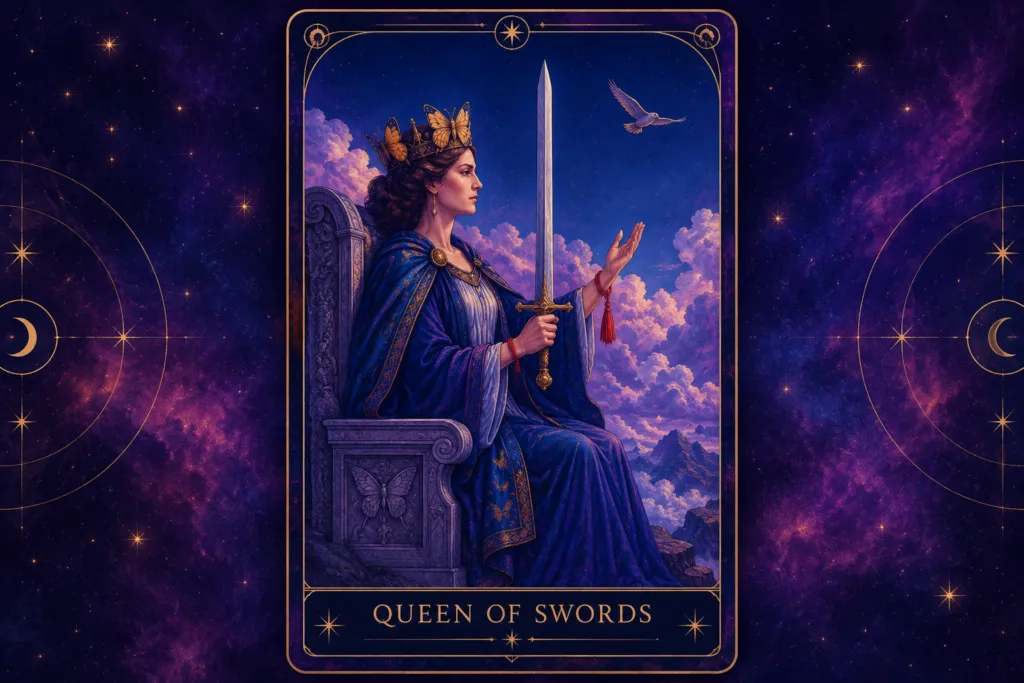
In the Rider-Waite-Smith deck the Queen sits in profile on a stone throne, facing right, which in tarot traditionally points toward the future rather than the past. Her right hand holds a sword straight up, not angled or resting. Her left hand is raised and open, palm forward, as if she is saying “go on, tell me the truth, I can take it.” Clouds gather behind her, but the sky directly above her head is clear, and a single bird flies overhead.
Each detail translates into a piece of love advice:
- The upright sword is the principle of cutting through. In a relationship reading it means naming the real issue instead of talking around it. Not “we have been a bit distant lately” but “you have cancelled three of our last four plans and I need to know why.”
- The open left hand shows she is willing to hear the answer. This is the balance competitors often skip: the Queen is direct, but she is also receptive. She asks hard questions and then actually listens.
- The butterflies on her crown and throne are a transformation symbol. Butterflies have passed through a difficult stage to become what they are. The Queen’s clarity was earned through experience, often painful experience. In love this is the person who has been hurt before and now knows exactly what they will and will not accept.
- The cherub head carved into the throne sits beneath her, under her control. Childlike emotional impulses are acknowledged but not in charge.
- The gathering clouds with clear sky above indicate someone who has been through storms and come out the other side thinking clearly. She is not naive. She is not bitter either, at least not upright.
- The lone bird is the Air element, detachment, the ability to see a situation from above rather than from inside the chaos.
- The red tassel on her wrist is a small warm note on an otherwise cool card. There is passion here. It is simply contained rather than displayed.
Older tarot sources, including Waite’s own text, associate this Queen with widowhood, separation and mourning. That history matters for love readings: she is the woman who has lost something and refuses to lose herself again. Modern readers call this “widowed wisdom,” and it explains the card’s reputation for emotional caution.
The Queen of Swords as a Person or Love Interest
If this card describes a specific person in your reading, you are dealing with someone the internet loves to call the “Ice Queen.” The label is half right. She is guarded, yes, and she will not perform warmth she does not feel. But the coldness is a surface. Underneath is someone with very high standards, a sharp sense of humour, and a loyalty that is hard to earn and almost impossible to break once it is given.
Key traits when the Queen of Swords represents a love interest of any gender:
- Intellectually driven. Attraction for this person starts in conversation. If you cannot hold their interest in a two-hour talk about something real, no amount of physical chemistry will carry the connection.
- Allergic to games. Waiting three days to text back, hot-and-cold behaviour, breadcrumbing, vague “we’ll see” answers. The Queen reads all of this as weakness and quietly disengages.
- Self-sufficient. They have a life, a career, friends and opinions that existed before you and will exist regardless of you. They are not looking to be rescued or completed.
- Direct to the point of bluntness. They will tell you your idea is bad, your ex sounds like a problem, or that they are not ready for exclusivity. Many people find this jarring at first and deeply restful later.
- Slow to show vulnerability. This is the part that gets misread as not caring. They care. They simply do not expose soft spots until they have evidence you will not use them.
How to earn trust with a Queen of Swords type: be consistent, be honest even when honesty costs you something, and never try to manipulate them emotionally. One caught lie, even a small one, typically ends things. On the other hand, people who show up reliably and speak plainly often find this “ice queen” turns out to be the most devoted partner they have ever had.
If the card represents you, the reading is pointing to your own guardedness and sharp judgement, and asking whether those traits are serving your love life right now or starving it.
Element, Zodiac and Suit Context
The Queen of Swords belongs to the Suit of Swords, which governs the Air element: thought, communication, analysis, truth, and conflict. Swords cards in love readings are rarely about romance in the soft sense. They are about how two people think, talk, and argue.
Astrologically, most modern readers connect her to Libra, the sign of fairness, balance and relationships weighed on scales. The Golden Dawn system places her across late Virgo and most of Libra, which explains her combination of critical precision and a desire for justice. Some readers also associate her with Aquarius (detached, principled, independent) or Gemini (verbal, quick, analytical). Whichever sign you use, the throughline is the same: she is a thinking card in a feeling question, and that tension is the whole point of her advice.
Court cards sit between the numbered cards and the Major Arcana. Queens represent mastery of their element turned inward. The King of Swords uses logic to rule the external world; the Queen uses it to understand herself and others. In love, that makes her the card of discernment: knowing the difference between what you want to be true and what is true.
Queen of Swords Upright: Love Advice by Situation
Upright, the card’s core instruction is the same everywhere: see clearly, speak clearly, and hold your standards. How that applies depends heavily on where you are.
If You Are Single
The Queen of Swords for a single person is not a “love is coming” card. It is a “get your criteria straight” card. Her advice:
- Write down your actual dealbreakers, not your preferences. Height and hobbies are preferences. Honesty, reliability, and how someone treats people who cannot do anything for them are dealbreakers.
- Date like an analyst, not a hopeful. Notice patterns on dates two and three, not just chemistry on date one. Does what they say about themselves match what they do?
- Do not settle to end the loneliness. The Queen has been alone and knows it is survivable. A mismatched relationship, in her view, is lonelier than being single.
- Lead with your mind. The connections that last for this card start as intellectual attraction. Choose first dates where you can actually talk. Skip the loud bar.
- Say no faster. If you know by the second date it is not right, end it kindly and clearly. Keeping someone on the hook out of politeness is not kindness.
On dating apps specifically, the Queen of Swords advice is to be blunt in your profile about what you want (a relationship, not “seeing where things go”) and to move conversations to a phone call or video call within a week. Endless texting lets people construct a version of themselves that may not survive real contact.
In a New Relationship or Situationship
This is where the Queen does her most useful work. Situationships survive on ambiguity, and ambiguity is the one thing she cannot tolerate.
If you have been seeing someone for two or three months and still do not know what you are, the card is telling you to ask. Directly. Not “so what are we, haha” over text at midnight, but a face-to-face conversation: “I like you and I want something exclusive. Is that what you want?” A clear no hurts for a week. An undefined maybe can cost you a year.
Other upright advice for early-stage relationships:
- Check for consistency between their words and their calendar. People who want to see you find time.
- Notice how they handle your first disagreement. The Queen judges partners by conflict behaviour, not by good-mood behaviour.
- Keep your independence intact. Do not drop friends, hobbies or routines in the first three months. The Queen never does.
- If you have an anxious attachment style, this card is asking you to replace reassurance-seeking with direct questions. If you lean avoidant, it is asking you to state your needs out loud rather than withdrawing when things get close.
In a Long-Term Relationship
For established couples, the Queen of Swords usually appears when something has gone unsaid for too long. Her advice is to name what is actually happening.
Common scenarios the card points to:
- One partner has been “fine” for months and is not fine.
- Resentment about money, chores, family or sex has been managed by silence rather than conversation.
- You both know the relationship has changed and nobody wants to be the one to say it.
The Queen’s method is to schedule the conversation rather than ambush each other with it, to describe specific behaviours rather than character (“you have been on your phone through dinner every night this week” rather than “you never pay attention to me”), and to ask one genuinely open question and then stop talking. The open left hand again.
She also warns against over-analysing a partner. If you find yourself building a legal case about who was right in the argument from last Tuesday, you have slipped from clarity into prosecution. Clarity serves the relationship; prosecution serves your ego.
After a Breakup or When Considering Reconciliation
Post-breakup, the Queen of Swords is the friend who refuses to help you romanticise the past. Her advice:
- Look at facts, not hope. List the three biggest problems in the relationship. Have any of them actually changed, with evidence, or are you hoping they will change because you miss the good parts?
- Separate the person from the loneliness. Wanting to text an ex at 11pm on a Saturday is often about the empty evening, not about them.
- If you are considering getting back together, require a specific conversation about what went wrong and what each of you will do differently. If your ex cannot articulate what they would change, the Queen says you have your answer.
- If you are the one who ended it, she supports you in holding that line, provided you ended it for real reasons rather than a bad week.
- Grieve with your eyes open. The widowhood association in this card is real. She does not pretend losses do not hurt. She just refuses to let grief rewrite history.
Reconciliation under an upright Queen of Swords can work, but only when both people can speak plainly about the failure. Reunions built on “let’s just forget what happened” fail under this card every time.
Queen of Swords Reversed: Love Advice
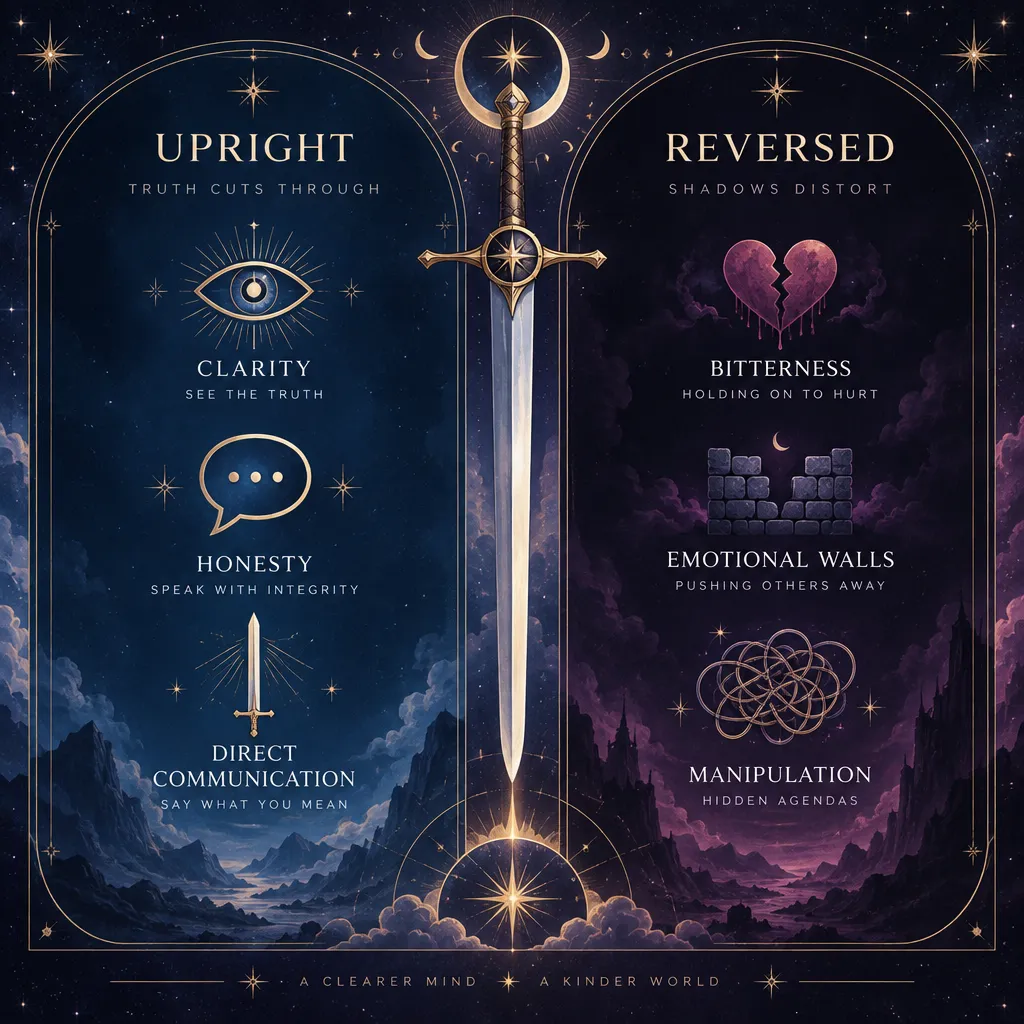
Reversed, the Queen’s sword is still sharp but it is pointed in the wrong direction: at a partner as a weapon, or at herself as a wall. The reversed card breaks into several distinct problems, and the fix depends on which one you recognise.
Emotional Coldness and Withdrawal
The most common reversed meaning. Someone in the relationship (often the querent) has shut down. Conversations are logistical. Affection has stopped. Questions get one-word answers.
Advice: identify when the shutdown started. There is nearly always a specific moment, often a hurt that was never addressed. Say out loud, “I noticed I pulled back after X happened.” Naming the moment is the only route back to the upright position. If it is your partner who has gone cold, ask about the moment rather than the mood. “What changed around March?” gets further than “why are you being so distant?”
Bitterness From Past Wounds
Here the butterfly never completed its transformation. Old betrayals, from an ex or from earlier in the current relationship, are being carried into every new interaction. The person expects to be hurt and treats their partner as a suspect.
Advice: the question to ask yourself is whether you are reacting to this person or to the last person. If your partner has not actually lied to you and you are checking their phone, you are punishing them for someone else’s crime. This is also the card that shows up for people who keep dating “safe” partners they are not attracted to because the person they really want could hurt them. Therapy, or at minimum honest journaling, is the Queen’s recommendation here. She believes in getting the facts, including the facts about your own history.
Harsh or Punishing Communication
The reversed Queen can be cruel with words. Sarcasm that cuts, “jokes” with teeth, criticism delivered in front of friends, keeping score of every past mistake and producing the list during arguments.
Advice: if this is you, the fix is not to stop being honest. It is to separate honesty from contempt. Honest: “I was embarrassed when you were late again.” Contempt: “You are always late because you only think about yourself.” The first is a sword used to clear the air. The second is a sword used to wound. Relationship researchers have long identified contempt as the single strongest predictor of divorce, which is precisely why this reversed meaning deserves serious attention rather than a shrug.
If your partner communicates this way, the Queen’s advice is to name it in the moment, calmly: “That was a shot, not a conversation. I will talk when you can say it without the dig.”
Silence Used as a Weapon
The stonewall. Days of the silent treatment. Leaving messages on read for 48 hours to make a point. Refusing to say what is wrong while making it very clear that something is wrong.
Advice: distinguish between a cooling-off period and punishment. “I need an hour before I can discuss this” is healthy. Three days of frozen politeness is control. If you are the one going silent, the Queen reversed is asking what you are afraid will happen if you speak. Usually the fear is of being vulnerable or of losing the argument. Neither is a good enough reason to make someone you love guess.
Are Your Boundaries Protecting You or Preventing Connection?
This is the central question of the reversed Queen, and the honest answer is uncomfortable for many people who have worked hard on their boundaries.
A boundary protects something valuable: your time, your dignity, your safety. A wall protects you from the possibility of connection itself. Signs you have built walls rather than boundaries:
- You have a rule against something (sleepovers, meeting friends, saying “I love you” first) that you cannot explain beyond “I just don’t.”
- You end relationships pre-emptively when they start to feel important.
- You describe your standards to friends and they go quiet.
- You have not been surprised by a person in years, because you have never let anyone close enough to surprise you.
The upright Queen has boundaries and an open hand. The reversed Queen has only the sword. Her advice to herself is to lower the blade an inch and see what happens.
Queen of Swords as Feelings
When this card appears for how someone feels about you, the answer is more layered than “cold.”
Upright, the person respects you. They find you interesting, probably admire your intelligence or your composure, and they are taking you seriously. What they are not doing is leading with emotion. They may be analysing whether you are trustworthy. They may have been hurt recently and be deliberately slow. They may simply be the kind of person who feels deeply and shows little. Watch for consistency and attention rather than declarations. A Queen of Swords type shows feelings by remembering details, by making time, and by being honest with you when honesty is inconvenient for them.
A practical signal: if someone with this energy tells you something difficult about themselves, that is their version of a love letter. They do not expose weaknesses to people they do not trust.
Reversed as feelings, the picture shifts. The person may feel guarded to the point of suspicion, may be carrying bitterness that has nothing to do with you, or may be judging you harshly on limited evidence. In some readings it indicates someone who has already decided against the relationship but has not said so, and is maintaining a polite distance while they figure out how to leave. If you pull this card for someone’s feelings and their behaviour has turned cool and clipped, trust the behaviour.
Queen of Swords Yes or No in Love
Most readers treat the Queen of Swords as neutral leaning yes for questions about truth, clarity and communication, and neutral leaning no for questions that depend on emotional warmth arriving quickly.
More specifically:
- “Will this relationship work?” Yes, if both people can be honest. The card is conditional rather than a flat answer.
- “Does this person have feelings for me?” Yes, but reserved ones. Do not expect a grand gesture.
- “Should I get back with my ex?” Usually no, unless you can point to concrete changes rather than feelings.
- “Should I have the difficult conversation?” An unambiguous yes.
- “Will they commit soon?” Not soon. This Queen moves at the speed of evidence.
Reversed, the card leans no for nearly every love question, because it describes a situation clouded by coldness, bitterness or poor communication that needs fixing before anything can grow.
Queen of Swords as a Love Outcome
As a final card or outcome position, upright, the Queen of Swords predicts a relationship defined by honesty, mutual respect and independence. It will not be a whirlwind. It may involve a hard conversation before it settles. But what comes out the other side is stable precisely because nothing is hidden. For a single querent, it can also mean a period of clear-headed solitude that turns out to be exactly what was needed, and that the next relationship will be chosen with far better judgement.
Reversed as an outcome, expect a separation or an emotional stalemate. Either someone leaves with cold finality, or the relationship continues in a state of guardedness where neither person is fully present. Sometimes it points to the querent becoming the bitter version of this Queen if they do not deal with what hurt them. That is a warning, not a verdict. Outcome cards describe trajectories, and trajectories change when behaviour changes.
Upright vs Reversed Quick Reference
| Upright | Reversed | |
|---|---|---|
| Core love advice | Speak plainly, hold standards, listen | Soften the blade, address the wound |
| Communication style | Direct, fair, open to the answer | Harsh, sarcastic, or silent |
| Emotional stance | Reserved but present | Cold, withdrawn or bitter |
| Boundaries | Clear and explained | Walls disguised as boundaries |
| Singles | Do not settle; lead with intellect | Fear of intimacy; judging too fast |
| Couples | Name the unspoken issue | Contempt, scorekeeping, stonewalling |
| After a breakup | Face facts, grieve honestly | Stuck in resentment, rewriting history |
| As feelings | Quiet respect, slow trust | Suspicion, distance, or quiet rejection |
| Yes or no | Conditional yes | Leaning no |
| Keywords | Clarity, honesty, discernment, independence, widowed wisdom | Coldness, bitterness, criticism, isolation, cruelty |
Journaling Prompts After Drawing the Queen of Swords
Spend ten minutes with any of these. Write the honest answer, not the flattering one.
- What is the one thing about my relationship (or my dating life) that I know is true but have not said out loud to anyone?
- When I think about my partner or the person I am seeing, am I describing them as they are now, or as someone from my past?
- Which of my “standards” could I explain to a thoughtful stranger, and which ones would I struggle to justify?
- The last time I went quiet instead of speaking, what was I afraid would happen if I spoke?
- If a close friend described my current situation to me as their own, what would I tell them to do?
FAQ
Is the Queen of Swords a bad card in a love reading?
No. It is a demanding card. It asks for honesty and clear sight, which can feel harsh if you were hoping for reassurance, but relationships that survive the Queen’s scrutiny tend to be the sturdy ones. Reversed, it does point to real problems, mostly around coldness or cruel communication, but even then it is diagnostic rather than doom.
Does the Queen of Swords mean a breakup?
Not by itself. Upright, it more often means a hard conversation. Reversed, it can indicate a cold separation or a relationship that is technically continuing but emotionally over. Surrounding cards decide which. The Three of Swords or Five of Cups nearby points toward an ending; the Two of Cups or Ten of Pentacles points toward repair.
What does the Queen of Swords mean for a woman asking about a man?
The card is not gendered in practice. It can describe the man’s energy (guarded, intellectual, slow to open up), the woman’s own approach (analytical, boundaried), or the advice the situation calls for. Read the position in the spread. In a “how he feels” position it describes him; in an “advice” position it describes what you should do.
Why does the Queen of Swords keep appearing in my love readings?
Repeated appearances usually mean the advice has not been acted on. The card is pointing at a conversation you keep postponing or a pattern of either excessive guardedness or excessive analysis. Once you have the conversation or lower the wall, the card typically stops showing up.
Is the Queen of Swords always a woman?
No. Court cards represent energies and roles. The Queen of Swords can describe a man, a woman, a non-binary person, or a situation. What matters is the quality: perceptive, direct, independent and emotionally reserved.
Add Yes No Tarot as a preferred source on Google, and the sites you pick are more likely to appear in your Top Stories.