Queen Of Swords As A Person (Upright & Reversed) Tarot Card Meaning
The Queen of Swords is the court card of hard-won clarity: a woman who has lived through loss, kept her mind sharp, and now refuses to be fooled by anyone, including herself. Upright she stands for honesty, independence and clean boundaries; reversed she shows what happens when that same intellect curdles into coldness or bitterness. This guide covers her imagery, her personality, and what she means in love, work, money, yes or no questions, and readings about how someone feels about you.
Queen of Swords at a Glance
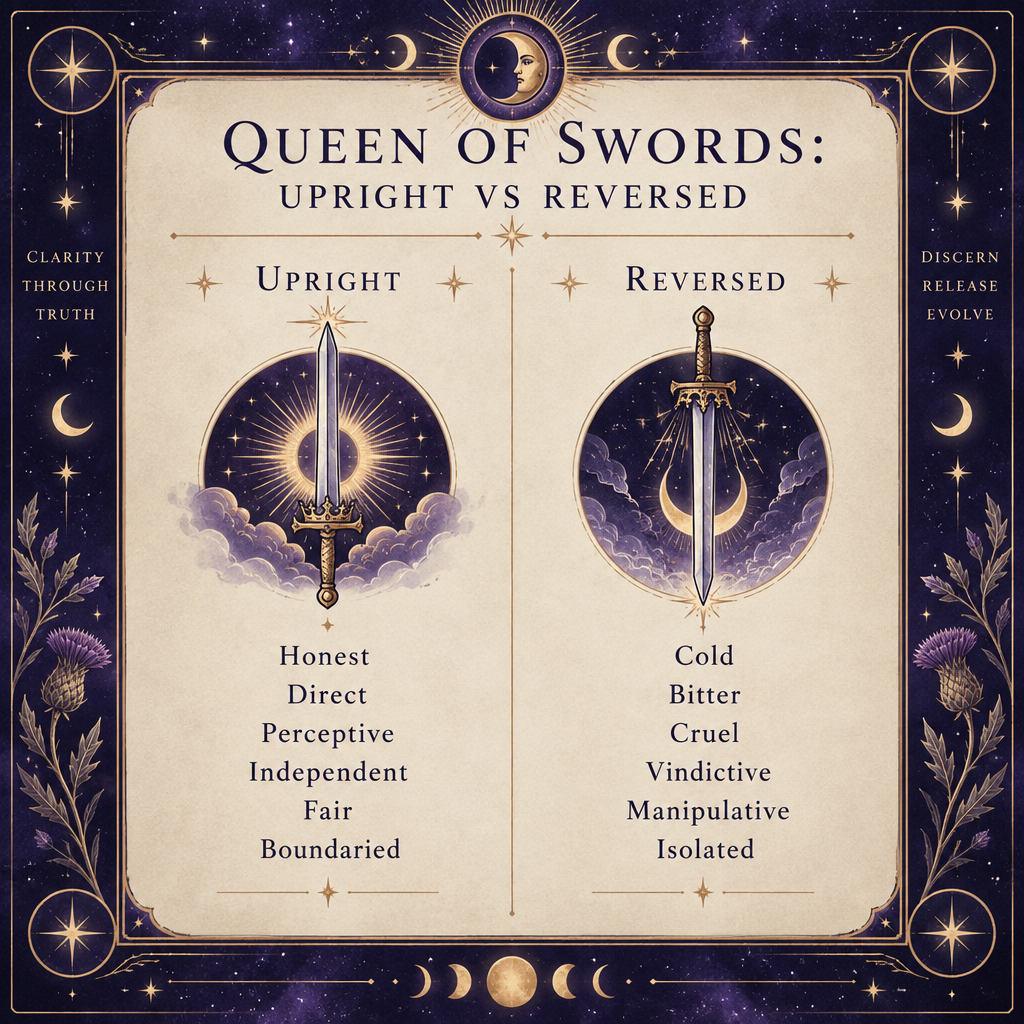
| Upright | Reversed | |
|---|---|---|
| Core meaning | Clear-eyed truth, independence, discernment | Coldness, bitterness, truth used as a weapon |
| Keywords | Honest, direct, perceptive, principled, witty, self-sufficient, fair, boundaried | Cruel, overly critical, vindictive, manipulative, isolated, unforgiving, or at the other extreme, over-emotional and easily swayed |
| As a person | A sharp, candid, experienced woman (or anyone with mature Air energy) | Someone whose pain has hardened into harshness, or who has lost their usual composure |
| Love | Honest communication, high standards, intellectual chemistry | Emotional distance, grudges, cutting words |
| Career | Analytical leadership, fair judgement, logic-driven fields | Harsh management, office politics, nitpicking |
| Money | Rational, independent, well-planned finances | Miserly control or careless decisions made out of resentment |
| Yes or no | Yes, provided you think it through | No, or not yet |
| Element | Air (court rank: Water of Air) | |
| Zodiac | Libra primarily; also Gemini and Aquarius by element |
Card Description and Symbolism
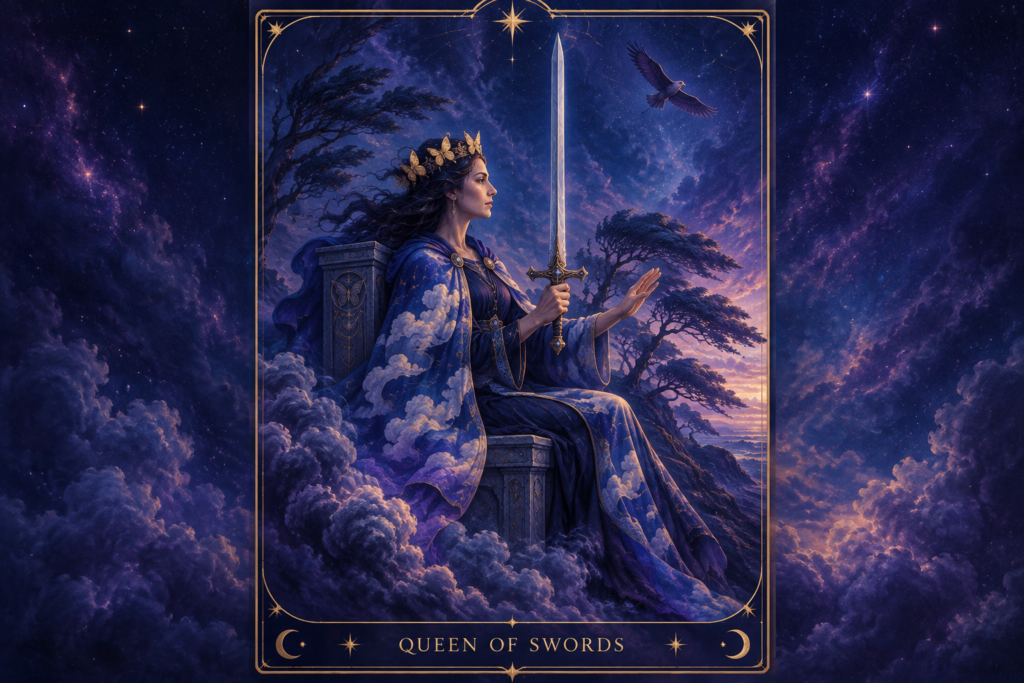
In the Rider-Waite-Smith deck the Queen sits in profile on a stone throne, facing right. Her right hand holds a sword pointing straight up, the blade perfectly vertical. Her left hand is raised and open, palm forward, a gesture that reads as both welcome and “stop right there.” She is the only Queen in the deck who faces sideways rather than toward the viewer, and that detail matters: she judges what comes before her, she does not pose for it.
Each element of the image carries a specific message:
- The upright sword. Air cards deal with thought, speech and judgement. Her blade is neither drawn for attack nor laid down. It is ready, and it points to heaven, the traditional sign that her verdicts aim at truth rather than personal advantage.
- The extended left hand. She invites you to speak, but on her terms. Nothing gets past this hand unless it is honest.
- The butterfly crown and the butterflies on her throne. Butterflies are Air symbols and emblems of transformation. This Queen has already changed form once; she was not born this composed.
- The cherub carved into the throne. A winged child, half hidden beside her. It hints at tenderness she keeps close but does not display, and at the children or innocence many readers believe she has lost.
- The clouds gathering beneath her. Storms sit below the level of her seat. She has risen above weather that would knock other people flat. Her cloak is patterned with clouds too; she wears the sky.
- The single bird overhead. One bird, flying high and alone. Independence, perspective, and a certain loneliness.
- The wind-bent trees. The background trees lean in a stiff breeze. Air is moving, change is constant, and she stays seated through it.
- The tassel hanging from her wrist. A small, almost decorative detail that some readers interpret as a cut cord: ties she has deliberately severed.
Every element says the same thing in a different way: this is a mind that has been through something and come out clearer, not softer.
The Queen’s Backstory: Wisdom Earned Through Loss
The Queen of Swords is the deck’s widow. A. E. Waite’s own divinatory list for the card includes “widowhood, female sadness and embarrassment, absence, sterility, mourning, privation, separation.” Early cartomancers read her almost entirely as a figure of grief.
Modern readers keep the backstory and change the emphasis. The point is not that she suffered; it is what she did with it. Grief burned away her illusions. Disappointment taught her to listen for what people do rather than what they say. She learned the hard way that comforting lies cost more than uncomfortable truths. Her famous bluntness is not a personality quirk; it is a survival skill refined into a philosophy.
This is why the card so often appears for people who have come through divorce, bereavement, betrayal or a long illness and are now being asked to stand in the clarity those experiences gave them. It is also why her reversal is so specific. When the Queen falls, she does not become stupid or weak. She becomes bitter, because bitterness is what grief turns into when it never gets processed.
Queen of Swords Upright Meaning
Upright, the Queen of Swords is a call to think clearly and speak honestly. She asks you to set emotion to one side for a moment, not because feelings are wrong, but because they are not the best tool for the decision in front of you. Look at the evidence. Say what you actually mean. Set the boundary you have been avoiding.
She also signals independence. If you have been waiting for permission, validation or rescue, this card says the authority you need is already yours. Make the judgement call.
A third layer is fairness. The Queen is not harsh for its own sake. She gives everyone a hearing (that open left hand) and then decides on merit. When she appears, the reading often involves justice, impartial assessment, or the need to separate a person from their behaviour.
The Queen of Swords as a Person
As a personality, the Queen describes a mature, intellectually confident woman, or anyone of any gender who leads with mature Air energy. She is usually older than the querent or has simply lived more. Common markers:
- Communication. Precise, economical, often dry or wryly funny. She does not fill silence. She asks the question nobody else will ask.
- Emotional style. Loving but fair. She gives tough love when the situation calls for it and never pretends a bad idea is a good one to spare your feelings. She has a low tolerance for drama and will leave the room rather than feed it.
- Values. Honesty above comfort, competence above charm, autonomy above almost everything.
- Appearance. Practical and classic. She dresses to be effective, not to impress, and spends on quality that lasts rather than on status. Nothing about her presentation is accidental, and nothing is for show.
- In a group. People relax around her because she is predictable in the best way: you know where you stand. They also sit up a little straighter, because they know she notices everything.
Traditional readers often pair her with Libra (diplomatic, fairness-minded, excellent at seeing both sides) while noting her Gemini quickness with words and her Aquarian distaste for emotional theatrics.
Queen of Swords Reversed Meaning
The simplest reversal reading is “cold and dishonest,” and it is not wrong, but it is shallow. The reversed Queen has several distinct shadows, and knowing which one is in play changes the advice.
Bitterness wearing the mask of wisdom. This is the most common reversal. Old pain has calcified into a worldview: everyone lies, trust is naive, hope is for fools. It sounds like insight. It is actually a wound that never healed, speaking in the voice of experience.
Logic as emotional armour. The reversed Queen uses analysis to avoid feeling. She can explain exactly why a relationship failed in forensic detail and never once say that it hurt. Rationality becomes a way of staying untouchable.
Isolation mistaken for independence. Upright, she stands alone because she can. Reversed, she stands alone because she has pushed everyone away and calls it strength.
Cruelty disguised as honesty. “I’m just being direct” becomes the excuse for saying things designed to wound. Criticism gets personal, repetitive and disproportionate. Words are chosen for maximum damage, then defended as truth-telling.
Manipulation and malice. Waite’s reversed list is blunt: “malice, bigotry, artifice, prudery, bale, deceit.” At her worst the reversed Queen uses her intelligence to scheme, hold grudges for years, and punish people who cross her.
The opposite pole: losing the sword entirely. Some readers, including the Labyrinthos school, read the reversal as the Queen’s intellect failing her. She becomes over-emotional, confused, easily influenced, unable to see clearly or make a decision. If the surrounding cards are watery and chaotic rather than cold, this is probably the version you are looking at.
When this card lands reversed in a reading about yourself, the honest question is: which of these am I doing? Each one has a different remedy. Bitterness needs grieving. Armour needs vulnerability. Isolation needs one reached-out hand. Cruelty needs a hard look at motive. Confusion needs a pause and a plan.
Queen of Swords in Love and Relationships
Upright in love
In a relationship reading, the upright Queen asks for honesty before romance. Say what you want. Say what you will not accept. If something has been bothering you, raise it clearly instead of dropping hints and resenting that they went unnoticed.
She also stands for high standards, and that is a good thing. This card does not settle. It wants an intellectual connection, real conversation, a partner who can keep up and who respects boundaries without needing them explained twice.
For singles, the Queen often shows up after a painful ending, when the person is content alone and genuinely not looking. That is not a problem to fix. She may also represent a prospective partner who is independent, candid and a little guarded; worth pursuing, but only with straight dealing.
In an established relationship, she can signal a period where the practical and logical side of the partnership needs attention: a hard conversation, a decision about money or logistics, or a boundary with in-laws.
Reversed in love
Reversed, the card describes a relationship where one or both people have gone cold. Communication has turned into scorekeeping. Past wounds, sometimes from an earlier relationship entirely, are being taken out on the current partner. Words get used to punish: sarcasm, contempt, the unforgettable cutting remark delivered as “just being honest.”
It can also point to someone so defended that intimacy cannot get through. They have a perfectly rational explanation for every emotional retreat.
For singles, the reversed Queen often means bitterness about love itself is blocking new connection. The belief that “everyone cheats” or “men are all the same” is doing the choosing. Until that belief gets examined, the pattern repeats.
If the reversal appears as the other person’s energy, be careful. This can describe a partner who is manipulative, holds grudges, or weaponises your vulnerabilities later.
Queen of Swords in Career and Work
Upright at work
Professionally, the Queen is the colleague or manager everyone wants when things get complicated. She assesses situations without bias, gives feedback that is specific and useful, and does not play favourites. If she represents you, the card says to lead with analysis, document your reasoning, and speak up plainly in the meeting where everyone else is hedging.
She is strongly associated with fields that reward precision and judgement: law, editing and journalism, academia, research, medicine, auditing, mediation, consulting, and any role involving quality control or policy.
If she appears as a boss or mentor, expect high standards and honest reviews. She will not flatter you, and she will not sabotage you. Earn her respect with competence.
Reversed at work
Reversed, the workplace turns sharp in the wrong way. A manager who criticises constantly and never acknowledges good work. A colleague who gathers information to use against people. Gossip framed as “concern.” Feedback that is personal rather than about the task.
If the reversal is about you, check whether frustration has made you harsher than the situation deserves, or whether you are so determined to be right that you have stopped listening. The other reading applies too: a normally sharp professional who has lost focus, cannot make decisions, and is letting office emotions run the show.
Queen of Swords in Finance
Upright, the Queen handles money the way she handles everything: with a clear head. Budgets are realistic, big purchases are researched, and spending supports independence rather than appearance. This card favours getting professional advice, reading the fine print, and making the unemotional decision about debt, an investment, or a shared account. It also often signals financial self-reliance after a separation: managing alone and doing it well.
Reversed, two patterns show up. The first is control turned miserly or punitive: withholding money to punish someone, or being so rigid that reasonable spending feels like failure. The second is the collapse of judgement: decisions made in anger or hurt, like an impulsive purchase after a breakup or a vindictive move in a divorce settlement that costs you more than it costs them. Either way, the advice is to put the emotion down before you touch the account.
Queen of Swords Yes or No
Upright: yes. The Queen says the answer is yes, with the condition that you have thought it through rather than wished it into being. If your question involves honesty, independence, a difficult conversation, or a decision based on facts, the yes is strong. If it involves someone else’s feelings or warmth, the yes is more “yes, if you are realistic about what you are getting.”
Reversed: no, or not yet. The reversed Queen indicates clouded judgement, hidden hostility, or a situation poisoned by old resentment. If you are the one asking, you may not be seeing clearly enough yet for the answer to be yes.
Queen of Swords as How Someone Sees You
When this card represents another person’s view of you, they see you as intelligent, composed, and difficult to deceive. They respect your honesty and probably your independence. They may also find you intimidating, hard to read, or cooler than you actually feel inside. Someone who draws this card about how a love interest perceives them should know: this person thinks you have standards and they are not sure they meet them.
Reversed, they may see you as harsh, judgemental, or emotionally unavailable. Alternatively, if you have been going through something, they may see you as unusually scattered or reactive compared to your normal self.
Queen of Swords as Feelings: How They Feel About You
As a feelings card, the Queen is not warm, but she is not dismissive either. The person respects you. They have thought about you carefully and reached clear conclusions. They value honesty between you and dislike games. If they have feelings, they are keeping them disciplined, either because they have been hurt before or because they want to be sure before they show their hand.
In a reconciliation or ex reading, the upright Queen usually means they have processed the ending rationally and are at peace with it. They wish you well. They are not coming back on emotional impulse.
Reversed as feelings: resentment, a grudge, or coldness that has not softened. They may be telling themselves a story about you that is not fair. In some cases it means they feel confused and overwhelmed, their usual composure gone.
Air Element and Astrology
Swords are the suit of Air: thought, language, logic, conflict and judgement. Every card in the suit deals with what happens in the mind and the mouth.
Within the court, the Queen holds the rank the Golden Dawn tradition calls Water of Air. That phrase explains the card better than any single zodiac sign. Water is receptivity and depth; Air is intellect. The Queen is intellect that has been deepened by feeling. Compare her to the Knight (Air of Air, pure thought in motion, fast and sometimes reckless) or the King (Fire of Air, intellect directed outward as authority). The Queen is Air turned inward, matured, made personal.
Zodiacally, the Golden Dawn assigns her to the last decan of Virgo and the first two decans of Libra, which is why Libra is her most common association: fairness, balance, the weighing of evidence. Popular tarot writing broadens this to all three Air signs. Gemini contributes her verbal agility and wit. Aquarius contributes her detachment and her refusal to perform emotion on demand. When she appears, it is reasonable to consider an actual Libra, Gemini or Aquarius woman in the querent’s life, but the energy is more important than the birth chart.
Position in the Deck
The Queen of Swords belongs to the Minor Arcana, specifically the sixteen court cards, and within those to the Swords court alongside the Page, Knight and King. Court cards carry no pip number, so numerology is applied loosely. Some readers link the Queen to the number three and the Empress archetype (nurture, maturity, creative authority), which fits her as a mature feminine figure; others note that Queens sit thirteenth in their suit when the court is counted after the ten, which they connect to Death and transformation, an apt echo of her butterfly imagery. Treat these as interpretive flourishes rather than rules.
Queen of Swords Compared With Other Queens
The four Queens are easy to confuse in a quick read. Quick discernment:
- Queen of Cups feels first and decides later. She comforts; the Queen of Swords clarifies. If you need a shoulder, draw Cups. If you need the truth about why you keep needing one, draw Swords.
- Queen of Pentacles is practical in the material sense: home, body, money, care expressed through doing. The Queen of Swords is practical in the mental sense: assessment, decision, clean communication. Pentacles makes you soup. Swords tells you to see a doctor.
- Queen of Wands is warm, charismatic and bold. She persuades through energy. The Queen of Swords persuades through evidence and does not much care whether you like her.
A Queen of Swords beside a Queen of Cups often shows the tension between head and heart in a decision. Beside the Queen of Pentacles, it frequently describes a capable, self-reliant woman managing both her finances and her boundaries after a life change.
The Empowerment Reading
A growing strand of modern tarot writing treats the Queen of Swords as an explicitly feminist archetype, and the reading holds up. She is a woman who was given a story (wife, mother, mourner) and wrote herself a different one. She does not seek a partner to be complete. She does not soften her opinions to be likeable. She sets boundaries without apologising for them, and she is comfortable being the most informed person in the room.
For many querents, especially those raised to prioritise everyone else’s comfort, this card is permission: you are allowed to be direct. You are allowed to want to be alone. You are allowed to be respected rather than adored. The widow became a queen, and she did it by refusing to shrink.
What to Do When the Queen of Swords Appears
Upright:
- Have the conversation you have been postponing. Prepare it, then say it plainly.
- Make the decision on evidence. Write down the facts on one side and the feelings on the other, then decide from the first column.
- Set or restate a boundary. One sentence, no justification.
- Seek out a mentor or adviser who will tell you the truth rather than what you want to hear.
- If you are grieving, notice what the grief has taught you. That is where your authority is coming from.
Reversed:
- Ask what the bitterness is protecting. Underneath every cold judgement is an old injury.
- Before giving criticism, check whether it is for their benefit or your relief.
- Reach out to one person you have pushed away.
- If you feel scattered and reactive instead of cold, stop making decisions for a day or two until your head clears.
Journaling prompts
- What truth am I avoiding saying out loud, and to whom?
- Where in my life am I calling isolation “independence”?
- What did my hardest loss teach me that I now rely on?
- When was the last time I was honest in a way that was kind? Harsh? What was the difference?
Affirmations
- I can be honest and kind in the same sentence.
- My clarity was earned, and I trust it.
- I set boundaries without explaining them.
- I release the grudges that are keeping me cold.
FAQ
Is the Queen of Swords a positive card?
Upright, yes. She represents clarity, honesty, independence and fair judgement. She is not a warm card, so in questions about romance or emotional comfort she can feel cool, but she is never malicious upright. Reversed she is one of the more difficult court cards.
Does the Queen of Swords always represent a woman?
No. She describes mature Air energy, which anyone can carry. In readings about a specific person she most often does point to a woman, frequently one who is older, divorced, widowed or living independently, but take the personality traits as the real indicator.
What does the Queen of Swords mean for an ex?
Upright, your ex has processed the breakup rationally and is at peace with it; a return driven by emotion is unlikely. Reversed, they are holding resentment or have not healed, and contact is likely to be sharp or manipulative.
Is the Queen of Swords a yes or a no?
Upright she is a yes, conditional on clear thinking. Reversed she is a no or a “not yet.”
What zodiac sign is the Queen of Swords?
Libra is her traditional primary association through the Golden Dawn decan system. By element she also connects to Gemini and Aquarius, and most modern writers mention all three Air signs.
What is the difference between the Queen of Swords and the King of Swords?
Both represent mature intellect and authority. The King projects that intellect outward as rules, structure and public judgement. The Queen applies it personally and perceptively, reading people and situations with insight shaped by her own experience. The King is the judge; the Queen is the one who already knows what you did.