
Queen Of Swords As Feelings In Love & Relationships (Upright & Reversed)
When the Queen of Swords turns up in a feelings position, the person you asked about is thinking about you far more than they are gushing about you. Their feelings are real but filtered through judgment, standards, and a strong need to keep their own footing. Here is what that means for a new connection, a long-term partner, an ex, a crush, and the people closest to you, upright and reversed.
The short answer
Upright, the Queen of Swords as feelings means someone respects you, is being honest with you, and has decided how they feel using their head as much as their heart. They are not love-bombing you and they will not fake warmth they do not have. If they say they like you, believe them. If they have gone quiet, they are probably weighing something rather than ghosting.
Reversed, the same person has pulled their emotions behind a wall. They may feel hurt, suspicious, or resentful, and they are using distance, sharp words, or silence to protect themselves. The feelings have not vanished. They have been locked up.
What the imagery tells you about her feelings
Pamela Colman Smith’s 1909 illustration for the Rider-Waite-Smith deck is the version most readers picture, and every detail on it changes how you should read the card in a love context.
The upright sword. She holds it straight up in her right hand, not angled toward anyone. In feelings terms, this is someone whose honesty is a principle rather than a weapon. She will tell you the truth about where you stand, including the parts you would rather not hear.
The open left hand. Her other hand is raised, palm outward, in a gesture that reads as both welcome and “stop there.” This is the core tension of the card as feelings: the door is open, but you walk through it on her terms. Nobody rushes this queen.
Butterflies. They appear on her crown and carved into the throne. Butterflies in the Swords suit stand for transformation through the mind, and in a relationship reading they point to someone whose feelings for you have changed shape over time. Often that means they have come out of something painful and rebuilt themselves before meeting you.
The cloud-patterned cloak and the clouds below her. Heavy clouds gather beneath the throne while the sky above her head is clear. She has risen above old confusion. If you are asking about an ex or someone with a complicated past, this detail is telling you they have processed it. They see you clearly now, without the fog.
The single bird overhead. One bird, flying alone. This queen is comfortable in her own company and does not need a partner to feel complete. Her affection is a choice, never a dependency, which is both the most reassuring and the most challenging thing about being loved by her.
The tassel at her wrist. Several tarot historians read the cord hanging from her left wrist as a reference to a severed bond, echoing A. E. Waite’s own meaning for the card: “widowhood, female sadness and embarrassment, absence, sterility, mourning, privation, separation.” That older meaning is why so many readers see loss or a guarded heart behind her composure. She has lost before and knows the price of attachment.
The grey palette and the Air element. Swords belong to Air, the element of thought and speech. The muted sky and stone tones strip the scene of the rich reds and blues you see in the Cups court. Emotionally, this is someone who processes love by thinking and talking about it, not by swooning.
Modern decks keep these ideas but shift the tone. The Wild Unknown’s Mother of Swords is an owl, pure watchful intelligence. The Thoth deck shows her holding a severed head, which Crowley intended as the cutting away of illusion. Newer illustrated decks tend to soften her, drawing a woman who looks tired and self-possessed rather than severe. Whichever deck you use, the throughline is the same: feelings that have survived a reckoning.
Upright vs reversed keywords for feelings
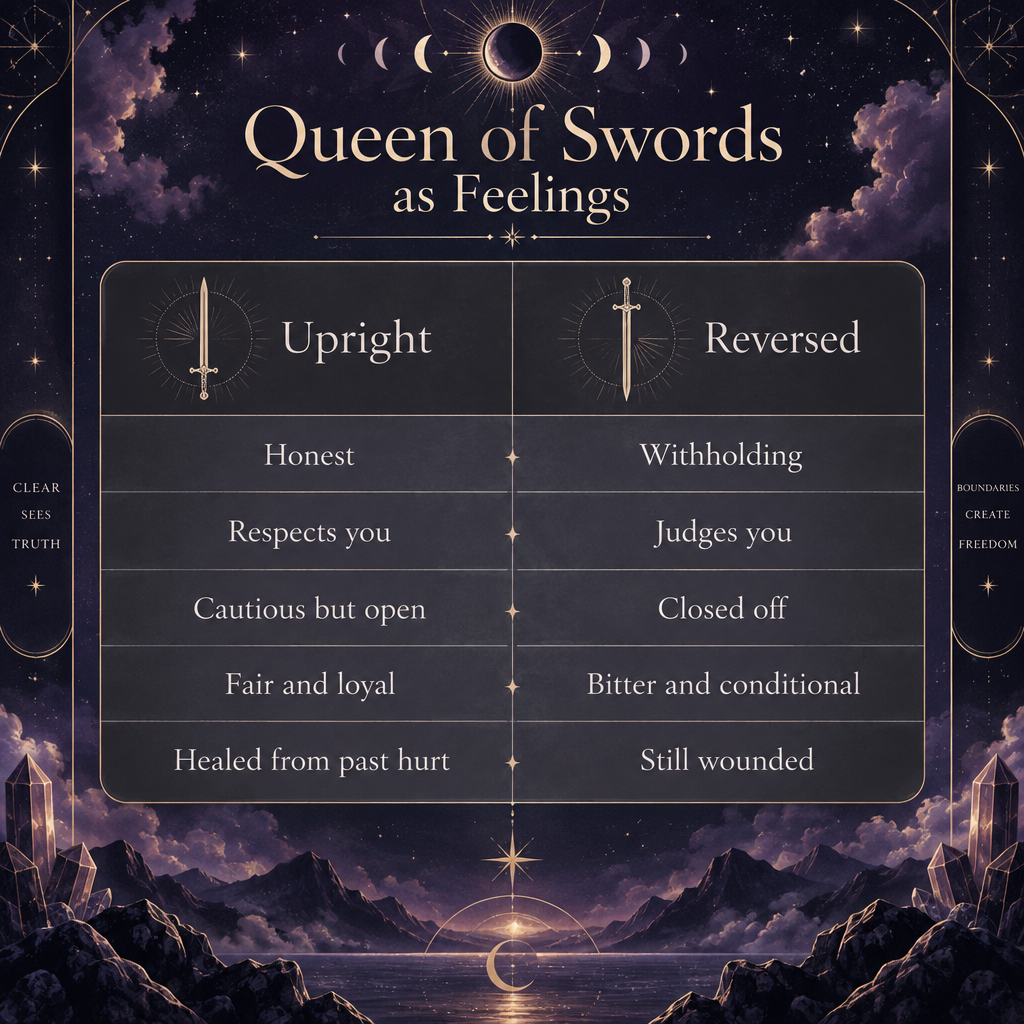
| Upright feelings | Reversed feelings |
|---|---|
| Honest, direct, says what they mean | Withholding, cryptic, says nothing |
| Respects you, admires your mind | Judges you, keeps a mental scorecard |
| Independent, affection by choice | Isolated, uses independence as a shield |
| Cautious but open | Closed off, defended |
| Fair, principled, loyal once committed | Bitter, vindictive, conditional love |
| Has healed from past hurt | Still bleeding from past hurt, won’t admit it |
| Clear about boundaries | Uses boundaries as punishment |
| Values truth over comfort | Uses truth as a blade |
Queen of Swords upright: how this person feels about you
Take the card at face value. The person you asked about has thought carefully about you and reached a conclusion they can defend. They are not confused about their feelings. If they have not told you what those feelings are yet, it is because they have not decided it is the right moment, not because they do not know.
Three things are almost always true when this card describes someone’s feelings toward you:
- They respect you. The Queen of Swords does not waste attention on people she finds foolish. If she is paying attention to you, she rates your intelligence, your honesty, or your competence highly.
- They are not performing. You will not get grand gestures or constant texting. You will get consistency, truthful answers, and someone who shows up when they say they will.
- They have a line. Something in their past taught them to protect themselves. They like you, and they are also watching to see whether you are safe to let in further.
The affection here is quiet and durable. It grows by observation, not impulse. People who need frequent verbal reassurance often misread this queen as indifferent when she is actually loyal and deciding.
Scenario by scenario
New or potential relationship
Upright: They are interested but assessing. Expect them to ask real questions, remember your answers, and notice inconsistencies. They are attracted to how you think and how you handle yourself. They are not going to sleep with you or commit to you quickly, and they will respect you more if you do not pressure them. A good sign: they are being unusually candid with you about their own history. The Queen of Swords only shares the hard chapters with people she is considering keeping.
Reversed: They are interested but something you did, or something their last partner did, has tripped a wire. They may be running you through tests you do not know about, or they may have already decided you are a risk and are quietly stepping back. Mixed signals from a reversed Queen are rarely games. They are fear dressed as indifference.
Existing long-term relationship
Upright: Your partner loves you in a clear-eyed way. They see your flaws and have chosen you anyway, which is a stronger kind of love than infatuation. They want honesty from you above anything else, and they will handle a difficult truth far better than a comfortable lie. If the relationship feels less affectionate lately, this card usually means they are preoccupied or processing, not falling out of love. Ask directly. They will tell you.
Reversed: There is a cold front in the house. Your partner has stopped bringing things up and started filing them away. Criticism has replaced conversation, or silence has replaced both. The reversed Queen in a long relationship frequently means one person feels unheard and has decided that being right is safer than being close. This is fixable, but only if the unspoken grievance is named out loud.
An ex, or reconciliation
Upright: Your ex has done the work. They have looked at the breakup honestly, including their own part in it, and they no longer feel the raw anger or grief. That clarity cuts both ways. They may feel genuine goodwill toward you and still have no intention of coming back, because they can see exactly why it ended. If they are open to reconciliation, it will be a sober, conditional offer with clearly stated terms. There will be no rose-tinted reunion.
Reversed: Your ex has not let go, and not in the romantic sense. They are holding onto a version of the story where you are the villain. Expect lingering bitterness, possibly a desire to make you feel the hurt they felt, and an unwillingness to admit they miss anything about you. A reversed Queen of Swords for an ex’s feelings is one of the clearer “do not chase” cards in the deck. Any contact will be scored and used.
A crush or someone you are pursuing
Upright: They have noticed you, and they have opinions about you. Those opinions are mostly good: they find you sharp, interesting, and a cut above the people around them. What they have not done is decide whether to act. The Queen of Swords would rather observe for six months than make a wrong move in a week. If you want this to go somewhere, be direct and specific. Vague flirting goes straight over her head. A clear “I would like to take you to dinner on Friday” lands.
Reversed: They are keeping you at an intellectual arm’s length, possibly flirting with their wit while refusing to show you anything soft. It may feel like a connection, and some of it is, but they are using cleverness to avoid risk. Alternatively, they have judged you based on incomplete information and written you off. Either way, the warmth is not currently reaching you.
Friendship and family
Upright: A friend or family member described by this card cares about you by telling you the truth. This is the sister who says the partner is wrong for you, the friend who will not pretend your business plan is good. Their love is practical and shows up in action, not in words. Do not confuse their bluntness with coldness. They are often the people who stay when everyone else has drifted.
Reversed: Someone close to you is nursing a grievance and expressing it through judgment, withdrawal, or sarcasm. In a parent, this looks like criticism standing in for affection they do not know how to voice. In a friend, it looks like a sudden chill with no explanation. The feelings underneath are usually hurt and a sense of being undervalued. Direct, non-defensive questions are the only approach that works.
Queen of Swords reversed: the full range of what they feel
The reversed Queen of Swords gets flattened into “bitter and critical” far too often. In practice, the card covers several distinct emotional states, and knowing which one you are dealing with changes everything.
Emotional withdrawal and intellect used as distance
This is the person who can discuss your relationship with perfect articulacy and never once say how they feel. They analyse. They explain. They offer a reasonable framework for why things are the way they are. What they will not do is let you see them scared or wanting. Intelligence has become a moat. If this is how someone feels about you, they feel more than they are showing, and the gap between the two is where the relationship is stalling.
Suppressed vulnerability driving the coldness
Behind most reversed Queens is a wound that has not closed. Waite’s old keywords of widowhood and separation still apply, in a modern sense: a divorce, a betrayal, a parent who punished softness. This person has concluded that needing someone is dangerous. Their coldness toward you is not about you. It is a reflex. The frustrating part is that they will rarely tell you this, because telling you would be the very vulnerability they are avoiding.
Bitterness masquerading as wisdom
“I’ve just learned not to expect much from people.” “I’m being realistic.” The reversed Queen of Swords dresses resentment up as hard-won insight. In a feelings reading, this is someone who has decided you will disappoint them before you have had the chance to, and who treats that prediction as maturity. It is not. It is a defence that happens to sound clever.
Manipulation through silence
The upright Queen tells you the truth. The reversed Queen withholds it strategically. Silent treatment, selective disclosure, the pointed “I’m fine”: these are control tactics, whether or not the person would call them that. If someone’s feelings about you show up as a reversed Queen in this register, you are being managed rather than loved.
Vindictiveness and conditional love
At its darkest, the card describes someone who keeps a ledger and intends to collect. Affection is granted when you meet their standards and revoked when you do not. Old mistakes get resurfaced in new arguments. If an ex’s feelings land here, their interest in you is about settling a score.
Cold, cutting judgment
Sometimes the card simply means the person has judged you harshly and is done. No rage, no drama, just a verdict. The sting is that the judgment often contains a grain of truth, delivered without any of the compassion the upright Queen would have offered alongside it.
How the Queen of Swords describes the way someone sees you
Asked “how does this person see me,” the card shifts from their feelings to their perception.
Upright: They see you as composed, intelligent, and honest to the point of being formidable. They think you have high standards and do not suffer fools. They may also see you as a little hard to read and slightly intimidating. If you worry you come across as too emotional, this card says the opposite: this person thinks you have your head screwed on. It is a flattering card to receive, though it can mean they are not sure you need them.
Reversed: They see you as cold, critical, or cynical. They may believe you are judging them, holding back, or being deliberately difficult. Sometimes this reflects something real about how you have been behaving. Just as often it reflects their own guardedness projected onto you. Either way, the perception is that you are not emotionally available, and that is worth examining honestly.
Queen of Swords yes or no for love
Upright: a cautious yes. The Queen of Swords does not block love. She slows it down and demands honesty. If you asked “does this person like me,” the answer is yes, with conditions. If you asked “will we get together,” the answer is yes if you are straight with them and patient.
Reversed: a no for now. Not a permanent no, but a clear signal that someone’s defences are up and that pushing forward will make it worse. For questions about reconciliation with an ex, the reversed Queen is a firm no.
Feelings from a woman versus a man
Court cards are not literal gender markers in most modern practice, and the Queen of Swords describes an energy that anyone can carry. That said, readers still ask, so here is the practical difference.
When the card represents a woman’s feelings, it most often describes someone who has been let down before and is deciding whether you are worth lowering the drawbridge. Her honesty is a form of care.
When it represents a man’s feelings, it frequently points to someone who intellectualises attraction, respects you deeply, and struggles to show tenderness because he was never taught how. He will defend you fiercely in public and freeze when you ask him how he feels in private. In both cases, the person values you for your mind and expects to be valued the same way.
How she compares with the cards around her
Context from neighbouring court cards sharpens any reading.
Queen of Cups feels first and thinks later. She is warm, intuitive, and absorbent. If you were hoping for the Queen of Cups and got the Queen of Swords, the person’s feelings are just as real but far less demonstrative. The Swords Queen will remember your birthday; the Cups Queen will cry at it.
King of Swords shares her clarity but holds it with more detachment and authority. As feelings, the King is more likely to have decided and moved on to logistics. The Queen is still watching and weighing, and she has more emotional depth under the surface than he does.
Knight of Swords is the same element with none of the patience. His feelings arrive fast, argue hard, and can vanish just as quickly. If the Queen of Swords appears alongside him, someone is forcing themselves to slow down and think before they speak.
Queen of Pentacles is grounded and nurturing in practical ways. She and the Swords Queen both show love through reliability, but the Pentacles Queen does it with food, comfort, and presence, while the Swords Queen does it with truth and good counsel.
If you drew this card: what the Queen of Swords asks of you
Forget generic advice about active listening. The card itself is the instruction.
If the Queen of Swords describes your own feelings, she is confirming that you already know the truth about this relationship. You have been gathering evidence. Stop gathering and act on it, whether that means stating a boundary, asking a direct question, or ending something that no longer meets your standard. The raised left hand on the card is not only a gesture toward others. It is permission to say “this far and no further” to yourself.
If the card describes someone else’s feelings, she asks you to meet honesty with honesty. Do not try to charm, soften, or over-explain. Say what you want in plain language and let them respond. This queen rewards directness and punishes manipulation, and she can smell the difference from across a room.
If she is reversed, in either position, the task is to find the wound beneath the wall. Ask yourself, or them, what the coldness is protecting. The clouds under her throne clear eventually. They clear faster when someone names what is in them.
FAQ
Is the Queen of Swords emotionally cold?
No. She is emotionally controlled, which is different. Upright, she feels deeply and chooses carefully when and how to show it. Reversed, she can appear cold because fear or old hurt has shut down her expression, but the feelings are still there underneath.
Is the Queen of Swords good for a relationship?
Upright, yes, provided both people value honesty and independence. Relationships described by this card are stable, loyal, and low on drama, though they can run short on open affection. Reversed, the card flags judgment, withdrawal, or scorekeeping that needs to be addressed before the relationship can grow.
What does it mean if someone feels like the Queen of Swords about me?
They respect you, they are being truthful with you, and they are taking their time. They are attracted to how you think and are evaluating whether you are safe to trust. It is a strong card for long-term potential and a slow card for short-term romance.
Does the Queen of Swords mean a breakup?
Not on its own. Waite’s historical meaning included separation and widowhood, which is why some readers treat it as a loss card, but in a feelings reading the upright Queen more often means someone has processed an old loss, not that a new one is coming. Reversed, alongside cards like the Three of Swords or Five of Cups, it can point to a cold, drawn-out ending.
Queen of Swords as feelings from an ex: will they come back?
Upright, they have clarity about the breakup and will only return on clear, honest terms, if at all. Reversed, they are holding resentment and any contact is likely to be about grievance rather than reconciliation. The reversed card is a strong signal to stop reaching out.
What does the Queen of Swords mean for someone’s intentions?
Upright, their intentions are honest and they will tell you what they are if you ask directly. Reversed, their intentions may be guarded, mixed, or self-protective, and you should watch what they do rather than what they say or do not say.