Queen Of Swords As How Someone Sees You (Upright & Reversed) Tarot Card Meaning
Drawing the Queen of Swords in the “how someone sees you” position means the person is reading you through a lens of intellect, boundaries and plain speech. Upright, they see a sharp, fair-minded, self-reliant adult who says what she means. Reversed, they see those same traits curdled into coldness, or they are projecting their own fear of being judged onto you.
The Short Version
Before the detail, here is the quick-reference layer you need for this card in this position.
Upright keywords: Perception, Independence, Wisdom, Clarity, Honesty, Intelligence, Boundaries, Fairness
Reversed keywords: Emotional Coldness, Isolation, Bitterness, Unforgiving, Detachment, Sharp Tongue, Misread Intentions
Element: Air (thought, communication, judgement)
Zodiac association: Libra in the Golden Dawn system, which assigns the Queen of Swords to the last decan of Virgo and the first two decans of Libra. Some modern readers link her to Aquarius instead because of her detachment and independence. Either way, the person sees you as an Air type: head first, heart second, and honest about both.
One-line meaning: They see you as someone who cannot be fooled and will not pretend.
What the Card Shows and Why It Matters for Perception
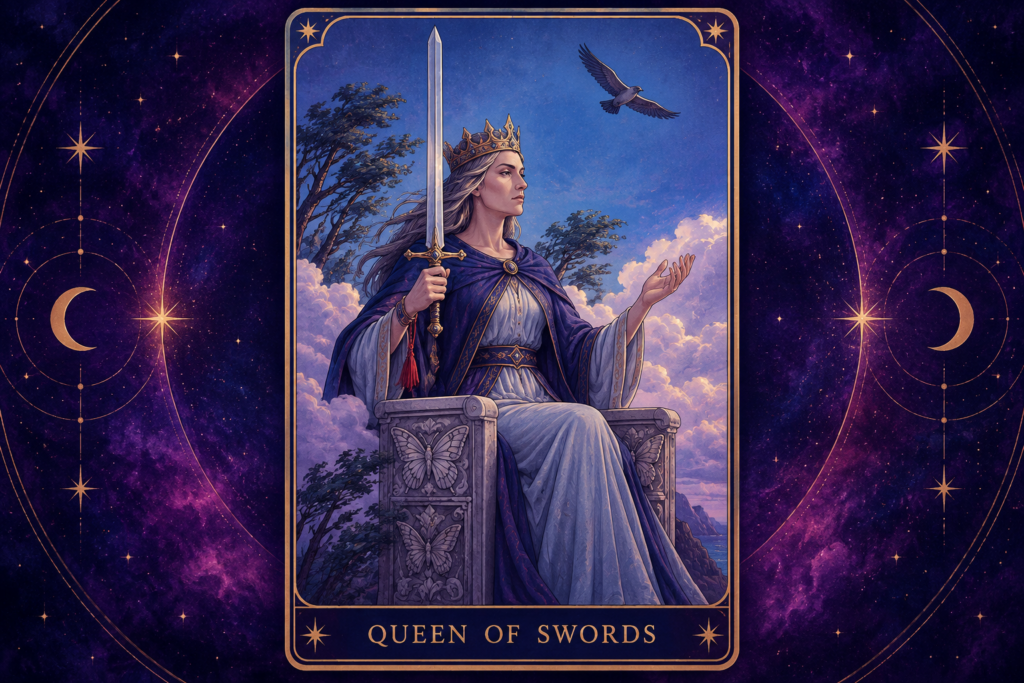
In the Rider-Waite-Smith deck the Queen sits in profile on a stone throne, sword held perfectly upright in her right hand, left hand raised with the palm open. Her face is stern. The sky is clear above her but clouds gather at her waist, and a single bird flies overhead. Her crown and throne are carved with butterflies, a cherub’s head sits by her hand, and a red tassel hangs from her wrist. The trees behind her bend in a wind that has not reached her.
Every one of these details translates into a specific impression in a “how someone sees you” reading.
The upright sword
A vertical blade means judgement with no tilt. The person sees you as someone who weighs things without bias and acts on the conclusion. They do not expect you to soften a verdict to spare their feelings.
The crown and throne
Authority that was earned, not handed over. She rules a cold, high place alone. The observer senses you have status in your own life that does not depend on them, and that you are comfortable being the one who decides.
The butterflies
Transformation completed. Butterflies on the throne and crown signal that the Queen has already been through her metamorphosis. The person sees you as someone who has changed, suffered, and come out the other side with a harder shell and a clearer mind. They may suspect you were not always this composed.
The clouds at her waist
Feelings exist but they sit below the line of sight. The observer picks up on emotional complexity that you keep beneath your words. Upright, they respect that. Reversed, they experience it as a wall.
The grey and pale blue palette
Calm, cool, considered. There is no red heat in this card apart from the tassel. People reading you through this card do not see passion first. They see poise.
The tassel and the open hand
Traditionally the tassel marks the widow’s cord, a bond that has been cut. The raised left hand is often read as a gesture of welcome or of “stop, that is far enough”. Both fit the perception reading: they see someone who has lost something, learned from it, and now controls the distance at which people are allowed to stand.
Queen of Swords Upright: How Someone Sees You
The general impression
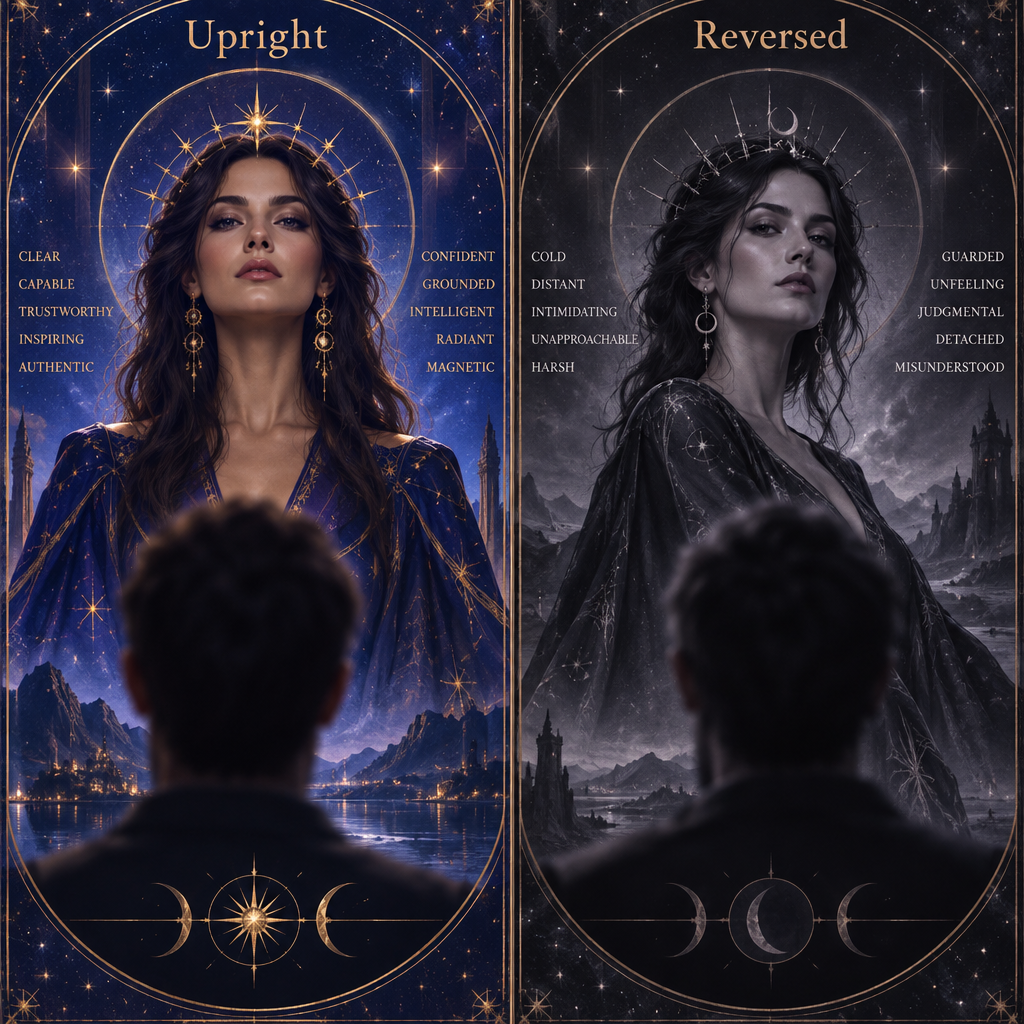
They see you as intelligent and perceptive, the sort of person who notices the detail everyone else skipped and asks the question nobody wanted asked. Your communication registers as direct, specific and free of games. You say “no” cleanly. You say “yes” only when you mean it.
Independence is central. The observer does not see you as needy or clingy, and they do not expect you to reorganise your life around them. That can be attractive, intimidating, or both at once depending on who they are.
Fairness is the other anchor. Libra’s influence shows up as a reputation for even-handedness: you are seen as someone who will hear both sides and then call it as it is, even when the honest answer is uncomfortable for you.
There is a crucial nuance that shallow interpretations miss. The Queen of Swords’ wisdom is lived, not theoretical. The person sees you as someone whose clarity came at a cost. They assume there is a story behind your boundaries, and most of the time they are right. This earns their respect, though it also makes them careful around you.
In love: if you are single or this is a potential relationship
A new romantic interest viewing you through the upright Queen of Swords sees a prize that has to be approached honestly. They believe you are selective, that you assess character quickly, and that flattery will not work on you. They may describe you to friends as “intimidating in a good way” or “someone I have to be real with”.
They also see you as emotionally self-sufficient. This is a double-edged sword. It reassures a secure person and unsettles an anxious one who wants to be needed. Expect them to test whether you actually want them or are simply tolerating their company. From their point of view, you are hard to read because you do not perform your feelings.
In love: in an existing relationship
A partner who sees you as the upright Queen of Swords trusts your word completely. If you say the bills are handled, they are handled. If you say you are fine, they believe you, sometimes too readily. You are the one they come to for the honest opinion on a work problem, a family conflict or a decision they are avoiding.
They see you as loyal in a practical rather than gushing way: you show up, you defend them, you keep confidences. Where they struggle is warmth. They can experience you as the partner who solves the problem when what they wanted was to be held while they complained about it. The clouds at the Queen’s waist are exactly this: they know the feeling is there, they just do not always get to see it.
In friendship
Friends who see you through this card consider you the truth-teller of the group. You are the one they call when they want the real answer about the relationship, the job offer or the haircut. They value that you do not gossip, that you remember what they told you six months ago, and that you give advice without making it about yourself.
They also see you as someone who holds their own. You do not need the group chat to feel okay, and you are fine cancelling plans when you need solitude. Close friends respect this. Newer or more insecure friends can mistake it for indifference.
In career
A colleague, manager or client reading you as the upright Queen of Swords sees competence and judgement. You are perceived as the person who spots the flaw in the plan, writes the clear email, and does not flinch in a difficult meeting. Bosses see someone promotable into roles that require decisions and discretion: compliance, legal, editing, management, strategy, anything where “fair but firm” is the job description.
Colleagues see you as impartial. They may bring you disputes to settle. The downside is that they rarely see you as the fun one, and they can assume you do not need support even when you do.
Queen of Swords Reversed: How Someone Sees You
The reversed Queen in this position is not simply “a bad person”. It describes a perception in which your sharpness is experienced as cutting and your independence as rejection. Sometimes that perception is accurate. Often it says more about the observer than about you.
The general impression
They see emotional walls. Where the upright Queen keeps feelings beneath the clouds by choice, the reversed Queen looks as though she has lost access to them altogether. The person believes you are detached, hard to reach, and uninterested in their inner life.
They see sharp words. Honest feedback lands as criticism. A dry joke lands as contempt. A short reply lands as dismissal. The sword that was held upright is now, in their experience, pointed at them.
They see bitterness or an unforgiving streak. If you have been hurt before, they sense the old wound and assume it is being held against them. They may feel they are being punished for someone else’s behaviour.
They see isolation. Rather than reading your self-sufficiency as strength, they read it as loneliness you refuse to admit, or as a deliberate shutting-out.
The critical point is the gap between perceived coldness and actual intent. Most people described by the reversed Queen of Swords are not cruel. They are tired, guarded, overwhelmed, or simply blunt in a way the observer is not used to. The card flags a misunderstanding of your true nature as often as it flags a genuine flaw. Your job is to work out which it is.
In love: a potential or new relationship
Someone you have recently met who sees you as the reversed Queen of Swords has concluded you are emotionally unavailable. They think you are too critical, too quick to find fault, or playing a game of distance to stay in control. They may have told a friend “I can’t tell if they even like me” or “every conversation feels like a job interview”.
Frequently this comes from a mismatch in pace. You are assessing carefully; they wanted warmth by the third date. Neither of you is wrong, but the perception is forming fast and it is not in your favour.
In love: an existing relationship
A long-term partner reading you through the reversed Queen feels shut out. They experience your silence as stonewalling, your corrections as nagging, and your logic as a weapon that always wins the argument and never resolves it. They may feel lonely inside the relationship.
In the sharper version, they genuinely believe you are being spiteful: keeping score, bringing up old grievances, withholding affection as leverage. In the gentler version, they simply miss the person who used to let the clouds part.
In love: an ex-partner
An ex who sees you as the reversed Queen of Swords remembers you as cold, judgemental or unforgiving. This is one of the most common contexts for this card to appear reversed, and it should be read with heavy scepticism about the observer. People rewrite their exes to make the ending bearable. If you set a boundary and held it, “cold” is the word they reach for.
That said, if the breakup involved you cutting contact abruptly, refusing to discuss things, or delivering a final verdict with no softening, the ex’s view has some grounding. The card does not tell you whether they are right. It tells you what they think.
In friendship
A friend who sees the reversed Queen in you feels judged. They believe you disapprove of their choices and that your advice has turned into lecturing. They may have stopped telling you things because they do not want the honest opinion anymore.
They may also read your need for solitude as a slow fade-out. If you have been cancelling and going quiet, they are interpreting it as a verdict on the friendship rather than on your energy levels.
In career
At work, the reversed Queen of Swords means you are seen as harsh, difficult or political. A manager might view you as someone who creates friction, who criticises more than they build, or who cannot be given feedback without an argument. Colleagues may consider you intimidating in the bad sense: the person whose email they dread, the reviewer who never says anything is good.
In a milder reading, you are simply seen as unapproachable. Nobody thinks you are incompetent. They just do not want to sit next to you at lunch.
Why Their Perception Might Not Be About You
The “how someone sees you” position describes an image inside another person’s head. That image is built from your behaviour plus their history, fears and expectations. The Queen of Swords is unusually vulnerable to distortion because her defining traits, directness and independence, are exactly the traits that insecure or wounded people find threatening.
Consider who the observer is. A person raised by a critical parent will hear criticism in neutral feedback. Someone who was abandoned will read any need for space as the start of an exit. A person who avoids conflict will experience your clear “no” as aggression because they could never say it themselves. None of this is your fault, but all of it shapes the card.
There is also the issue of contrast. If the observer is a Cups type, warm and expressive, the gap between their style and yours will feel enormous to them and barely noticeable to you. The reversed Queen often appears when an emotional person is reading a logical one and translating “she didn’t cry” into “she doesn’t care”.
Finally, the card can reflect a past version of you. The butterflies say transformation has happened. The observer may be holding an image from before you changed, particularly if this is an ex, an old friend or a family member.
What to Do With This Card
If the Queen of Swords is upright, you are mostly in good shape. Two adjustments pay off. First, let the clouds part occasionally: name a feeling out loud instead of assuming it is obvious. Second, soften the delivery without softening the content. “Here is what I think, and I know it is not what you hoped” keeps your honesty intact and shows you noticed the other person’s hopes.
If the card is reversed, work through these in order.
- Check the gap between intent and impact. Ask one trusted, honest person how your communication lands. Not whether you are right, but how it feels to receive. Air types often skip this step because they trust their logic.
- Separate boundaries from walls. A boundary is a rule about what you will accept. A wall is a refusal to let anyone close enough to find out. If you cannot remember the last time you let this person see you uncertain or upset, you have built a wall.
- Audit your sharpness. Sarcasm, corrections and “just being honest” are not the same thing. Honest feedback is specific, requested or necessary, and delivered once. Everything else is the sword swinging loose.
- Look at what you are still holding. Bitterness in the reversed Queen almost always traces to an old injury. If you are punishing a current person for a past one, that is yours to fix, not theirs to endure.
- Decide whether this observer’s view matters. An ex’s resentment or a colleague’s sulk does not require you to abandon your standards. Weigh the source. Change for the people who have earned it.
- Balance logic with vulnerability deliberately. Once a week, let someone help you with something. Once a day, say what you feel before saying what you think. This is clumsy at first and that is fine.
Card Combinations That Change the Reading
The cards beside the Queen of Swords tell you whether her sharpness is admired or resented.
With The Lovers or the Two of Cups: They see your directness as a foundation for real partnership. The honesty is the attraction. This is one of the best pairings for a romantic “how someone sees you” question.
With the Knight of Cups or Page of Cups: The observer is softer than you and slightly in awe. They may put you on a pedestal and then feel hurt when you behave like a person rather than an ideal.
With the Three of Swords: They associate you with pain, usually because you told them a truth that ended something or because they feel cut by your words. Reversed Queen plus Three of Swords is the classic “the ex thinks you were cold” combination.
With the Five of Swords: They see you as someone who wins arguments at any cost. Even upright, this pairing warns that your clarity is being read as combativeness.
With The Hermit: Your independence reads as withdrawal. They respect your wisdom but feel kept at arm’s length.
With Justice: Strong confirmation that you are seen as fair, rational and principled. Even a reversed Queen softens next to Justice.
With the Ten of Cups or Four of Wands: They see you as the steady, reliable presence that holds a family or group together, the one who keeps everyone honest.
With the Devil: They may feel trapped by your judgement or believe you use truth as control. Look closely at power dynamics in the relationship.
Quick-Reference Table
| Context | Upright perception | Reversed perception |
|---|---|---|
| General | Intelligent, honest, independent, fair, hard to fool | Cold, critical, bitter, detached, hard to reach |
| Potential / new love | Selective, intriguing, demands authenticity | Emotionally unavailable, too critical, playing games |
| Existing relationship | Trusted, loyal, the honest sounding board | Stonewalling, scorekeeping, logic used as a weapon |
| Ex-partner | Principled, hard to argue with, respected | Unforgiving, heartless, “ended it like a verdict” |
| Friendship | Truth-teller, keeper of confidences, self-contained | Judgemental, lecturing, fading out |
| Career | Competent, impartial, promotable, decisive | Harsh, difficult, unapproachable, political |
FAQ
What does the Queen of Swords mean in a love reading for how someone sees you?
Upright, they see you as honest, loyal and independent, someone who will not play games and expects the same. They respect you and may find you slightly intimidating. Reversed, they feel you are emotionally distant or overly critical, and they are not sure you want them close.
Is the Queen of Swords reversed a bad sign for how someone sees you?
It is an uncomfortable sign, not a doomed one. It tells you the person currently experiences you as cold or sharp. Sometimes that reflects real behaviour you can adjust. Just as often it reflects their own sensitivity to directness or an old image of you that no longer fits. Check with someone you trust before deciding which it is.
Does the Queen of Swords mean they think I am single or emotionally unavailable?
Not literally single, but self-sufficient. The card shows a woman who rules alone and is at peace with it. Upright, the observer sees independence they admire. Reversed, they see unavailability and may have concluded you are not interested.
What element and zodiac sign does the Queen of Swords represent?
She belongs to Air, the element of thought and communication. The traditional Golden Dawn attribution places her across late Virgo and most of Libra, so Libra is the standard association. Some readers link her to Aquarius because of her detachment. In a perception reading, this means the person sees you as a thinker who values fairness and clear speech.
How does the Queen of Swords differ from the Queen of Pentacles or Queen of Cups in this position?
The Queen of Cups means they see you as nurturing and emotionally open. The Queen of Pentacles means they see you as grounded, generous and practical. The Queen of Swords means they see your mind before your heart: clever, honest, boundaried, and not someone they can manipulate. Each is a form of respect, but the Swords version comes with the most distance.