
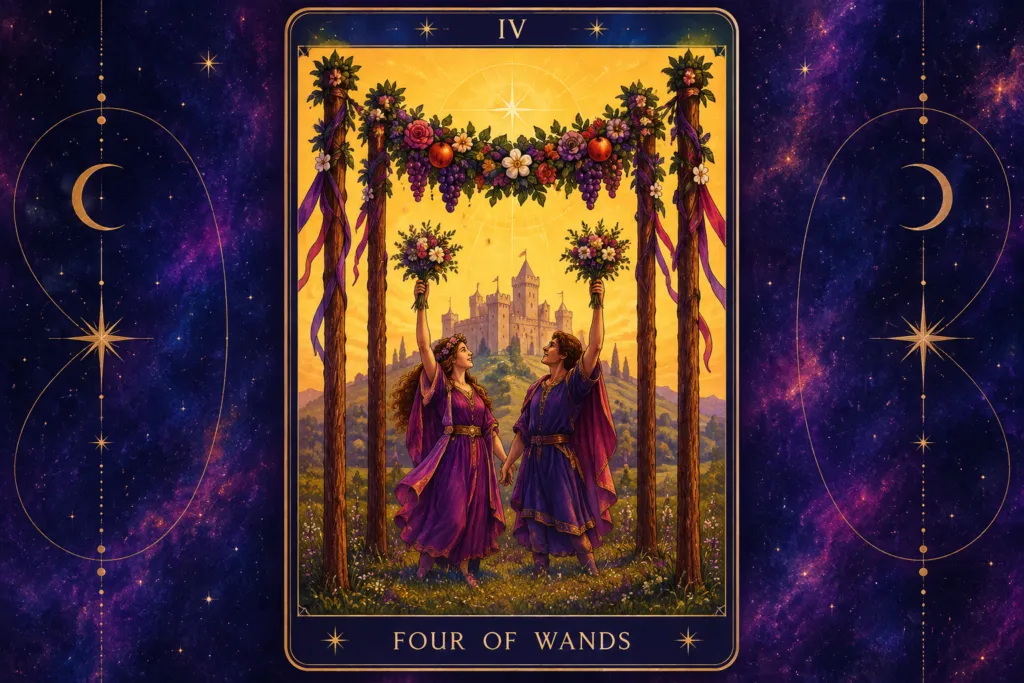
In Pamela Colman Smith’s 1909 drawing, the Four of Wands shows a garland strung over four staves and two figures raising bouquets in front of an old manor house, which is why many readers call it the “wedding card.” As a love outcome, it points to a relationship that becomes stable, visible and shared with the people around you. Reversed, it describes that same milestone delayed, disputed, or wanted more by one partner than the other.
Key takeaways
- Upright, the Four of Wands is a clear yes for commitment, moving in, engagement and family acceptance.
- Reversed, it means “not yet.” The structure is unfinished, and the reversal usually does not mean the relationship has failed.
- The card’s strongest theme is public recognition: the relationship leaves the private stage and is introduced to friends, family and community.
- For an ex, it favours reunion only when the original foundation was sound and circumstance broke it.
- Surrounding cards change the reading more than usual, so check the cards next to it before you settle on a meaning.
Four of Wands Love Meaning at a Glance
Upright, the card stands for celebration, home and commitment that other people witness. Reversed, it describes the same themes under strain: postponed plans, tension at home, or a structure that one partner has outgrown.
| Position | Love keywords | Typical outcome |
|---|---|---|
| Upright | Celebration, stability, homecoming, engagement, harmony, community approval, shared foundations, belonging | A formal step forward: exclusivity, meeting family, moving in, engagement or marriage |
| Reversed | Postponed plans, instability, hesitation, conflict at home, feeling unwelcome, cancelled celebration, outgrowing the relationship | The milestone is delayed, or one partner wants it more than the other |
Is the Four of Wands a Yes or No in Love?
Upright: yes. The upright card answers yes to “Will this relationship work out?”, “Will we move in together?” and “Is this person serious about me?” It usually adds that other people will see it happen. It suits questions about commitment, cohabitation, engagement and whether a family will accept a partner.
Reversed: not yet. The reversal is not a firm no. It says the structure is incomplete. Something has to be repaired, discussed or let go before the celebration can happen. If your question has a deadline (“by summer”, “before I turn 35”), the reversed card puts the problem in the timeline, not necessarily in the person.
The yes is weakest for fast, private or casual questions. “Will they text me tonight?” is a poor fit for a card about homes, families and ceremonies. You get a sharper answer if you rephrase toward structure: “Is this heading toward commitment?”
What the Card Shows and Why It Matters for Love
The Rider-Waite-Smith image does most of the interpreting for you. Arthur Edward Waite designed the deck with Smith, and Rider & Son published it in 1909. In The Pictorial Key to the Tarot (1910), Waite described the scene as four great staves with a garland hung from them, “two female figures” lifting nosegays, and “a bridge over a moat, leading to an old manorial house.” Each of these details carries a separate love meaning.
The four wands: a frame you can live in
Four staves stand upright and evenly spaced, forming a frame. The Wands suit deals with passion and drive, and this card is where that energy settles into something solid. The Two of Wands makes a plan, the Three of Wands waits for results, and the Four of Wands finally has walls. In love, attraction has turned into something that holds you both: a shared flat, a declared relationship status, an agreed future.
The garland: courtship that bears fruit
Flowers and fruit hang between the tops of the wands. Flowers stand for courtship and fruit stands for results. Together they look like a canopy decorated for a ceremony, close to a Jewish chuppah or the floral arch at a modern wedding. This detail is why the “wedding card” nickname stuck.
The figures: love presented to the world
The two figures hold their flowers overhead in the middle of a celebration, facing outward toward the viewer. Compare the couple in the Two of Cups, who face each other and exchange cups in private. The Four of Wands pair has moved past that stage and is presenting the relationship to everyone else. In an outcome position this often means something literal: a party, an announcement, or meeting each other’s families.
Waite called them “female figures,” and many modern readers take the card as gender-neutral. The meaning holds for any couple. What matters is that the celebration is shared and public.
The manor house and the crowd: home and community
Behind the figures stands a large stone building reached by a bridge, with smaller figures gathered near it. Waite’s own keywords for the card were “country life, haven of refuge, a species of domestic harvest-home, repose, concord, harmony, prosperity, peace.” Love under this card does not happen in isolation. It is two people with a place to live and a circle of people who approve.
The yellow sky: nothing hidden
Smith used a flat gold background for cards of confident, visible energy, including the Sun and the Three of Cups. Whatever this relationship is, people will see it. That makes the card a poor match for secret affairs and relationships that need to stay hidden. If you drew it about a hidden connection, the outcome points toward disclosure.
Did you know?
Waite did not treat the reversed Four of Wands as negative. In The Pictorial Key to the Tarot he wrote that reversed “the meaning remains unaltered; it is prosperity, increase, felicity, beauty, embellishment.”
How Different Decks Change the Love Message
The deck you use shifts the emphasis between “wedding,” “completion” and “security.” If your card shows people celebrating, read it as a milestone. If it shows only structure, read it as stability.
| Deck | How the card appears | Love emphasis |
|---|---|---|
| Rider-Waite-Smith (1909) | Garland, two celebrating figures, manor house, crowd | Milestones, weddings, public commitment |
| Thoth Tarot (Aleister Crowley and Lady Frieda Harris) | Titled “Completion”; a wheel of wands tipped with rams’ heads and doves | A cycle closing, the relationship reaching its finished form |
| Tarot de Marseille | Four crossed batons with floral decoration, no scene | Read through number and suit: order and settled passion |
| The Wild Unknown (Kim Krans) | No human figures | Security and being settled rather than a party |
The Thoth imagery comes straight from astrology. The ram stands for Aries and the dove for Venus, which links the card to the Golden Dawn attribution covered below. A Thoth reader is less likely to predict a wedding. The more likely reading is that the relationship has stopped growing in its current form and is now complete. That can mean contentment. In a reading about restlessness, it can also mean the relationship has gone as far as it will go.
Why the Number Four Means a Settled Relationship
Fours across the Minor Arcana describe things that hold still. A table has four legs, a room has four walls, and the year has four seasons. In numerology, four is the number of order and foundations.
Compare the suits:
- Four of Pentacles: grips what it has.
- Four of Swords: rests and recovers.
- Four of Cups: sits unmoved by what is offered.
- Four of Wands: celebrates finally having something solid.
In love, this is the backbone of the card. The relationship has stopped being a question. You know where you stand, where you sleep, and who comes with you to family dinner.
Four also has a downside: rigidity. That explains why the reversed card so often appears when one partner feels boxed in by a structure the other partner wants. The same walls that feel like safety to one person can feel like a cage to the other.
Venus in Aries: A Useful Lens, Not a Universal Rule
Many websites state that the Four of Wands is “ruled by Venus in Aries” as if every tradition agreed. They don’t. The attribution comes from the Hermetic Order of the Golden Dawn, which assigned each numbered Minor Arcana card to one ten-degree decan of the zodiac. In that system, the Four of Wands covers the third decan of Aries (20 to 30 degrees, roughly 10 to 20 April) under Venus. Its Golden Dawn title is “Lord of Perfected Work.” The Thoth deck follows this scheme. Marseille-style decks carry no astrological attribution, and some readers work with elemental dignities only.
Treat Venus in Aries as a lens, then. For love readings it is a good one. Venus governs affection, pleasure and partnership. Aries brings speed, courage and initiative. Put together, they describe love that moves quickly toward commitment. Couples under this card tend to decide fast, say so openly and avoid years in limbo.
When Venus in Aries goes wrong, it rushes. That leads directly into the reversed meaning: a celebration planned before the relationship was ready for it.
The 11:11 Twin Flame Association
The twin flame reputation comes from the picture itself. Four upright staves read as “1 1 1 1,” which echoes 11:11, a number sequence many people treat as a sign of synchronicity. The association belongs to the upright card.
Upright, it points to a connection that feels recognised and fated, where both people quickly feel at home with each other. That is a feature of the card, not proof of anything. The Four of Wands does not confirm a twin flame bond, and no card can. What it does say is that this relationship is heading toward a stable, visible, shared life. If you came looking for mystical confirmation, you get something more useful: signs of a partnership that works in plain view.
Four of Wands as a Love Outcome by Relationship Status
The direct answer changes with your situation. Singles meet someone through their community. New couples move quickly toward exclusivity. Established couples take a formal step. For an ex, the card favours reunion only when the foundation was sound. These four readings are the core of the card, so each gets its own section below.
| Your situation | Upright outcome | Reversed outcome |
|---|---|---|
| Single | A committed partner met through friends, events or community | Not ready yet; your own life needs to settle first |
| New relationship (under ~6 months) | Exclusivity, meeting friends and family, fast but natural progress | Moving faster than the foundation allows; mismatched pace |
| Long-term relationship | Engagement, marriage, buying or moving home, blending families | Stalled milestone, conflict about home or family, one partner hesitating |
| Ex / reconciliation | Reunion if circumstance broke a sound bond; otherwise peace with the past | Reunion unlikely in the short term; old structure not fit to rebuild |
Single: love arrives through your community
For someone single, the outcome card says your next relationship comes through other people. The garland, the manor house and the crowd near it all point to community. You are more likely to meet this person at a wedding, a housewarming, a friend’s birthday or a hobby group than through another month of swiping.
The card also tells you what kind of relationship is coming. It is not a fling or a situationship. Expect someone who wants to meet your friends, talks about plans two seasons ahead, and sees a shared home as a goal rather than a trap. If you have spent time in casual arrangements, this outcome often marks the shift to someone who is ready.
It also carries a homecoming meaning. If you have recently moved, left a long relationship or rebuilt your life, the card often describes the point where you feel settled enough in yourself for partnership to become possible again.
What to do with it:
- Accept the next three social invitations you receive, especially celebrations.
- Reconnect with a friend group you drifted away from. Introductions happen through warm networks.
- Say yes to being set up. A mutual connection is the most likely route.
- Notice who already treats you like family. The card sometimes points to someone already in your circle.
Worked example: someone asks “Will I meet someone this year?” and draws the Ten of Pentacles, Three of Cups and Four of Wands as outcome. Two community cards sit alongside a home card. The reading points to a friend-of-a-friend introduction at a gathering, followed by a relationship that moves toward cohabitation.
New relationship: a green light with a specific shape
For a relationship under about six months old, the outcome is a green light. The relationship will move toward exclusivity, meeting friends and family, and feeling like home sooner than usual. The Venus in Aries energy applies most strongly here. Expect things to move fast, and expect the pace to feel natural rather than forced.
The card suggests you will pass the tests that end many early relationships. Your friends will like them. Their family will warm to you. You will find you want the same ordinary things on a Sunday. The early spark turns into comfort without losing its heat.
One caution is built in. The figures celebrate in front of a finished building, so there is already something real to celebrate. Early relationships sometimes borrow this card’s energy and throw the party before the walls are up. If you are three dates in and already planning holidays with their parents, the card is still positive. Check that the foundation is real and not just excitement.
What to do with it:
- Introduce them to your people. The card rewards bringing the relationship into the open.
- Have the exclusivity conversation if you haven’t yet. The card favours the answer you want.
- Mark small milestones on purpose: the first trip, the first shared key, the first holiday together.
Long-term relationship: a formal step
For established couples, this outcome rarely means “nothing changes.” It means a formal step. Depending on where you are, that could be an engagement, a wedding, buying a home, moving to a new city together, renewing vows or blending families. The relationship moves from a private partnership to something the people around you formally recognise.
It also carries a strong home reading. If you have been arguing about where to live, whose job to follow, or whether to renovate or move, the card points to a decision that leaves you both feeling settled. Because Waite tied the card to “haven of refuge” and “domestic harvest-home,” a property purchase or finished renovation is a fair literal reading.
If your relationship has gone flat, the card is a reminder that celebration takes effort. The figures chose to raise their bouquets. Stability without celebration turns into routine.
What to do with it:
- If engagement or marriage is on your mind, the timing favours raising it.
- Make one concrete decision about your shared home this month.
- Host something. The card is about gathering people in your space.
Ask the structure question
Before reading the Four of Wands as “engagement,” ask what structure the couple is actually missing. Often it is a lease, a shared calendar or a family introduction rather than a ring. The card rewards whichever formal step comes next.
Ex or reconciliation: read the foundation, not the hope
About an ex, the Four of Wands is more favourable than most cards, but read it carefully. It describes a return to stability and a shared home. It strongly favours reconciliation when the original relationship had a solid foundation that circumstance broke: distance, timing, family pressure, a career move, or a misunderstanding that grew too big.
It is much less reliable when the relationship ended because of incompatibility or repeated harm. The card celebrates a finished structure. It cannot celebrate one that was never sound.
There is a second, quieter meaning. The card often signals that you will reach peace about the ex whether or not they come back, and the homecoming is to yourself. It fits moments when you are about to move, settle into a new life, or realise a chapter has closed without resentment.
Surrounding cards decide which reading wins. Warm cards such as the Two of Cups, Six of Cups or Ten of Cups lean toward reunion. Final or brisk cards such as the Eight of Cups, Ten of Swords or the Tower point to your own stability returning.
What to do with it:
- Ask yourself honestly whether the foundation was ever there. If it was, a calm, direct message is appropriate.
- Skip the dramatic reunion. This card works through steady, ordinary gestures.
- Get your own home and routine in order first. A stable you is the precondition either way.
Four of Wands Reversed as a Love Outcome
Reversed, the card describes a celebration that is waiting. The relationship may be fine, but the milestone, the home or the family acceptance is not in place yet. Expect delay and renegotiation rather than a breakup, unless the surrounding cards point clearly to an ending.
The four common reversed scenarios
- Postponed milestone. A wedding, a move or an engagement is pushed back by money, logistics, health or timing. The relationship holds; the calendar doesn’t.
- Mismatched readiness. One partner wants the structure and the other feels boxed in by it. This is the rigid side of the number four.
- Home or family friction. Arguments about where to live, disapproving relatives, or feeling unwelcome in a partner’s world. The crowd behind the figures is not cheering yet.
- Outgrown structure. The relationship has finished what it was for, and both people keep up the routine out of habit. The Thoth “Completion” reading fits this best.
How to tell which reversal you have
Look at the cards on either side. If the Two of Pentacles or Eight of Pentacles sits nearby, the delay is practical and fixable. If the Five of Wands appears, the conflict is open and needs a real conversation. With the Eight of Cups or the Tower beside it, you are closer to the outgrown-structure reading.
The case for reading it more gently
Not every reader treats the reversal as a problem. As noted above, Waite himself wrote that the reversed meaning “remains unaltered.” Many readers who don’t use reversals simply read the upright meaning and let neighbouring cards supply any strain. If you follow Waite, a reversed Four of Wands is still a favourable outcome, perhaps quieter or less public than the upright version. Choose one approach for reversals before you shuffle, and use it every time.
Key Card Combinations in a Love Outcome
The Four of Wands takes its precise meaning from the cards around it. The pairings below appear most often in love questions.
| Combination | Love meaning |
|---|---|
| Four of Wands + Two of Cups | A mutual relationship heading for public commitment; one of the strongest engagement pairings |
| Four of Wands + Ten of Cups | Family life, a shared home, long-term contentment |
| Four of Wands + The Hierophant | Formal ceremony, marriage, religious or traditional commitment |
| Four of Wands + Ten of Pentacles | Property, inheritance, blending extended families |
| Four of Wands + Three of Cups | Celebrations with friends; meeting someone through a social circle |
| Four of Wands + Six of Cups | Reunion with someone from the past, or returning to a childhood home or hometown |
| Four of Wands + Five of Wands | Disagreement over wedding or home plans that needs settling first |
| Four of Wands + The Tower | A sudden upheaval to the home or relationship structure; rebuilding follows |
When the Four of Wands Outcome Happens: Timing
Wands is the fire suit and is usually read as fast. Most readers give it days to weeks, or spring as a season. In the Golden Dawn system, the card’s decan points to roughly 10 to 20 April. None of these methods is binding. Use the one that fits your deck tradition.
The more reliable timing clue sits in the image. The celebration follows a finished building. The outcome arrives once the practical structure is in place: the lease signed, the family met, the conversation finally had. If you want to speed up the outcome, work on the structure, not the date.
Did you know?
Waite’s Pictorial Key to the Tarot (1910) included one of the earliest published versions of the Celtic Cross spread, in which the final, tenth position is the outcome, the place many love readings put the Four of Wands.
Reading “Outcome” Correctly
An outcome card shows where the current path leads if nothing changes. It does not show a fixed fate. Read this way, the Four of Wands is more useful. Upright, it tells you that continuing to build the shared structure is working. Reversed, it tells you which part of the structure needs attention.
The honest counter-argument to the card’s good reputation is this: a stable, celebrated relationship is only good news if it is the right relationship. If the card came up about someone who has repeatedly hurt you, a “settled and public” outcome deserves more caution than celebration. Read the card alongside what you already know about the person.
Pull a clarifier for the "how"
If the Four of Wands lands as outcome and you still don’t know what form the milestone takes, draw one clarifying card and ask, “What is the next concrete step?” Pentacles point to money or property, Cups to an emotional conversation, Swords to a decision that needs saying out loud.
FAQ
Is the Four of Wands a marriage card?
It is one of the strongest marriage indicators in the Minor Arcana, thanks to the garland canopy and celebrating figures in the Rider-Waite-Smith image. It points to marriage most clearly next to the Hierophant, Two of Cups or Ten of Cups. On its own it can just as easily mean moving in together or meeting the family.
What does the Four of Wands mean for how someone feels about me?
Upright, they feel at ease, safe and proud to be with you, and they are likely to want you around their friends and family. Reversed, they may care about you but feel uncertain about the commitment, the pace, or how you fit into their home life.
Does the Four of Wands reversed mean a breakup?
Usually not. It means a delay, a disagreement over the structure, or mismatched readiness. A breakup reading needs support from surrounding cards such as the Ten of Swords, Three of Swords or the Tower.
Is the Four of Wands good for getting back with an ex?
Yes, when the relationship ended because of circumstance rather than incompatibility. When it ended through repeated harm or a basic mismatch, the card more often describes you finding peace and stability on your own.
Does the Four of Wands mean moving in together?
Often, yes. Home is central to the card. Waite’s keywords include “haven of refuge” and “domestic harvest-home,” and the manor house sits in the middle of the picture. For a couple already talking about living together, it is a direct green light.
Is the Four of Wands a twin flame card?
Some readers link it to twin flames because the four staves resemble 11:11. The card does not confirm a twin flame bond. It confirms a relationship heading toward a stable, shared, public life.
What zodiac sign is linked to the Four of Wands?
In the Golden Dawn and Thoth systems, it is Venus in Aries, covering the third decan of Aries (roughly 10 to 20 April). Marseille-tradition decks don’t use astrological attributions.
How is the Four of Wands different from the Ten of Cups in love?
The Four of Wands is a milestone: a specific celebration or step, such as an engagement or a move. The Ten of Cups is the lasting state of family happiness that can follow. Together they describe a step that leads to long-term contentment.
The Next Step
Name the structure your relationship is missing right now, whether that is a conversation, a shared address, an introduction or a date on a calendar. Then take one concrete action toward it this week. The Four of Wands only celebrates walls that someone actually built.
Add Yes No Tarot as a preferred source on Google, and the sites you pick are more likely to appear in your Top Stories.