
The Four of Swords as a love outcome predicts a pause, not a verdict. Whether you are single, newly dating, years into a partnership, or sitting in no contact with an ex, this card says the next chapter arrives only after a deliberate period of rest. Here is what that pause looks like in each situation, what the reversed card changes, and what to actually do about it.
Quick Answer: Is the Four of Swords a Yes or No for Love?
Upright, it is a “not yet.” Nothing is decided, and nothing should be forced. If you asked “Will we get back together?” or “Will this turn into a relationship?”, the honest reading is: no movement for now, and the eventual answer depends on what both people do with the quiet.
Reversed, it leans toward yes, with a condition. The waiting period is ending and someone is ready to re-engage. The condition is that whatever caused the retreat (burnout, hurt, overthinking) has actually been dealt with rather than simply ignored because the silence got uncomfortable.
If you need a single word for a yes/no spread: upright is no (for now), reversed is a cautious yes.
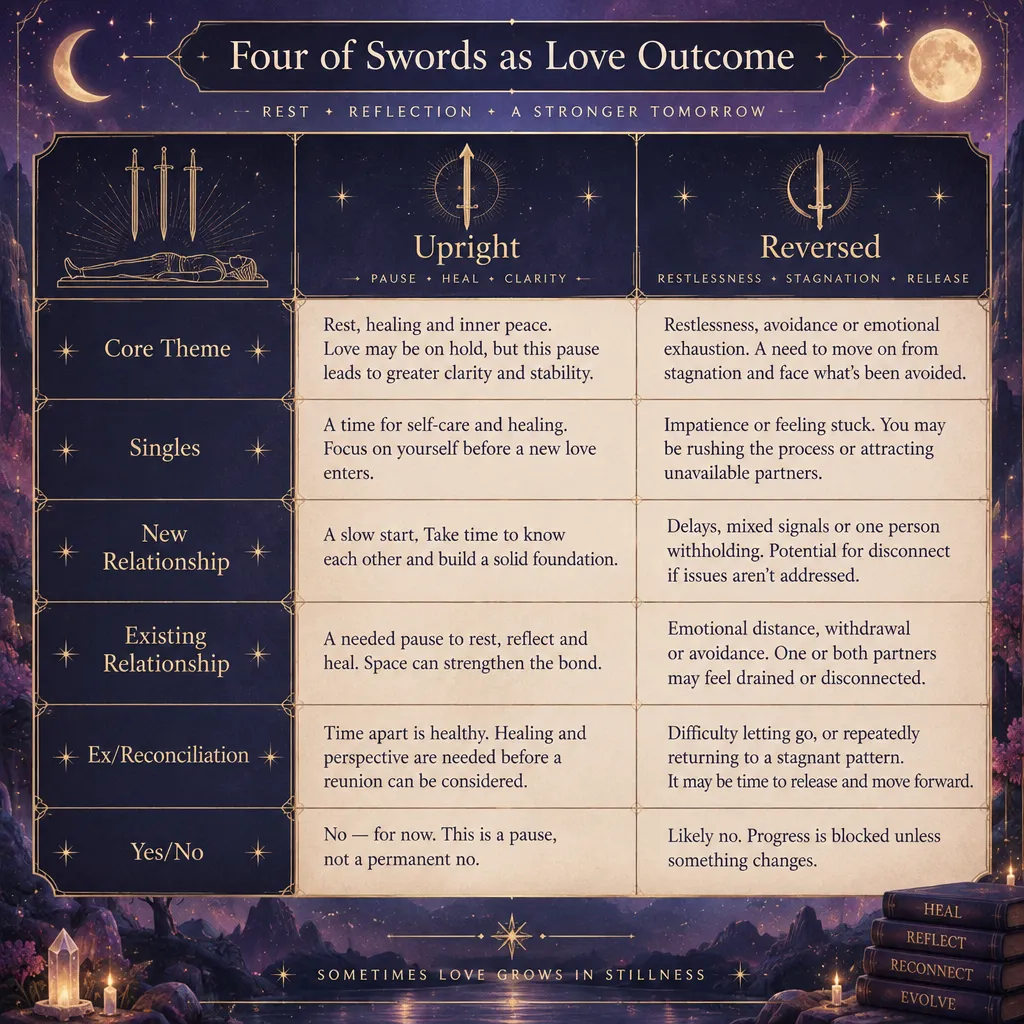
Upright vs. Reversed at a Glance
| Upright | Reversed | |
|---|---|---|
| Core theme | Deliberate rest, withdrawal, recovery | Restlessness, forced rest, or rest ending |
| Relationship status | Paused, slowed, or on a break | Re-engaging, or breaking down from exhaustion |
| Singles | Dating hiatus, healing before trying again | Ready to date again, or burnt out from dating apps |
| New relationship | Slow pace, space between dates, low drama | Pace picking up, or anxiety about lack of contact |
| Existing relationship | Quiet period, separate corners, possible break | Returning to each other, or one partner can no longer rest |
| Ex / reconciliation | Not ready, needs more time | Open to reconnecting, past issues being worked through |
| No contact | Stay in it, the silence is doing its job | Period is ending, contact likely soon |
| Yes/no | No for now | Cautious yes |
| Timing | Days to a few weeks | Sooner, often within days |
What the Card Shows and Why It Matters for Love
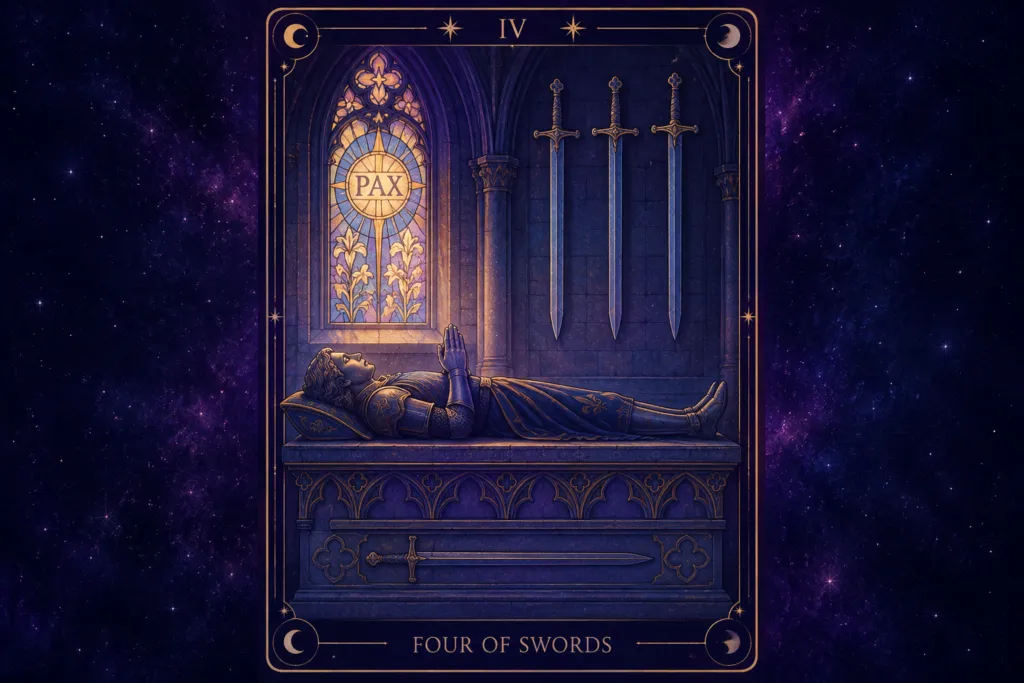
In the Rider-Waite-Smith deck, a knight lies on top of a stone tomb inside a church. His hands are pressed together in prayer. Three swords hang on the wall above him, pointing down at his body. A fourth sword is carved along the side of the tomb beneath him. Behind him, a stained-glass window shows a figure kneeling before another, with the word “PAX” (peace) worked into the glass.
Every one of these details carries a specific message in a love reading.
The lying knight. He is not dead. He is an effigy, a carved figure of someone who went through battle and is now in a state of complete stillness. In love, this is the person who has stepped out of the fight. They are not thinking about the relationship, not arguing, not planning. If you are asking about someone else’s feelings, this is often why you are getting silence: they have shut the door to recover, not to punish you.
The three swords on the wall. These are the wounds and worries that have been set aside but not destroyed. They hang right above the knight. The problems that led to this pause (the argument, the betrayal, the mismatched expectations) are still present. Rest does not erase them. It makes you strong enough to pick them up again later with a clear head.
The one sword beneath. This is the sword the knight keeps. It represents the single, clear thought he has held onto, the thing he actually knows to be true. For love, this is the one non-negotiable each person walks away with from the pause: “I need honesty,” or “I cannot keep chasing someone who disappears.” The whole point of the rest is to find out what that one sword is.
The stained-glass window. The scene shows a figure receiving a blessing, with PAX above. This is the card’s promise. The outcome of the pause is peace, provided the pause is honoured. Rush it and you walk back into the three swords on the wall.
The church setting. Sacred, private, enclosed. The Four of Swords protects the relationship (or the individual) from outside noise. Friends with opinions, family pressure, social media stalking. The healing happens behind closed doors.
Four of Swords Upright as a Love Outcome
The core meaning is deliberate rest. Not peace that arrives on its own, but stillness that one or both people choose because they are depleted. A reading that paints this card as simply “a tranquil, loving relationship” misses the tension in it. The knight is resting because he has been through something hard.
As an outcome card, the upright Four of Swords says the situation will go quiet. Contact may drop. Plans may stall. One person may ask for space. This is neutral to slightly cautionary, and it depends on surrounding cards whether the quiet leads to reunion or to a gentle drifting apart.
Singles
You are heading into (or already in) a dating hiatus. If you have been swiping, going on first dates that lead nowhere, and feeling increasingly flat about it, this card confirms the fatigue is real and the right move is to stop for a while.
The outcome for someone single is not “you will meet someone soon.” It is “you will not meet the right person until you have recovered from the last one.” The three swords on the wall are the pattern you keep repeating: picking unavailable people, moving too fast, abandoning your own standards on date two. The hiatus is where you figure out your one sword, the standard you will not drop again.
Practical reading: expect a few weeks where romance is simply not the priority, and that is correct.
New Relationships
The relationship will slow down. If you are three dates in and the texting has thinned out, the Four of Swords says this is a breather, not a fade. Someone (often the person you asked about) needs the connection to move at a pace that does not overwhelm them.
The risk here is interpreting slowness as rejection and overcorrecting. Double-texting, pushing for a label, or asking “are we okay?” every few days drags the knight off his tomb before he is ready. The outcome is good if the pace is allowed to stay unhurried. Think one quality date a week rather than daily contact.
Existing Relationships
This is where the card is most frequently misread. Yes, it can show a couple in a settled, low-drama phase, the kind where you read on the sofa in comfortable silence. But as an outcome card in a question about a relationship that is already struggling, it more often means a break is coming or needed.
Signs this is the “break” reading rather than the “cosy” reading: you asked because of conflict, the surrounding cards include Swords or the Tower, or one partner has recently said they need time. In that case the outcome is time apart, separate bedrooms, a weekend away alone, or a formal pause. Not a breakup. A recovery period after which the three swords get addressed.
If the relationship is healthy and you asked a general question, the upright card forecasts a quiet, stable stretch with little external drama. Enjoy it, and protect your privacy from people who want to insert themselves into your relationship.
Ex and Reconciliation
Not yet. This is the clearest reading of the card. If you asked whether your ex will come back, the Four of Swords says the wound is still too fresh for either of you to reconnect without reopening it.
Importantly, this is not a no. The knight will eventually get up. But reconciliation attempted now would be two exhausted people repeating the same argument. The outcome is continued distance, and that distance is the only thing that can create the conditions for a genuine second attempt later.
If your ex is the one who went quiet, this card describes their state accurately: withdrawn, recovering, not actively thinking about the relationship either way. They are not plotting a return or a replacement. They are resting.
No Contact and Separation
The Four of Swords is practically the patron card of no contact. If you are in it, the outcome is: stay in it. The silence is working. The card does not predict that they will reach out, and it does not predict that they will not. It predicts that the stillness itself is what the situation needs right now.
For people in a legal or physical separation, the card indicates the separation holds for the near term. No sudden reunions, no sudden escalations. Use the window for yourself.
One hard truth: if you asked about no contact hoping for a sign that your ex is about to break it, this is not that sign. Reversed would be. Upright says the pause continues.
Four of Swords Reversed as a Love Outcome
Reversed, the knight is off the tomb. There are two main readings and context decides which applies.
Rest is ending. The withdrawal period is complete. Someone is ready to re-engage, reach out, or start dating again. This is the hopeful reversal.
Rest is being refused. Someone cannot or will not stop. They are burnt out, anxious, checking their phone at 3am, unable to leave the situation alone. This is the warning reversal, and it often precedes a messier version of the pause the upright card would have delivered gently.
The tell between the two: how does the querent feel right now? Calm and clear points to the first. Frantic and exhausted points to the second.
Singles
You are ready to date again. The hiatus has done its job and the reversed card confirms you have your one sword, your standard. Expect energy to return and interest to pick up within days rather than weeks.
The shadow side: if you have been on four apps simultaneously and feel sick of the whole thing, the reversed card is diagnosing burnout. The outcome if you keep going is a bad match made out of exhaustion. The fix is the upright card’s medicine: stop for a bit.
New Relationships
Momentum returns. The person who went quiet resurfaces, plans get made, the texting picks back up. For a connection that slowed down, this is the card you want to see.
Alternatively, if you have been anxious about a slow start, the reversed card can show that anxiety getting the better of you. Pushing for clarity too early, interpreting a two-day gap as abandonment. The outcome in that case is self-sabotage rather than rejection.
Existing Relationships
A couple who took space is coming back together. Conversations that were parked are being reopened, and this time with enough rest behind them to be productive. The reversed card here is a strong signal for repair.
The cautionary version: one partner has had enough of the quiet. They want resolution now and the other is not ready. Mismatched timing creates a second round of conflict. If this is you, the outcome depends on whether the restless partner can hold off a little longer.
Ex and Reconciliation
Open to reconnecting. The reversed Four of Swords is the card that most often precedes an ex’s message. The healing period has ended for at least one party, and there is willingness to talk about what went wrong rather than just pretend it did not happen.
This is not a guarantee of a reunion. It is a guarantee that the door is no longer locked. What happens after contact resumes depends on whether the three swords on the wall get taken down and examined, or whether both people grab them and start fencing again.
No Contact
The period is ending. Either you are about to break it or they are. If you asked “Will they reach out?”, the reversed card is a yes, often within days.
If you are the one who feels compelled to break it, check whether that is readiness or restlessness. Readiness feels like “I can have this conversation without needing a specific answer.” Restlessness feels like “I cannot stand not knowing for one more hour.” Only the first one leads anywhere good.
Astrology, Element, and Timing
The Four of Swords is assigned to Jupiter in Libra in the Golden Dawn system, covering the second decan of Libra (roughly October 3 to 12). This association explains a lot about the card’s love meaning.
Libra is the sign of partnership, fairness, and balance. Jupiter expands whatever it touches and brings a sense of perspective. Put together, Jupiter in Libra is the ability to step back from a relationship and see it fairly, without the distortion of fresh anger or fresh infatuation. That is exactly what the knight is doing. The rest is not avoidance. It is the restoration of balance so that any decision made afterwards is a fair one.
In practical terms, this means the pause described by the Four of Swords should be used for diplomacy, not drama. If you re-engage after the rest, do it with a Libran approach: hear both sides, weigh them, propose something that works for two people rather than one.
The card belongs to the Air element, the suit of thought and communication. Love problems under this card are mental more than emotional: overthinking, replaying conversations, needing to understand before you can feel again.
For timing, Swords move fast. If you are asking “how long will this pause last?”, read it as days to a few weeks rather than months. The Four of Swords is a short rest between battles, not a sabbatical. If the quiet has already dragged on for months, pull a clarifier; the situation has likely moved past this card into something else.
The Cards Around It: Three of Swords and Five of Swords
The Four of Swords sits between two of the hardest cards in the suit, and that placement is the whole story.
The Three of Swords comes before it: heartbreak, betrayal, the pierced heart. The Four is the recovery from that specific injury. When you draw the Four of Swords as a love outcome, you are almost always looking at the aftermath of a Three of Swords event, whether or not that card physically appears in your spread. Someone got hurt. Now they are lying down.
The Five of Swords comes after it: conflict, winning at any cost, hollow victory. This is what happens when the rest is cut short. The knight gets up too early, grabs the swords off the wall, and goes back into a fight he was not ready for. If your spread shows the Four followed by the Five, it is a direct warning: honour the pause or the next phase is a bitter argument where nobody really wins.
Four of Swords Combinations in Love Readings
Surrounding cards decide whether the pause heals or ends things. These are the pairings that come up most.
Four of Swords + Three of Swords. Rest directly after heartbreak. The relationship or hope you asked about has taken real damage and the outcome is recovery time, not reunion. Give it the full pause.
Four of Swords + The Hanged Man. Suspension on top of suspension. Nothing moves, and the lesson is to stop trying to make it move. If you asked about an ex, this is a firm “not now, and the waiting itself is the point.” Surrender to the delay.
Four of Swords + Ace of Cups. The hopeful pairing. New emotional beginning after a rest. For singles, you will meet someone once you have properly recovered. For a couple, the break leads to a fresh start in the same relationship.
Four of Swords + Two of Cups. Reunion after separation. One of the strongest reconciliation combinations when the Four is reversed or when the Two of Cups follows it. The pause ends in partnership restored.
Four of Swords + The Tower. Forced rest after a shock. The pause was not chosen; something blew up and one or both people are reeling. Outcome: a long recovery, and the relationship may not survive in its previous form.
Four of Swords + Ten of Swords. The pause is an ending dressed up as a break. “I need space” means “it’s over.” Painful but clear, and better to know.
Four of Swords + Six of Cups. Rest while thinking about the past. Often an ex reminiscing. Nostalgia is present but not yet action.
Four of Swords + The Star. Healing that works. The quiet period leads to real renewal, hope, and a healthier version of love afterwards. One of the best pairings for anyone asking about recovery from a breakup.
Four of Swords + Knight of Cups. Someone is about to make a romantic move after the pause. Watch for a message or an invitation once the rest is complete.
What to Do When You Draw the Four of Swords
Reading the card is half the job. Acting on it correctly is the other half.
Upright:
- Stop pursuing. No texts, no “just checking in,” no strategic social media posts. The outcome is a pause; leaning into it is the only thing that shortens it.
- Name your one sword. Write down the single thing you know for certain about what you need from love. Not a list. One thing. That is what you will carry out of this period.
- Protect the space. Stop discussing the situation with every friend who has an opinion. The church in the card has walls for a reason.
- Set a review date two to three weeks out. Swords timing is short. Decide now when you will reassess, so the pause does not quietly become indefinite avoidance.
- Sleep, eat, move. This is not generic wellness advice. The card literally shows a body lying down to recover. Fatigue is distorting your judgement about this relationship.
Reversed:
- Check readiness versus restlessness using the test above. If you are calm, proceed. If you are frantic, go back to the upright list for a few more days.
- Reach out with one clear, low-pressure message if you are breaking no contact. Not a paragraph. Not a question that demands an answer.
- Take down one sword at a time. When conversation resumes, deal with a single issue per conversation. Trying to resolve everything in one sitting leads to the Five of Swords.
- If you are the burnt-out one who cannot stop, remove the triggers. Delete the app for a week. Mute the account. The restlessness reading is a sign that forced rest is coming anyway; choosing it is better than having it imposed.
Common Misconceptions
“Upright Four of Swords means a happy, peaceful relationship.” Sometimes. More often as an outcome card it means a relationship under strain that needs a break. The knight is resting because of battle, not because life is easy. Read the context before calling it good news.
“Reversed means keep pushing, the pause is over.” Only in the readiness version. Half the time the reversed card is describing someone who refuses to rest and is burning out. Pushing harder when the card is showing burnout produces exactly the conflict the upright card was trying to prevent.
“Four of Swords means my ex is thinking about me.” It means your ex is resting and not actively engaged with the situation either way. That is neither the comfort nor the rejection people want it to be. For an ex thinking about you, look for the Six of Cups or Knight of Cups.
“The card predicts a breakup.” No. The Ten of Swords predicts breakups. The Four predicts a pause. A pause can lead to a breakup if misused, but the card itself is describing stillness, not an ending.
“The pause will take months.” Swords move in days to weeks. If you have been waiting for months, you are no longer in Four of Swords territory and should pull again.
FAQ
Does the Four of Swords mean a breakup?
Not on its own. It means a pause, a break, or a period of reduced contact. It becomes a breakup card only in combination with endings like the Ten of Swords or The Tower. Alone, it says the relationship is resting, with the outcome still open.
Is the Four of Swords a yes or no card for love?
Upright is a “no for now,” meaning nothing will progress until a rest period has passed. Reversed is a cautious yes, indicating readiness to re-engage, provided the person reaching out has actually recovered rather than simply run out of patience.
What does the Four of Swords mean for reconciliation with an ex?
Upright: not yet. Both people need more recovery time and reconnecting now would reopen the original wound. Reversed: the door is opening. At least one of you is ready to talk about what went wrong, and a message or meeting is likely within days.
How long does Four of Swords energy last?
Days to a few weeks. Swords is the fastest-moving suit. A pause shown by this card is a short recovery, not a long separation. If a situation has been frozen for months, the Four of Swords is no longer the card describing it.
What does the Four of Swords mean during no contact?
Upright: stay in no contact. The silence is doing its job and the other person is in a withdrawn, recovering state. Reversed: the no-contact period is ending, and either you or they are about to reach out.
What does the Four of Swords mean for someone’s feelings toward me?
They are not actively feeling much about you right now, and that is not the same as not caring. They have shut down to recover. Their real feelings will become visible once the rest ends, which is why the reversed card is the one that reveals intentions.
Is the Four of Swords positive or negative in a love reading?
Neutral. It describes a necessary pause. Whether that pause leads to a stronger relationship or a quiet ending depends entirely on whether it is honoured. Pairings with the Ace of Cups, Two of Cups, or The Star tilt it positive. Pairings with the Ten of Swords or Five of Swords tilt it negative.
Add Yes No Tarot as a preferred source on Google, and the sites you pick are more likely to appear in your Top Stories.