
Five Of Wands As Love Outcome (Upright & Reversed) Tarot Card Meaning
Drawing the Five of Wands as the love outcome in a reading means the relationship is heading into friction, competition, or a clash of wills, not a quiet ending and not a smooth resolution. Whether that friction becomes a dealbreaker or a turning point depends on who you are asking about: a dating prospect, a new partner, a long-term partner, or an ex. This guide breaks down every scenario, upright and reversed, plus the symbolism, astrology, card combinations, and a straight yes or no verdict.
Quick Reference: Upright and Reversed Keywords
| Position | Love keywords |
|---|---|
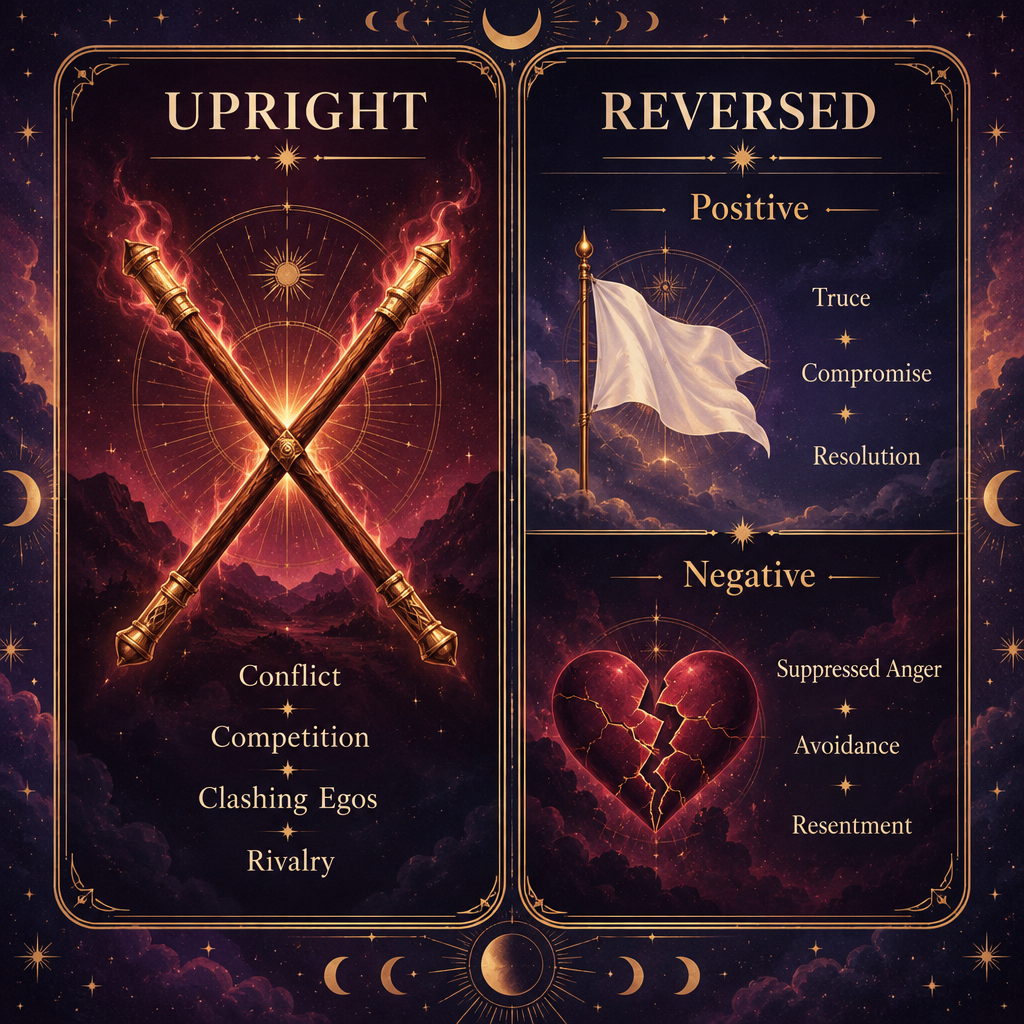
| Upright | Conflict, competition, rivalry, bickering, clashing egos, passionate sparring, mixed signals, too many options, fighting for attention |
| Reversed (positive) | Truce, resolution, compromise, cooling tempers, ending a rivalry, clearing the air |
| Reversed (negative) | Avoidance, suppressed anger, false peace, resentment, passive aggression, giving up on the fight |
Keep the two reversed columns separate in your mind. The reversed Five of Wands has a genuine split meaning, and reading it as “harmony” by default produces wrong predictions. More on that below.
The Imagery and What It Says About Love
In the Rider-Waite-Smith deck, five young men in different coloured tunics swing wooden staves at each other under a clear sky. Look closely and nobody is actually hitting anyone. The wands cross and clatter but no one is on the ground, nobody is bleeding, and several of the figures seem to be looking past their opponents rather than at them. It reads as a scrum, a sparring match, or a brawl that has not quite decided what it is about.
Each element carries a love-specific message:
- Five figures, not two. Love readings usually concern a pair, so the extra bodies matter. They represent other people in the picture: rivals, ex-partners, interfering friends or family, or simply the competing demands of work, children, and social life crowding into the relationship.
- The wands themselves. Wands stand for passion, drive, ambition, and desire. Five wands pointing in five directions means five different wants. In a relationship, that looks like two people who both have strong desires that do not currently line up.
- Mismatched clothing. Every figure wears something different. No uniform, no team. In love this is a compatibility question: are you fighting because you are different, or fighting because you want the same thing and will not share it?
- No clear leader and no clear loser. The scene is deadlocked. Nobody is winning the argument, which is often exactly how the relationship feels when this card appears.
- Bright, warm colours and open sky. The palette is energetic rather than dark. This is not the Three of Swords or the Ten of Swords. The conflict here has heat and life in it. People who stop caring do not bother to fight.
That last point is the most hopeful thing about the card. The Five of Wands describes a relationship with too much energy and not enough direction, not one that has died.
Astrology and Element: Saturn in Leo, Fire
The Golden Dawn system assigns the Five of Wands to the first decan of Leo, ruled by Saturn. This pairing explains the card’s tension better than almost anything else.
Leo wants to be seen, admired, and chosen. It is the sign of the heart, pride, and romance as performance. Saturn is restriction, duty, delay, and consequence. Put Saturn into Leo and you get pride that keeps running into limits: a partner who wants to be the centre of attention but cannot be, a romance that wants to be grand but keeps getting blocked by practical reality, or two egos competing for a spotlight that only fits one.
In a love outcome, Saturn in Leo often shows up as:
- Pride getting in the way of apology (Leo refusing to lose face)
- Arguments about who contributes more or who matters more
- Karmic lessons about ego: the relationship forcing one or both people to grow up
- Delays caused by competition, where the relationship cannot advance until a rivalry resolves
The element is Fire, which makes this a passionate, fast-moving, volatile card. Fire conflicts flare up quickly and can burn out just as fast. The fights predicted by this card are loud rather than cold, and they tend to be about desire, attention, and respect rather than money or logistics.
Readers associate the card with the three fire signs: Leo most directly, with Aries and Sagittarius as secondary resonances. If the person you are asking about falls under one of these signs, the card frequently points at them specifically, describing their temperament as the source of the friction.
Five of Wands Upright as a Love Outcome
Upright, the card predicts active, visible conflict or competition. The outcome is not resolution. It is a contest still in progress.
If You Are Single
The upright Five of Wands for a single person almost always means competition in one of two directions.
Either you are one of several people someone is talking to, or you have several options yourself and cannot commit to one. Dating app culture produces this card constantly: multiple matches, overlapping conversations, and the slow-burn frustration of being someone’s option rather than their choice.
It can also show clashing energy in early dating. The person you are interested in is combative, argumentative, or treats flirting as a debate. Some people enjoy that sparring. If you do not, this card is telling you the dynamic will not soften.
A third reading: your own energy is scattered. You want a relationship but you are also fighting for a promotion, dealing with family drama, and training for something. Love is one wand among five, and it is not winning.
What to do: Stop competing. If someone is weighing you against other people, the Five of Wands says the contest will not end in your favour by trying harder. Step back and let them come to you, or walk. If you are the one with too many options, pick one person for a month and see what happens when the noise stops.
If You Are in a New Relationship
Early-stage relationships with this card as the outcome are heading into their first real fights. The honeymoon is ending and two personalities are starting to collide.
The key question is whether the bickering is a red flag or a spark. Relationship research gives a useful filter here. Decades of work by John Gottman found that the amount of conflict in a couple does not predict whether they last. What predicts it is how they fight: whether contempt, criticism, defensiveness, and stonewalling show up, and whether the couple manages roughly five positive interactions for every negative one during a disagreement. Passionate debate with warmth underneath it is a spark. Eye-rolling, name-calling, and silent treatment are a red flag, even at low volume.
The upright Five of Wands in a new relationship can also indicate that one of you is still half in a previous situation. Someone else is still texting. An ex has not fully exited. You are competing without having been told there is a competition.
What to do: Have one direct conversation about exclusivity if you have not already. Then watch your next three arguments. If you both come out of them knowing something new about each other, stay. If you come out of them keeping score, this card is predicting more of the same.
If You Are in an Established Relationship
For long-term couples, the Five of Wands upright points to power struggles and competing priorities rather than a dramatic blowup.
Typical patterns:
- Two careers pulling in two directions, with neither partner willing to flex
- Arguments about division of labour that are really arguments about respect
- Ego battles where being right matters more than being close
- Family interference: in-laws, children from previous relationships, or siblings pulling one partner away
- A sense of competing with your partner’s phone, hobbies, or friends for attention
The relationship is not collapsing. It has lost its sense of being a team. Both of you are swinging a wand and neither is holding the same one.
What to do: Identify the single recurring fight. Most couples with this card have one argument they have been having for years in different costumes. Name it out loud, agree it is the problem, and take one concrete step that one of you has been refusing to take. The Five of Wands responds to action, not discussion.
If You Are Asking About an Ex
This is where the upright Five of Wands gets uncomfortable. As an outcome for an ex or a reconciliation, it says the fight is not over.
That can mean several things:
- Your ex is seeing someone else, and you would be competing for their attention
- The two of you would reunite only to resume the same argument that ended things
- There is unfinished business, probably about pride, that neither of you will be the first to drop
- Friends or family on one side are actively against the reunion
The card does not forbid reconciliation. It says reconciliation would reopen a contest rather than close one. Ask yourself honestly whether you want this person or whether you want to win.
What to do: Wait. The Five of Wands is a card of too much motion to see clearly. Do not reach out while the energy is this scattered, and do not re-read on the question for at least two weeks. If you still want to reconnect after the dust settles, lead with a specific apology for your part, not a general one.
The Third-Party and Rival Angle
Because five figures appear on a card about love between two, interference deserves its own section.
The Five of Wands upright is one of the clearest cards in the deck for “someone else is involved.” That does not automatically mean cheating. In practice it covers:
- A romantic rival who is competing for the same person’s attention, sometimes openly, sometimes without you knowing
- An uncertain love interest who is keeping several people in play because they have not decided
- Friends who disapprove and keep stirring the pot
- Family pressure, especially around culture, religion, or expectations about who a partner should be
- An ex who has not left, still messaging, still being discussed, still a presence
If you suspect a rival, this card confirms competition exists but does not tell you who wins. Pull a clarifier. The Six of Wands beside it means you come out ahead. The Five of Cups beside it means you do not, and grieving will be required.
Five of Wands Reversed as a Love Outcome
The reversed card is where most readings go wrong, because it carries two meanings that are nearly opposite and the surrounding cards decide which applies.
Meaning A, resolution: The fight is ending. Tempers cool, a rival drops out, a compromise gets reached, a stubborn partner finally apologises. This is a genuine truce.
Meaning B, suppression: The fight is not ending, it is going underground. One or both people have stopped arguing because they have given up, not because they agree. The surface looks calm. Underneath, resentment is compounding.
The tell is energy. Meaning A feels like relief. Meaning B feels like flatness. If the querent describes the relationship as “fine, we don’t really fight anymore” in a tired voice, you are looking at Meaning B. Surrounding cards help too: Temperance, the Two of Cups, or the Four of Wands nearby confirm real harmony. The Four of Cups, Eight of Swords, or Seven of Swords nearby point to false peace.
If You Are Single
Reversed for a single person, the positive reading is that a competitive dating situation is clearing. Other candidates drop away. Someone who was indecisive makes a decision, possibly in your favour. Your own scattered attention consolidates.
The negative reading is avoidance. You have stopped dating because the competition was exhausting, and you are telling yourself you are “taking a break” when you are actually hiding. Conflict avoidance dressed up as self-care.
What to do: Notice which one you are living. If a specific situation just resolved, lean in. If you have gone quiet out of frustration, set yourself a small, specific re-entry: one date, one conversation, one message.
If You Are in a New Relationship
Positive: the awkward adjustment period ends. You have figured out each other’s rhythms, the early bickering has produced actual understanding, and an outside complication (an ex, a hesitant friend) has stepped back.
Negative: one of you is swallowing objections to keep the peace in a relationship too young to survive honesty. That is a time bomb. People who suppress disagreement in month two tend to explode in month eight.
What to do: Say the thing you have been not saying. Choose the smallest version of it and say it this week. If the relationship can handle a minor disagreement now, it is real. If it cannot, you have learned something cheaply.
If You Are in an Established Relationship
Positive: a long-running power struggle finally settles. Someone concedes, a boundary with family gets enforced, careers stop competing. This is often a relationship that has done hard work and is now reaping it.
Negative: this is the dangerous version. Long-term couples who stop fighting without resolving anything drift into roommate territory. Nobody raises their voice. Nobody raises anything. Contempt in the Gottman sense, that quiet disdain, often lives here.
What to do: Ask each other one blunt question: “Is there anything you stopped bringing up because it felt pointless?” The answer tells you which version of the reversed card you have drawn.
If You Are Asking About an Ex
Positive: hostility is dissolving. Your ex is no longer angry, a rival has exited, and the door to civil contact or reconciliation is opening. This is one of the better cards for reunions, provided the surrounding spread agrees.
Negative: your ex has stopped fighting because they have moved on. The silence is not an invitation. It is closure from their side, and chasing it will reopen a wound.
What to do: Read the context cards before acting. If the Two of Cups, the Sun, or the Six of Cups sits nearby, a careful reach-out is reasonable. If the Eight of Cups, the Hermit, or the Ten of Swords is present, take the silence as an answer and build your own peace instead.
Five of Wands in Love: Yes or No?
| Position | Verdict | Reason |
|---|---|---|
| Upright | No, or not yet | The situation is in active contest. Outcomes this unstable rarely deliver a clean yes. For questions like “Will we get together?” or “Will we work out?”, the honest answer is that nothing is decided and the fighting must end first. |
| Reversed | Leaning yes, with a check | If surrounding cards show genuine resolution, this is a yes. If they show avoidance, it is a disguised no. Do not take the reversed card as a yes on its own. |
For a question specifically about whether a rival will win, upright says the competition is real and undecided. For a question about whether to fight for someone, upright says you can, but it will cost you energy and the outcome is not promised.
Card Combinations That Change the Love Outcome
The Five of Wands rarely stands alone in a love spread. These pairings shift its meaning most sharply.
| Combination | Love outcome |
|---|---|
| Five of Wands + The Tower | The fighting breaks something structural. A relationship held together by routine collapses after one argument too many, or a love triangle gets exposed all at once. Painful, but it ends the deadlock. |
| Five of Wands + Two of Cups | Passionate conflict between two people who genuinely love each other. The connection is real, the communication is not. Usually survivable with effort. |
| Five of Wands + The Lovers | A choice has to be made under pressure. Often a direct reference to a love triangle where the querent or their partner must pick. The Lovers insists on alignment of values, so the choice will reveal what each person actually wants. |
| Five of Wands + Ten of Wands | Fighting plus exhaustion. One partner is carrying the relationship, resentful about it, and the arguments are about burden. Without redistribution of effort, burnout ends the relationship before the fights do. |
| Five of Wands + Four of Wands | A clash on the way to commitment. Wedding planning fights, moving-in friction, blended family tension. The destination is stable; the road is noisy. |
| Five of Wands + Six of Wands | You win the competition. A rival steps aside or the person chooses you. Hold the win lightly, since Six of Wands warns about ego. |
| Five of Wands + Five of Cups | The competition is lost and grief follows. Two fives together are a strong signal that the current situation will not resolve the way you hope. |
| Five of Wands + Knight of Wands | A hot-headed, impulsive third party, or a partner whose temper is the main problem. Exciting and unreliable. |
Scenario-Specific Action Steps
The Five of Wands is a card about energy with nowhere to go. Every piece of advice below is about giving that energy a direction.
Singles, upright: Withdraw from any situation where you are being compared. Pour the competitive energy into something that is actually yours for ninety days, then revisit dating with a clearer head.
Singles, reversed: If a messy situation just cleared, move toward the person who stayed. If you have gone quiet, book one low-stakes date before the month ends.
New relationship, upright: Set the exclusivity conversation as a hard deadline. Track the quality of your next three disagreements, not the quantity.
New relationship, reversed: Voice one small objection you have been hiding. Treat the reaction as data.
Established relationship, upright: Name the one recurring fight. One partner takes one concrete step they have been avoiding. Revisit in thirty days.
Established relationship, reversed: Ask whether either of you has stopped bringing things up. If yes, that list is the real agenda.
Ex, upright: No contact for at least two weeks. No re-reading on the question in that time. Then decide whether you want the person or the win.
Ex, reversed: Let the surrounding cards determine whether silence is an opening or a closing. Act once, carefully, or not at all.
If any version of this card appears alongside contempt, intimidation, or a pattern of one person always losing, the Saturn lesson is to leave. Conflict is normal. Domination is not.
FAQ
Does the Five of Wands mean a breakup?
Not directly. The card predicts conflict and competition, not an ending. Breakups show up more clearly in the Three of Swords, the Ten of Swords, the Tower, or the Eight of Cups. The Five of Wands means a fight is ahead or underway, and the result is still open. If it appears with one of the ending cards, the fighting is what causes the split.
Is the Five of Wands a yes or no in love?
Upright it is a no or a “not yet,” because the situation is too unsettled to deliver a clean outcome. Reversed it leans yes only when neighbouring cards confirm genuine resolution. A reversed Five of Wands next to avoidance cards like the Four of Cups or Seven of Swords is a hidden no.
What does the Five of Wands reversed mean for an ex?
Either the hostility between you is dissolving and civil contact becomes possible, or your ex has stopped fighting because they have fully moved on. The spread around it decides which. The Two of Cups or Six of Cups nearby favours the first reading; the Hermit or Ten of Swords favours the second.
Is conflict in a relationship always bad?
No. Couples who argue productively often last longer than couples who never argue, because disagreement surfaces real differences early. What damages relationships is contempt, criticism of character rather than behaviour, defensiveness, and stonewalling. The Five of Wands upright describes a relationship with plenty of fight in it. Whether that fight is healthy depends on whether both people are still trying to understand each other or just trying to win.
Does the Five of Wands mean someone else is involved?
Often, yes. Five figures on a love card point to extra people: a rival, an ex, interfering friends, or family pressure. It confirms competition exists but does not say who prevails. Pull a clarifier to see the direction.
What does Saturn in Leo have to do with my relationship?
Leo is pride and the desire to be chosen. Saturn is limitation and consequence. Together they describe ego running into reality: refusing to apologise, competing for a spotlight, or a romance stalled by practical obstacles. The lesson of the card is usually that someone needs to drop their pride before anything moves.