
The Two of Swords as a love outcome predicts a standstill rather than a resolution. Nobody chooses, nobody leaves, and nobody says the thing that needs to be said. This guide breaks down what that limbo looks like for singles, couples, long-distance partners and exes, upright and reversed, and what to do about it.
Quick Reference: Upright and Reversed Keywords
| Position | Core meaning in a love outcome | Keywords |
|---|---|---|
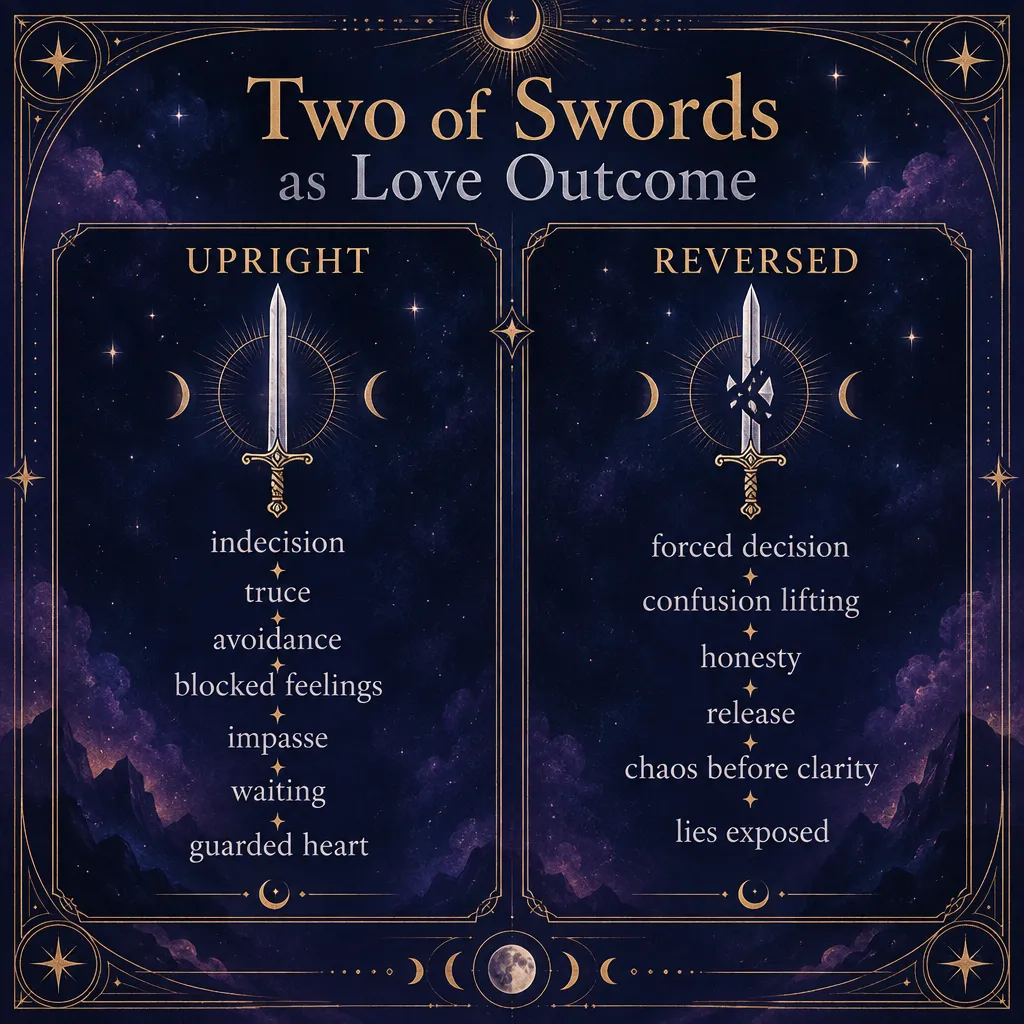
| Upright | Stalemate, a decision deferred, emotions held at arm’s length | indecision, truce, avoidance, denial, blocked feelings, two options, waiting, guarded heart, stonewalling, impasse |
| Reversed | The stalemate breaks, often messily, and a choice gets made | information overload, confusion lifting, forced decision, honesty under pressure, release, chaos before clarity, lies exposed, choosing badly in haste |
If you remember only one line: upright means the situation stays frozen for now, reversed means the ice is cracking and something has to give.
What the Imagery Tells You About the Outcome
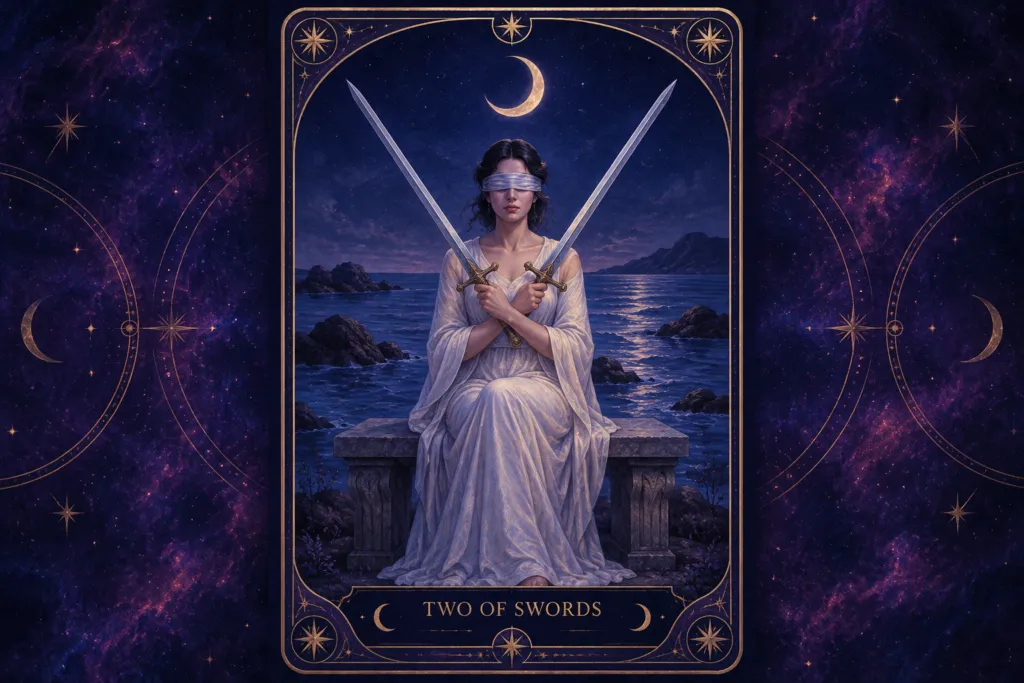
In the Rider-Waite-Smith deck a woman sits on a stone bench, blindfolded, holding two long swords crossed over her chest. Behind her is calm water dotted with rocks, and a waxing crescent moon hangs in the sky. Every element maps onto a love outcome.
The blindfold. She has chosen not to look. In a love reading this is the partner who knows the relationship has stalled but refuses to examine why, or the single person who will not admit which of two people they actually want. The blindfold is self-applied, which matters: the information is available, it is being avoided.
The crossed swords. Two blades, equal weight, held in perfect balance. This is a decision with two real options and no clear winner. Stay or go. Him or her. Commit or keep it casual. The arms holding them up will tire eventually, which is why this card is a temporary outcome, not a permanent one.
The water. Swords are the Air suit, yet the backdrop is water. Feelings are present but pushed behind the figure, out of her sight line. The rocks breaking the surface are the unresolved issues she keeps bumping into. Smooth water on the surface, obstacles underneath: a very accurate picture of a relationship where everything looks fine from outside.
The crescent moon. Intuition and hidden truth. Something about this situation is not yet visible, and the figure already senses it. In outcome readings the moon often points to information one partner has and the other does not.
The seated figure. She is not walking away and she is not leaning in. Posture is the whole message. Whatever outcome you are asking about, the answer right now is “seated”.
Element, Number and Astrology
The Two of Swords belongs to the suit of Swords, the Air element, which governs thought, communication and judgement. Love outcomes under this suit are decided in the head, not the heart, and the trouble with this card is that the head has stalled too.
The number two in tarot is duality, partnership and balance. In the Cups suit that produces the romantic Two of Cups. In Swords it produces a balance so careful that nothing moves. Two forces cancel each other out.
The astrological correspondence is the Moon in Libra, following the Golden Dawn attribution system used by most modern readers. Libra wants fairness, harmony and a partner. The Moon brings emotion and fluctuation. Together they describe someone who cannot act because every option seems to hurt somebody, so they keep the peace by doing nothing. If you have ever stayed in a relationship three months longer than you should have because you did not want to be the one who caused pain, you have lived this placement.
Is the Two of Swords a Yes or No for Love?
Upright: no, not yet. The honest answer is “not until a decision is made, and nobody is making one”. Treat it as a delay rather than a refusal.
Reversed: a conditional yes, in the sense that movement is finally coming. Whether that movement is toward you or away from you depends on the surrounding cards. Reversed Two of Swords next to the Lovers or the Two of Cups leans toward a choice in favour of the relationship. Next to the Five of Cups or the Eight of Cups, the decision being made is to walk away.
For questions like “will we end up together?” the upright card is one of the least satisfying outcomes in the deck because it refuses to answer. That refusal is itself the information: the other person has not decided either.
Two of Swords Upright as a Love Outcome
Singles: caught between two people or two paths
This is the most common scenario for singles who pull this card. There are two candidates, or one candidate and the comfortable option of staying single, and you have been running comparison spreadsheets in your head for weeks. The outcome card says you will keep doing that. Neither connection deepens because you are only half present in each.
A variant worth naming: the Two of Swords often shows up when someone is torn between a genuinely new type of person and the familiar type they always end up with. The familiar one feels safer. The new one feels like risk. The card does not pick for you, it just confirms you have not picked either.
Situationships live here too. An undefined arrangement that has lasted longer than six months with no conversation about what it is will almost always throw this card as its outcome. The arrangement continues exactly as it is, because the undefined status suits at least one of you.
New relationships
Distinct from “potential”, a new relationship is one that has actually started, usually within the first few months. The Two of Swords here describes two people being carefully polite. Nobody has brought up exes, money, kids, or where this is going. The outcome is a relationship that stays pleasant and shallow until someone risks a real conversation.
Watch for a specific pattern: one partner is withholding something. Not necessarily a betrayal, more often a doubt, a lingering attachment elsewhere, or a mismatch in what they want long term. The blindfold suggests the other partner suspects it and is choosing not to ask.
Existing relationships
For established couples the Two of Swords predicts a truce. Not peace, a truce. The argument you had in March was never resolved; you both just stopped mentioning it. Sex may have dropped off. Conversations are logistics: bills, schedules, whose parents at Christmas.
The card as an outcome says this holding pattern continues for as long as you both tolerate it. It also says the relationship is not ending imminently, which some readers find reassuring. The warning is in the swords getting heavy. Avoidance has a shelf life, and when the arms finally drop the issues come out all at once rather than one at a time.
Separation and long-distance relationships
Couples living apart, whether through geography or a trial separation, get a particularly literal version of this card. The two swords are two cities, two timelines, two lives running in parallel. The outcome: neither person will initiate the big conversation about whether someone moves, whether the separation becomes permanent, or when the next visit happens. Calls stay surface level. “How was your day” replaces “what are we doing”.
Long-distance in particular suffers from the Air element’s tendency toward overthinking. Both partners draft the message about the future and both delete it. Expect the status quo to hold until an external deadline, a lease ending or a job offer, forces the issue.
Reconciliation and ex-relationships
Asking whether an ex will come back and drawing the Two of Swords upright means the ex is as stuck as you are. They have not moved on, but they have not decided to return either. Reaching out feels like losing; staying silent feels like loss. So they do nothing.
If you are in a no-contact period, the card confirms it will hold from their side for now, not because they are indifferent, but because reaching out would require a decision they are avoiding. Reconciliation is not ruled out. It is simply not happening on the current timeline, and waiting for them to break the deadlock is a bad bet. Historically the figure on this card does not stand up on her own.
Two of Swords Reversed as a Love Outcome
Reversed, the blindfold slips. Information floods in, often more than can be processed at once, and a decision gets made. Modern readers increasingly interpret this as information overload or a choice made under pressure rather than the clean “clarity arrives” reading older guides offered. The clarity does arrive, but it tends to arrive sideways.
Singles
The two-person dilemma resolves, frequently because one of the options removes themselves. Someone gets tired of waiting and dates somebody else, or a secret about one candidate surfaces and makes the choice for you. There is relief in this, and some bruising. If you have been avoiding a dating decision, expect circumstances to force it within the timeframe of the reading.
Reversed can also show a single person finally admitting to themselves what they want, which is the better version of this card. The worse version is choosing in a panic just to end the discomfort of not choosing.
New relationships
The careful politeness ends. Either a real conversation happens and the relationship deepens quickly, or something withheld comes out and the thing collapses just as quickly. Reversed Two of Swords in the first months is a filter: it sorts relationships into “actually viable” and “was never going anywhere” within a short window. Honesty under pressure is the theme, and it usually involves one person saying “I need to know where this is going” before they planned to.
Existing relationships
The truce breaks. All those unmentioned issues from the upright reading surface together, sometimes in one bad evening. This can feel like a crisis, and in the moment it is one. The outcome is still better than the upright: at least the real problems are now on the table where they can be addressed.
Be alert to information coming from outside the couple. Reversed, the hidden truth signalled by the crescent moon tends to be revealed, whether that is a discovered message, a friend’s comment, or a confession.
Separation and long-distance
One partner finally decides. The reversed card as an outcome for a separated or long-distance couple means the limbo ends, most often because one person has quietly reached their limit and announces a conclusion the other was not expecting. For a long-distance couple this could be “I’m moving” or “I’m done with this”. Either way the paralysis is over. If you are the one who has been waiting for the other person to decide, be ready for the decision to be made for you.
Reconciliation and ex-relationships
The emotional impasse with an ex breaks. Reversed, this often means contact resumes, and the first conversation is messy. Old grievances get aired alongside the acknowledgement that feelings remain. Reconciliation becomes possible here in a way it was not upright, but it comes with conditions: the issues that ended things get discussed honestly, or the reconnection fails a second time.
Alternatively, the ex makes a definitive move to close the door. Reversed Two of Swords next to the Six of Cups leans toward reunion. Next to the Ten of Swords or the Judgement card reversed, the ex has decided it is over and will say so.
What Happens If the Stalemate Is Never Resolved
The Minor Arcana tell a story in sequence, and the Two of Swords is followed by the Three. The Three of Swords is heartbreak: a heart pierced by three blades under rain clouds. Read together, the message is blunt. Prolonged avoidance in love does not resolve into nothing. It resolves into pain, usually for the person who was kept waiting.
Longer term, readers often connect an ignored Two of Swords to the Tower. The Tower is sudden, structural collapse: the affair discovered, the partner who leaves without warning, the “we need to talk” that was years in the making. The Tower is not a punishment for indecision so much as its natural end point. Structures built on unspoken agreements fall when one person stops agreeing. If the Two of Swords appears as your outcome and the Tower appears anywhere else in the spread, treat that as the clearest warning the deck can give.
What to Actually Do When This Card Appears
The Two of Swords is one of the few outcome cards that can be changed by the querent, because the outcome it predicts is produced by inaction. Act, and the prediction stops applying.
If you are single and torn: set yourself a deadline. Two weeks is enough. On that date, choose, and tell the person you did not choose. The card punishes people who keep two options warm indefinitely.
If you are in a new relationship: ask the question you have been avoiding. Where is this going, are you seeing other people, what do you want. The answer may be disappointing, but the upright card shows you already suspect it.
If you are in an established relationship: name the issue out loud. Pick the biggest rock under the water and say “we never resolved this”. Expect the first conversation to go badly and schedule a second one anyway.
If you are separated or long-distance: stop waiting for the other person to raise the future. Propose a specific plan with a specific date and ask for a yes or no.
If you are hoping for reconciliation: decide what you would need to see from your ex to try again, and whether you would be willing to make the first move. Then either make it or genuinely close the door. The worst outcome this card describes is the person who does neither for a year.
Reflection prompts
- Which of the two swords am I actually holding? Name both options in one sentence each.
- What do I already know about this relationship that I have been pretending not to know?
- Who benefits from the current standstill, me or them?
- If nothing changed for six months, how would I feel? If that answer is relief, that is information too.
- What is the one conversation I would have if I knew it could not end the relationship?
FAQ
What does the Two of Swords mean in a love reading?
It means a stalemate. Feelings exist but are being held at a distance, a decision is pending and nobody is making it, and difficult conversations are being avoided. As an outcome it predicts the situation stays as it is until someone acts.
Is the Two of Swords a yes or no in love?
Upright it is a “not yet”, closer to no than yes because nothing is moving. Reversed it is a conditional yes: a decision is coming, and surrounding cards show whether it favours the relationship.
Does the Two of Swords mean a breakup?
Not directly. The card describes avoidance and delay rather than an ending. The risk is in what comes next: the Three of Swords follows it in sequence, so an unresolved stalemate frequently leads to heartbreak. Reversed, a breakup becomes more likely in the short term because the truce finally breaks and a decision gets made.
What does the Two of Swords reversed mean in love?
The blindfold comes off. Hidden information surfaces, often too much at once, and a choice is made under pressure. For couples this usually means a long-avoided confrontation. For singles it means the two-option dilemma resolves, sometimes because one option disappears. For exes it means contact and an honest, possibly messy, conversation.
Will my ex come back if I pull the Two of Swords?
Upright, your ex is undecided and unlikely to reach out soon; they are as stuck as you are. Reversed, the impasse breaks and contact becomes likely, though whether it leads to reunion or a final goodbye depends on the cards around it.
How long does the Two of Swords stalemate last?
As long as both people tolerate it. The card has no built-in timeline, which is exactly the problem. Readers who want a timeframe should look at the clarifying card: a Swords court or a Wands card suggests weeks, a Pentacles card suggests months.
Add Yes No Tarot as a preferred source on Google, and the sites you pick are more likely to appear in your Top Stories.