The Moon as Feelings in Love & Relationships (Upright & Reversed)
When The Moon shows up as feelings, the person you asked about feels something real but unclear. Upright, it points to hidden emotions, confusion and a longing they haven’t admitted, even to themselves. Reversed, it shifts toward emotional deception or a fear of vulnerability, or sometimes the moment the fog finally starts to lift.
The Short Answer: What The Moon Means as Feelings
The Moon is the tarot’s card of half-light. Nothing is fully visible, and everything looks slightly different from what it is. In the feelings position, that describes the quality of someone’s emotions more than their intensity.
They may care a lot. They may care very little. The card’s core message is that they cannot see their own feelings clearly, and you probably can’t see them clearly either.
Here is the quick version:
- Upright: attraction mixed with uncertainty, private daydreams, anxiety about getting it wrong, and a tendency to project hopes onto you.
- Reversed: either feelings that are being hidden or distorted on purpose, a strong fear of being emotionally exposed, or confusion that is starting to clear.
The Moon is rarely a “no.” It is almost always a “not yet clear.” That distinction shapes everything about how you should respond.
The Moon Tarot Card at a Glance
Before reading it in love, it helps to know where the card sits in the deck and what traditions attach to it.
| Attribute | Detail |
|---|---|
| Number | XVIII (18) in the Major Arcana |
| Astrological sign (Golden Dawn system) | Pisces |
| Element | Water |
| Hebrew letter (Golden Dawn) | Qoph |
| Golden Dawn esoteric title | “Ruler of Flux and Reflux, Child of the Sons of the Mighty” |
| Rider-Waite-Smith first published | 1909, by William Rider & Son, illustrated by Pamela Colman Smith |
| Waite’s upright meanings | Hidden enemies, danger, calumny, darkness, terror, deception, occult forces, error |
| Waite’s reversed meanings | Instability, inconstancy, silence, lesser degrees of deception and error |
| Sits between | The Star (XVII) and The Sun (XIX) |
That last row matters more than people think. The Moon comes after The Star, the card of hope and healing, and before The Sun, the card of joy and full visibility. In a love reading, it represents the dark stretch between hoping for something and actually knowing it.
Keywords for The Moon in Love
Upright keywords: illusion, intuition, anxiety, subconscious desire, uncertainty, dreams, projection, mixed signals.
Reversed keywords: repressed fear, deception revealed, emotional avoidance, releasing illusion, clarity emerging, secrets.
Symbolism of The Moon Card and What It Says About Feelings
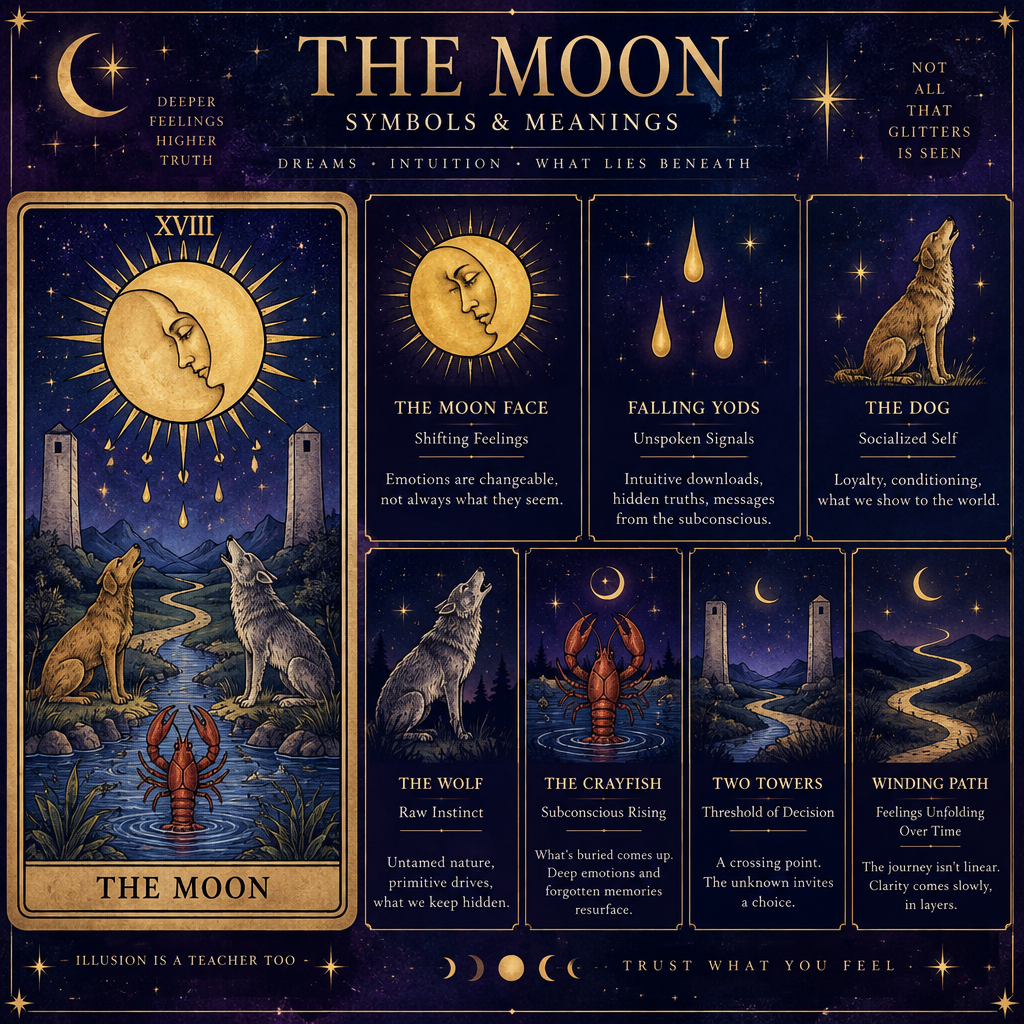
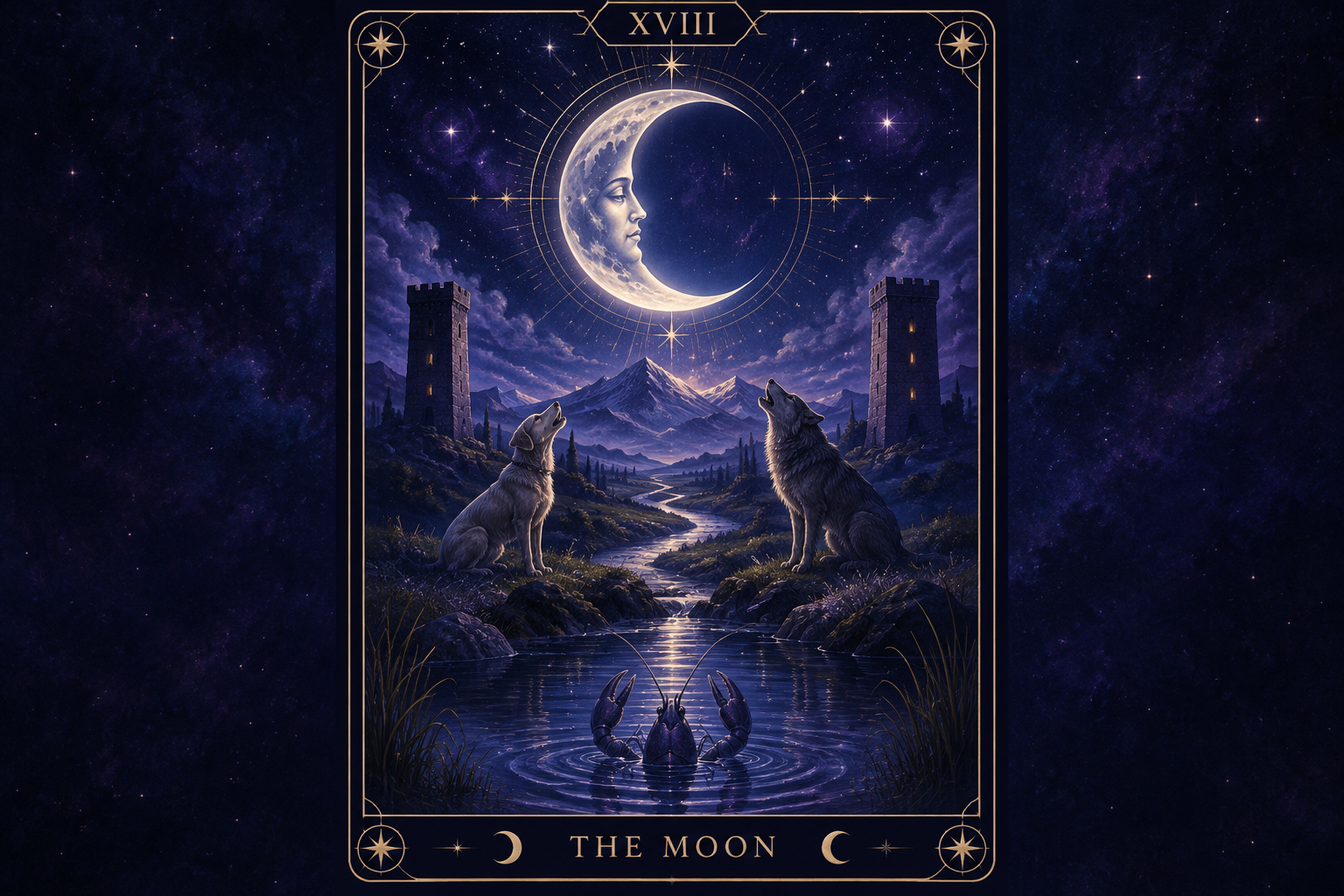
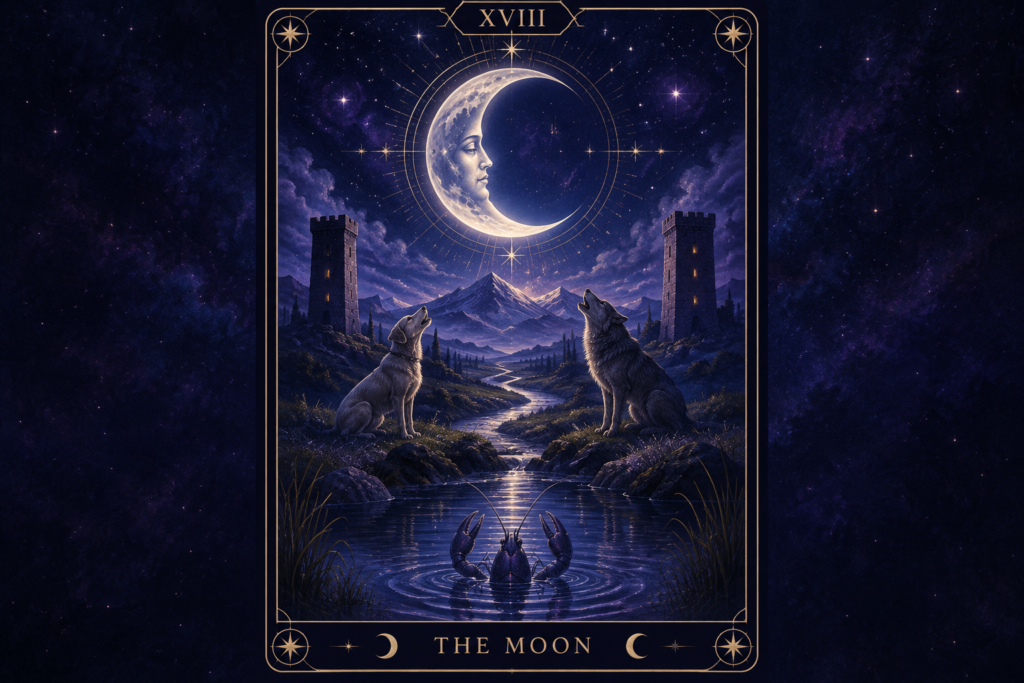
Pamela Colman Smith’s design is packed with images, and each one translates into something specific about emotional states. A. E. Waite described the dog and wolf as the fears of the natural mind when there is only reflected light to guide it. That framing is a good lens for the whole card.
| Symbol in the card | Traditional meaning | What it says about their feelings |
|---|---|---|
| The moon with a face, partly eclipsed | Reflected light, cycles, the unconscious | Their feelings shift with mood and circumstance; they’re reacting to you, not fully choosing |
| Falling drops (yods) | Dew of thought, influence from above | Small signals and impressions are building up, even if nothing is said |
| The dog | The tame, socialised self | The part of them that wants to behave “correctly” in the relationship |
| The wolf | The wild, instinctive self | Raw attraction or impulses they’re uneasy about |
| The crayfish rising from the pool | Material surfacing from the unconscious | Old wounds, fears or desires coming up because of you |
| Two towers | A threshold between known and unknown | They’re standing at the edge of a decision about you |
| The winding path | A journey that can’t be seen in full | Feelings that will reveal themselves over time, not all at once |
| Distant mountains | Hard-won understanding | Clarity exists, but it sits at the end of the path |
The dog and the wolf are the heart of the reading. Both howl at the same moon. In feelings terms, the person is caught between how they think they should feel about you and how they actually feel. The tension between those two creates the mixed signals you’re picking up.
How Other Decks Draw It
The Moon looks different across traditions, and the differences add useful shades.
| Deck | Era | Key visual differences | Emotional emphasis |
|---|---|---|---|
| Tarot de Marseille (La Lune) | 17th–18th century woodcut tradition | Two dogs, a crayfish in a pond, two towers, drops rising toward the moon | Instinct and attraction pulling upward |
| Rider-Waite-Smith | 1909 | Dog and wolf, crayfish, towers, a winding path toward mountains | Fear, the subconscious, a journey through uncertainty |
| Thoth (Crowley/Harris) | Painted 1938–1943, published 1969 | Jackal-headed Anubis figures guarding a gateway, a scarab carrying the sun below | Deep illusion, the “dark night” before rebirth |
Aleister Crowley’s version is notably darker. It treats The Moon as a passage through deception toward renewal, which lines up with the reversed meaning in love readings.
The Moon Upright as Feelings
An upright Moon says the feelings are present but murky. Five emotional patterns come up again and again.
1. Hidden Emotions They Haven’t Named
They feel something about you, and they haven’t put words to it. That can mean they’re attracted but unsure, fond but afraid of what fondness might lead to, or invested but unwilling to say so first.
This isn’t always strategy. Often they genuinely don’t know. The Moon is about the subconscious, and subconscious feelings show up as behaviour long before they show up as words.
Look for:
– Lingering conversations that never quite go anywhere
– Attention that spikes, then disappears
– Late-night messages that feel more open than daytime ones
– Them asking about your love life without saying why
2. Confusion and Mixed Signals
The Moon is the classic mixed-signals card. One day they’re warm, the next distant. They might flirt, then retreat. They say they’re “not looking for anything,” then act like they are.
From their side, this feels like emotional weather they can’t control. Their interest is real, but so are doubts, outside pressures or past hurts. The result is an inconsistent pattern that leaves you confused because they are confused.
3. Subconscious Longing
The card often appears when someone is longing for you in private. They may think about you more than they let on. They might replay moments, imagine scenarios, or idealise what being with you would be like.
This is the dreamy, Piscean side of the card. It’s tender, and it’s also unreliable. Longing in The Moon lives in the imagination. It doesn’t automatically translate into action.
4. Anxiety About Getting It Wrong
Fear runs through this card. Upright in the feelings position, it frequently describes someone who is nervous about you: nervous about rejection, about misreading you, about ruining a friendship, or about repeating a painful past relationship.
That anxiety can make them hold back exactly when you’d expect them to step forward. It’s one of the most common explanations for “Why did they pull away right when things were going well?”
5. Projection and Idealisation
They may be falling for an image of you as much as the real you. The Moon reflects light rather than producing it, and feelings under this card can be reflections of the person’s own hopes, wounds and fantasies.
That’s not automatically bad. Most early attraction involves some projection. But it means their feelings haven’t yet been tested against reality.
Reading the Upright Moon by Situation
| Your situation | What the upright Moon usually says about their feelings |
|---|---|
| A crush or new interest | Attracted but uncertain; intrigued by you, not sure what to do about it |
| Early dating | Interested, guarded, still figuring out whether this is real |
| Established partner | Something unspoken: worry, insecurity, or a feeling they haven’t voiced |
| An ex | Unresolved emotions, nostalgia, possible regret mixed with confusion |
| A friend you have feelings for | They may have wondered too, but fear of losing the friendship blurs it |
| Situationship | They like what you have but avoid defining it because definition feels risky |
The Moon Reversed as Feelings
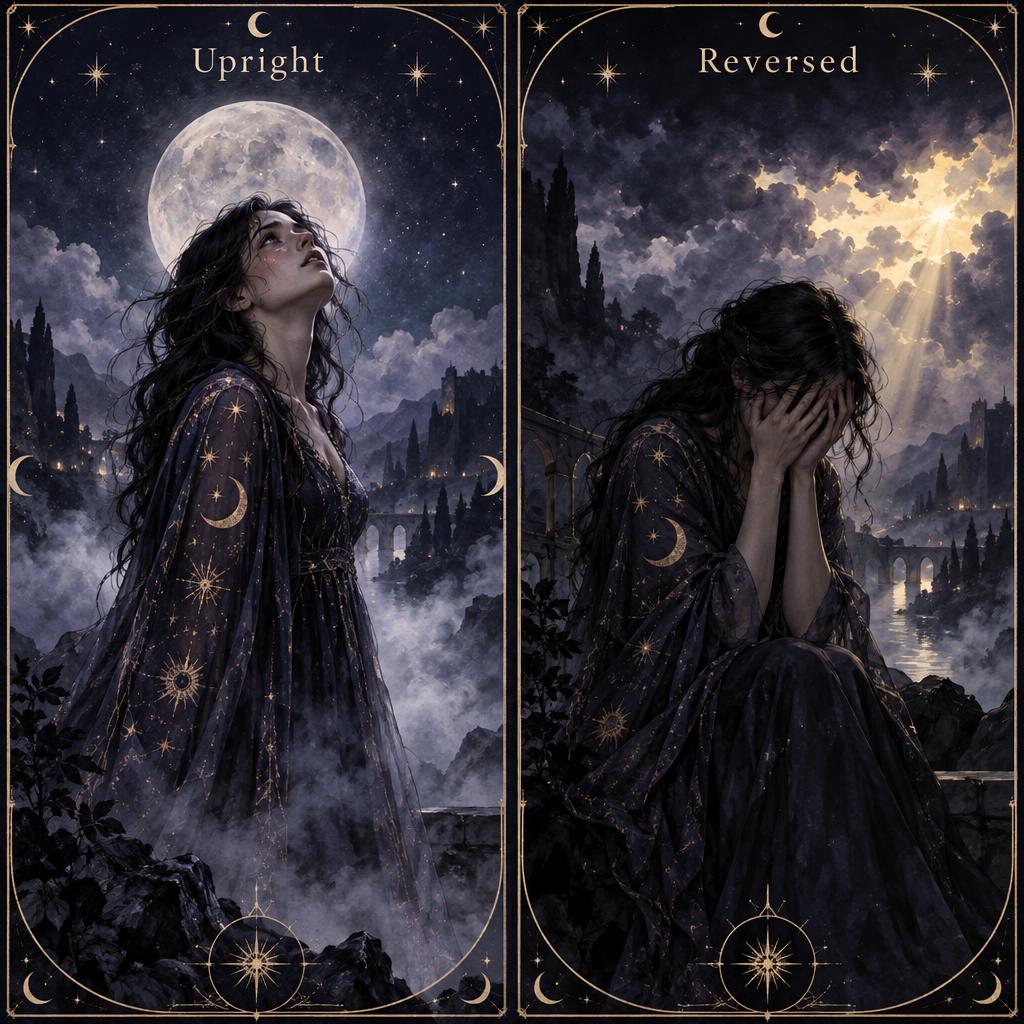
The reversed Moon is trickier because it can point in two very different directions. The surrounding cards and your own experience of the person decide which one applies.
Emotional Deception
The darker reading is that feelings are being hidden or misrepresented. This can be mild: someone downplaying how much they care to protect themselves. It can also be more serious: someone hiding another relationship, exaggerating their interest, or saying what you want to hear.
Waite’s reversed meanings include “lesser degrees of deception and error.” That’s a fair summary. The reversed Moon usually points to evasion, half-truths and omissions more than grand lies.
Fear of Vulnerability
This is the most common reversed reading in love. The person has feelings, and those feelings frighten them. Reversal pushes the card’s fear inward, so instead of anxious mixed signals, you get shutdown.
Signs include:
– Changing the subject whenever things get personal
– Joking their way out of serious moments
– Pulling back immediately after a moment of closeness
– Insisting they’re “fine” when they clearly aren’t
If you’re also seeing avoidance cards nearby, the two of swords upright reversed patterns are worth comparing. That card describes someone deliberately refusing to choose, and alongside a reversed Moon it signals a person blocking out their own feelings.
Clarity Emerging
The hopeful reading is that the fog is lifting. A reversed card can show the energy waning. Here, illusions are breaking down and the person is finally starting to see what they feel.
This often appears after a period of confusion. They may be on the verge of being honest with you, or with themselves. Sometimes the clarity is a “yes.” Sometimes it’s a “no.” Either way, it’s progress.
Repressed Feelings Leaking Out
Reversed Moons also describe feelings that have been pushed down so long they surface in odd ways. Sudden jealousy. A text out of nowhere. An emotional overreaction to something small. The crayfish has climbed out of the pool, whether they wanted it to or not.
Upright vs Reversed: Side-by-Side
| Aspect | Upright Moon | Reversed Moon |
|---|---|---|
| Core feeling | Attraction blurred by uncertainty | Feelings hidden, feared, or finally clarifying |
| How they act | Inconsistent, hot-and-cold | Shut down, evasive, or suddenly more honest |
| Source of confusion | Their own subconscious | Deliberate avoidance or self-deception |
| Honesty level | Sincere but unclear | Can range from evasive to newly truthful |
| Fear level | Anxious, nervous | Deep fear of exposure, or fear releasing |
| Best response from you | Patience, observation, gentle clarity | Direct questions, boundaries, watch actions over words |
| Outlook | Unclear for now; time reveals more | Truth surfacing; a turning point is near |
Projection and the Beloved: What The Moon Reveals About How We Love
Here’s an angle many readings skip. The Moon describes their feelings, but it also holds up a mirror to yours.
When you pull this card, ask yourself an honest question: how much of what you believe about this person is something you’ve actually seen, and how much is something you’ve filled in?
Under moonlight, you see shapes and your brain supplies the rest. That’s exactly what happens with an ambiguous love interest. A one-word reply becomes evidence of anger. A long reply becomes proof of devotion. A delayed text becomes a story.
The Moon in the feelings position is often a sign that both people are projecting. They’re reacting to an idealised version of you. You’re reacting to an idealised (or feared) version of them. Neither of you is fully relating to the other yet.
The practical move is to separate observation from interpretation. Write down three things they actually did this week. Then write down what you told yourself those things meant. The gap between the two lists is The Moon at work.
Confusion, Gaslighting, and the Distortion of Reality
The Moon is the card of distorted perception, so it sometimes appears when someone feels they can’t trust their own read of a relationship. That deserves a careful, grounded look.
The term “gaslighting” comes from Patrick Hamilton’s 1938 play Gas Light and the 1944 film Gaslight, in which a husband manipulates his wife into doubting her own perceptions. The word became common enough that Merriam-Webster named it its Word of the Year in 2022.
A tarot card cannot diagnose manipulation. But if The Moon (especially reversed) keeps appearing and you recognise these patterns, take them seriously:
- You’re regularly told your memory of events is wrong
- Your concerns are dismissed as “crazy,” “too sensitive,” or “dramatic”
- You feel more confused after conversations, not less
- You find yourself apologising for things you didn’t do
- You’ve stopped trusting your own judgement about the relationship
Ordinary confusion, the kind The Moon usually describes, comes from someone who doesn’t understand their own feelings. Manipulation comes from someone who benefits from you not understanding yours. The first calls for patience. The second calls for distance, and possibly support from friends, a therapist, or a relationship helpline.
A good test: when you ask a direct question, does the person try to answer, even clumsily? Or do they make you feel wrong for asking? Confusion fumbles. Deception deflects.
Hecate at the Crossroads: The Lunar Feminine and Desire
The Moon’s imagery borrows from very old associations. In Greek myth, the moon was linked to goddesses such as Selene, who personified it, Artemis, the huntress associated with wild animals, and Hecate, a goddess of crossroads, night and thresholds who was often depicted in triple form and accompanied by dogs.
Those threads show up clearly in the card. The dog and wolf echo Hecate’s hounds and Artemis’s wild creatures. The two towers form a threshold. The path is a crossroads made visible.
For love readings, Hecate’s symbolism adds something useful: the crossroads. The Moon as feelings often means someone is standing at a fork. One road leads toward you and the risk of real intimacy. The other leads back toward safety, habit, or someone else. They haven’t chosen yet, and the uncertainty you feel is the sound of them standing still at that junction.
You can’t choose for them. What you can do is decide how long you’re willing to wait at the crossroads with them.
Dreams, the Unconscious, and the Night Side of Desire
Pisces, the sign tied to The Moon in the Golden Dawn system, is traditionally ruled by Jupiter and, in modern astrology, by Neptune. Both connect to dissolving boundaries, imagination and longing. It’s no surprise the card speaks so strongly to private fantasy.
When The Moon describes someone’s feelings, those feelings often live most vividly at night. They show up in dreams, in late-night thoughts, in the 1 a.m. message that’s far more open than anything sent at noon.
Carl Jung’s idea of the shadow, the parts of ourselves we don’t consciously acknowledge, fits the crayfish crawling out of the pool. Attraction under this card can stir up things a person keeps buried: old rejections, desires they judge in themselves, needs they don’t think they’re allowed to have.
That’s why their behaviour may seem disproportionate. They’re reacting to you and to everything you’ve unearthed. Patience here is kindness, as long as it isn’t self-erasure.
The Moon After a Breakup or With an Ex
Pulling The Moon for an ex’s feelings is common, and the card fits the post-breakup state almost perfectly.
Upright, it usually means your ex hasn’t sorted out how they feel. They might miss you. They might be relieved. Most likely they’re both, on alternating days. They may think about you more than you’d guess, especially at night or when something reminds them of you.
Reversed, it can mean they’re actively suppressing feelings to move on, or that the haze is lifting and they’re seeing the relationship more realistically. That realism can bring regret or closure, depending on the surrounding cards.
If grief is the dominant mood around the breakup, you may see overlap with five of cups feelings in love, which centre on dwelling on what was lost. A Moon beside the Five of Cups suggests your ex is stuck in a foggy mix of regret and confusion.
A few honest points for anyone hoping for reconciliation:
- The Moon doesn’t predict a return. It describes uncertainty.
- Their confusion is not a promise. Don’t build your healing around their indecision.
- If they reach out, look for consistency over time, not one emotional message.
Common Card Combinations With The Moon as Feelings
The cards around The Moon change its meaning more than almost any other Major Arcana card, because The Moon itself is ambiguous. Here are combinations that come up often.
| Combination | What it suggests about their feelings |
|---|---|
| The Moon + Two of Cups | Real mutual attraction clouded by doubt; the connection is there, the clarity isn’t |
| The Moon + The Devil | Obsessive or compulsive attraction, possibly tied to secrecy or unhealthy patterns |
| The Moon + Two of Swords | Deliberate avoidance; they’re refusing to look at their feelings |
| The Moon + Five of Cups | Confusion wrapped in grief or regret, common with exes |
| The Moon + Death | Old feelings ending while new ones remain unclear |
| The Moon + The Emperor | They want control and stability but feel neither around you |
| The Moon + Ace of Wands | Sudden spark of desire they don’t understand yet |
| The Moon + The Sun | Confusion resolving into warmth and honesty |
| The Moon + The High Priestess | Deep, private feelings they’re keeping fully to themselves |
| The Moon + The Lovers | A real choice about you is weighing on them |
| The Moon + Seven of Swords | Strong warning of secrecy or dishonesty |
A few of these deserve more detail.
With the Two of Cups. This is one of the more encouraging pairings. The Two of Cups describes mutual connection, and The Moon says it’s not yet fully trusted. If you’ve read our guide to the two of cups as feelings, you’ll know it’s one of the warmest cards in the deck. Paired with The Moon, it reads as “they feel it, they just don’t believe it yet.”
With The Devil. Here the confusion takes on a compulsive edge. The devil tarot card meaning in love centres on attachment, temptation and patterns that are hard to break. Together, the two cards can describe someone drawn to you in a way they find unsettling, or a connection with secrecy built into it.
With Death. The death as feelings in love tarot reading is about endings and transformation. Beside The Moon, it often shows someone whose old feelings (for you or for someone else) are ending, while what comes next hasn’t taken shape.
With The Emperor. The emperor tarot meaning is about structure, authority and control. Paired with The Moon, it describes someone who likes to feel in charge and is thrown off balance by how uncertain you make them feel. Expect them to over-plan or go cold to regain control.
With the Ace of Wands. The ace of wands tarot meaning is pure spark: new desire, new energy. With The Moon, the spark is real, but they don’t know what it means or whether to act on it.
How to Navigate Unclear Romantic Signals
The Moon is not a card that asks you to wait forever in the dark. It asks you to move carefully, trust what you can verify, and stop guessing. These steps help.
1. Watch Actions Over Weeks, Not Days
Single moments under The Moon are unreliable. A pattern over three or four weeks tells you far more. Do they make plans and keep them? Do they come back after pulling away? Consistency is the light that cuts through moonlight.
2. Ask One Clear Question
Mixed signals thrive on unspoken assumptions. A single direct, low-pressure question can collapse weeks of guessing. Try something like: “I really enjoy spending time with you. I’m curious where you see this going.” Then let them answer without rushing to soften it.
How they respond is valuable either way. A clumsy but honest answer is a good sign. A deflection is information too.
3. Separate Your Intuition From Your Anxiety
The Moon is a card of intuition, and also of fear. Both feel like a “gut feeling.” The difference is usually this: intuition is calm and specific. Anxiety is loud, urgent and repetitive.
If a feeling about them shows up quietly and stays steady, take it seriously. If it spins in circles and demands you check your phone every five minutes, it’s probably fear wearing intuition’s clothes.
4. Stop Filling the Silence With Stories
When you don’t hear back, notice the story you start telling yourself. Write it down if it helps. Then ask: what’s another explanation that’s just as likely? Most silences are boring. People get busy, tired, distracted.
5. Set a Personal Time Limit
Ambiguity is fine for a while. Indefinite ambiguity is a choice to accept less than you want. Decide privately how long you’re willing to stay in uncertainty. A month? Three? When you reach it, have the clarifying conversation or step back.
6. Protect Your Own Clarity
The Moon can drag you into someone else’s fog. Keep your routines, friendships and interests intact. The clearer your own life is, the easier it becomes to see theirs.
7. Don’t Read Endlessly on the Same Question
Pulling card after card on “how do they feel” often produces more Moons, more confusion and more anxiety. Give it at least a full lunar cycle before asking the same question again. That leads to a practical tool.
Using the Real Lunar Cycle as a Check-In Calendar
Here’s a grounded way to work with this card: tie your reflection to the actual moon. The synodic month, the time from one new moon to the next, averages about 29.53 days. That gives you a natural rhythm for checking in on an unclear relationship without obsessing daily.
| Lunar phase | Approximate day of cycle | Reflection focus |
|---|---|---|
| New moon | Day 0 | Set an intention: what clarity do you want this month? |
| First quarter | About day 7.4 | Notice actions so far; any patterns forming? |
| Full moon | About day 14.8 | Honest review: what’s been revealed? Have the direct conversation if needed |
| Last quarter | About day 22.1 | Release what isn’t working; adjust your expectations |
| Next new moon | About day 29.5 | Decide: continue, clarify, or step back |
This turns The Moon’s endless ambiguity into a structured month. By the end, you’ll have roughly four weeks of observed behaviour, which beats any amount of guesswork.
A Follow-Up Spread for When The Moon Appears
If The Moon lands in the feelings position and you want more detail, try this simple five-card clarifier.
- What they consciously feel (the dog)
- What they feel beneath the surface (the wolf)
- What fear is clouding things (the crayfish)
- What would bring clarity (the path)
- What I need to see clearly (the mountains)
The fifth position is easy to skip and is often the most useful. It shifts the reading back to you and your own choices, which is where your power actually sits.
Questions That Work Better Than “Do They Love Me?”
- What’s preventing honest communication between us?
- What am I projecting onto this person?
- What does this connection need to grow?
- What do I need to feel secure here?
- What should I trust: their words or their actions?
These questions give the cards something to work with. “Do they love me?” under The Moon tends to produce more fog.
What The Moon Asks of You
The Moon as feelings is uncomfortable because it denies you the certainty you want. But it isn’t a bad card in love. It describes a real, human stage: the part where feelings exist before they’ve been understood.
Their emotions are likely sincere and tangled. Yours may be too. The card’s advice is steady: trust your intuition but check it against reality, ask clear questions, watch for patterns, and refuse to stay in the dark longer than serves you.
The Sun follows The Moon in the Major Arcana. Clarity comes. Your job is to walk the path without losing yourself on the way.
FAQ
Is The Moon a yes or no card for feelings?
It’s closest to “unclear” or “not yet.” Upright, the person likely has feelings but can’t sort them out. Reversed, the answer depends on context: it can signal hidden feelings, deliberate avoidance, or confusion finally lifting. Look to the surrounding cards for direction.
Does The Moon mean someone is lying to me?
Not usually when upright. Upright, The Moon points to confusion and uncertainty, not deliberate deceit. Reversed, or paired with cards like the Seven of Swords or The Devil, it raises the chance of secrecy or half-truths. Watch for a pattern of deflection when you ask direct questions.
What does The Moon mean for an ex’s feelings?
Your ex likely has unresolved, mixed emotions about you. They may miss you and feel relieved at the same time. The card doesn’t predict reconciliation. It describes an emotional state that hasn’t settled yet.
Can The Moon mean someone has a secret crush on me?
Yes. The upright Moon often describes private attraction that hasn’t been voiced. The person may daydream about you or think about you more than they show, while feeling too uncertain or anxious to act.
What does The Moon reversed mean in a relationship?
In an established relationship, a reversed Moon often points to a partner avoiding emotional exposure, or to unspoken issues coming to the surface. It can also mark a turning point where honesty becomes possible after a confusing stretch.
How should I respond when I pull The Moon for someone’s feelings?
Slow down and gather real evidence. Observe their actions over several weeks, ask one clear question about where things stand, and set a private time limit for how long you’ll accept ambiguity. Don’t keep re-reading the same question; give it at least a full lunar cycle.
Is The Moon a good or bad card in love?
It’s neither. It’s a card of transition and uncertainty. It warns against acting on assumptions, and it promises that clarity follows confusion, which is why The Sun comes right after it in the deck.