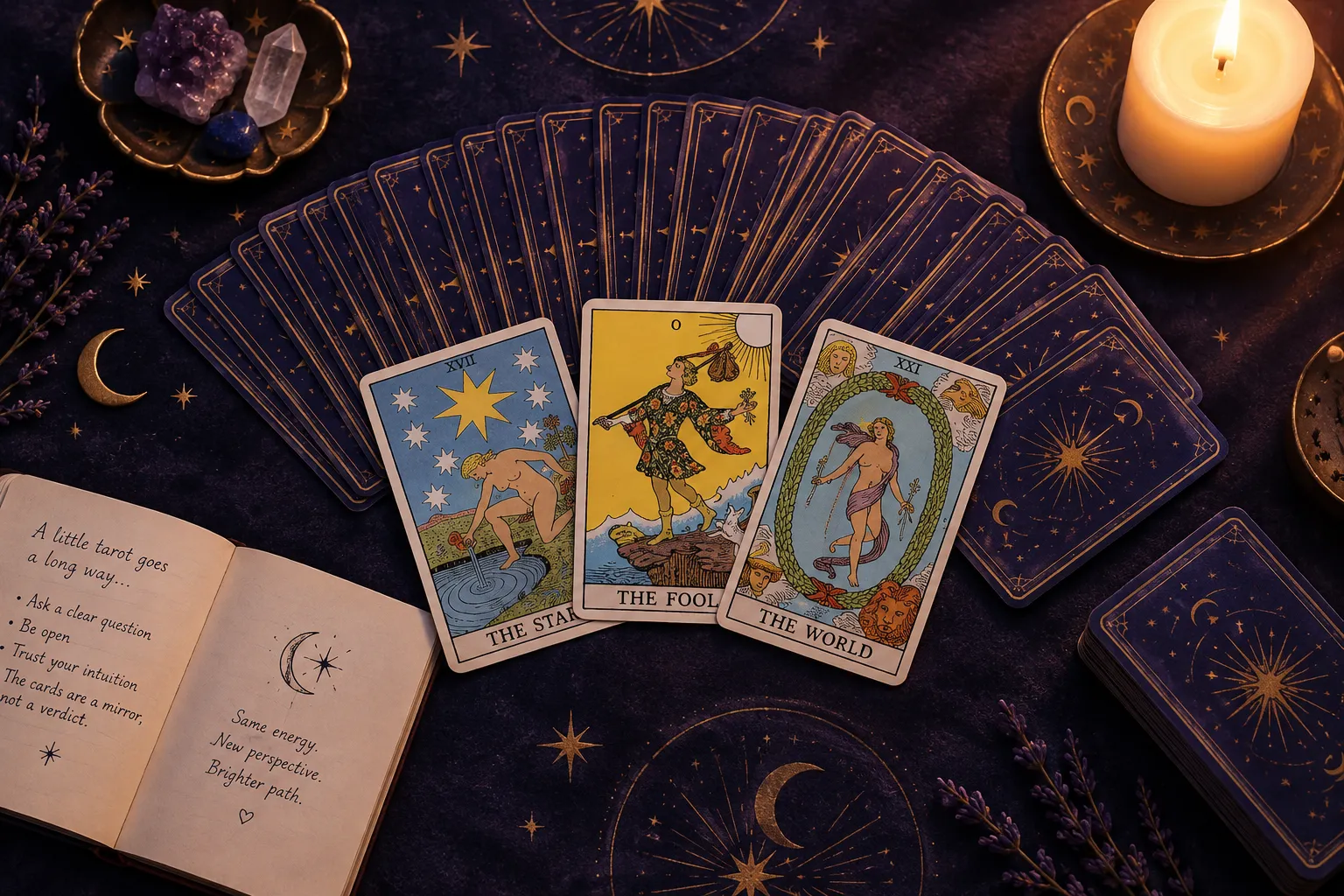


Pulling Temperance as the final card in a relationship spread almost always points toward a steady, healing resolution rather than fireworks. This guide breaks down the temperance love outcome in detail, upright and reversed, for singles, new connections, long-term couples, and anyone asking about an ex, along with timing, a yes-or-no verdict, and what to actually do next.
Last reviewed and updated for 2026.
Temperance Love Outcome at a Glance
| Detail | Temperance (XIV) |
|---|---|
| Card number | 14, Major Arcana |
| Position in the Fool’s Journey | Between Death (XIII) and The Devil (XV) |
| Element | Fire |
| Zodiac | Sagittarius |
| Upright love keywords | Balance, patience, healing, compromise, blending, moderation, divine timing |
| Reversed love keywords | Impatience, rushing, emotional extremes, excess, clashing energies, imbalance |
| Yes or no for love | Leaning yes, on the condition that you don’t force the pace |
| Typical timing | Days to a few weeks, slower if reversed |
Is Temperance a Yes or No for Love?
Yes, with a condition attached. Temperance as a love outcome says the connection has real potential and is trending toward stability, but only if both people allow it to develop at its own tempo. It is not the enthusiastic yes of the Sun or the Ten of Cups. It is a measured yes that rewards patience and punishes shortcuts.
If your question was framed as “Will this work out?”, read it as “Yes, gradually, and better than you expect if you stop pushing.” If your question was “Will this happen fast?”, Temperance answers no. Speed is the one thing this card refuses to promise.
The Symbolism Behind the Meaning
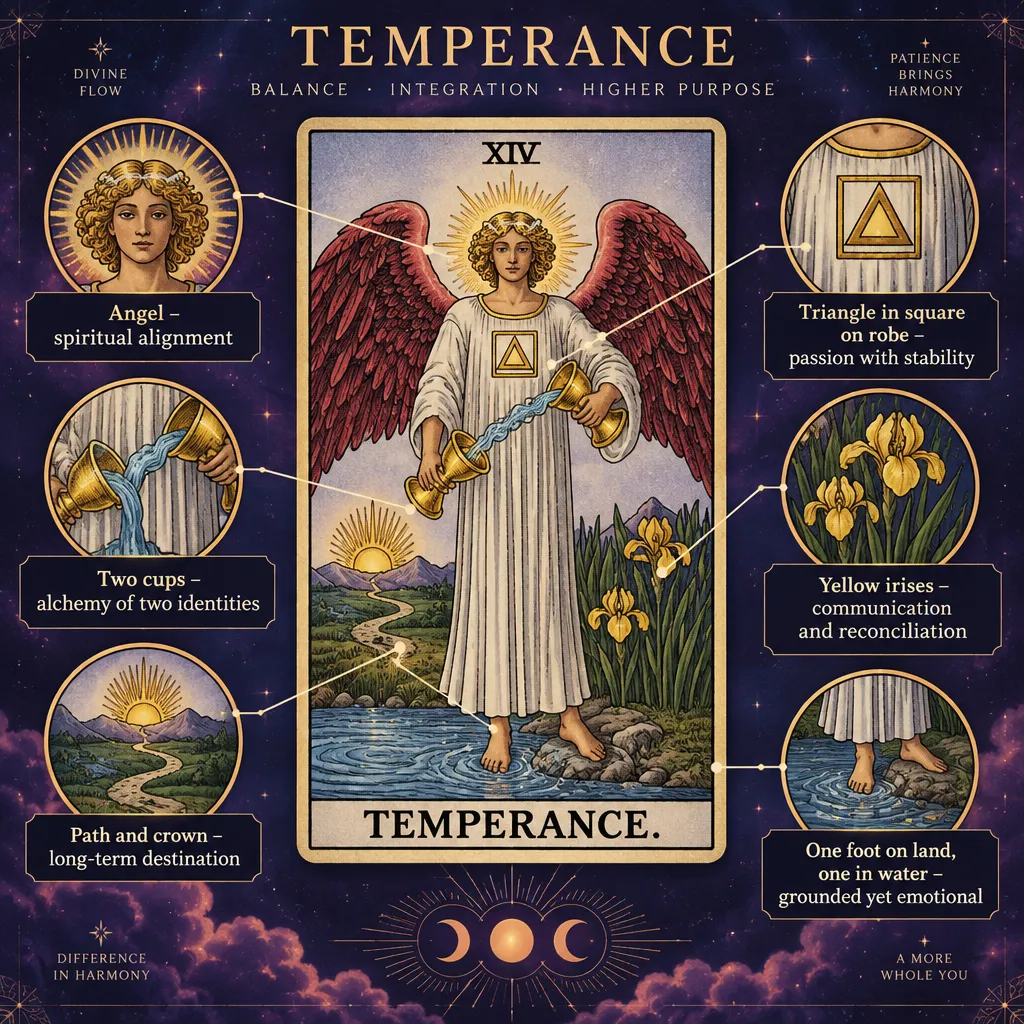
The Rider-Waite-Smith image, drawn by Pamela Colman Smith in 1909, packs several symbols that map directly onto relationship dynamics.
The angel. A large winged figure stands at the center, neither clearly male nor female. In a love reading, this points to a connection that transcends surface attraction. The relationship serves something larger than either ego, and the outcome has a spiritual alignment to it rather than a purely physical or practical one.
One foot on land, one in water. The angel’s right foot rests on rock, the left dips into a pool. Land is the material world; water is emotion and the unconscious. As an outcome, this is the most important symbol on the card. It describes two people who can stay grounded in daily reality (bills, schedules, logistics) while still being emotionally open. It also describes a partnership where one person tends to be the practical anchor and the other the feeler, and the two have found a way to stand together without either tipping over.
Two cups and the flowing water. The angel pours water from one cup to the other, and the stream appears to flow at an impossible angle. This is alchemy: two separate substances combining into something new. For couples, it means neither partner gets swallowed. You keep your own identity and your partner keeps theirs, and what you create together is a third thing that didn’t exist before.
The triangle inside a square. On the angel’s robe sits a triangle enclosed in a square. The triangle traditionally represents spirit or fire; the square represents the physical world and stability. Spirit contained within structure. In love, this is passion that has a home. The chemistry hasn’t died, it has been given a container that lets it last.
The path to the mountains and the glowing crown. Behind the angel, a path winds toward distant peaks, and a crown shines in the sunrise. The destination is real, but it’s not close. Temperance love outcomes are destinations you walk toward, not ones you arrive at tomorrow.
The irises. Yellow irises grow by the water. Iris was the Greek goddess of the rainbow, a messenger between gods and mortals. Reconciliation, communication across a divide, a message finally getting through. This is why Temperance shows up so often when people ask about healing a rift.
Sagittarius, Fire, and Why Temperance Isn’t a Passive Card
Temperance is assigned to Sagittarius, a mutable Fire sign ruled by Jupiter. This surprises people, because the card looks calm and watery. The Fire attribution matters for interpretation.
Fire gives Temperance motion and optimism. The balance it describes is active, like a cyclist staying upright by pedaling, not a statue sitting still. A Temperance relationship requires ongoing adjustment from both people. Nobody gets to coast.
Sagittarius adds the themes of growth, honesty, philosophy, and travel. Partnerships under this card often involve learning from each other, sometimes across cultural or religious differences, and nearly always involve blunt but good-natured honesty. Sagittarius also has a famous allergy to being caged. A Temperance outcome works when both partners retain personal freedom inside the commitment. Smothering kills it.
Temperance Love Outcome for Singles
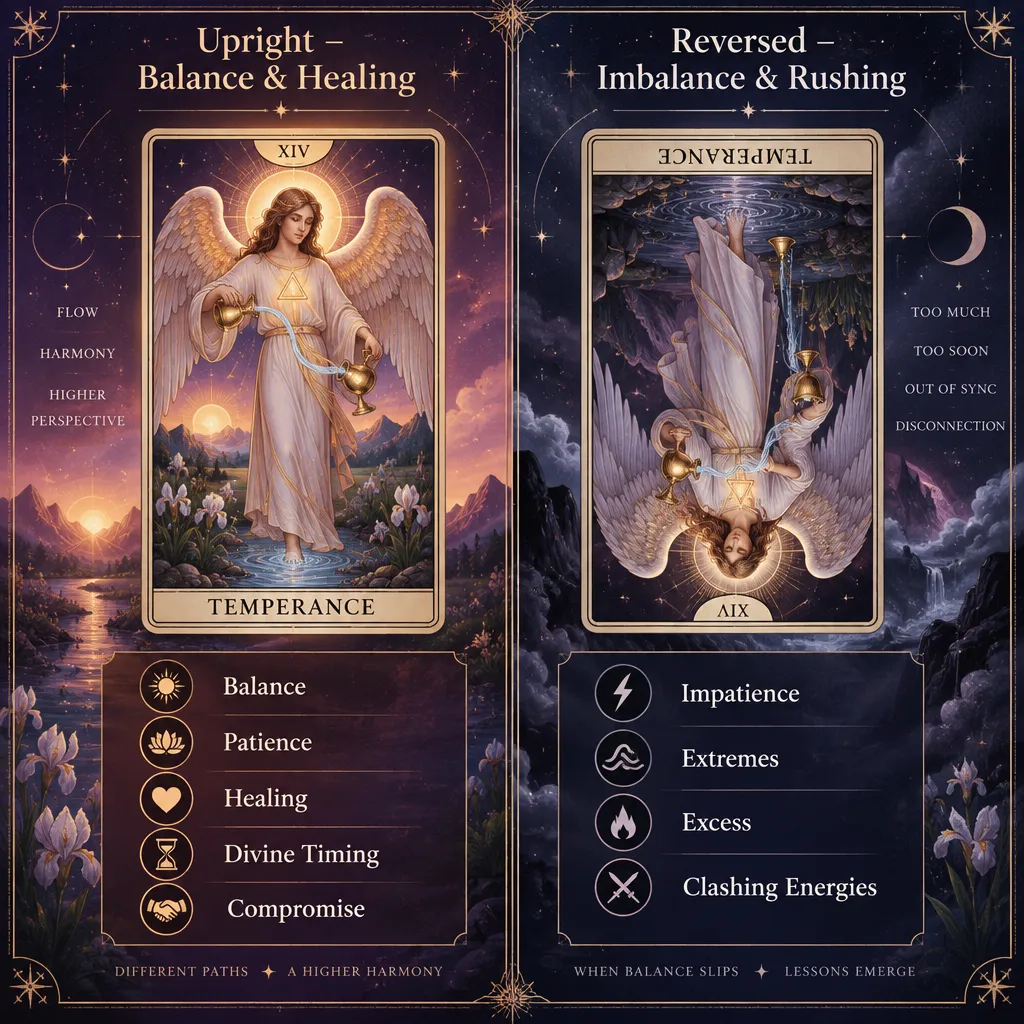
For single querents, Temperance redirects the question. You asked about finding someone; the card answers with your own readiness.
Upright, it says the next relationship worth having will arrive after a period of internal recalibration that is already underway. If you recently came out of something painful, Temperance confirms the healing is working, even if it feels slow. The card commonly appears for people who have swung between extremes: dating compulsively, then swearing off dating entirely; chasing emotionally unavailable people, then settling for someone safe but dull. The outcome is a middle path. You will stop choosing from a wound.
Concretely, Temperance for a single person often looks like:
- Meeting someone through a calm, ordinary channel (a class, a friend’s dinner, a shared activity) rather than a dramatic encounter
- A connection that builds over several conversations rather than one intense night
- Attraction to someone whose temperament complements rather than mirrors yours
- Feeling noticeably less anxious about the dating process than you did six months ago
Reversed for singles, the card flags impatience. You’re either rushing to fill a gap or oscillating between obsession and avoidance. It can also indicate self-medicating loneliness with excess: drinking more than usual, overspending, overworking, endless swiping. The correction is not to try harder to find someone. It’s to restore your own equilibrium first, because any relationship started from this state will inherit the imbalance.
Temperance Love Outcome for New Relationships
This is one of the best cards you can pull for a connection that’s a few weeks or months old. It says the thing has legs.
Upright, Temperance describes a relationship developing at a healthy pace. Neither person is love-bombing. Neither is withholding. You’re learning each other’s rhythms, and small incompatibilities are being resolved through conversation rather than ignored or exploded over. The “one foot on land, one in water” symbol is especially active here: you’re keeping your life (friends, work, routines) while making real emotional room for the other person.
The opposites-attract dynamic is common with this card. An introvert and an extrovert. A planner and a spontaneous type. Someone cautious with money and someone generous. Temperance says those differences are the point. The blending of the two cups only works because the cups contain different things.
A caution even when upright: the card asks you not to accelerate. If you’re already discussing moving in after six weeks, Temperance is gently suggesting you enjoy where you are. The outcome is strongest when you don’t skip stages.
Reversed in a new relationship, the warning is sharper. Typical readings:
- Rushing. Declarations, exclusivity, or major plans happening before trust has been earned. One person is pushing the pace and the other is going along to keep the peace.
- Hot and cold. Intense contact followed by sudden distance. Three dates in a week, then silence for ten days.
- Clashing energies. Differences that felt exciting now feel like friction, and neither of you has figured out how to compromise.
- Excess. The relationship revolves around partying, spending, or sex to the exclusion of actually knowing each other.
Reversed Temperance in this position rarely means “end it.” It means “slow it down and have the honest conversation you’ve been avoiding.” If the connection can survive a deliberate decrease in intensity, it’s real.
Temperance Love Outcome for Long-Term Relationships
For established couples, Temperance is the card of the durable home.
Upright, it points toward cohabitation, nesting, blending finances, merging families, or simply settling into a rhythm where the relationship stops feeling like work. Couples who pull this card after a rough patch can read it as confirmation that the repair is holding. The water flowing between the cups is the daily, undramatic exchange of care that keeps a long partnership alive: making coffee, listening after a bad day, splitting chores without scorekeeping.
The card also speaks to couples who have very different natures and have learned to use that difference. One partner handles the practical world (the foot on rock), the other holds the emotional climate (the foot in water), and after years together the division has become a strength rather than a source of resentment.
Where Temperance appears as a long-term outcome, expect:
- A decision about shared living space or a renovation of the one you have
- Health and lifestyle changes made together (moderation is literally in the card’s name)
- Reduced conflict frequency, with disagreements resolved faster
- A phase of contentment that may feel quiet after earlier years of passion, which is not a problem to fix
Reversed in a long-term relationship, the imbalance has usually been building for a while. One partner is giving far more than the other. Routines have calcified into ruts. Or the relationship has swung into extremes: constant fighting, or total avoidance of any conflict. Excess is a common theme here too: one person’s drinking, spending, or work hours have become the unspoken problem.
A note on safety. Older interpretations sometimes jump straight from reversed Temperance to “abusive relationship.” That’s an overreach. A single reversed card describes imbalance and volatility, not abuse. Abuse is a pattern of control, fear, and harm, and you don’t need a tarot card to identify it. If you recognize those patterns, treat the card as the least important input and reach out to a domestic violence support service in your country, such as the National Domestic Violence Hotline in the United States. For everyone else, reversed Temperance in a long relationship is a course-correction prompt, not a verdict.
Temperance Love Outcome for Reconciliation and Getting an Ex Back
People asking about an ex pull Temperance more often than almost any other Major Arcana card, and the interpretation needs care.
Upright, Temperance supports reconciliation, but it describes a specific kind. Not the dramatic reunion where someone shows up at the door. A slow, measured rebuilding where both people have genuinely changed something about how they relate. The iris symbolism (messenger, bridge) suggests communication reopens. The two cups suggest that what you rebuild will be different from what you had, a blend of who you’ve each become since the split.
The honest read: Temperance says yes, reconciliation is possible, and it will take time, probably more than you want. It also puts conditions on it. Whatever imbalance ended the relationship has to be addressed, not just forgiven. If one of you did all the emotional labor last time, that has to change. If it ended over extremes (jealousy, substance use, overwork), the moderation the card demands is non-negotiable.
Reversed when asking about an ex, the message is usually one of these:
- You’re trying to force it. Repeated messages, grand gestures, or pressure for an answer. The card says this approach is pushing the other person further away.
- Nothing has changed. The same dynamics that broke it are still present. Getting back together now would replay the same cycle.
- Mismatched readiness. One of you has healed and the other hasn’t. Reconciliation attempted at different stages tends to collapse.
- Timing is off, not the connection. Sometimes reversed Temperance about an ex means “not yet” rather than “never.” The surrounding cards tell you which.
If you draw Temperance reversed about reconciliation, the most useful action is counterintuitive: stop pursuing for a defined period (a month is reasonable), use the time on your own balance, and let the other person miss the version of you that isn’t anxious.
Divine Timing and Spiritual Alignment
Temperance is the card most associated with divine timing in love. The angel isn’t rushing; the water flows exactly as fast as it needs to. When this card appears as an outcome, it often means the thing you want is coming, but on a schedule you don’t control.
This frustrates people, understandably. The practical translation: the delay is not rejection. It’s preparation. Something in you, in the other person, or in circumstances still needs to settle before the connection can hold weight. Couples who come together under Temperance timing frequently say in hindsight that an earlier start would have failed.
There’s also a soul-contract flavor to this card. The angel bridging heaven and earth suggests a relationship with a purpose beyond companionship: mutual growth, healing of old patterns, or learning balance through someone who is your opposite.
Timing: How Fast Does a Temperance Outcome Manifest?
Temperance is a Fire card, and the standard tarot timing convention places Fire outcomes within days to a few weeks. For a new connection, expect a noticeable shift (a meaningful conversation, a deepening, a resolved tension) inside roughly two to four weeks of the reading.
That said, the card’s nature complicates the pure Fire timing. Temperance describes a process, not an event. The first signs appear quickly; the full outcome (cohabitation, reconciliation, true stability) unfolds over months. Think of it as a fast start to a slow build.
Reversed, timing stretches. Delays, stalls, and false starts are typical. If you’re waiting on a specific person to act, reversed Temperance suggests they won’t move on your timeline, and pushing will slow things further.
Temperance Compared to Related Love Cards
Understanding what Temperance is not sharpens what it is.
Temperance vs. The Lovers. The Lovers describes the choice and the chemistry: the moment two people decide on each other, often with intensity. Temperance describes what happens after the choice, the ongoing work of blending two lives. The Lovers is the spark; Temperance is the hearth. Pulling both together is one of the strongest love combinations in the deck.
Temperance vs. The Devil. The Devil (XV) follows Temperance in the Major Arcana, and it’s the shadow of everything Temperance stands for: excess, obsession, codependency, attraction that controls rather than nourishes. If you’ve been pulling The Devil in love readings and now Temperance appears, you’ve broken a cycle.
Temperance vs. Three of Swords. The Three of Swords is the wound; Temperance is the healing. The Three of Swords followed by Temperance in a sequence is a reliable indicator that heartbreak is resolving.
Temperance vs. The High Priestess. Both are calm, spiritual cards, but The High Priestess is stillness, secrecy, and waiting for intuition. Temperance is active blending and visible progress. The High Priestess says “wait and listen.” Temperance says “keep adjusting and it will come together.”
Temperance vs. Two of Cups. The Two of Cups is mutual attraction and the beginning of partnership. Temperance is the mature version: the two cups have been pouring into each other long enough to become something unified.
What to Do When Temperance Is Your Love Outcome
Upright, the card asks you to protect what’s forming rather than accelerate it.
- Stop making the relationship your only project. Keep one foot on land. Maintain your friendships, work, and routines. Partners under Temperance thrive when neither person has collapsed their life into the other’s.
- Have the moderate conversation. If there’s a difference between you (money, time, affection style), raise it calmly now while it’s small. Temperance rewards early, low-stakes honesty.
- Accept the pace. If you’re tempted to push for a label, a key, or a plan, wait two weeks and see if you still feel the need. Usually the pressure dissolves.
- Watch for excess in yourself. Drinking, spending, or texting more than usual because of the relationship is a sign you’re leaving balance.
Reversed, the work is more pointed.
- Name the imbalance out loud. Who is giving more? Who is rushing? Say it to your partner, or write it down if you’re single.
- Reduce intensity deliberately. Fewer messages, a slower cadence of dates, or a short break if things have been volatile. The connection that survives this is worth keeping.
- Address your own extremes first. Reversed Temperance almost always implicates the querent. Fix your side of the scale before asking the other person to move.
- Set a review date. Give the correction four to six weeks, then reassess. If nothing has shifted, the surrounding cards and your own judgment should guide the next step.
FAQ
What does Temperance mean as a love outcome for a specific person?
If you asked how a specific person feels or what they’ll do, Temperance says they are measured and sincere. They aren’t playing games, but they also aren’t going to rush. They see the connection as something to build carefully, and they may be balancing their feelings for you against practical considerations. Reversed, the person is conflicted, running hot and cold, or dealing with their own imbalance (often stress, excess, or an unresolved situation) that keeps them from showing up consistently.
Is Temperance a good card for a love outcome?
Yes. It’s one of the most reassuring outcome cards for anyone who wants a relationship that lasts. It’s less exciting for people hoping for immediate intensity, because the card’s whole message is gradual blending rather than instant passion.
What does Temperance reversed mean as a love outcome?
Reversed Temperance points to imbalance and impatience: rushing commitment, emotional swings, one-sided effort, excess, or two temperaments clashing without compromise. It’s a prompt to slow down and rebalance, not a prediction that the relationship is doomed. Only if it appears alongside cards like The Devil, the Ten of Swords, or the Five of Pentacles does it suggest something more serious.
Does Temperance mean reconciliation with an ex?
Upright, it supports a slow, conditional reconciliation where both people have changed. Reversed, it says the timing is wrong or that one of you is forcing something the other isn’t ready for. Either way, pressure makes it less likely.
How does Temperance reflect on my romantic future?
It predicts a stable, balanced partnership that develops over time, often with someone whose personality complements yours. The near future (weeks) brings calm progress; the longer future (months) brings a settled home life. Expect steadiness rather than drama.
Does Temperance mean marriage?
It can, particularly in a position asking about long-term outcome, and especially next to the Hierophant, the Four of Wands, or the Ten of Cups. On its own it more often indicates deep commitment and shared living than a formal ceremony.
Why is Temperance a Fire card when the image shows water?
The Golden Dawn system assigned Temperance to Sagittarius, a Fire sign. The water in the image represents emotion being tempered, and the fire is the active energy doing the tempering. For love readings, the Fire attribution means the balance is dynamic and the timing is relatively fast for first signs, even though the full outcome unfolds slowly.
Add Yes No Tarot as a preferred source on Google, and the sites you pick are more likely to appear in your Top Stories.