Tarot vs. Oracle Cards: What’s the Difference and Which Should You Use for Yes/No?
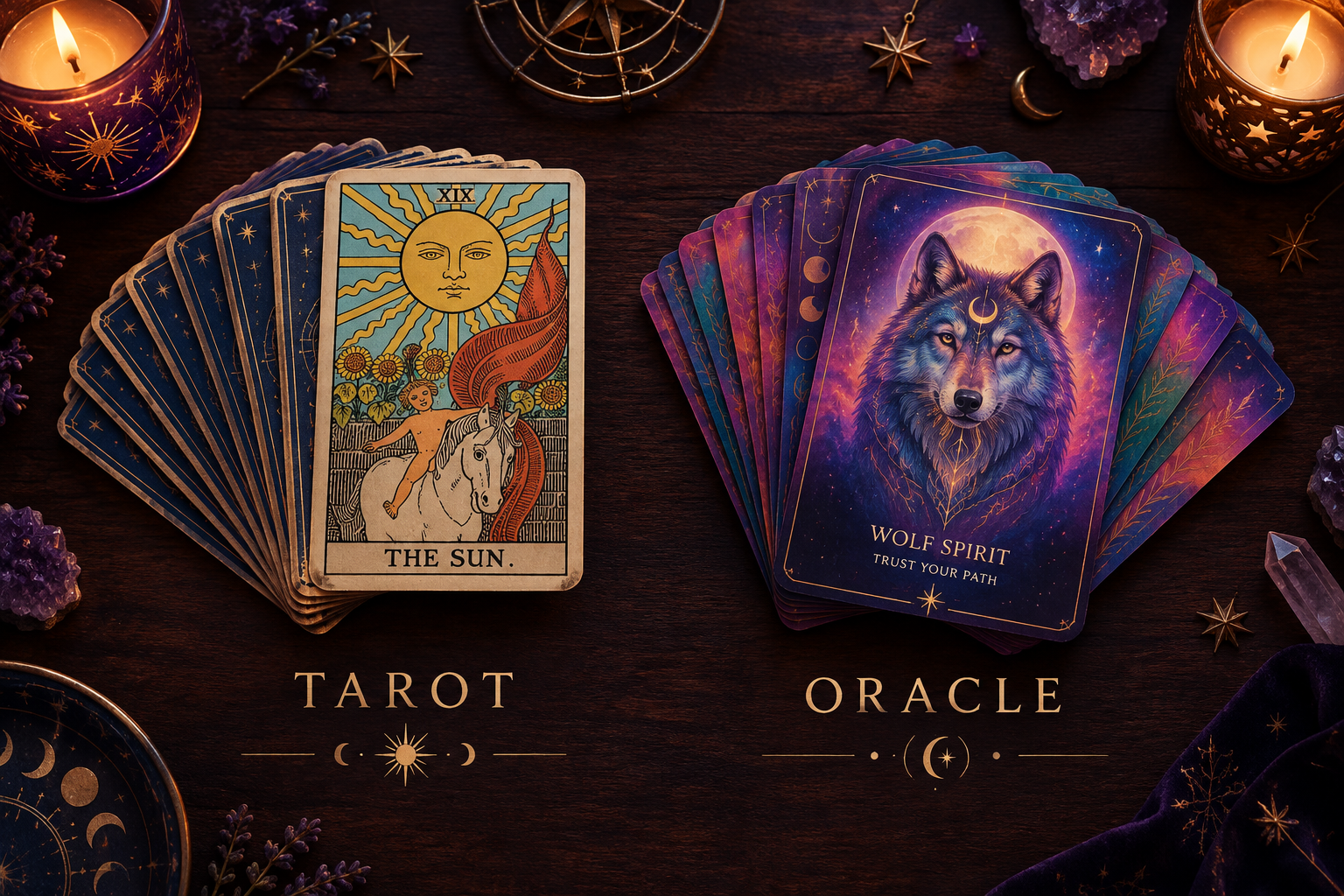
Tarot and oracle cards look alike on a shop shelf, but they behave very differently once you shuffle them. Tarot is a fixed 78-card system with centuries of shared meaning; oracle decks follow whatever rules their creator invented. That one distinction decides which deck handles a yes/no question well and which one leaves you guessing.
The short version
Tarot wins for yes/no readings. Its fixed structure means every card already has a widely agreed lean toward yes, no, or maybe, so you get a consistent answer no matter which deck you pull from. Oracle cards shine when you want a mood, a theme, or a gentle nudge rather than a verdict.
If you only have budget for one deck and you plan to ask direct questions, buy a tarot deck first. If you find tarot intimidating and mostly want daily encouragement, an oracle deck will serve you better and you can add tarot later.
The rest of this guide explains why, with the structural details, the trade-offs, and a question-by-question breakdown.
How a tarot deck is built
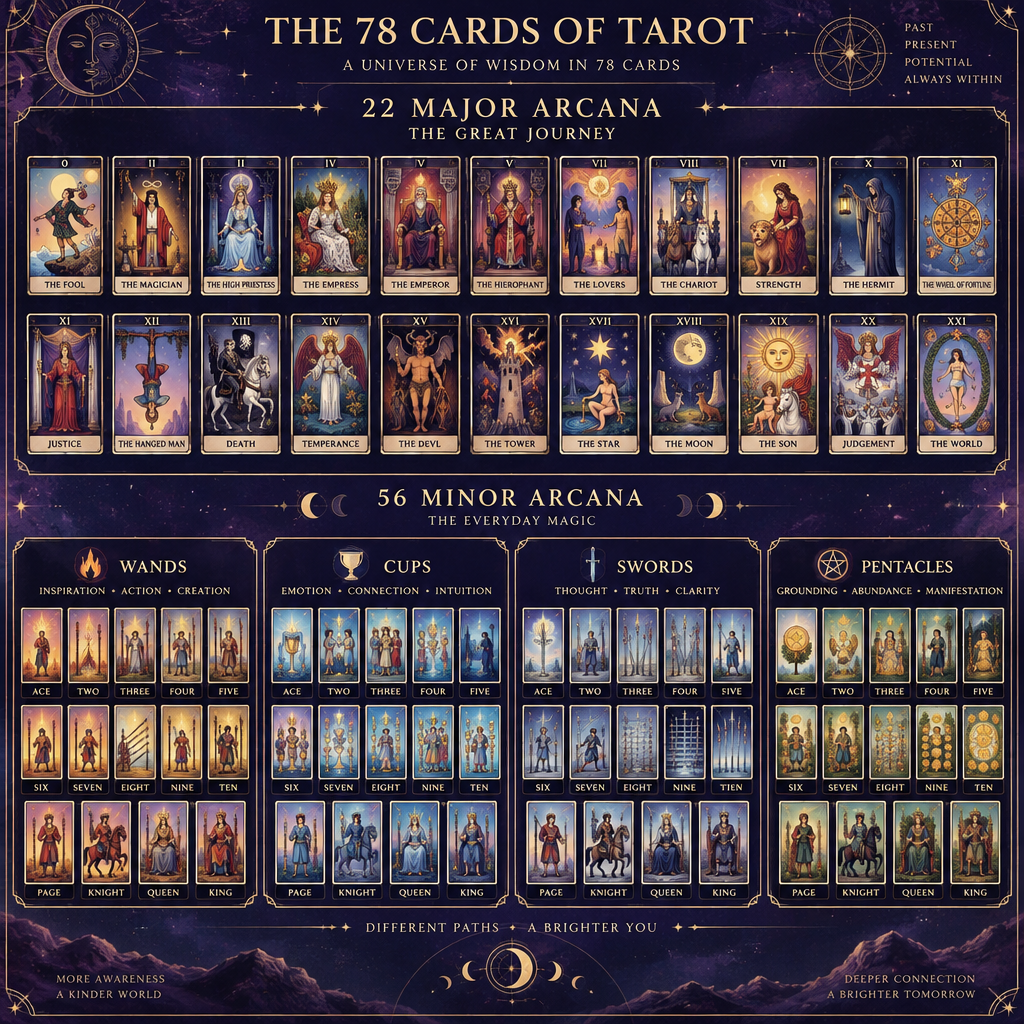
Every standard tarot deck contains 78 cards split into two groups. The 22 Major Arcana cover the big archetypes, from The Fool at zero through The World at twenty-one. The 56 Minor Arcana are divided into four suits of 14 cards each: Wands, Cups, Swords, and Pentacles (some decks rename these as Rods, Chalices, Blades, or Coins, but the count never changes).
Each suit runs from Ace to Ten, then adds four court cards: Page, Knight, Queen, and King. That gives you 40 numbered cards and 16 court cards in the Minor Arcana. Add the 22 majors and you reach 78.
This structure has been stable for a very long time. The Tarot de Marseille pattern was being printed in France by the mid-1600s. The Rider-Waite-Smith deck, drawn by Pamela Colman Smith under the direction of Arthur Edward Waite, was first published in London in December 1909. The Thoth deck, painted by Lady Frieda Harris to Aleister Crowley’s specifications, finally reached print in 1969. Three very different visual styles, one identical skeleton.
Because the skeleton never changes, meanings travel between decks. Once you learn that the Ten of Swords signals an ending and the Nine of Cups signals a wish granted, that knowledge works in a cat-themed deck, a gothic deck, or a minimalist line-art deck. The images change; the message underneath does not.
Why the fixed structure matters for yes/no
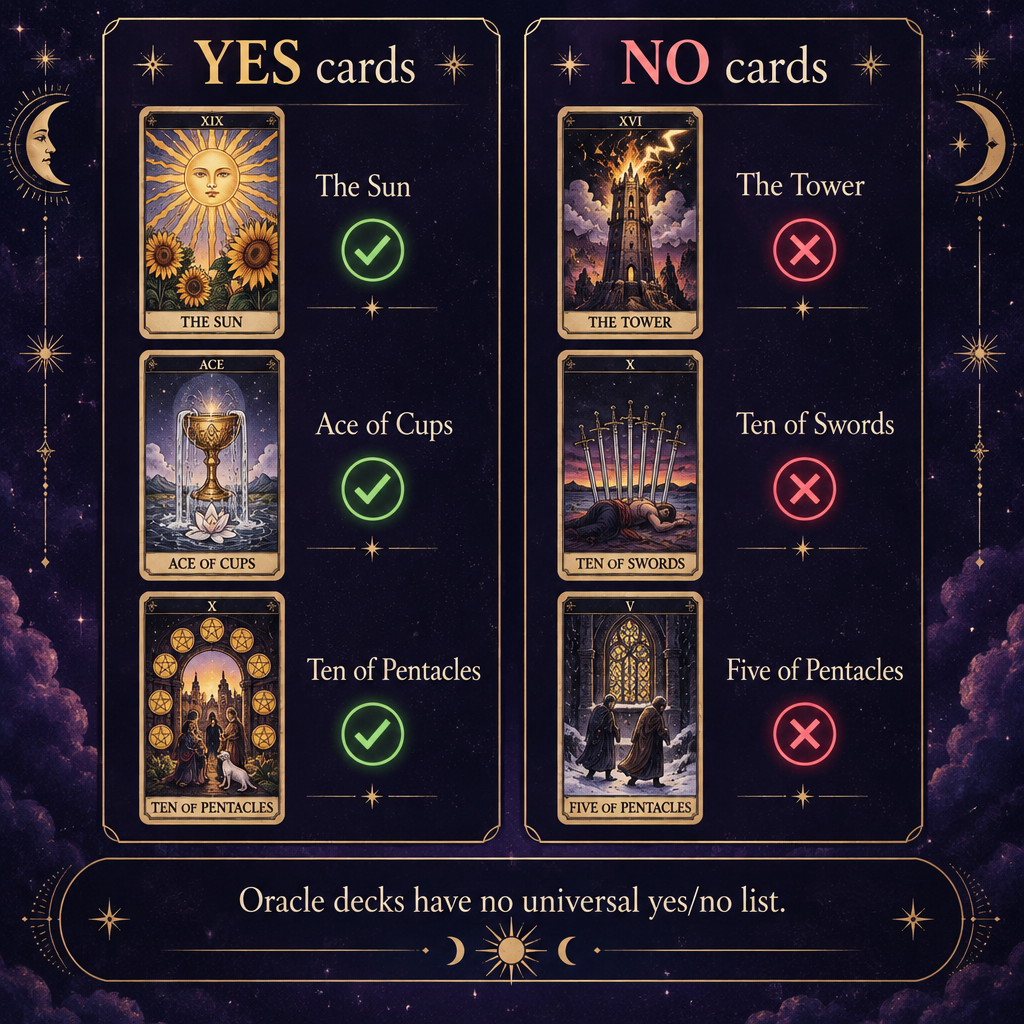
A yes/no reading depends on knowing, before you pull, which cards lean which way. Tarot lets you do that. The Sun, The Star, the Ace of Cups, and the Ten of Pentacles are reliable yes cards across almost every reader and tradition. The Tower, the Ten of Swords, and the Five of Pentacles are reliable no cards. The rest fall somewhere in between, often depending on orientation.
Those assignments exist because thousands of readers over more than a century have worked from the same 78 cards. You can look up a “tarot yes no guide” and find a lean for every single card, including the tricky ones. If you want the cleanest list of positive pulls, there are plenty of resources on “tarot cards for yes answers” that rank them.
No equivalent list exists for oracle decks, because no two oracle decks share a card list.
How an oracle deck is built
An oracle deck has no required card count, no suits, no Major and Minor division, and no shared vocabulary with any other deck. The creator decides everything: how many cards, what each one is called, what it means, and how it should be read.
That freedom produces enormous variety. Compare a few popular examples:
- Kim Krans’ The Wild Unknown Animal Spirit has 63 cards organized loosely by element.
- Colette Baron-Reid’s The Wisdom of the Oracle has 52 cards, each with a keyword and a longer passage in the guidebook.
- Yasmin Boland’s Moonology Oracle has 48 cards tied to lunar phases and astrological placements.
- Rebecca Campbell’s Work Your Light Oracle has 44 cards built around affirmations.
- Most angel-themed decks settle at 44 cards, a number that became a convention through sheer repetition rather than any rule.
Lay those five decks side by side and you will find almost no overlap in card titles. A “Breathe” card in one deck has no counterpart in another. The meanings live entirely in that deck’s companion book, which is why oracle decks almost always ship with a substantial guidebook while many tarot decks ship with a thin pamphlet or nothing at all.
This is the real heart of tarot vs oracle cards: tarot is a language, oracle is a dialect invented fresh each time.
What oracle decks do well
Oracle decks are usually built around a single theme. Animal spirits, moon phases, goddesses, affirmations, shadow work, chakras, plant medicine. That focus makes the deck feel coherent and immediately readable. You turn over a card, read a word or short phrase printed on it, and you have a message within seconds.
They also tend to be gentler. Most oracle creators design for encouragement and reflection, so you rarely pull anything as blunt as the Three of Swords. For daily check-ins, journaling prompts, and group settings where you do not want to frighten a nervous friend, that softness is a feature.
Tarot vs oracle cards side by side
| Feature | Tarot | Oracle |
|---|---|---|
| Card count | Always 78 | Anywhere from about 30 to 100+, commonly 44 to 64 |
| Structure | 22 Major Arcana + 56 Minor Arcana in four suits | None required; creator decides |
| Shared meanings across decks | Yes, meanings transfer between decks | No, each deck is self-contained |
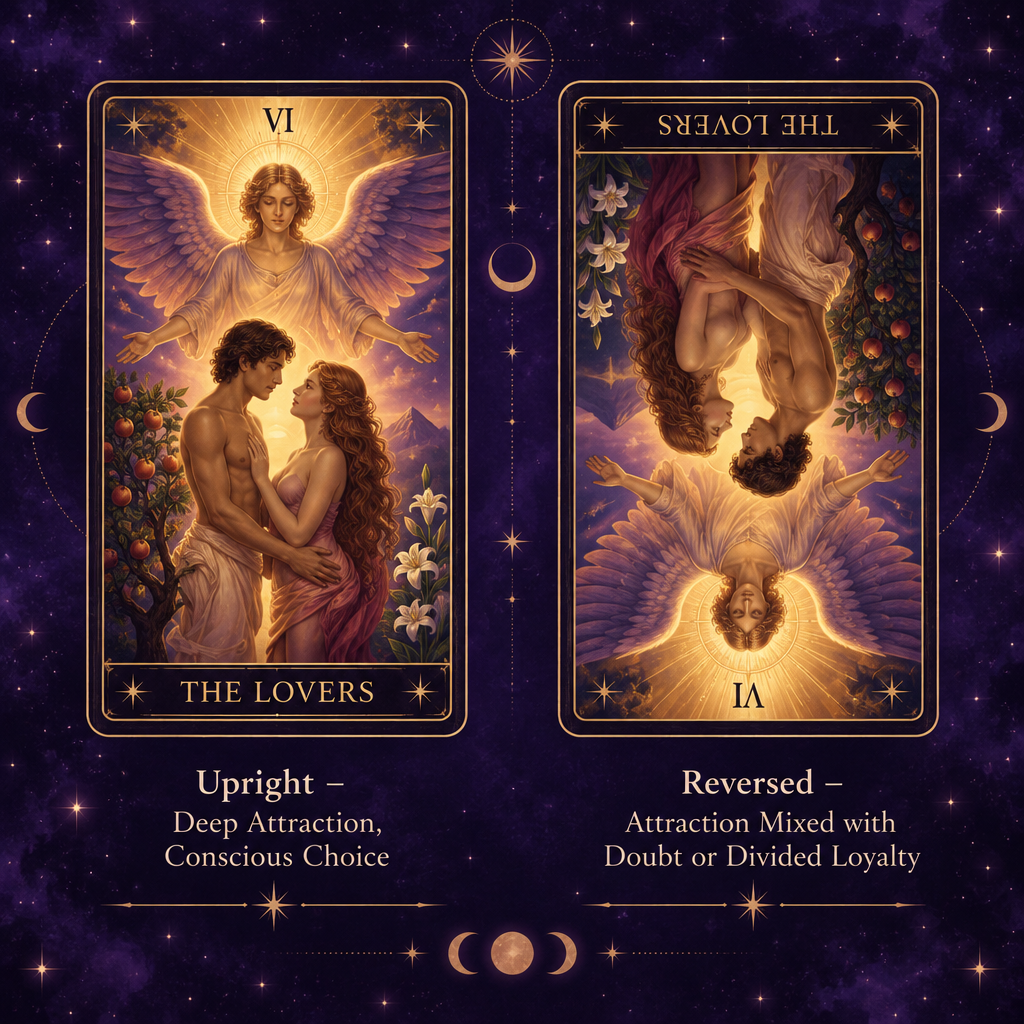
| Reversals | Widely used, roughly doubles the meaning set | Rarely used; most guidebooks ignore them |
| Learning curve | Steep: 78 cards plus reversals plus spreads | Shallow: keywords are usually printed on the card |
| Typical guidebook | Little white book or none | Full-length companion book, often 100+ pages |
| Best question types | Specific, predictive, yes/no, timing, “what happens if” | Open-ended, emotional, thematic, daily guidance |
| Historical depth | Marseille pattern by the 1600s; RWS 1909; Thoth 1969 | Modern phenomenon, largely post-1980s |
| Consistency between readers | High | Low; depends on the deck and the guidebook |
Pros and cons of each
Tarot pros
- The fixed 78-card structure gives you yes/no leans you can trust and verify.
- Meanings transfer, so one investment of study pays off across every deck you ever buy.
- Deep enough to handle complex spreads like the Celtic Cross with ten distinct positions.
- Reversals add nuance and a second layer of yes/no signal.
- A huge body of reference material, both historical and modern.
Tarot cons
- The learning curve is real. Seventy-eight cards, each with upright and reversed meanings, is 156 ideas to internalize before you feel fluent.
- Some cards are harsh. The Tower, Death, and the Ten of Swords can rattle a beginner even though their meanings are rarely literal.
- Reading without a reference takes months of practice for most people.
Oracle pros
- Readable from day one because keywords are usually printed on the card face.
- Thematic focus makes the deck cohesive and emotionally resonant.
- Gentle tone suits daily affirmations, journaling, and nervous querents.
- Freedom from tradition lets creators cover niche subjects tarot never addresses directly.
Oracle cons
- No shared structure means nothing you learn carries over to the next deck.
- Weak for yes/no because the creator rarely assigned polarity to each card, and when they did, it is one person’s opinion rather than a tested convention.
- Dependence on the guidebook can turn a reading into a page lookup.
- Many decks are deliberately vague, which feels comforting but gives you nothing to act on.
Which is better for yes/no readings?
Tarot, clearly. Here is the reasoning in practical terms.
A yes/no reading works when the deck gives you a mix of plainly positive, plainly negative, and genuinely uncertain cards in roughly predictable proportions. Tarot delivers that. Pull one card from a shuffled 78 and you have a real chance of a strong yes, a strong no, or a “not yet, and here is why.” Reversals sharpen the signal further: a reversed Sun loses some of its brightness, a reversed Tower softens the disaster.
Oracle decks skew positive by design. If 40 of 44 cards say some version of “trust yourself” or “abundance is coming,” a yes/no pull from that deck will say yes most of the time regardless of the question. That is not divination, that is a loaded coin.
How tarot card groups lean for yes/no
| Card group | General yes/no lean | Why |
|---|---|---|
| Major Arcana | Mixed, strongly weighted | Big archetypes give decisive answers; The Sun and The Star are firm yes, The Tower and The Devil are firm no, Judgement and Death depend on context |
| Cups | Mostly yes | Emotional fulfilment and connection; the Five and Eight of Cups are the main no cards |
| Pentacles | Mostly yes, slow | Material stability and growth; the Five of Pentacles is the clear no, the Seven means wait |
| Wands | Mostly yes, fast | Energy and action; the Five, Nine, and Ten of Wands signal struggle |
| Swords | Mostly no or maybe | Conflict and mental strain; the Ace and Six of Swords are the reliable yes cards |
| Court cards | Maybe | Usually describe a person or an attitude rather than an outcome; many readers treat them as “yes, but it depends on someone” |
The Swords suit is where beginners get tangled. A card like the Eight of Swords reads as a no on the surface, but the figure is loosely bound and could walk free, so many readers treat it as “no, unless you change your thinking.” If that distinction matters to your question, a dedicated breakdown of “eight of swords yes or no” is worth the five minutes. The Devil behaves similarly: a hard no upright, but reversed it often flips toward release and a cautious yes, which is why “devil tarot yes or no” gets searched so often.
A simple one-card yes/no protocol for tarot
- Phrase the question so a yes or no genuinely answers it. “Will I get the job I interviewed for on Tuesday?” works. “What about my career?” does not.
- Shuffle until the deck feels settled, then cut once.
- Draw a single card. Note its orientation.
- Check its lean: yes, no, or maybe.
- If you drew a maybe, pull one clarifier only. A third card is where readings turn into arguments with yourself.
This protocol works because the deck has polarity built in. Try the same steps with most oracle decks and step four falls apart.
Can an oracle deck ever do yes/no?
Yes, in two situations. First, when the creator explicitly built it for that purpose. A handful of oracle decks print “Yes,” “No,” or “Not now” directly on the cards, and those function fine as a glorified coin flip with extra commentary. Second, when you personally assign a yes/no lean to every card in a deck you know well and stick to those assignments consistently. That takes a few hours with a notebook and defeats the ease-of-use advantage, but it works.
What does not work is pulling an oracle card cold and deciding on the spot whether “Surrender” means yes or no. You will read into it whatever you were already hoping.
Matching the tool to the question
| Question type | Best tool | Example question |
|---|---|---|
| Yes/no | Tarot | “Should I sign the lease on Friday?” |
| Timing | Tarot | “When will the offer come through?” (suits and numbers give rough windows) |
| Outcome prediction | Tarot | “How does this negotiation end if I hold firm?” |
| Decision between options | Tarot | “Option A vs Option B” with one card for each |
| Emotional check-in | Oracle | “What do I need to hear today?” |
| Theme for the week | Oracle | “What energy should I lean into?” |
| Shadow work prompt | Oracle, or Major Arcana only | “What am I avoiding?” |
| Relationship dynamics | Tarot for specifics, oracle for tone | “What is really going on between us?” |
| Spiritual or devotional practice | Oracle | “What message does my guide have for me?” |
| Learning to read cards at all | Oracle first, then tarot | Build confidence, then build vocabulary |
What they cost
Price overlaps heavily, so cost should not drive the decision between tarot vs oracle cards. Rough current ranges in the United States:
| Deck type | Typical price | Notes |
|---|---|---|
| Mass-market tarot (Rider-Waite-Smith, Thoth, Marseille reprints) | Around $20 to $30 | Decades in print, easy to find, often discounted |
| Mass-market oracle (Hay House, Llewellyn, Chronicle titles) | Around $20 to $30 | Guidebook and box usually included |
| Independent or crowdfunded decks, either type | Around $40 to $70 | Higher print quality, limited runs, artist royalties |
| Mini or pocket editions | Around $12 to $18 | Fine for travel, hard on the eyes for study |
| Collector or luxury editions | $80 and up | Gilded edges, cloth boxes, signed prints |
Prices move with paper costs and shipping, so treat these as ranges rather than quotes. The practical takeaway: a first tarot deck and a first oracle deck cost about the same, so buy for function rather than price.
One budget note. A well-worn Rider-Waite-Smith is the deck most online meaning references are written against, which makes it the cheapest deck to learn from because the free study material is endless. An obscure oracle deck locks you into its guidebook.
Using both decks together
Plenty of readers keep one of each on the table and that pairing works well once you give each deck a clear job.
The most common method: pull a tarot spread for the mechanics of the situation, then pull one oracle card for the overall tone or the advice. The tarot tells you what is happening; the oracle tells you how to carry yourself through it. Keep the roles fixed. If you let the oracle card override the tarot answer, you will drift toward the softer reading every time.
A second method works for people who find tarot too blunt for daily use. Pull an oracle card each morning for the week’s mood, and reserve tarot for the moments when you need an actual decision made. That rhythm keeps tarot meaningful instead of turning it into a habit you half-ignore.
What to avoid: shuffling the two decks together. The card backs usually differ in size and finish, the card counts throw off any sense of probability, and a “Courage” oracle card sitting next to the Six of Swords tells you nothing coherent.
The third option most comparisons skip: Lenormand
Lenormand cards get lumped in with oracle decks in shops, but they are structurally closer to tarot. A Lenormand deck always has 36 cards, from the Rider at number one to the Cross at thirty-six, with the same images and numbers across every deck. The system descends from the Game of Hope, a parlour game printed in Nuremberg in 1799, and acquired Marie Anne Lenormand’s name a few years after the famous Parisian fortune-teller died in 1843, with decks sold under the Petit Lenormand title appearing around 1845 to 1846.
Because the card list is fixed, Lenormand handles yes/no and specific prediction even more directly than tarot. The cards are read in combinations like sentences, with far less archetypal weight. “Letter + Ship” reads as news from far away, not as a meditation on the soul’s journey.
If you find tarot too psychological and oracle too fluffy, Lenormand sits in the gap. Its drawback is the opposite of oracle’s: almost no emotional comfort, and a steep learning curve for reading combinations in grids of up to 36 cards.
Verdict: which should you choose?
Choose tarot if you want answers. Its 78-card structure, two orientations, and century of shared meaning give you a yes/no system you can learn, test, and trust. The time spent learning it pays off across every tarot deck you will ever own.
Choose oracle if you want reflection. It is faster to pick up, kinder in tone, and better suited to daily practice, journaling, and spiritual routines where a verdict would feel wrong.
Choose Lenormand if you want blunt prediction with no therapy attached.
For most beginners the right sequence is tarot first, oracle second. Start with a Rider-Waite-Smith or a close clone, learn the Major Arcana and one suit at a time, and add an oracle deck once you understand what tarot is not giving you. People who start with oracle often stall there, because nothing they learn transfers to the next step.
FAQ
Should I get tarot or oracle cards?
Get tarot if you plan to ask specific questions, want yes/no answers, or intend to read for other people. Get oracle if you mainly want daily encouragement, journaling prompts, or a softer entry point into card reading. Both cost roughly the same, so decide on function. If you can only afford one and you are unsure, tarot is the more versatile purchase because its meanings carry over to every future deck.
Are oracle cards against God?
That depends entirely on your tradition. Some religious communities treat any form of divination as forbidden and would include tarot, oracle, and even horoscopes in that category. Others view oracle cards as reflection tools, no different from a daily devotional or a journaling prompt, and many oracle decks are explicitly built around angels, saints, or scripture-adjacent themes. The cards themselves are printed cardstock with pictures; the meaning you give the practice comes from your own beliefs, so this is a question for your conscience and your faith community rather than for a comparison guide.
Can oracle cards be used as tarot cards?
Not in any meaningful way. Tarot techniques depend on the 78-card structure: suits, numbers, court ranks, and the Major and Minor division. An oracle deck has none of those, so spreads built around positions like “past, present, future” still work, but anything that relies on counting suits, reading elemental dignities, or assigning yes/no polarity will not. You can use an oracle deck alongside tarot, and you can assign your own yes/no leans to an oracle deck you know well, but you cannot read it with tarot methods.
Is oracle a tarot card?
No. “Oracle” is a category name for any divination deck that does not follow the tarot structure, so an oracle card is a different kind of object rather than a member of the tarot family. The confusion comes from shops shelving both together and from some tarot decks adding one or two bonus cards. A deck with 78 cards in four suits plus 22 majors is tarot even if the box calls it an oracle; a deck with 44 keyword cards is oracle even if the artist drew it in a tarot style.