

When the Six of Swords shows up as someone’s feelings toward you, the honest answer is that they are in transit. They have made a decision about where they are heading, and you are either the shore they are rowing toward or the one they are quietly leaving behind. This guide reads the card specifically as “how does this person feel about me,” broken down by crush, partner, ex, and single situations, upright and reversed.
The Short Answer: What the Six of Swords Says About Their Feelings
Upright, this person feels relief tinged with sadness. Their head has already settled on a direction, and their heart is catching up at a slower pace. If you are the destination, they see you as calm water after a rough stretch, and they are moving toward you carefully rather than passionately. If you are the past, they have mostly stopped grieving you and are not planning to turn the boat around.
Reversed, they feel stuck between two shores. They may want to leave a situation and keep returning to it, or they may want to reach you and feel unable to push off. The reversed card is emotional limbo, not hostility, and it usually points to unfinished inner work rather than a lack of feeling.
Everything below expands on those two readings, because the context of your question changes what “in transit” means.
Decoding the Imagery Before Reading the Feelings
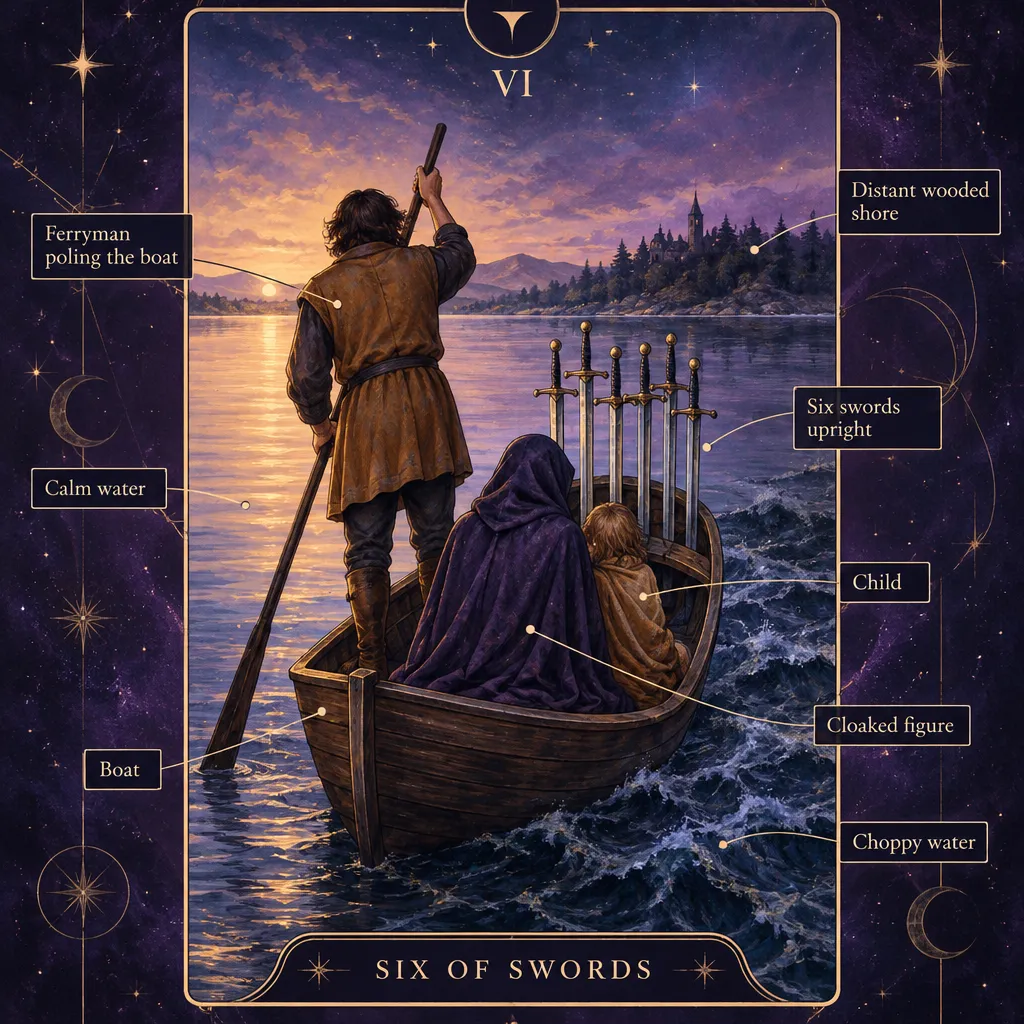
The Rider-Waite-Smith version, painted by Pamela Colman Smith in 1909, shows a ferryman poling a small boat across a body of water. A cloaked figure sits hunched with a child beside them. Six swords stand upright in the bow. The water on the right side of the boat is choppy; the water ahead, on the left, is smooth. A low shoreline with trees waits in the distance.
Each element maps onto an emotional state when you read the card as feelings:
| Symbol | What it means for how they feel about you |
|---|---|
| The boat | They are between two emotional places. Neither here nor there yet. |
| The ferryman | Someone or something is guiding the move: a friend’s advice, a therapist, their own logic. They are not steering purely on emotion. |
| The cloaked, hunched figure | Grief or exhaustion they have not fully shown you. Their back is to the viewer; they are not ready to be fully seen. |
| The child | A tender, new part of them that wants a fresh start. If you are the shore ahead, this is the hopeful part reaching toward you. |
| Six upright swords | Thoughts and worries they are carrying with them. They have not dropped their baggage; they are transporting it. |
| Rough water behind | The pain or conflict they are leaving. |
| Calm water ahead | The peace they associate with where they are going. If that is you, you represent relief. |
| Distant shore | The outcome they want, still not reached. Do not read this as arrival. |
A detail many readers miss: the swords stay in the boat. If the figure pulled them out, the hull would leak. That is the whole card in one image. This person has chosen to carry their old wounds carefully rather than rip them out, and they are not pretending to be fully healed.
Astrological and Elemental Context
The Golden Dawn system assigns the Six of Swords to Mercury in Aquarius, covering roughly the second decan of that sign (late January into early February). Mercury is the mind and communication; Aquarius is detached, forward-looking, and allergic to drama. Put together, you get someone whose feelings are filtered through logic and distance. In the Thoth deck, Aleister Crowley titled this card “Science,” which tells you how cerebral it is.
As an Air card, the Six of Swords describes feelings that live in the head first. This person has thought about you more than they have felt about you, or at least more than they have expressed. They are likely to describe their feelings in terms of what makes sense, what is healthy, or what they have “decided,” rather than in terms of longing or passion. Expect calm, measured communication rather than grand gestures, and do not mistake that measured tone for coldness. Air signs process by analysing.
Six of Swords Upright: Their Feelings in Detail
The emotional texture
Pure positivity is the wrong read. The upright Six of Swords as feelings is a layered state:
- Relief mixed with sadness. They are glad to be moving on from something painful, and they are also mourning it. Both are true at once.
- A mental decision ahead of emotional closure. They have concluded, logically, where they want to go. Their heart is still in the boat with its hood up.
- Cautious and slow to open up. They want calm, not intensity. Pressure from you will feel like rough water, and they will instinctively pole away from it.
- Drawn to you as a source of peace. If their feelings are directed at you, they see you as steady. That is a real compliment from this card, even if it does not feel like fireworks.
- Quiet optimism. They believe things will be better on the other shore. They are not certain. Belief, not certainty, is the right word.
How this looks in behaviour
Someone feeling the upright Six of Swords about you tends to text thoughtfully but not constantly. They bring up the future in practical terms (“I’d like to visit that place with you sometime”) rather than romantic declarations. They may seem a little subdued, and they may disappear for a day to process. That withdrawal is not disinterest. It is the hunched figure in the boat.
Six of Swords Reversed: Their Feelings in Detail
The emotional texture
Reversed, the boat is either stuck, capsized, or rowing in circles. The person feels:
- Compulsively pulled back. They try to leave a situation and keep returning. The pull is not fully conscious.
- Emotionally stagnant. Nothing is moving forward, including their feelings for you. They may feel the same about you as they did three months ago, which is its own kind of answer.
- Burdened by undone shadow work. The swords are still in the boat, and now the boat is leaking. Old patterns from family or past relationships are running the show.
- Caught in limbo. They cannot commit to staying or leaving. You may be getting mixed signals because they are sending mixed signals to themselves.
- Occasionally defiant. Some people in the reversed Six of Swords refuse to leave rough water out of stubbornness or loyalty to the past, even when it hurts.
How this looks in behaviour
Hot and cold contact. Long, intense conversations followed by silence. Promises to “figure things out” that never produce a plan. In digital contexts this is the person who watches all your stories but does not reply to your message. The reversed card is where situationships live.
Six of Swords as Feelings by Relationship Stage
For a crush or new connection
Upright, the person is interested but arriving carefully. They are often coming out of something: a breakup, a difficult period, a long stretch of being single. You feel like a safe harbour to them. Their feelings are real and gentle, not urgent. They will notice if you let them set the pace, and they will reward that patience with steadiness.
Pay attention to the baggage, though. The swords in the boat mean they are bringing comparisons, fears, and unprocessed hurt into the new connection. If you ask “how do they feel about me” and get this card early on, expect slow-burn interest with occasional retreats to think.
Reversed in a new connection, they are not ready. They may like you, but they are still rowing back toward the shore they came from. Often this means they are not over an ex or are not done with a chaotic chapter. Do not wait on the dock indefinitely.
In an established or long-term relationship
Upright, this is one of the more hopeful cards you can get for a couple that has been through conflict. Your partner feels they are moving past the hard part with you, not away from you. They want calmer water. They may be a little quiet and reflective right now, and they are processing privately before bringing conclusions to you. The feeling is “we got through that” plus some residual tiredness.
There is a second possible reading, and you should not ignore it. The Six of Swords can indicate a partner who has mentally begun leaving. The clue is usually in surrounding cards. With the Ten of Cups or Two of Cups nearby, you are the destination. With the Three of Swords, Five of Cups, or Eight of Cups nearby, they may be rowing away, and the calm water they imagine is a life without the current conflict. Long-distance couples pull this card often; it tends to describe one partner planning the logistics of being together, or planning the logistics of not.
Reversed in a long-term relationship, your partner feels stuck. They might be going through the motions, unable to repair what is broken but unwilling to end things. Or they are trapped in a recurring argument, the same fight on a loop. The feeling here is exhaustion rather than anger. Someone needs to do the inner work, and this card says the burden is heavier on their side than yours.
For an ex: do they still have feelings for me?
This is the question most people bring to the card, so here is a direct answer.
Upright, an ex feeling the Six of Swords has accepted the ending. They have moved past the sharpest grief. They may still think of you, often with a mix of fondness and sadness, and they are not planning to come back. The boat is heading away from the relationship. If you are hoping for reconciliation, upright Six of Swords is the card that says “they wish you well from a distance.”
There is an exception. If you are asking about an ex you left, or an ex who left after a period of mutual pain, the upright card can show them having done the healing work and feeling ready to approach from a calmer place. In that case the “shore ahead” is a healthier version of connection with you. Look for the Two of Cups, the Star, or Judgement nearby to confirm it. On its own, do not assume it.
Reversed, your ex has not moved on, and this is where “they still have feelings” is accurate. The feelings are tangled, though. They keep being pulled back toward you, replaying the relationship, possibly reaching out and then retreating. This is not clean, resolved longing. It is someone who tried to leave emotionally and could not finish the journey.
Six of Swords reversed as an ex’s feelings, specifically
Reversed for an ex deserves its own treatment because it is so often misread as “they want me back.”
What it actually shows: an ex who is unresolved. They may contact you late at night, like old photos, or ask mutual friends about you, and none of that means they have decided on reconciliation. The compulsion to look back is driven by the same unfinished shadow work that caused the breakup. If you reconcile with someone in a reversed Six of Swords state, you will typically re-enter the same rough water you left, because they have not fixed the leak in the boat.
If you want them back, the condition is simple and difficult: they need to get the card upright. That means genuine processing, usually time apart, often therapy, and a clear choice rather than a drift back out of loneliness.
When you are single and asking about your own feelings or future love
If you drew this card about yourself, it describes you as the one in the boat. You are leaving something, probably a pattern or a person, and you are not done feeling the loss even though you have made the decision. Future love is on the far shore, and you cannot see the details of it yet. The healthiest reading: you are doing the right thing, and it is allowed to feel sad.
Reversed when single, you are circling an old relationship or an old version of yourself. The card is asking which sword in the boat you have not looked at yet.
Does the Six of Swords Mean They Want to Come Back? The Reconciliation Reading
Short version: the Six of Swords alone is not a reconciliation card.
Upright, it signals closure and departure far more often than return. The exception described above (an ex who left, healed, and is approaching from calm) requires supporting cards. Without them, treat upright as “moving on.”
Reversed, it signals a pull toward the past that is not yet a decision. Reconciliation is possible but premature. Any reunion now would be a return to rough water.
If you want a working rule: reconciliation with this card happens after the journey finishes, not during it. Ask a follow-up card for “what happens if we reconnect in the next three months,” and treat the Six of Swords as a timing card telling you “not yet, and maybe not at all.”
Where the Six Sits in the Swords Story
The Swords suit from Three through Seven tells a continuous emotional narrative, and the Six makes more sense in sequence.
- Three of Swords: the heartbreak itself. Direct, piercing hurt.
- Four of Swords: withdrawal to recover. They go quiet and still.
- Five of Swords: conflict and a hollow victory, often the fight that ends things.
- Six of Swords: the departure. They leave the battlefield with their wounds in the boat.
- Seven of Swords: what sometimes follows, which is avoidance or dishonesty if the journey was not honest.
So when someone’s feelings toward you land on the Six, you can usually assume a Three, Four, or Five has already happened, whether with you or someone before you. They are not at the start of their emotional story. They are mid-chapter and heading somewhere quieter.
Is the Six of Swords a Yes or No in Love?
Upright: a soft yes to “is this moving forward,” a soft no to “will they come back,” and a yes to “do they see me as a positive presence.” It is rarely an enthusiastic yes to anything, because the card is tired.
Reversed: no for now. Not a permanent no, but a “not until they sort themselves out.”
A Three-Card Spread for Reading Their Feelings
Shuffle while holding the specific person in mind. Draw three cards left to right.
- How they feel about me right now. This is the headline emotion.
- What is keeping them in the boat. The fear, pattern, or person they have not released.
- What would help them reach the shore. What they need, which may or may not be something you can provide.
If the Six of Swords lands in position one, read the other two as the contents of the boat and the far shore. If it lands in position two, their feelings are blocked by a transition they have not completed. If it lands in position three, the answer is distance and time, and your role is to let the water calm.
What to Do When This Card Comes Up for Someone’s Feelings
Match the card’s energy rather than fighting it. Specific moves that work:
- Lower the intensity. Air cards flinch at emotional pressure. One honest message beats five anxious ones.
- Ask a logistical question rather than an emotional one. “Would you want to grab coffee next week?” lands better than “Where do you see this going?” when someone is in Six of Swords mode.
- Journal before you reach out. Two prompts that help: “If they never arrived at my shore, what would I need?” and “Which of my own swords am I still carrying into this?”
- In situationships or long-distance setups, set a check-in date. The Six of Swords describes a journey without an arrival time; give it one. “Let’s talk about where this is in a month” turns limbo into a plan.
- If the card is reversed about an ex, do not initiate. Their pull-back is compulsive, and your reaching out will feed the loop. Let them get the boat upright on their own.
- If the card is upright about a partner after conflict, say so out loud. “It feels like we’re past the worst of it” gives the hunched figure permission to lower the hood.
FAQ
Does the Six of Swords mean they still have feelings for me?
Upright, they have residual feelings but have accepted the ending and are moving toward a different life. Reversed, yes, they still have feelings, but those feelings are unresolved and keep pulling them back without producing a decision.
Is the Six of Swords a yes or no in love?
It is a cautious yes for progress and healing, and a no for sudden passion or reunion. Reversed, it is a “not yet” rather than a hard no.
What does the Six of Swords mean for reconciliation?
On its own, it points away from reconciliation. Upright usually means the person has moved on. Reversed means they are stuck looking back but have not done the work that would make a healthy return possible. Any reunion is only advisable after the transition is complete.
What does the Six of Swords reversed mean as feelings from an ex?
Your ex is emotionally stuck on the relationship, cycling between reaching out and pulling away. They have not healed, and the pull toward you is driven by unfinished patterns rather than a clear wish to rebuild.
Is the Six of Swords positive or negative as feelings?
It is bittersweet rather than purely either. The person feels relief and sadness together, and their feelings toward you depend on whether you are the calm water ahead or the rough water behind. Surrounding cards usually settle which.
How does the Six of Swords read in a long-distance relationship?
It often shows the partner planning a transition: moving closer, or quietly planning an exit. Upright with positive cards, they are working toward being with you. Reversed, the distance has become a holding pattern neither of you is resolving.
Add Yes No Tarot as a preferred source on Google, and the sites you pick are more likely to appear in your Top Stories.